Offered by Richard Redding Antiques
REQUEST INFORMATION

Leading antique and fine art gallery, specialises in the finest French clocks.
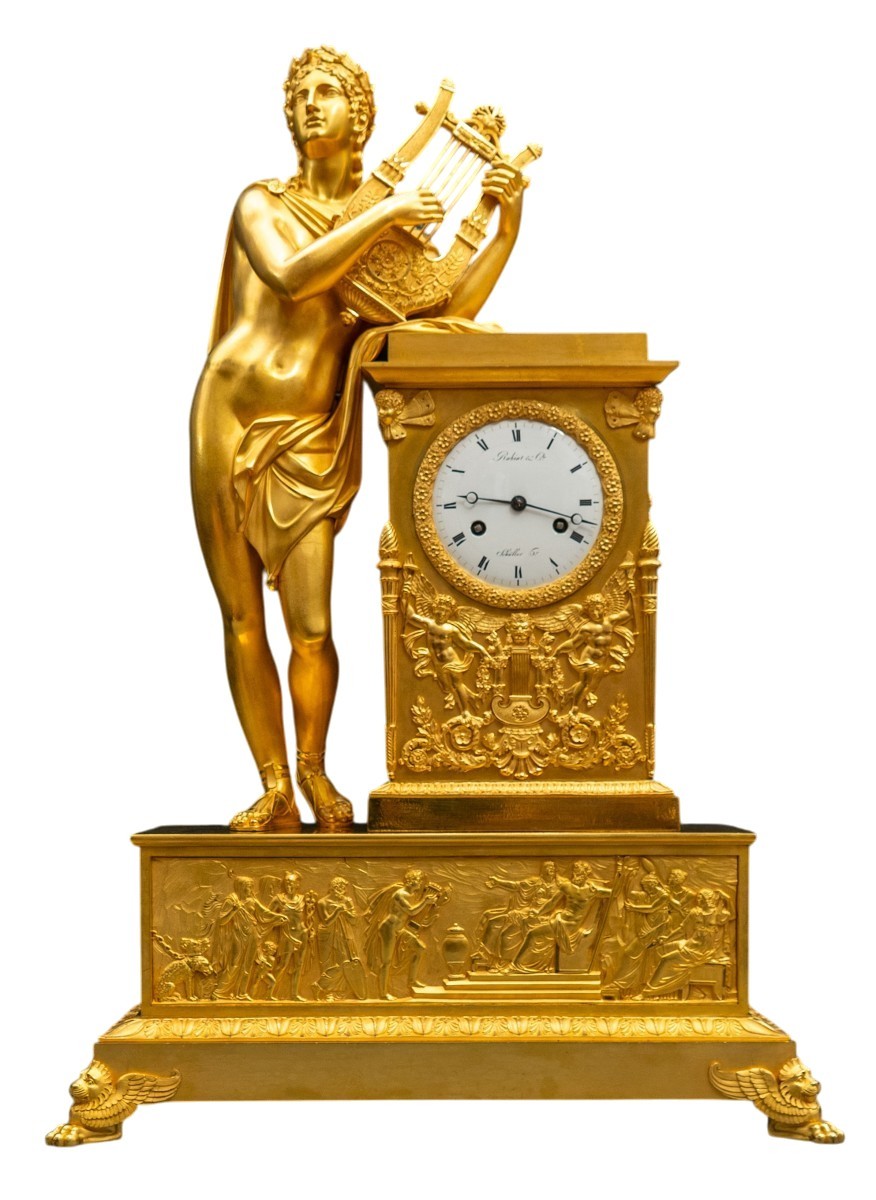
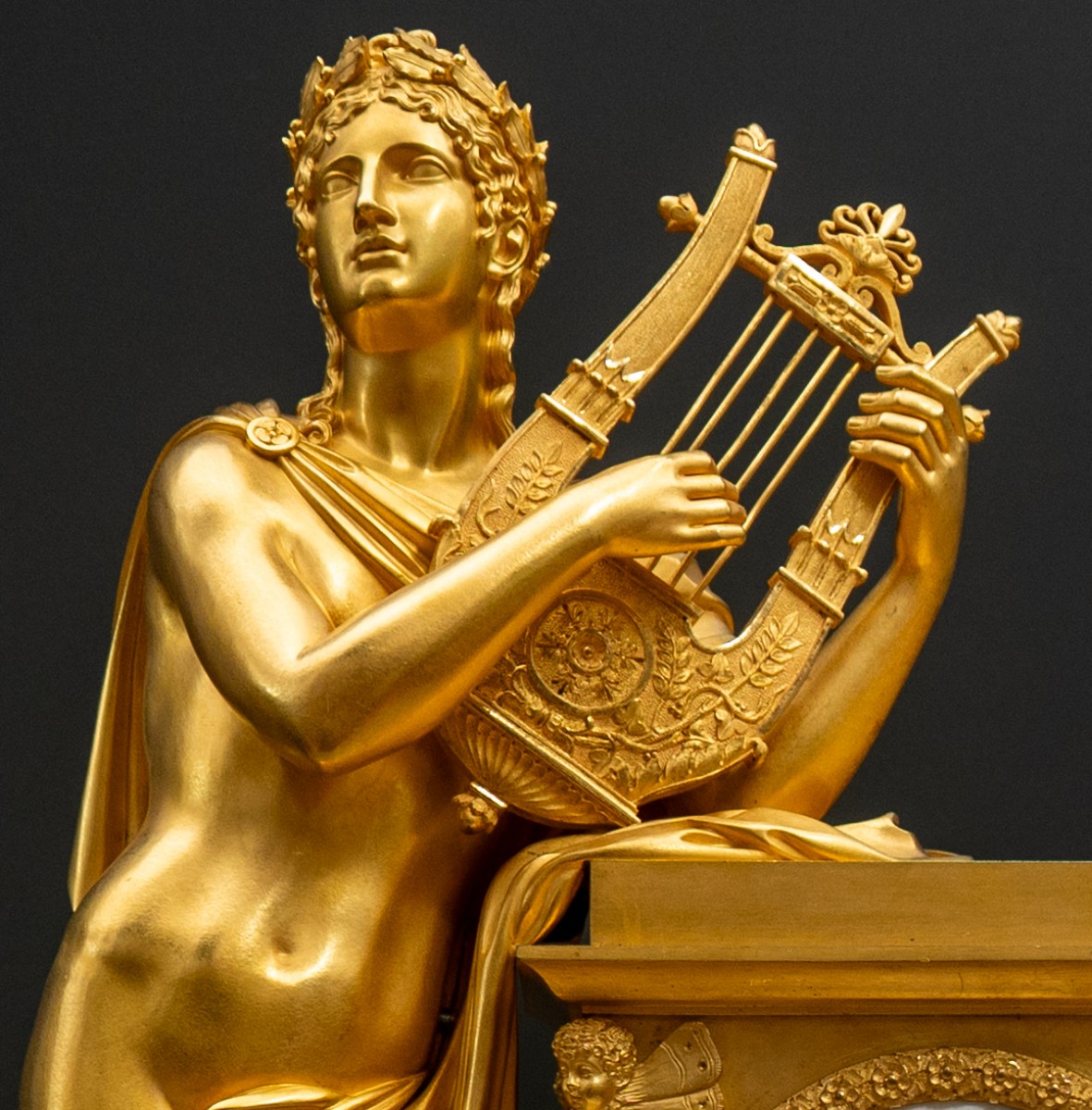
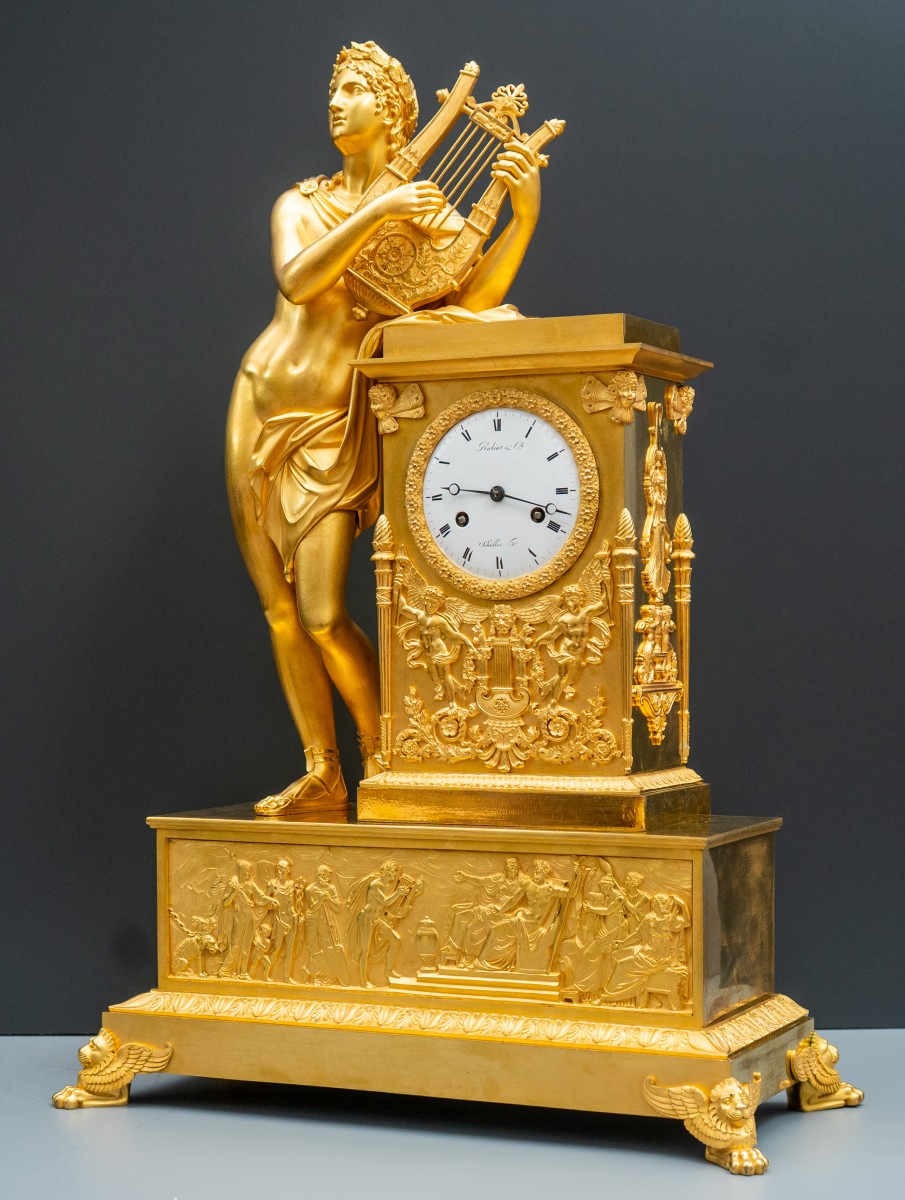
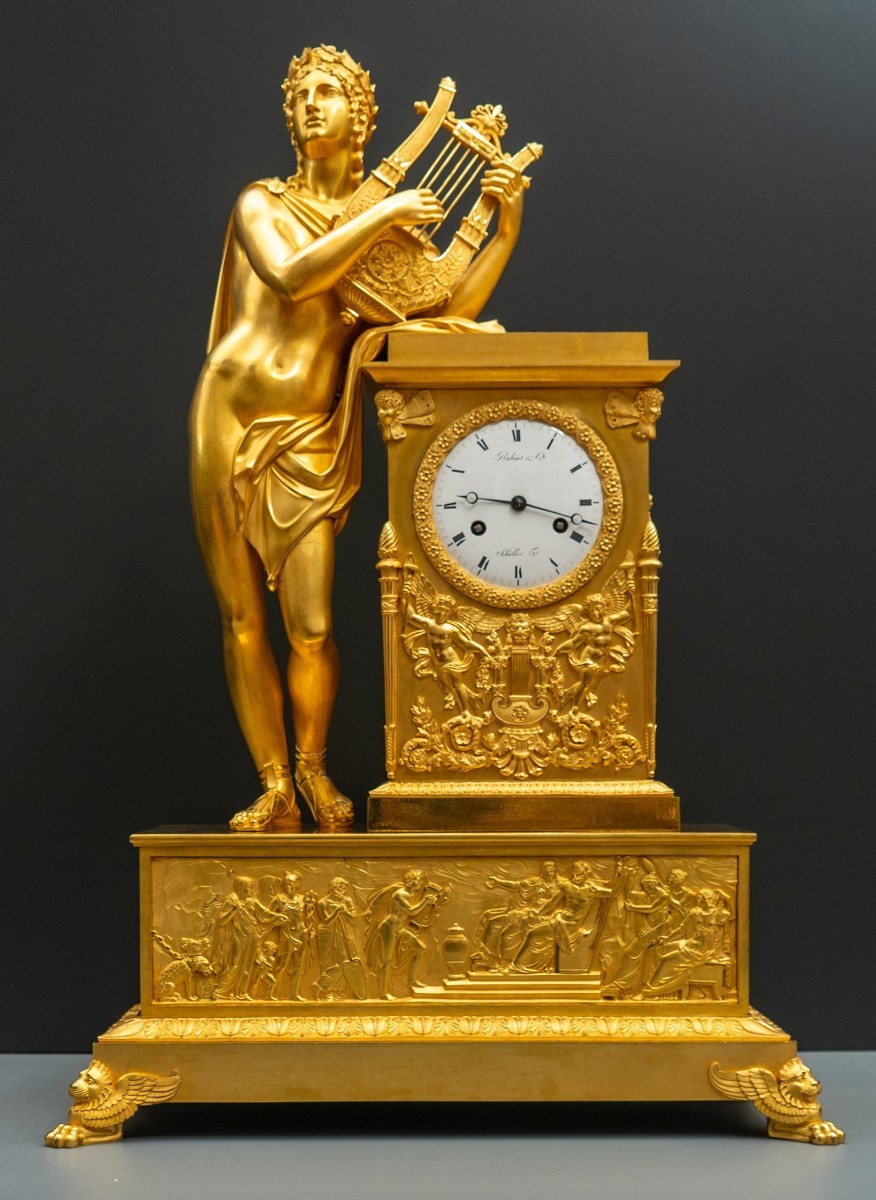
This important and finely chased Empire mantel clock depicts the god Apollo crowned with laurel, standing beside an altar like case and holding a loosely draped lyre. It is an exceptional and fully documented example of Parisian Empire clockmaking, carrying the joint signatures of two of the period's most significant bronziers, Claude François Rabiat and Pierre Chiboust, combined with a horological signature on the dial and a sculptural composition after a celebrated model by Pierre Philippe Thomire.
Subject and Iconography
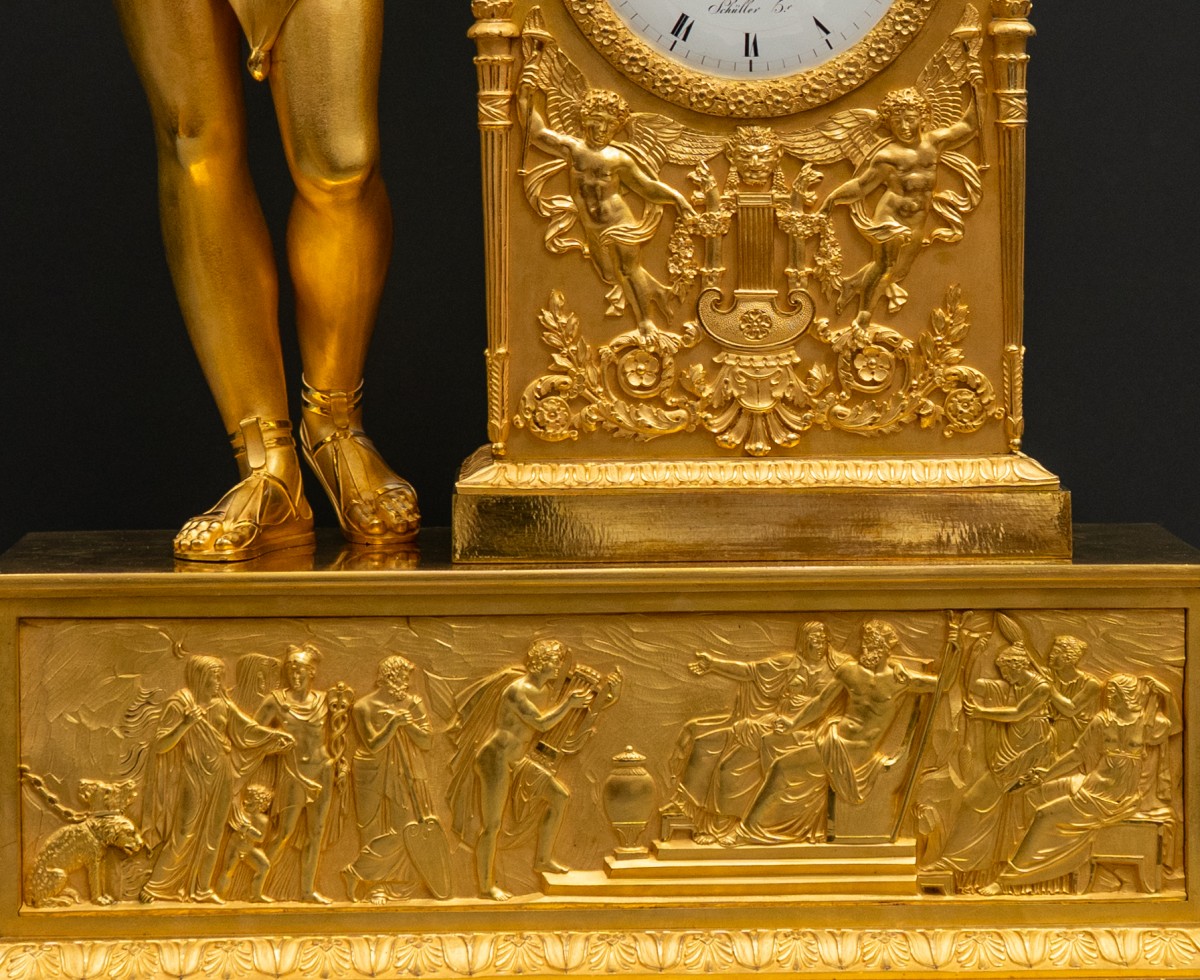
The iconographic programme unites the two greatest musicians of classical mythology. Apollo, the Olympian god of music and poetry, presides over the composition from his position beside the altar, the lyre held loosely in his hand as though he has just paused from playing. Below, the stepped plinth carries a fine bas relief depicting the myth of Orpheus and Eurydice, the mortal musician who attempted to reclaim his beloved from the underworld through the power of song. A procession of deities surrounds the central scene. The four winged lions supporting the base introduce a further imperial register, echoing the monumental sculptural language that Thomire developed for the furnishings of Napoleon's palaces.
The Makers of this Empire Clock
The reverse of the bronze case bears the signatures of both Claude François Rabiat and Pierre Chiboust, placing this clock within one of the best documented partnerships of the Paris bronze trade at the beginning of the nineteenth century.
Claude François Rabiat (1756 to 1815) was a Parisian fondeur ciseleur, received master in 1778 after training under Étienne Vignerelle. From his workshop on Rue Beaubourg he supplied gilt bronzes to the most prominent bronziers and clockmakers of the Empire, including Pierre Philippe Thomire, Claude Galle, Pierre Victor Ledure, Feuchère, Bailly and Mallet. Works bearing his signature are preserved in the Mobilier National, the Château de Compiègne, and in the collections of the former Imperial residences.
Pierre Chiboust, active in Paris circa 1806 to 1824, worked alongside Rabiat and took over his Rue Beaubourg workshop following Rabiat's death in 1815. Bronzes carrying the Chiboust signature are today found in major European collections and on the international market, and are cited in the scholarly literature as representative of the finest Paris Empire and early Restauration production.
The joint presence of both signatures on a single case is documentary evidence of the transitional years around 1806-1815, when Chiboust was consolidating his succession to the firm while continuing to mark pieces with Rabiat's name. This makes the present clock an important reference for the study of the late phase of the Rabiat workshop.
The model of Apollo standing beside the altar case derives from a composition by Pierre Philippe Thomire (1751 to 1843), appointed "ciseleur de l'Empereur" in 1809 and the leading Parisian bronzier of the Empire. The Orpheus and Eurydice relief and the winged lion bases belong to the decorative vocabulary that Thomire developed for his pendules à portique in the first years of the nineteenth century.
The Movement
The white enamel dial with Roman numerals and two pierced hands is signed Rabiat & Cie and Schüller Horloger, the latter generally identified with Mathias Schüller (died 1844). The Paris movement strikes the hours and half hours on a bell, with silk thread suspension, and is numbered 1344 C on the reverse of the bezel. Further foundry marks visible on the reverse include the stamp S.H struck twice on the architectural base, an E on the edge of the lyre and a corresponding E on the frame socket serving as assembly marks, and a G in a square cartouche on the reverse of the applique. The clock is complete with key.
Details of this Empire Mantel Clock
Dimensions: height 65 cm, width 45 cm, depth 21 cm.
Condition: the lyre detached and struck with an E assembly mark. The mercury gilding retaining its original rich tone with only minor rubbing in places and isolated verdigris. The enamel dial with slight chipping. Complete with key.
Paris, circa 1810.
Literature
H. Ottomeyer and P. Pröschel, Vergoldete Bronzen. Die Bronzearbeiten des Spätbarock und Klassizismus, 2 vols., Munich, 1986.
P. Kjellberg, Encyclopédie de la pendule française du Moyen Âge au XXe siècle, Paris, 1997.
J. D. Augarde, Les ouvriers du temps. La pendule à Paris de Louis XIV à Napoléon Ier, Geneva, 1996.
E. Niehüser, Die französische Bronzeuhr. Eine Typologie der figürlichen Darstellungen, Munich, 1997.
J. Niclausse, Thomire, fondeur ciseleur 1751 à 1843: sa vie, son œuvre, Paris, 1947.
Tardy, Dictionnaire des horlogers français, Paris, 1972, p. 295 (on Rabiat).
This important and finely chased Empire mantel clock depicts the god Apollo crowned with laurel, standing beside an altar like case and holding a loosely draped lyre. It is an exceptional and fully documented example of Parisian Empire clockmaking, carrying the joint signatures of two of the period's most significant bronziers, Claude François Rabiat and Pierre Chiboust, combined with a horological signature on the dial and a sculptural composition after a celebrated model by Pierre Philippe Thomire.
Subject and Iconography
The iconographic programme unites the two greatest musicians of classical mythology. Apollo, the Olympian god of music and poetry, presides over the composition from his position beside the altar, the lyre held loosely in his hand as though he has just paused from playing. Below, the stepped plinth carries a fine bas relief depicting the myth of Orpheus and Eurydice, the mortal musician who attempted to reclaim his beloved from the underworld through the power of song. A procession of deities surrounds the central scene. The four winged lions supporting the base introduce a further imperial register, echoing the monumental sculptural language that Thomire developed for the furnishings of Napoleon's palaces.
The Makers of this Empire Clock
The reverse of the bronze case bears the signatures of both Claude François Rabiat and Pierre Chiboust, placing this clock within one of the best documented partnerships of the Paris bronze trade at the beginning of the nineteenth century.
Claude François Rabiat (1756 to 1815) was a Parisian fondeur ciseleur, received master in 1778 after training under Étienne Vignerelle. From his workshop on Rue Beaubourg he supplied gilt bronzes to the most prominent bronziers and clockmakers of the Empire, including Pierre Philippe Thomire, Claude Galle, Pierre Victor Ledure, Feuchère, Bailly and Mallet. Works bearing his signature are preserved in the Mobilier National, the Château de Compiègne, and in the collections of the former Imperial residences.
Pierre Chiboust, active in Paris circa 1806 to 1824, worked alongside Rabiat and took over his Rue Beaubourg workshop following Rabiat's death in 1815. Bronzes carrying the Chiboust signature are today found in major European collections and on the international market, and are cited in the scholarly literature as representative of the finest Paris Empire and early Restauration production.
The joint presence of both signatures on a single case is documentary evidence of the transitional years around 1815, when Chiboust was consolidating his succession to the firm while continuing to mark pieces with Rabiat's name. This makes the present clock an important reference for the study of the late phase of the Rabiat workshop.
The model of Apollo standing beside the altar case derives from a composition by Pierre Philippe Thomire (1751 to 1843), appointed "ciseleur de l'Empereur" in 1809 and the leading Parisian bronzier of the Empire. The Orpheus and Eurydice relief and the winged lion bases belong to the decorative vocabulary that Thomire developed for his pendules à portique in the first years of the nineteenth century.
The Movement
The white enamel dial with Roman numerals and two pierced hands is signed Rabiat & Cie and Schüller Horloger, the latter generally identified with Mathias Schüller (died 1844). The Paris movement strikes the hours and half hours on a bell, with silk thread suspension, and is numbered 1344 C on the reverse of the bezel. Further foundry marks visible on the reverse include the stamp S.H struck twice on the architectural base, an E on the edge of the lyre and a corresponding E on the frame socket serving as assembly marks, and a G in a square cartouche on the reverse of the applique. The clock is complete with key.
Details of this Empire Mantel Clock
Dimensions: height 65 cm, width 45 cm, depth 21 cm.
Condition: the lyre detached and struck with an E assembly mark. The mercury gilding retaining its original rich tone with only minor rubbing in places and isolated verdigris. The enamel dial with slight chipping. Complete with key.
Paris, circa 1810.
Literature
H. Ottomeyer and P. Pröschel, Vergoldete Bronzen. Die Bronzearbeiten des Spätbarock und Klassizismus, 2 vols., Munich, 1986.
P. Kjellberg, Encyclopédie de la pendule française du Moyen Âge au XXe siècle, Paris, 1997.
J. D. Augarde, Les ouvriers du temps. La pendule à Paris de Louis XIV à Napoléon Ier, Geneva, 1996.
E. Niehüser, Die französische Bronzeuhr. Eine Typologie der figürlichen Darstellungen, Munich, 1997.
J. Niclausse, Thomire, fondeur ciseleur 1751 à 1843: sa vie, son œuvre, Paris, 1947.
Tardy, Dictionnaire des horlogers français, Paris, 1972, p. 295 (on Rabiat)