Offered by Richard Redding Antiques
REQUEST INFORMATION

Leading antique and fine art gallery, specialises in the finest French clocks.
JOSSE-FRANÇOIS-JOSEPH LERICHE (1738–1812)
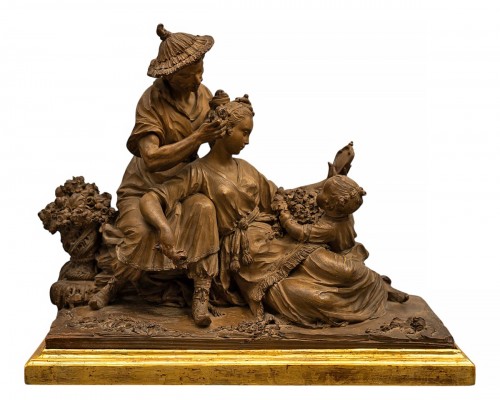
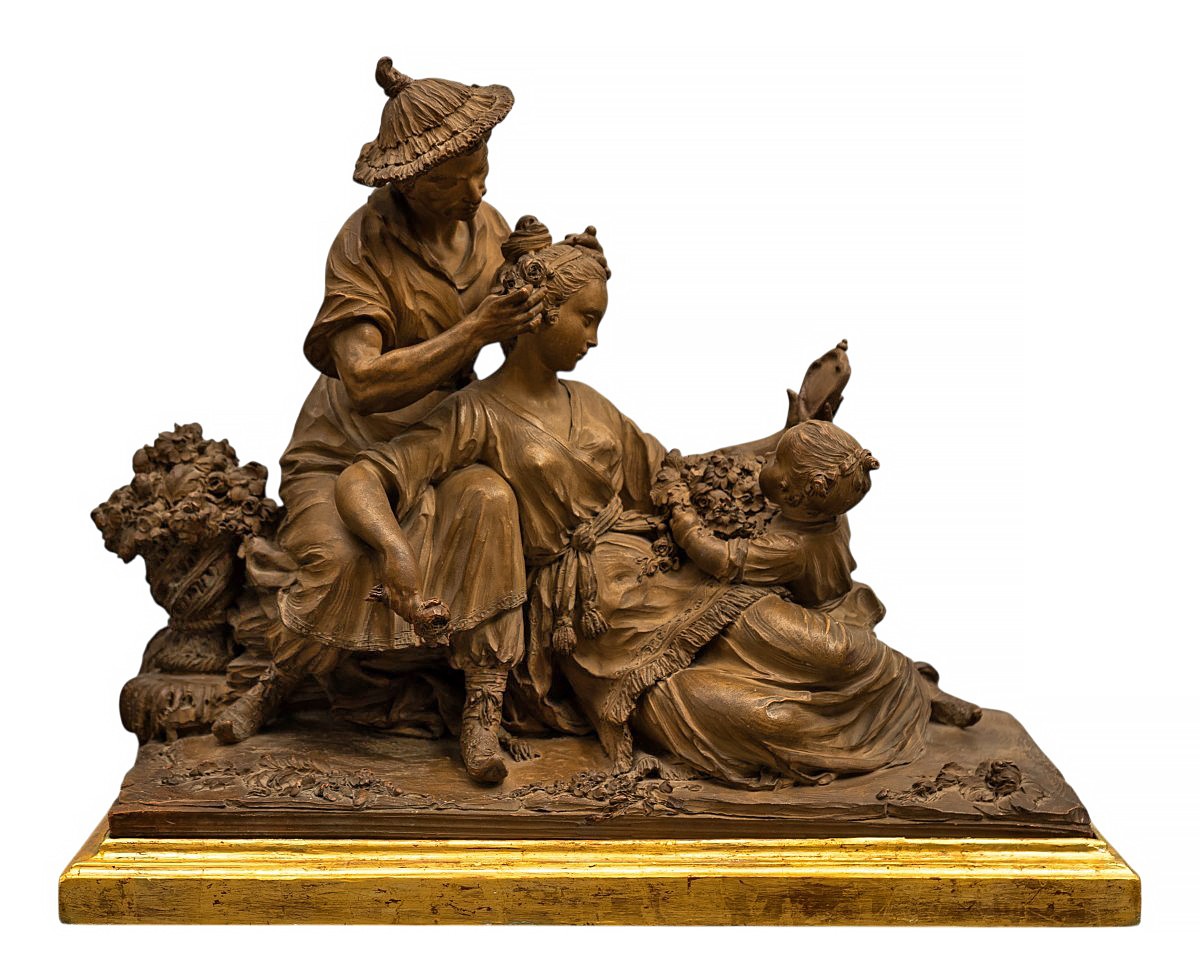
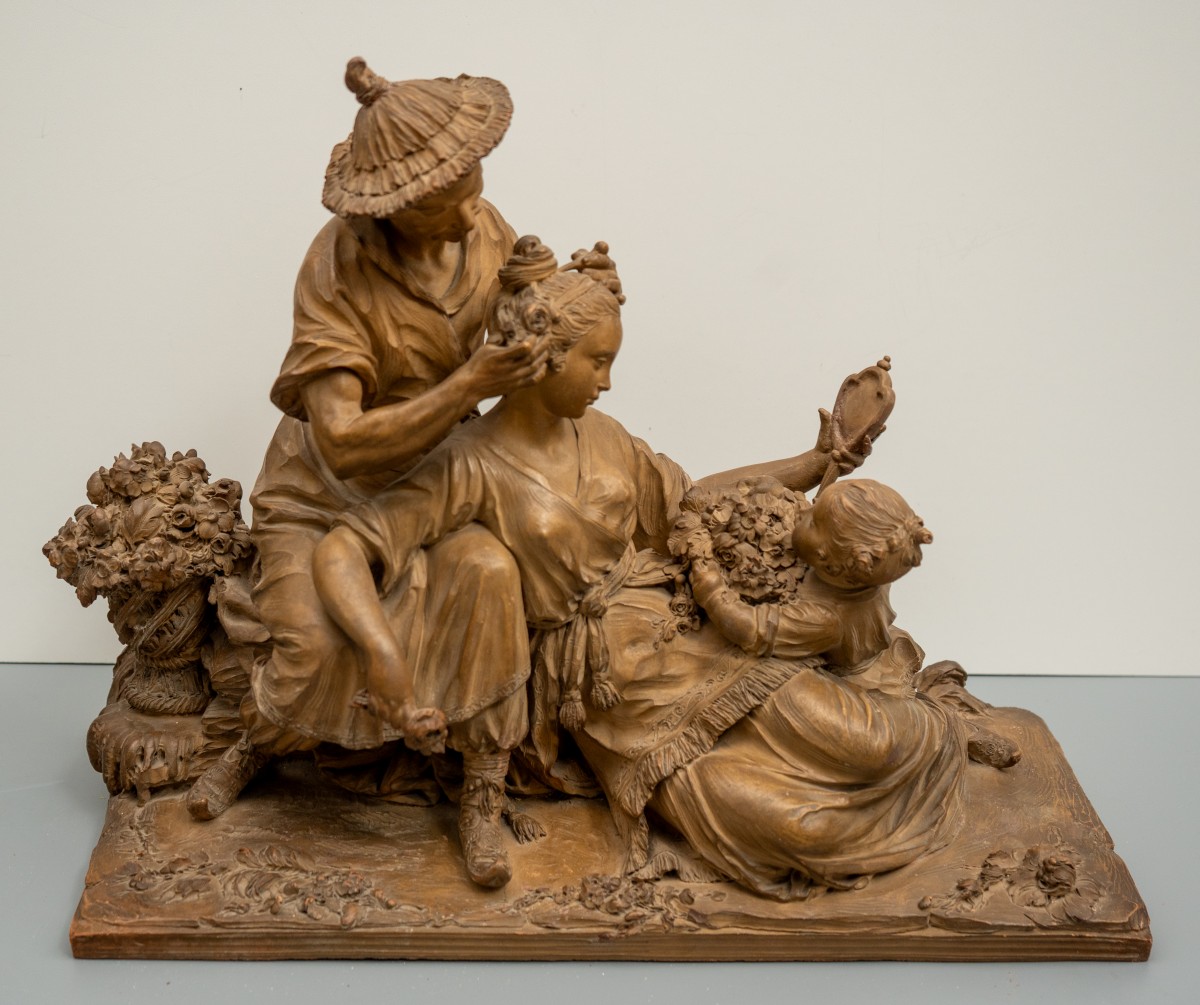
A Chinoiserie Terracotta Group: The Toilette
France, circa 1785
Height 38 cm, width 48 cm, depth 21 cm
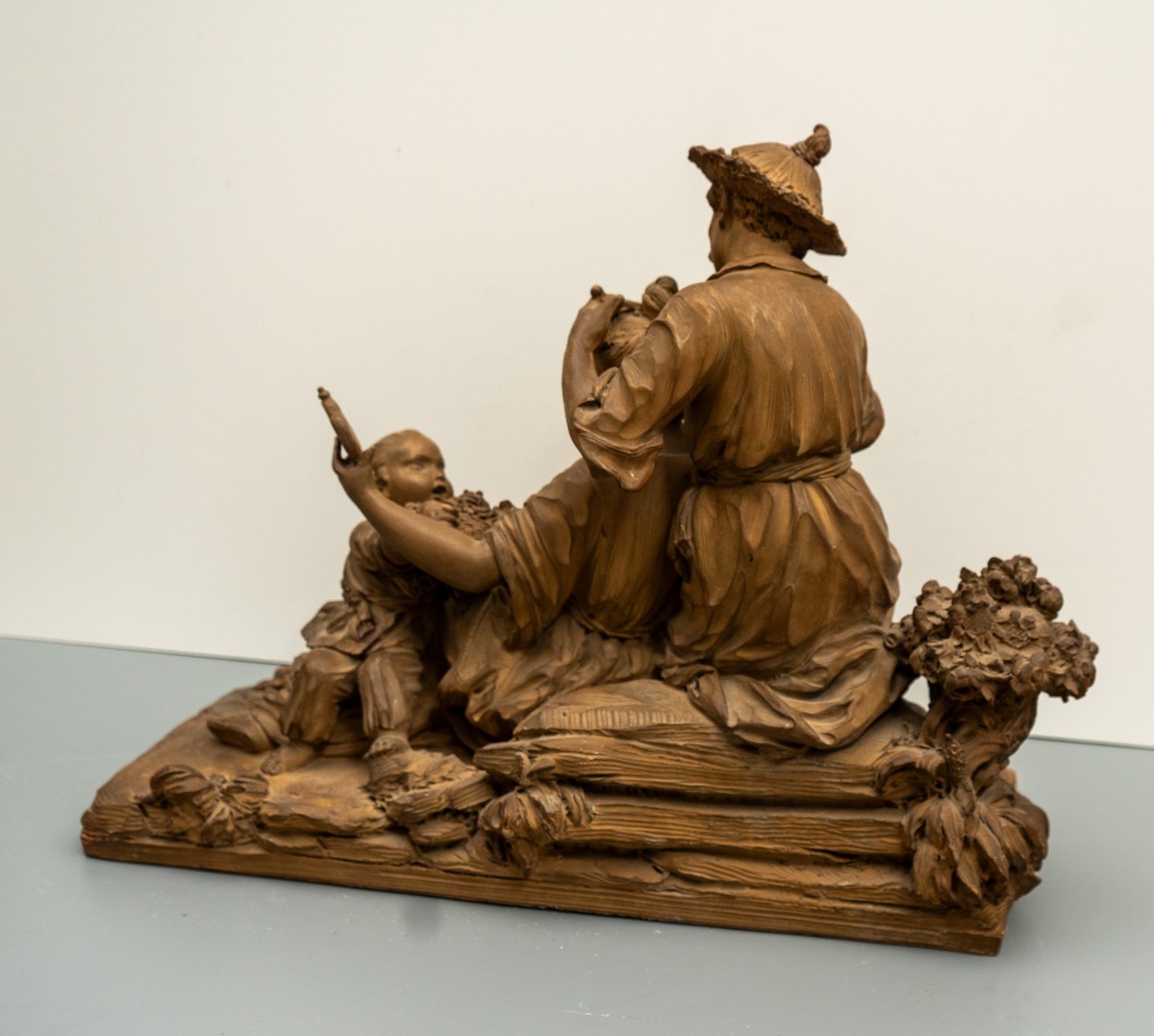
This exceptional terracotta group depicts three figures arranged on a naturalistically modelled rectangular base enriched with wood-grain texture, scattered flowers and foliage sprays. The dominant figure, a Chinese manservant wearing a broad conical hat with topknot finial and a belted tunic, kneels attentively to dress the hair of a young woman seated before him, working her chignon with raised hands. To the left, a young child reclines against the base, one arm raised holding a basket of flowers, the other extended in an animated gesture. A flowering shrub closes the composition to the right.
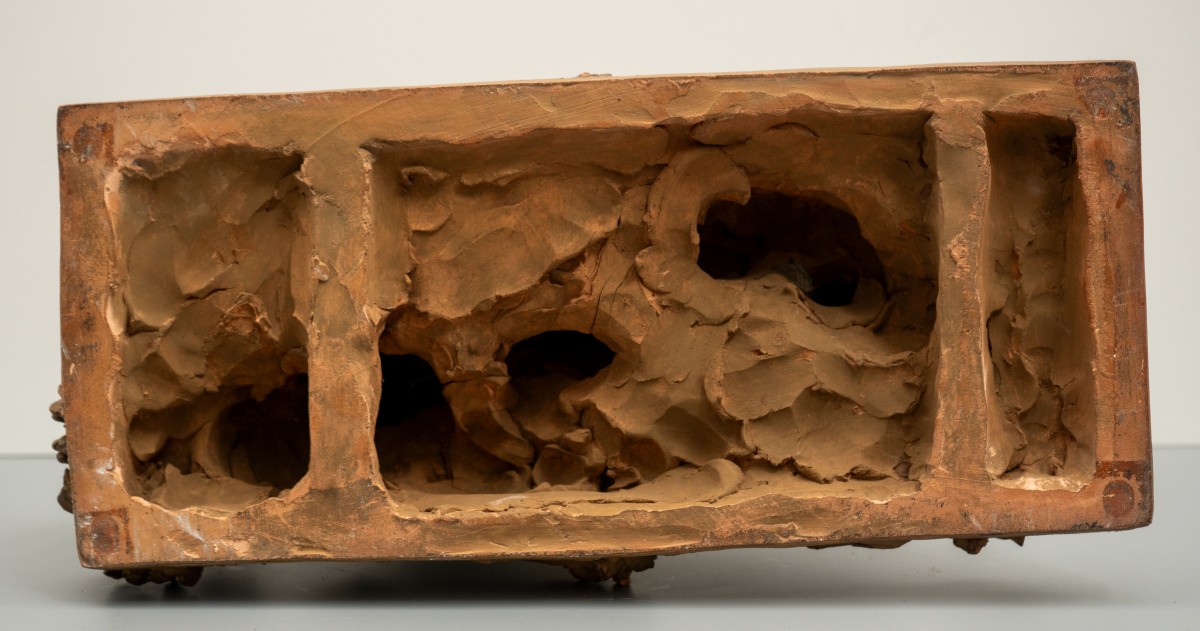
The modelling is of outstanding quality throughout. The drapery is deeply worked with incised folds, fringed borders and floral rosette ties, while the floral passages — more elaborate than those on the closely related version in The David Collection, Copenhagen (inv. B 468) — display a virtuosity of hand entirely consistent with autograph execution. The child's face is rendered with striking individual characterisation. The hollow construction, visible through the open base, is entirely consistent with high-quality French atelier practice of the Louis XVI period, the interior retaining original finger and tool marks. The warm reddish-brown clay body is unretouched throughout, without later paint or wash.
Josse-François-Joseph Leriche entered the Sèvres manufactory in 1757 and directed its sculpture workshop from 1780 until 1801, working alongside Falconet, Pajou and Boizot. He is particularly celebrated for his orientalising figure groups, among them the Le Billet Doux pair produced at Sèvres from 1751–52 and reissued throughout the nineteenth century. The present group belongs to the same distinguished current of late Louis XVI chinoiserie genre sculpture, combining the decorative warmth of the Rococo tradition with the restrained naturalism of the emerging neoclassical sensibility.
Comparative example: The David Collection, Copenhagen, inv. B 468 (closely related version, illustrated on the museum's website).
Literature
S. Lami, Dictionnaire des sculpteurs de l'école française au XVIIIe siècle, Paris, 1910, vol. II, pp. 37–39 (for the artist).É. Bourgeois and G. Lechevallier-Chevignard, Le biscuit de Sèvres: recueil des modèles de la Manufacture de Sèvres au XVIIIe siècle, Paris, 1913 (for related Sèvres models).T. Préaud and G. Scherf, La Manufacture des Lumières: la sculpture à Sèvres de Louis XV à la Révolution, Dijon, 2015 (for Leriche's role at Sèvres and the broader context of French terracotta sculpture of the period).