Offered by Richard Redding Antiques
REQUEST INFORMATION

Leading antique and fine art gallery, specialises in the finest French clocks.
After a model by Gabriel Grupello (Geraardsbergen, 1644 – Kerkrade, 1730)
France, 18th century
Brown-patinated bronze; gilt bronze bases
Height: 27 cm (with base)
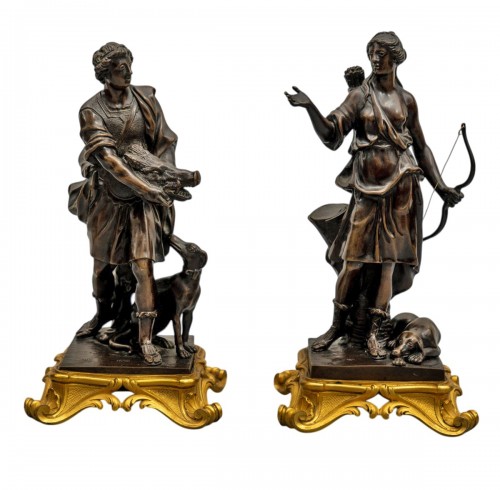
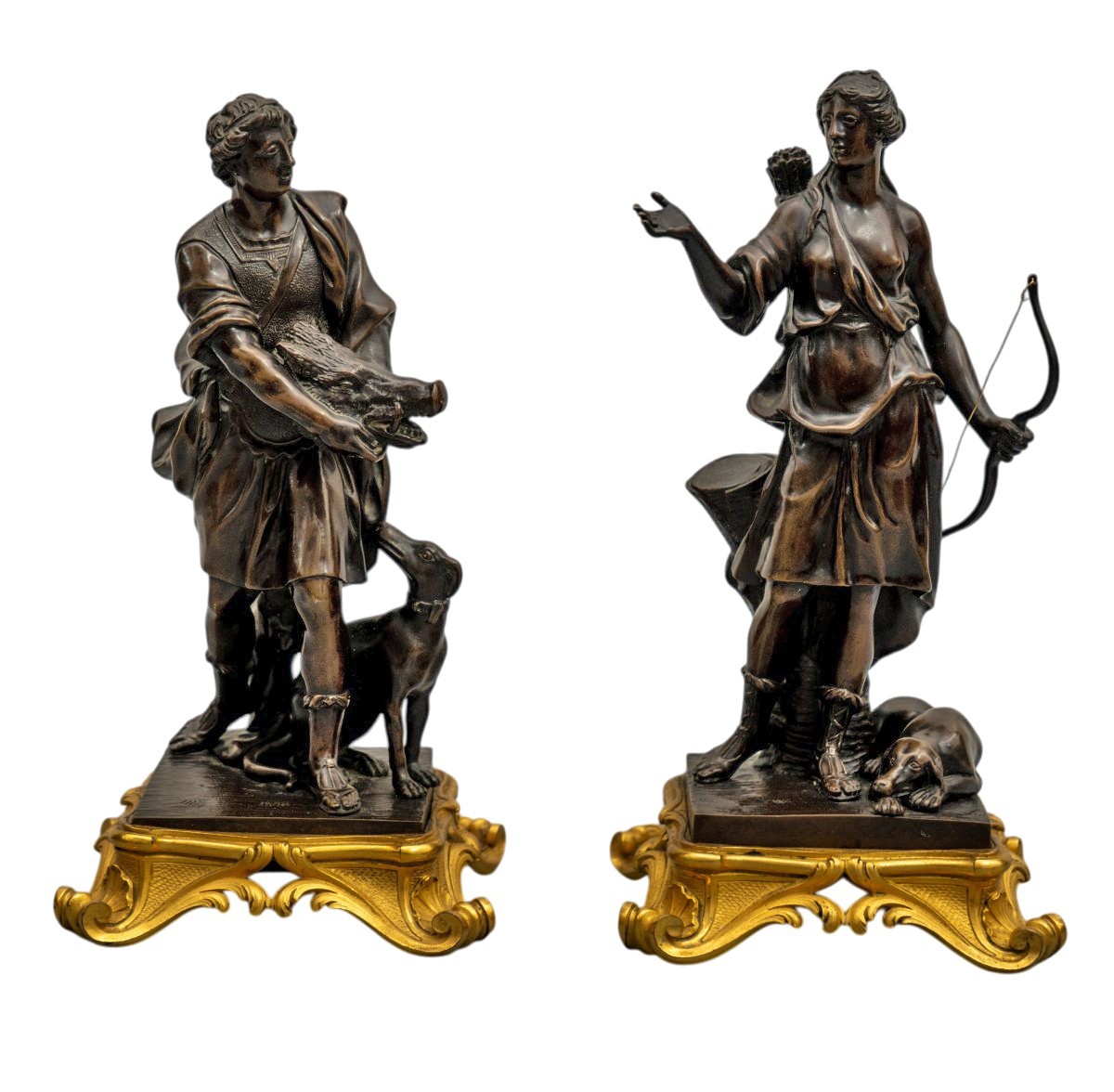
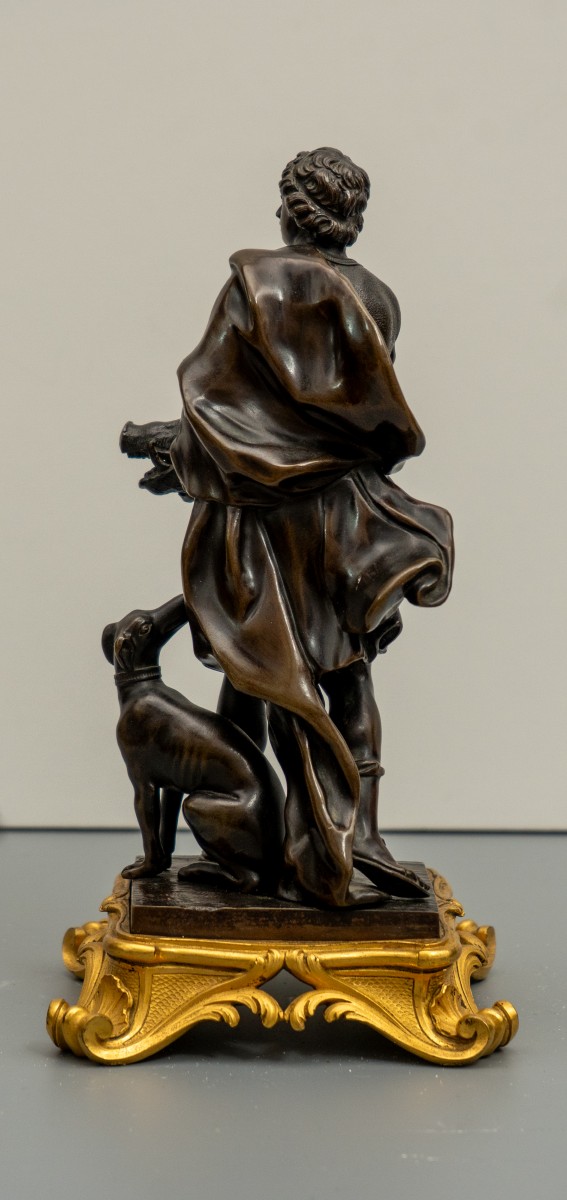
A finely cast pair of brown-patinated bronze statuettes representing Atalanta and Meleager, the celebrated huntress and hero of the Calydonian myth, each mounted on a serpentine gilt bronze base with boldly scrolled volute feet in the Louis XV taste.
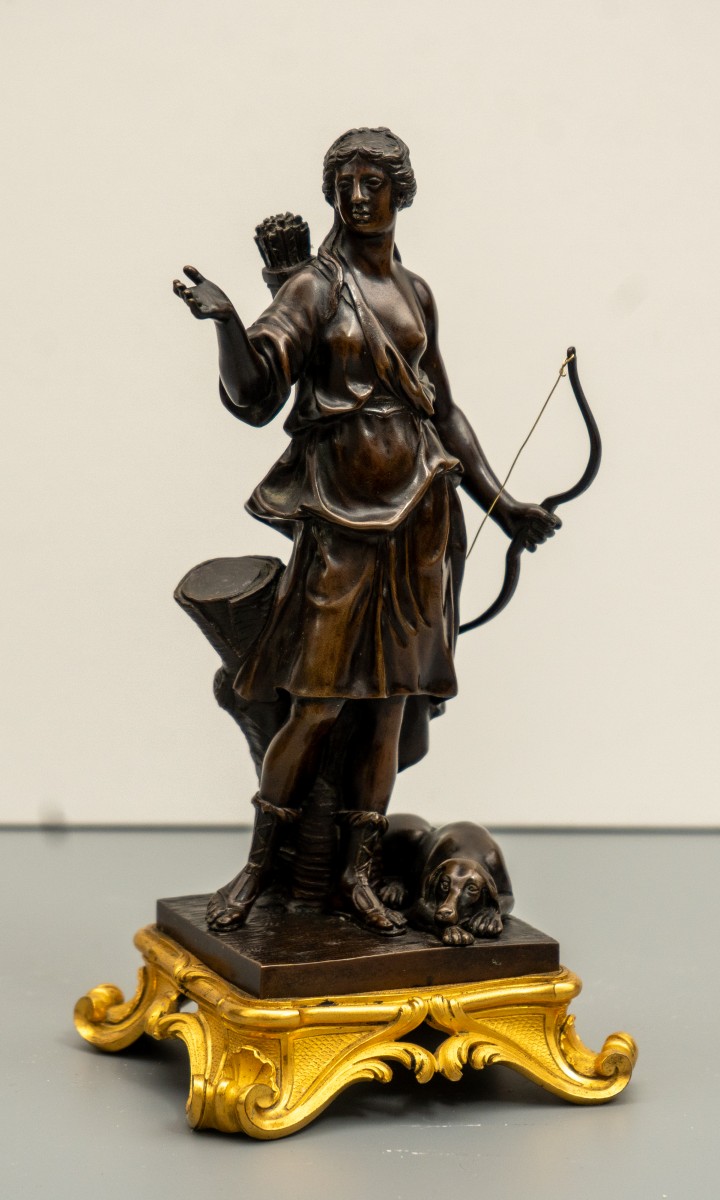
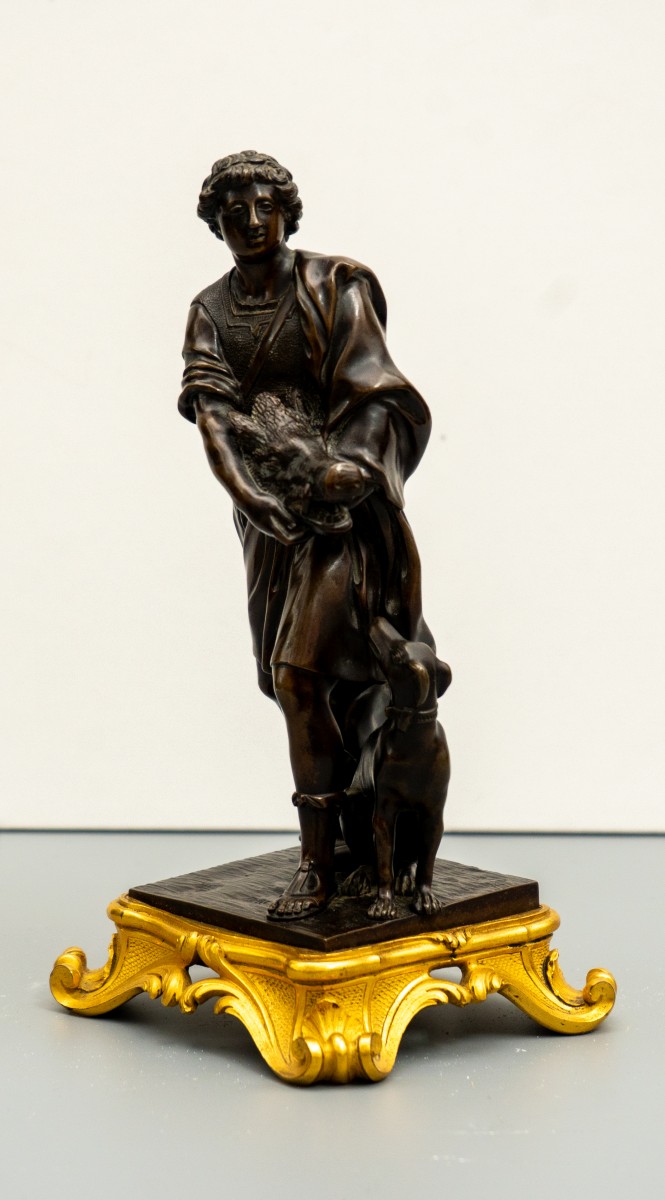
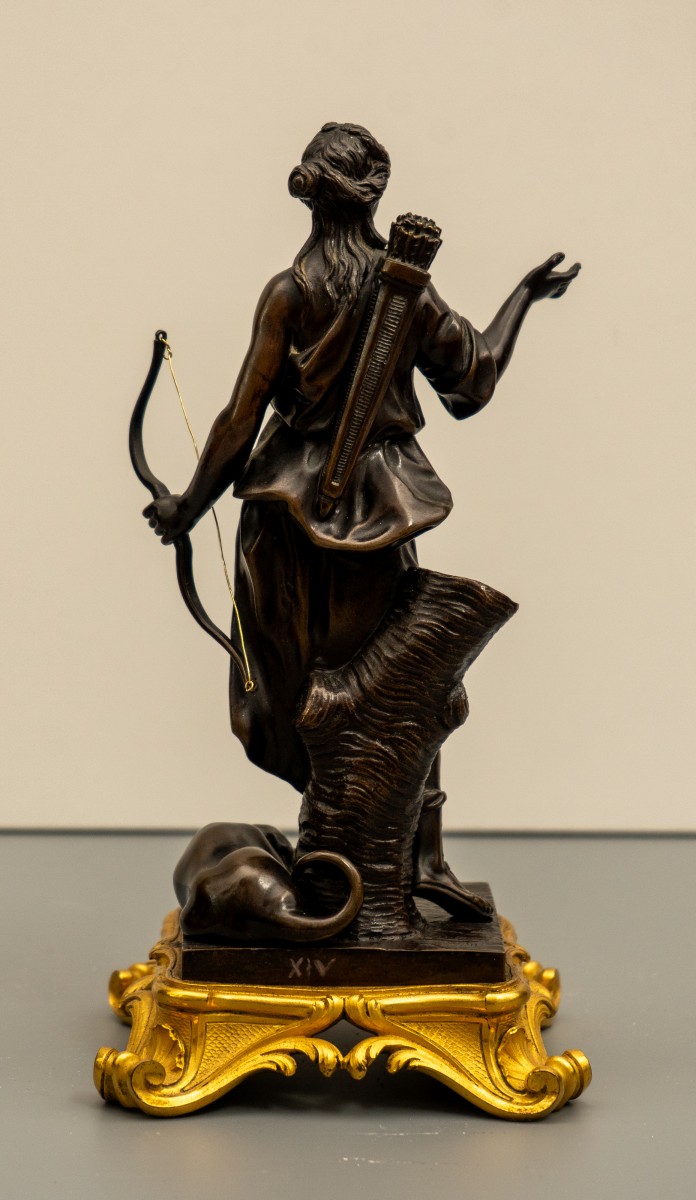
Atalanta stands in a graceful contrapposto, her right arm extended forward in a commanding gesture, while her left hand holds the arc of a bow. A quiver of arrows is slung across her back. She wears a short huntress's tunic and laced boots, with billowing drapery. At her feet, a hound lies recumbent, its head raised alertly; behind her rises a truncated tree stump serving as a formal support. The rear of the plinth is inscribed with the Roman numeral XIV. Meleager, her counterpart, turns his head to the left with a faint smile, presenting the severed head of the Calydonian boar held before him in both hands. A hunting hound stands alert at his side. He is dressed in a classical tunic with a chlamys falling from his shoulder, the handling of the drapery showing the vigorous Flemish Baroque modelling characteristic of Grupello's workshop.
The casting is of high quality throughout, with crisp chasing in the hair, musculature, and animal fur, and a warm, even brown patina.
The Subject
The myth of the Calydonian boar hunt is among the most celebrated of classical antiquity, recounted at greatest length in Ovid's Metamorphoses (Book VIII). According to Ovid, Diana had sent an enormous wild boar to ravage the region of Calydon as punishment after King Oeneus failed to make the promised sacrifices to her. His son Meleager assembled the most skilled hunters of the age to kill the beast. Among them was Atalanta, a courageous huntress who was the first to wound it, making it easier for Meleager to deliver the fatal blow. As a tribute to her bravery, Meleager awarded her the boar's head — a gesture that provoked fierce resentment among the other hunters and set in train the tragic chain of events leading to Meleager's death. Museo Nacional del Prado The subject enjoyed particular favour in Flemish and French Baroque art as an allegory of the hunt as a domain of both martial virtue and courtly love.
Gabriel Grupello and the Model
Gabriël Grupello (1644–1730) was a Flemish Baroque sculptor of exceptional versatility, producing religious and mythological sculptures, portraits, and monumental public works in marble, ivory, and bronze. He trained in Antwerp under Artus Quellinus the Elder, studied subsequently in Italy, and completed two years in Paris and Versailles, where he learned the technique of bronze casting and worked alongside compatriots including Philippe de Buyster, Gerard van Opstal, and Martin Desjardins. In 1695 he was appointed official court sculptor to Elector Johann Wilhelm of the Palatinate at Düsseldorf, the most prestigious sculptural appointment in the German-speaking lands at that date. Wikipedia His early work shows a classicising tendency formed during his French period, which in Flanders deepened into the full-blown Baroque idiom of Rubens's circle, the synthesis that defines his mythological bronzes.
Grupello's model of Atalanta and Meleager as a pair of independent statuettes was among the most widely diffused of his compositions, reproduced throughout the eighteenth century in French and Franco-Flemish foundry production. The present pair, with their boldly modelled drapery, sensitively worked animal accessories, and the distinctive Louis XV bases, are characteristic of high-quality French workshop production of the mid-to-later 18th century.
A closely related pair after the same model is illustrated in Hans R. Weihrauch, Europäische Bronzestatuetten 15.–18. Jahrhundert, Braunschweig, 1967, p. 378, figs. 461 and 462, the standard scholarly reference for European bronze statuettes of this period.
Provenance
The Arlette and Antony Embden Collection, France.
Literature
Hans R. Weihrauch, Europäische Bronzestatuetten 15.–18. Jahrhundert, Klinkhardt & Biermann, Braunschweig, 1967, p. 378, figs. 461–462 (related pair after the same model).
A note on the XIV inscription: the Roman numeral on the rear of Atalanta's plinth most likely indicates a foundry or series number within a recorded run of casts, consistent with the organised production practices of major 18th-century French bronze ateliers, and is a useful indicator that these bronzes formed part of a documented edition.