Offered by Richard Redding Antiques
REQUEST INFORMATION

Leading antique and fine art gallery, specialises in the finest French clocks.
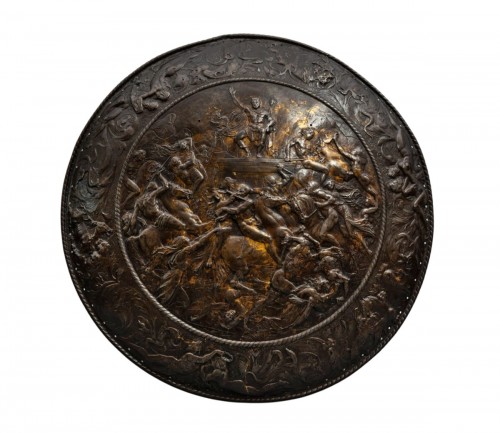
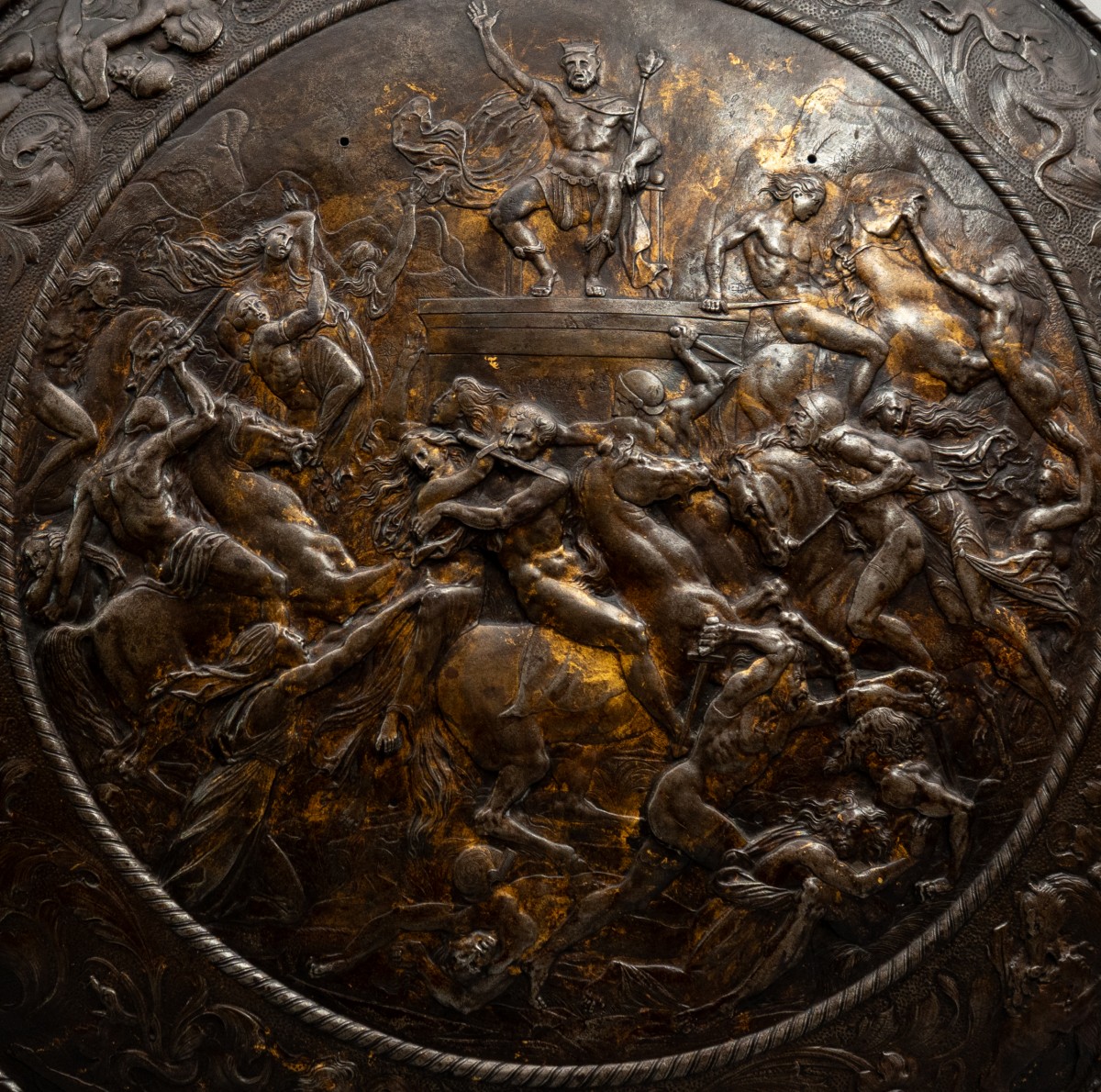
Italian Renaissance Parade Shield (Rotella) with the Rape of the Sabines
Northern Italy, probably Milan, second half of the 16th century
Embossed, chased and engraved iron with substantial remains of fire gilding.
Description
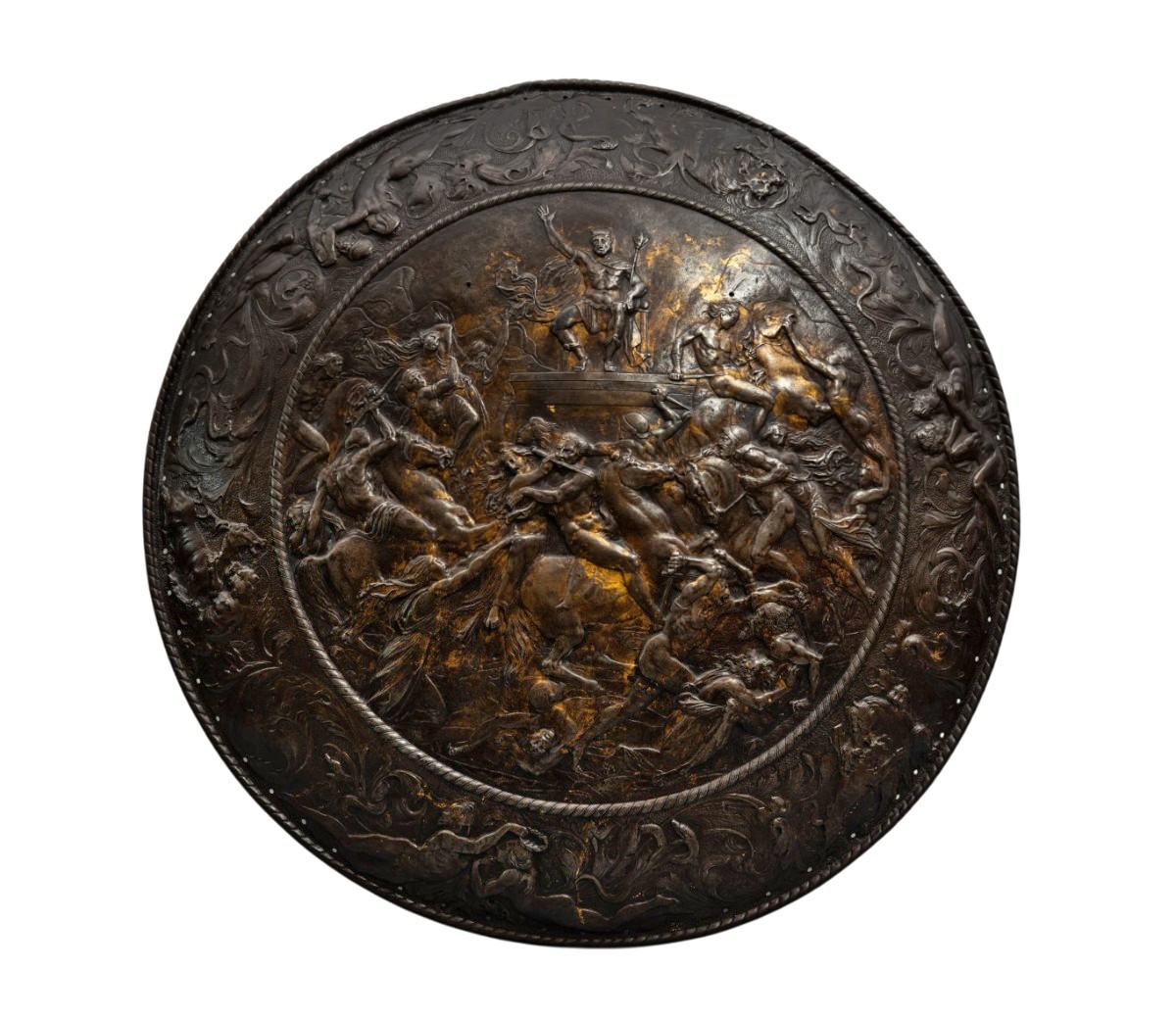
A large and exceptionally ambitious circular parade shield of the type known in Italian as rotella, produced in one of the leading Milanese workshops during the heroic age of Italian embossed armour. The shield is worked from a single sheet of iron, raised and chased in high relief with a densely peopled battle composition, and surrounded by a broad ornamental border. The whole surface was originally fire gilt, and rich ochre traces of the gilding are still distributed across the entire field, in the recesses of the drapery, between the horses' limbs, along the architectural setting and throughout the foliate border. The shield is framed by a rope twist (cordonné) moulding at both the inner division and the outer rim, a device that recurs on a number of well documented Milanese rotelle of the period.
The Central Scene:
The Rape of the Sabines
The main field, approximately 41 cm across, is occupied by a tumultuous scene of the Ratto delle Sabine (Rape of the Sabines), one of the foundational episodes of early Roman history as recounted by Livy (Ab Urbe Condita I, 9) and Plutarch (Romulus, 14). The subject shows Romulus, newly established as first king of Rome and confronted with a shortage of women among his followers, staging games in honour of the god Consus and inviting the neighbouring Sabine people. At a pre arranged signal the Roman youths seized the Sabine women as wives, an act that, after subsequent war and reconciliation, was understood in antiquity and again in the Renaissance as the political birth of the Roman state through marriage.
On this shield the narrative is set out with remarkable compositional clarity. At the top centre, elevated on a stepped architectural platform inscribed ROMVLVS, the king appears in full length: crowned, bearded, draped, with raised right arm and a sceptre or lituus in his left hand, giving the signal for the abduction. A second figure beside him, also on the dais, adds rhetorical emphasis. This elevated tribune is the iconographic kernel of the entire episode and immediately identifies the scene without ambiguity.
Below and around him the action unfolds in a manner that is pure late Cinquecento Mannerism: mounted Roman warriors in classical armour wheel their horses, seize the fleeing Sabine women and ride over fallen combatants. One of the most striking groups shows a helmeted Roman rider carrying off a woman across the withers of his rearing horse, while a second mounted figure thrusts his sword over the victim's shoulder; below, a dismounted warrior grapples with a further woman on the ground. The landscape setting is only lightly indicated, all emphasis being placed on the figura serpentinata, on the outstretched, twisting female bodies, and on the nervous anatomy of the horses. The composition is directly in the tradition of the monumental friezes painted by Polidoro da Caravaggio in the Palazzo Milesi in Rome and circulated in print form by Cherubino Alberti from the 1570s onward, as well as of the engraving of the same subject after Baccio Bandinelli by Giovanni Jacopo Caraglio. Milanese armourers and chisellers habitually drew on this body of printed imagery when composing narrative reliefs for parade armour.
The Border
The central field is enclosed by a narrow rope twist moulding, and beyond it lies a wide concentric border, approximately 9 cm in depth, filled with a virtuoso repertoire of Mannerist ornament.
Within dense foliate scrolls one finds:
pairs of wrestling or embracing nude couples, a staple of the grotesque vocabulary derived from the Domus Aurea and popularised through the decorative systems of Raphael, Giovanni da Udine and Perino del Vaga,
animal combats and chimerical creatures, including lion and dragon motifs,
masks, dolphins and sinuous marine monsters set among curling acanthus,
occasional putti and reclining figures.
The outer rim is finished with a rolled edge and a further cordonné band, a practical as well as decorative feature that reinforced the vulnerable edge of the raised sheet.
Technique and Construction
The shield was raised and embossed from a single iron sheet, then worked from both sides with a range of punches and chisels to bring out the crisp definition of hair, drapery folds, horse manes and armour detail. The ground areas of the border are enlivened with very fine matting, executed with a ring punch, against which the polished and gilt relief stood out dramatically when the piece was new. The whole surface was then fire gilt; where the gilding has been rubbed back by use and time, the exposed iron has taken on a warm dark brown patina that contrasts beautifully with the ochre tone of the remaining gold.
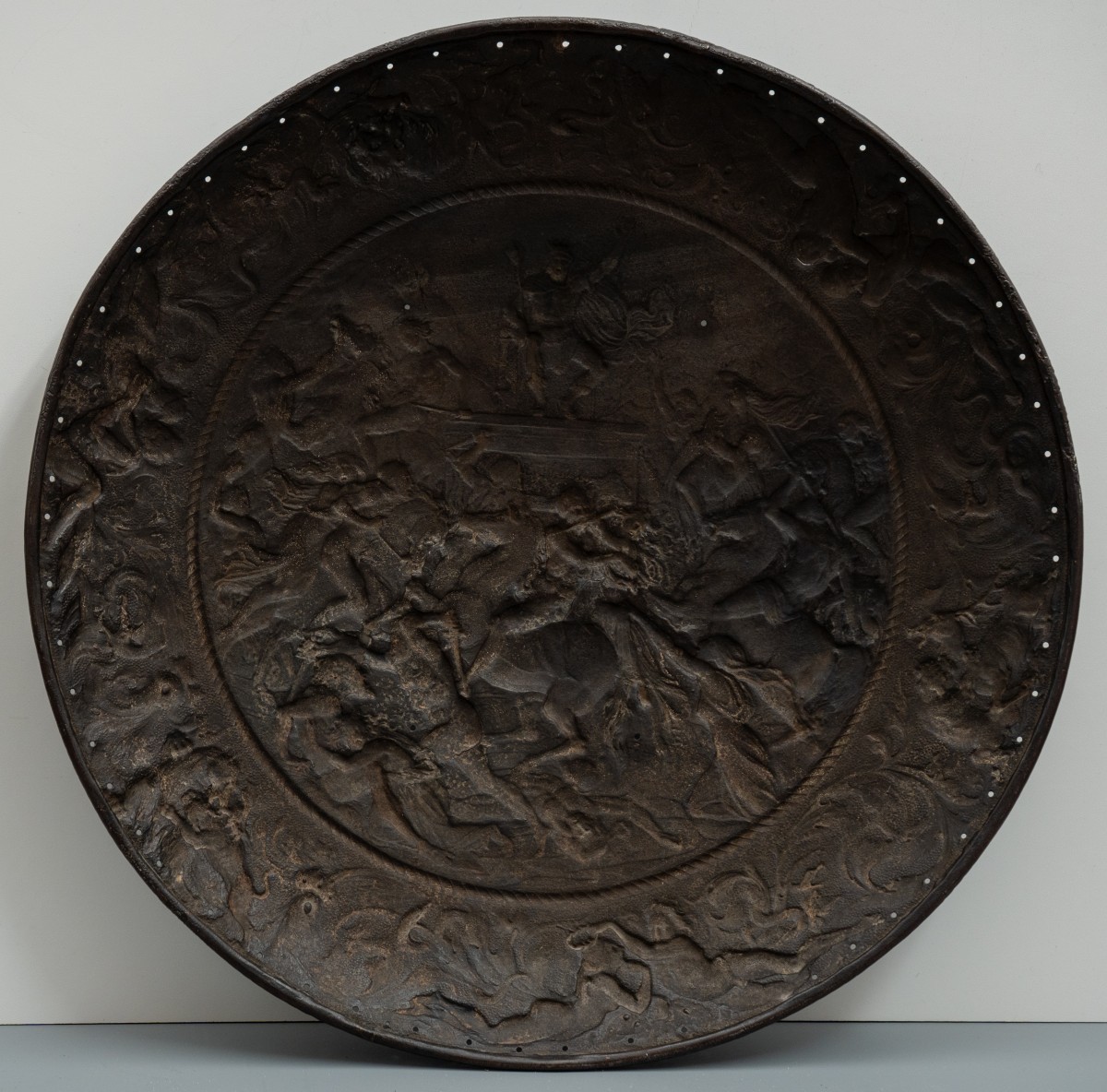
The reverse shows a dark, undisturbed interior patina and carries the expected series of small perforations: a dense ring of rivet holes close to the rim for the attachment of the original padded lining, and a smaller, functionally placed pattern of larger holes for the enarmes, the leather arm straps by which the shield was carried. The logical, ergonomic placement of these strap holes is an important indicator of period manufacture, since later historicist reproductions tend to reproduce the appearance of such holes in a decorative rather than functional arrangement.
Historical Context
Circular and oval parade shields embossed in relief with scenes from ancient history, the Old and New Testaments, or classical mythology were a speciality of Milanese armourers and goldsmiths of the second half of the 16th century. They were produced in the same workshops that made the celebrated all'antica parade armours for the Habsburg, Valois, Medici, Farnese, Este and Savoy courts, and were commonly paired with a matching burgonet or cabasset and with a mail or plate harness styled after Roman prototypes. The names most often associated with this production are those of the Negroli family, Lucio Piccinino, Pompeo della Cesa and their circle. Compositions were almost invariably adapted from printed sources: engravings by Etienne Delaune, Jean Mignon, Cherubino Alberti, Caraglio, the Ghisi, Cornelis Cort and their followers provided the figural vocabulary which the armourer then translated into repoussé iron.
The Rape of the Sabines was an especially congenial subject for such a piece: it is a heroic episode from the foundation of Rome, it allowed the display of male and female nudes in extreme poses in the Mannerist taste, and above all it was emphatically topical in the years around and after the unveiling of Giambologna's marble Ratto delle Sabine in the Loggia dei Lanzi in Florence in 1583, a work that fixed the composition in the European imagination and generated a wave of related prints, bronzes and reliefs.
Comparable Examples in Public Collections
Parade shields of closely related type, technique and ambition are preserved in the principal European arms collections, notably:
https://www.finestresullarte.info/de/reisenotizbucher/12732vn_tiere-und-fantastische-orte-in-italiens-museen-piemont.php
https://www.metmuseum.org/art/collection/search/22895
Armeria Reale, Turin, which holds one of the densest groups of Milanese embossed rotelle of the later 16th century, including four shields with the Conversion of Saint Paul (inv. F.17, F.19, F.20, F.21);
Museo Poldi Pezzoli, Milan, whose arms gallery includes several Milanese parade shields of this family;
Metropolitan Museum of Art, New York, including the shield with the Conversion of Saint Paul (inv. 25.163.1, c. 1570) and a Milanese Rondache in Late 16th Century Milanese Style (inv. 25409);
Musée de l'Armée, Paris (inv. I.65 and I.79, both with the Conversion of Saint Paul);
Wallace Collection, London, with comparable embossed defences;
Rüstkammer, Dresden (Zwinger), with a significant group of Italian parade shields from the Saxon electoral armoury.
Two conveniently illustrated points of comparison, both showing the same broad, partly worn distribution of gilding seen on the present shield, are the Milanese rotella illustrated on the website of Finestre sull'Arte in its Piedmont feature on Italian museum holdings, and the Parade Shield Depicting the Conversion of Saint Paul at the Metropolitan Museum of Art (25.163.1).
Provenance
From a Swiss private collection. Acquired in the 1980s from the Bergamo dealer and blacksmith Urbano Quinto, author of Gli Antichi Segreti del Fabbro (1983), at a significantly higher price than its current estimate. The present shield comes from the same private collection as a Venetian ducal parade shield (Prunk Wappenschild eines Dogen) illustrated in Quinto's book and subsequently sold at Schuler Auktionen, Zurich (lot 505, catalogue no. 178).
Literature
L.G. Boccia and E.T. Coelho, L'Arte dell'Armatura in Italia, Milan 1967.
L.G. Boccia, Il Museo Poldi Pezzoli. Armeria I, Milan 1986.
L.G. Boccia, F. Rossi and M. Morin, Armi e Armature Lombarde, Milan 1980.
J.F. Hayward, Virtuoso Goldsmiths and the Triumph of Mannerism 1540 to 1620, London 1976.
B. Thomas and O. Gamber, L'arte milanese dell'armatura, in Storia di Milano, vol. XI, Milan 1958, pp. 697 to 841.
S.W. Pyhrr and J.A. Godoy, Heroic Armor of the Italian Renaissance. Filippo Negroli and His Contemporaries, exh. cat., The Metropolitan Museum of Art, New York 1998.
S.W. Pyhrr, D.J. La Rocca and M. Ogawa, Arms and Armor. Notable Acquisitions 1991 to 2002, New York 2002.
D.J. La Rocca, How to Read European Armor, New York 2017.
C. Blair, European Armour circa 1066 to circa 1700, London 1958.
U. Quinto, Gli Antichi Segreti del Fabbro, Bergamo 1983.
The Armeria Reale of Turin, ed. F. Mazzini, Busto Arsizio 1982.
For the iconographic sources of the central scene see in particular the engravings of the Rape of the Sabines by Cherubino Alberti after Polidoro da Caravaggio (c. 1570 to 1615, after the frescoes of the Palazzo Milesi / Ricci, Rome) and by Giovanni Jacopo Caraglio after Baccio Bandinelli (early to mid 16th century, inscribed RAPTVS SABINARO), and the chiaroscuro woodcut of Andrea Andreani after Giambologna (Florence, 1584), all of which helped to fix the iconography that the Milanese embossers drew upon.
Condition
Overall very good condition commensurate with age and original function. Rich, stable patina on the reverse. On the obverse, the high points of the relief show the expected smooth wear from handling and display, with generous remains of the original fire gilding distributed across the whole surface, including in the recesses of the central scene and throughout the border. The rim is intact, with its rope twist moulding and rolled edge. The perimeter is pierced with the original series of small holes for the lining rivets and with larger holes for the leather enarmes, all placed in the functionally correct positions. No later repairs, no significant losses, no restorations of note.
Dimensions
Overall diameter: 60.8 cm
Diameter of central figural field: 41 cm
Width of ornamental border: 9 cm
Weight: 2,140 g
A rare survival from the great age of Milanese parade armour, combining an ambitious mythological composition of textbook quality with all the technical and structural features of a genuine late 16th century rotella, and preserving an unusually generous amount of its original fire gilding. A piece of museum calibre for the serious collector of Renaissance arms and armour or of Italian Mannerist decorative sculpture.