Offered by Gregory Redding
REQUEST INFORMATION

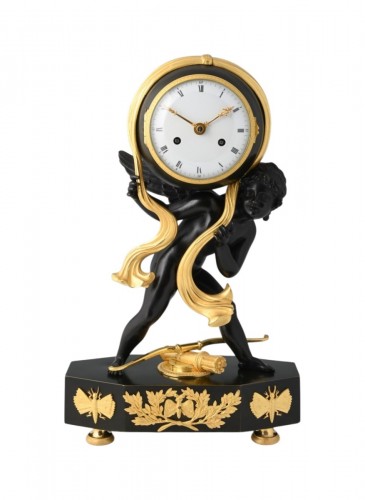
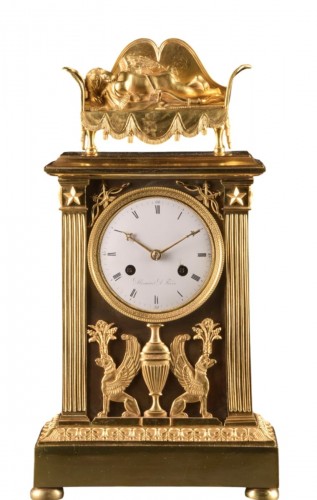
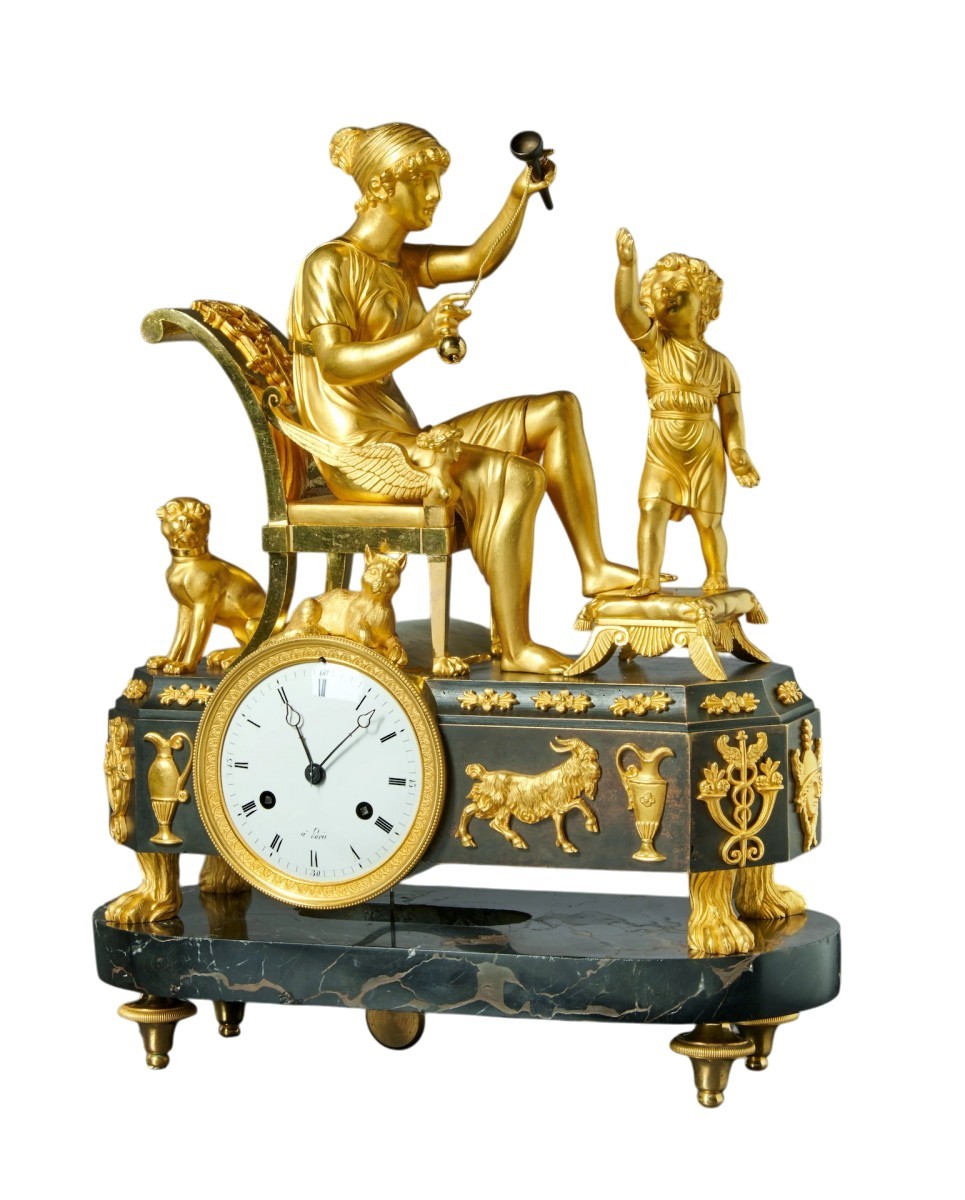
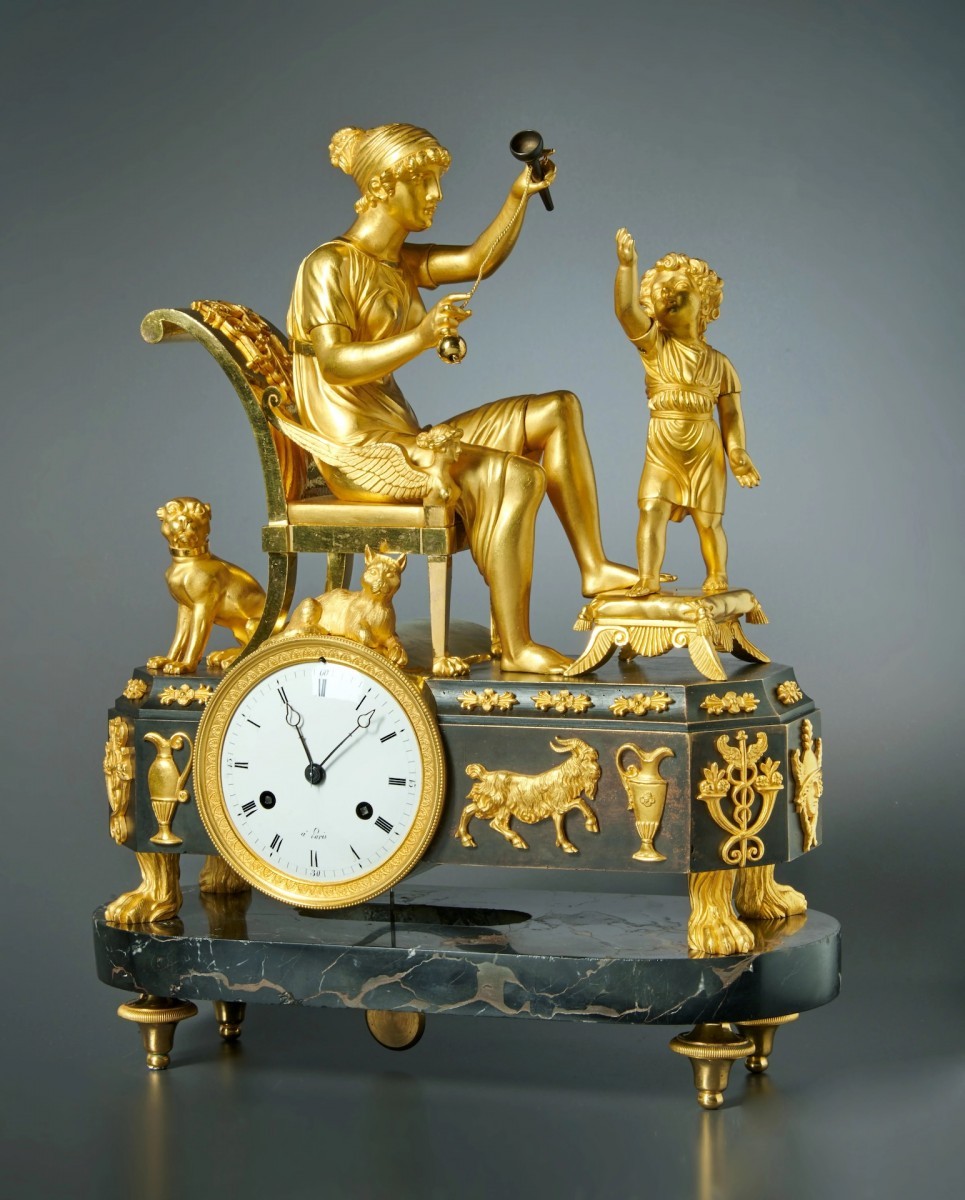
The white enamel dial signed à Paris, with Roman and Arabic numerals and blued steel moon-style hands. Eight-day movement with silk thread suspension, anchor escapement, outside count wheel, striking the hours and half-hours on a single bell.
Circa.1810, Paris
The case depicting a young mother seated in an Egyptian Revival fauteuil, dressed in a classical tunic, playing a game of ball and cup (bilboquet) with her young son, who stands on a cushioned tabouret de pied and reaches upward. The fauteuil of pronounced Empire character, with scroll back, winged sphinx arm supports, sabre back legs and straight front legs terminating in lion paw feet. The footstool with scrolled acanthus apron and corresponding feet. A dog and cat are included in the composition beside the chair, alluding to domestic fidelity and, in the case of the cat, to the prevailing Egyptomania of the period.
The white enamel dial asymmetrically set within an octagonal-section rectangular plinth, mounted at the front with classical pitchers and a ram — attributes of Mercury in his role as protector of shepherds — and at the angles with caducei issuing from conjoined cornucopias. The ends applied with the head of Mercury wearing his winged petasus. The plinth on hairy lion paw feet, the whole raised on a rectangular marble base with rounded ends on toupie feet.
Note:
The present clock belongs to a well-defined group of Empire figural mantel clocks celebrating the theme of domestic intimacy. A closely related example, in which the mother holds a yoyo rather than a bilboquet, is illustrated in Niehüser's standard reference work on French bronze clocks. Both bilboquet and yoyo were popular diversions in early nineteenth-century Parisian society, and their inclusion here reinforces the mood of affectionate family play.
The fauteuil depicted in the bronze group finds close parallels in documented Empire seat furniture. A set of eight giltwood fauteuils with winged sphinx arms, attributed to Jacob Frères and made for the Palais du Directoire, is preserved at the Château de Fontainebleau. A pair of fauteuils with sphinx arms made for Madame Récamier, likewise attributed to Jacob Frères, is in the Musée du Louvre. A set of eight fauteuils with winged lion-head arm supports on lion paw feet, circa 1802, made for the grand salon of Lucien Bonaparte's Parisian hôtel on the rue Saint-Dominique, provides a further parallel. The form also accords with designs by Charles Percier (1764–1838) for fauteuils by Georges Jacob incorporating sphinx arms, sabre legs and lion paw feet. The tabouret de pied may be compared with two examples by the ébéniste Pierre Marcion made for the Palais de Compiègne.
Literature
Elke Niehüser, Die Französische Bronzeuhr, Munich, 1997, for a closely related example with yoyo group.
Jean-Pierre Samoyault, Mobilier Français Consulat et Empire, Paris, 2009, p. 50, pl. 60 (Jacob Frères fauteuils, Fontainebleau); p. 56, pl. 74 (Bonaparte fauteuils, rue Saint-Dominique); p. 180, pls. 310–311 (Marcion tabourets, Compiègne).
Marie-Noëlle de Grandry, Le Mobilier Français, Directoire Consulat Empire, Paris, 1996, p. 51 (Jacob Frères fauteuils for Madame Récamier, Musée du Louvre).
Denise Ledoux-Lebard, Le Mobilier Français du XIXe Siècle, Paris, 2000, p. 283 (Percier drawings for Jacob fauteuils with sphinx supports).