Offered by Gregory Redding
REQUEST INFORMATION
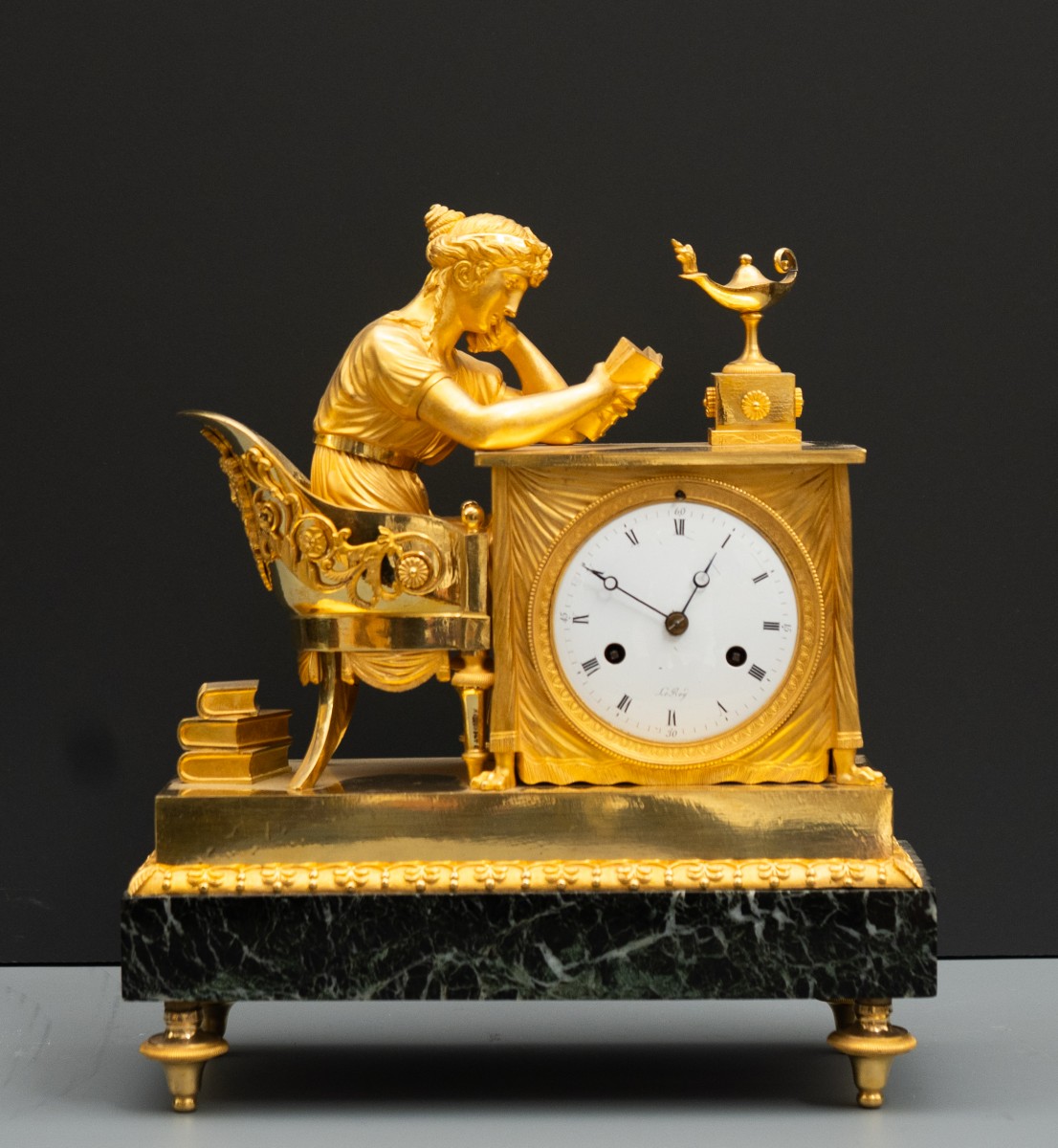

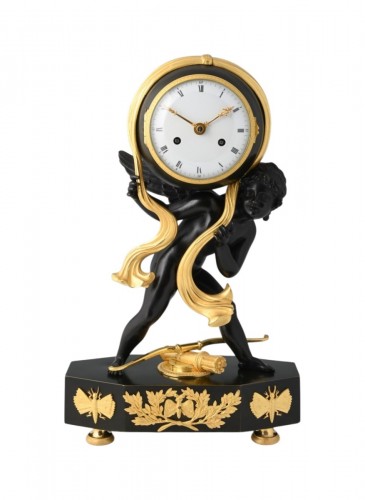
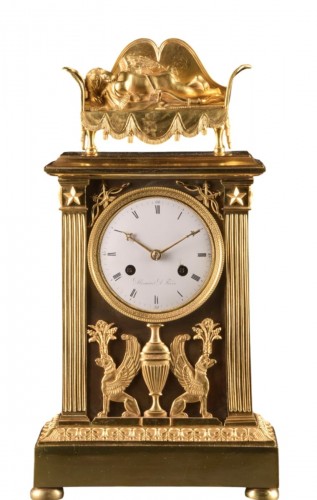
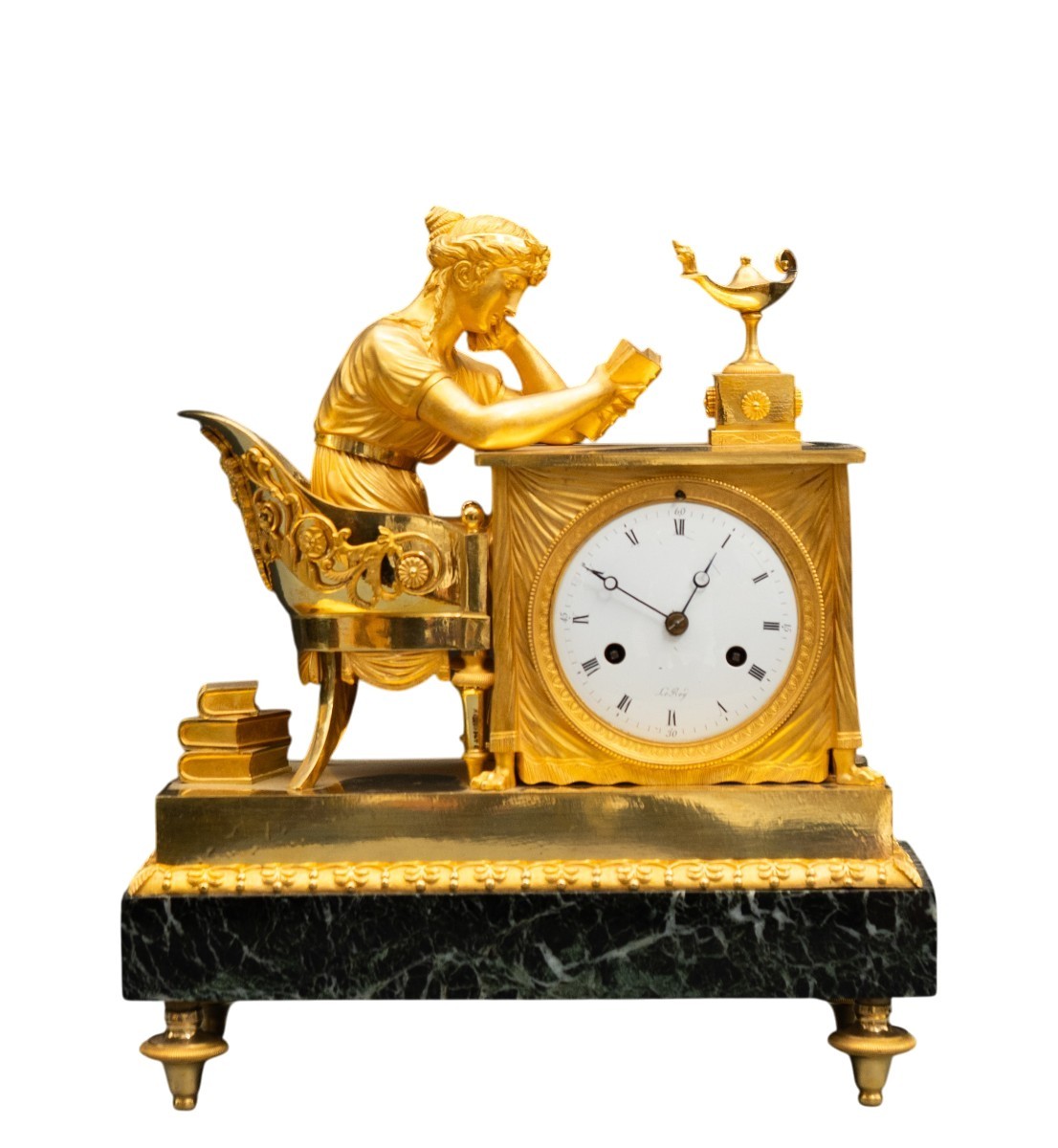
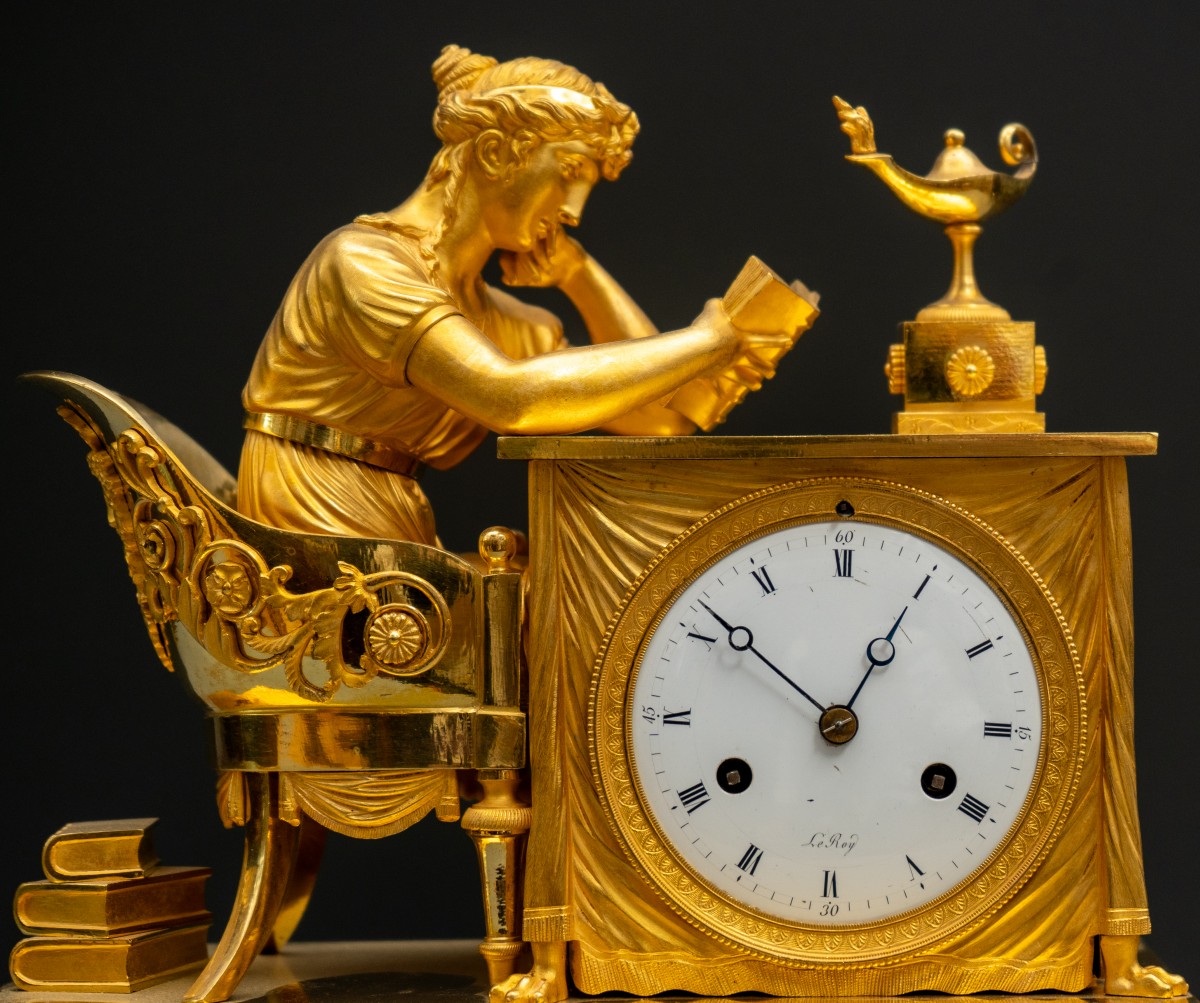
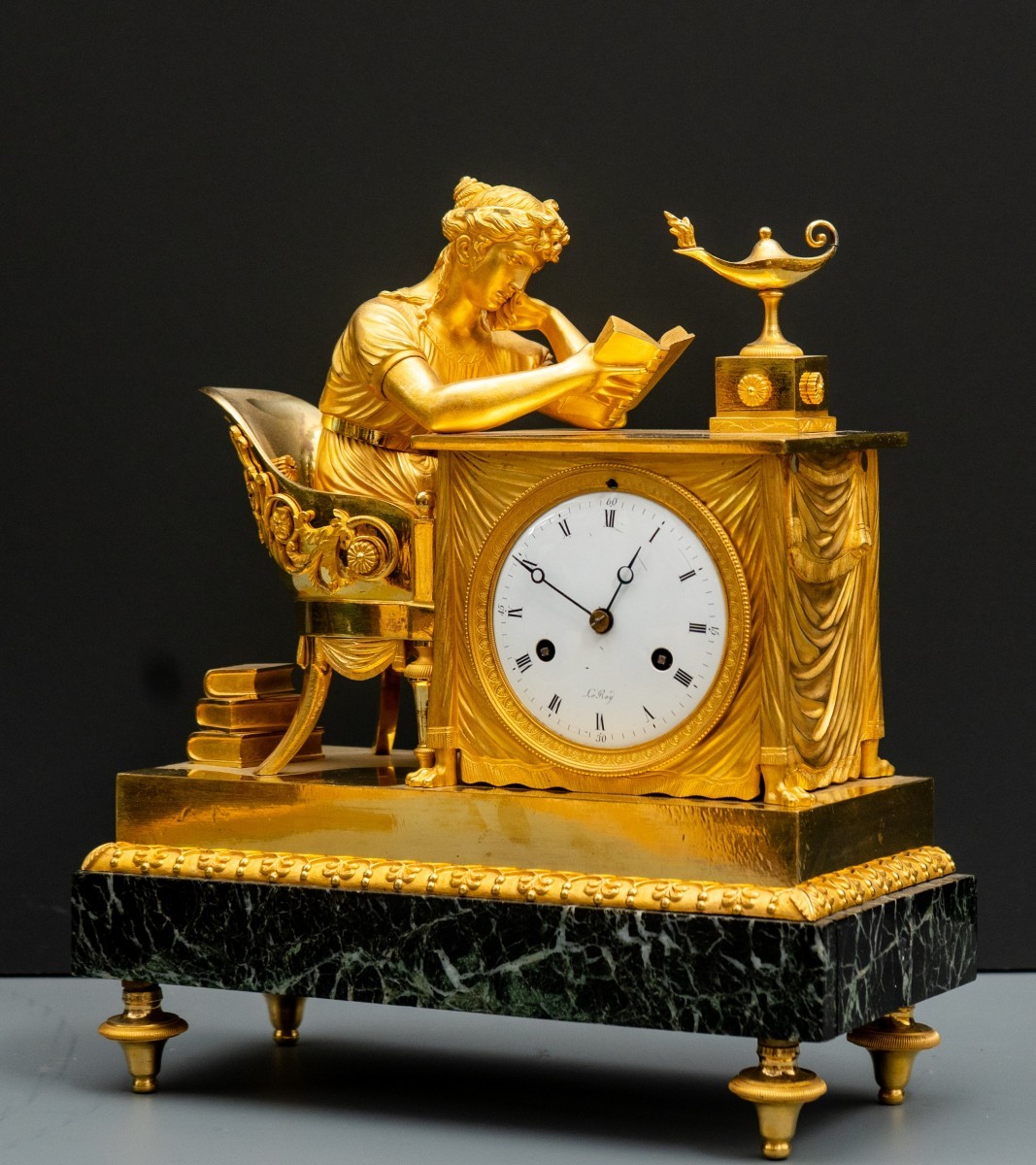
A fine Empire period mantel clock in finely chased and mercury gilt bronze, mounted on a stepped verde antico marble base raised on four toupie feet. The case models the allegory of Study, known in the repertoire of Parisian bronziers as La Liseuse: a young woman in classical dress, her hair bound in a diadem, seated in a klismos chair with scrolled stiles and rosette terminals, leaning forward on a draped plinth to read an open book. Beside her, on a stepped pedestal with applied rosettes, stands a Roman oil lamp with scrolled handle and flaming wick, emblem of vigil and learning. At her feet, a stack of folio volumes. The plinth concealing the movement is richly draped in swags of chased bronze, the apron with a band of stiff leaves.
Circular Parisian movement with count wheel strike on bell, running for eight days, white enamel dial with Roman hour numerals and Arabic five minute divisions, blued steel hands, signed Le Roy à Paris at the VI position.The signature refers to the workshop of Basile Charles Le Roy (1765 to 1839), Horloger de l'Empereur et Roi and of Madame Mère, one of the most prominent Parisian makers of the First Empire, continued from 1828 by his son Charles Louis Le Roy under the name Le Roy et Fils.The model is associated with the circle of the bronzier Jean André Reiche (1752 to 1817) and was produced by the leading Parisian ateliers of the period, including the workshops of Claude Galle, Pierre Philippe Thomire and André Antoine Ravrio. Comparable examples are preserved in the Mobilier National and in the collections of the Château de Fontainebleau.
Condition: Original mercury gilding in very good state of preservation, with the characteristic contrast of matte and burnished surfaces. Movement in working order.
France, Paris, circa 1810 to 1820
Dimensions: H. 33 x W. 29 x D. 13.5 cm
Literature:
Pierre Kjellberg, Encyclopédie de la pendule française du Moyen Âge au XXe siècle, Paris, Les Éditions de l'Amateur, 1997, pp. 385 to 420 (Empire period, "La Liseuse" model illustrated).
Elke Niehüser, Die französische Bronzeuhr. Eine Typologie der figürlichen Darstellungen, Munich, Callwey, 1997, figural model "Lesende" / "La Liseuse".
Hans Ottomeyer, Peter Pröschel et al., Vergoldete Bronzen. Die Bronzearbeiten des Spätbarock und Klassizismus, Munich, Klinkhardt und Biermann, 1986, vol. I.
Jean Dominique Augarde, Les Ouvriers du Temps. La pendule à Paris de Louis XIV à Napoléon Ier, Geneva, Antiquorum, 1996.
Tardy, La Pendule française, vol. III, Du Louis XVI à nos jours, Paris, Tardy, 1974.
Tardy, Dictionnaire des horlogers français, Paris, 1972, entry Le Roy (Basile Charles).