Offered by Gregory Redding
REQUEST INFORMATION
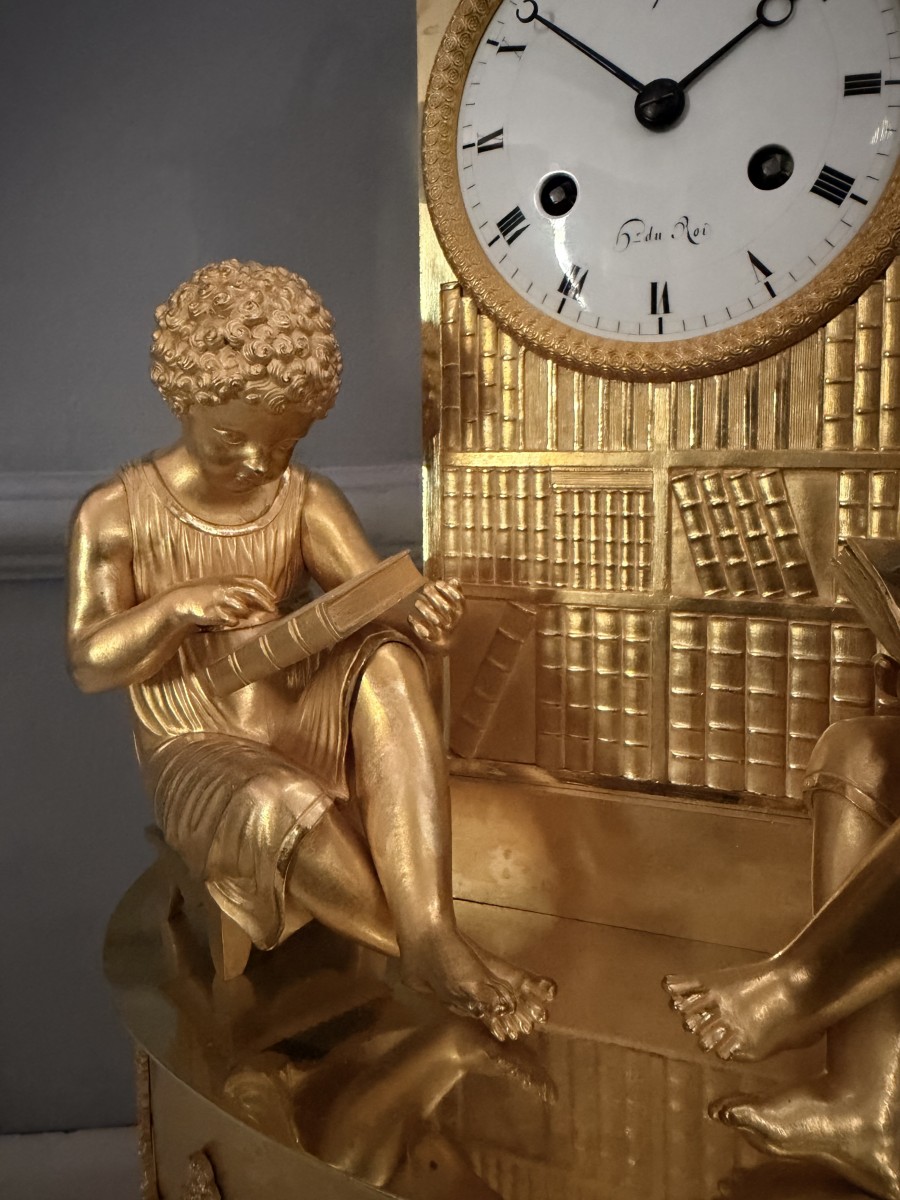
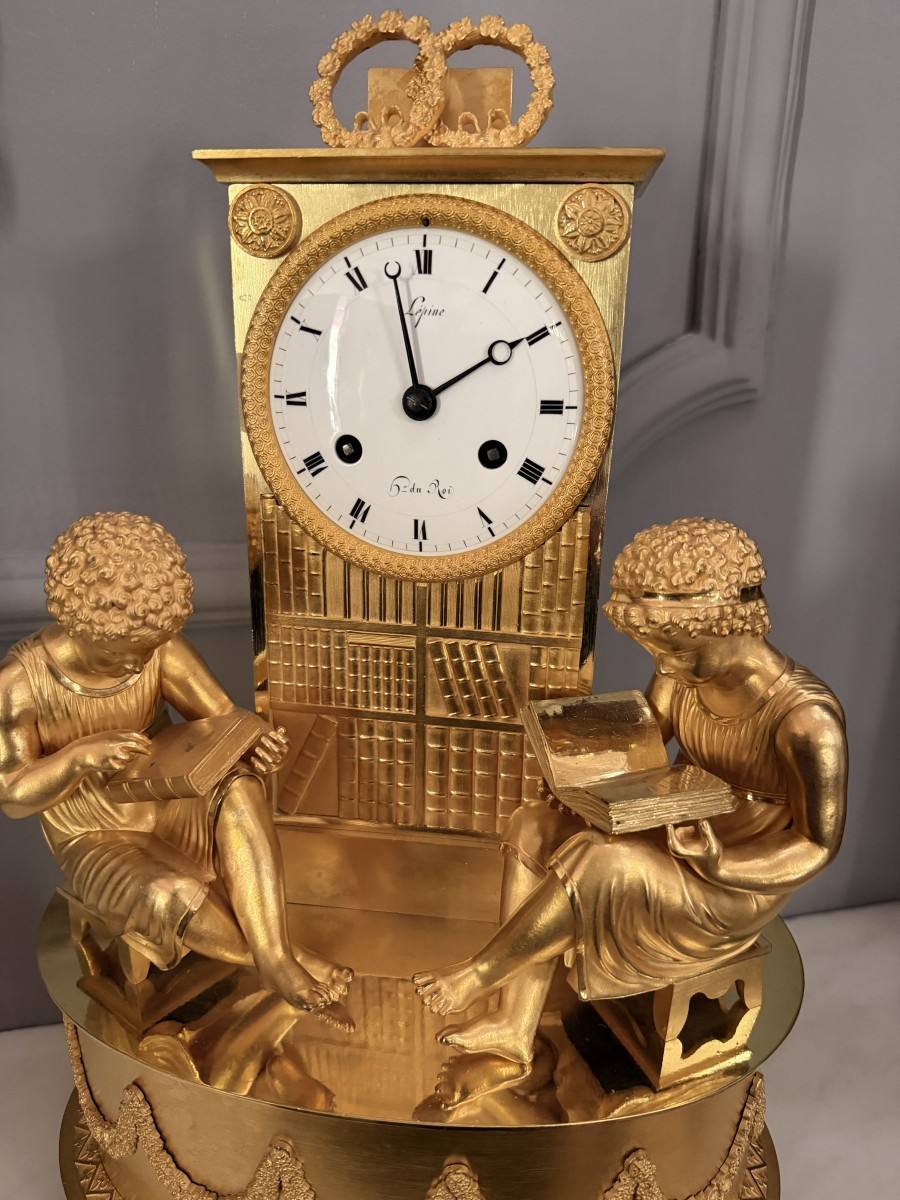

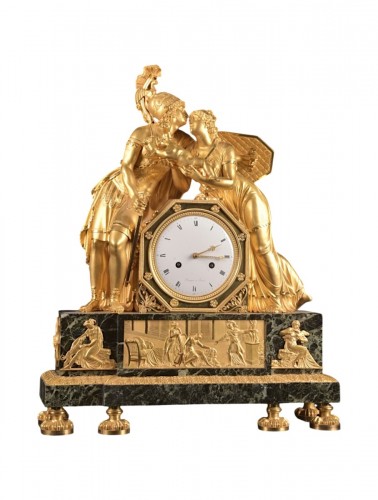
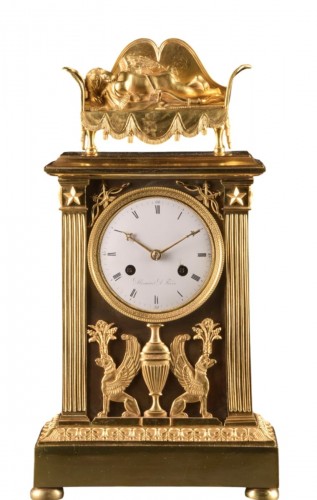
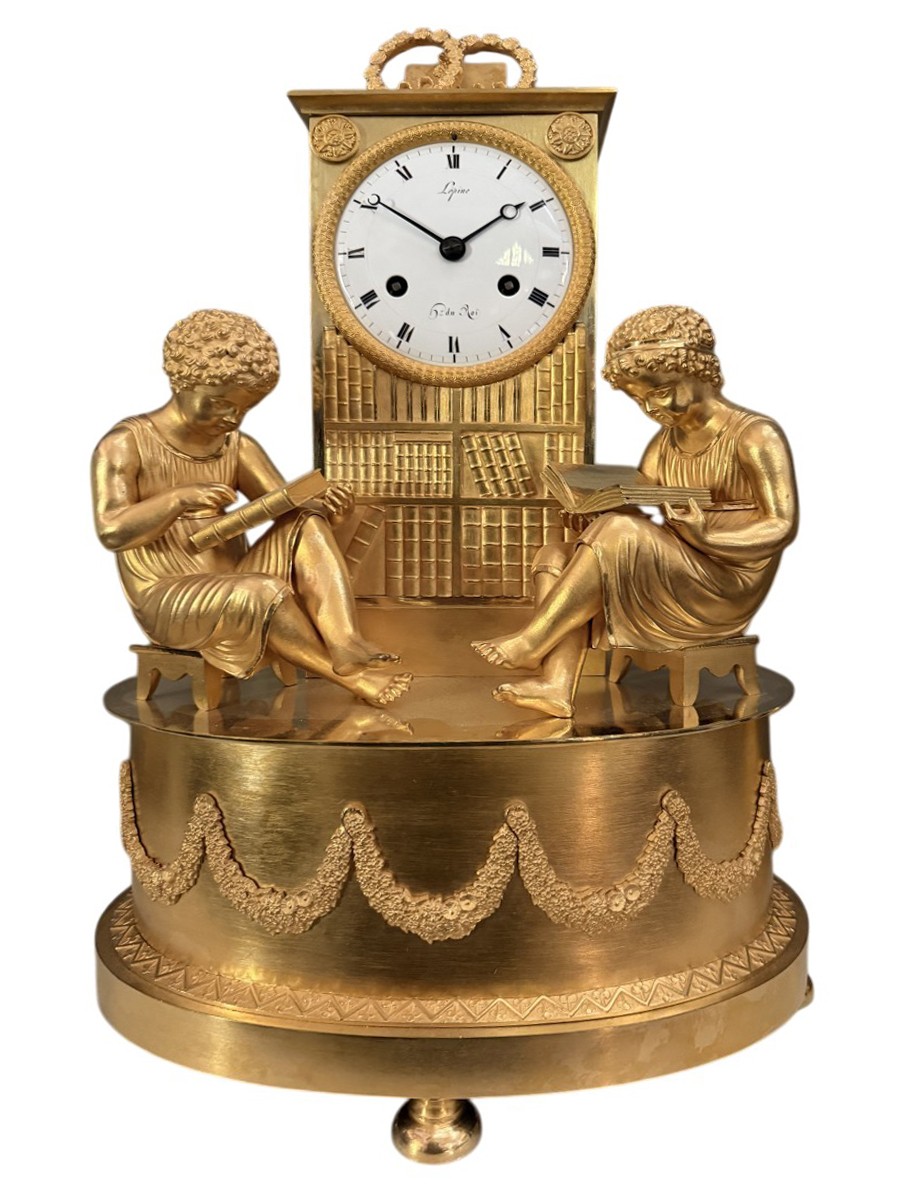
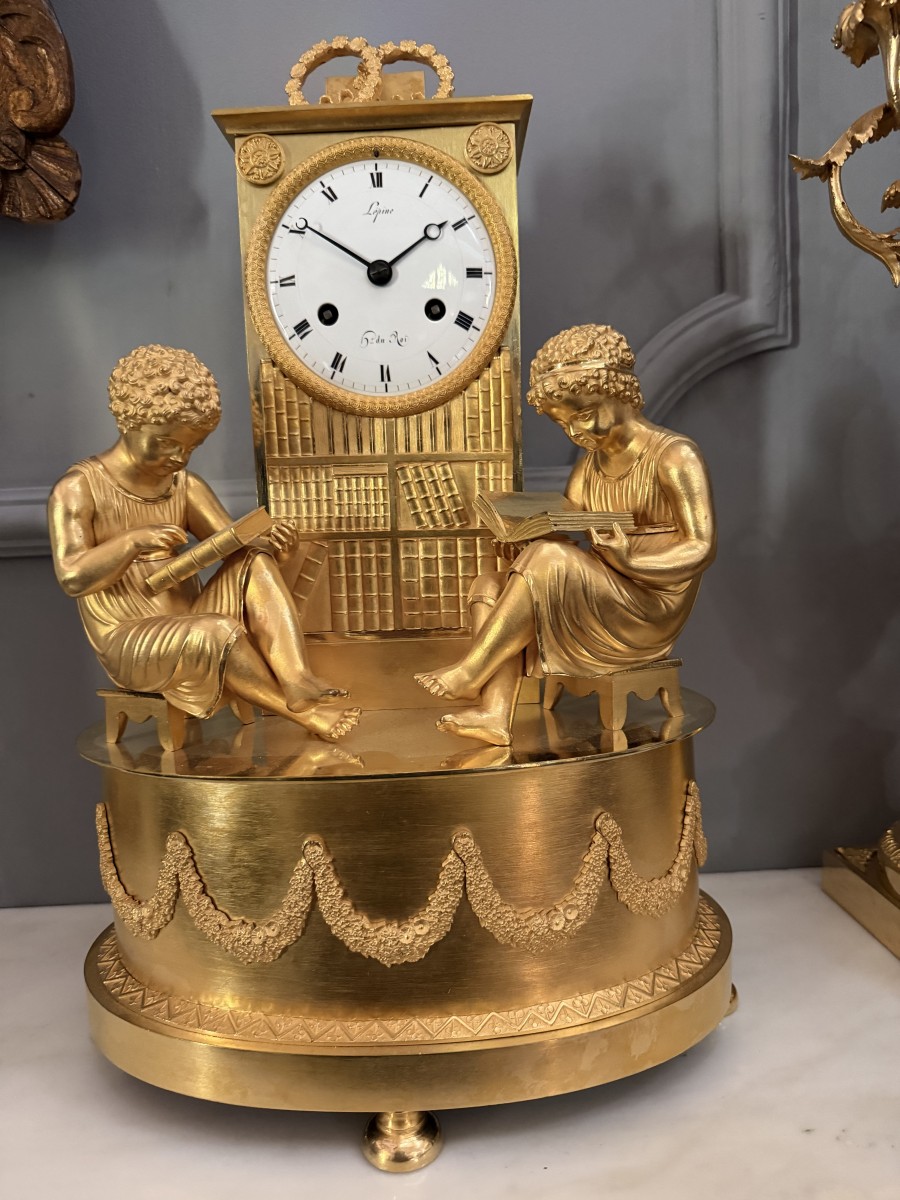
A fine French Empire ormolu mantel clock (pendule de bibliothèque aux liseurs), the white enamel dial signed Lépine / h'r du Roi.
Paris, circa 1800–1810.
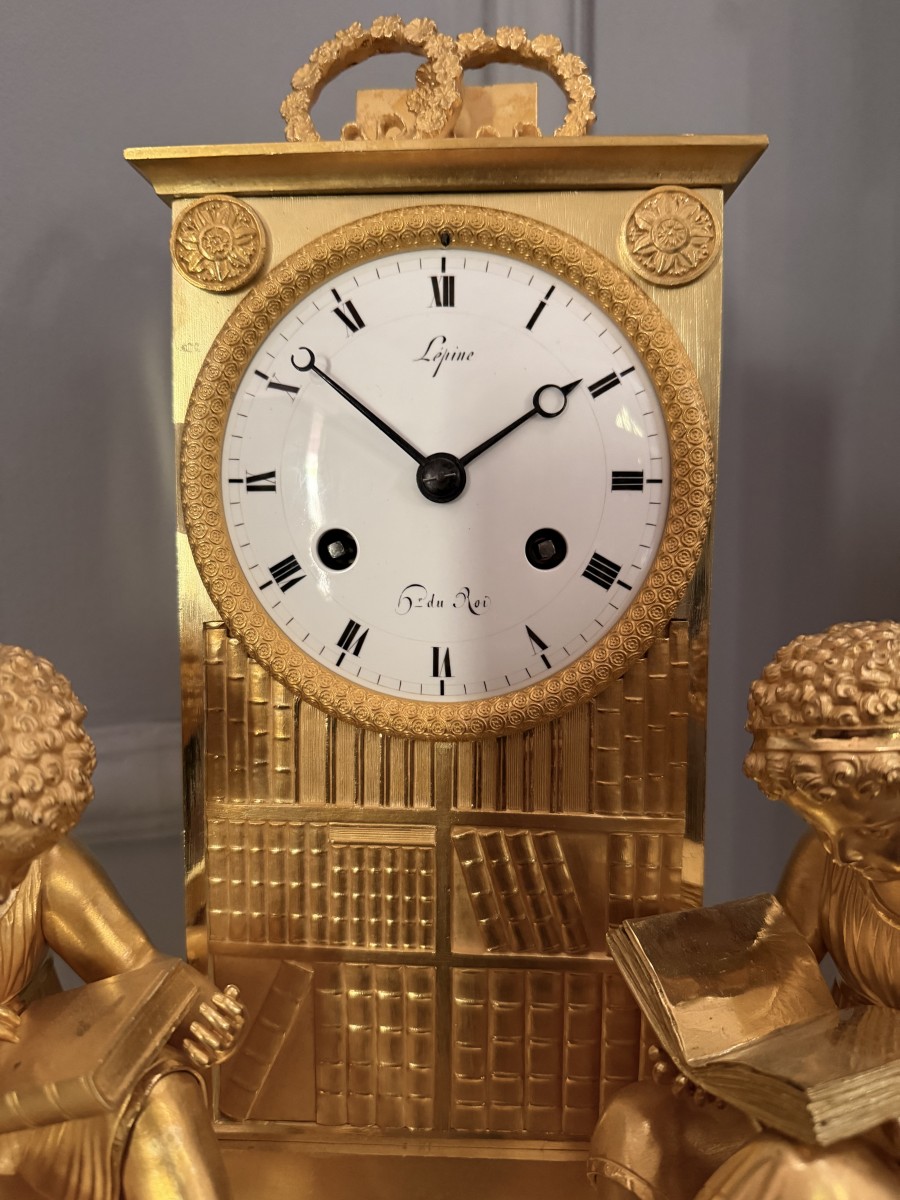
The rectangular bookcase-form case in finely chased fire-gilt bronze, the face cast with three tiers of book spines in full relief, set within a beaded bezel and surmounted by a floral wreath finial above a plain cornice with rosette corner medallions. Flanking the case on a raised gilt bronze platform, two finely cast and chased seated figures in antique dress — a young man to the left, a young woman to the right — both absorbed in reading, seated on pierced Gothic-arch supports. The whole raised on a large cylindrical drum base with brushed gilt finish, applied with swaged festoon ornament in matted bronze, the foot with engraved chevron border, on three ball feet.
The white enamel dial with Roman chapter ring and fine minute track, signed Lépine above and h'r du Roi below centre, within a beaded and engine-turned gilt bronze bezel. Two-train movement with silk thread suspension, striking the hours and half-hours on a bell.
Height 44 cm, width 29 cm, depth 19 cm.
The celebrated Lépine firm was founded by Jean-Antoine I Lépine (1720–1814), Horloger du Roi to Louis XV and Louis XVI and inventor of the calibre Lépine. The firm passed in 1784 to his son-in-law Pierre-Claude Raguet-Lépine (1753–1810), who maintained the prestigious Lépine Horloger du Roi signature throughout his directorship. At the date of this clock the workshop remained one of the most distinguished in Paris, supplying movements to the Imperial court and the foremost bronziers of the day.
Literature: P. Kjellberg, Encyclopédie de la pendule française du Moyen Âge au XXe siècle, Paris, 1997; Tardy, La Pendule française, des origines à nos jours, Paris, 1964–67; J.-D. Augarde, Les Ouvriers du Temps, Geneva, 1996.