Offered by Antichità San Felice
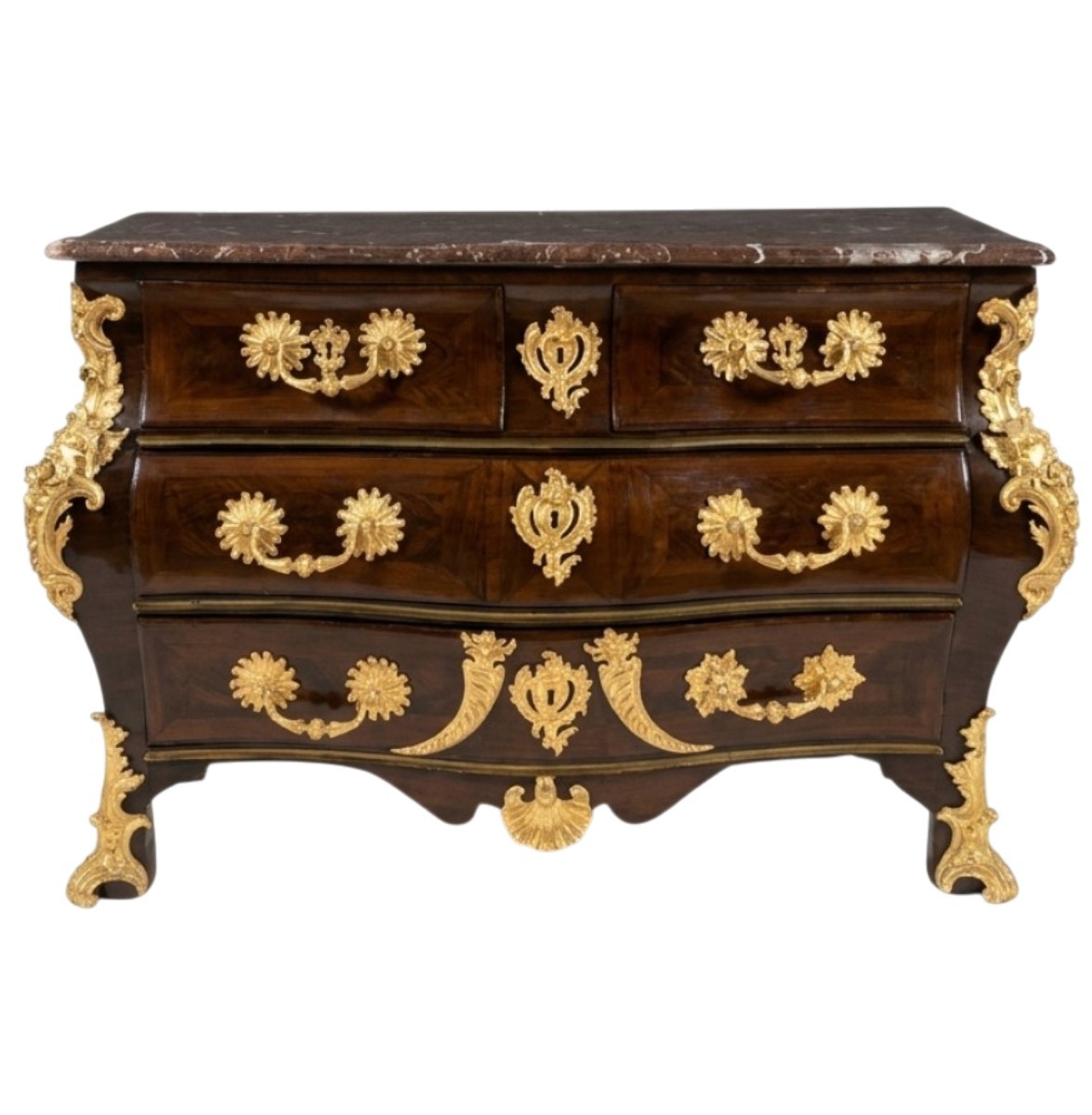
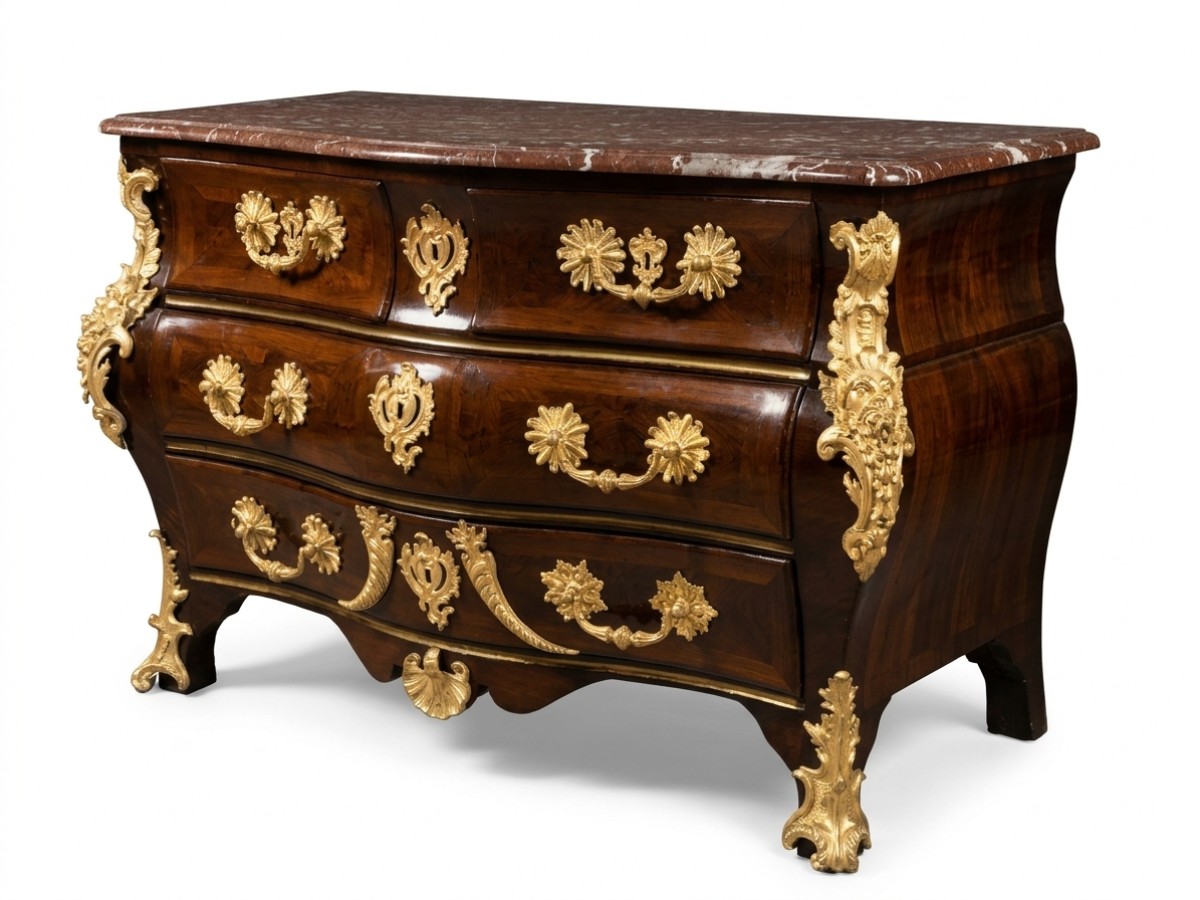
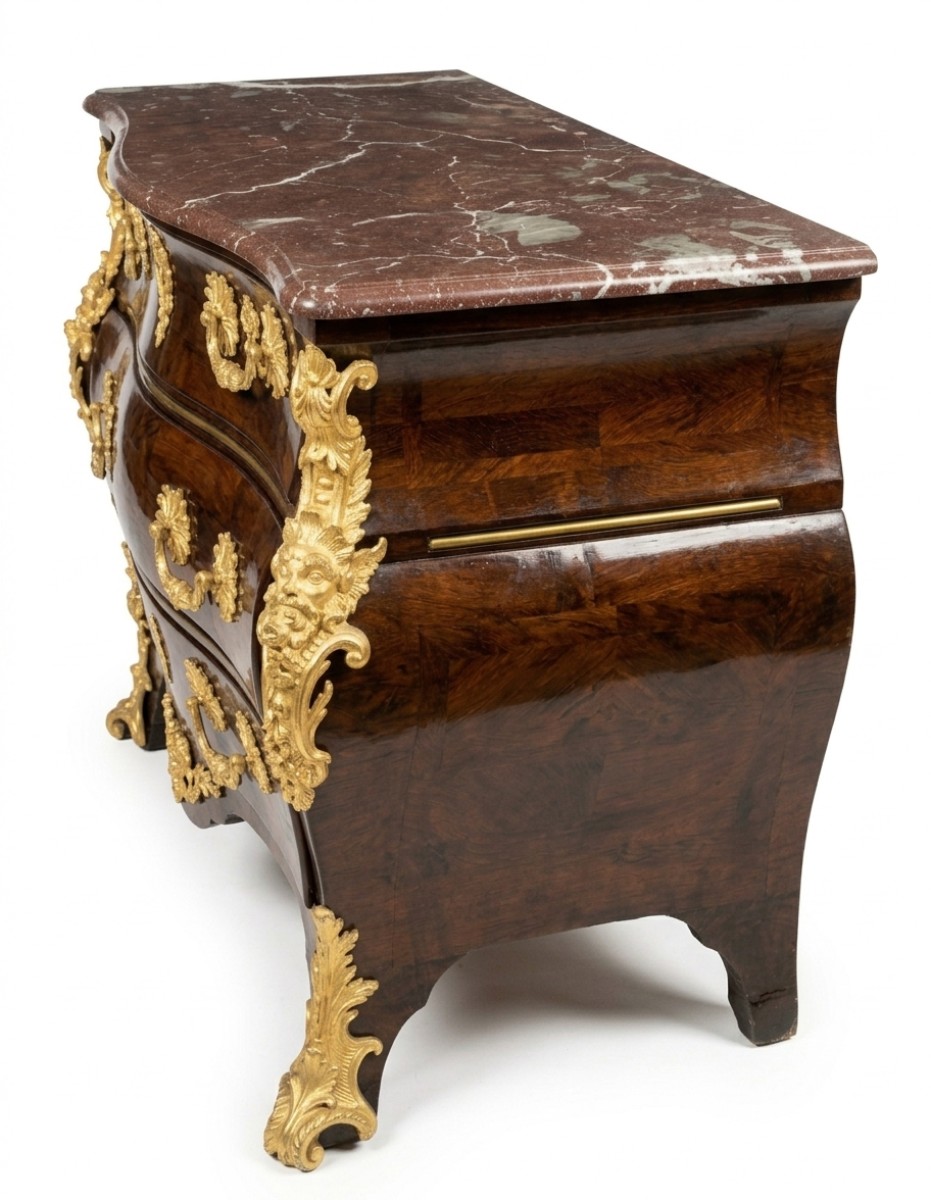
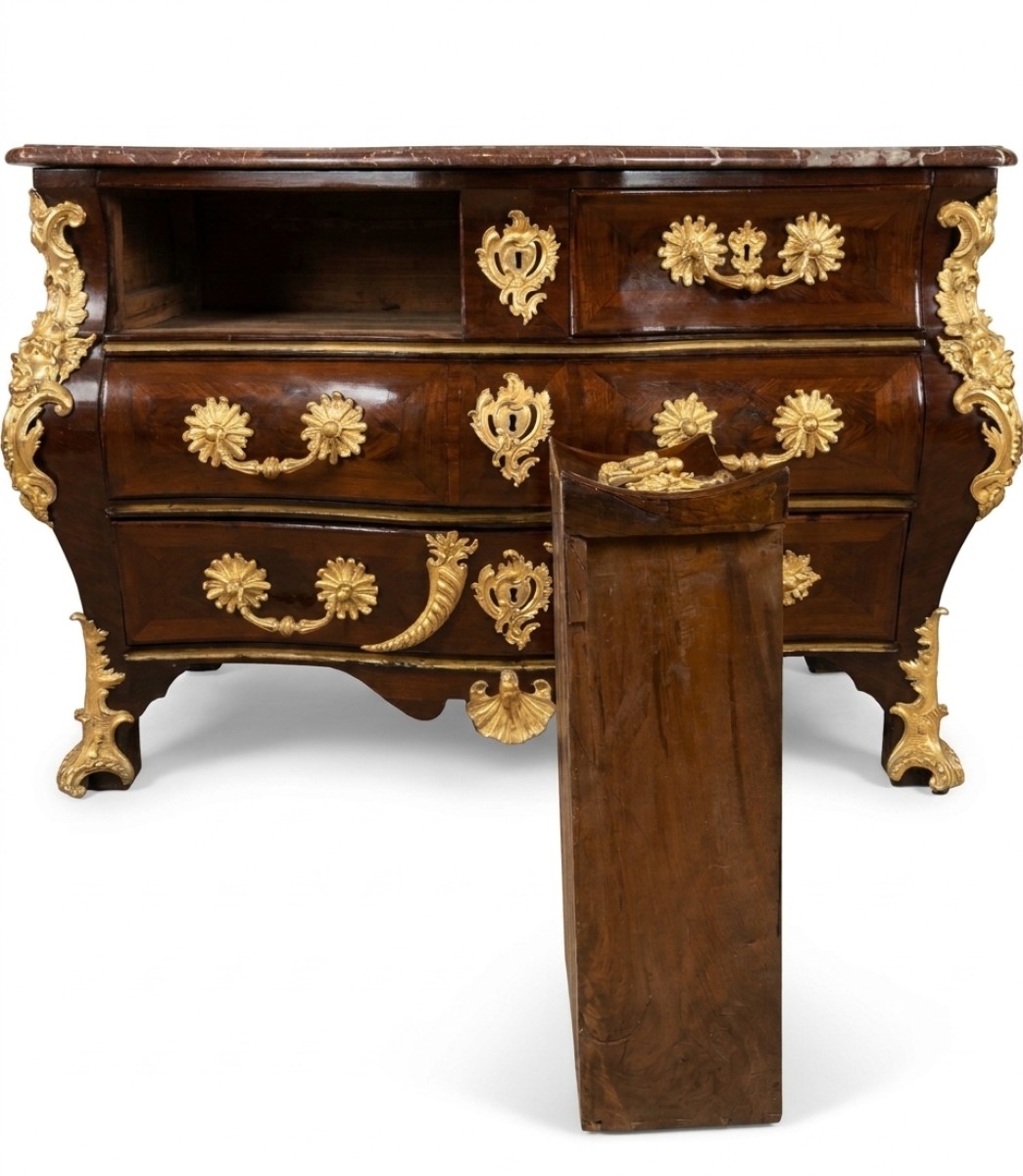
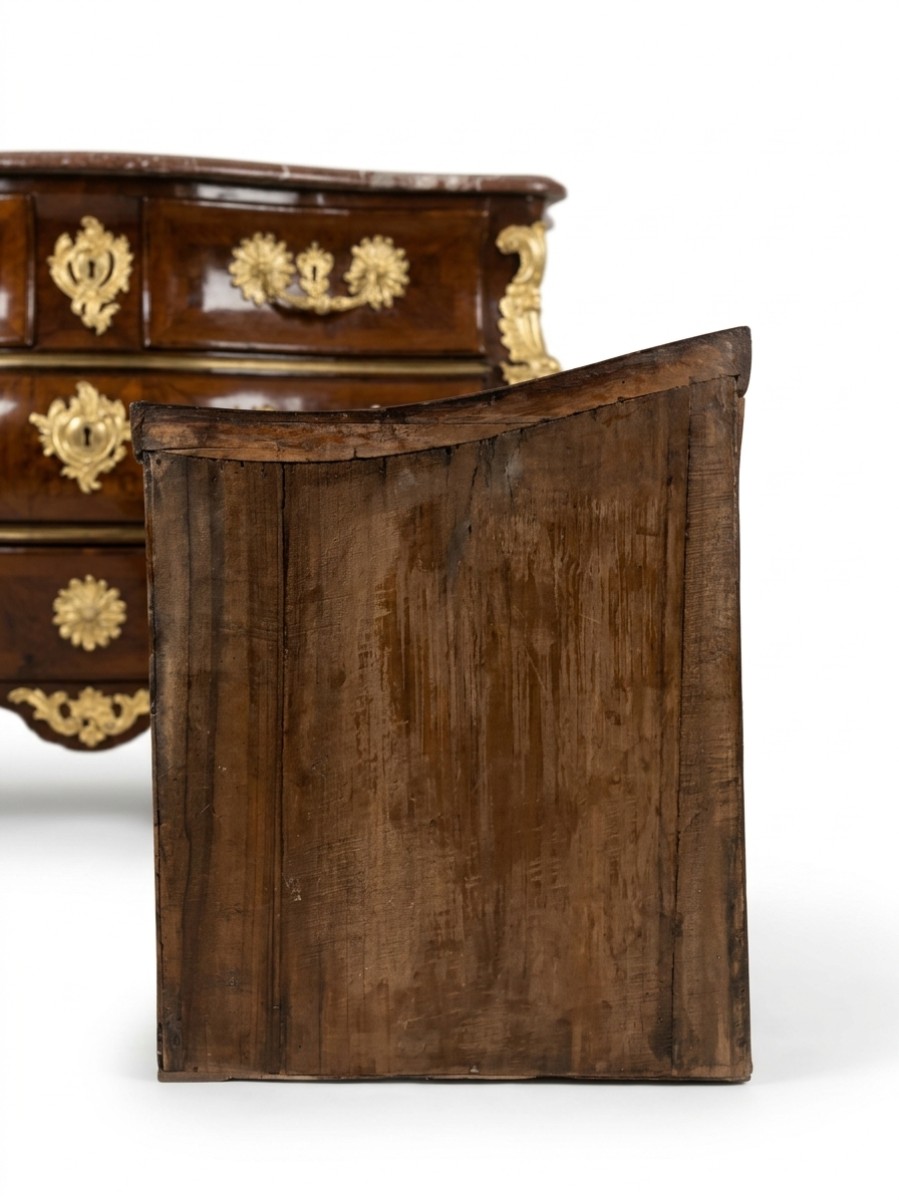

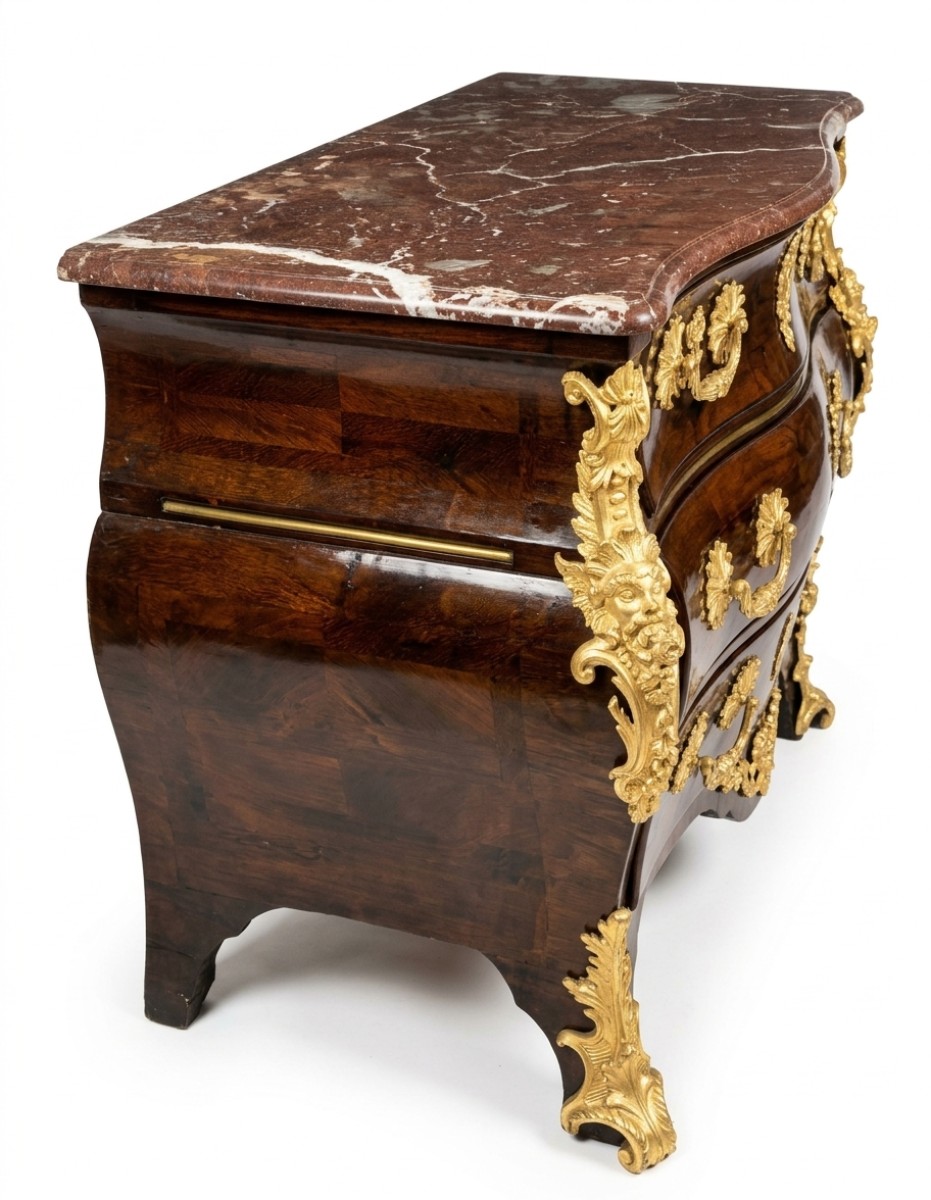
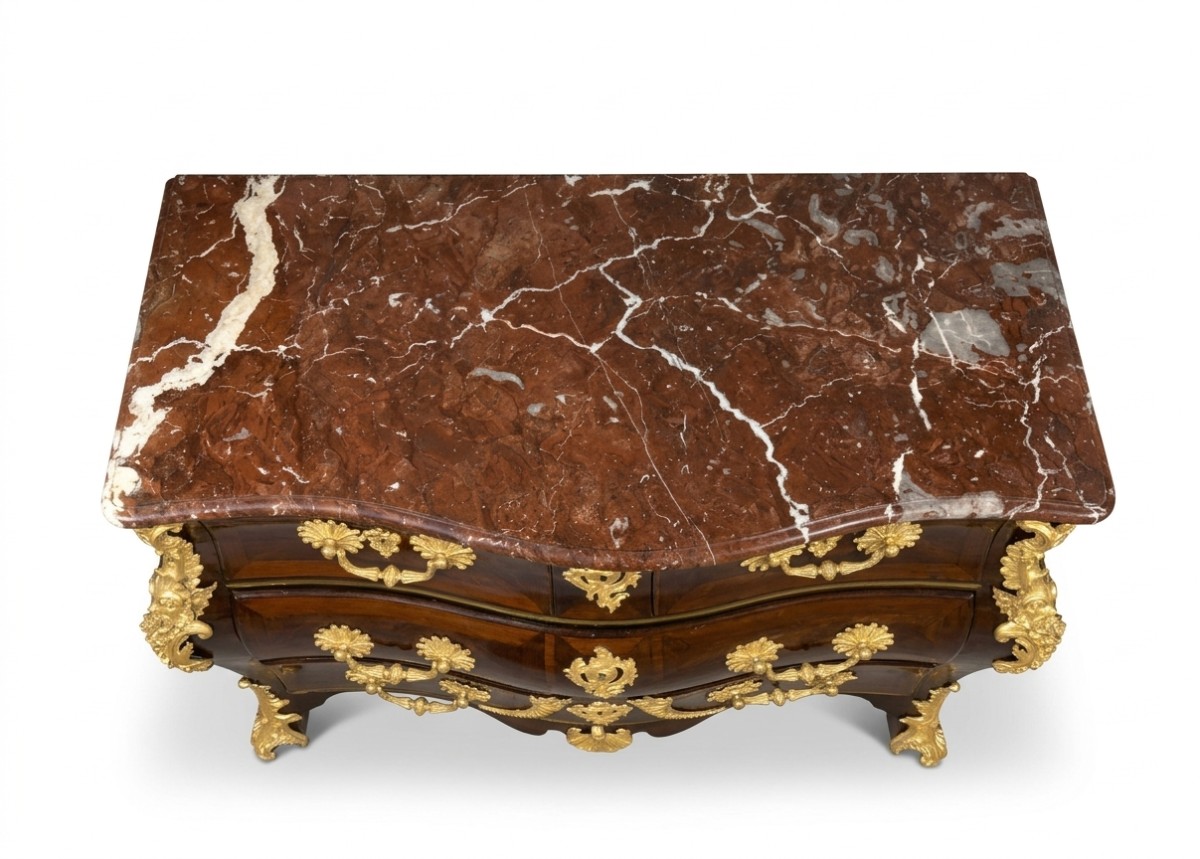
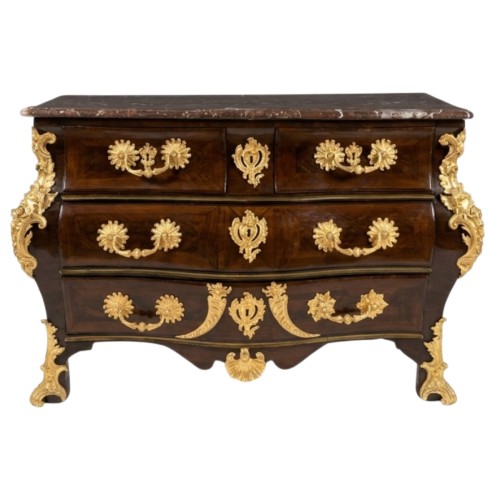
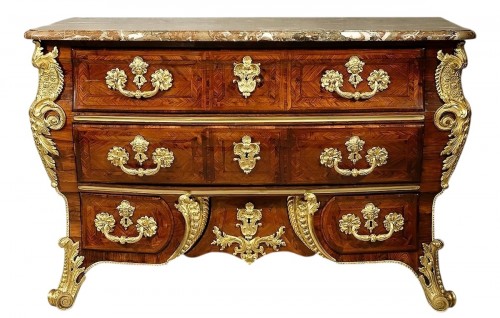
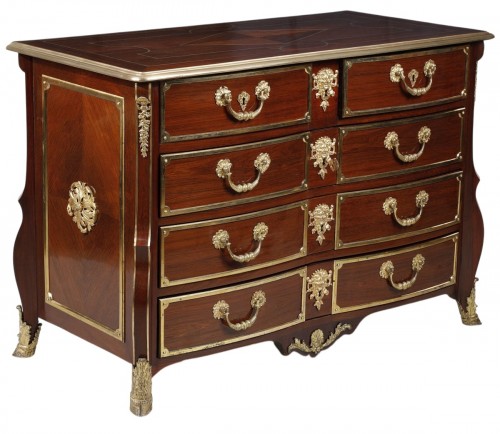
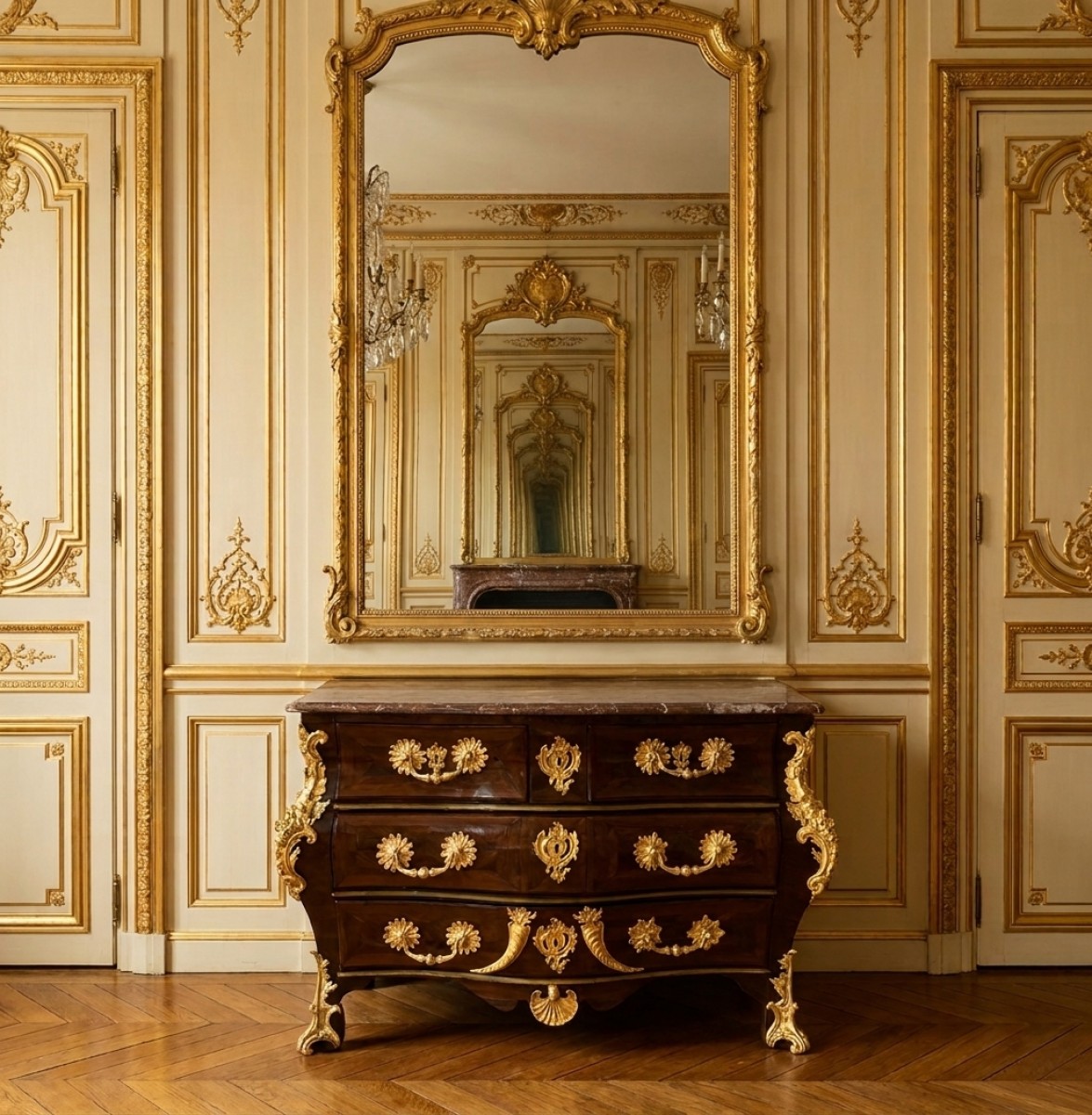
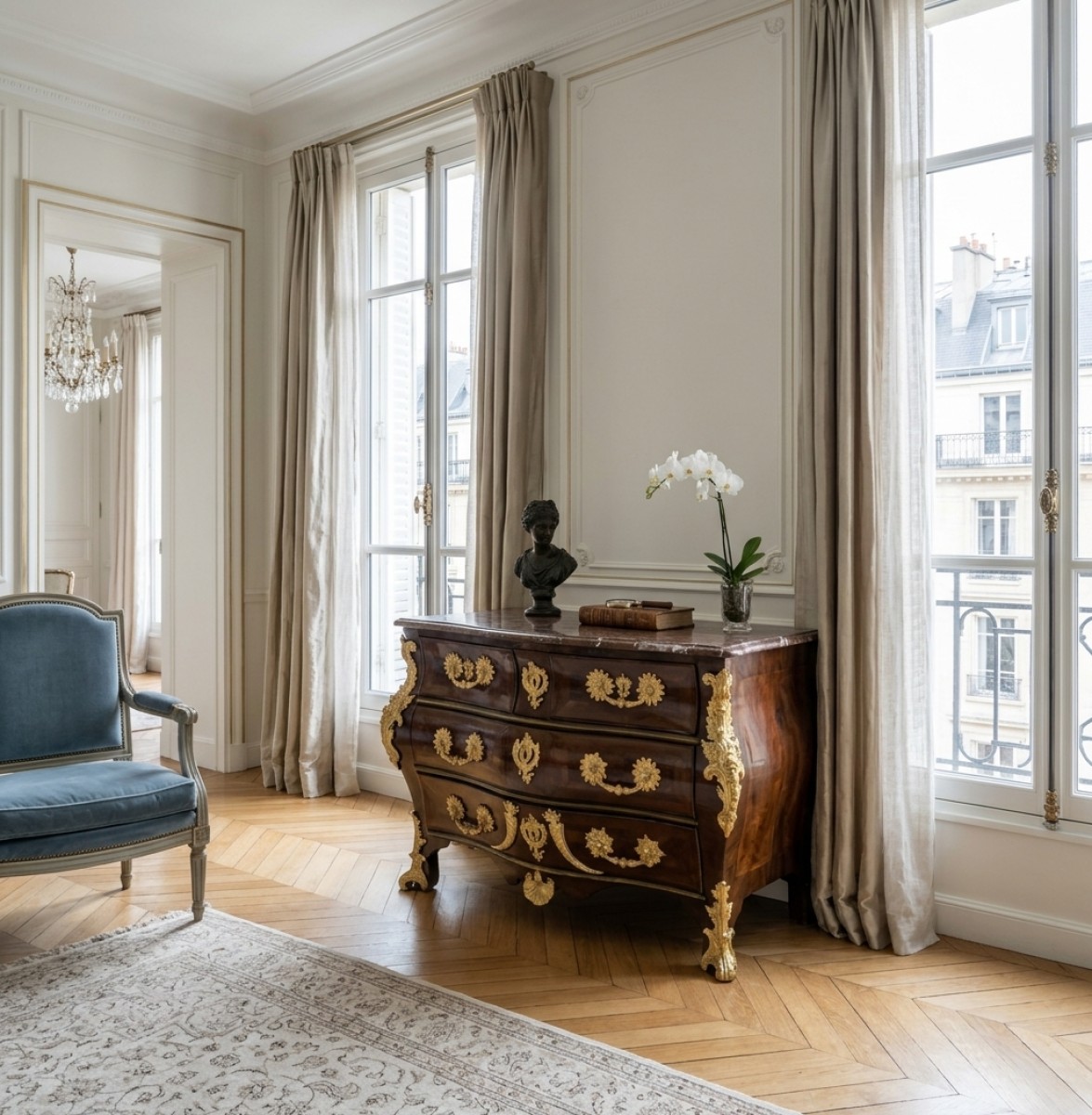
A rare "en tombeau" (tomb-shaped) commode, featuring four drawers arranged across three tiers.
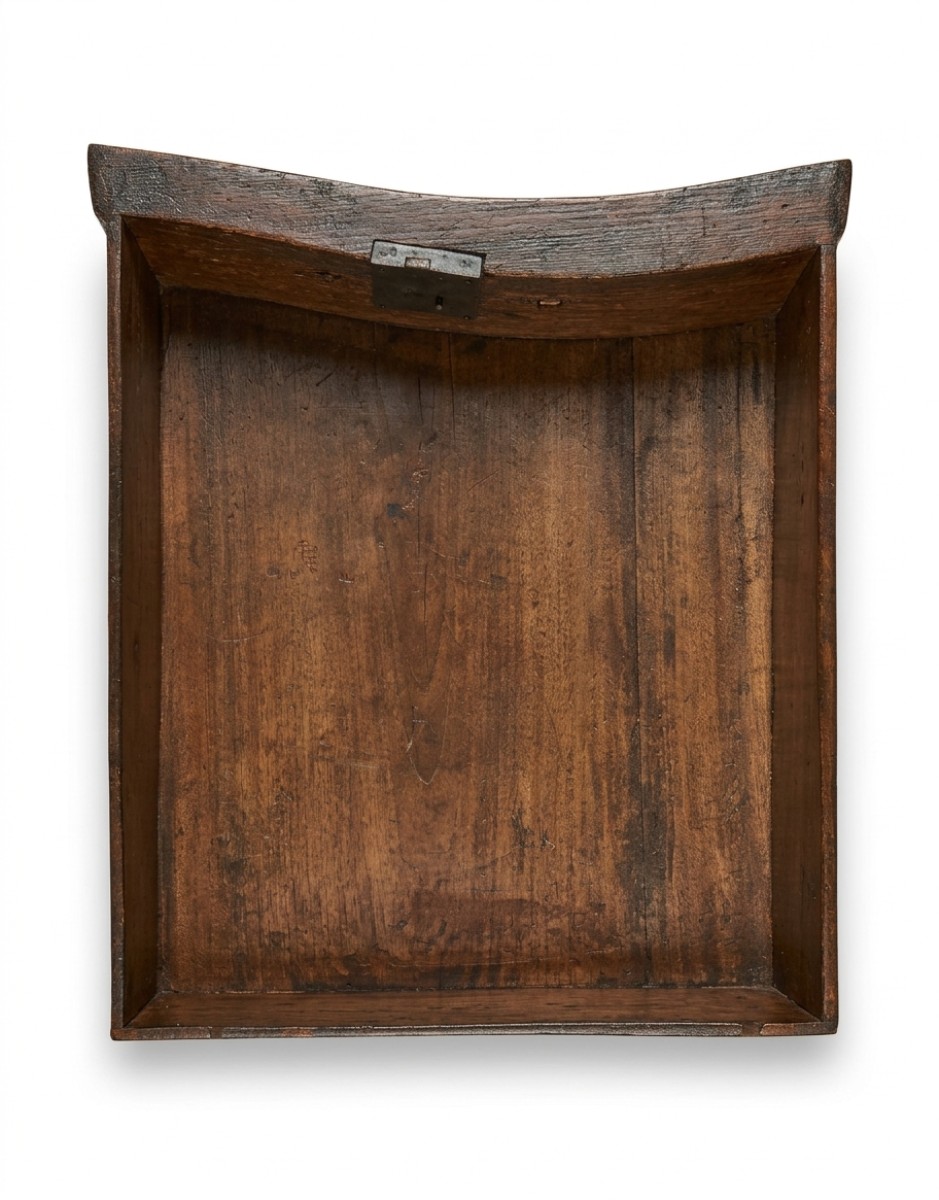
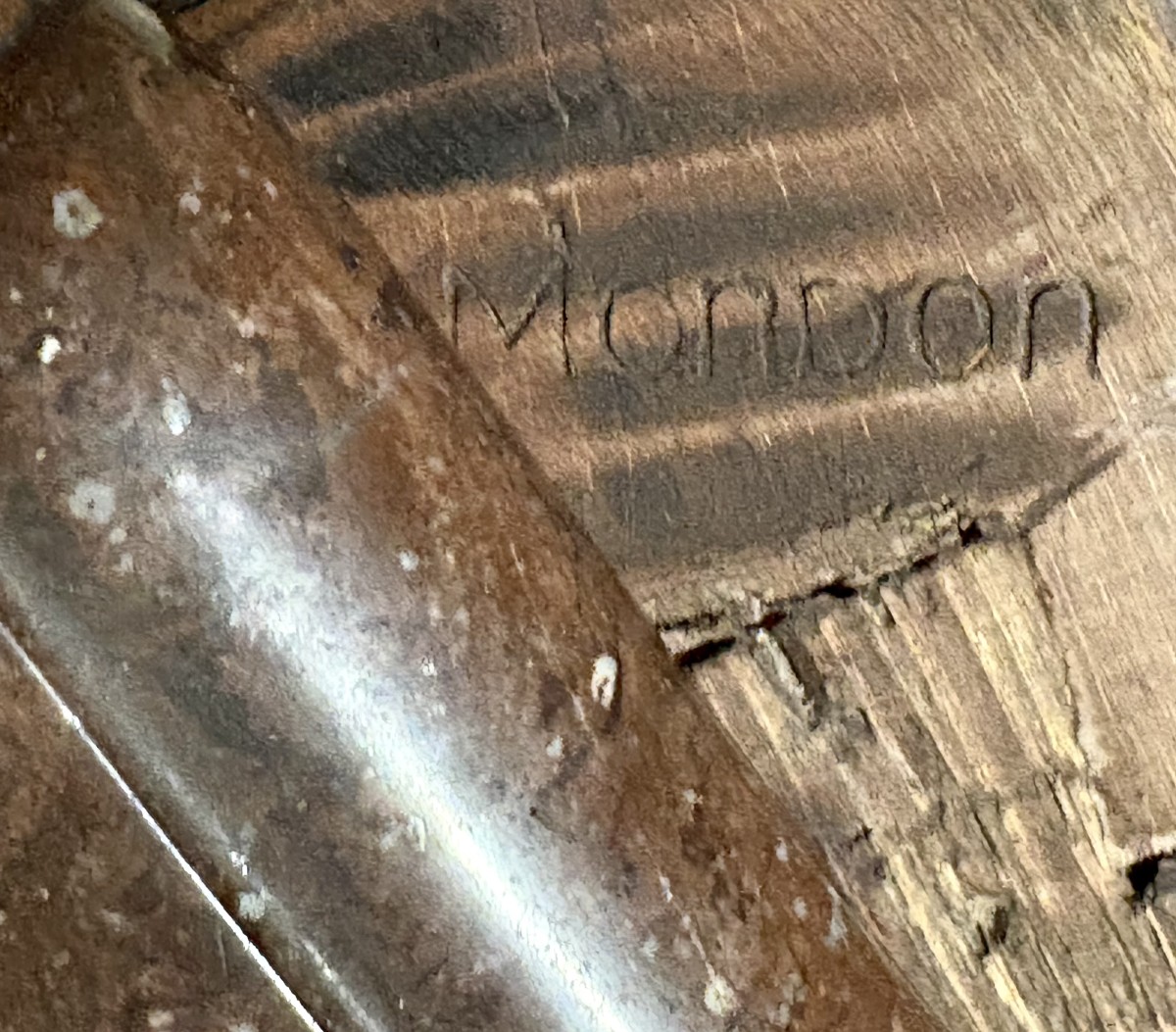
Stamped "MONDON" on the upright, identifying the maker as François Mondon (1694–1770).
Regency/early Louis XV period, circa 1730–1740.
Paris, France.
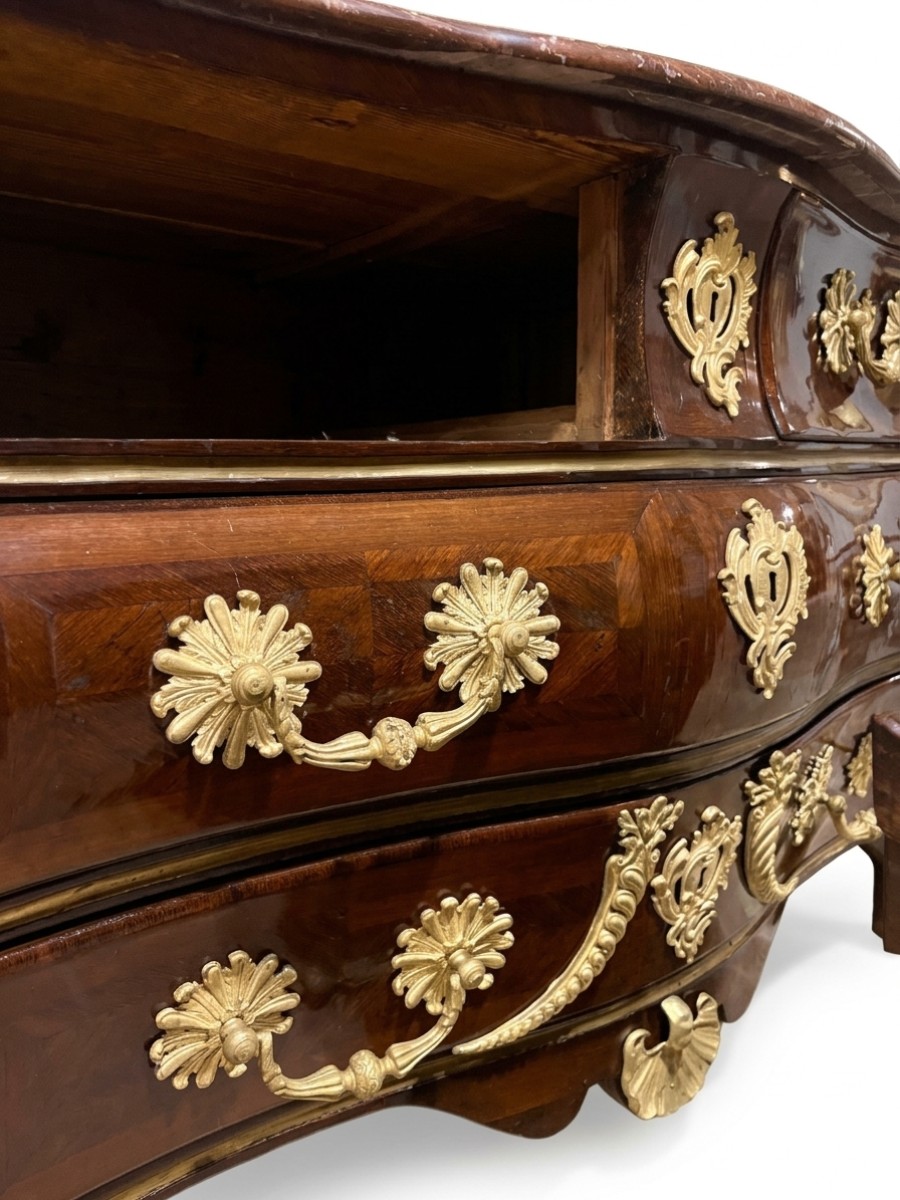
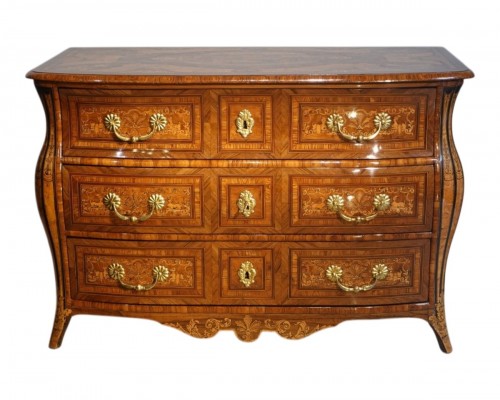
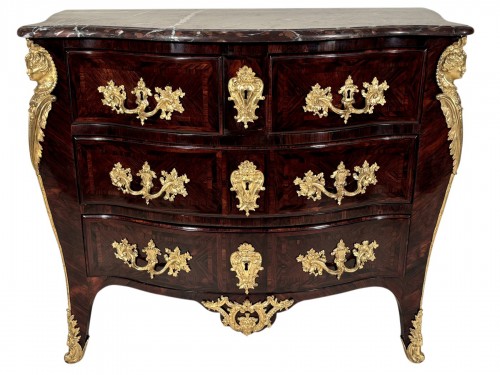
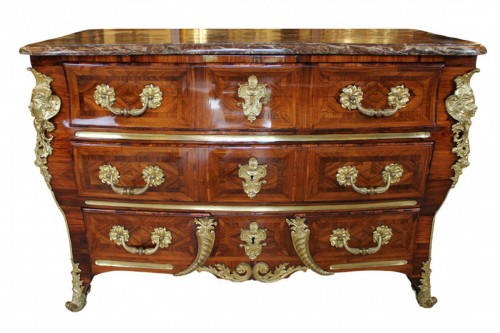
The front is organized into three tiers of drawers, following the classic geometric configuration of the era: two side-by-side drawers in the top row, and two large, full-width drawers in the middle and bottom rows (totaling four drawers). The piece exhibits a bombé (curved) silhouette, characterized by a pronounced curvature—or "galbe"—on both the front and the sides. The drawers are separated by wooden cross-rails, embellished with moldings and inlaid fluted brass strips.
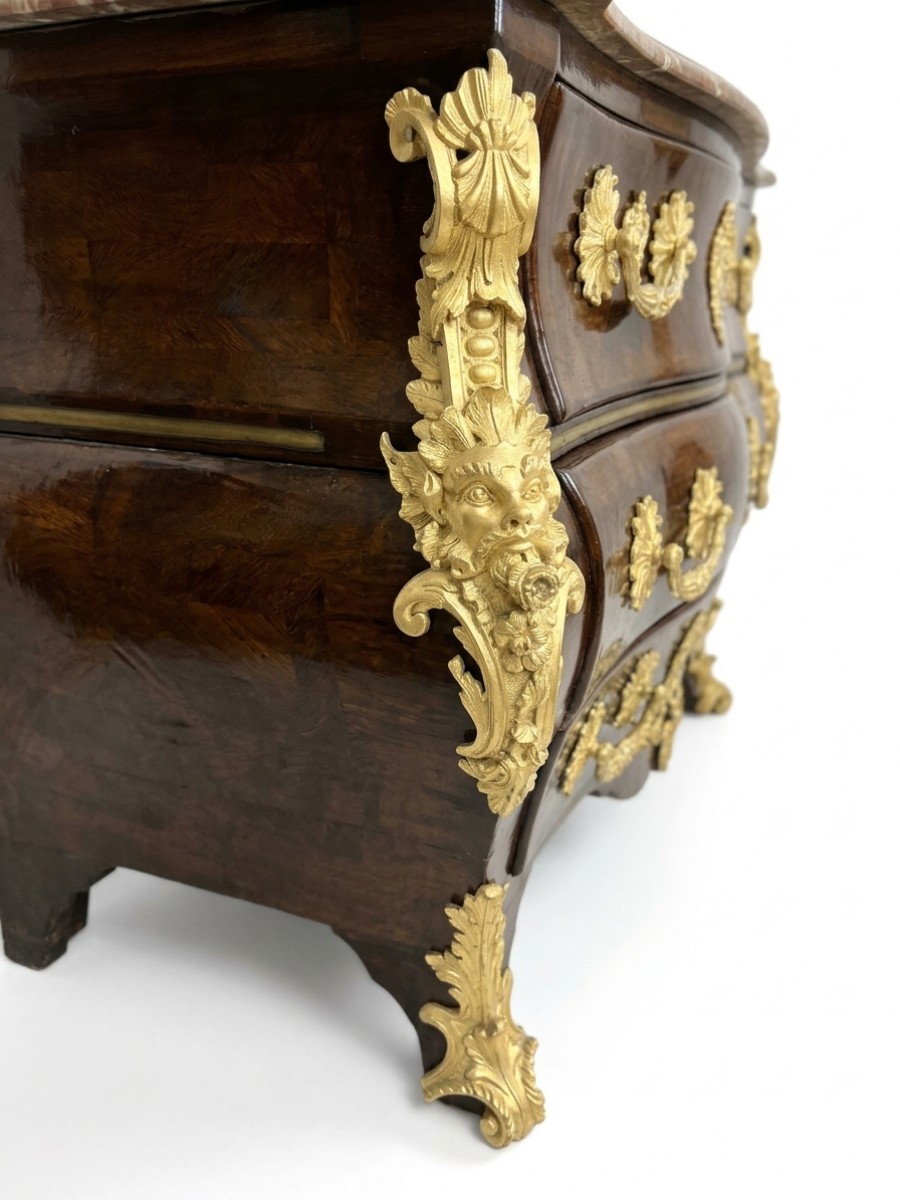
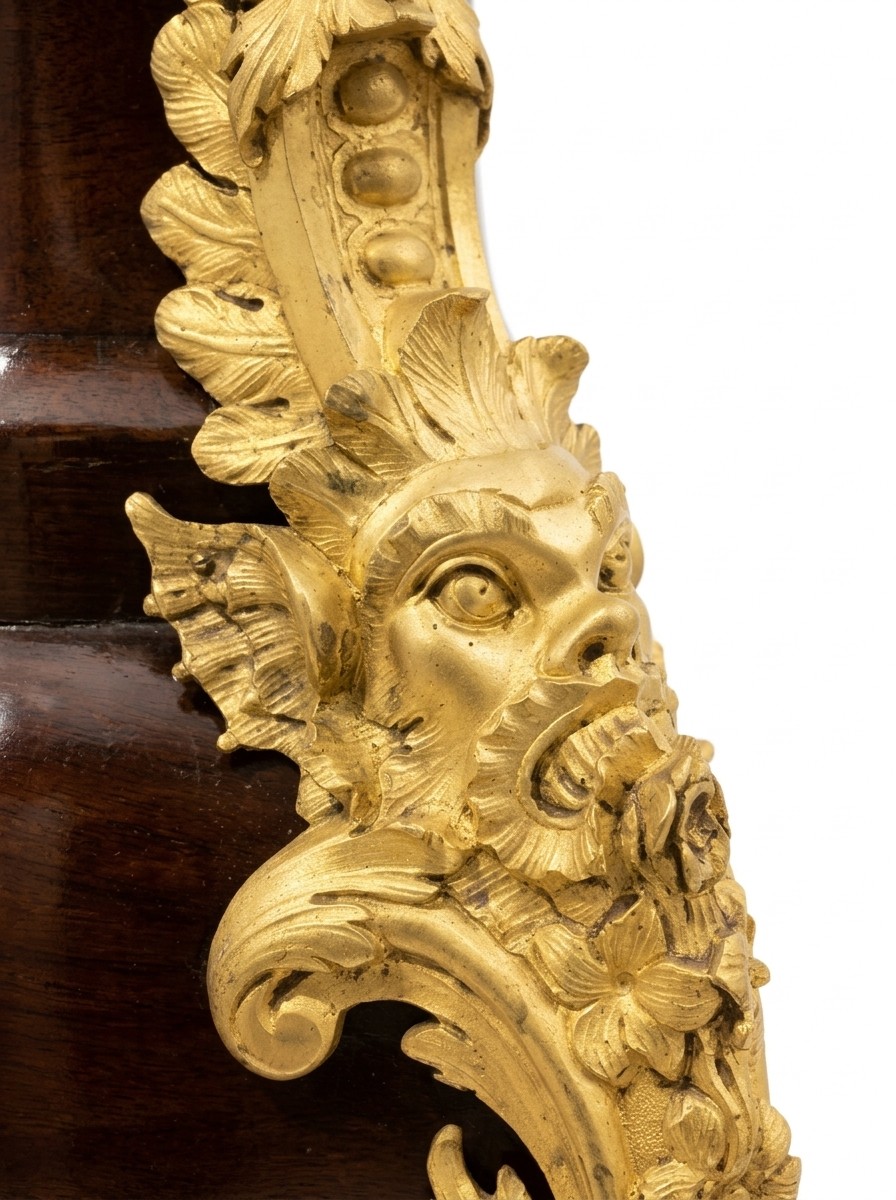
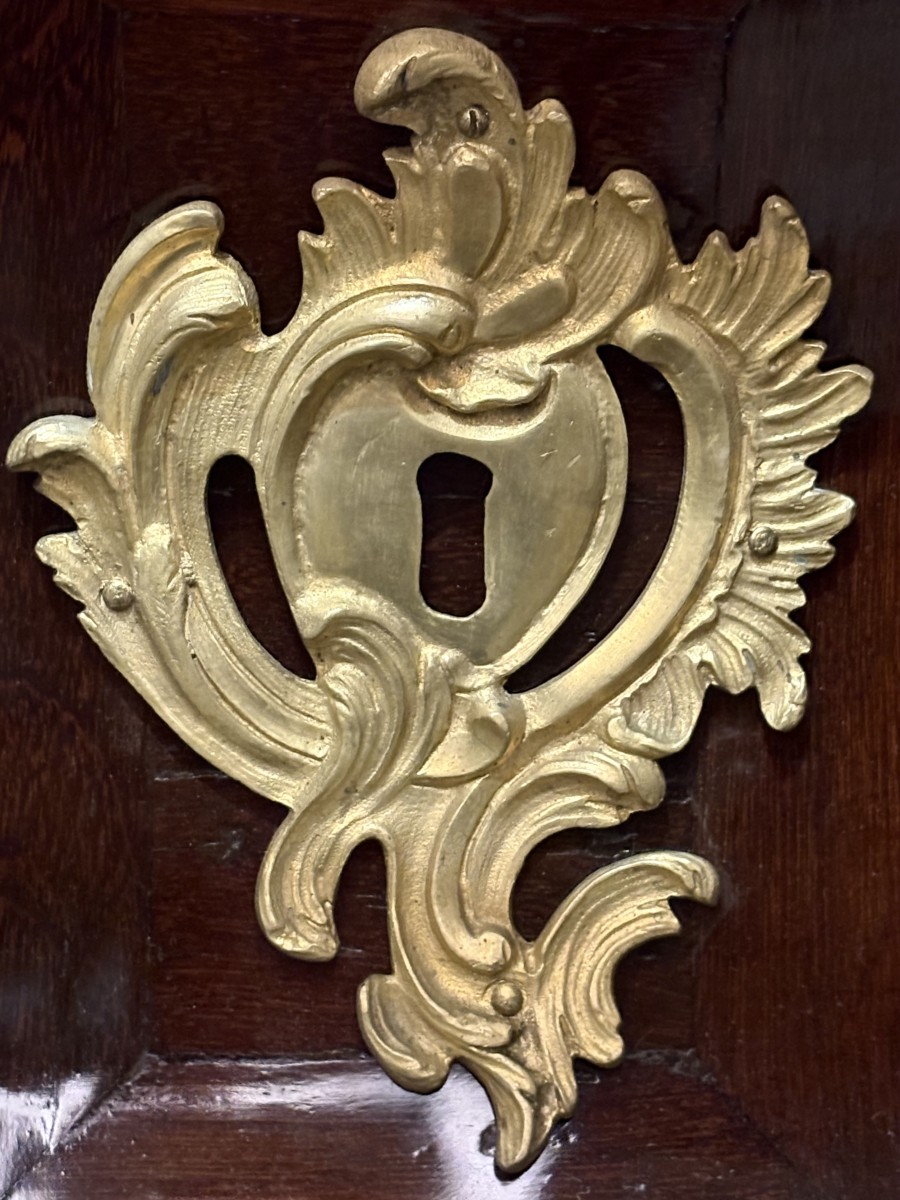
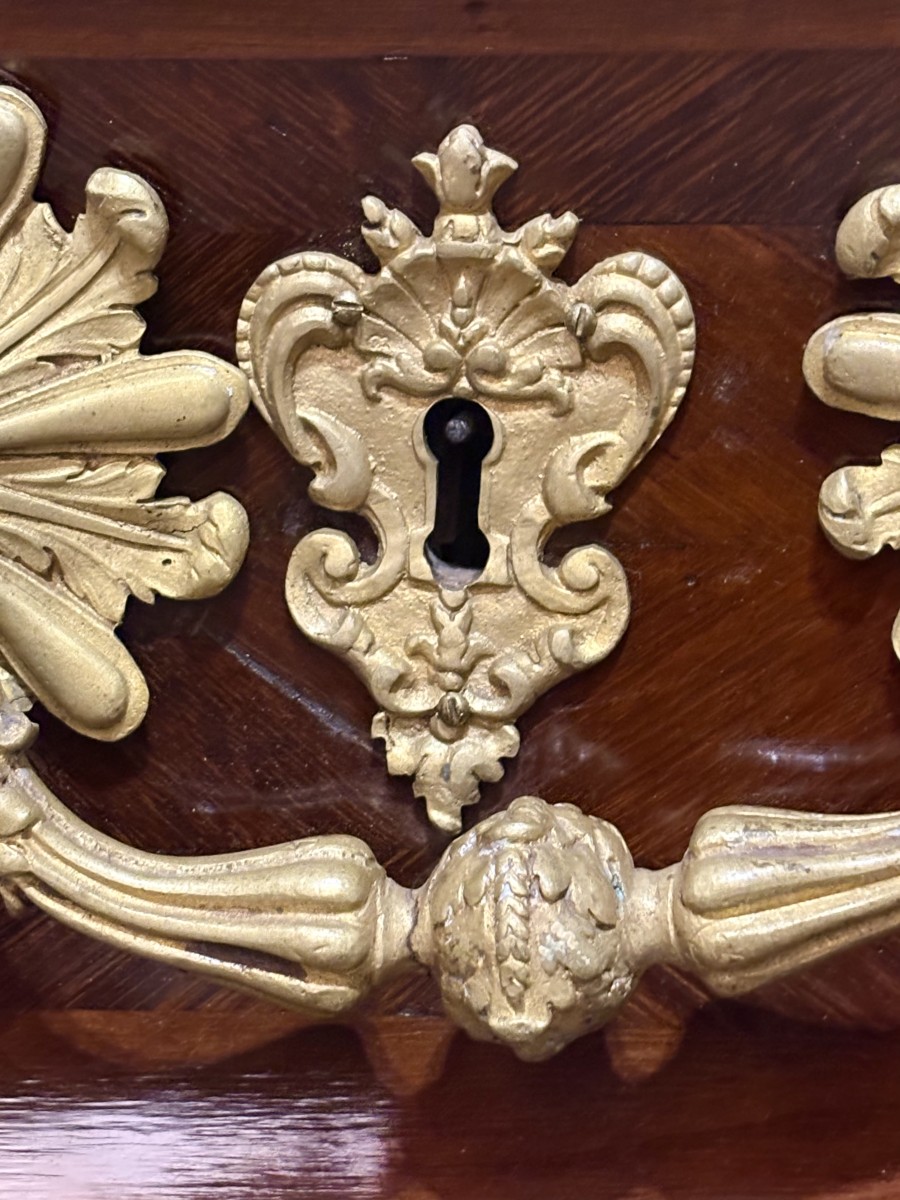
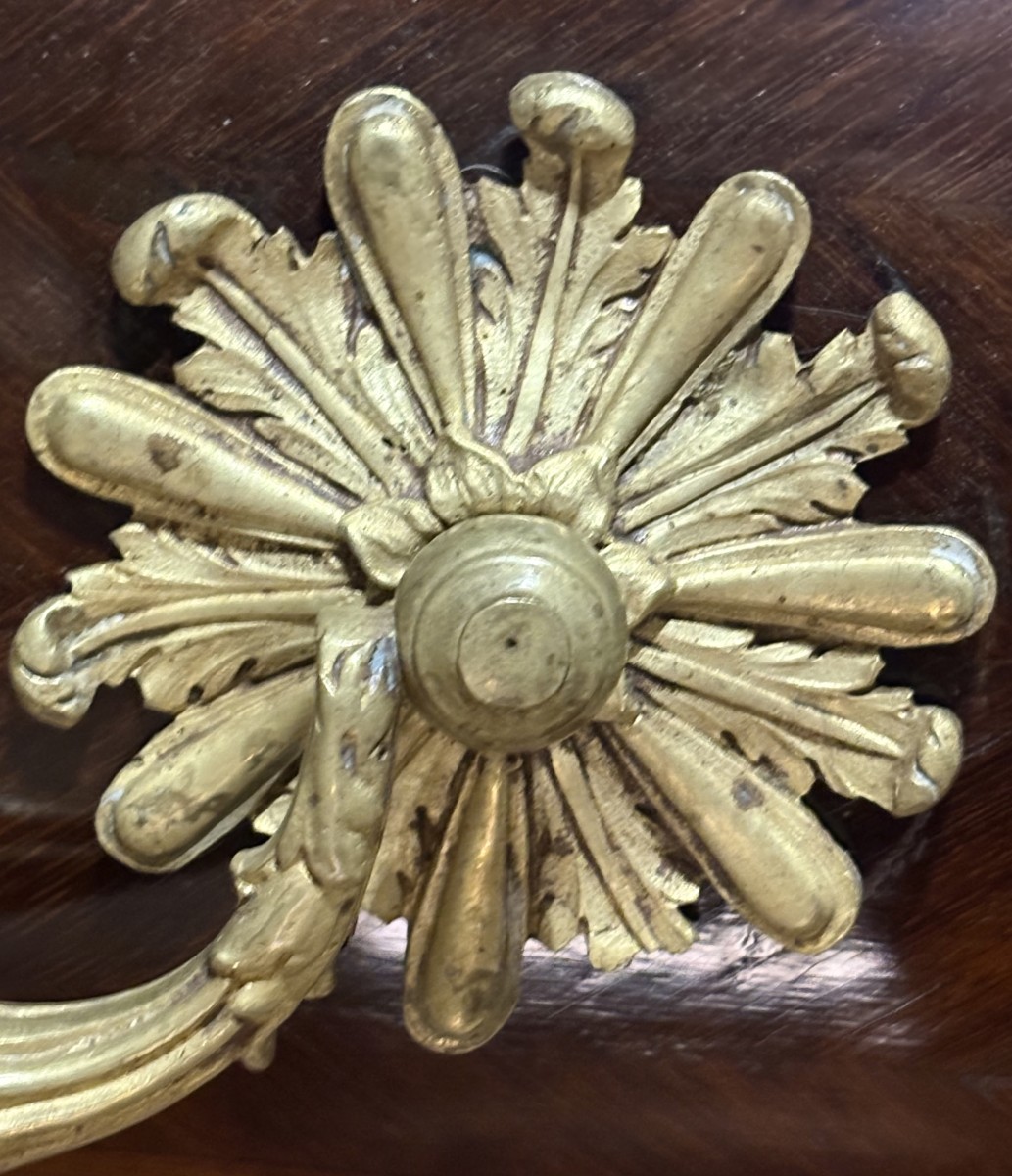
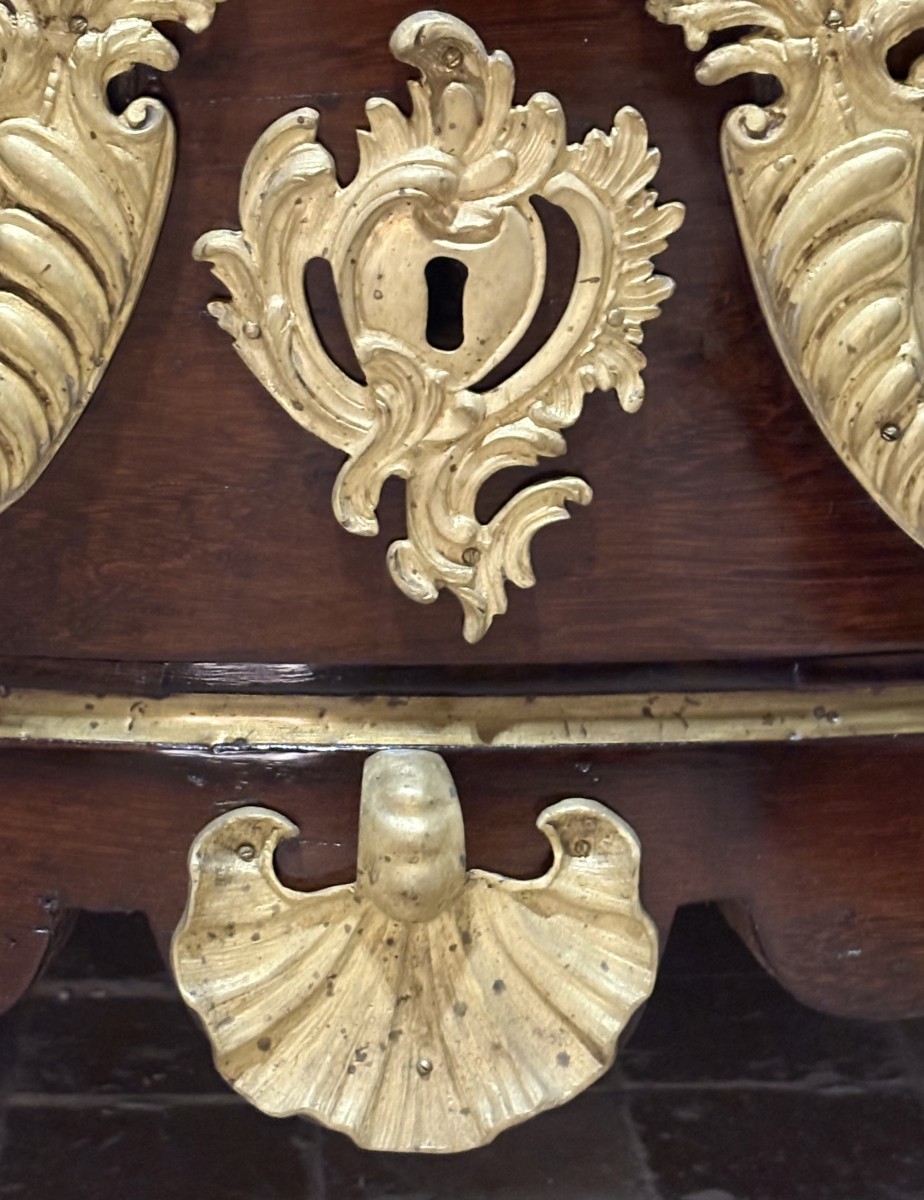
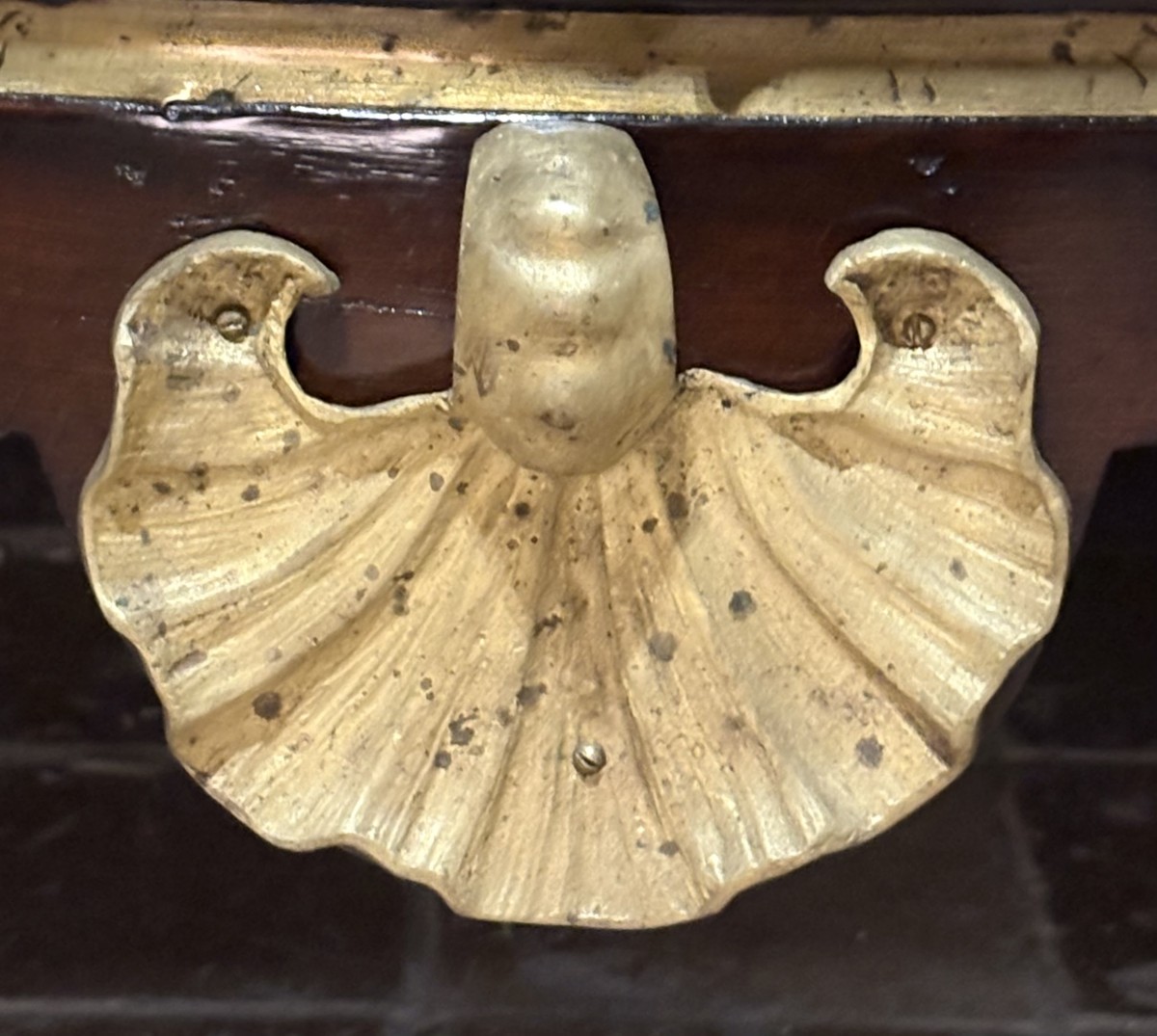
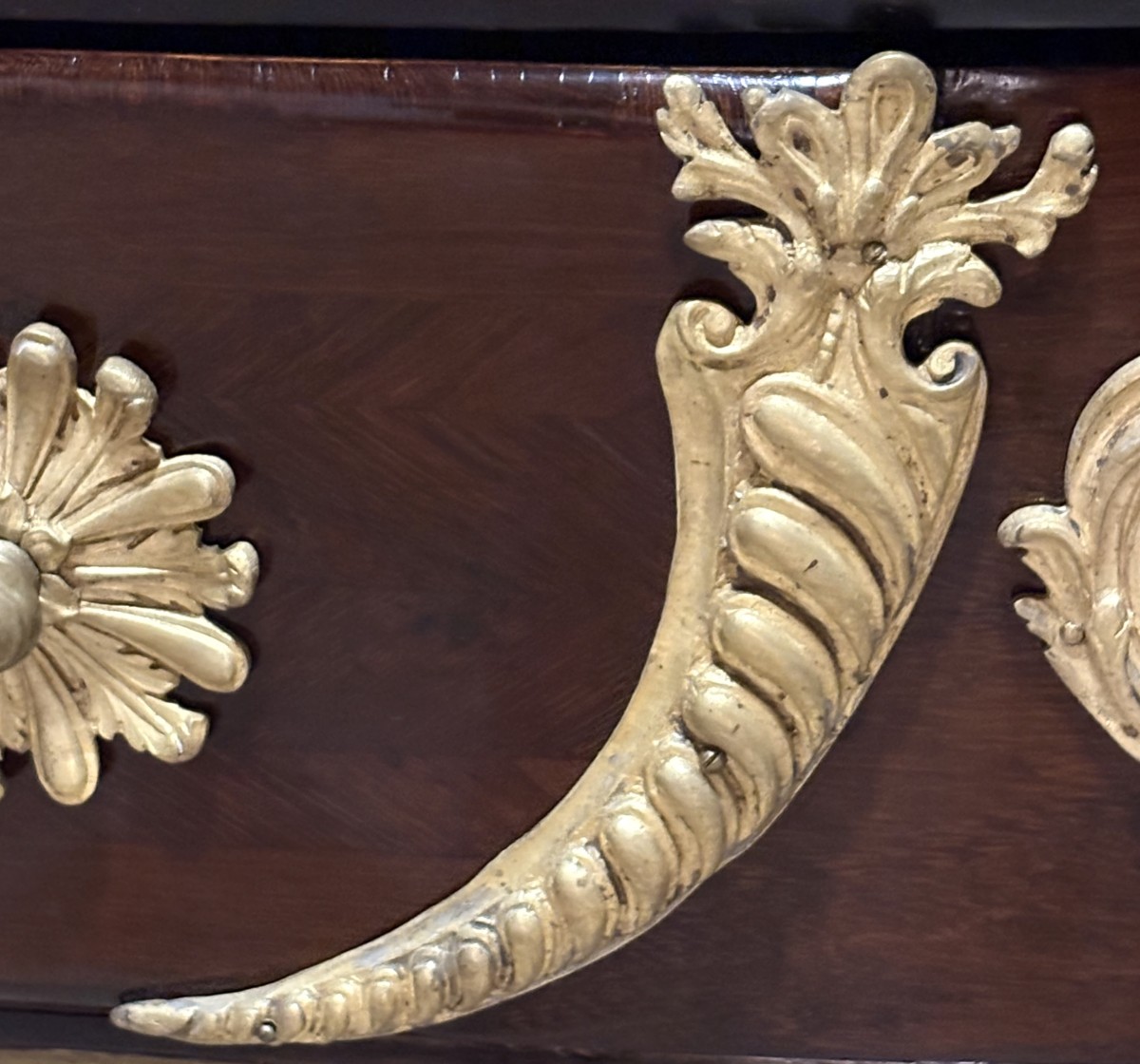
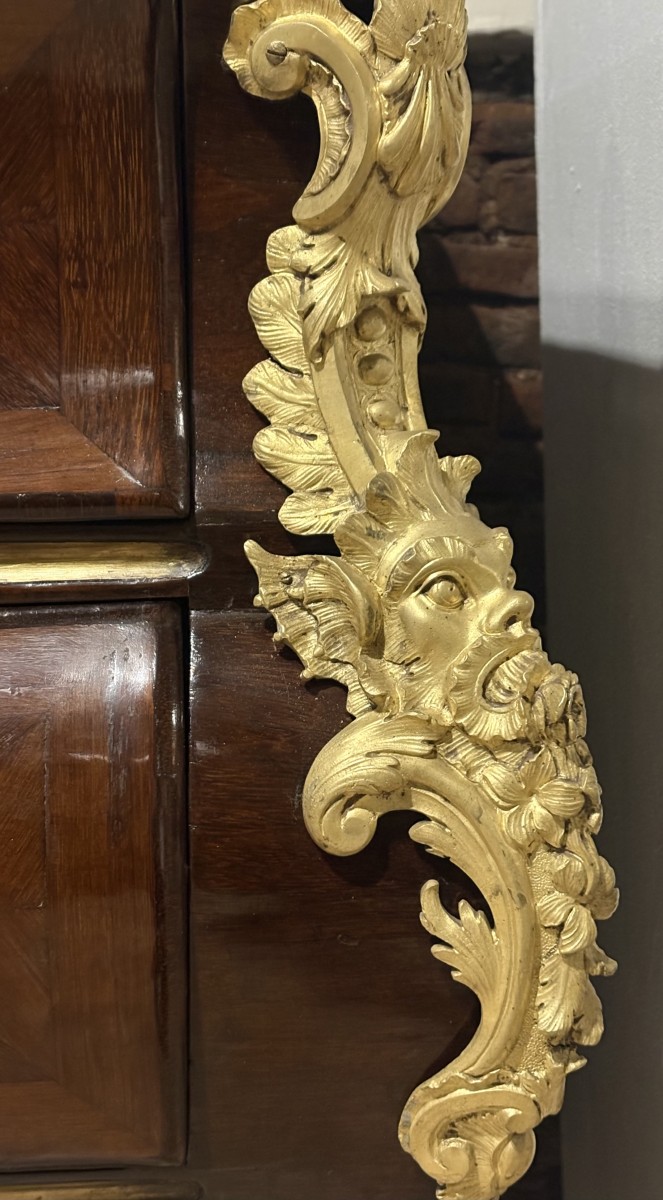
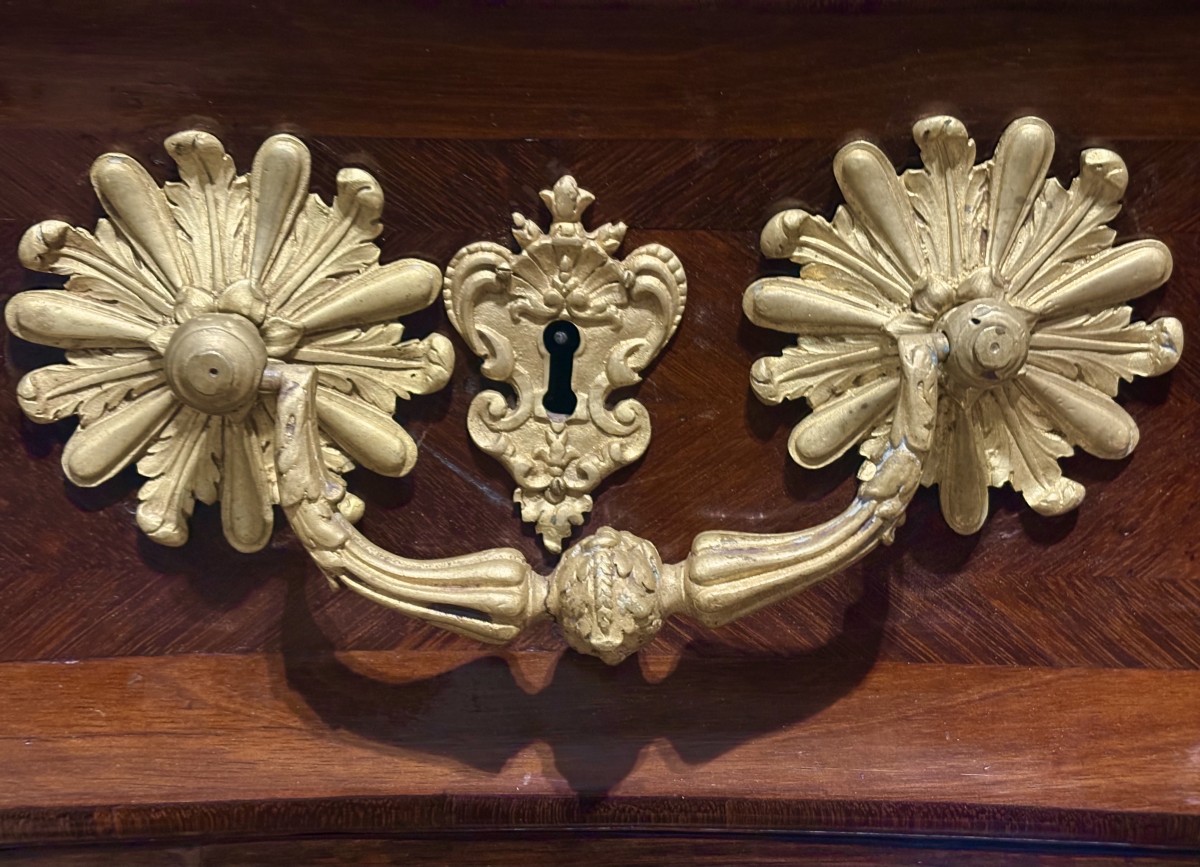
The veneer consists primarily of Indian violetwood and rosewood, arranged in a chevron pattern with opposing grain directions ("frisage en feuilles"). This arrangement creates symmetrical geometric panels that highlight the natural chromatic nuances and contrasts of the wood grain, further defined by dark stringing. The commode is adorned with rich, exuberant gilt-bronze mounts—a hallmark of Mondon’s Parisian workshop—including drawer pulls shaped as symmetrical, foliate *rocaille* scrolls, paired with large, central, scrollwork-cartouche escutcheons. Impressive bronze mounts grace the front uprights and extend down the curved legs, featuring a continuous motif of acanthus leaves and scrolls, accented by two striking faun heads. The lower rail features, at its center, a large and spectacular stylized shell in gilt bronze, which serves as the decorative closing element for the piece. The legs terminate in gilt-bronze sabots (mounts), fashioned as stylized paws surrounded by foliage. The top consists of a slab of solid "Rouge de France" marble with a serpentine, contoured edge. Its rim is finished with a "crow's beak" (*bec de corbin*) molding that faithfully follows the sinuous, broken profile of the underlying wooden structure.
The commode is in an excellent state of preservation. The bronze ornaments are all authentic; the gilding is original—dating back to the 18th century—and has never been retouched. The marble top is also original and bears evidence of historical restorations.
Dimensions
W cm 130
D cm 60
H cm 88
François Mondon
Master cabinetmaker active in Paris around 1730; born in 1694, died in 1770.
Hailing from a family of craftsmen from the Dauphiné region, François Mondon established himself as one of the foremost specialists in Parisian commodes during the first half of the 18th century.
He operated his cabinetmaking workshop on the Rue du Faubourg Saint-Antoine, under the sign "La Pie" (The Magpie), opposite the Rue Saint-Nicolas. Although the exact date he attained the rank of master remains unknown, it likely occurred during the 1730s. He served as a juror for his guild from 1736 to 1738, and on August 1, 1764, he was appointed a "principal" (a senior, distinguished member), cementing his status as one of the most respected figures in his profession. He maintained business relations with the upholsterer and decorator Lelorin and also supplied a large portion of his creations to another cabinetmaker and dealer, Pierre Migeon (1696–1758).
It is likely that, early in his career, he used the stamp "F.M.D." before later adopting a mark that omitted the initial of his first name. Mondon successfully crafted luxury furniture; almost his entire output consists of Régence-style commodes known as "en tombeau" (tomb-shaped)—a type of furniture emblematic of the first half of the 18th century, of which he became a major specialist. One such piece is part of the furnishings belonging to Count Gérard de Brye at the Château de Louvigny (Calvados), while another is located at the Château de Ludwigsburg, the former summer residence of the Dukes and Kings of Württemberg.
Mondon also produced commodes with straight uprights in the Louis XIV taste, as well as Louis XV-style models with more fluid lines; period records also attest to his creation of secretaries, *chiffonniers* (tall chests of drawers), flat-topped desks, and writing stands.
Most of the furniture produced by Mondon is veneered in dark woods, such as rosewood or *bois de violette* (kingwood). He skillfully and tastefully incorporated chased bronze ornaments—sometimes understated, at other times rich and abundant—which were often inspired by designs dating from the Louis XIV or Régence periods.
More rarely, his body of work includes a few commodes featuring two drawers without a horizontal crossbar (*traverse*). Among these, one example—sold in Versailles in June 1975—is veneered in kingwood and embellished with rich, Rococo-style bronze ornamentation, while another features a marquetry design with a trellis pattern, incorporating a central reserve depicting ...flowers (Drouot, March 15, 1983). Also of note is a small secretary desk, adorned with floral marquetry in stained woods against a rosewood background, framed by borders of amaranth (New York, November 5, 1986), as well as a flat-topped writing desk (*bureau plat*) decorated with Rococo-style bronze elements and veneered in violetwood (Versailles, June 12, 1988).
Delevery information :
Antichità San Felice takes care of organizing the packaging, home delivery and all the administrative formalities related to the shipment.
Antichità San Felice works with several service providers selected for their professionalism, in order to ensure delivery of works of art in the best conditions.
For the packaging of the goods, we involve craftsmen who were responsible for the construction of custom-made wooden crates.
For transport, depending on the case, we involve the most suitable service provider.
All shipments from Antichità San Felice are covered by value insurance. It is important to note that the Customer must indicate on the dispatch note any reservations upon receipt of the object, in order to be able to bring the insurance into play.
Payments accepted:
bank transfer
online bank card
paypal (+3.4% Europe +5% rest of the world)