Offered by Antiquités Philippe Glédel


18th Furniture, country french furniture
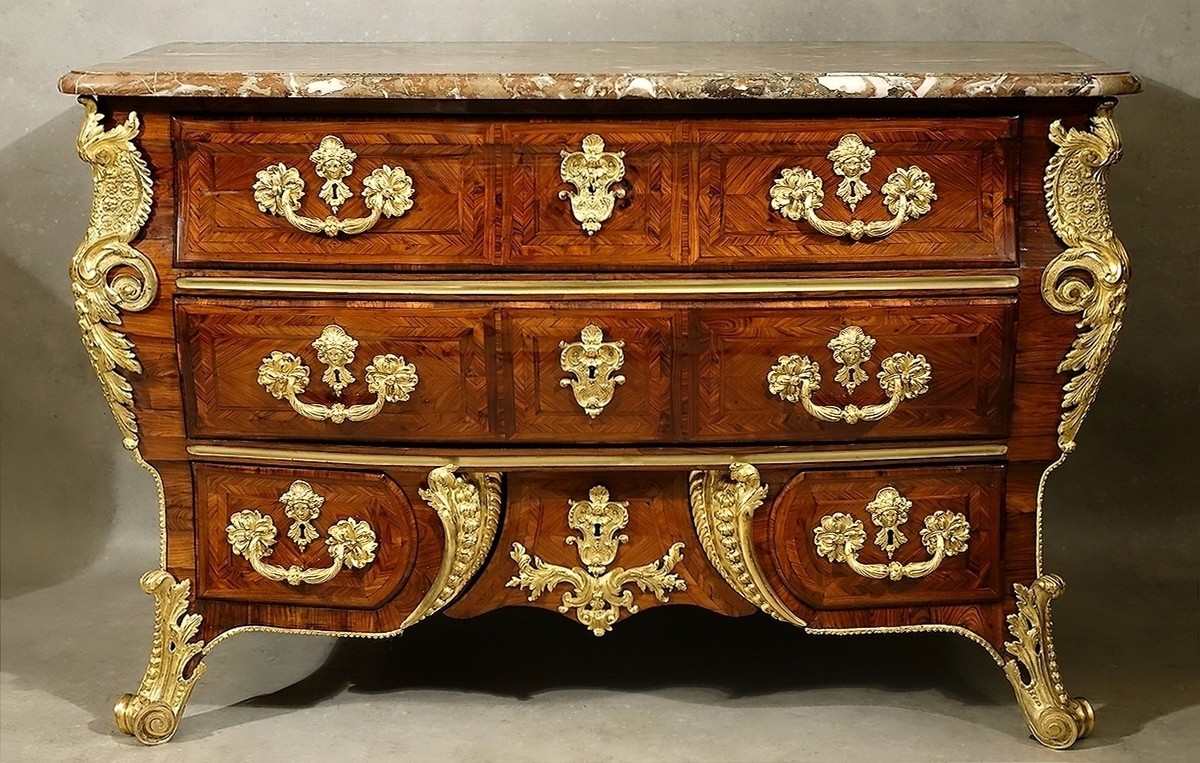
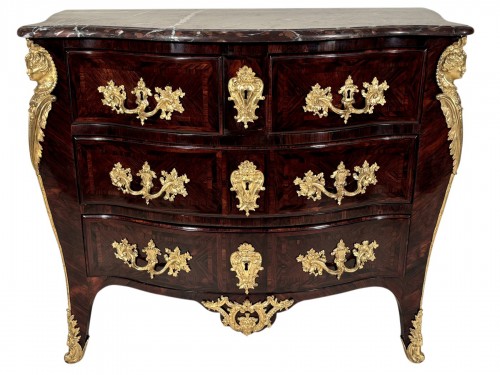
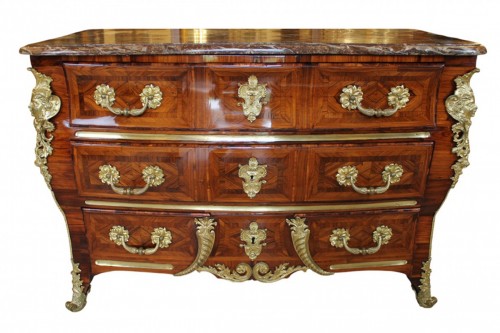
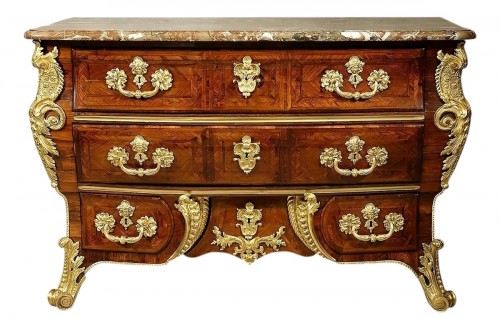
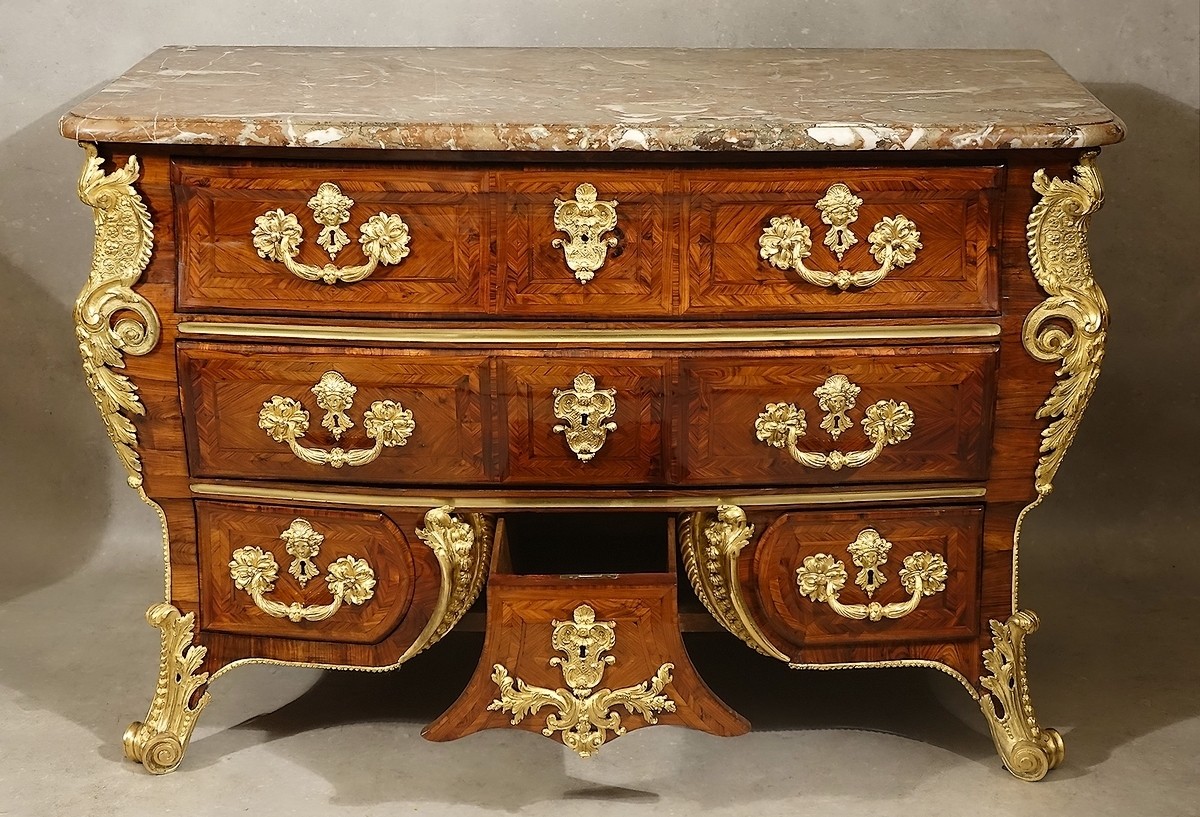
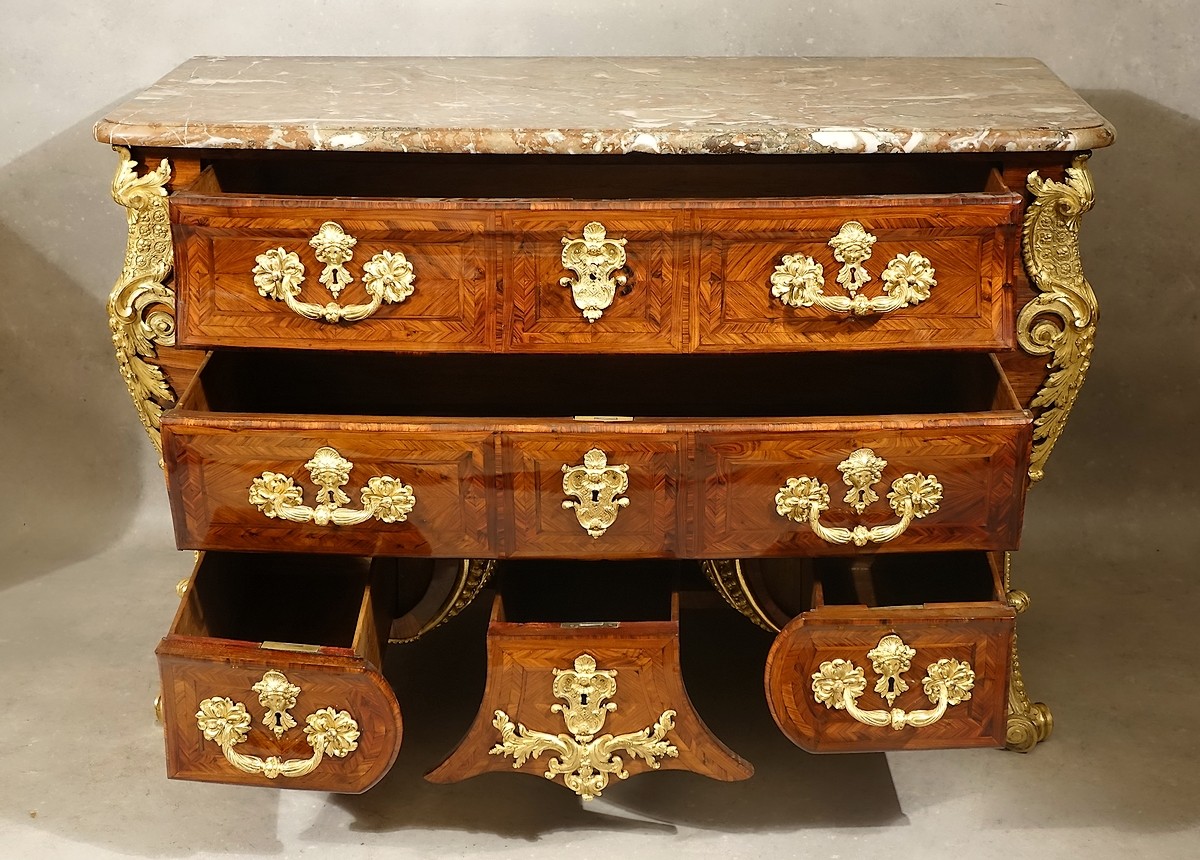
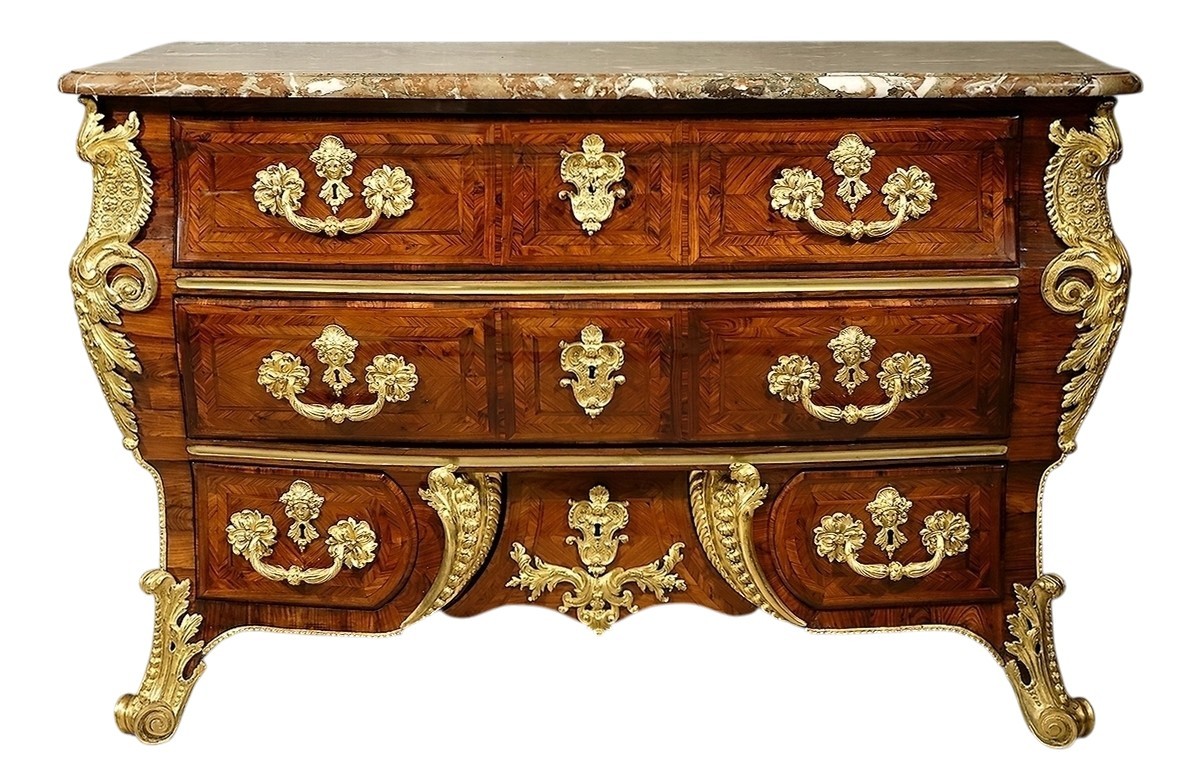
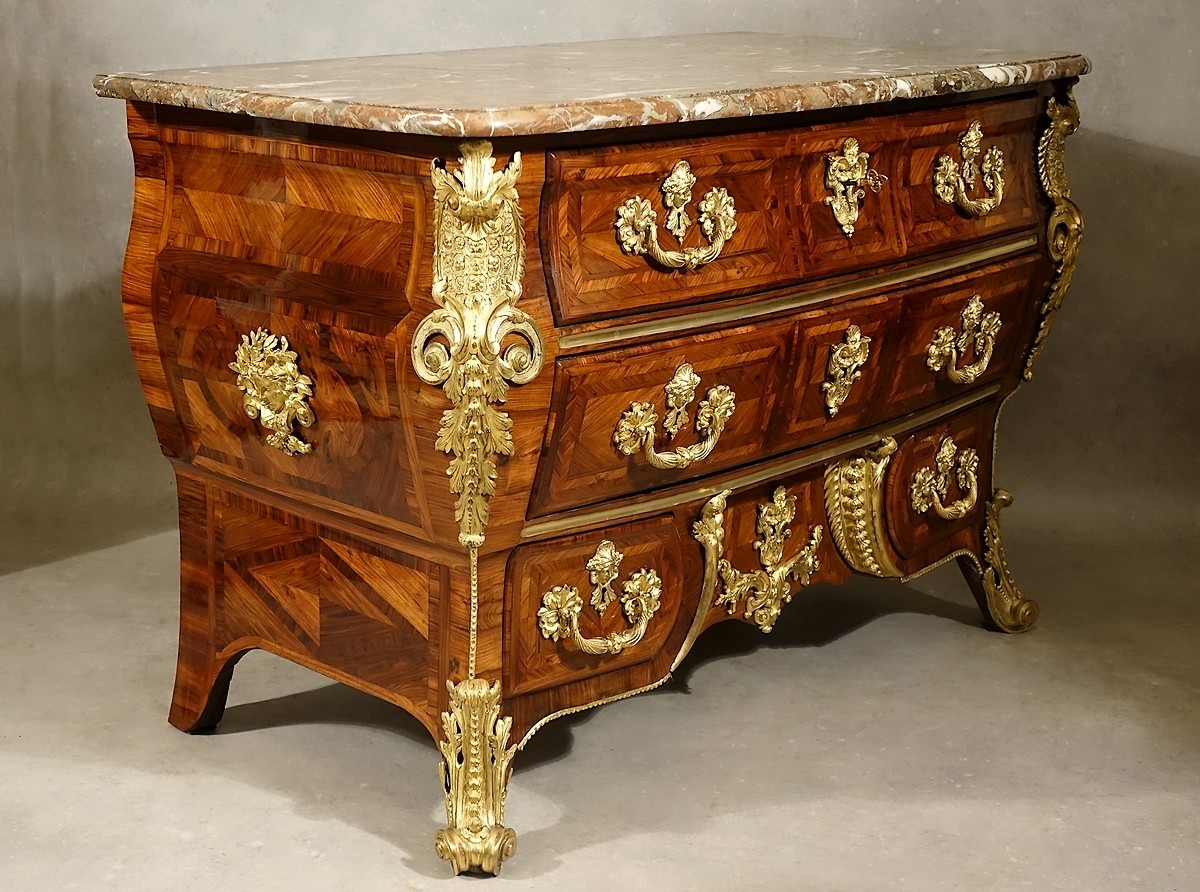
Important and very rare sarcophagus-shaped commode with bridge form, curved on all sides.
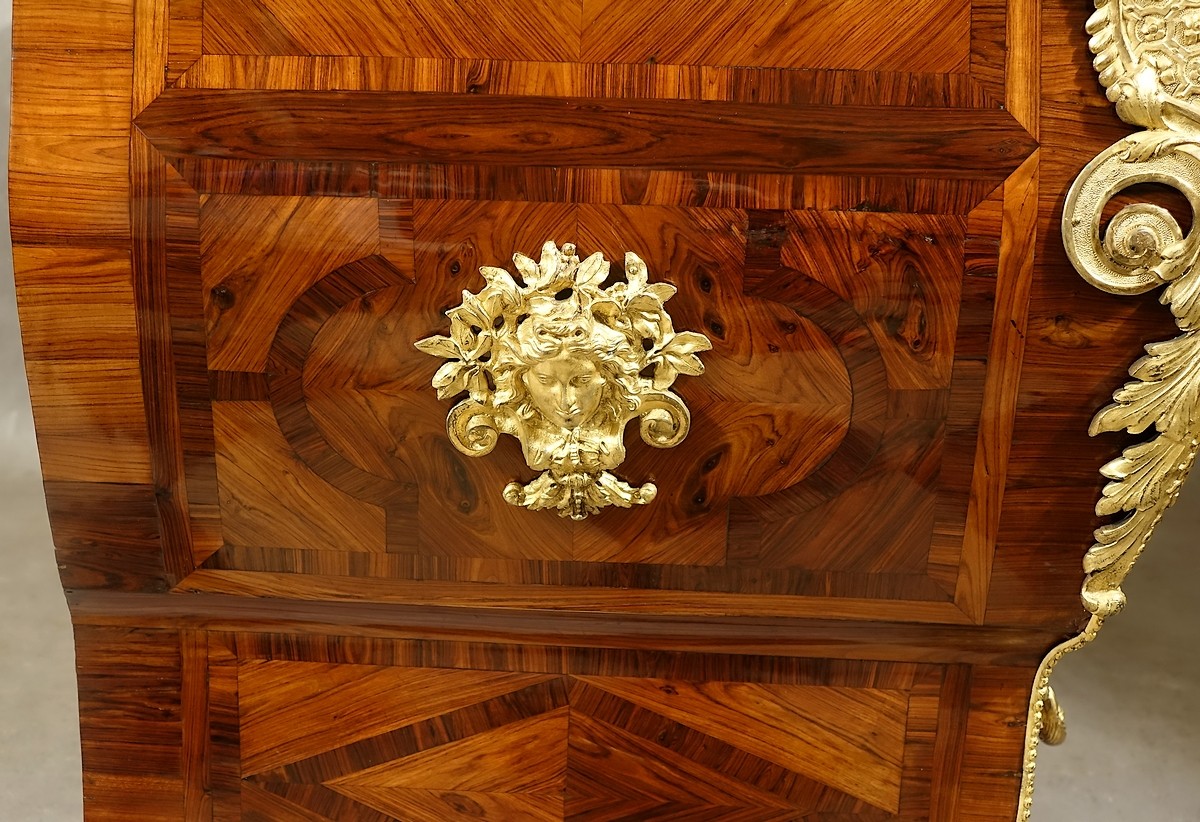
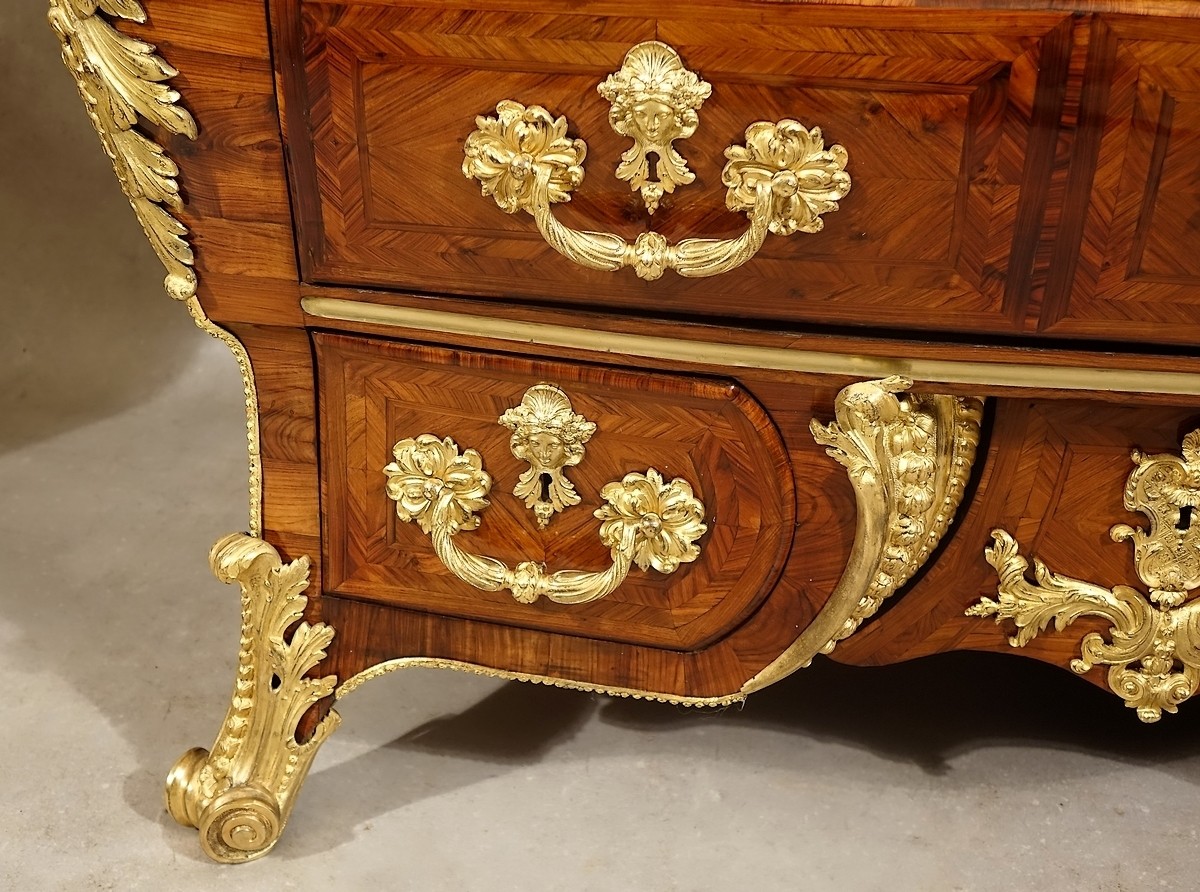
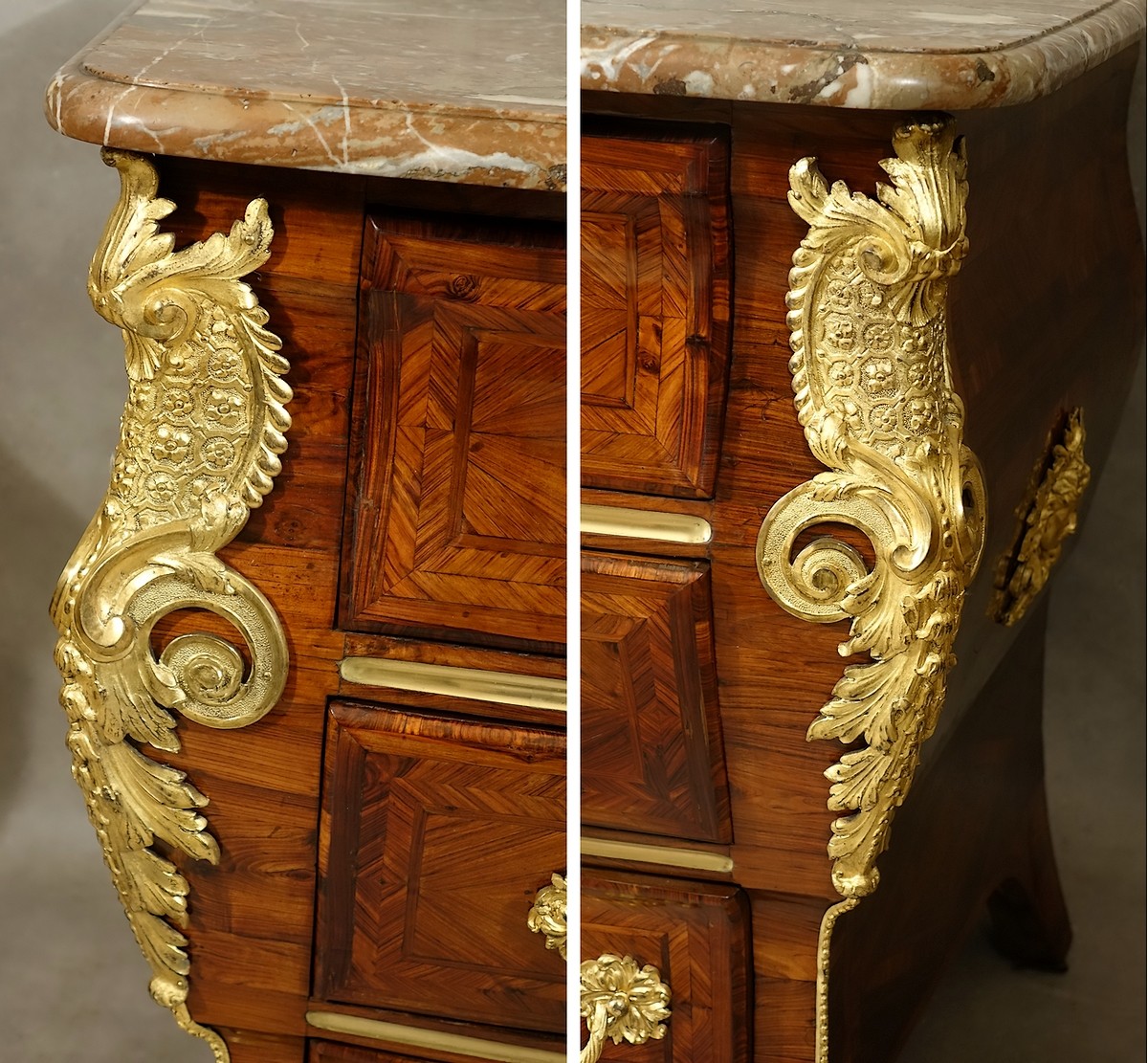
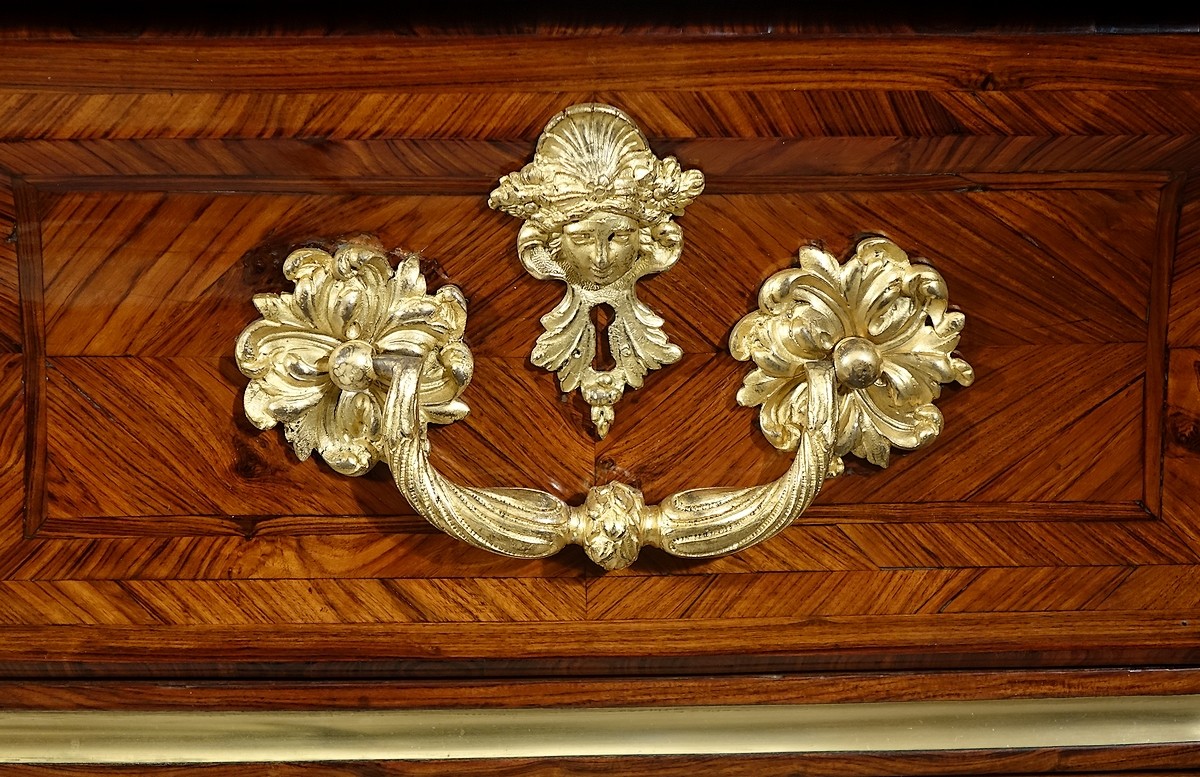
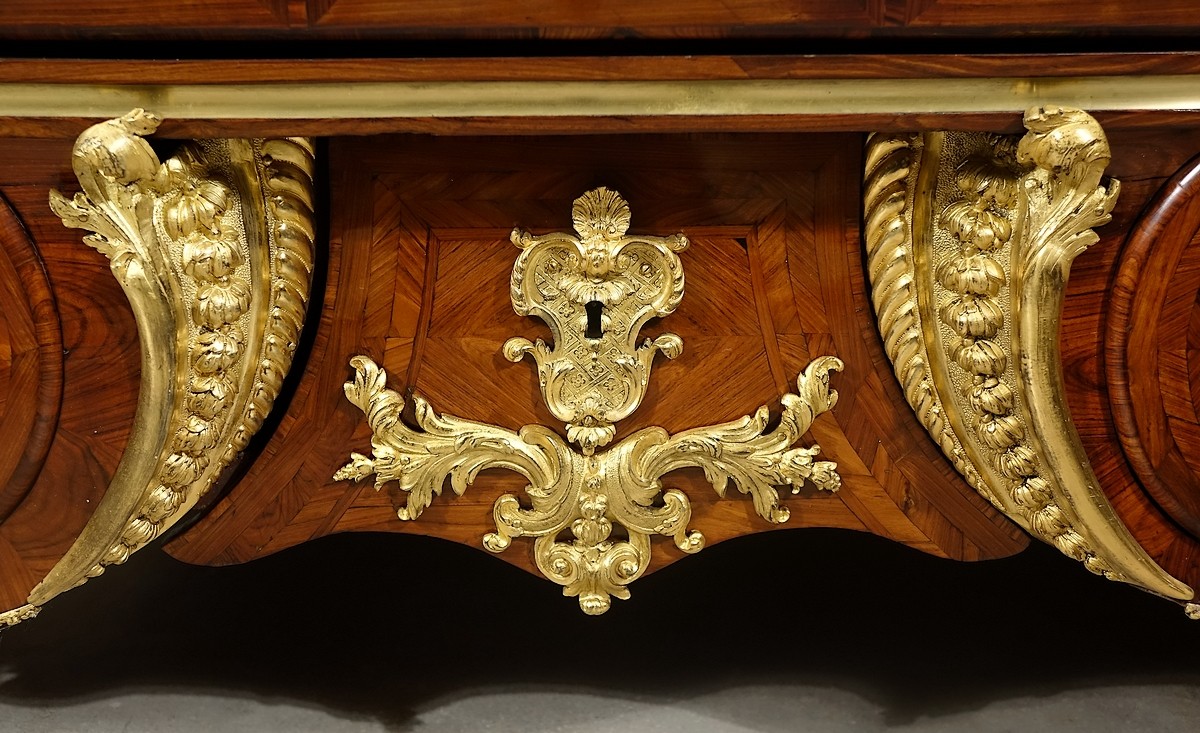
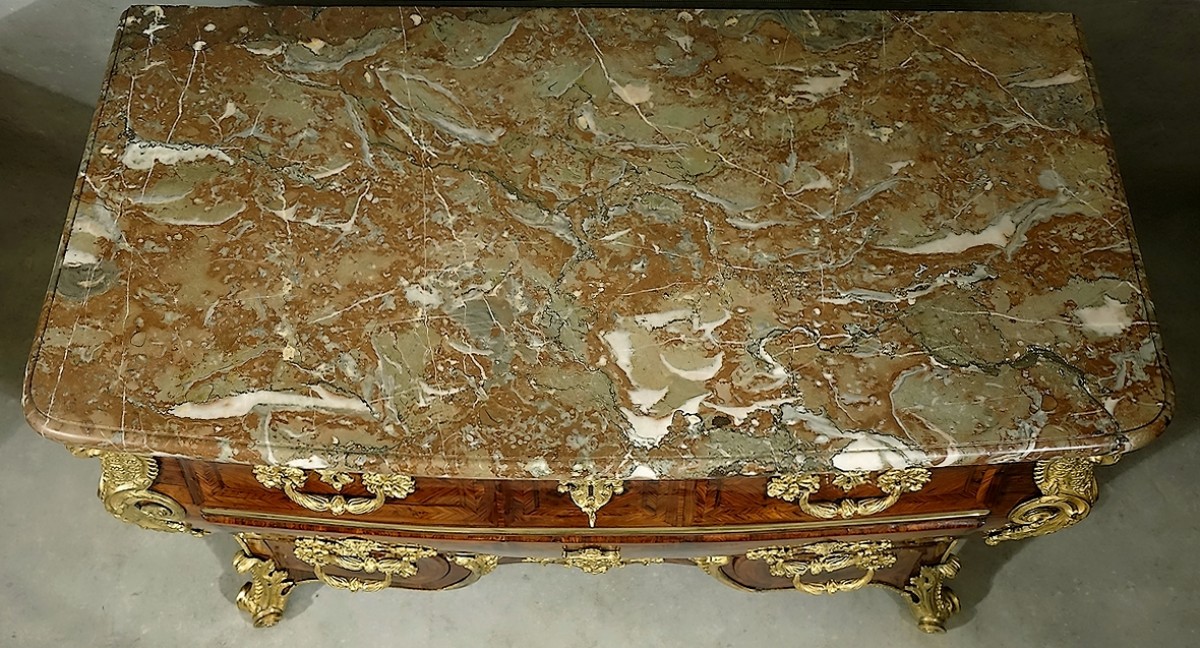
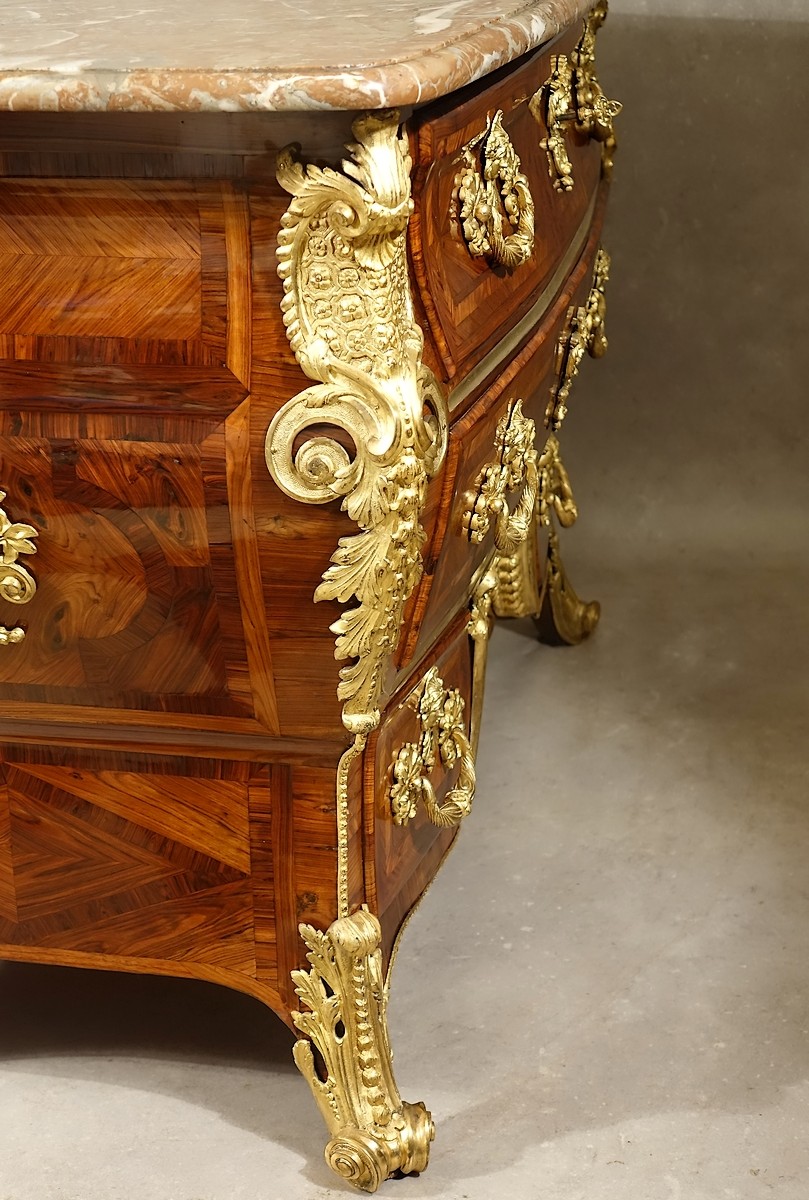
Exclusively veneered with violetwood (rhythmically arranged with numerous bands and reserves in cross-banded veneers, butterfly wings and diamond points), topped with a Royal Red marble, it opens with five drawers on three alternating rows accented with gilt brass fluting, and is adorned on all sides with a suite of finely chased and gilt bronze mounts of very high quality.
The commode only appeared in France at the end of the reign of Louis XIV, and among the very first examples is the pair delivered in 1708 by André-Charles Boulle for the King’s bedroom at the Grand Trianon. In their bulging forms, a resemblance was seen with sarcophagi, and this model (designed by the master a few years earlier) should be viewed as the prototype of a cabinetmaker still under the influence of Baroque Mannerism, from which he would soon free himself. Thus, Boulle himself, followed by the greatest Parisian masters of the period (among whom we may name Antoine Robert Gaudreaus, Nicolas Sageot, Noël Gérard, François Lieutaud, Philippe and Joseph Poitou), produced throughout the reign of the Sun King commodes with much stricter forms, straight in elevation and only slightly bombé in plan.
It was therefore only a few years later, during the Regency period, that following Boulle’s productions, commodes curved first in elevation, then curved in both plan and elevation, would appear — the latter being referred to throughout the 18th century as “à la Régence” (likewise, it would not be until the 1720s to see again commodes with two rows of drawers, known as “à la Cressent”).
The model we present, designated as a “sarcophagus” commode due to its analogies with the Grand Trianon example, likewise features curved forms but still oriented exclusively toward elevation. Initiating the emancipation from the straight line, it should therefore be regarded as an intermediate stage between the Louis XIV commode and the Régence commode. One sometimes encounters this type of commode retaining a marquetry wood top very much in the Louis XIV tradition, but also quite often presenting the characteristics of the so-called “bridge” commode (for example, the commode attributed to Noël Gérard from the Maria Callas estate), yet always with the same constant: high-quality craftsmanship.
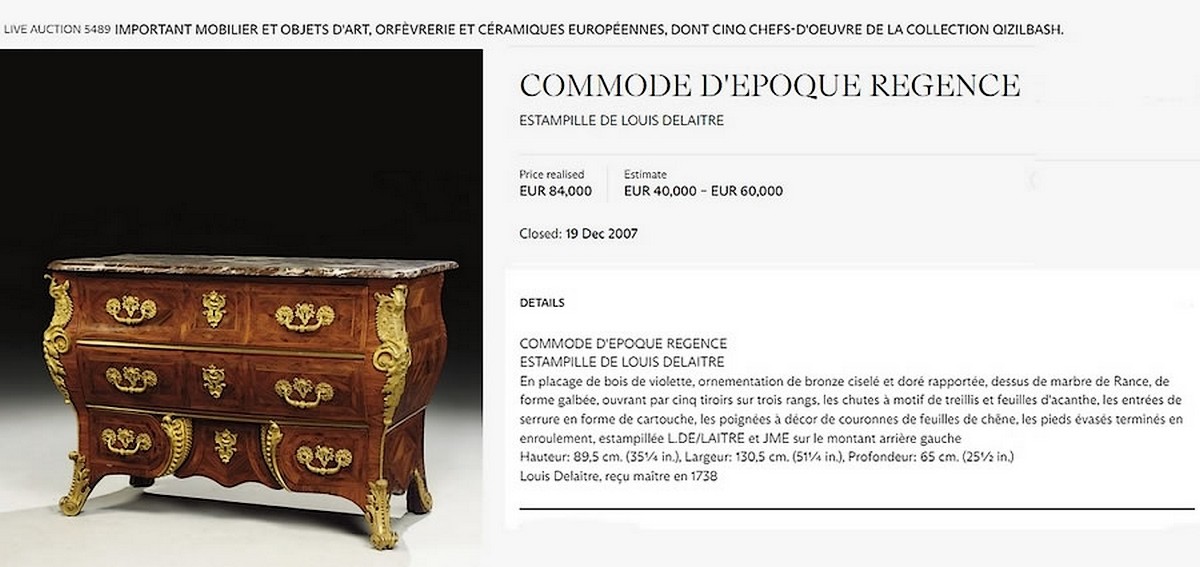
Rarer than the classic Régence commode, also known as the “tomb” commode, this particular model presents lines that are both very powerful and very refined. While most of the previously mentioned masters are found as authors of sarcophagus models — particularly Noël Gérard and the Poitou brothers — an as yet unidentified cabinetmaker signing P.M., and especially Louis Delaitre, are particularly well known for being the authors of a corpus of ceremonial commodes (almost always of high aristocratic provenance), within which our commode can be placed. This is a model whose production he seems to have continued beyond the Regency into the early Louis XV period, since his stamp L. DE/LAITRE has been found on some of his sarcophagus commodes (these being the only ones bearing a non-abbreviated mark). Our commode is not stamped, which argues in favor of a Regency-period dating, but as a precaution we date it circa 1730*.
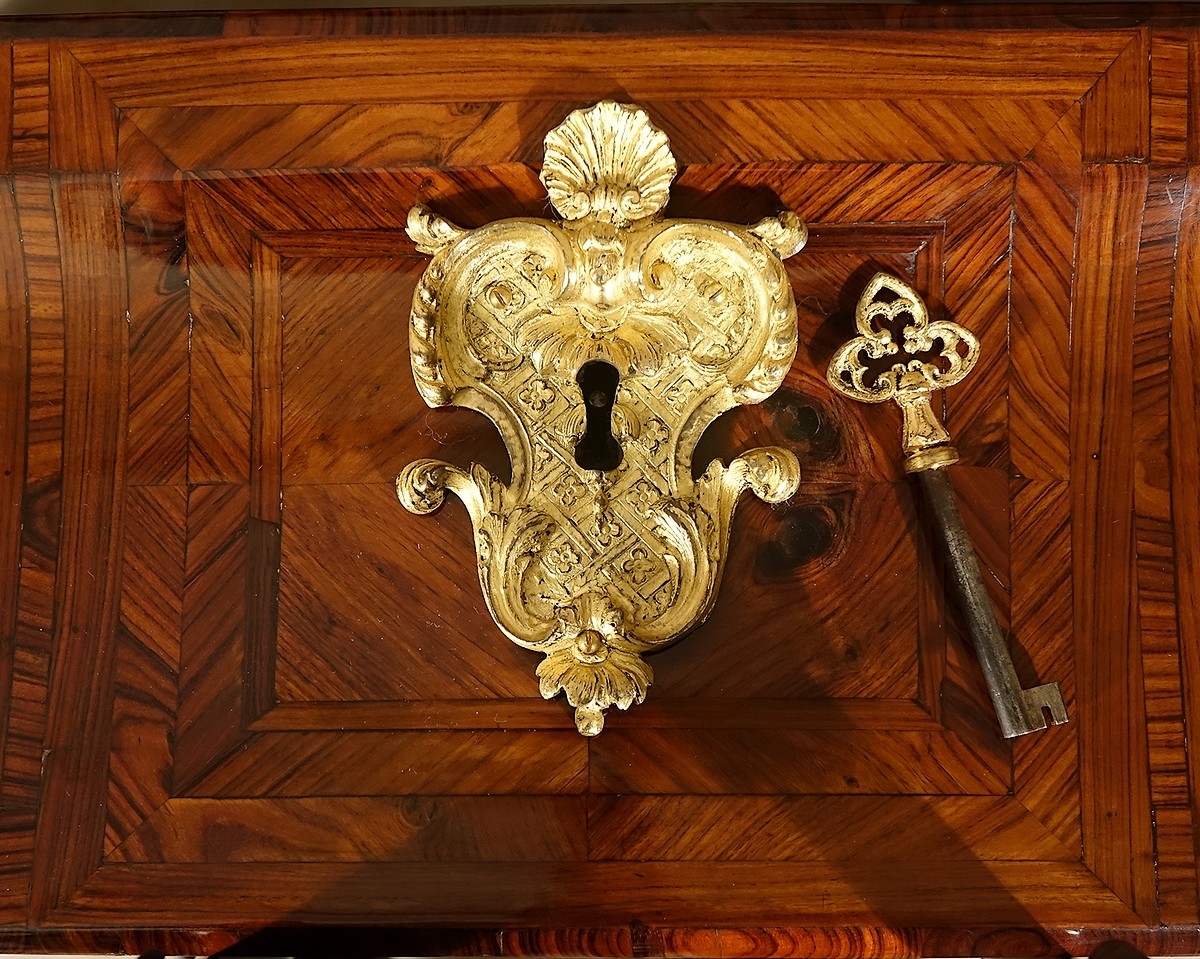
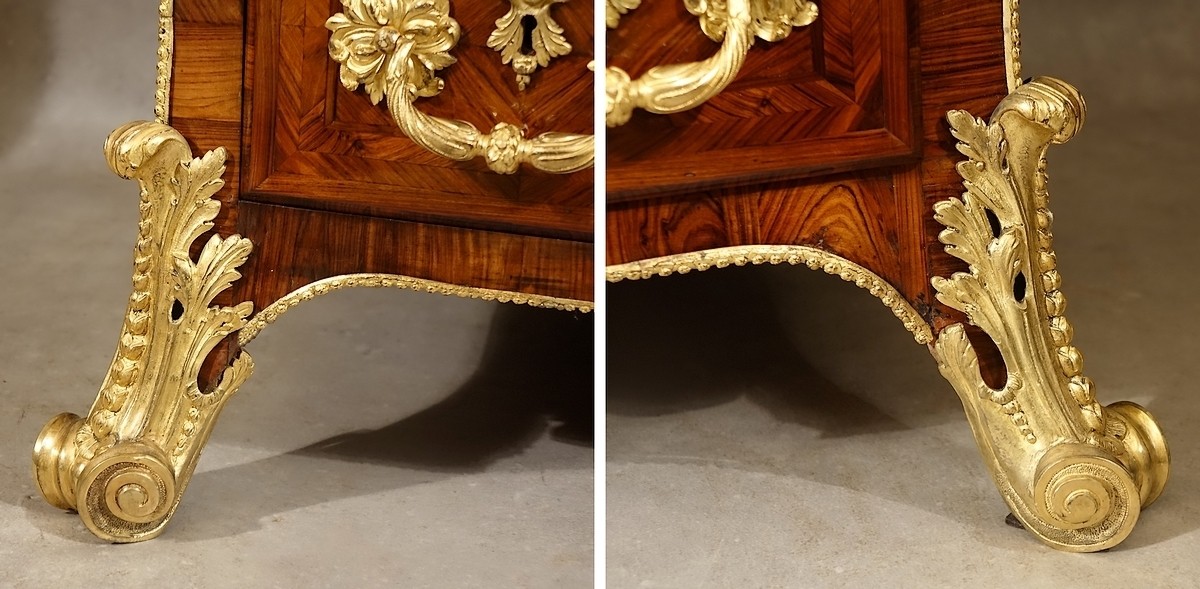
The commode is topped with a Royal Red marble molded with a 30 mm beak molding, and fitted with an ornamentation of finely chased and gilt bronzes of a very Boulle-like character** and truly exceptional (we will not enumerate the 40 bronzes — which required no fewer than 10 different molds — that make up its decoration), remarkable for their exclusivity, volumes, complexity, and finally the quality of their chasing, observable for example in the mosaic grounds punctuated with quatrefoils. Let us add that among all the rare sarcophagus models by Louis Delaitre known to us, ours appears to be the most richly ornamented with bronzes.
Two commodes (from a pair) almost identical to our commode but executed in Boulle marquetry in part and counterpart are known: former Goelet collection — sale in New York, October 13–15, 1966 for the first; and Delorme sale — Paris, Hôtel Drouot, November 23, 1976 for the second.
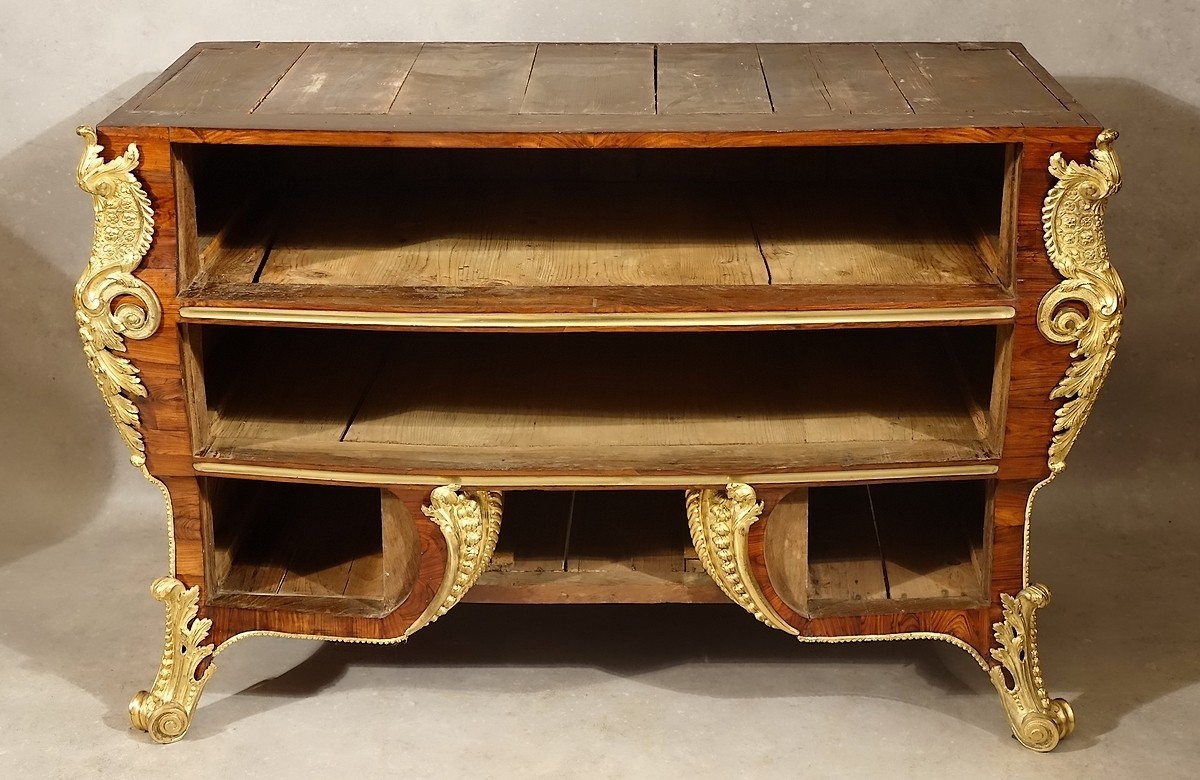
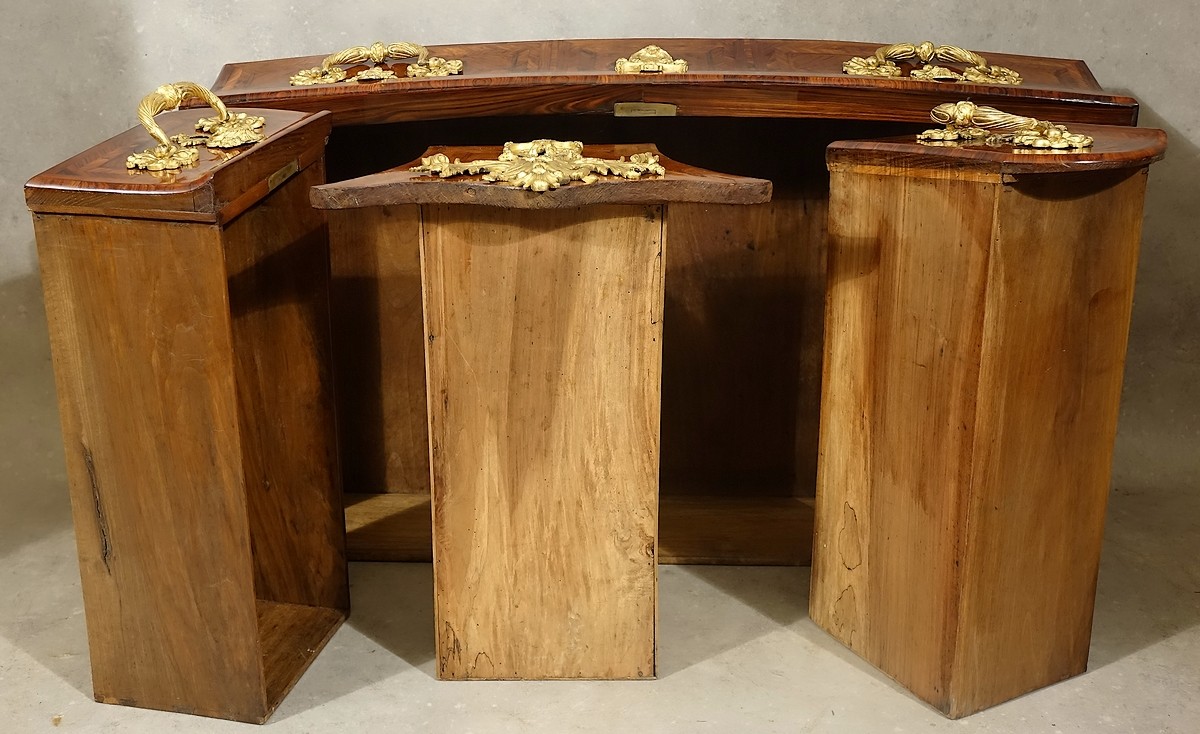
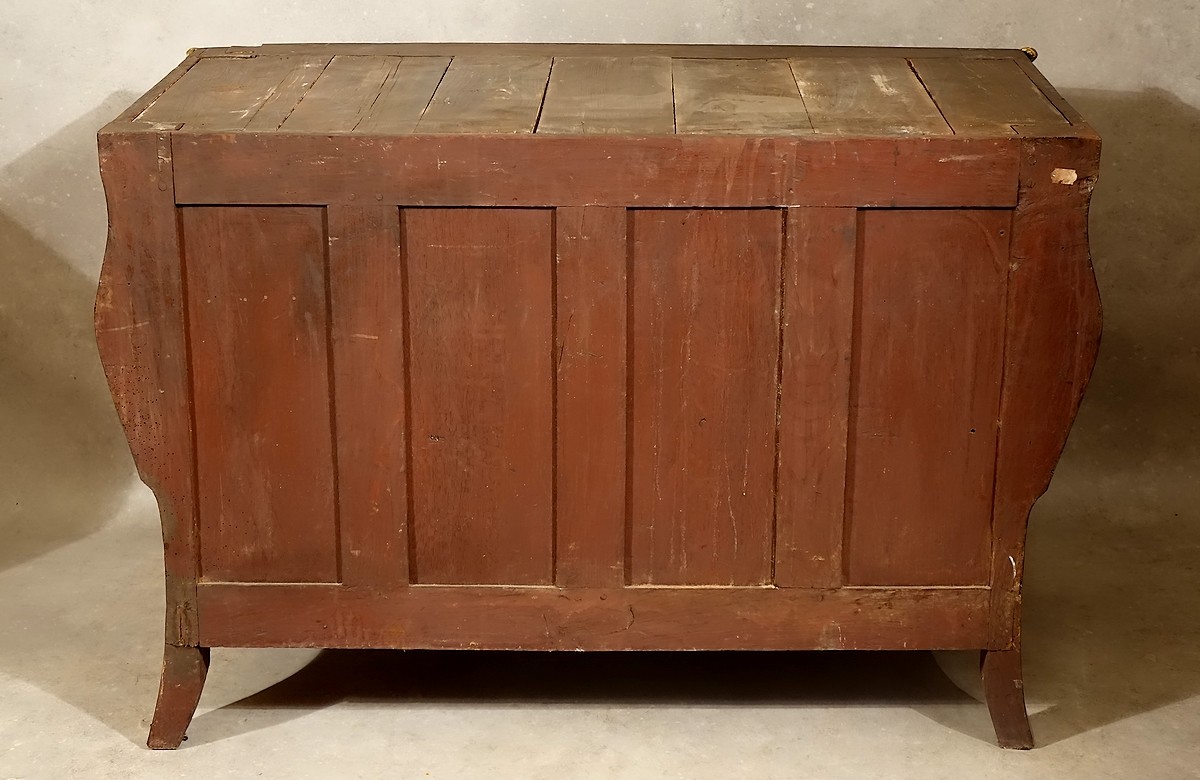
The carcass conforms to that of the finest Regency creations: the woods used include a high-quality softwood for the drawer fronts, intermediate shelves and sides; oak of the highest quality for the four thick uprights and the back; and finally a superb, perfectly planed walnut for the complete construction of the drawer boxes, finely assembled with mortise joinery.
Note that the use of oak is uncommon during the Regency period (even if Boulle already used it under Louis XIV), as are paneled and pegged backs.
The piece is presented in an exceptionally rare state of preservation (no notable damage to report): the veneer intact and of fine thickness, with its period bronzes delicately chased, its marble in excellent condition (the rear edge cut with a chisel and especially the hand-polished edge offering a surface not perfectly flat but slightly undulating — the only absolutely inimitable characteristic of 18th-century marbles). In short, a superb original condition, enhanced by very delicate restoration and French polishing carried out by a master cabinetmaker. The bronzes have been regilded with alternating matte and burnished finishes and patinated by our gilder.
Parisian work attributed to Louis Delaitre, from the late Regency period, circa 1730.
LOUIS DELAITRE (also spelled Delaître): Parisian cabinetmaker who worked for several years on the Rue de Lappe as a free artisan before obtaining his mastership in 1738. He later resided on the Rue Saint-Nicolas until his death in 1750. He acquired a reputation as a man of strong character, if not even brutal.
“He had the double reputation of an excellent cabinetmaker and a violent and vindictive man.”
Le Mobilier Français du XVIIIe siècle – Pierre Kjellberg
“Moreover, Delaître practiced his craft with talent and supplied fashionable dealers. He left behind fine furniture bearing the mark (the oldest on two levels) L. DE/LAITRE.”
Les ébénistes du XVIIIe siècle – Comte François de Salverte
“Delaitre produced mainly commodes… made wide use of violetwood in his veneers and knew how to adapt bronzes of harmonious and distinguished design.”
L’art et la manière des maîtres ébénistes français au XVIIIe siècle – Jean Nicolay
We know indeed that he worked, for example, for the Migeon family.