Offered by Antiquités Philippe Glédel




18th Furniture, country french furniture
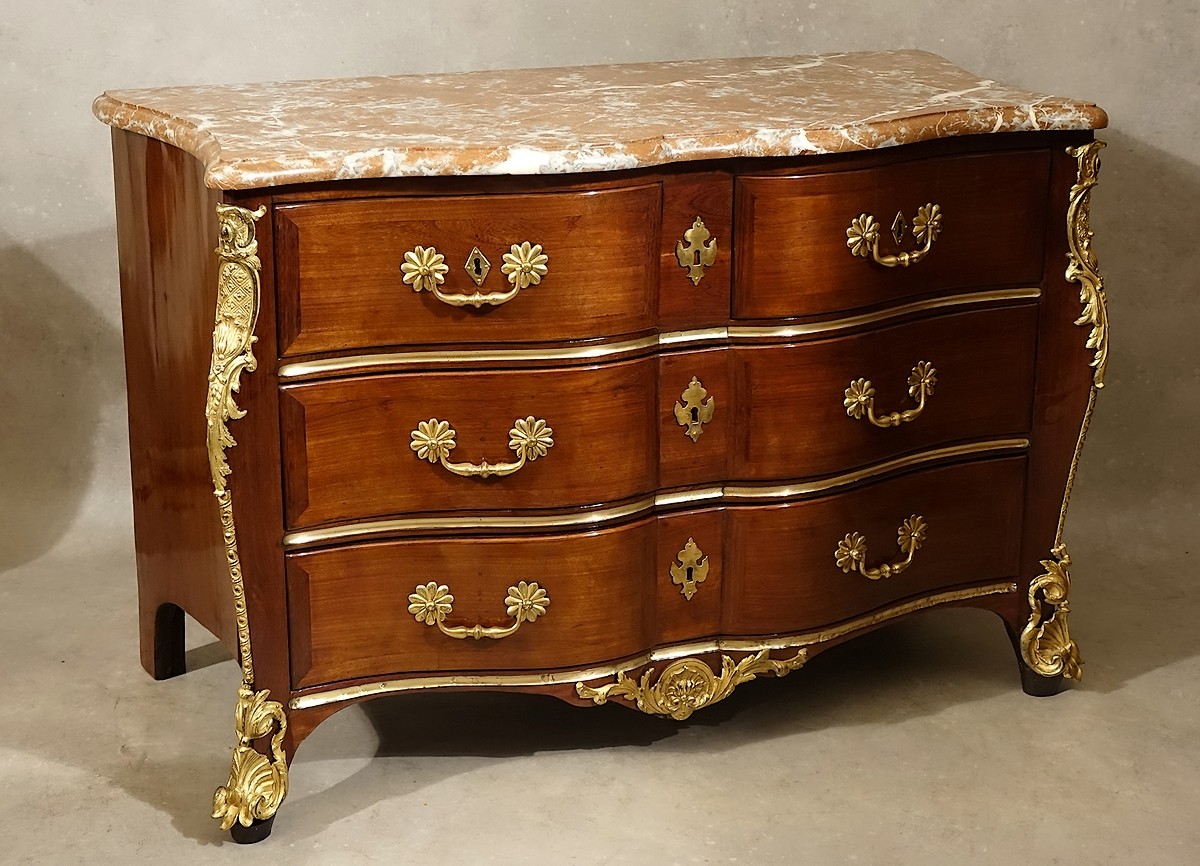
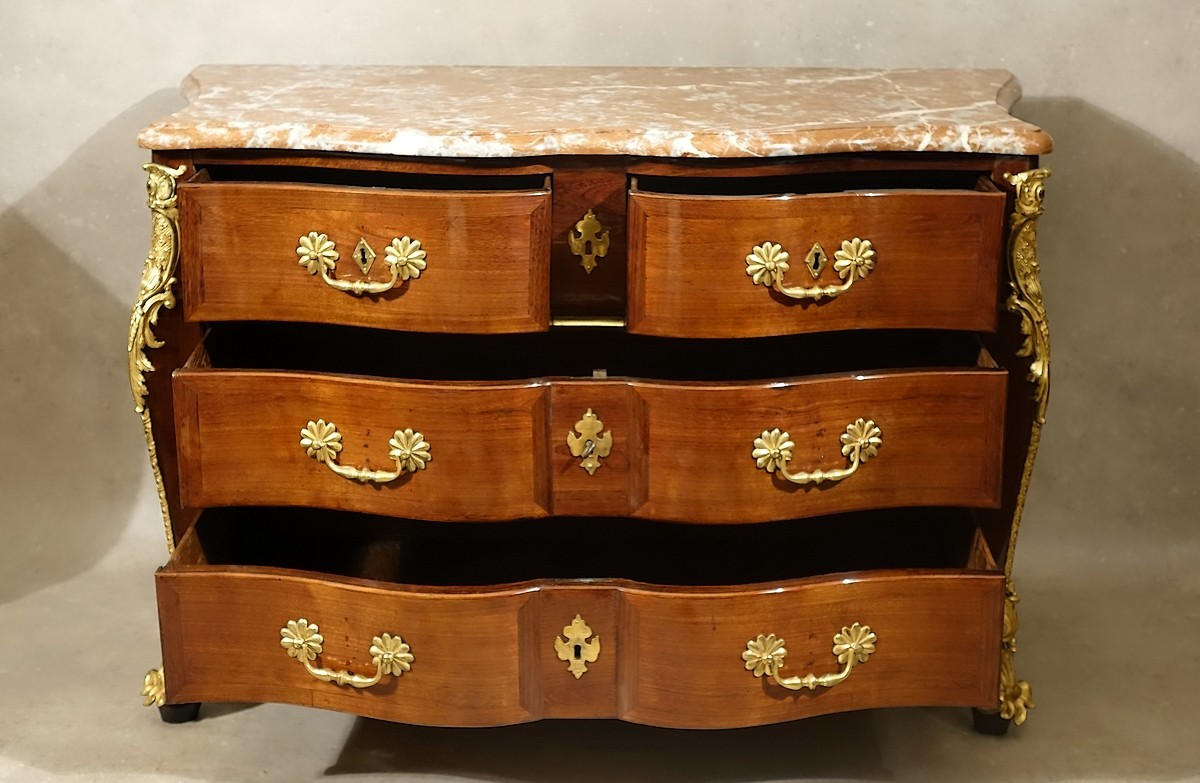
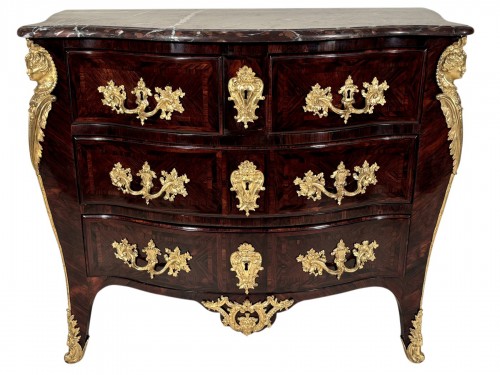
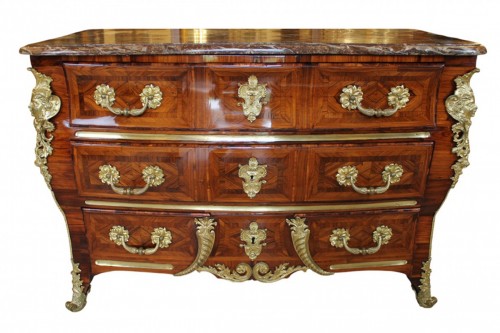
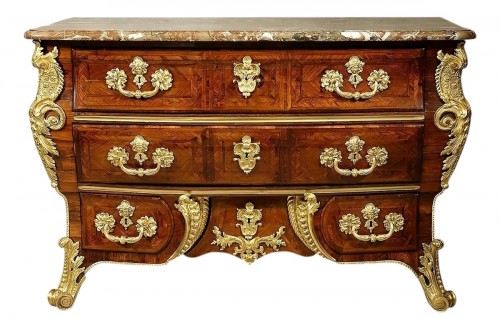
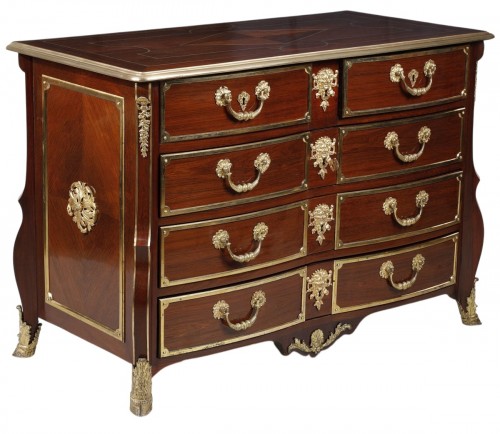
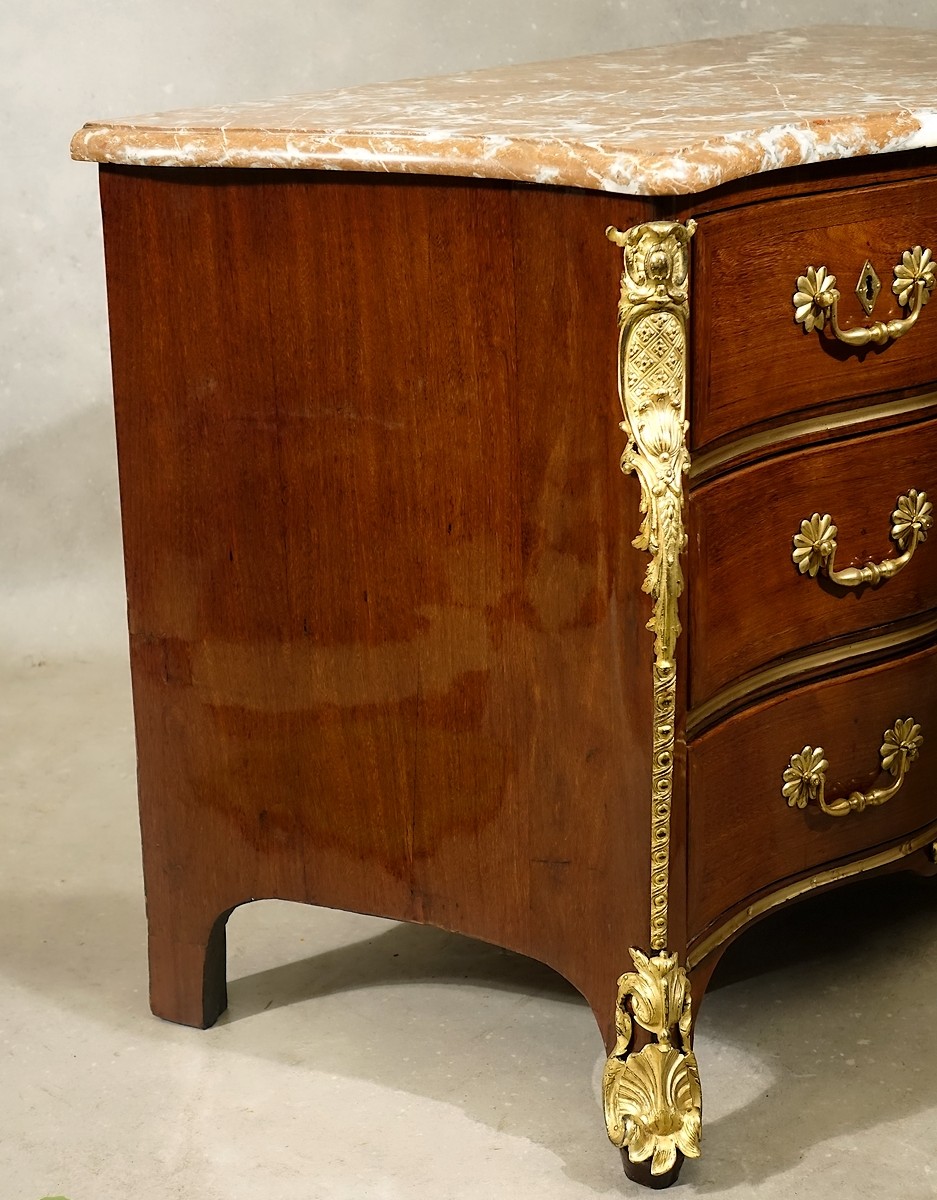
Regence-period commode with a crossbow-shaped (arc d’arbalète) façade, serpentine on all sides, opening with four drawers (simulating three) arranged in three tiers separated by dark crosspieces with brass fluting, and topped with a 3 cm thick molded Royal Red Flanders marble with a corbin-beak edge.
Constructed in amaranth veneer over a high-quality fir carcass, with oak drawer boxes, it features a powerful crossbow-shaped curvature to the front, shouldered uprights, and curved sides.
The piece is richly adorned with chased bronze and brass mounts, all fire-gilded and of exceptional quality, including:
Two corner mounts in bronze decorated with acanthus scrolls enriched with ovolo cartouches, palmettes, fleurons, reticulated grounds—typical of the Regence period—punctuated with quatrefoils.
Two bronze linking moldings with interlaced decoration.
Two enveloping bronze sabots, pierced, of a rather exceptional and almost unusual rocaille model, decorated with large leafy palmettes that, by visual effect, resemble shells.
Six bronze drawer pulls with rosettes.
Three large brass escutcheons and two smaller diamond-shaped ones, regarded as a true signature of Lieutaud.
An important bronze apron mount (cul-de-lampe) decorated with a shell flanked by veined and crisply modeled acanthus leaves.
The commode is presented in an exceptional state of originality, retaining its original veneer and mounts, as well as its old iron locks with a key.
The carcass assembly is without rebates or mortise-and-tenon joints, but with dovetails and blind dovetails, characteristic of constructions from the first third of the 18th century.
This highly refined piece is representative of the most charming productions of the Regence period.
By François Lieutaud.
Parisian work from the end of the Regence period or the very beginning of the Louis XV period, circa 1720–1730.
François Lieutaud (1665–1748) was a cabinetmaker of Marseille origin who received his master’s letters in Paris at the end of the 17th century and was active under Louis XIV and during the Regence. He worked within the privileged enclosure of the cloister of Saint-Jean-de-Latran (where Philippe Poitou the Younger also worked), and Louis XIV granted him the rare privilege of creating and producing the bronze mounts for his own furniture (at a time when the guild of bronze founders claimed exclusive rights). He is also known to have collaborated with Noël Gérard (who was likewise a marchand mercier), as well as with Charles Cressent and even André-Charles Boulle, who appointed him as his personal expert during a trial in 1719. Lieutaud founded a dynasty of cabinetmakers, as his son Charles and his grandson Balthazar (famous for his regulators) pursued the same profession. Long overlooked by art historians due to his stamp consisting only of initials (the use of stamps becoming regulated and widespread only during the Louis XV period), he is now recognized among the greatest cabinetmakers of his time.
Dimensions: H. 0.84 m × W. 1.25 m (1.16 m at the front) × D. 0.61 m.