Offered by Galerie Alexandre Piatti
REQUEST INFORMATION

Works of art, sculptures and furniture Haute Epoque
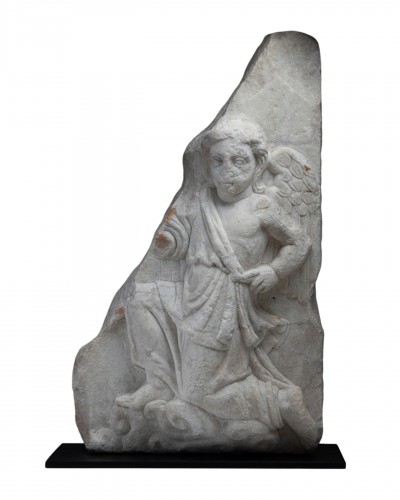
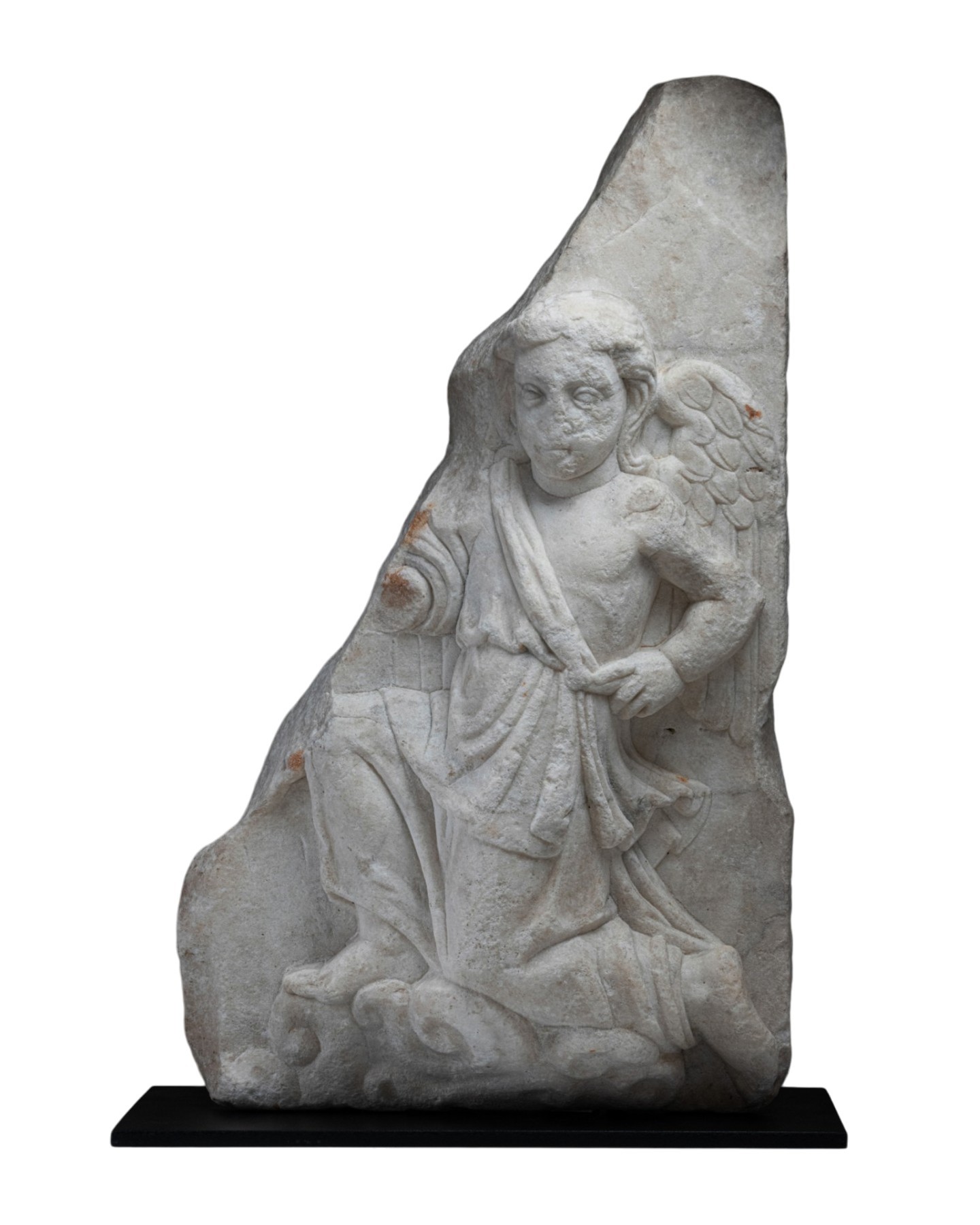
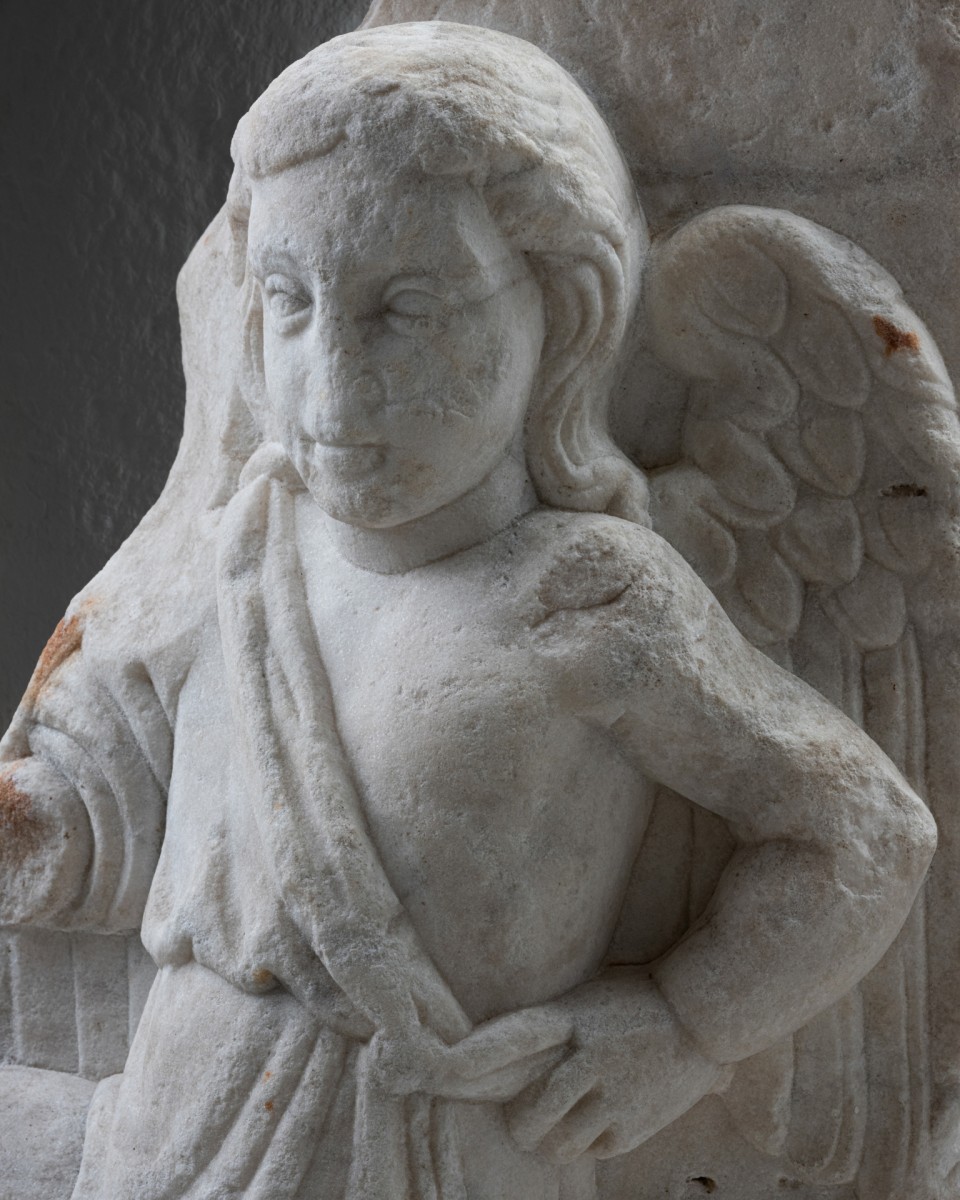
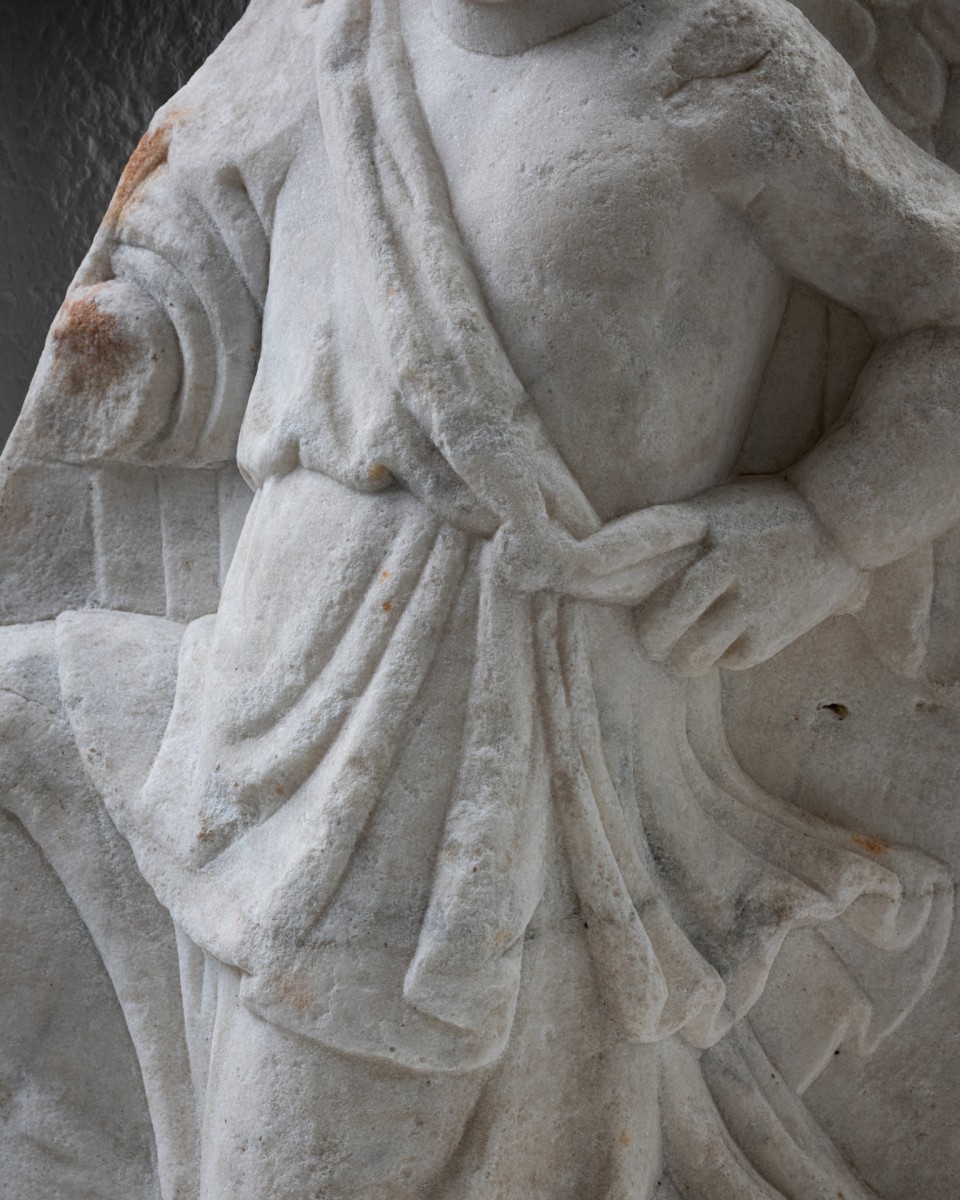
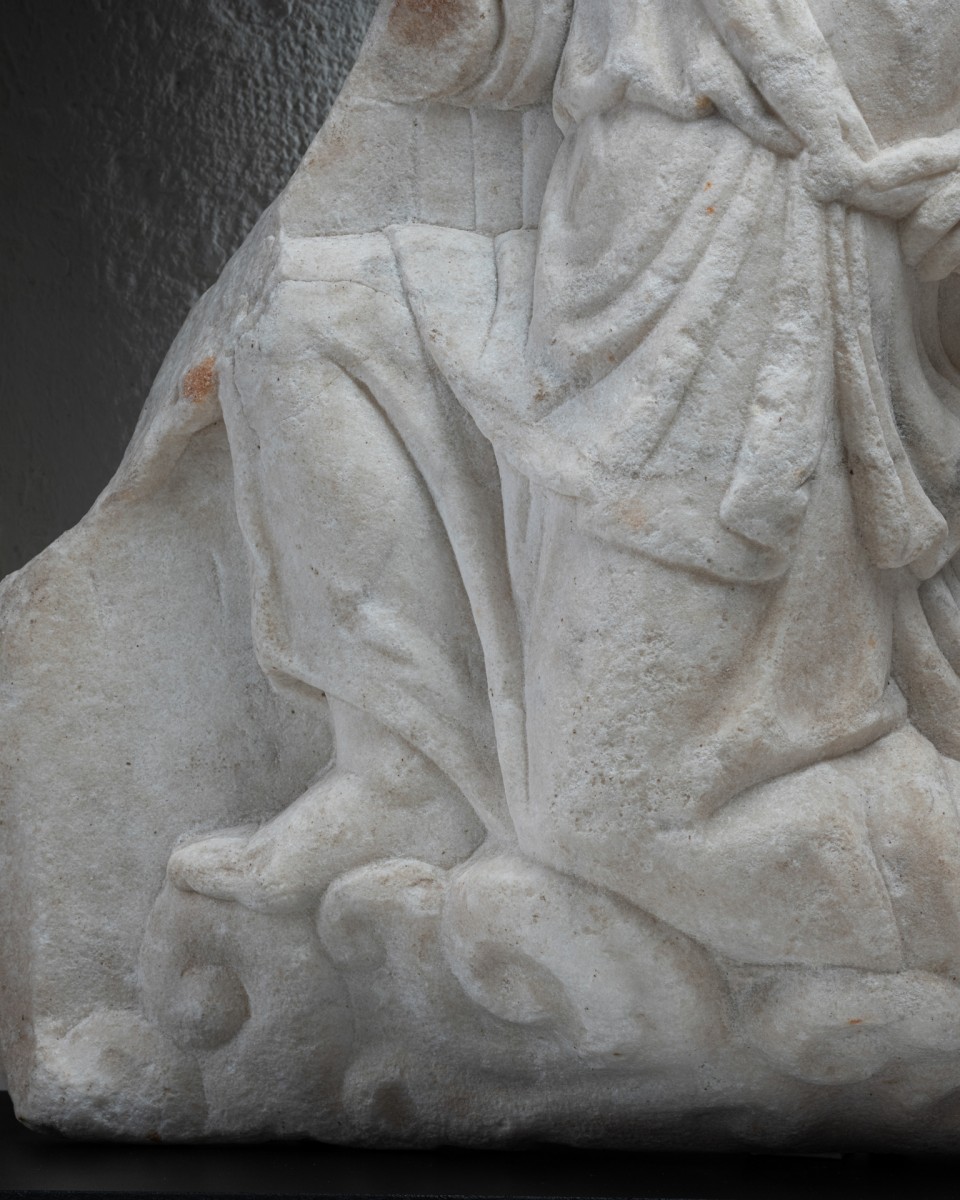
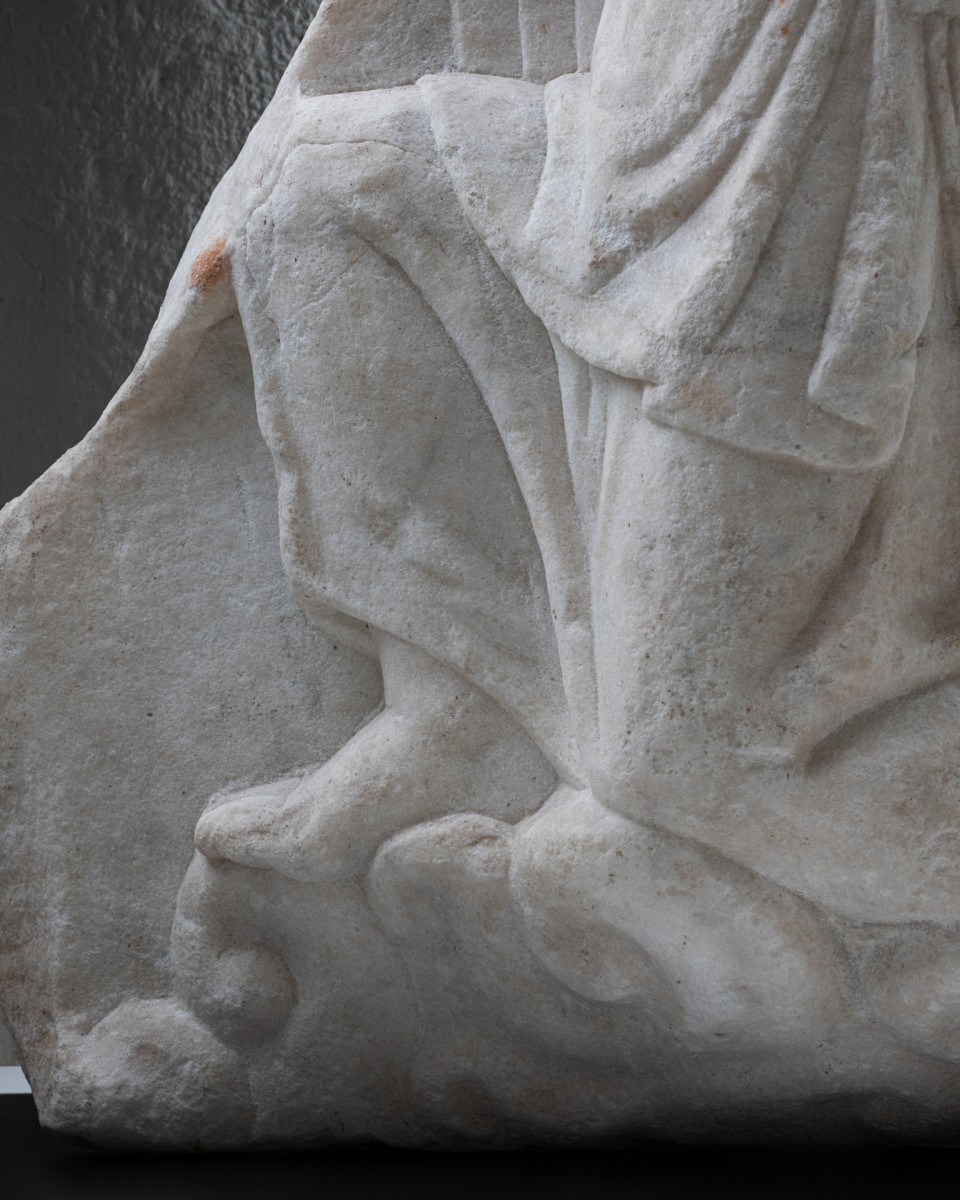
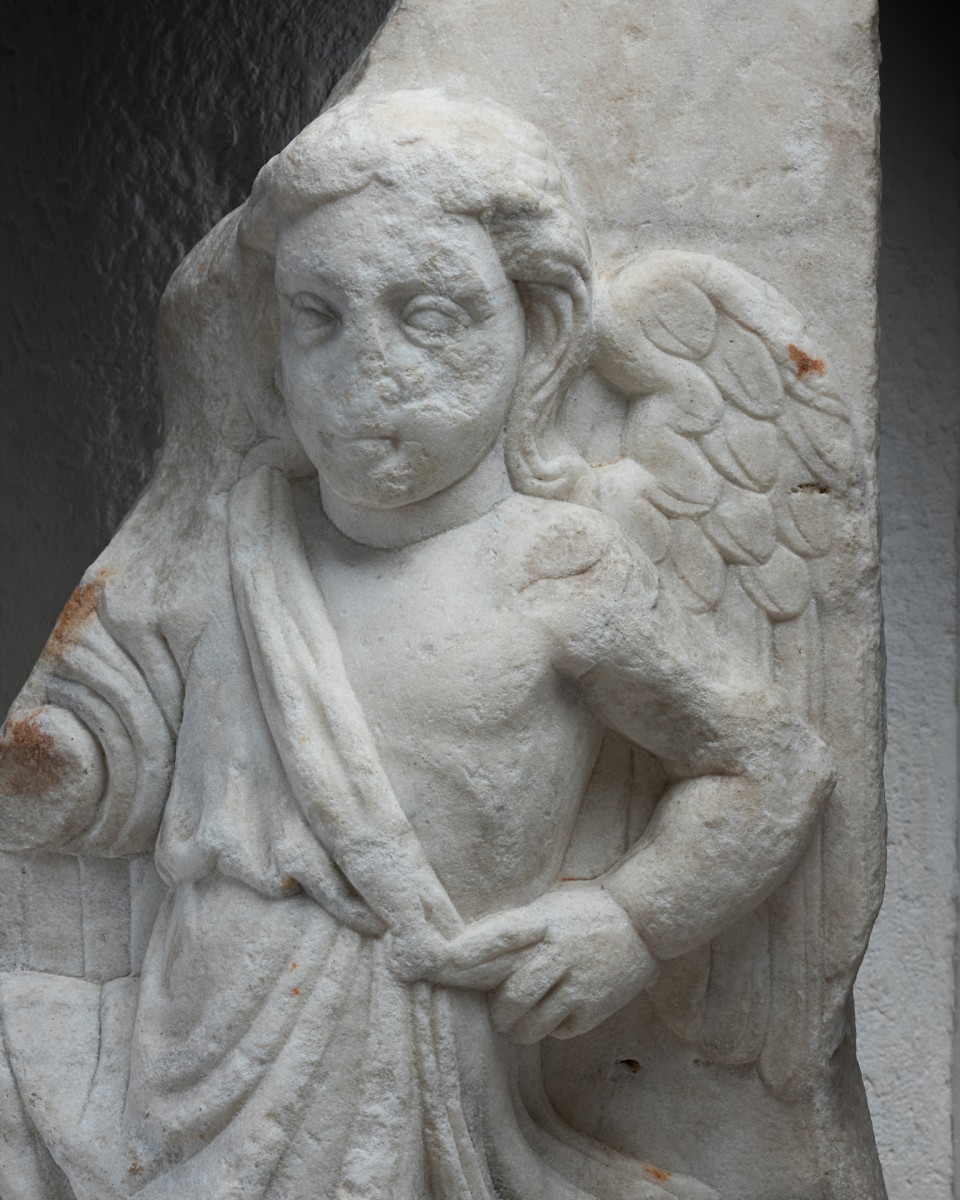
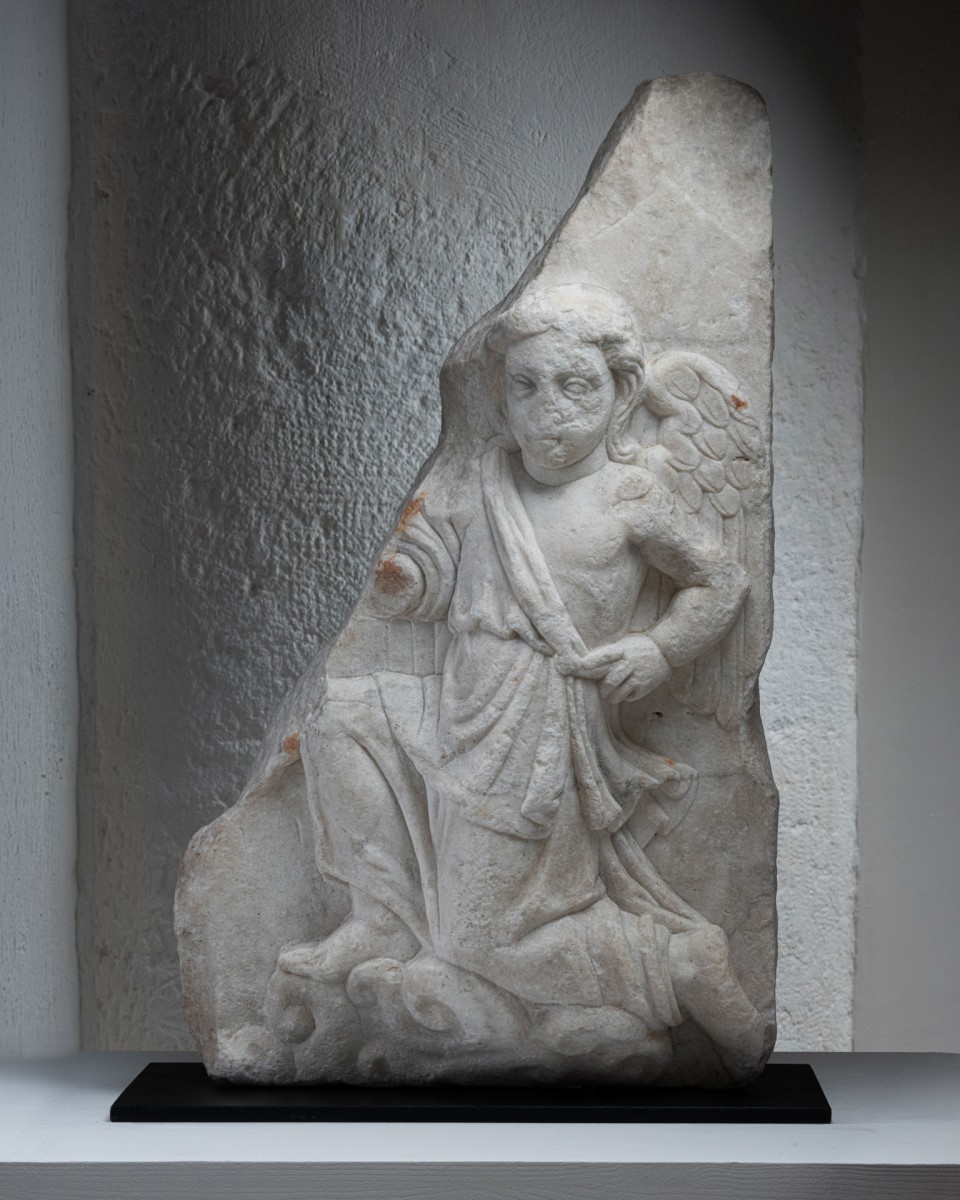
The work consists of a fragment of a white marble relief, carved in high relief, depicting a youthful figure with a slightly androgynous appearance. The figure is depicted barefoot, the body wrapped in a drapery that gathers around the torso and legs. The composition is enlivened by a sharply raised knee, giving the figure a dynamic and sinuous posture. The torso is slightly turned, while the head faces toward the interior of the composition. The right hand gathers part of the drapery, and a wing stands out clearly behind the shoulder, characterizing the figure as a winged being.
On the left side—toward which the figure’s gaze is directed—a circular shape, now incomplete, likely corresponds to a missing attribute. Its placement suggests a medallion that was once flanked on either side by two symmetrically arranged winged figures. This arrangement, centered on a circular element flanked by two genii, is fully in keeping with the decorative repertoire of Roman funerary sculpture. The preserved figure thus belonged to a larger composition in which the clipeus—a funerary medallion often depicting the deceased—likely formed the center.
The figure rests on a stylized base, treated—in accordance with the conventions of Roman sculpture—as a rock, a feature of the landscape, or a conventional plant form. Far from being a mere filler, this base contributes to the spatial construction of the composition and reinforces its symbolic character. The reverse side, which is relatively flat and roughly carved, confirms that the relief was intended to be viewed from the front and was part of a larger sculpted ensemble.
All of the work’s characteristics—the winged figure, the youthfulness of the subject, the fluidly rendered drapery, partial nudity, the movement of the body, and the pronounced relief—place it within the realm of Roman funerary sculpture. The fragment likely belonged to a sarcophagus or an end piece, and thus formed part of a decorative ensemble with symbolic significance. The composition centered around a medallion is, in particular, a well-documented type in the Roman funerary repertoire.
In Roman art, these winged juvenile figures are part of the symbolic vocabulary of funerary sculpture and may accompany or frame central elements such as clipei. Their function is not limited to that of the Erotes or Cupids: wings may also characterize funerary genii, personifications, or figures associated with the passage to the afterlife. Here, identification as a winged genius is favored due to the combination of the youthful and androgynous morphology, the absence of specific attributes, and, above all, the probable symmetrical arrangement of the figure around a missing medallion—a configuration characteristic of genius figures used as accompanying elements in Roman funerary decorations. A personification of the Seasons could have been considered within the same decorative repertoire, but the absence of any plant or seasonal attributes—flowers, ears of grain, fruits, or bunches—precludes this identification, while the identification as Eros or Cupid is ruled out by the absence of a bow, arrows, or a quiver.
The work can be dated to the Roman Imperial period, more specifically between the late 2nd and 3rd centuries A.D. This chronological attribution is based on the treatment of the drapery, the dynamic rendering of the body, the pronounced relief, and the presence of a winged figure integrated into a funerary decorative composition. The comparison with the decorations on Roman sarcophagi from the 2nd and 3rd centuries is particularly relevant. The sculpture reflects a preference for highly animated figures with gracefully contoured bodies, whose movement is accentuated by the rendering of the drapery. It is conceivable that the work was produced in the Western Roman world, particularly in the regions of Narbonensis or Tarraconensis, where funerary sculpture flourished and where models from the major Roman production centers were in circulation.
Furthermore, a particularly significant parallel is housed at the Louvre Museum. It is a fragment of a sarcophagus identified as an acroterion, dating from the 3rd century A.D. This work bears an important structural and typological resemblance to our fragment, notably in its monumental size, its depiction of a winged figure, its deeply recessed relief, and its integration into the decoration of a sarcophagus. This is not an iconographic duplicate, but a parallel that confirms the place of this type of figure in the vocabulary of Roman funerary sculpture.
The fragment can thus be interpreted as a remarkable example of Roman funerary decoration depicting a winged genius, dating from the late 2nd or 3rd century A.D. The reconstruction of a composition centered on a clipeus, flanked by two winged genii, lends the work a particularly coherent interpretation and allows us to mentally reconstruct the scale and richness of the original composition.
Delevery information :
Please note that packing and shipping costs are not included in the price of the objects which are quoted ex shop.
Final amount including packing and shipment to be discussed with Galerie Alexandre Piatti.