Offered by Galerie Piatti
REQUEST INFORMATION
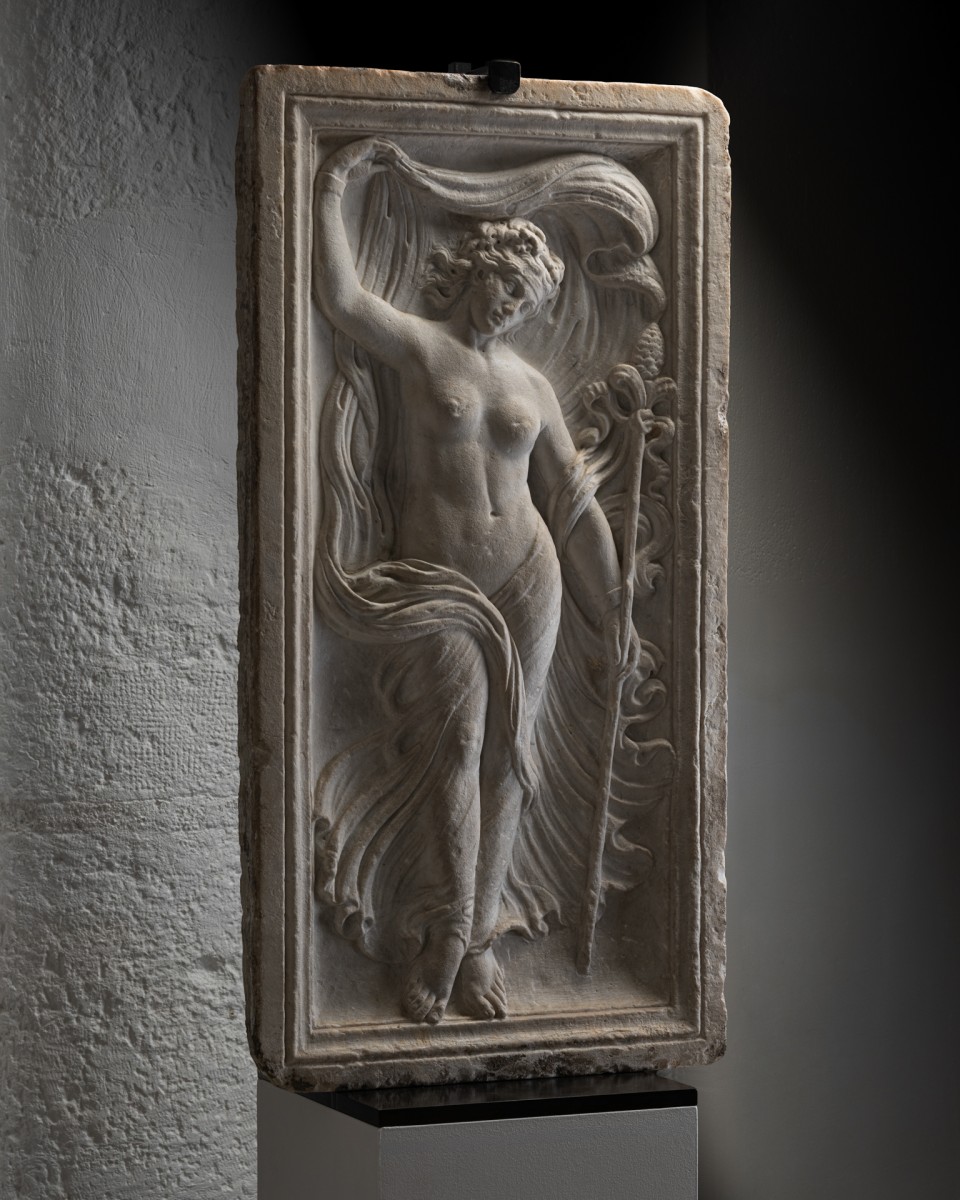
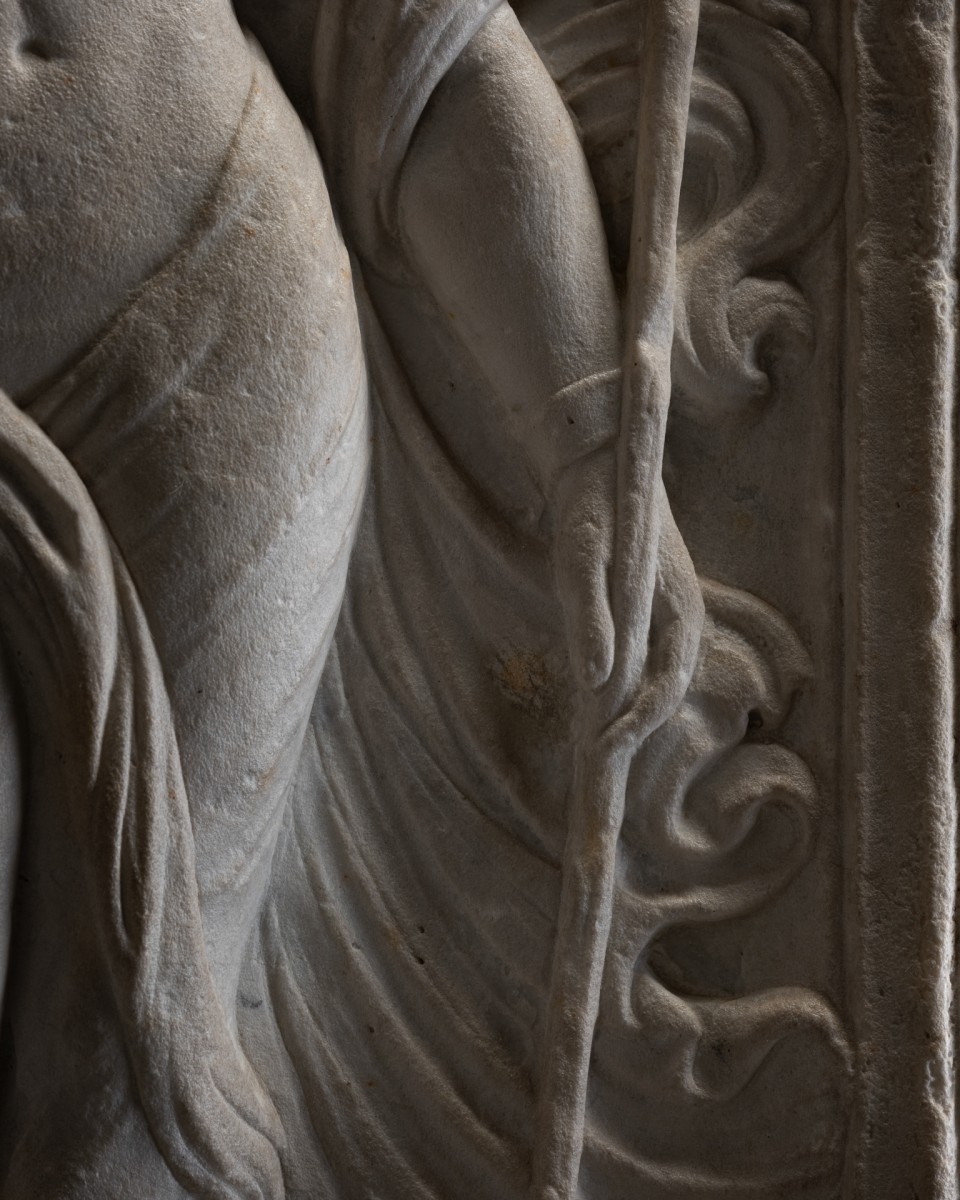
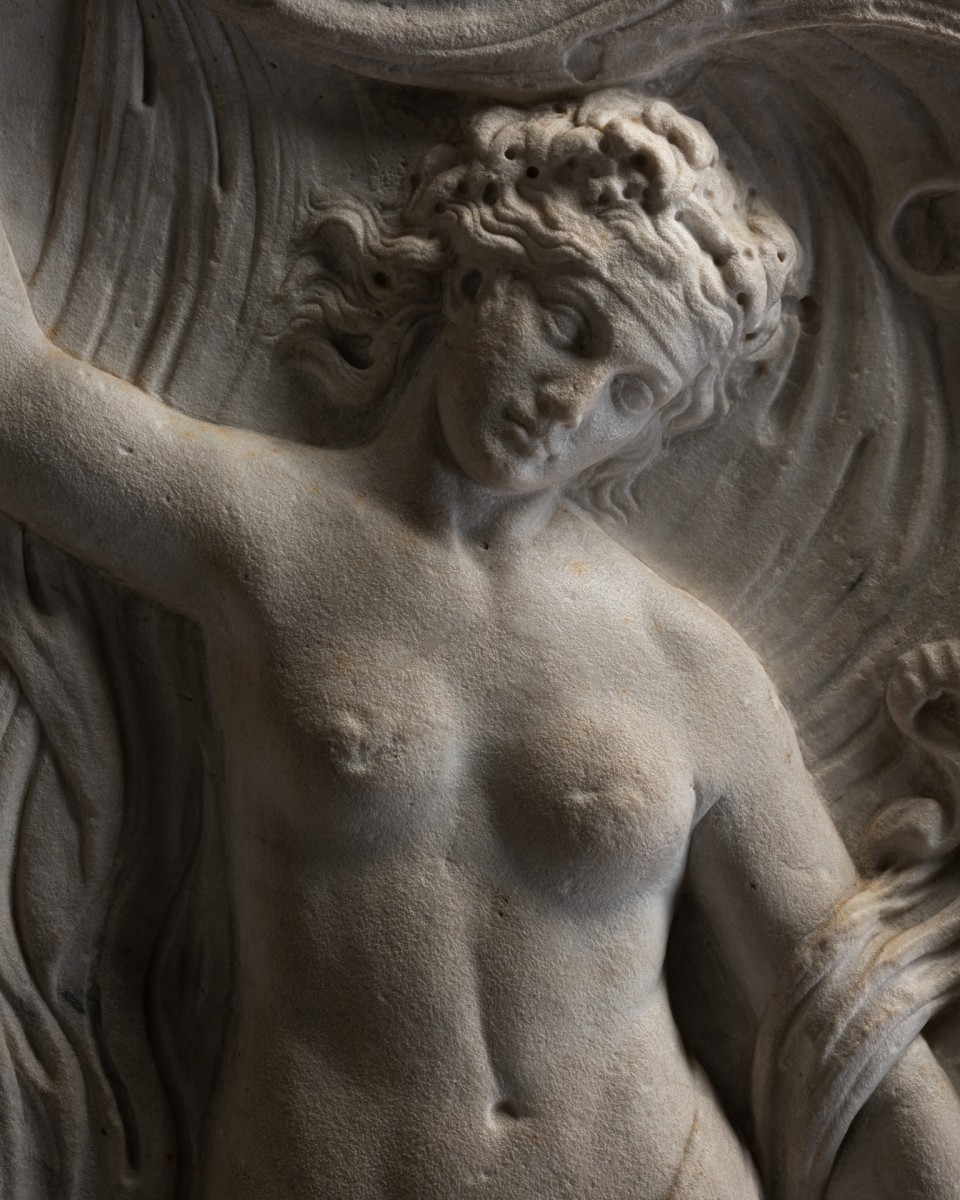

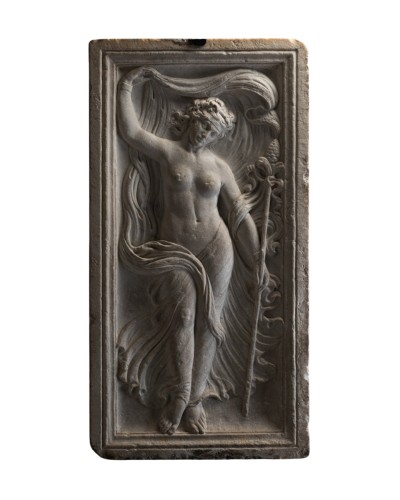
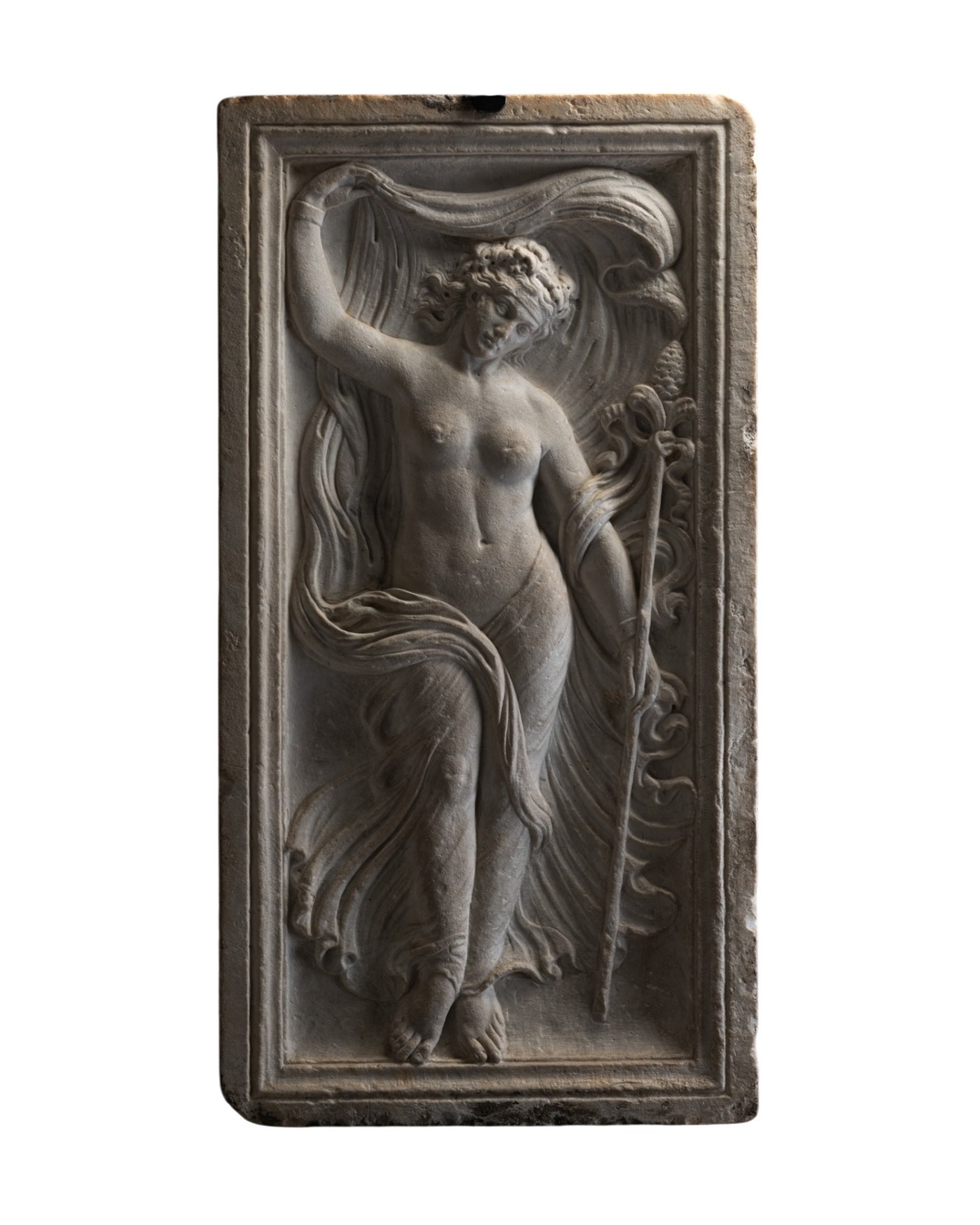
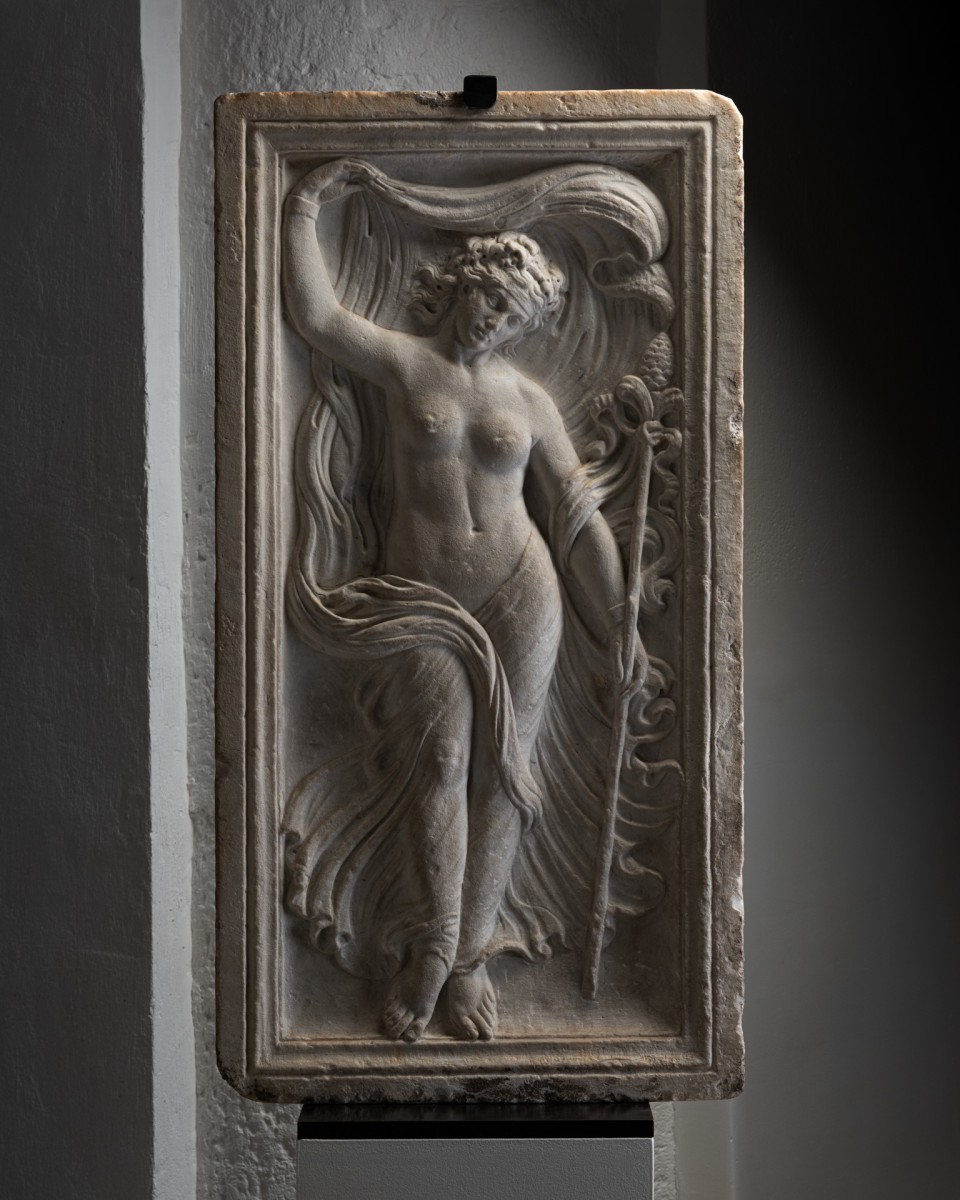
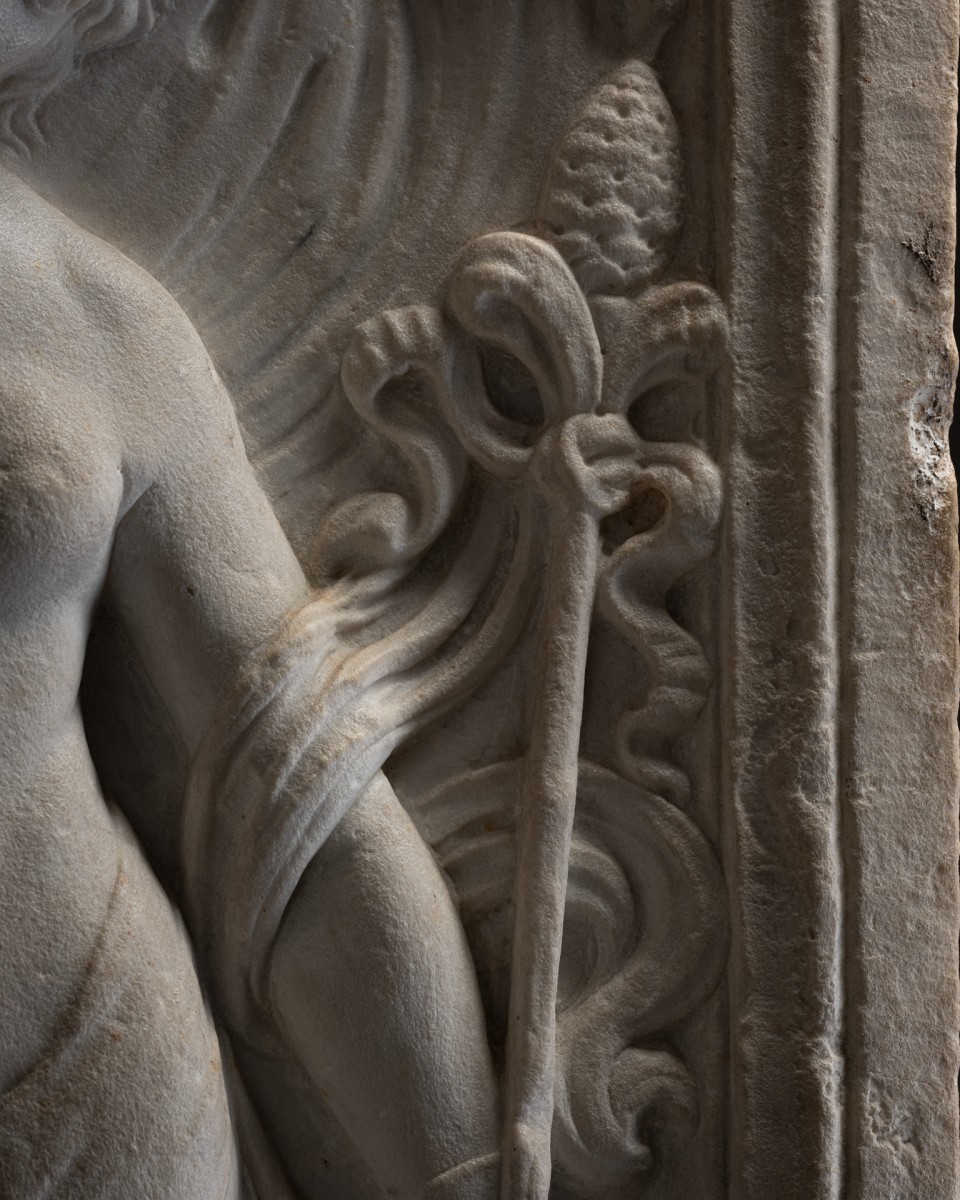
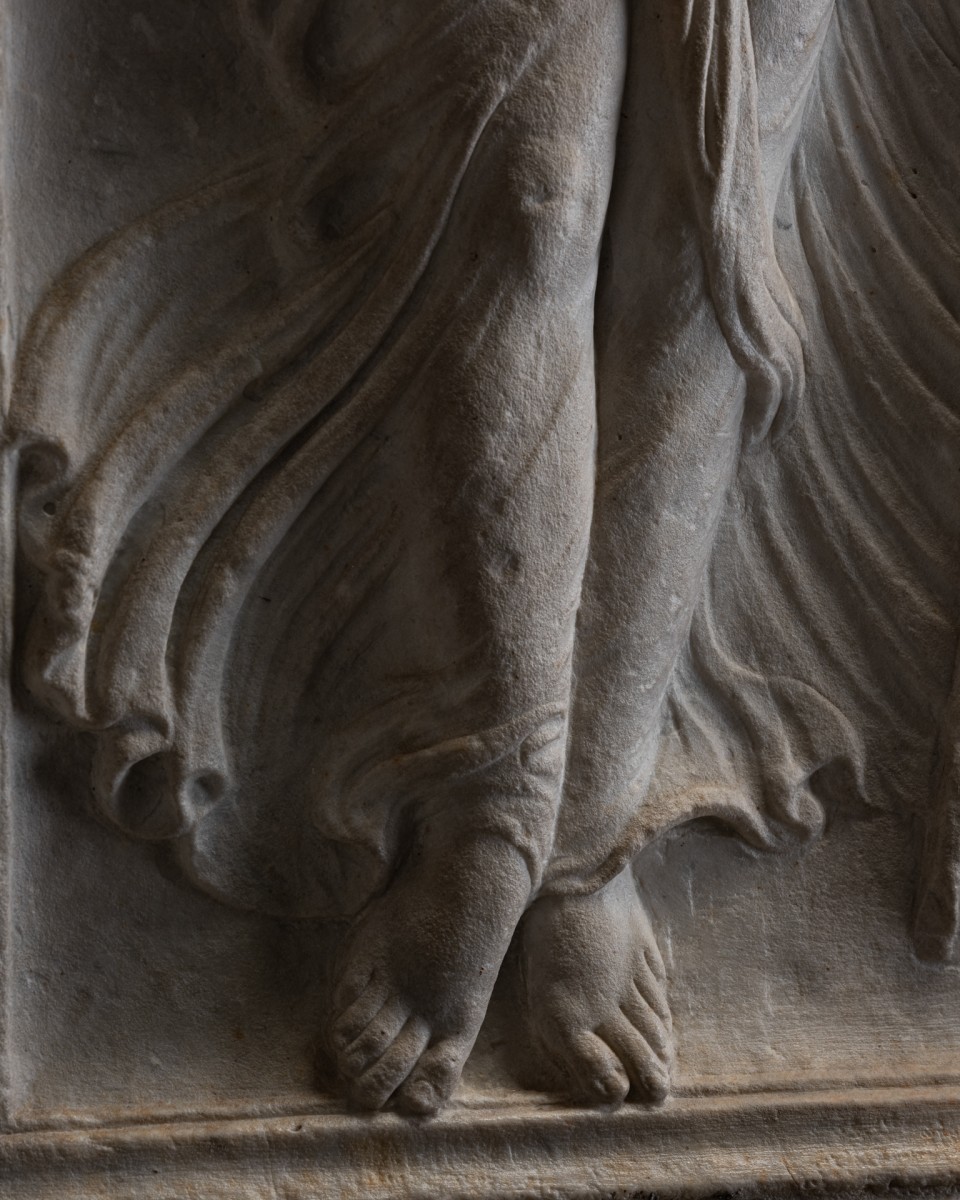
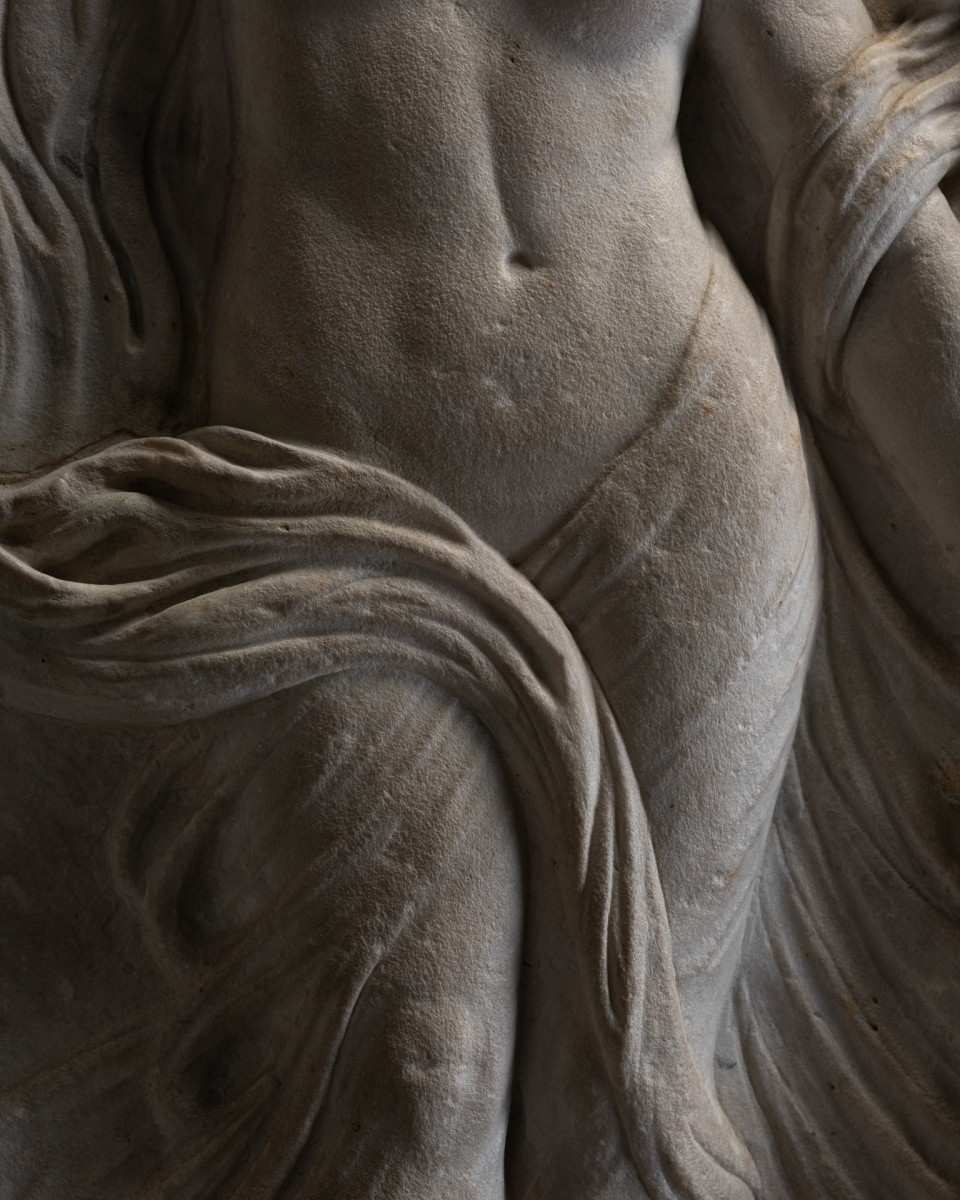
This rectangular marble slab, framed by a molded border carved from a single block, depicts an almost nude female figure captured in the midst of a dance. Standing with her hips slightly swayed, she raises one arm above her head to hold back a large, billowing veil that forms an arc around her. In her other hand, she holds a long staff adorned with a knotted ribbon and topped with a pine cone: a thyrsus, an attribute of Dionysus. She is therefore a Maenad, or Bacchante, a follower of the god in the Bacchic procession. Her torso is bare, and a flowing drapery wraps around her hips and legs, hugging her form while creating numerous folds. Her head, slightly tilted, conveys an almost detached calm, far removed from the ecstasy typically attributed to Bacchantes. Her curly hair, adorned with plant motifs, is pierced with small drill holes. Her large, almond-shaped eyes lack engraved irises or pupils: her gaze arises solely from the volume of the eyeballs and the shape of her eyelids. Smooth bracelets encircle her wrists, and a taenia—a ribbon worn around the forehead—discreetly adorns her face.
The figure stands out clearly against the background, while the background itself and certain sections of the veil retain the understated quality of the stiacciato technique. The reverse side—thick, rough, and pitted—has no finish comparable to that of the front. It bears a continuous ochre patina that extends into the recesses; the edges are blunted, and the borders show minor wear and loss. Taken as a whole, the piece suggests a plaque intended to be embedded or incorporated into a decorative element—such as an architectural panel, a fireplace, or palace or cabinet furniture—rather than a marble sculpture meant to be viewed in isolation. This intended use is crucial to the investigation: it points to sculptors whose figures were designed to be integrated into non-religious architecture.
The subject matter is the strongest aspect of the research conducted on this piece. The dancing maenad is one of the major themes of ancient sculpture: large-scale reliefs, often nearly 1.5 meters tall, preserved notably at the Metropolitan Museum of Art in New York, the Gardner Museum in Boston, the Uffizi, and the Louvre, are derived from a 5th-century BCE Greek prototype that tradition attributes to Callimachus. These figures, with their sweeping dance, flowing veils, and thyrsus, were widely copied during the Roman period in the so-called Neo-Attic style, and it was in this form that the Renaissance came to know them. Italian artists of the 15th and 16th centuries had these reliefs, these Dionysian sarcophagi, these gems, and these coins right before their eyes; they sketched them, circulated them as drawings, bronze plaques, and prints, and freely reinterpreted them. Our maenad is part of this tradition, whose drawings and prints also carried its language beyond the Alps. However, she does not copy any known example: the tilted head, the bare torso, and the arrangement of the veil and thyrsus all differ from both the absorbed type derived from Callimachus and the menad thrown into ecstasy of the so-called Dresden type. This divergence is precisely what one would expect from a Renaissance work, which draws inspiration from antiquity without reproducing it.
La date retenue comme hypothèse de travail est donc le milieu du XVIe siècle, dans un climat maniériste que partagent l’Italie et la France. Plusieurs traits y invitent. Le goût pour le nu antique et pour le drapé mouillé, qui laisse deviner le corps tout en démultipliant les plis, est commun à toute la sculpture all’antica de la période. La pose, théâtrale et déhanchée, le contraste entre les chairs lisses et les plis creusés, l’ambiguïté entre citation savante et invention moderne relèvent d’une sensibilité qui, après les équilibres du début du siècle, cherche l’élégance, la virtuosité et le mouvement. Le travail au trépan dans les boucles, d’abord prisé des sculpteurs romains, est repris par les artistes de la Renaissance qui veulent retrouver l’effet de profondeur des marbres antiques. Enfin, les yeux vierges ont un équivalent chez des sculpteurs italiens du XVIe siècle, notamment dans les bustes et reliefs féminins all’antica de l’entourage des Lombardo, qui se distinguent en cela de la manière de leurs maîtres, lesquels incisaient systématiquement le regard.
The dancing maenad first and foremost embodies the sacred ecstasy that the Greeks called *enthousiasmos*: the state of one who is filled with the god. In the procession of Dionysus, she represents the abandonment of self-control under the influence of wine, music, and dance—a ritual intoxication experienced as communion with the deity rather than mere excess. The thyrsus she brandishes—a staff wrapped in ivy and vine leaves and crowned with a pinecone—evokes plant vitality, the vine, and the cyclical renewal of nature, for she accompanies a god who dies and is reborn. The myth also attributes a dark side to her, as seen in Euripides’ *The Bacchae*, where the same fury that liberates can also destroy. Everything about this figure’s body conveys this trance: the swaying hips, the raised arm, the large veil billowing with movement, and the drapery pleating around her legs. Her face, however, is surprisingly calm. It bears neither the laughter nor the grimace one would expect from a Bacchante, and the expression—almost detached—seems at odds with the body’s agitation. One can discern in it the tension characteristic of art inspired by Antiquity: a body carried away and an idealized face, undistorted by delirium. One can also see in it the mark of the trance itself, for the possessed person is “out of herself” (ekstasis) and appears oblivious to her surroundings. The large eyes—left without engraved irises or pupils—reinforce this impression: her gaze is directed at no one; the figure dances in a time that is not the viewer’s. Like her gaze, the maenad eludes us: we search for her in Italy or France, from ancient art to the Renaissance; she still dances, and she remains silent.
Delevery information :
Please note that packing and shipping costs are not included in the price of the objects which are quoted ex shop.
Final amount including packing and shipment to be discussed with Galerie Alexandre Piatti.