Offered by Galerie Alexandre Piatti

Works of art, sculptures and furniture Haute Epoque
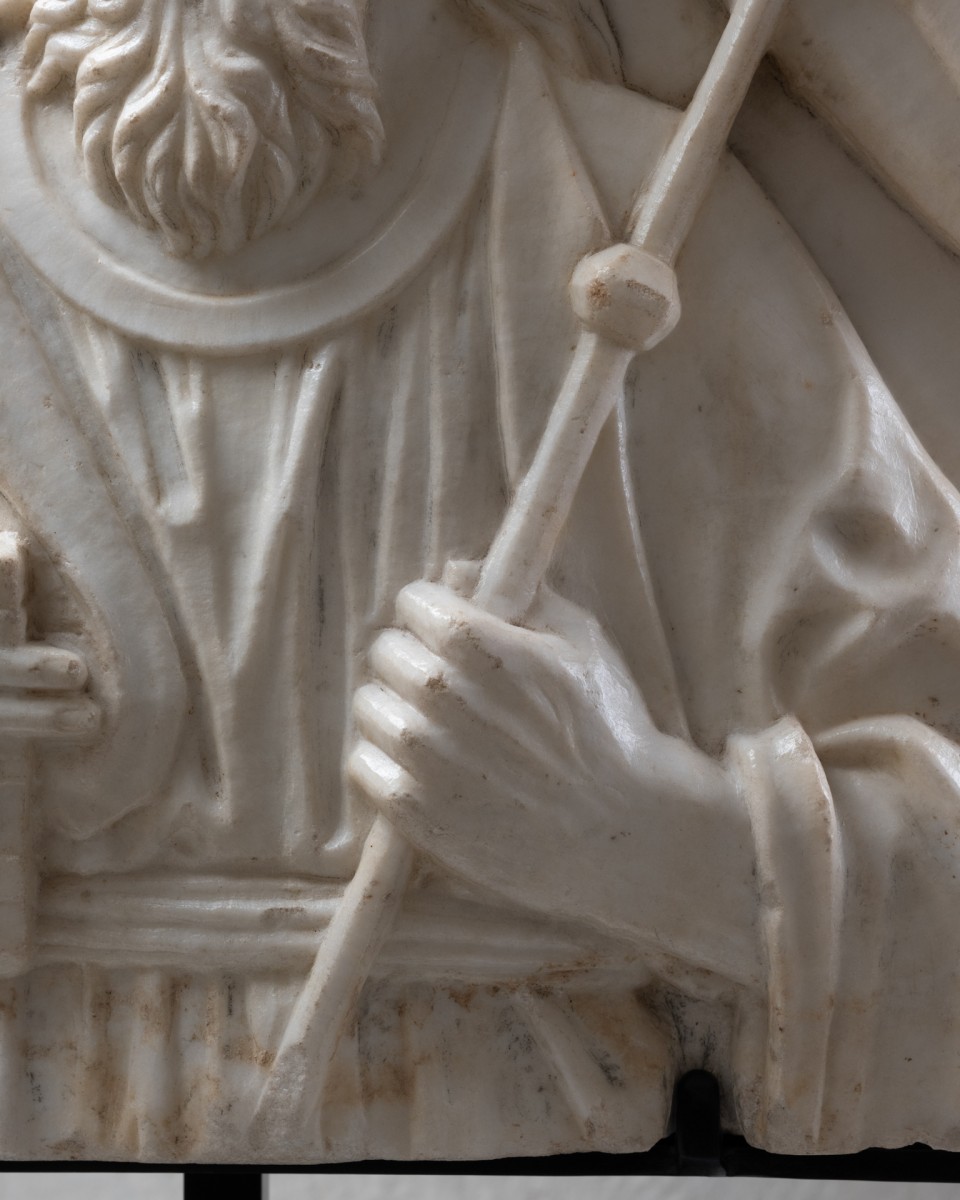
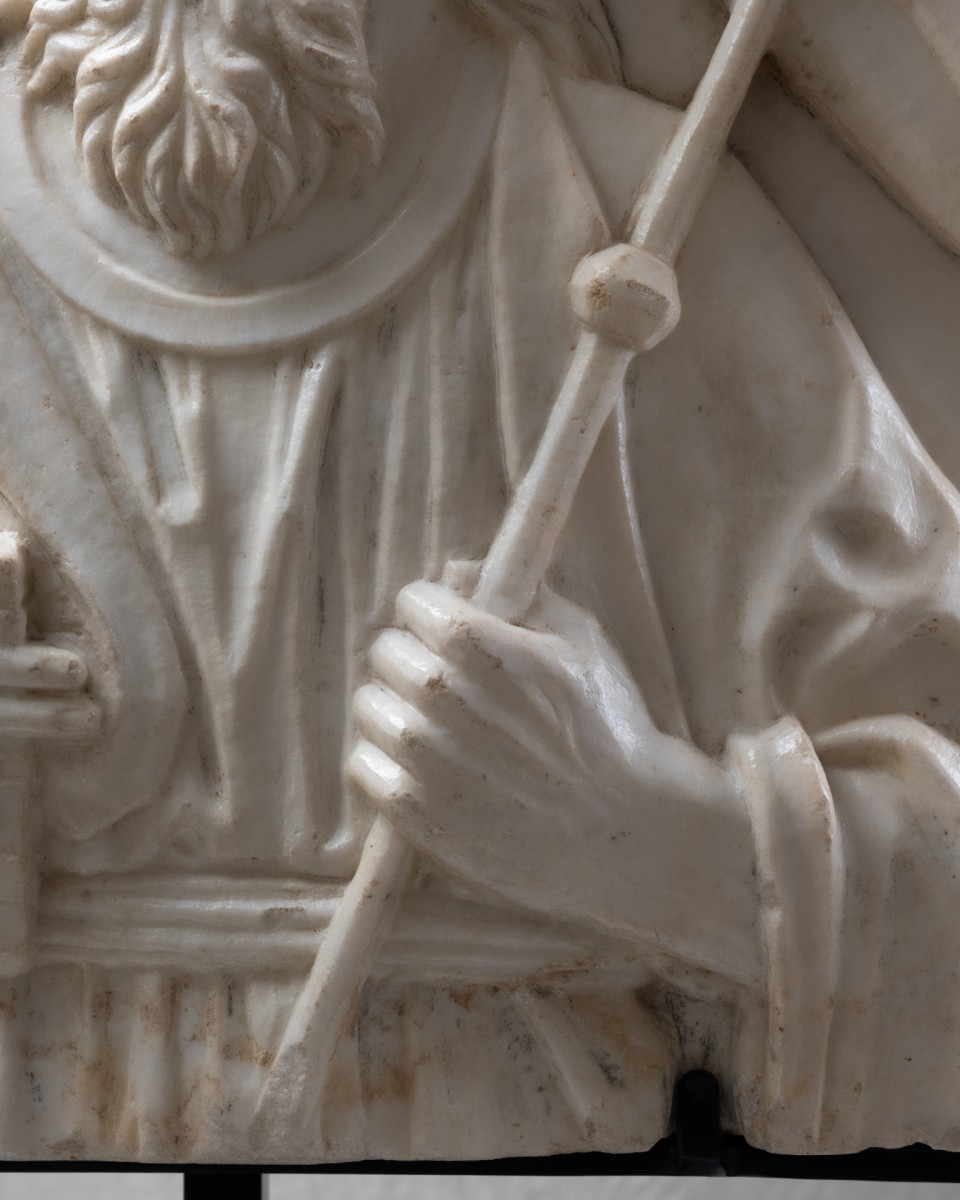
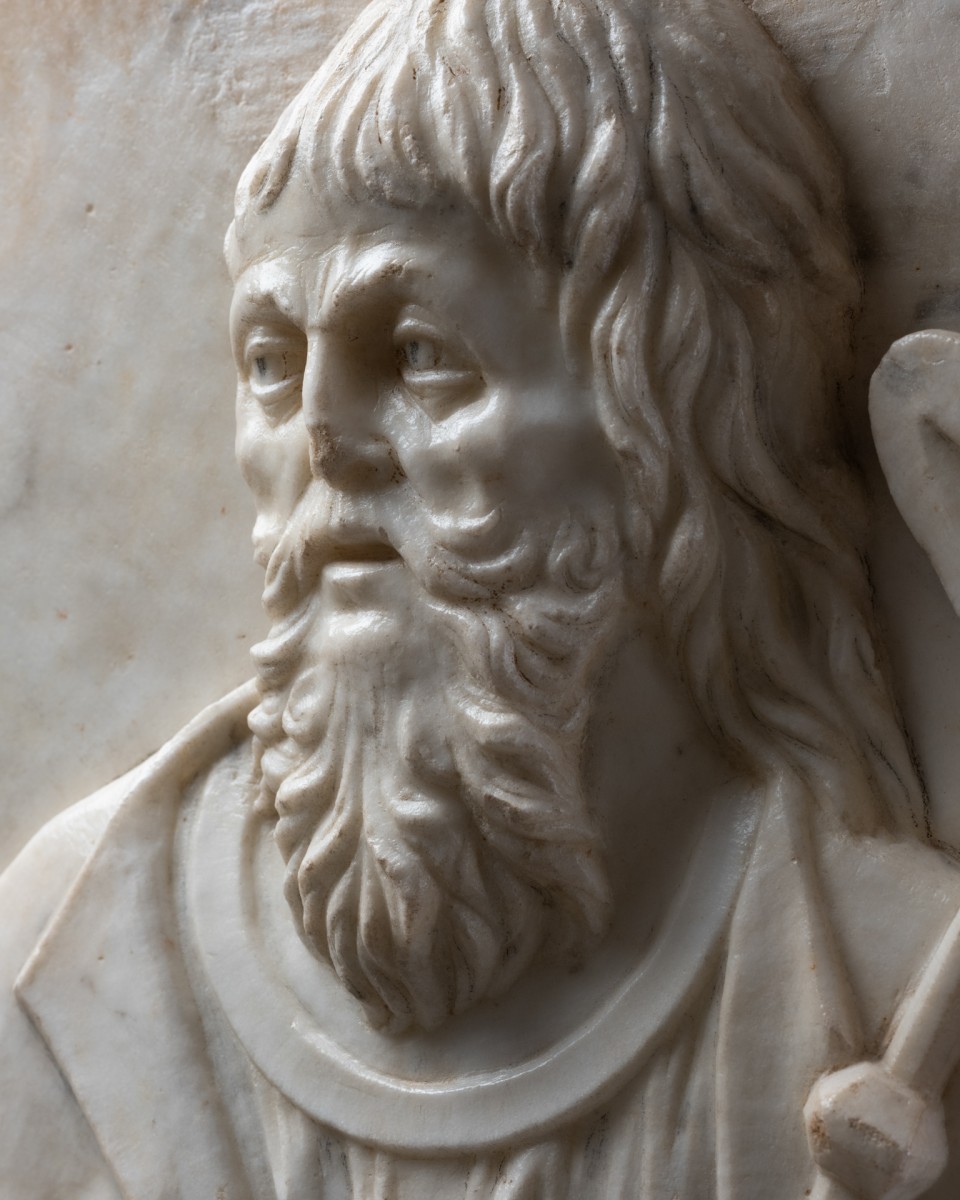
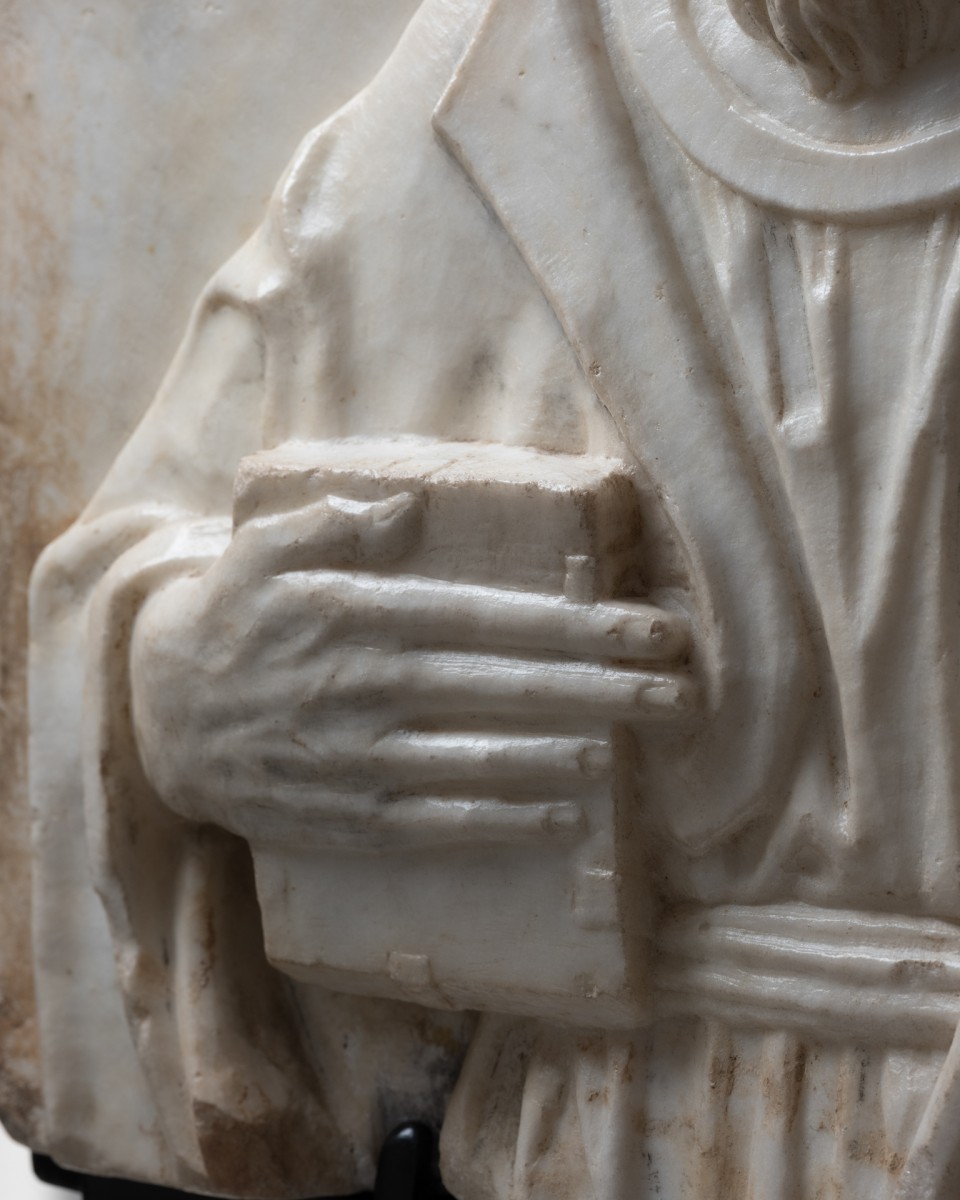
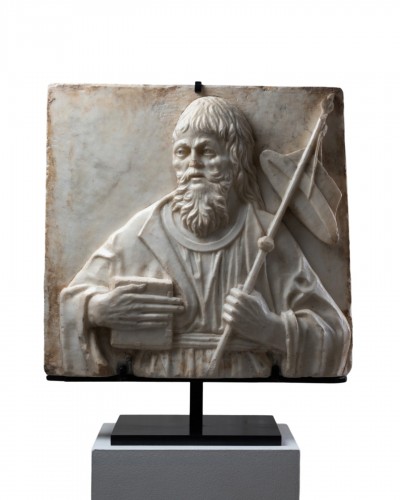
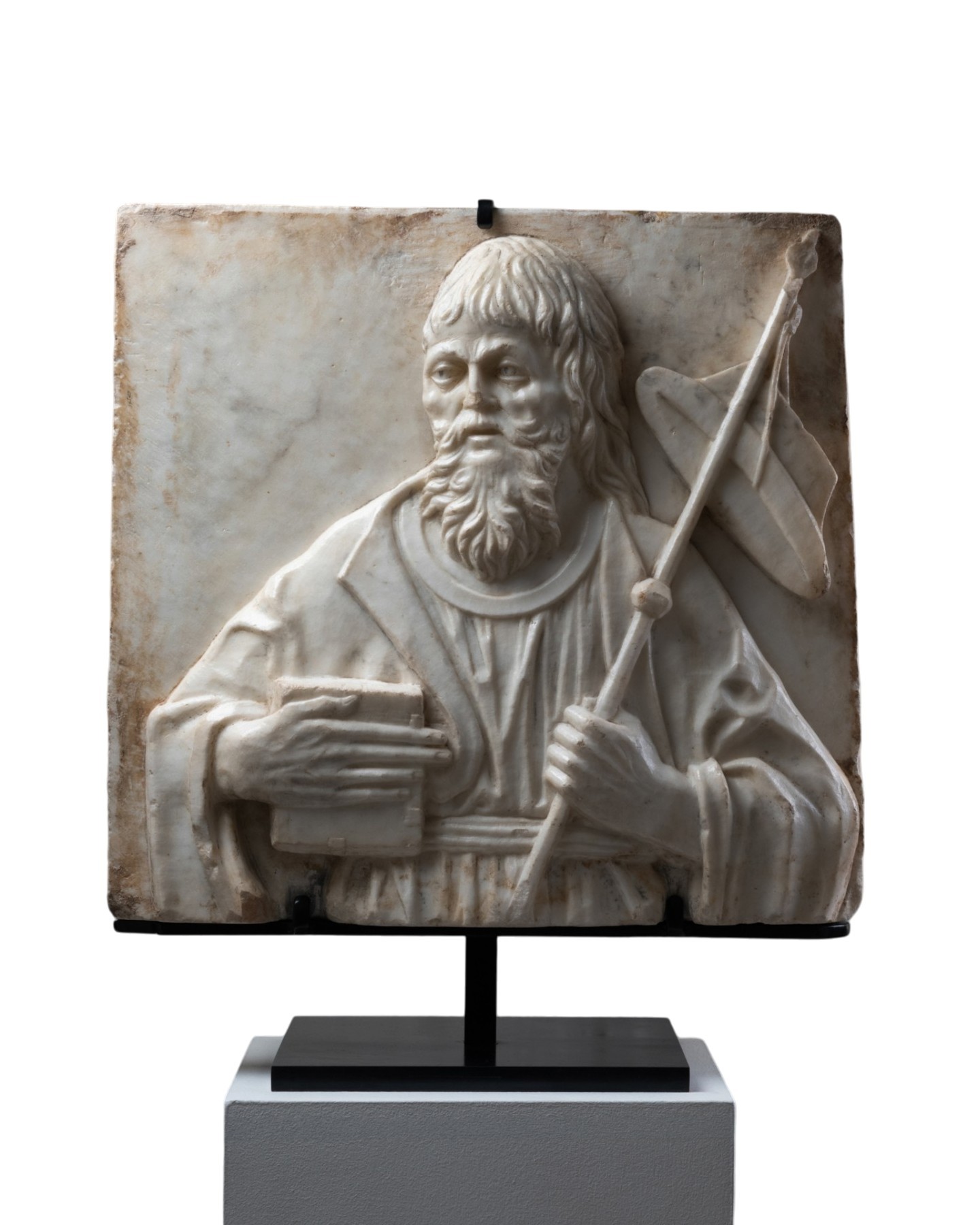
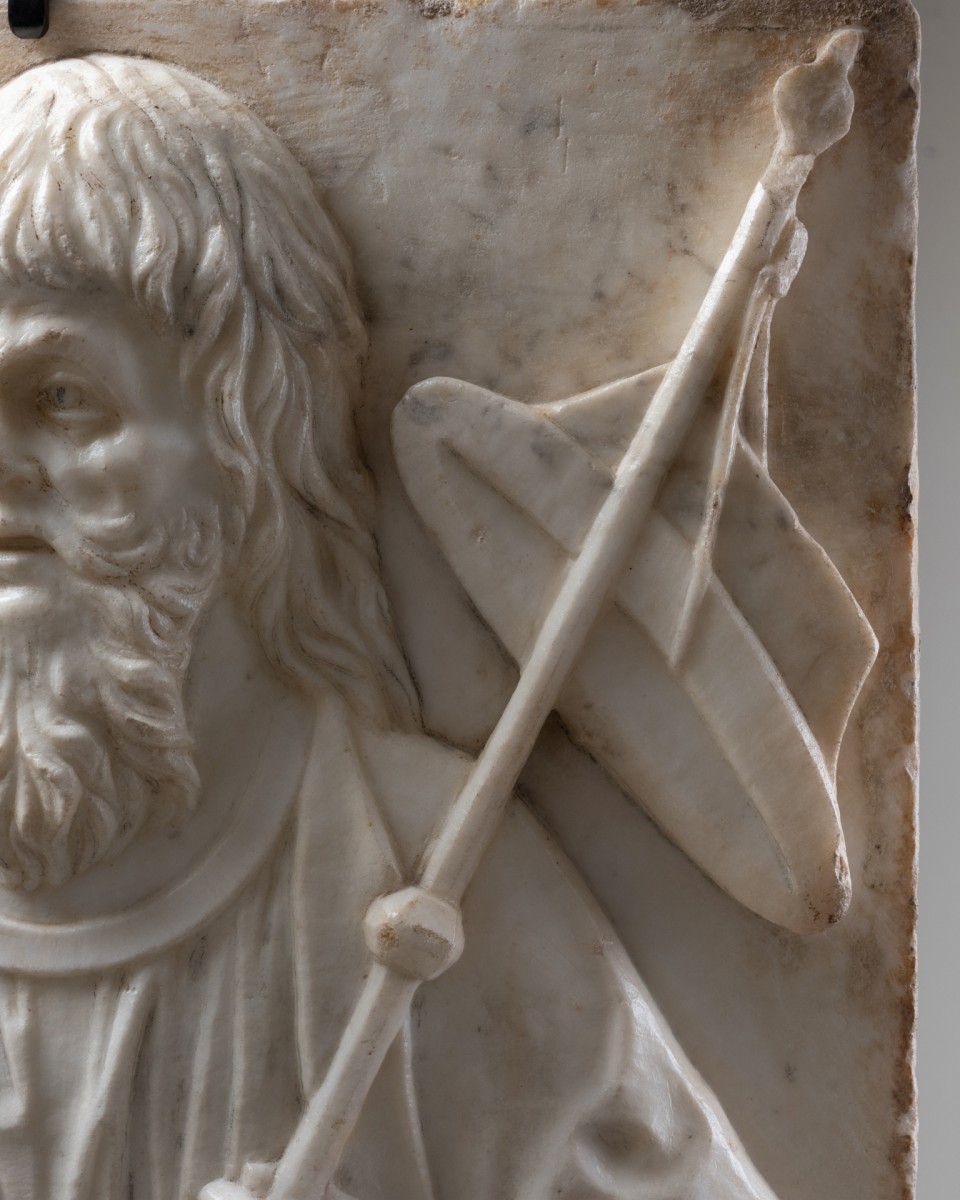
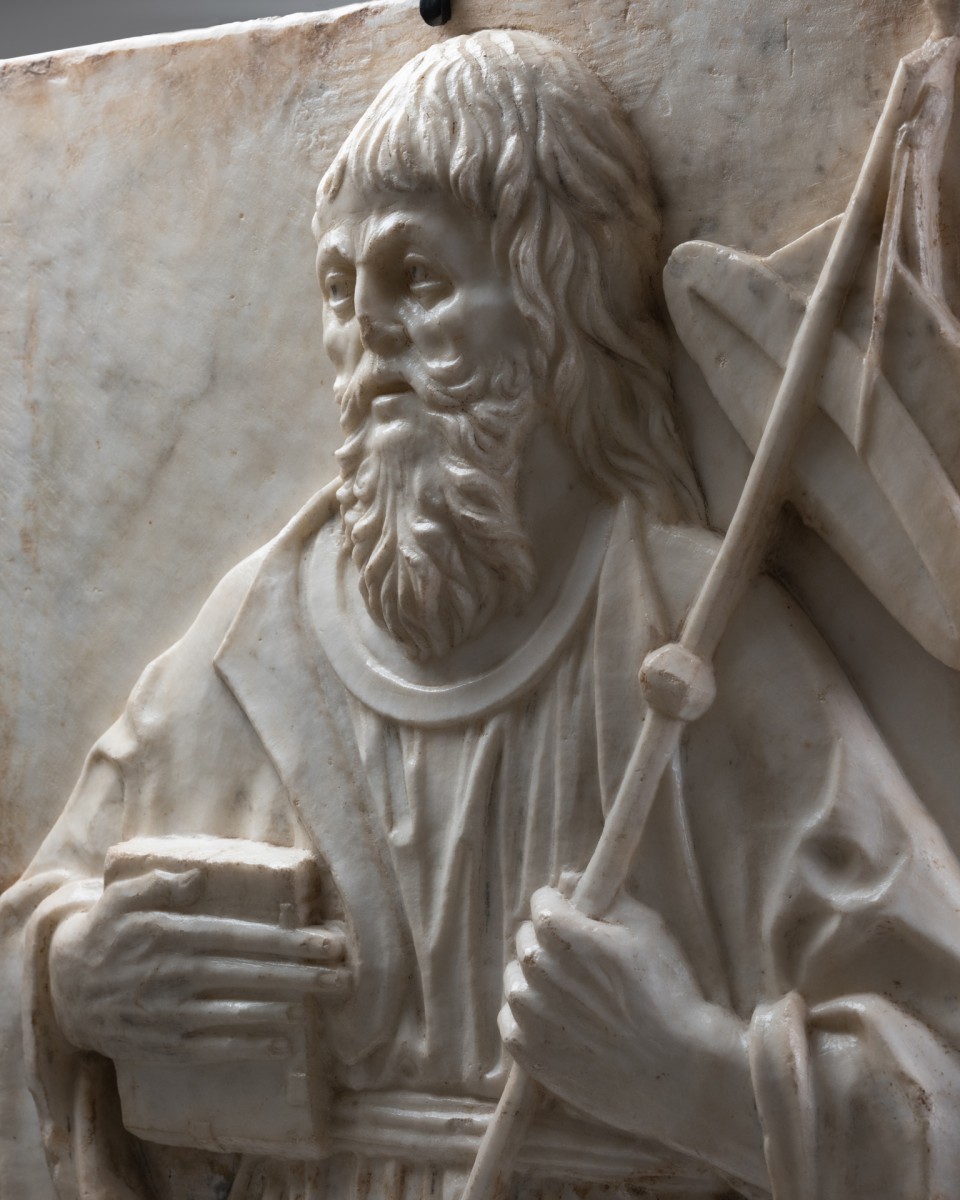
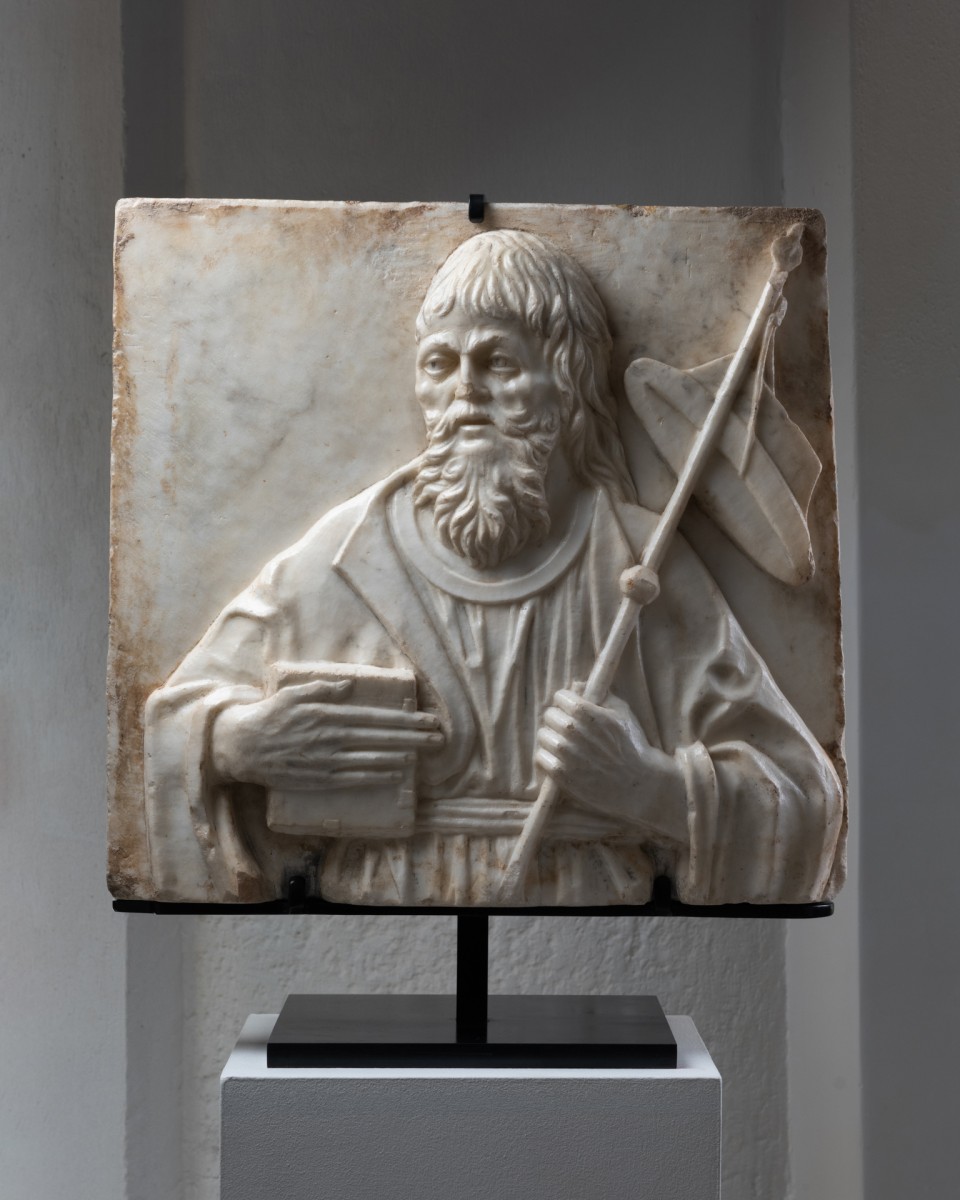
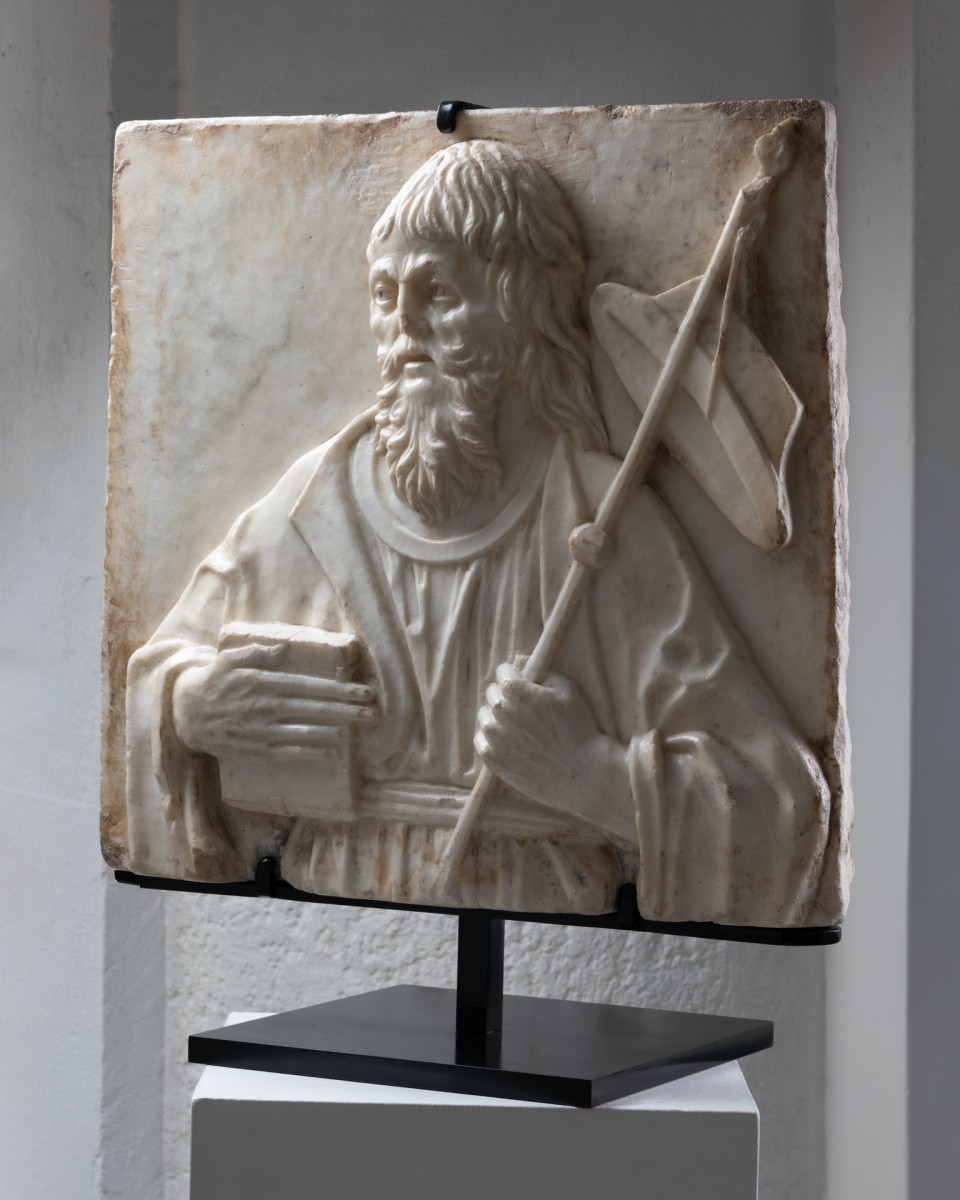
Saint James the Greater is depicted in full face as a pilgrim in a white marble relief of nearly square shape. The figure is rendered in very high relief, with the face, beard, and hands projecting strongly, while the various attributes are arranged across several planes. The man—mature, bearded, and with a full head of hair—holds a closed book in his left hand—likely the Book of the Gospels, an attribute of the apostles—and grasps a long staff positioned diagonally with his right hand, known as a pilgrim’s staff. Behind his shoulder, his pilgrim’s hat is clearly visible, crossed by the staff. The combination of these attributes—book, staff, and hat—allows us to confidently identify the saint as James the Greater, depicted in his role as a pilgrim. The scallop shell, a traditional attribute of the saint, is not clearly visible, but its absence does not prevent identification when the other attributes associated with St. James are so clearly present.
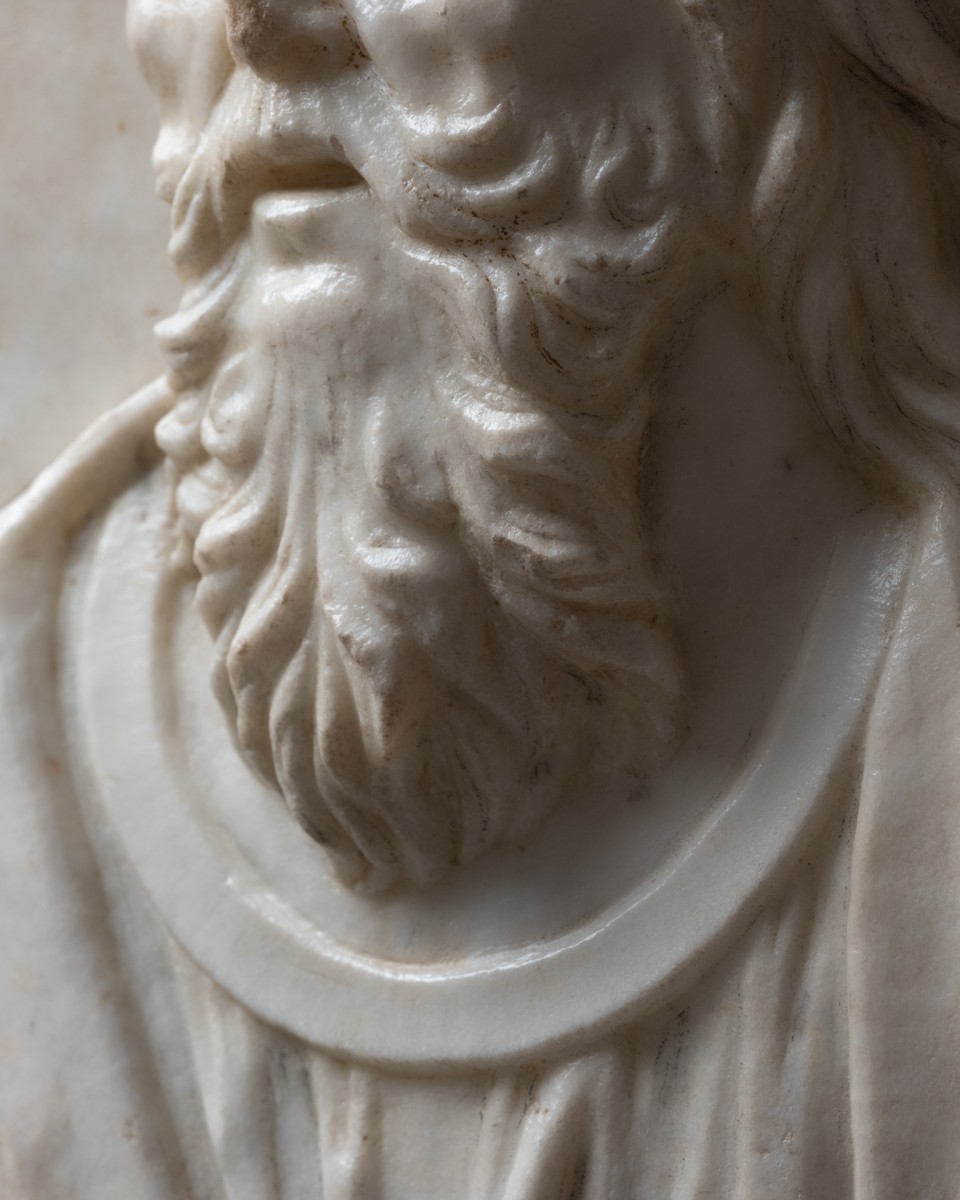
The composition is distinguished by a particularly assertive monumental design. The diagonal line of the staff brings dynamism to an otherwise frontal figure, while the crossing of the attributes behind the shoulder creates a succession of planes and accentuates the depth of the relief. The face, beard, and hands are powerfully projected toward the viewer. The hands, executed with remarkable finesse, are particularly striking due to the delicate rendering of the fingers, joints, and protruding veins, rendered with exceptional naturalistic precision despite the figure’s overall monumentality. The beard and hair are rendered as broad masses crisscrossed by deep furrows rather than as a detailed depiction of individual hairs, while the face is characterized by heavy upper eyelids, deeply set eye sockets, a powerful nose, a compact mouth, and pronounced nasolabial folds. This set of features is fully in keeping with the style of Brescian sculpture from the first decade of the 16th century, and the balance between monumental power and refined detail is one of the relief’s most remarkable qualities.
These characteristics directly link the relief to the work of Gasparo Cairano and his immediate circle. Active in Brescia from 1489 and documented until 1513, Cairano was one of the city’s leading sculptors at the turn of the 15th and 16th centuries. The portal of the Duomo of Salò, created between 1506 and 1509, provides a particularly significant point of comparison: the figures of Saint Peter and Saint John the Baptist attributed to him display a rendering of the faces, beards, and volumes that is particularly similar to what is seen here. The same stylistic language is found in the Apostles of San Pietro in Oliveto in Brescia, a group of marble busts created in the early 16th century and attributed to Cairano and his collaborators. It is also worth noting here that his treatment of the hand—and more specifically the fingers—is characteristic of his work: particularly slender and elongated fingers, displaying a rare delicacy.
The comparison with the *Compianto sul Cristo morto*, studied by Vito Zani in 2022, also sheds light on the construction of the facial features. The value of this comparison lies in the continuity of the treatment of the eyes, nose, mouth, beard, and facial contours rather than in a mere general resemblance. The *Compianto*, however, should be considered a point of stylistic comparison, whereas the figures on the Salò portal and the Apostles of San Pietro in Oliveto provide more solid references for situating the relief within the artistic context of Cairano. Other parallels, notably with the five-figure Pietà at the Castello Sforzesco, the Arca di Sant’Apollonio in Brescia, and the Madonna on the Throne with the Child Pointing to the Book, round out this body of work and reinforce the credibility of the Brescian attribution.
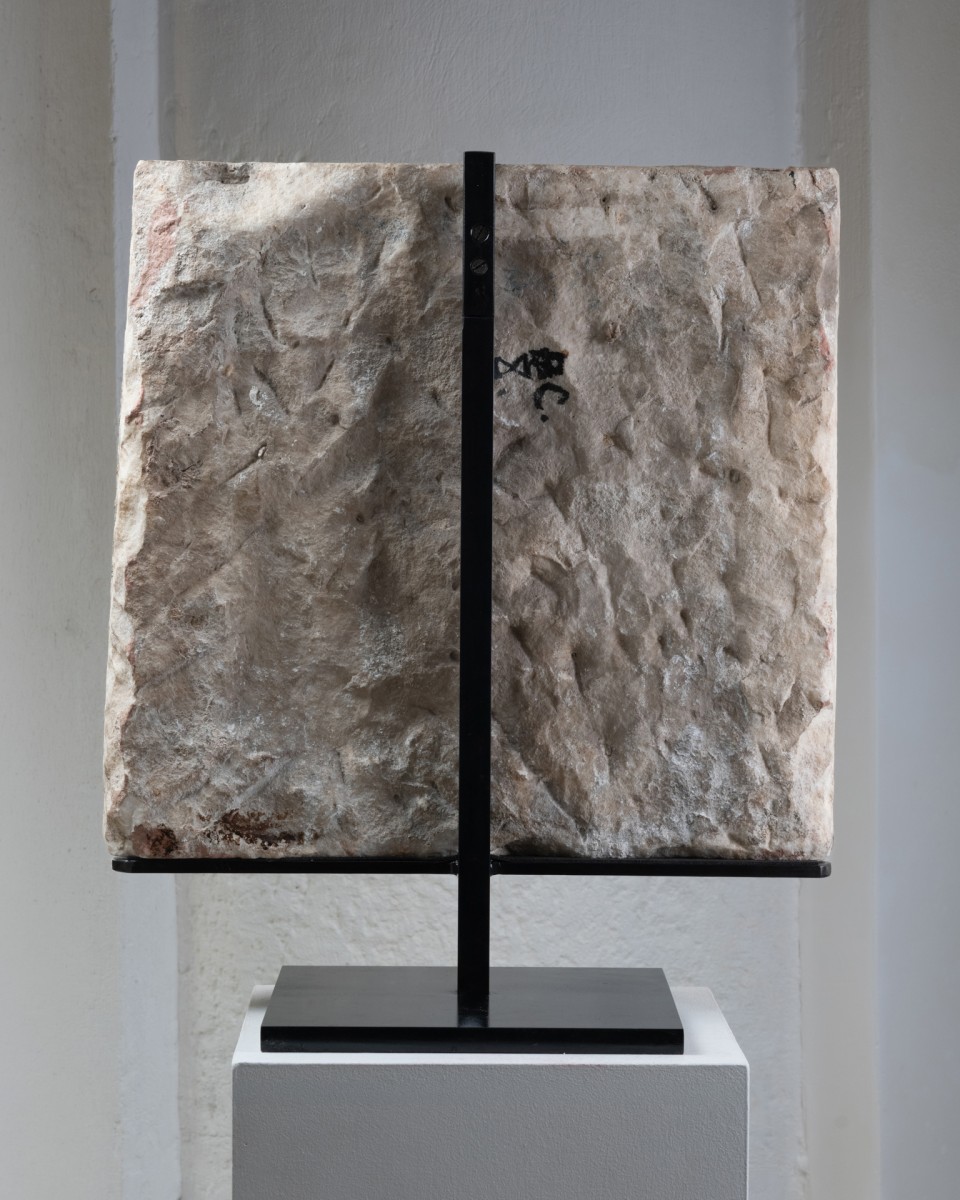
The work can thus be dated to Brescia, in eastern Lombardy, around 1505–1515, with a preference for the years 1507–1512, a period that is particularly consistent with the connections established with the Cairano workshops. Furthermore, its nearly square format, its preserved background, and its deeply recessed relief treatment indicate that it was designed to be part of a larger, likely architectural, ensemble. The construction of the relief also shows that the figure was intended to be viewed from a vantage point situated slightly lower and to the right: when viewed head-on, Saint James exhibits a slight distortion of proportions, which is corrected when the work is viewed from this preferred angle. This optical correction suggests an elevated location, likely within an architectural setting, and a presentation designed to be viewed primarily from the right.
Iconographically, Saint James the Greater embodies the figures of the apostle, the martyr, and the pilgrim. The son of Zebedee, brother of Saint John the Evangelist, and one of Christ’s closest disciples, he was present, in particular, at the Transfiguration and the Agony in the Garden of Gethsemane. He was the first of the Twelve Apostles to die a martyr, executed in Jerusalem on the orders of Herod Agrippa around A.D. 44. Added to this apostolic history, beginning in the Middle Ages, is the great Jacobean tradition: according to which James is said to have evangelized Spain, and his body was subsequently transported to Galicia, where his tomb was discovered in Santiago de Compostela, making the city one of the principal pilgrimage centers of Western Christendom. This tradition, even though some of its episodes remain historically disputed, has profoundly shaped his iconography. In our relief, the iconographic association is particularly significant: the staff and hat make James the embodiment of the pilgrim on the road, while the book refers to the transmission of the faith. He thus appears as an apostle, a witness to Christ, and a spiritual guide, embodying the figure of the Christian journeying toward the holy place and, more broadly, toward salvation.
With its clearly identifiable subject, the quality of its craftsmanship, and above all its sculptural style, this Saint James the Greater is a particularly representative example of Brescian sculpture from the early 16th century.
Delevery information :
Please note that packing and shipping costs are not included in the price of the objects which are quoted ex shop.
Final amount including packing and shipment to be discussed with Galerie Alexandre Piatti.