Offered by Ars Antiqua
REQUEST INFORMATION

Old Masters paintings, furniture, sculptures and modern art
The pair of marble sculptures presented here fits within the context of early eighteenth-century Venetian sculpture, and specifically within the circle of Francesco Bertos—a sculptor and founder born near Venice, precisely in Dolo, along the banks of the Brenta River. Reconstructing his biography has been highly difficult for critics, to the point of being unable to confirm with certainty the long-rumored hypothesis of a youthful journey to Rome.
A closer examination, made possible by new studies carried out on the occasion of the recent exhibition dedicated to him at the Gallerie d'Italia in Vicenza, has instead deemed travels and experiences in the Veneto region or neighboring Romagna more plausible. This outlines a training closely tied to his homeland, where the Bonazza workshop operated, founded by his contemporary Giovanni, with whom Bertos also collaborated. The latter was a pupil of the Flemish artist Giusto Le Court, who was active in Venice and a representative of that virtuosity of seventeenth-century Flemish and German sculptors who so deeply inspired Bertos in the meticulous creation of small bronze and marble sculptural groups.
Other sources of inspiration outside of Venice include Tuscan influences, such as the works of the Florentine Giovanni Battista Foggini, a contemporary sculptor and architect in the service of the Medici, and those of a Mannerist stamp by Giambologna, whose compositions—such as the Two-Figure Rape (1579)—served as inspiration for Bertos's most original sculptures. Indeed, his fame would be established among great European patrons, such as Tsar Peter the Great, King Charles Emmanuel III of Sardinia (Savoy), and Doge Alvise Pisani, thanks to small-format works executed with minute detail and through compositions of extreme complexity and a dynamic structure, free to expand in space.
Bertos's incredible technical skill amazed his contemporaries, so much so that this almost superhuman mastery drew the attention of the Inquisition, which accused him of having made a pact with the devil. In addition to this highly praised technical virtuosity, Bertos's sculptures hide a scholarly, allegorical, mythological, and symbolic dimension, allowing them to be interpreted as precious intellectual games. This is also present in this pair of statuettes, which are connected not only by genre but also by the hunting theme—a subject the artist also treated in other sculptures, such as the Allegory of Hunting in the Royal Palace of Turin. If one can be interpreted as Diana, the Roman goddess of the hunt, represented here perhaps in the act of drying herself after her bath, the other seems to be a hunting deity closer to the allegorical representation of the American continent, often depicted with a bow and arrows and in a vigilant, combative pose.
The dynamic and fluid poses, the meticulous workmanship, the small format, and the subtlety with which the theme of the hunt is allegorically treated appear as clear references to the art of this sculptor and to the culture of the period and areas in which he lived and worked.
Part 2: Giuseppe Cesari (Cavalier d'Arpino) – Essay
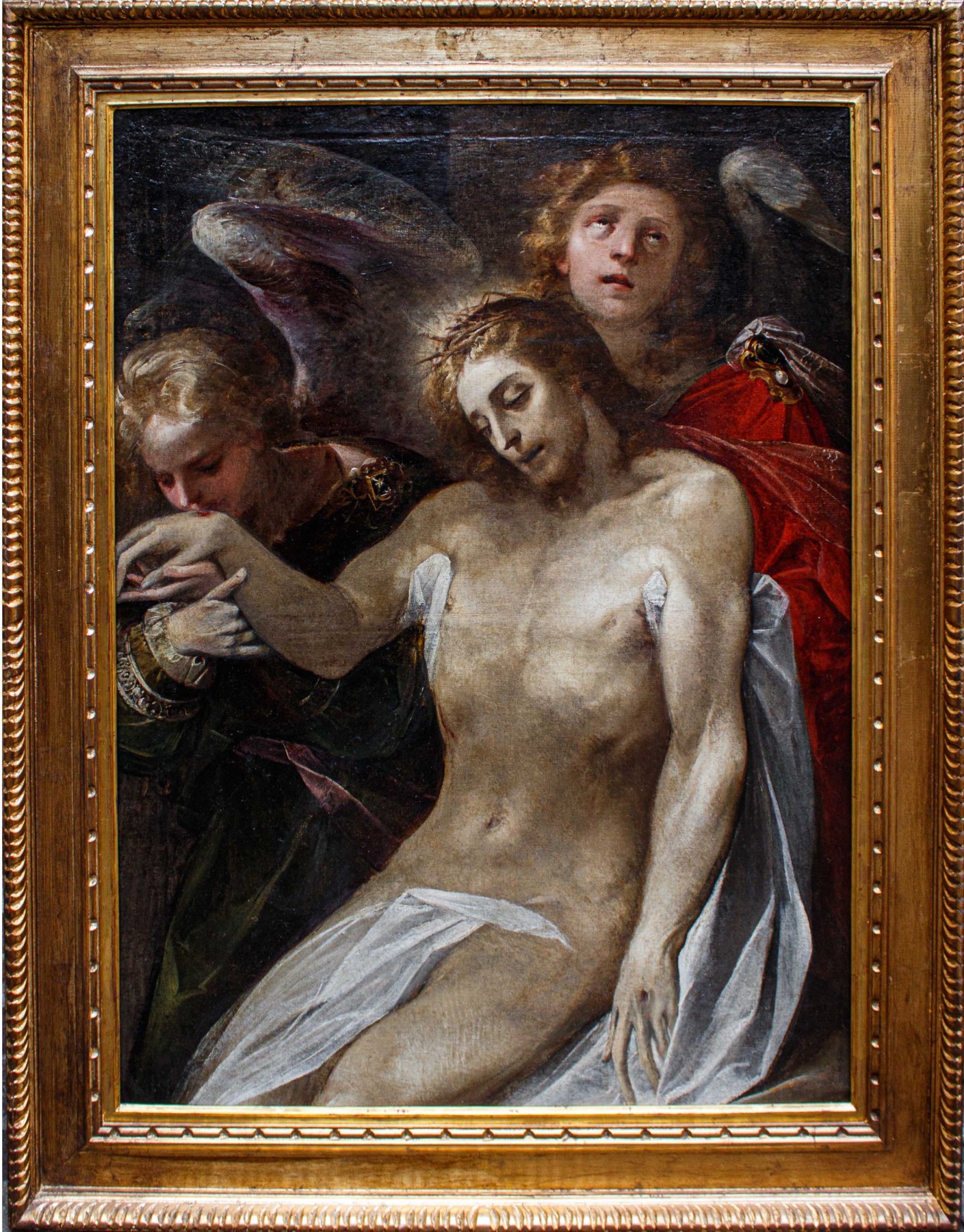
The compositional and stylistic references connect this canvas depicting the Dead Christ Supported by Angels to the oeuvre of the painter Giuseppe Cesari, known principally as the Cavalier d'Arpino (Arpino 1568 – Rome 1640).
The unusual subject of Christ lamented by angels, though not appearing in biblical texts, falls within the devotional tradition of the Pietà, in which the lifeless body of Christ is held upright by angels or mourners. This iconography is typical of the highly fruitful second decade of the seventeenth century, during the height of the Counter-Reformation. The pathetic theme of Christ's death perfectly meets, in its emotional potential, the aims of the post-Tridentine Church. Compared to Renaissance examples, the typology of the dead Christ supported by angels represents a thematic novelty dating back to Taddeo Zuccaro, which was destined to become highly popular in the seventeenth century. It is no longer humans but the angels of Heaven who weep for and adore the Son of God sacrificed for humanity; neither the Virgin, the holy women, nor Joseph of Arimathea appear, as if only Heaven could worthily mourn His death.
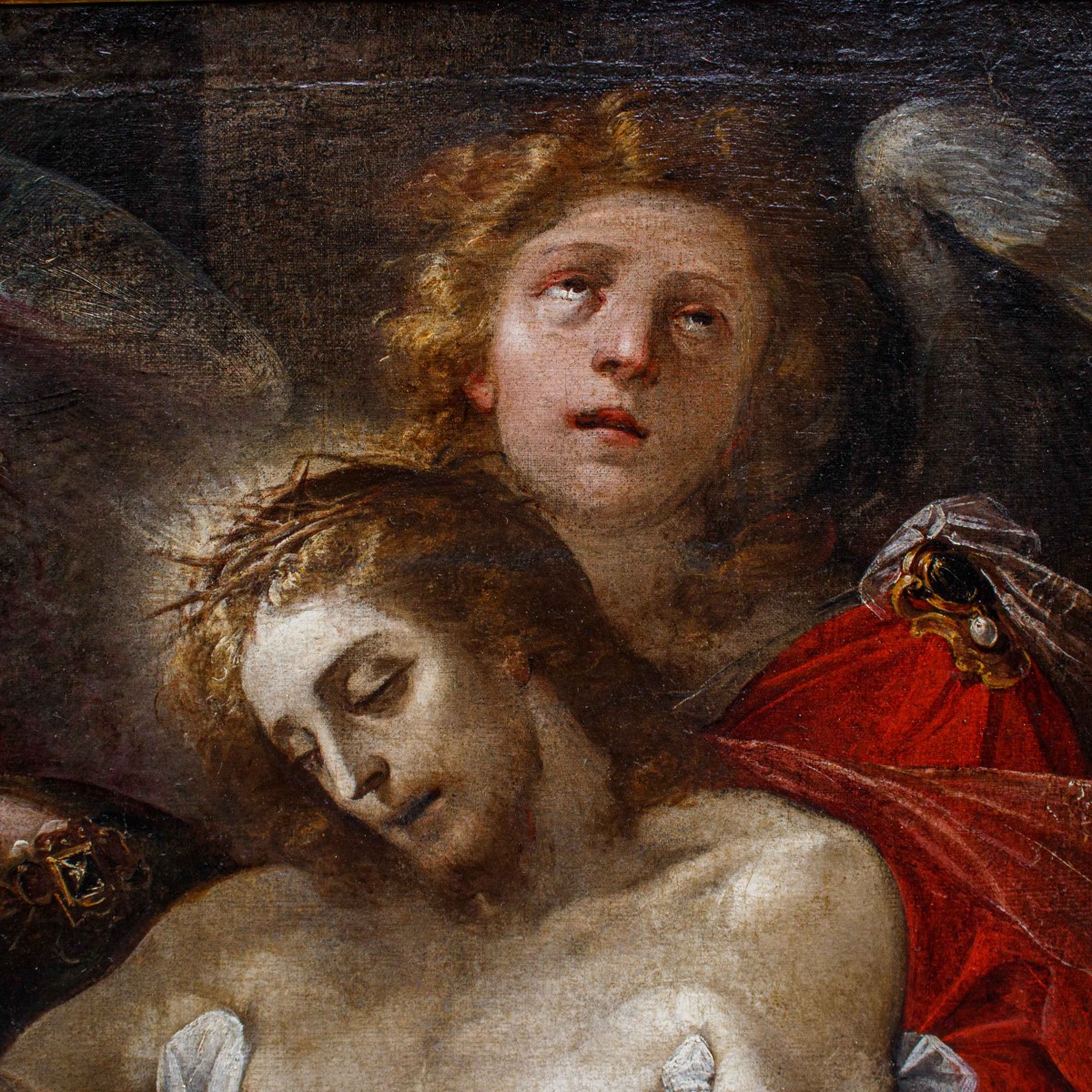
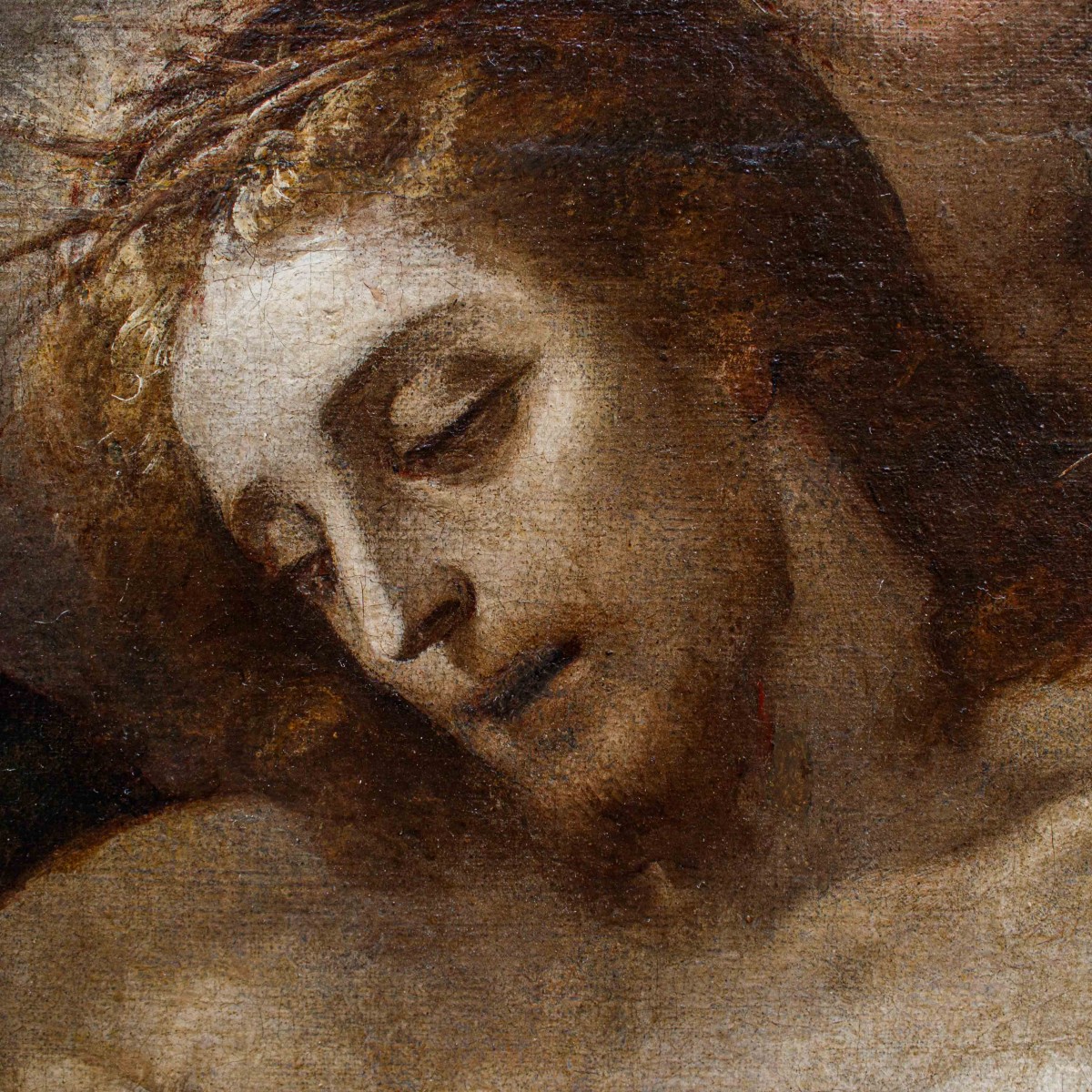
In the present work, the focal point of the composition is the pale body of the Savior in pietà, still wrapped in the shroud and with His head completely slumped, supported by two angels wearing precious tunics. Of particular note are their brooches adorned with precious gems and the delicate embroidery on the sleeve of the angel on the left. One of them kisses the Redeemer's hand while the other turns his eyes toward heaven.
As written above, the present painting is, as stated by Professor Alberto Crispo, to be attributed to the hand of Giuseppe Cesari, called the Cavalier d'Arpino, one of the most esteemed and celebrated artists of seventeenth-century Rome.
Born in Arpino in February 1568 to his father Muzio, who was also a painter, he moved to Rome with his mother in 1582. Under the direction of Niccolò Circignani, his first Roman master, he worked on the decoration of the Vatican Loggias, the old Hall of the Swiss Guard, and the Hall of the Palafrenieri. It was in this environment that the young Cesari, not yet a knight, distinguished himself through his creativity and skill, so much so that by 1583 he joined the Academy of Saint Luke and in 1586 was accepted among the Virtuosi al Pantheon. Following these prestigious appointments, he secured numerous commissions, working for the church of Trinità dei Monti, Palazzo Santori, and Sant'Anastasio dei Greci. In Naples, he was commissioned to decorate the Sancta Sanctorum of the Certosa di San Martino.
With the election of Pope Clement VIII Aldobrandini, Cesari was finally able to secure his professional success, becoming one of the best-known and most sought-after painters in Rome, especially for large decorative projects. Overburdened by numerous commissions, he was assisted by a workshop based in Torretta, considered one of the most prestigious in Rome. It was here, in the spring of 1596, that Michelangelo Merisi, known as Caravaggio, arrived, before the rivalry between the two took over. 1599 was the year Cesari was elected Prince of the Academy of Saint Luke and secured the highly important commission for the frescoes in the transept of San Giovanni in Laterano. Cesari's economic and social position was by then thoroughly consolidated, allowing him to purchase a palace on Via del Corso and to build a residence in his native Arpino, which still partially stands today. Among Cesari's clients, in addition to the wealthy Roman aristocracy, were Emperor Rudolf II and the kings of Spain and France.
In particular, the painting can be linked to other works of the same subject, such as the Dead Christ Supported by Angels in the M. Roy Fisher Fine Art Museum in New York, where one angel is shown kissing the Savior's hand while the face of the other, eyes directed toward heaven, appears literally traced from our painting. Other points of reference can be found in the version in the Cavallini Sgarbi Foundation and in a second version that has appeared several times on the art market. Further stylistic connections can also be traced to the Deposition of Christ with Saints in the Cavallini Sgarbi Foundation or the Betrayal of Christ in San Carlo ai Catinari.
Delevery information :
Les frais d'expédition seront calculés au moment de la commande en fonction de la destination, des dimensions et du poids du tableau, ainsi que de l'assurance couvrant la valeur totale de l'œuvre.
For paintings purchased from abroad: following payment, the application process to obtain the export license (ALC - Attestato di Libera Circolazione) will be initiated. All antiques shipped abroad from Italy require this document, which is issued by the Ministry of Cultural Heritage. The procedure may take 3 to 5 weeks from the date of request; therefore, the painting will be shipped as soon as the document is obtained