Offered by Richard Redding Antiques
REQUEST INFORMATION

Leading antique and fine art gallery, specialises in the finest French clocks.
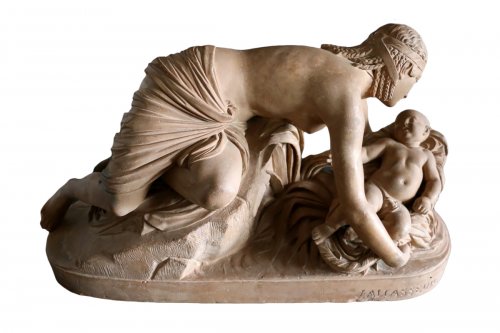
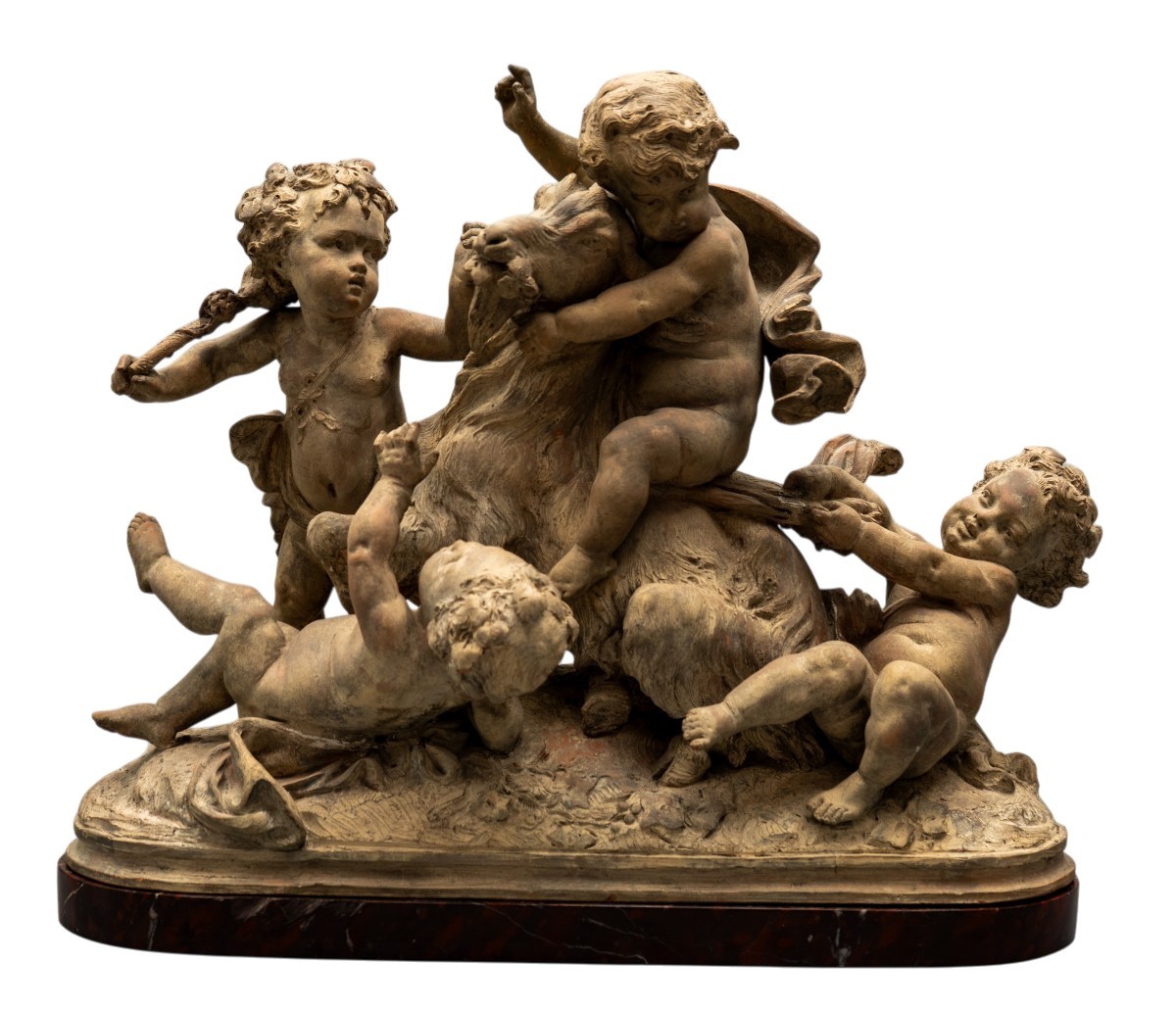
By Albert-Ernest Carrier-Belleuse (1824–1887), Paris, circa
1860
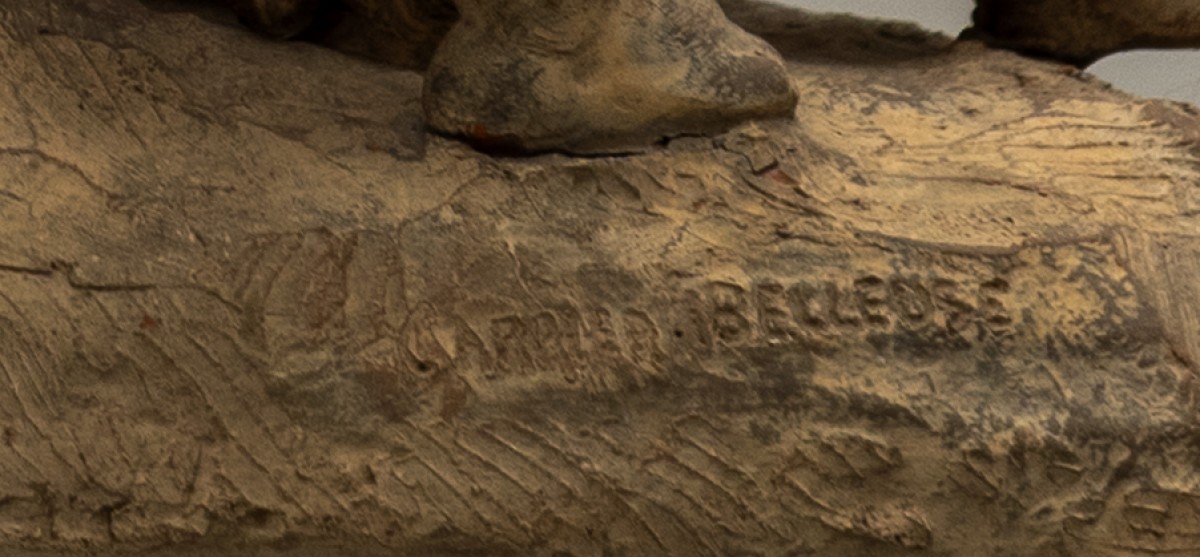
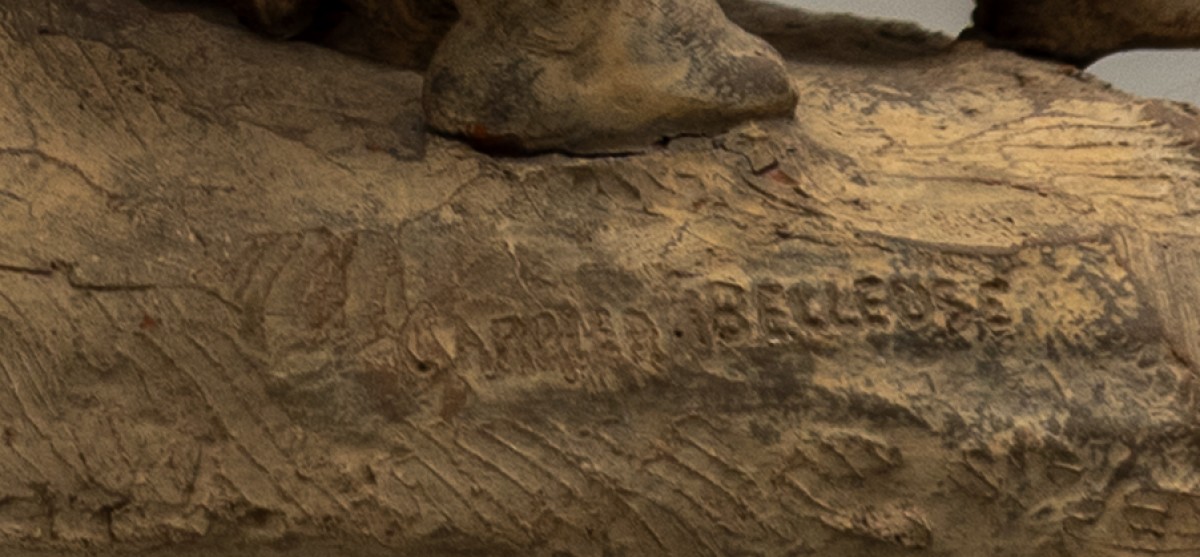
Terracotta, signed "Carrier-Belleuse" to the naturalistic rocky base. Raised on a later oval rouge marble socle.
Dimensions: 47 cm high x 56 cm wide x 18 cm deep
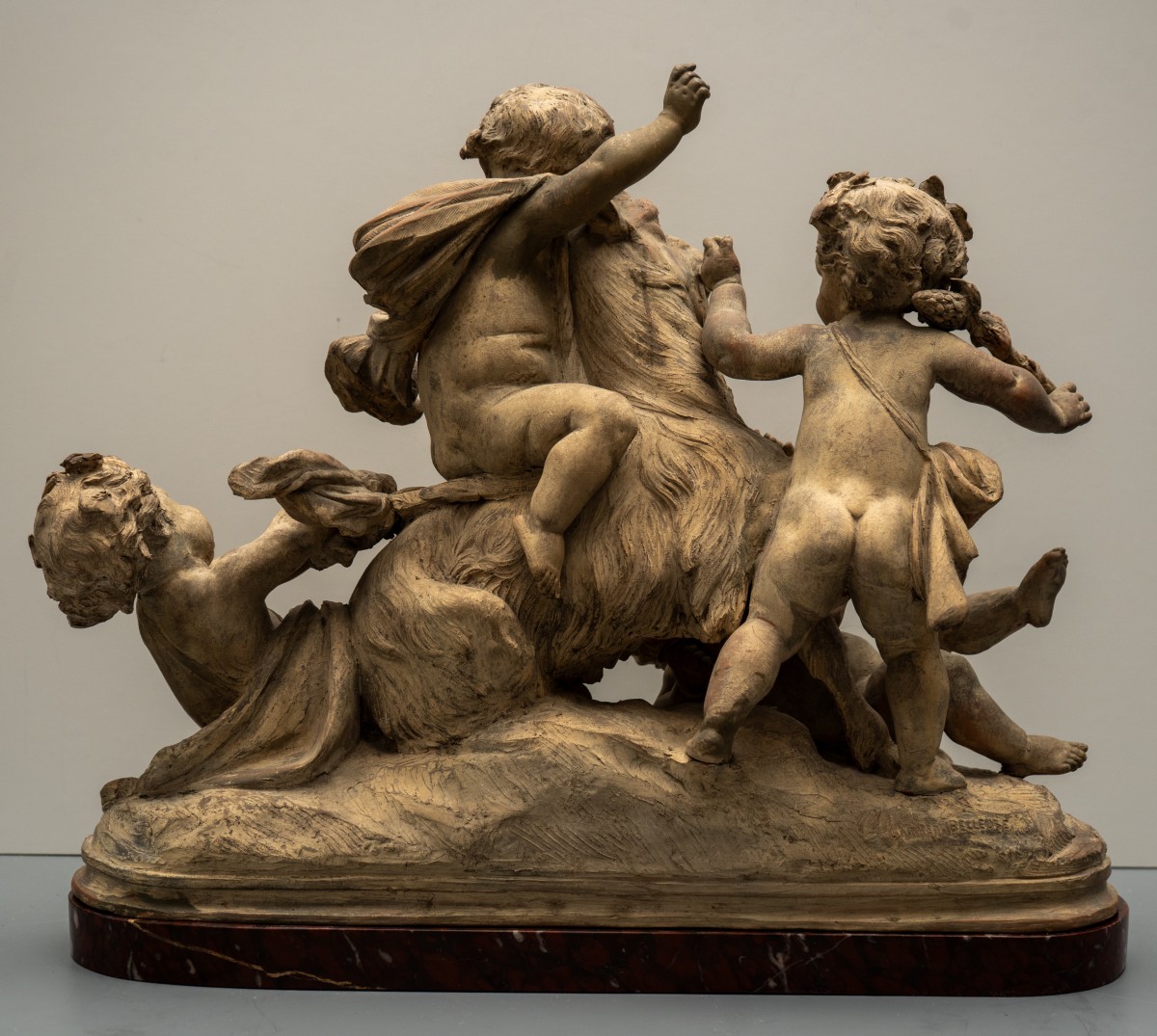
A charming and animated composition depicting four putti at play with a goat: one astride the animal's back grasping its horns, with drapery billowing behind him; a second tumbling at the goat's feet; a third pulling at a cluster of grapes; and a fourth standing with a length of vine or cord, the whole set upon a naturalistic rocky mound strewn with drapery and foliage.
Albert-Ernest Carrier-Belleuse was one of the most prolific and commercially successful French sculptors of the second half of the nineteenth century. Trained under David d'Angers before working as a designer for Minton, Wedgwood, and Coalbrookdale Ironworks in England, he returned to Paris in 1855 and rose to prominence at the Salon through the 1860s, receiving the Salon Medal of Honor and the Légion d'Honneur for his marble Le Messie in 1867. He later served as Director of Works at the Manufacture de Sèvres from 1875, and numbered Auguste Rodin among the sculptors who trained in his studio.
Carrier-Belleuse was frequently likened to the eighteenth-century sculptor Clodion for his mastery of small-scale Bacchic and mythological groups in terracotta, a genre he revived and made his own. The present subject, putti tormenting or riding a goat, draws on a long iconographic tradition traceable to Virgil's second Georgic, which explains the goat's sacrifice to Bacchus on account of the damage it caused to young vines. The motif was later taken up by François Boucher in the eighteenth century before Clodion, and by Carrier-Belleuse in the nineteenth.
The composition is a recorded model within the artist's oeuvre, subsequently issued in gilt bronze by the Parisian foundry Raingo Frères at a closely comparable scale (cf. Christie's, London, 22 September 2011, lot 56, sold GBP 6,875; Heritage Auctions, gilt bronze, 56.5 x 61 x 21.6 cm, marked Raingo Frères). The slightly reduced dimensions of the present terracotta are consistent with the shrinkage inherent to the firing process, supporting its identification as an early, first generation modello.
Literature: P. Kjellberg, Les Bronzes du XIXe Siècle, Paris, 1989, pp. 189–192.