Offered by Richard Redding Antiques
REQUEST INFORMATION

Leading antique and fine art gallery, specialises in the finest French clocks.
By Nicolas Gribelin à Paris, Case Attributed to the Workshop of André-Charles Boulle
Paris, circa 1700–1710
At a Glance
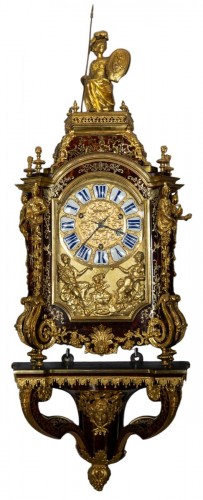
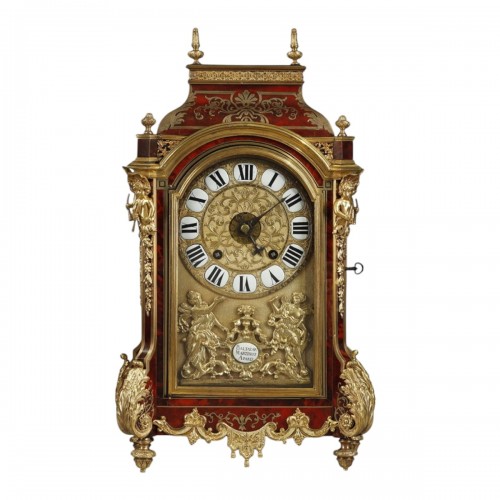
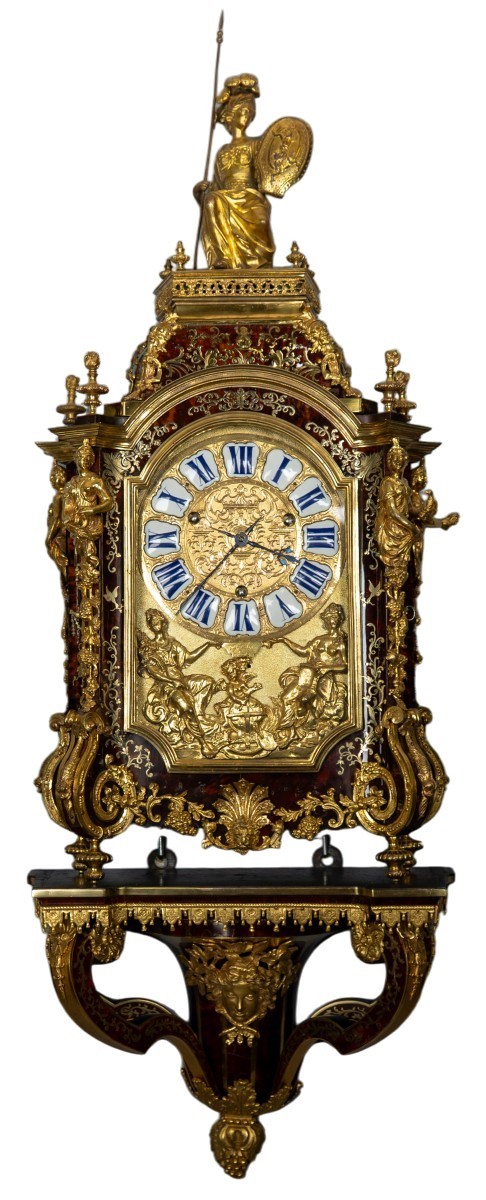
A superb cartel clock in première-partie Boulle marquetry, engraved brass and tortoiseshell, on a case of architectural form, accompanied by its original matching bracket (cul-de-lampe). This is a rare survival, as most clocks of this type have long since lost their bracket. The movement is signed twice by Nicolas Gribelin, Horloger de Monsieur le Dauphin, one of the greatest clockmakers of the reign of Louis XIV. The case, of exceptional quality in its chasing, gilding and marquetry, is attributed to the workshop of André-Charles Boulle, Premier ébéniste du Roi and the most celebrated cabinetmaker of his time.
Clocks bringing together a documented movement by Gribelin and a case of this calibre, having retained its bracket, are exceptionally rare on the market.
Description
Movement: Three-train movement with pendulum and verge escapement, silk-thread suspension. One barrel governs the going train, a second sounds the hours and half-hours on a bell, and a third sounds the quarters on two small bells. Signed on the backplate and again on an engraved brass plate below VI o'clock: "Gribelin à Paris."
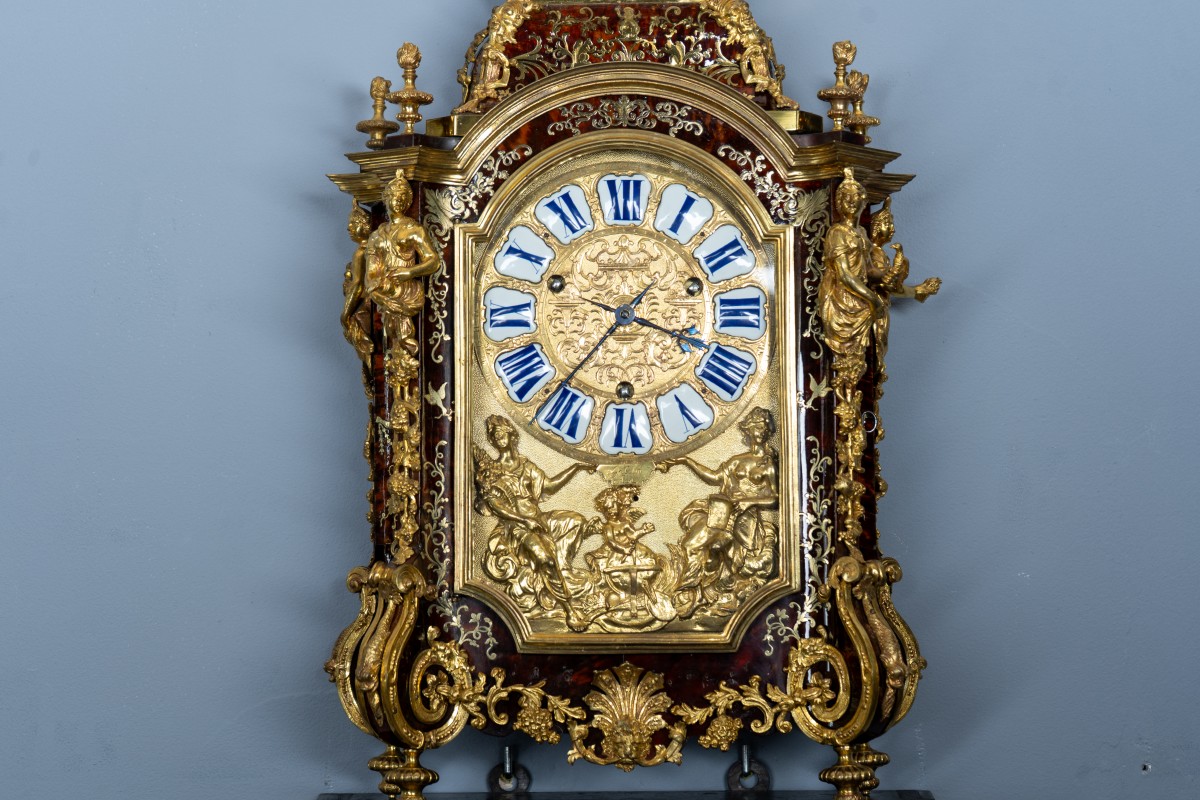
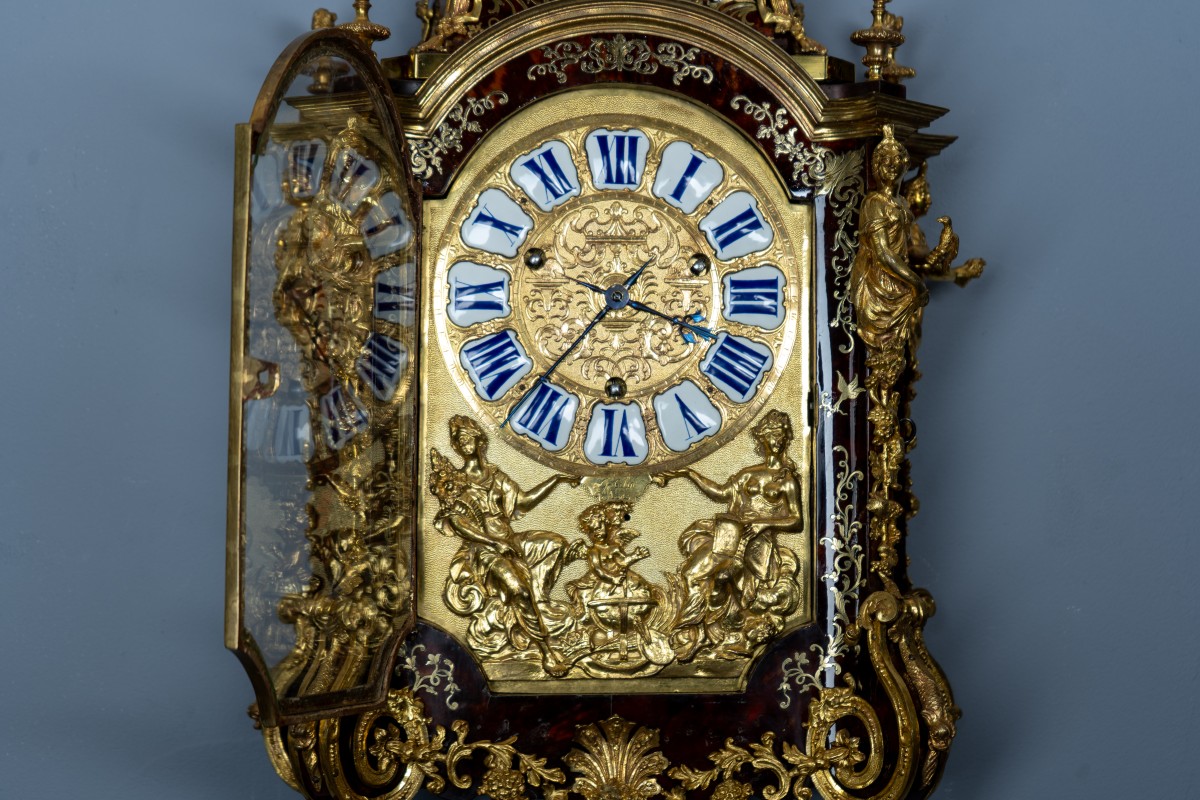
Dial: Finely chased and gilded dial, blue Roman numerals on shaped white enamel cartouches, outer minute track, and a pair of blued-steel hands.
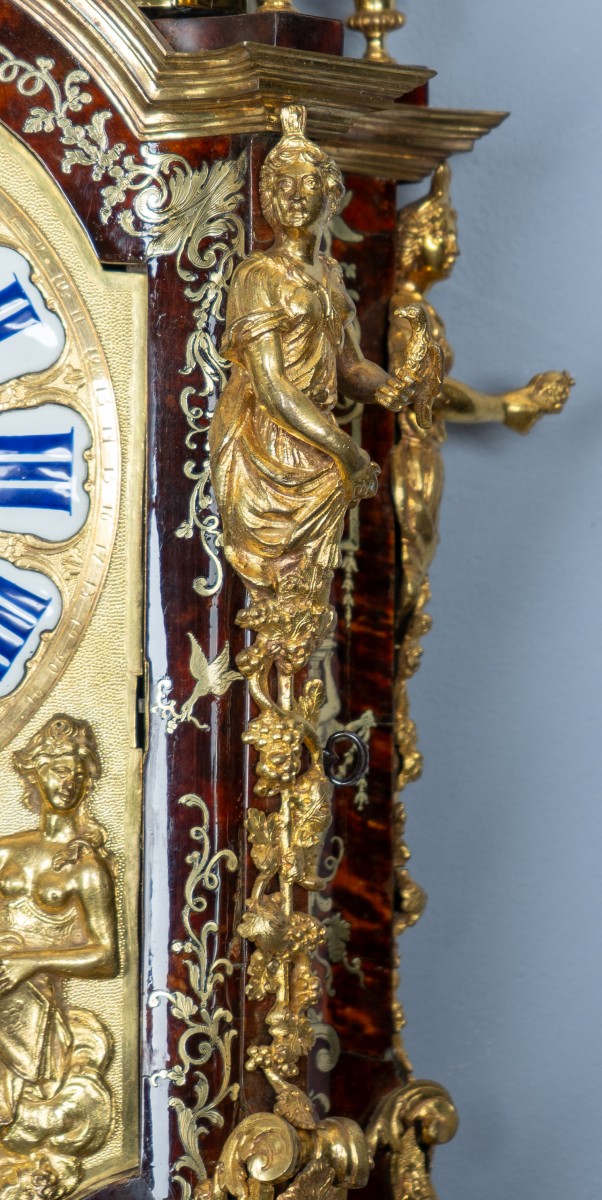
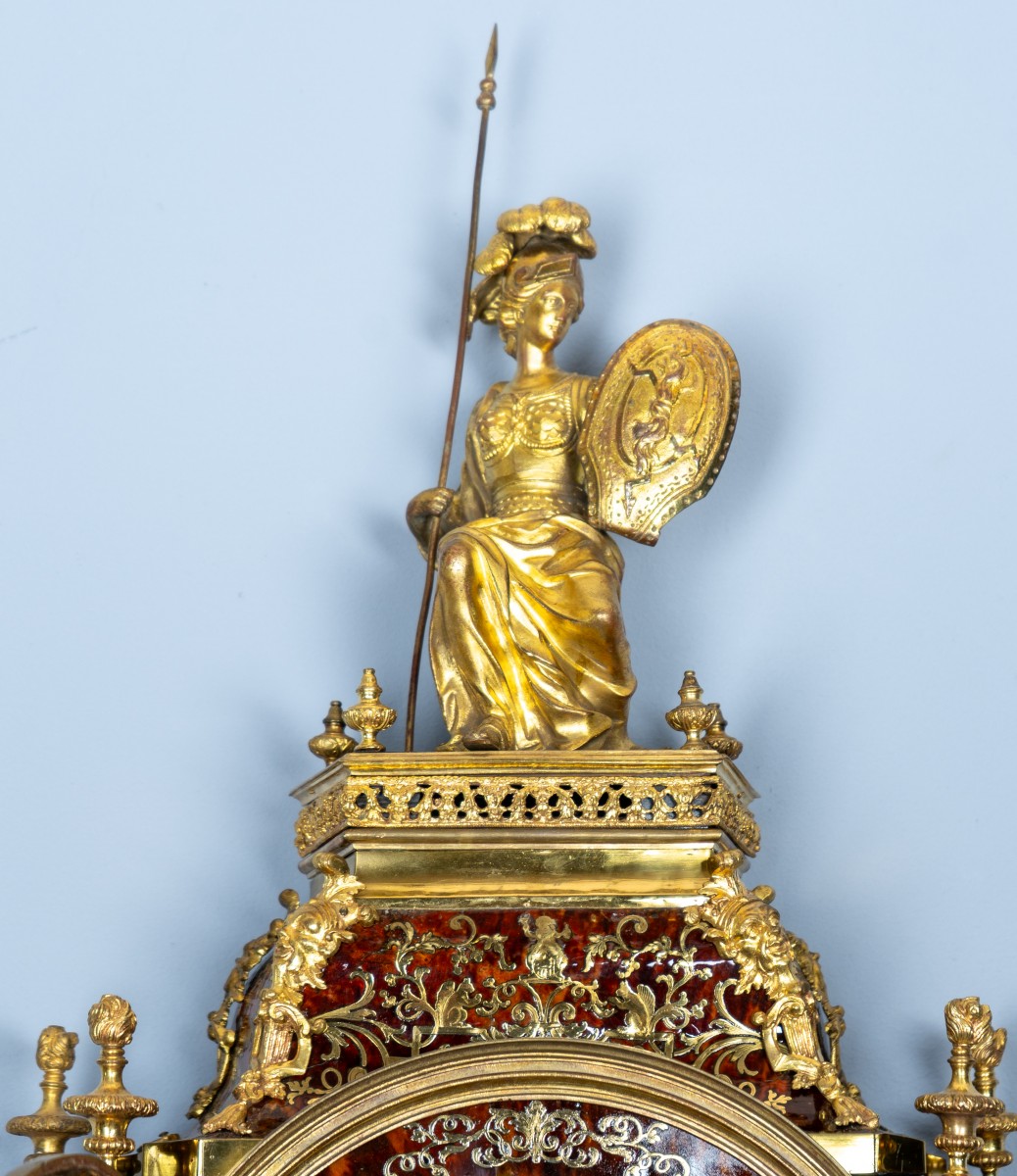
Case: Of architectural form, with an arched cornice bordered in gilt bronze, four gadrooned urn-and-foliate finials, and mask heads at each corner beneath flaming finials. The case is veneered throughout in première-partie Boulle marquetry, engraved brass ornament applied on a tortoiseshell ground. The sides display finely inlaid decoration in the taste of Jean Bérain: winged female terms, mask heads, fantastical creatures, birds and a butterfly amid strapwork and grotesques, each corner bordered by one of the four Muses standing above vine leaves and grape clusters, on scrolled, foliate-mounted supports and turned feet.
Figural mounts: Surmounted by a gilt-bronze figure of Minerva (goddess of war and protectress of the arts and letters), seated, in plumed helmet, holding a spear and shield. Below the dial, gilt-bronze figures of Flora and Urania appear to support the dial on either side of a putto poised above a globe, flanked by a crown and an artist's palette with brushes.
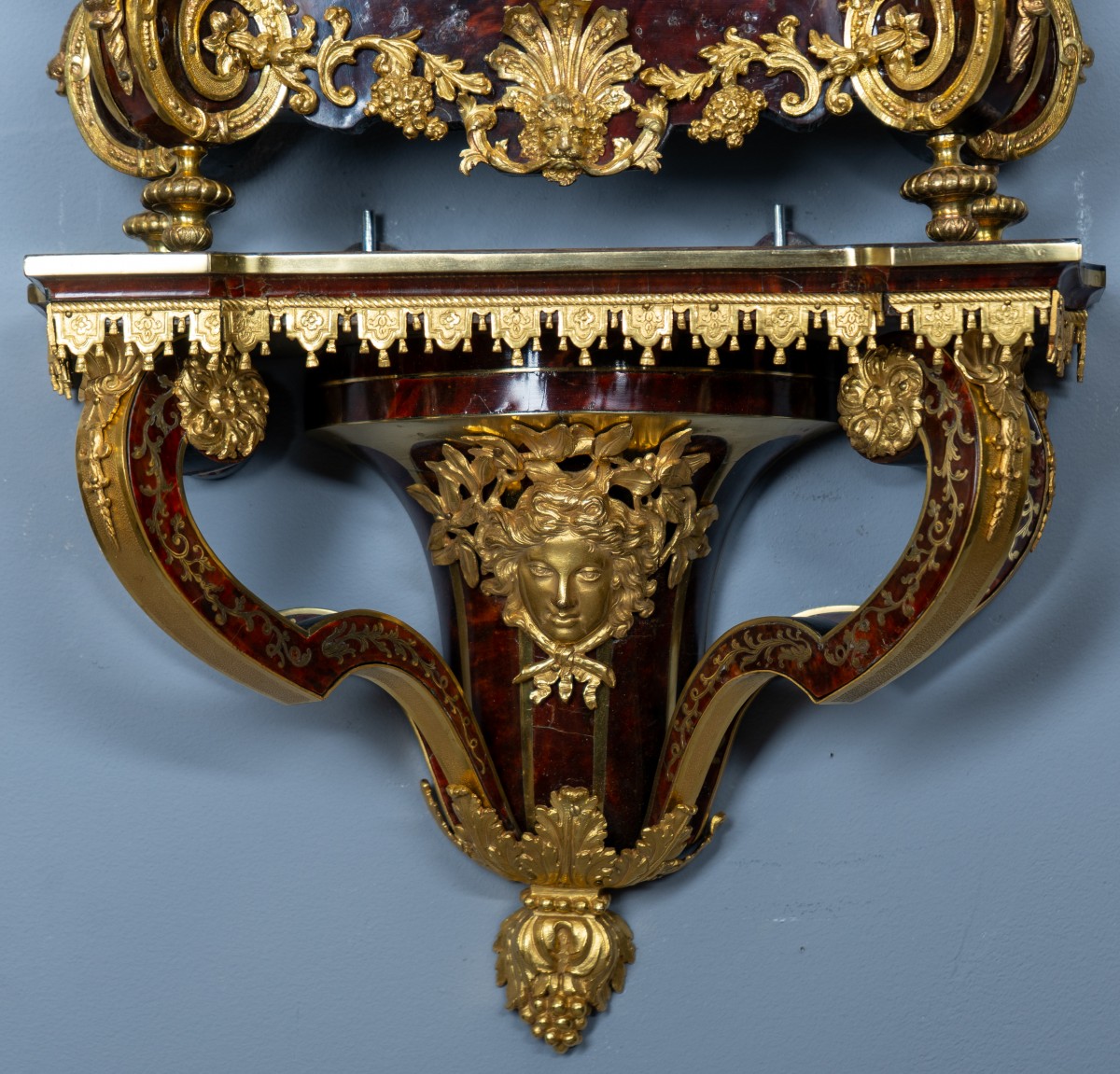
Bracket (cul-de-lampe): Shaped shelf with a lambrequin frieze, above four serpentine supports headed by rosettes, enclosing at the centre a demi-lune back mounted with a magnificent gilt-bronze Apollo mask, beneath a substantial foliate and berried boss.
Dimensions: Height 125 cm, Width 40 cm, Depth 20 cm (clock and bracket, overall)
The Clockmaker: Nicolas Gribelin (1637–1715/9)
Born in Blois on 27 November 1637, son of the royal clockmaker Abraham Gribelin, Nicolas Gribelin trained under his father before being received as a master clockmaker in the Faubourg Saint-Germain-des-Prés around 1660, then in Paris on 5 June 1675. He held the office of garde-visiteur of his guild (1676–78 and 1684–86) and, before 1674, received the title of Horloger de Monsieur le Dauphin, clockmaker to the Grand Dauphin, son of Louis XIV.
His clocks numbered among the highest circles of the court: four are recorded in the Dauphin's 1689 inventory, one in Louis XIV's own posthumous inventory, and further examples belonged to the duc du Maine, the comte de Toulouse, the duc de Bourbon, and other prominent nobles and financiers of the day.
Gribelin's work is today held at the Musée du Louvre, the Musée des Arts Décoratifs, and the Château de Versailles, as well as at the Mathematisch-Physikalischer Salon (Dresden), the British Museum, the Art Institute of Chicago, and the Indianapolis Museum of Art.
The Case: The Workshop of André-Charles Boulle (1642–1732)
Given the exceptional quality of the mounts and marquetry, and their close kinship with documented works by Boulle, this case and its bracket are attributed to the workshop of André-Charles Boulle. Appointed Premier ébéniste du Roi in 1672 on Colbert's recommendation, Boulle furnished the royal palaces, notably Versailles, as well as foreign courts, including that of Philip V of Spain. His name remains inseparable from the technique seen here: engraved brass and tortoiseshell cut together with a fretsaw, so that each material fits precisely into the other, producing a so-called "première-partie" ground (brass on tortoiseshell), as on this clock, or its inverse, "contre-partie."
Boulle's workshop, housed at the Louvre, stood not far from that of the designer Jean Bérain, with whom he frequently collaborated; the grotesques and strapwork seen on the sides of this case reflect that shared decorative language.
Literature / Comparable Examples
Tardy, La Pendule Française, Ire partie, de l'Horloge Gothique à la Pendule Louis XV, 1967, p. 98: a similarly shaped clock by J. Mornand, Musée Saint-Pierre, Lyon, showing the same figures of Flora and Urania below the dial.
Pierre Kjellberg, Encyclopédie de la Pendule Française du Moyen Âge au XXe Siècle, 1997: p. 45, an important Louis XIV Boulle clock bearing the same figures of Flora and Urania; p. 48 pl. A, a clock signed Jacques Cogniet à Paris, fitted with a moon-phase dial in place of the globe; p. 49, a further example with bracket; p. 50 pl. B, a red-tortoiseshell cartel clock by Nicolas Gribelin with a very comparable bracket and central Apollo mask.
The same pairing of Flora and Urania is also thought to appear on a Boulle clock depicted in Watteau's L'Enseigne de Gersaint (1721, Charlottenburg Palace, Berlin).