Offered by Dei Bardi Art


REQUEST INFORMATION


Sculptures and works of art from the Middle Ages and the Renaissance
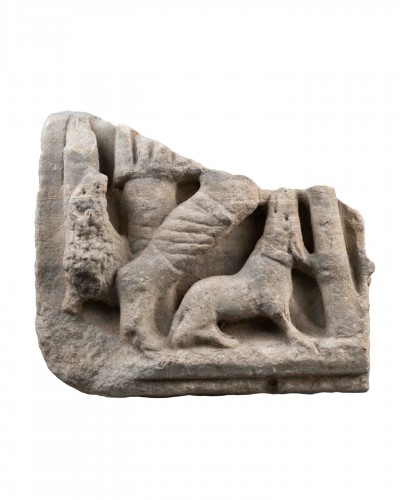
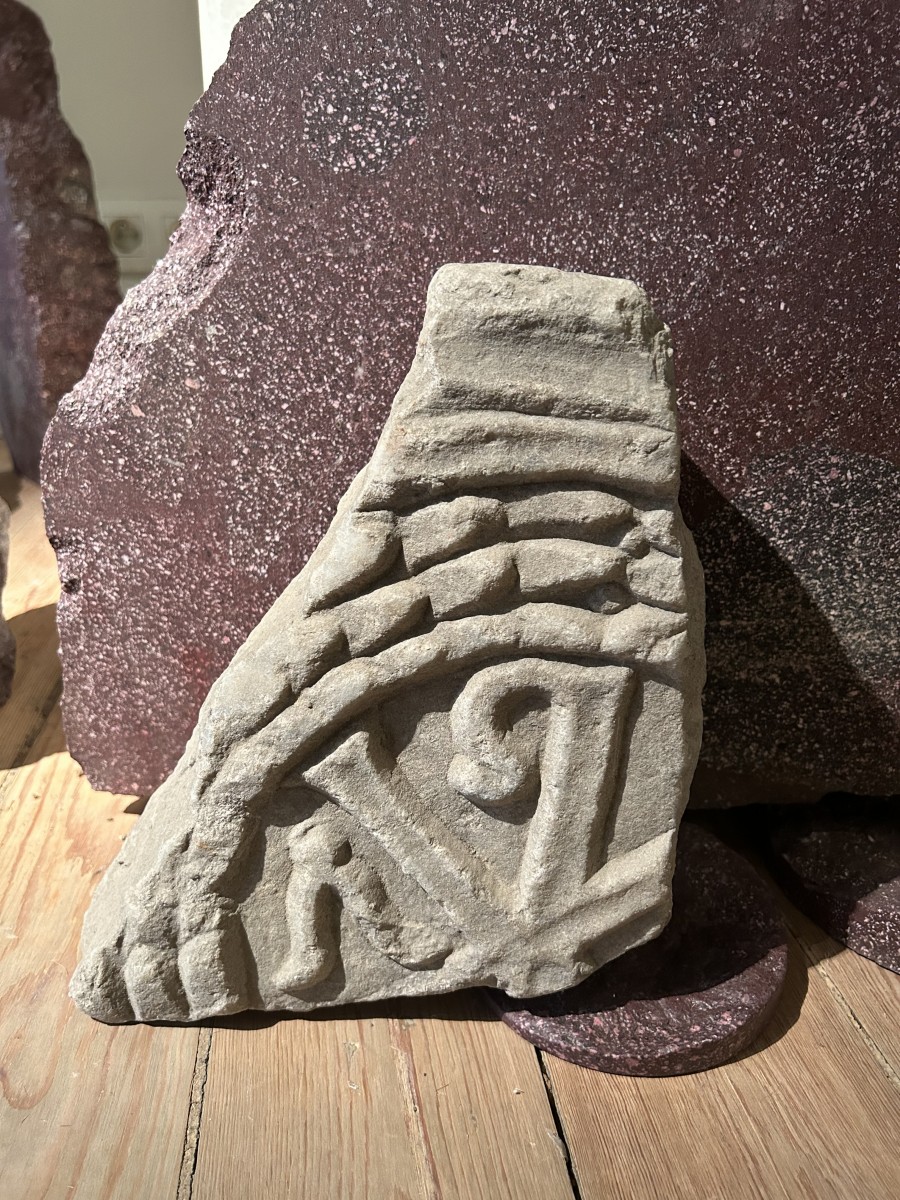
Marble Roman Relief Representing a Christogram
Roman art, 3rd–4th century AD
Marble?
25 × 22 cm
Provenance?Collection of the Château de B., Nevers, assembled by Georges C. S. (1833–1909), scholar.?The château and its collections were acquired in 1938 by the current owners of the estate.
This rare marble fragment preserves a relief carved with a Christogram (Chi-Rho) enclosed within a circular frame. The monogram is composed of the Greek letters Chi (?) and Rho (?)—the first two letters of the name ??????? (Christ)—with the Chi superimposed upon the Rho. The letter Alpha is still visible on one side of the relief; the missing portion would originally have included the Omega.
The Alpha and Omega, which frame the Greek alphabet, symbolize totality, beginning and end, as expressed in the Apocalypse: “I am the Alpha and the Omega, the first and the last, the beginning and the end” (Revelation 22:13). The enclosing circle may evoke the ouroboros, the serpent biting its own tail, an ancient symbol of eternity, cyclical renewal, and the reconciliation of opposites.
According to Lactantius, Emperor Constantine received, on the eve of the Battle of the Milvian Bridge in AD 312, a divine injunction in a dream to mark the shields of his soldiers with a heavenly sign. Eusebius of Caesarea, Constantine’s hagiographer, relates in his Ecclesiastical History that the emperor, already converted, experienced a vision—shared by his troops—of a sign appearing in the sky, accompanied by the words “In hoc signo vinces” (“By this sign you shall conquer”). Constantine subsequently adopted this emblem on the imperial standard, the labarum, although the precise nature of the sign remains ambiguous. As a divinely revealed and personal symbol, the Christogram thus acquired a powerful magical and imperial dimension.
The Chi-Rho appears discreetly for the first time on the emperor’s helmet on a coin struck at Ticinum in 315 to commemorate Constantine’s decennalia. It would take nearly twenty-five years before the symbol reappeared on imperial coinage.
The Chi-Rho monogram, however, predates Christianity. It is found on amphorae to indicate their contents and in Greek and Egyptian pagan manuscripts as an abbreviation of ??????? (khr?stós), meaning “useful” or “auspicious,” serving either as a wish or an approving remark. In Plato’s Timaeus, the crossing of the cosmic bands forming the anima mundi is compared to the shape of the letter Chi, possibly referring to the intersection of the ecliptic and the celestial equator—an association that further enriches the symbolic resonance of the sign.
This fragment bears witness to the convergence of multiple cultural traditions: inseparable from Christianity through its association with Christ, yet deeply rooted in Greco-Roman philosophy and imperial ideology. As such, it constitutes an early and rare testimony to the emergence of Christian art at the crossroads of Roman, Eastern, and proto-Byzantine visual culture.