Offered by Subert
REQUEST INFORMATION

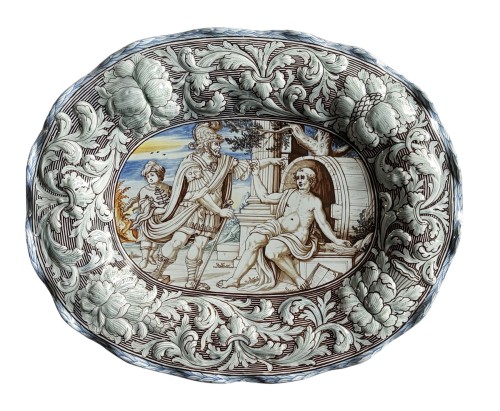
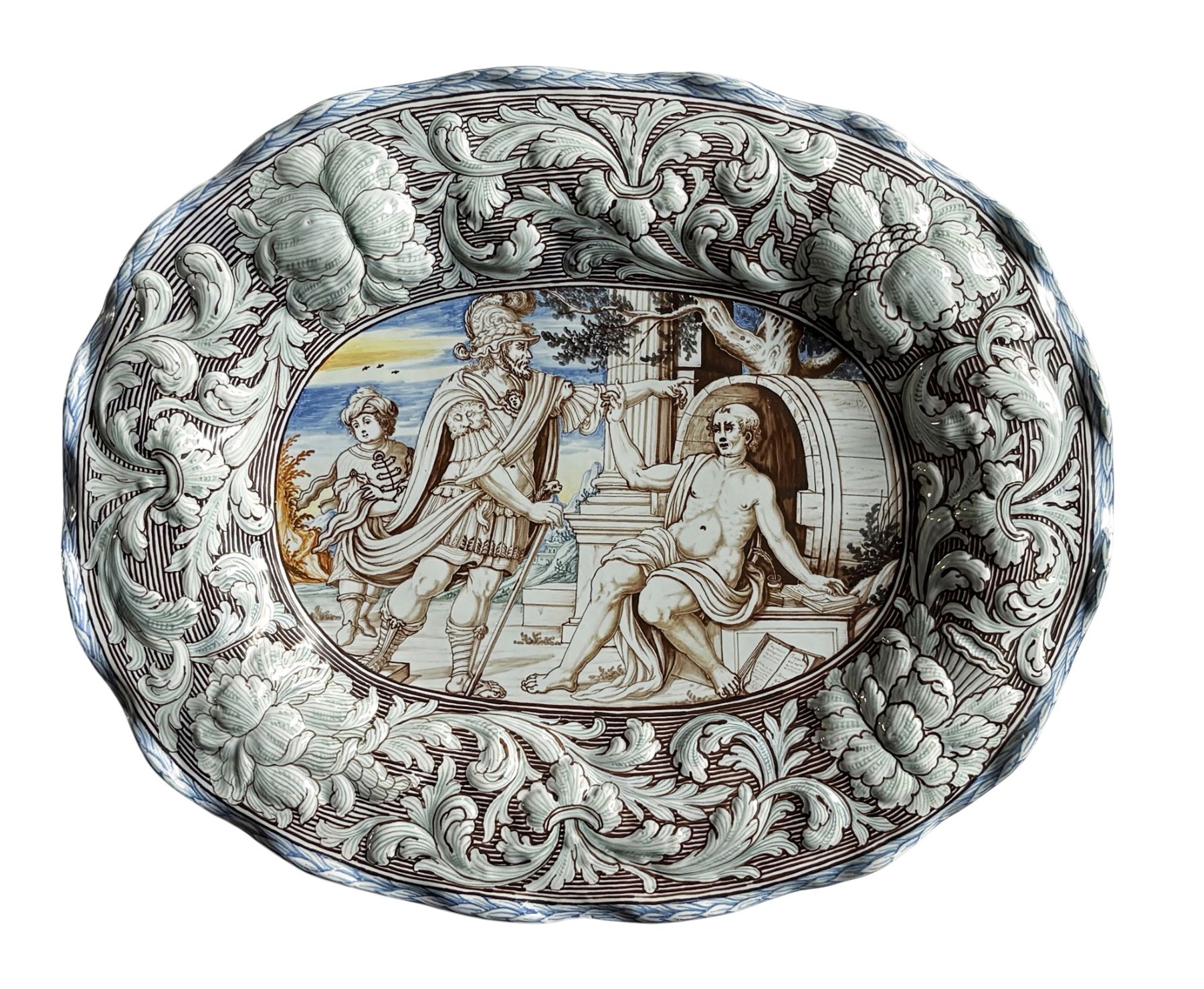
Polychrome Maiolica Oval Dish
Pavia Manufactory, 1693–1704
Painted by Siro Antonio Africa and Siro Domenico Africa
Dimensions: height (inches) 1,96 x 18,89 x 15,35 (cm 5 × 48 × 39)
Weight: lb 2.73 (kg 1.24)
Condition: intact.
This dish belongs to an important category of maiolica works representing some of the finest ceramic production of the late 17th and early 18th centuries. For a long time, this kind of ceramics was attributed to the Venetian village of Angarano (near Bassano del Grappa), but by the late 1990s it had definitively been reassigned to the principal manufactories of Pavia. See the study by E. Pelizzoni, M. Forni, and S. Nepoti, La maiolica di Pavia tra Seicento e Settecento, Milan, 1997.
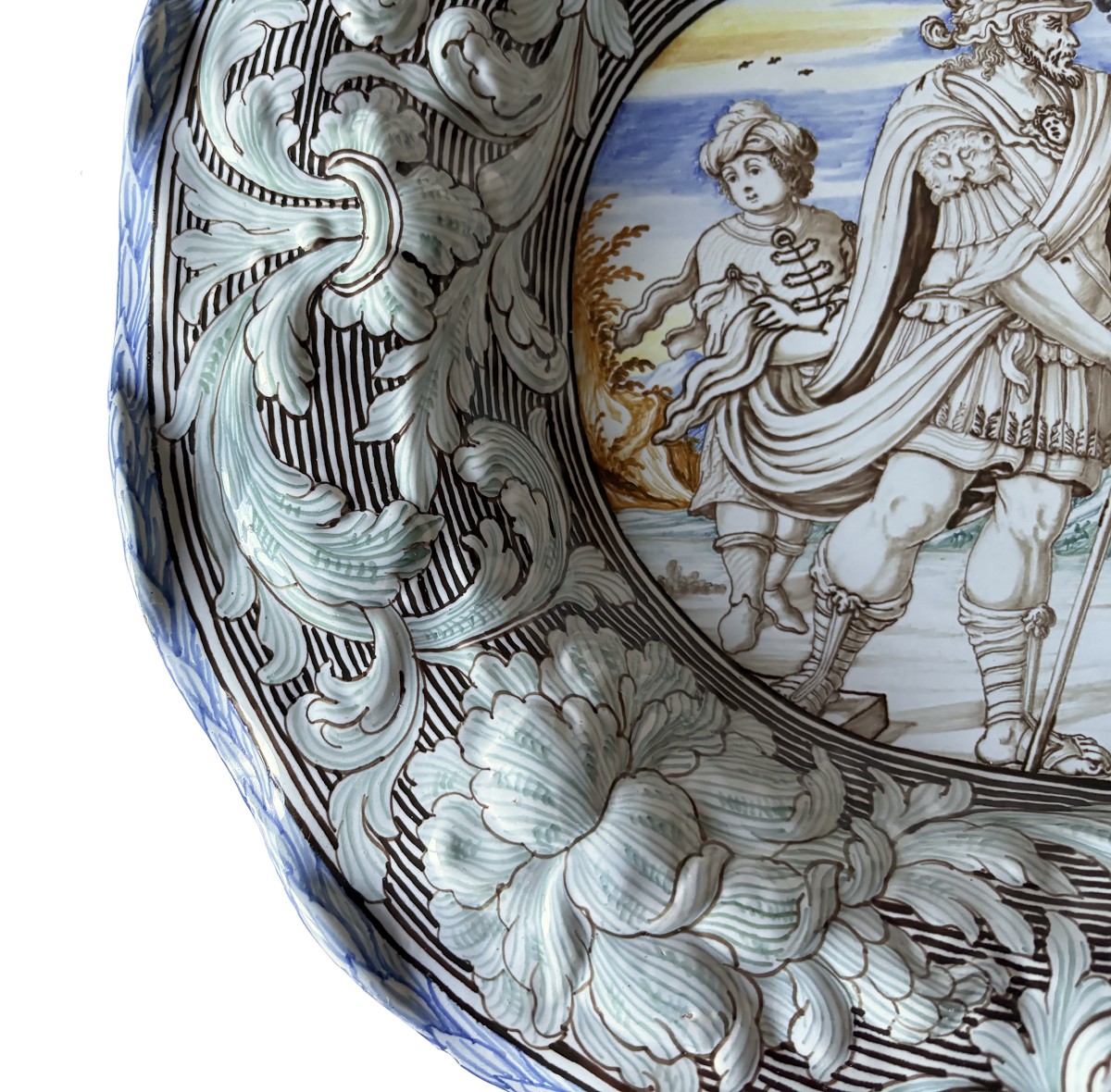
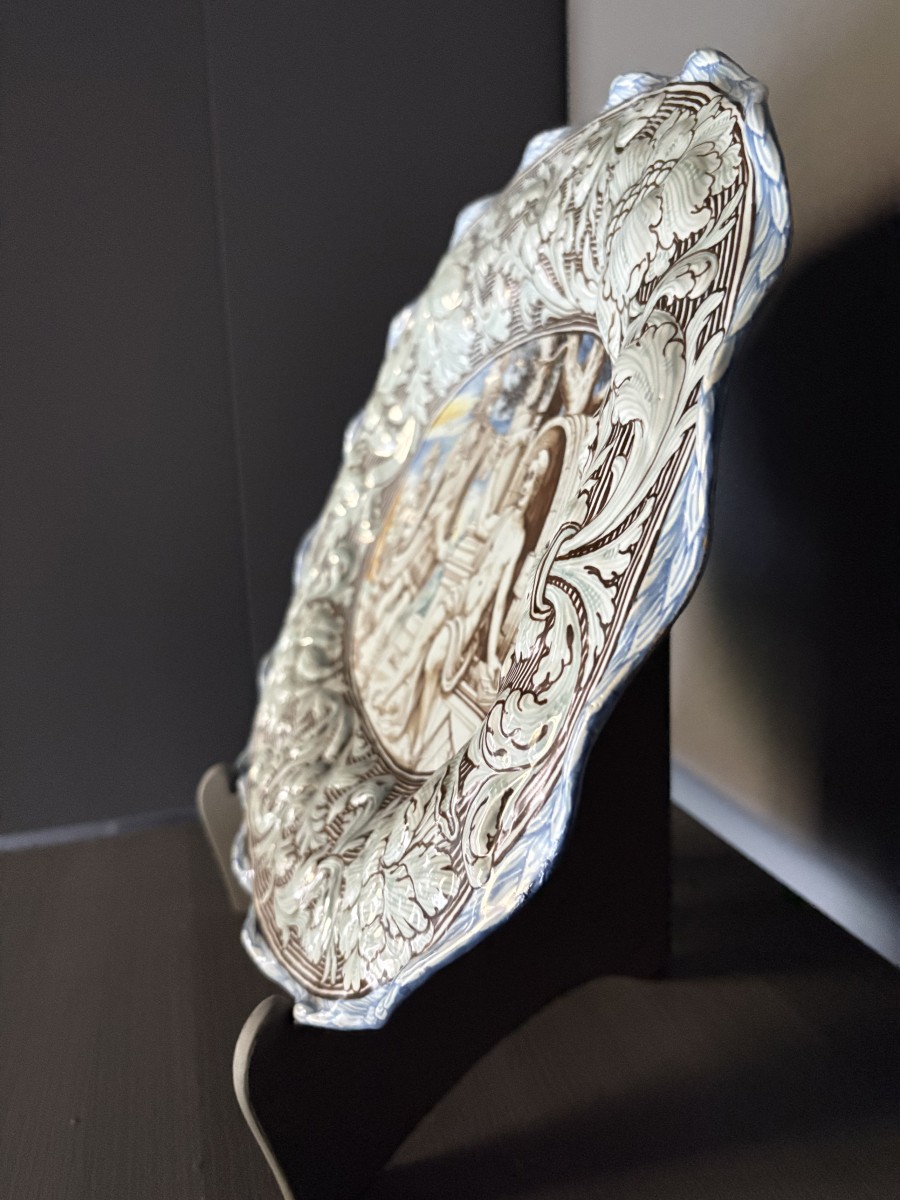
This large dish is oval with a flat well and a broad convex rim. The rim has a decorative wavy edge and is highlighted in manganese purple. It is further embellished with a dense crown-like motif of small cobalt-blue lanceolate leaves.
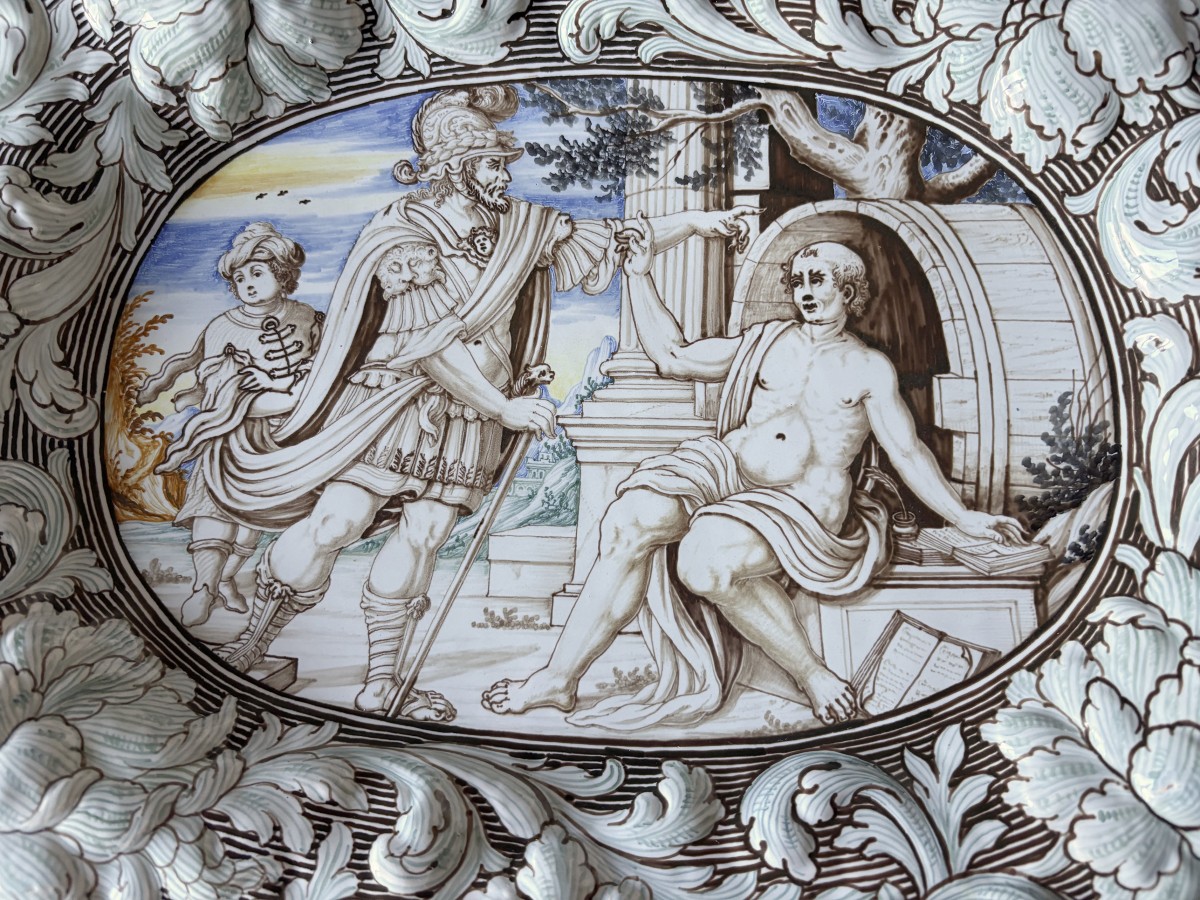
The surface of the rim features a dense pattern of parallel manganese lines which form, in relief, a floral motif with large blossoms and scrolling foliage. At the center of the well is a historical scene depicting Alexander the Great visiting Diogenes of Sinope at Corinth.
Diogenes, unusually depicted bald, sits on the step of an architectural structure in front of the large barrel in which he lived. Beside him are an open book and an inkwell, while another volume lies at his feet. With his arm raised in gesture, the philosopher appears to be dismissing the Macedonian king. Alexander is shown armed and with a staff in his right hand. He is motioning toward the philosopher with his left hand. Behind him, a page dressed in Turkish-style attire assists with his cloak. The scene is set among trees, columns, and small shrubs. It opens onto a mountainous landscape with architectural structures in the distance.
It has not been possible to identify the precise iconographic source that inspired the painter. This is due to the large number of engravings depicting the celebrated episode in which Diogenes - referring to the light of philosophical knowledge - asks Alexander the Great to move out of his sunlight. In response, the admiring conqueror declares that, were he not already Alexander, he would wish to be Diogenes, thus paying tribute to the pursuit of wisdom.
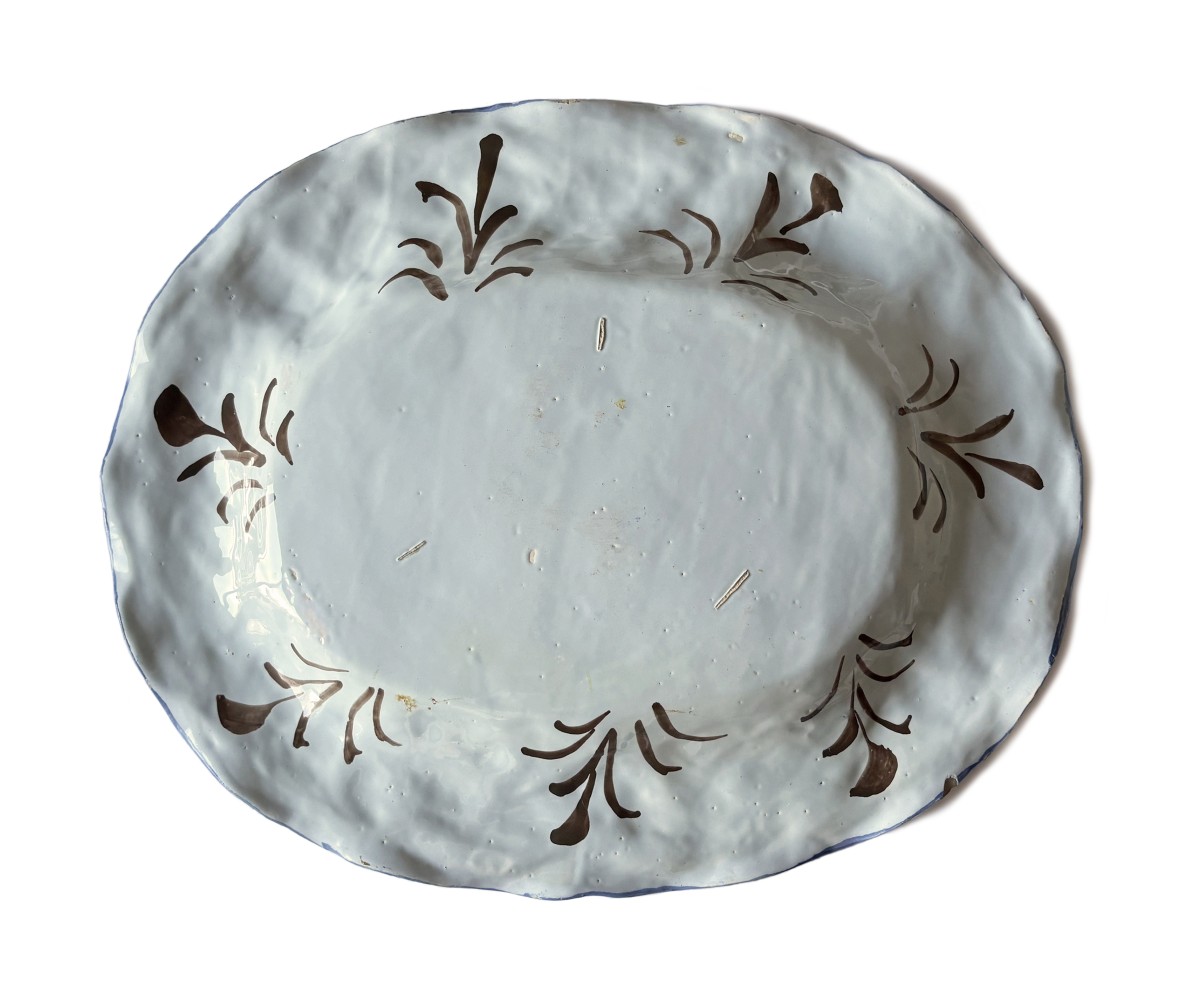
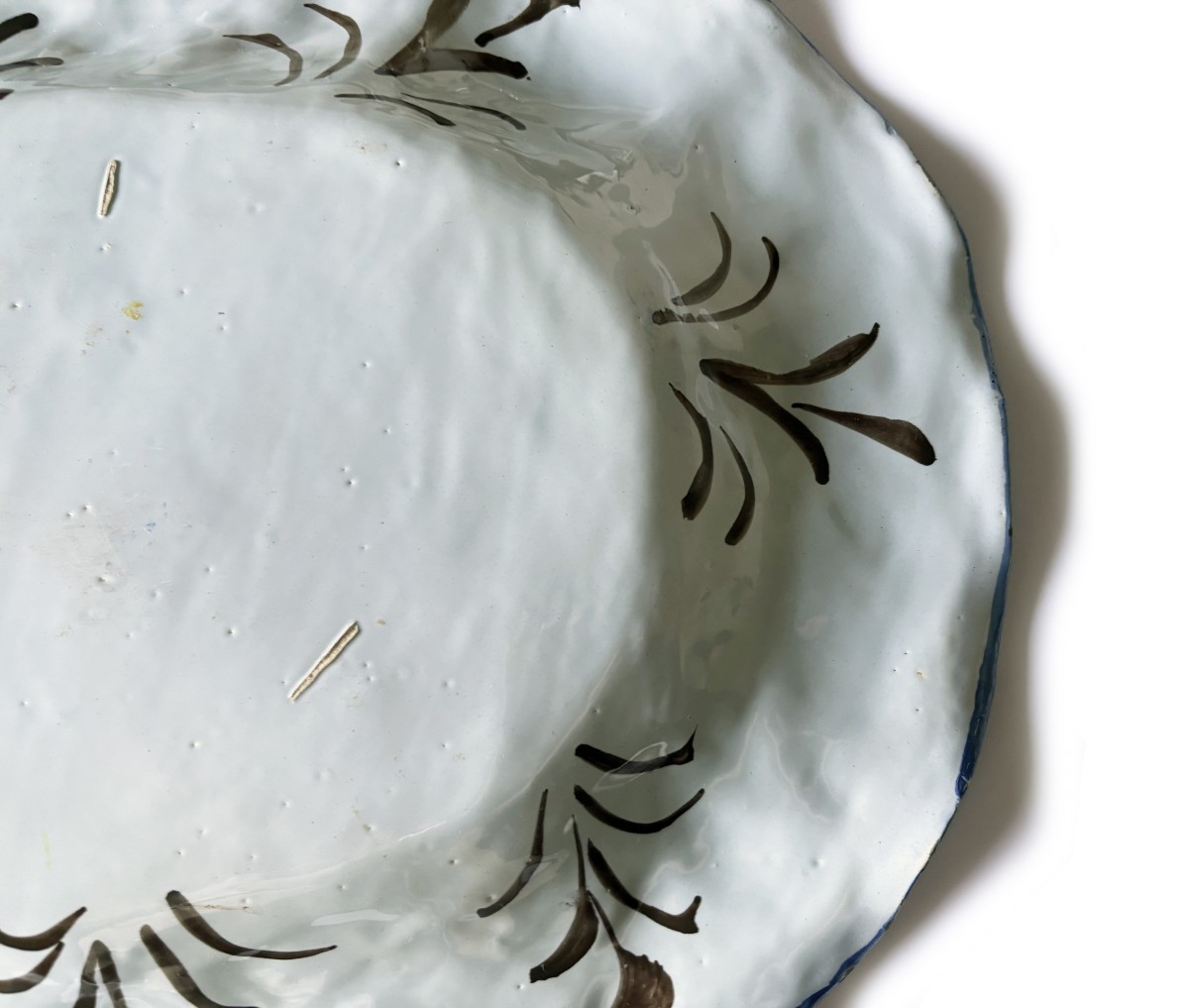
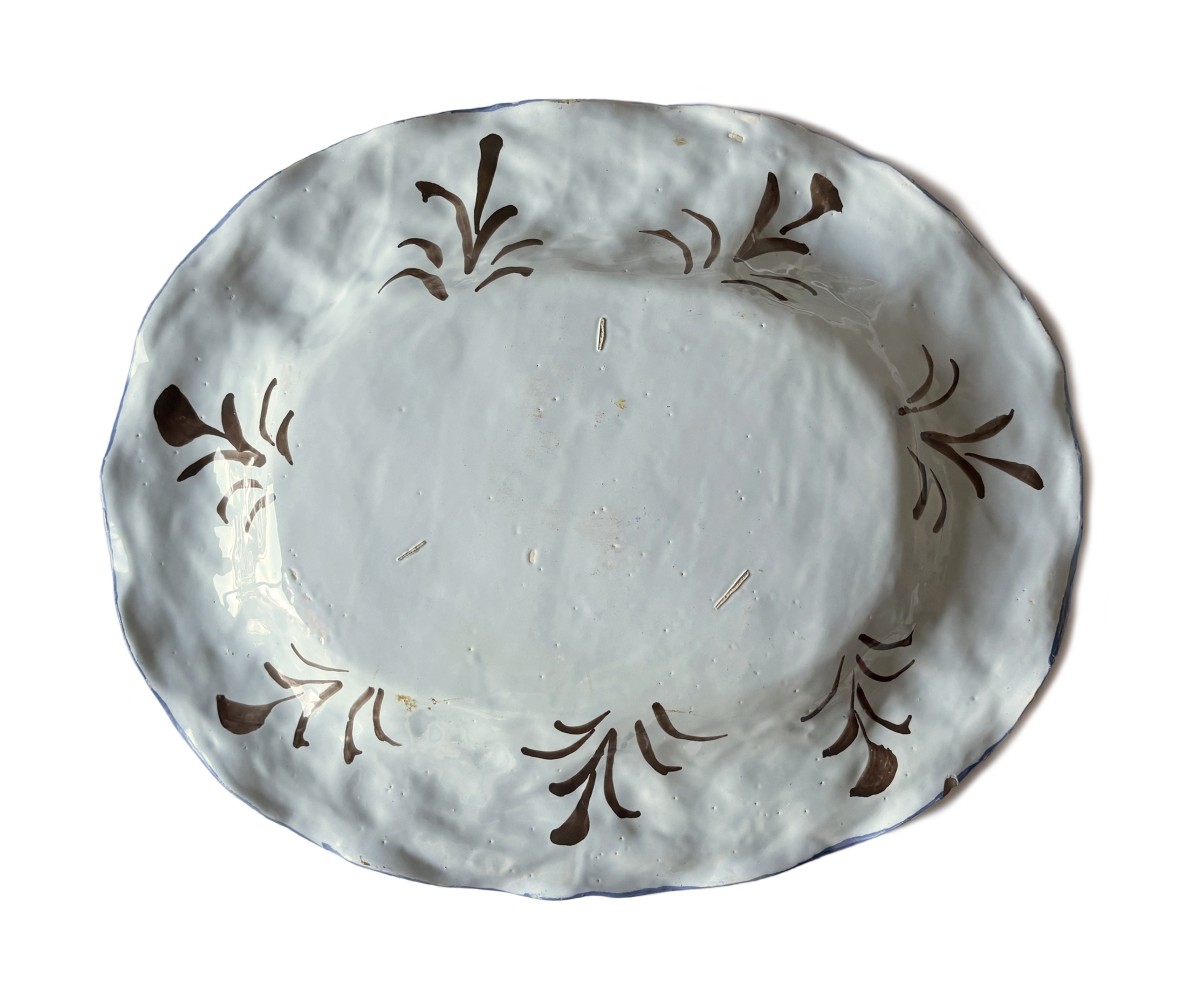
On the plate's reverse appear characteristic sprigs with elongated leaves frequently found on Pavia ceramics of this period.
Although the large tray bears no mark, it may nevertheless be attributed to the production of Siro Antonio Africa working in collaboration with his nephew Siro Domenico Africa in Pavia. The slightly differing treatment of the figures and faces suggests the intervention of both painters, who are documented as having worked - sometimes intermittently - for all the major manufactories of the city of Pavia (E. Pelizzoni, op. cit., pp. 29–32).
Other examples with stylistic and morphological characteristics closely comparable to the present work are preserved in various museum and private collections. Particularly noteworthy are a large tray with a similar rim and a scene of ruins with an allegorical figure, and a tray depicting ruins with Artemis and Cupid bearing the mark “AF e àncora (anchor)”, both conserved in the Palazzo Madama Civic Museum in Turin (inv. 3125/c; inv. 3138C); the example marked “AF palme, croce e corona (palms, cross and crown),” depicting architecture, a nymph, and a satyr, in the Museo Internazionale delle Ceramiche (inv. 21684/c 8479/29); and the splendid tray with Neptune driving a chariot through the waves in the Roudnice Lobkowicz Collection in Prague (E. Pelizzoni, op. cit., p. 131 nos. 94–95; p. 141 no. 108; p. 143 no. 111).
The decorator Siro Antonio Africa had worked alternately in the two main Pavia factories (Carlo Giuseppe Rampini and Antonio Francesco Imbres as documented from the last decades of the seventeenth century) where he signed his works in a different way (E. Pelizzoni in, op. cit., pp. 29-32). In the 1735 inventories of the Rampini manufactory, the maiolica are defined with the architectural structures of Africa. He is considered among the initiators of refined decoration with architectural motifs, of which this work is one of the finest examples. Preserved in the major ceramics museums of the world, the dishes of Pavia are considered among the most elegant works among eighteenth-century maiolica: we recall, among others, the plates of the New York Met (inv. 2018. 460), and those of the Cambridge Fitzwilliam (inv. C.252-1991).
Comparative bibliography:
E. Pelizzoni – M. Forni – S. Nepoti, La maiolica di Pavia tra Seicento e Settecento, Milan, 1997.
Delevery information :
to be agreed with the customer depending on the object and the place of destination