Offered by Subert


Pair of glass coolers
Felice Clerici or Pasquale Rubati Factory
Milan, 1745-1788 Circa
Maiolica polychrome decorated “a piccolo fuoco” (third fire)
Dimensions of each: 5.9 in in height (15 cm) x 7.28 in (18.5 cm); mouth diameter 6.30 in (16 cm); foot diameter 5.12 in (13 cm)
They weigh: a) 1.32 lb (600 g); b) 1.42 lb (645 g)
State of conservation:
a) Some chipping on the foot and wear on protruding areas.
b) Wear on protruding parts; hole behind in the center of foot; slight enamel flaking due to use.
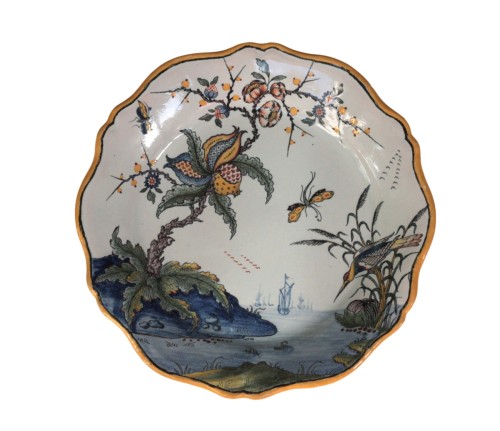
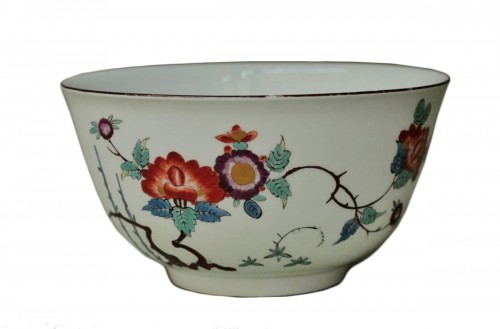
The pair of twin glass coolers are moderately sized and can accommodate six glasses each. The undulating cylindrical basin has a waved rim which mirrors the shape of the slightly raised base. The shape is designed to hold the stem of the chalices while chilling them. On either side are two small bracket-shaped handles inspired by coeval silverware.
The decoration, executed in third fire polychrome, is referred to in manufacturing sources as “al casotto Chinese (Chinese hut-style)”, but is now more commonly known as “al carabiniere (carabiniere-style)” because of the coloration, which resembles that of the plumes on the hats of the carabinieri. In the center of the basin, a river landscape is featured. It is brought to life by a small boat and a typical multi-story pagoda, painted in blue with touches of red and yellow to define the upper balcony and arched entrance. The building is flanked by landscape elements with an oriental flavor: a tall, pierced rock, stylized saplings, and a pavilion with rounded shapes complete the decoration.
Particularly significant are the two characters depicted: a Chinese dignitary who is welcoming a Westerner.
This motif, referred to in a European context as “Imari trichrome,” spread to the West through the importation of Chinese porcelain. This, in turn, reinterpreted Japanese patterns produced for the Chinese market and exported via the port of Imari. In the second half of the 18th century, such a repertoire entered the decorative vocabulary of many European manufactures, sometimes enriched with the use of gold in place of yellow. In the Clerici inventory this decoration stands out precisely because it is well defined as “alla chinese con casotto” (R. Ausenda, La maiolica a Milano nel Settecento, Firenze 2025, p. 110). It does not seem to be described in the inventories of Pasquale Rubati's manufacture, in which, however, there are signed specimens with a shrewder pictorial style (R. Ausenda, a cura di, Musei e Gallerie di Milano. Museo d’Arti Applicate. Le ceramiche, t. II, Milano 2001, pp. 285–286, n. 306).
In terms of material, style, and technical characteristics, the work can be confidently attributed to one of the Milanese manufactures of Felice Clerici or Pasquale Rubati, active between 1745 and 1788. The attribution and dating are based on comparisons with a core of works consistent in form and ornament published in the catalogue of the Museo d'Arti Applicate del Castello Sforzesco in Milan (R. Ausenda, a cura di, Musei e Gallerie di Milano. Museo d’Arti Applicate. Le ceramiche, t. II, Milano 2001, pp. 286–303, n. 307).
Bibliography:
R. Ausenda, a cura di, Musei e Gallerie di Milano. Museo d’Arti Applicate. Le ceramiche, T. II, Milano 2001;
R. Ausenda, La maiolica a Milano nel Settecento, Firenze 2025.
Delevery information :
to be agreed with the customer depending on the object and the place of destination