Offered by Galerie Magdeleine
REQUEST INFORMATION

Paintings and drawings from the 17th to the 19th century
Philippe-Jacques VAN BRÉE (Antwerp, 1786 – Saint-Josse-ten-Noode, 1871)
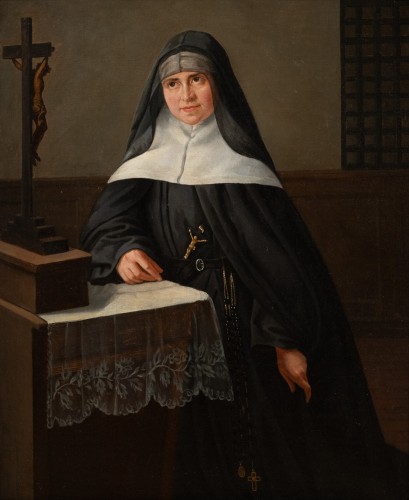
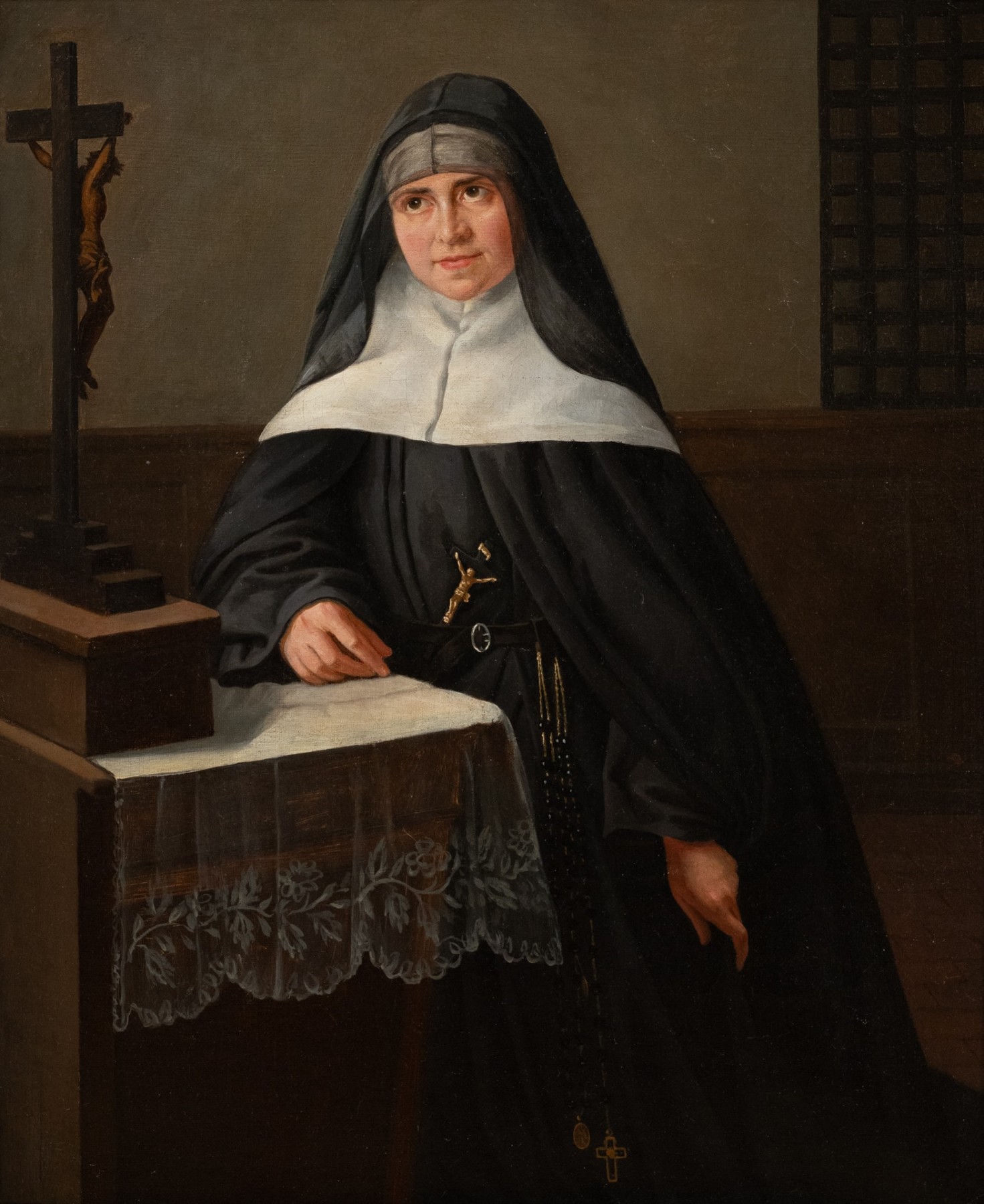
A Spanish Nun
Circa 1811. Oil on canvas. H: 55; W: 45.5 cm.
Exhibition: Withdrawn from the Brussels Salon, 1811; possibly Salon des Artistes Vivants, Paris, 1819, no. 1118: “A Nun in Meditation”.
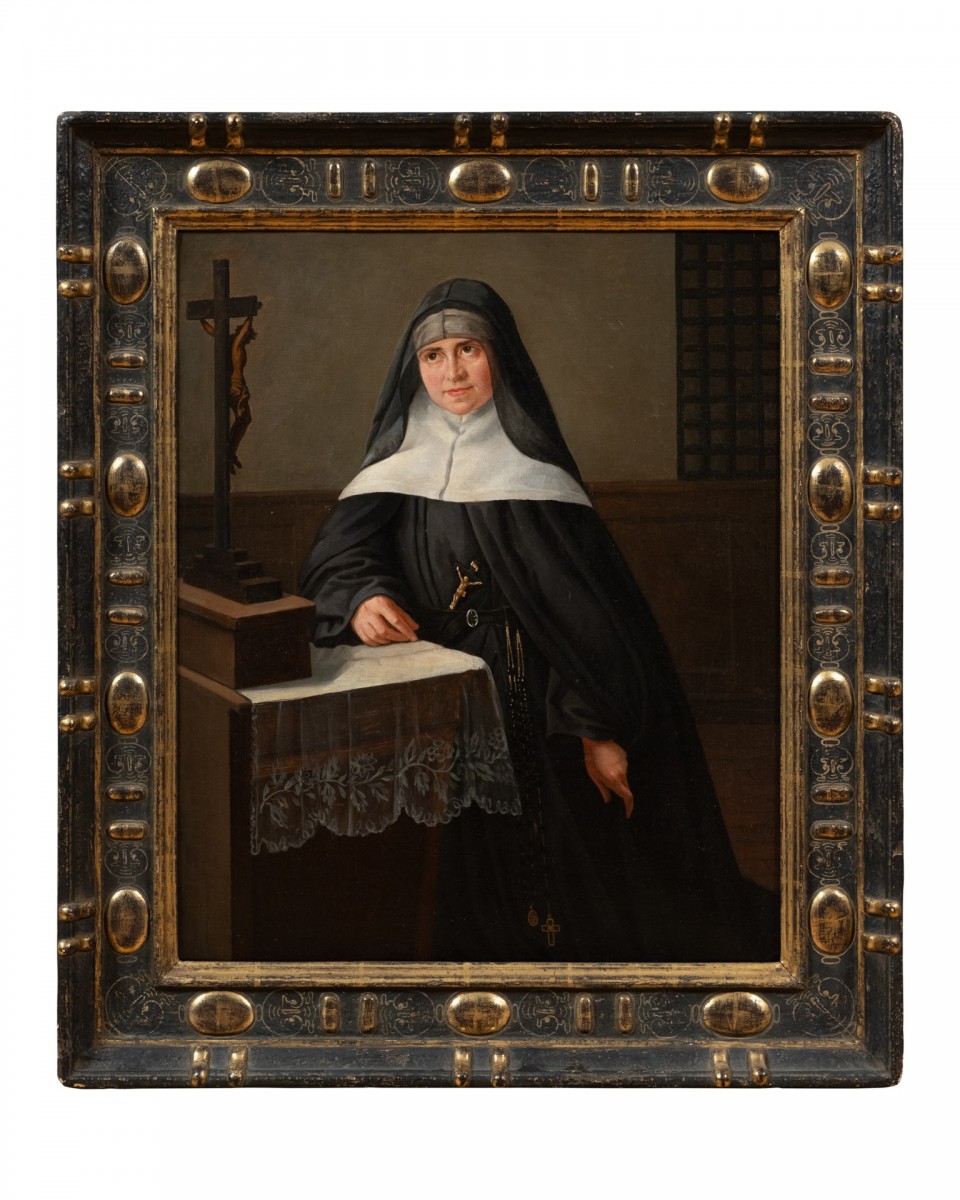
This painting by Philippe-Jacques van Brée depicts a nun praying before a crucifix in a monastic cell. Several elements drawn from Spanish-inspired iconography suggest that she belongs to a Spanish convent. Her rather ample black veil and white wimple forming a broad triangle correspond to the traditional dress of Spanish nuns as perceived in the European pictorial imagination at the turn of the 19th century. The length and lateral position of the rosary attached to her belt, as well as the crucifix worn at her waist rather than around her neck, evoke monastic iconography widely found in the Iberian tradition. Finally, the almost complete absence of decoration in the cell can be associated with the ideal of visual austerity often linked to Spanish spirituality. The painting's frame, almost certainly original, also draws upon a Spanish decorative vocabulary inherited from the Golden Age.
Alongside his Travelers in the Orient (a work now lost), our Spanish Nun is one of the first two paintings of Philippe-Jacques van Brée's official career. Born in Antwerp in 1786, Philippe-Jacques entered the Royal Academy of Fine Arts in his native city, where his brother, Matthieu-Ignace, had been a professor since 1803. Unlike his brother, who was a history painter, Philippe-Jacques van Brée devoted himself to genre painting.
For his first public exhibition, he participated in the Brussels Salon of 1811. He intended to present two paintings, our Spanish Nun and Travelers in the Orient. However, an incident thwarted his original intentions. Indeed, The Spanish Nun was removed from the exhibition walls by the Salon directors before the opening. In his Annales du Salon de Gand of 1823, the commentator Lieven de Bast reported the event:
“The Directors did not permit [The Spanish Nun] to be exhibited, for particular reasons unrelated to the merits of this graceful composition; this occurred at the Brussels Salon in 1811, at the height of the war in Spain, and as we have not seen the painting, it is not for us to judge the motives of the Salon Directors.”
The political explanation put forward by De Bast constitutes a plausible hypothesis for why Van Brée's Spanish Nun was prevented from being exhibited. As Brussels had been annexed by France since 1795, the painting, despite its seemingly anecdotal subject, may indeed have been interpreted as an anti-French statement in the context of the Spanish War of Independence, which had opposed Bourbon Spain to Napoleon's armies since 1808. The depiction of a Catholic nun was all the more sensitive in light of the abduction and subsequent imprisonment of Pope Pius VII by those same Napoleonic forces in 1809.
Following this first exhibition in 1811, Van Brée went to study in Paris in the studio of Anne-Louis Girodet. He subsequently traveled to Italy from 1816 to 1818 before returning to Paris. He participated in the Paris Salon for the first time in 1819. Alongside two historical genre scenes, he submitted A Nun in Meditation under no. 1118. Perhaps this was once again our Spanish Nun, which he may finally have been able to exhibit in a calmer political climate following the restoration of the Bourbons to the French throne in 1815.