Offered by Galerie Magdeleine
REQUEST INFORMATION

Paintings and drawings from the 17th to the 19th century
Marie Éléonore GODEFROID (Paris, 1778 – Paris, 1849)
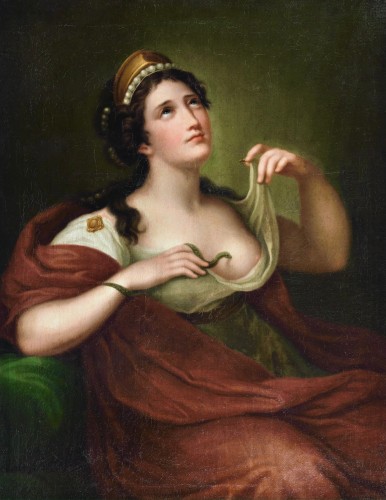
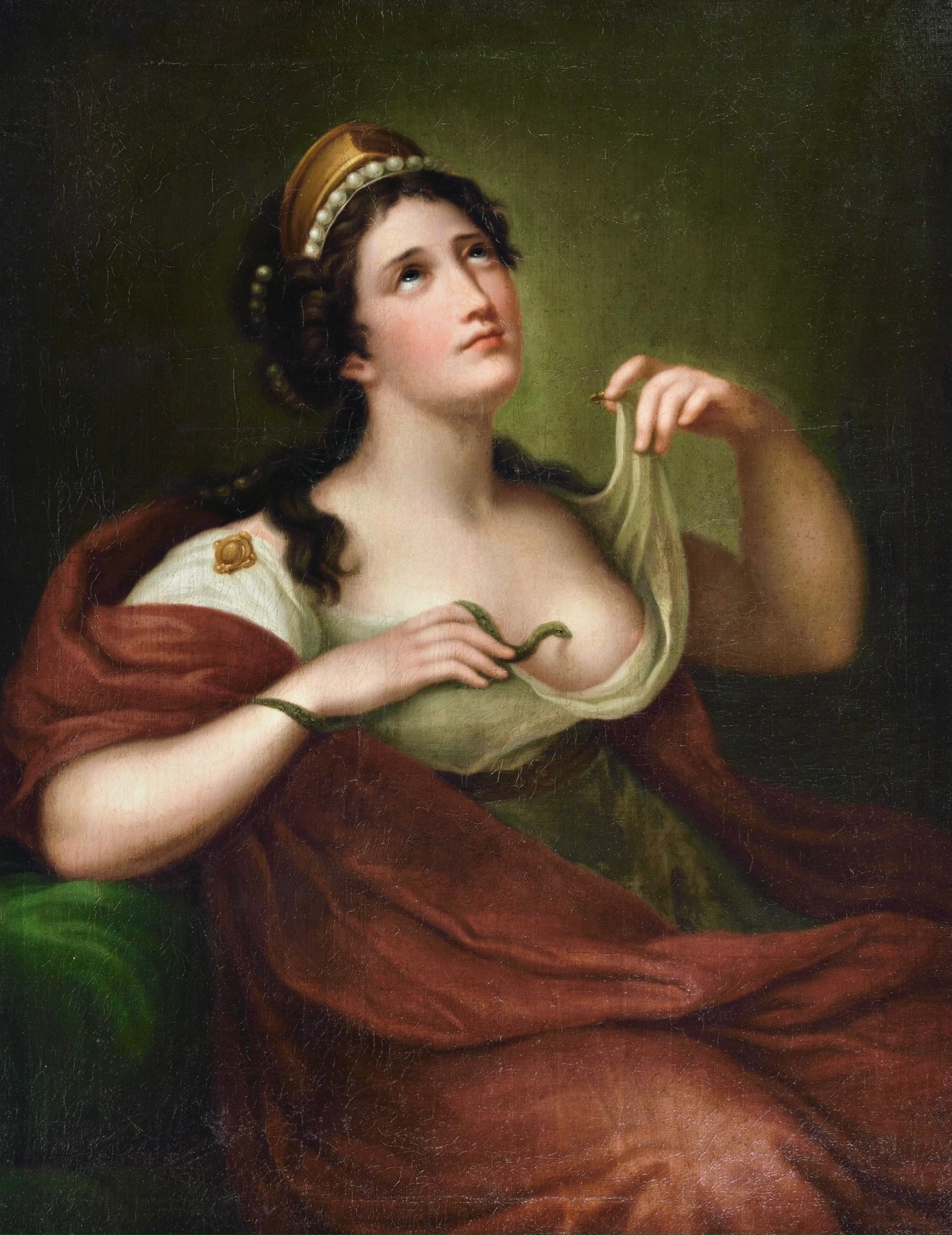
The Suicide of Cleopatra
Circa 1805–1806. Oil on canvas. H: 100; W: 80 cm.
Born in 1778, Marie-Éléonore Godefroid grew up at the Louvre, where her father, Ferdinand-Joseph Godefroid, worked as a restorer of the King's paintings. From childhood, she was therefore familiar with the great masters represented in the royal collections. Initially trained by her father, at the age of seventeen she became a teacher of drawing and music at the girls' school founded by Madame Campan in Saint-Germain-en-Laye. At the time, this boarding school educated the female elite of the Directoire and the Empire. She left it in the mid-1800s, when Madame Campan was appointed to direct the institution at Écouen, in order to devote herself entirely to painting. She then furthered her training under two former pupils of David, Jean-Baptiste Isabey and, above all, François Gérard. She worked alongside the latter from 1805, then moved into his household in 1812, becoming his collaborator and principal copyist.
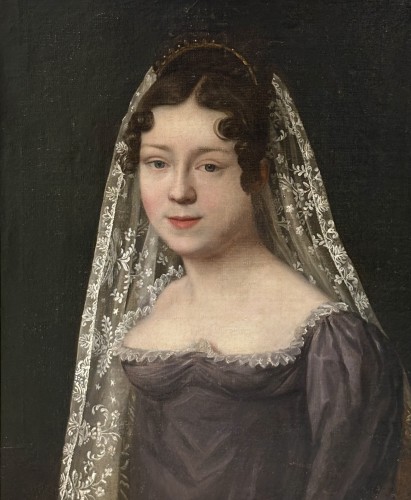
From 1800 to 1847, Godefroid exhibited almost exclusively portraits at the Salon: the children of Marshal Ney in 1810, Queen Hortense and her sons in 1812, and later the children of the Duke of Orléans during the Restoration. She was awarded medals in 1812 and 1824. Her technique was so close to that of her master that part of her work circulated for many years under Gérard's name. This is one of the reasons why she rapidly faded from recognition after her death.
Our painting depicts Cleopatra in a half-length composition, at the moment when she brings the asp to her breast.
The composition follows the Bolognese tradition of depicting a heroine in half-length, her gaze turned toward the heavens, a model that the young artist could have studied in the Louvre collections. She nevertheless tempers it with a distinctly Neoclassical restraint.
The attribution and dating are based on comparisons with the artist's portraits. The painting appears to us to be slightly earlier than the Portrait of Madame Campan, which she executed around 1807. We find the same softness of the flesh, modeled through imperceptible transitions; the velvet treated in broad luminous planes, which would become almost a hallmark of her work; the voluminous hair, divided into large, supple locks; and the hands with slender, slightly curved fingers, recognizable from one painting to another.
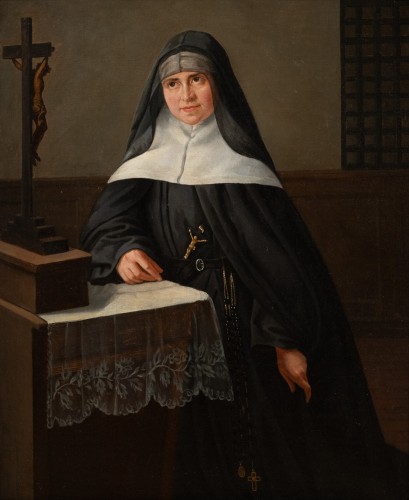
The drapery, above all, is characteristic of the artist. Godefroid renders it heavy and fluid, as though weighed down by its own substance: the fabric falls under its own weight in broad flowing folds, without ever breaking sharply. The ridges of the folds remain soft, rounded, almost merging into the shadows. She thus departs from the sharp, sculptural folds of the Davidian tradition, allowing light to glide over the fabric rather than sharply defining it. This treatment of drapery can be found throughout her career, including in the portrait of Madame Campan commissioned in 1845 by Louis-Philippe for the Historical Museum of Versailles.
The resemblance is even closer to the Portrait of Marie-Joséphine-Louise of Savoy attributed to the artist, whose format is almost identical to that of our canvas. In both paintings, the folds follow the rounded forms of the bodies in broad curves, and the breasts are modeled with the same rounded softness.
Gérard's influence is evident here. A former pupil of David, he had abandoned history painting to become the most sought-after portraitist of the Empire. Nevertheless, he had retained in his portraits the dignity and idealization of the grand genre.
Godefroid takes the opposite approach: she treats a historical subject in the manner of a portrait, with a single figure, framed at half-length and isolated against a dark background. From Gérard she inherits the porcelain-like quality of the flesh tones, the enveloping light that separates the figure from the background, and a taste for sumptuous fabrics whose rendering becomes part of the subject itself.
Why did Godefroid never exhibit this painting? First, it should be regarded as a work of artistic training. At the age of twenty-seven, the artist entered Gérard's circle, and the exercise of painting a historical figure under the master's supervision belonged to studio practice. But its absence from the Salon also reflects a deliberate career strategy. A former teacher at Madame Campan's institution, Godefroid built her reputation among the families of the Imperial elite, who entrusted her with portraits of their children. A Cleopatra with an exposed breast was hardly compatible with this image of respectability, at a time when critics reminded women painters of the limitations imposed upon their sex.
The painting thus perfectly illustrates the approach described in this catalogue. The ancient heroine is presented alone before the viewer, in the manner of a portrait, while the ambition to engage with the grand genre remains confined to the private sphere. It is a rare testimony to the ambition to practice history painting on the part of an artist whom posterity has remembered only as a portraitist.