Offered by Galerie Magdeleine
REQUEST INFORMATION

Paintings and drawings from the 17th to the 19th century
Frédérique O’CONNELL (Potsdam, 1822 – Neuilly-sur-Marne, 1885)
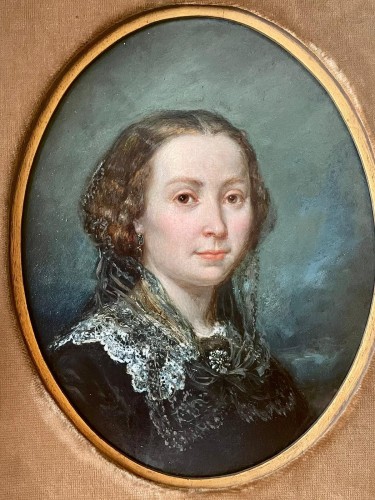
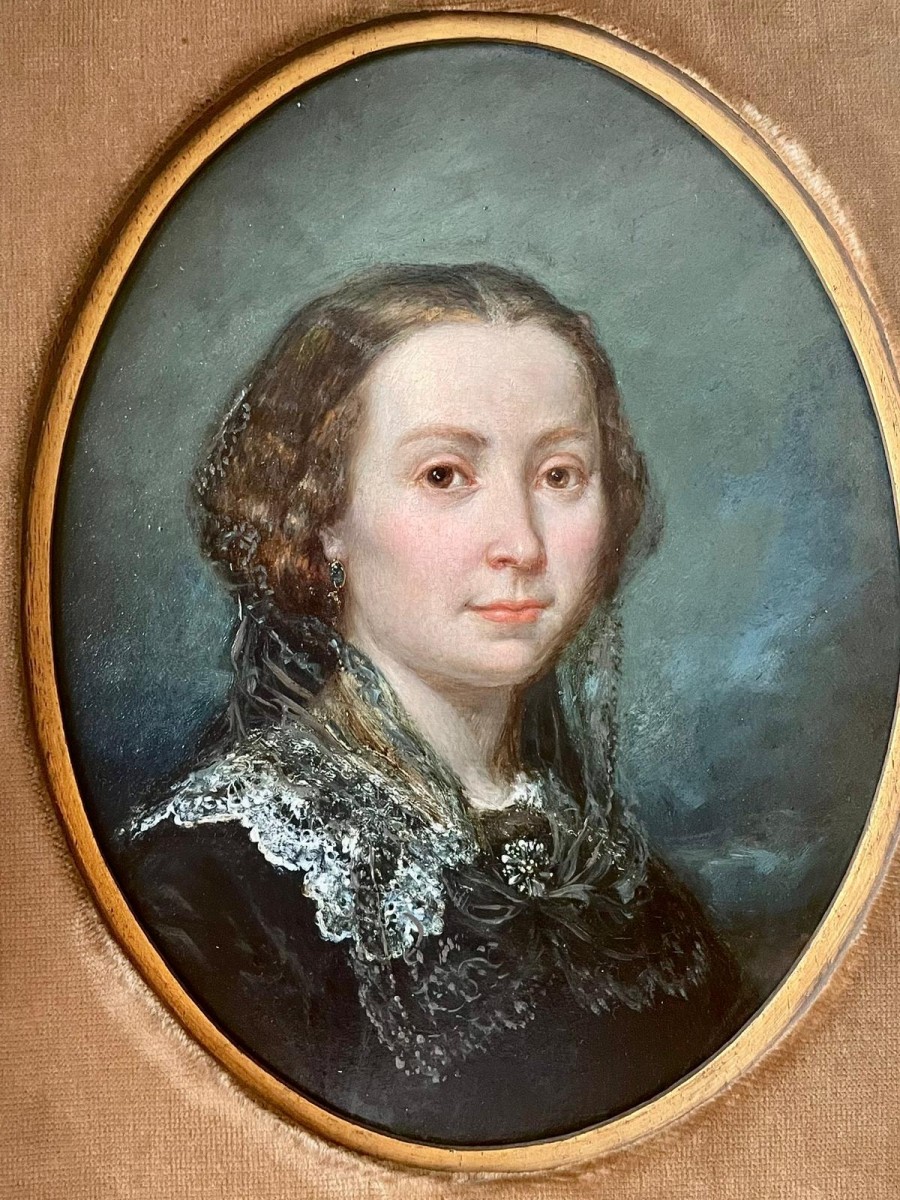
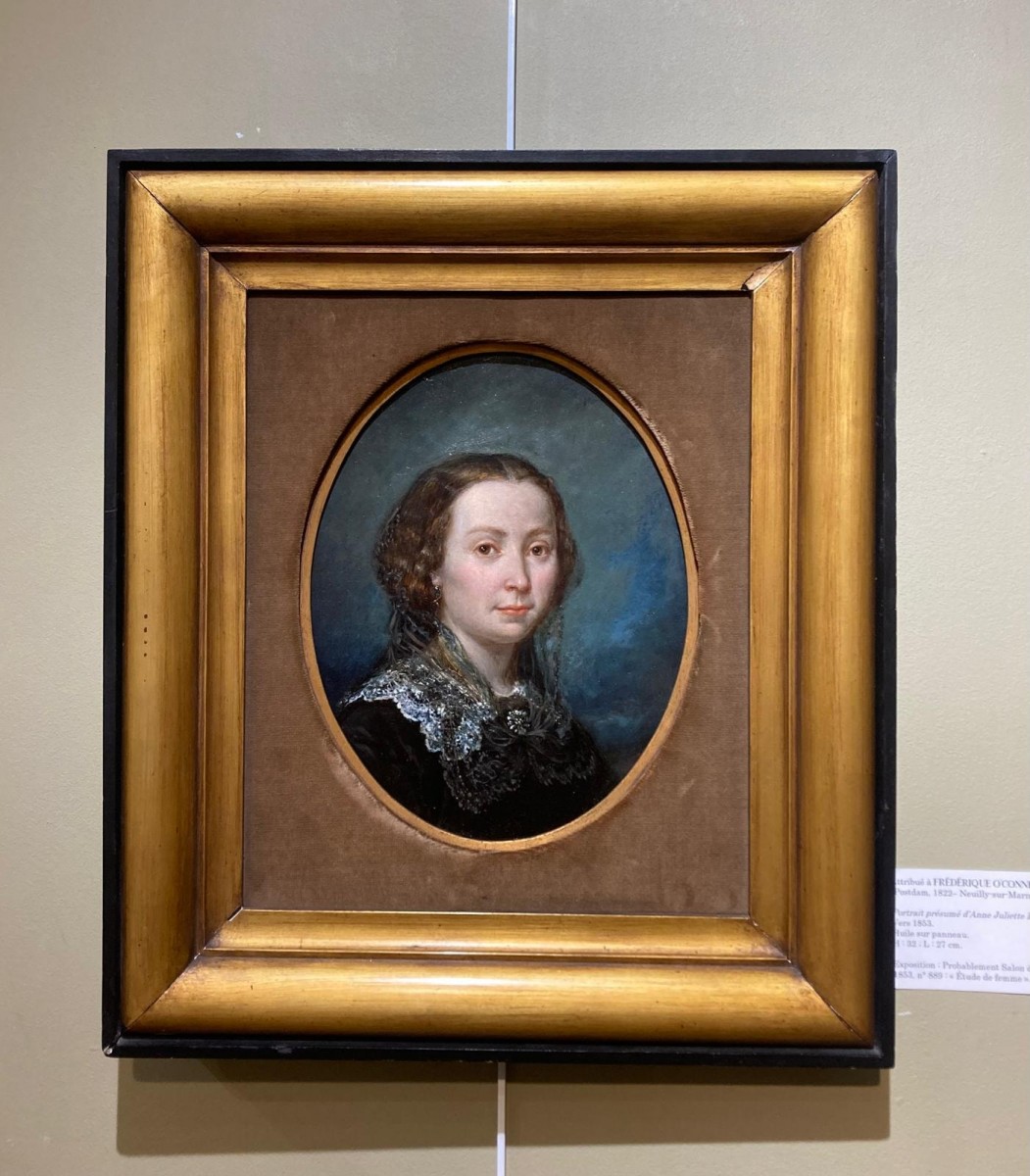
Presumed Portrait of Anne Juliette Ducos
Circa 1853. Oil on canvas. H: 32; W: 27 cm.
Exhibition: Probably Salon des Artistes Vivants, Paris, 1853, no. 889: “Study of a Woman”.
Shortly before the Salon of 1853, a journalist from La Revue des Beaux-Arts visited O’Connell’s studio and inquired about the paintings she intended to submit to the forthcoming exhibition:
“The recent exhibitions in Brussels and Paris have provided Mme O’Connell with favorable opportunities to make her work known; today, this lady has taken her place among the masters […]. Thus, full-length and bust portraits are present in quite considerable numbers, merely awaiting the moment to leave Avenue Frochot for the exhibition’s final venue. Among these portraits, executed with the vigor and grand style of the masters of the 16th and 17th centuries, the most distinguished are those of the Comte de Persigny, M. de Romieu, M. Arsène Houssaye, as well as those of Mme Ducos, wife of the Minister of the Navy, and Mlle Rachel, dramatically dressed in black velvet.” [1]
At the Salon of 1853, O’Connell ultimately exhibited the portraits of Mlle Rachel and M. Romieu, but also a Study of a Woman, which appears to correspond to the Portrait of Madame Ducos (1819–1898) mentioned in the article from La Revue des Beaux-Arts.
The portrait’s small format and particularly rapid and confident execution may have prompted the artist to choose the title Study. It is also possible that this title was intended to preserve the sitter’s anonymity, since Madame Ducos’s husband, Théodore Ducos, was a politician who had held the position of Minister of the Navy and Colonies since 1851.
This was not the first time O’Connell had chosen to exhibit a portrait under the title Study. Her Study of a Woman from Life, exhibited at the Antwerp Salon in 1849, proved to be the Portrait of Amélie Turlot.
It is also interesting to note that the portraits of Mesdames Turlot and Ducos were conceived and executed according to the same scheme, namely as false ovals, with painted corners that nevertheless maintain a separation from the central representation.
The vigorous pictorial style employed in the portrait of Madame Ducos was particularly noted by critics:
“Her Study of a Woman, on the contrary, despite the excessive use of chalky tones and the phantasmagoria of the lighting, is a successful and striking likeness.” [2]
This highly personal style, characterized by the granular treatment of flesh tones and the firm application of paint to form the costume, remains a recurring feature throughout O’Connell’s work.
The portrait of Madame Ducos reveals numerous details echoing earlier works by the artist. Thus, the white lace adorning Madame Ducos’s bodice can also be appreciated in the portrait of Peter the Great; the graphic accents of her veil are equally visible in the self-portrait of 1851, while the ethereal background can be compared both to that same self-portrait and to the portrait of Catherine II of Russia.