Offered by Galerie Magdeleine
REQUEST INFORMATION

Paintings and drawings from the 17th to the 19th century
Adélaïde LENOIR (Paris, 1769 – Paris, 1832)
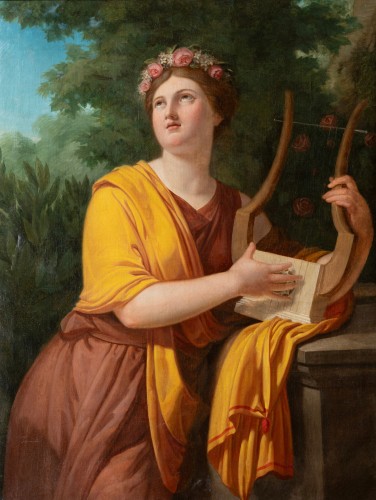
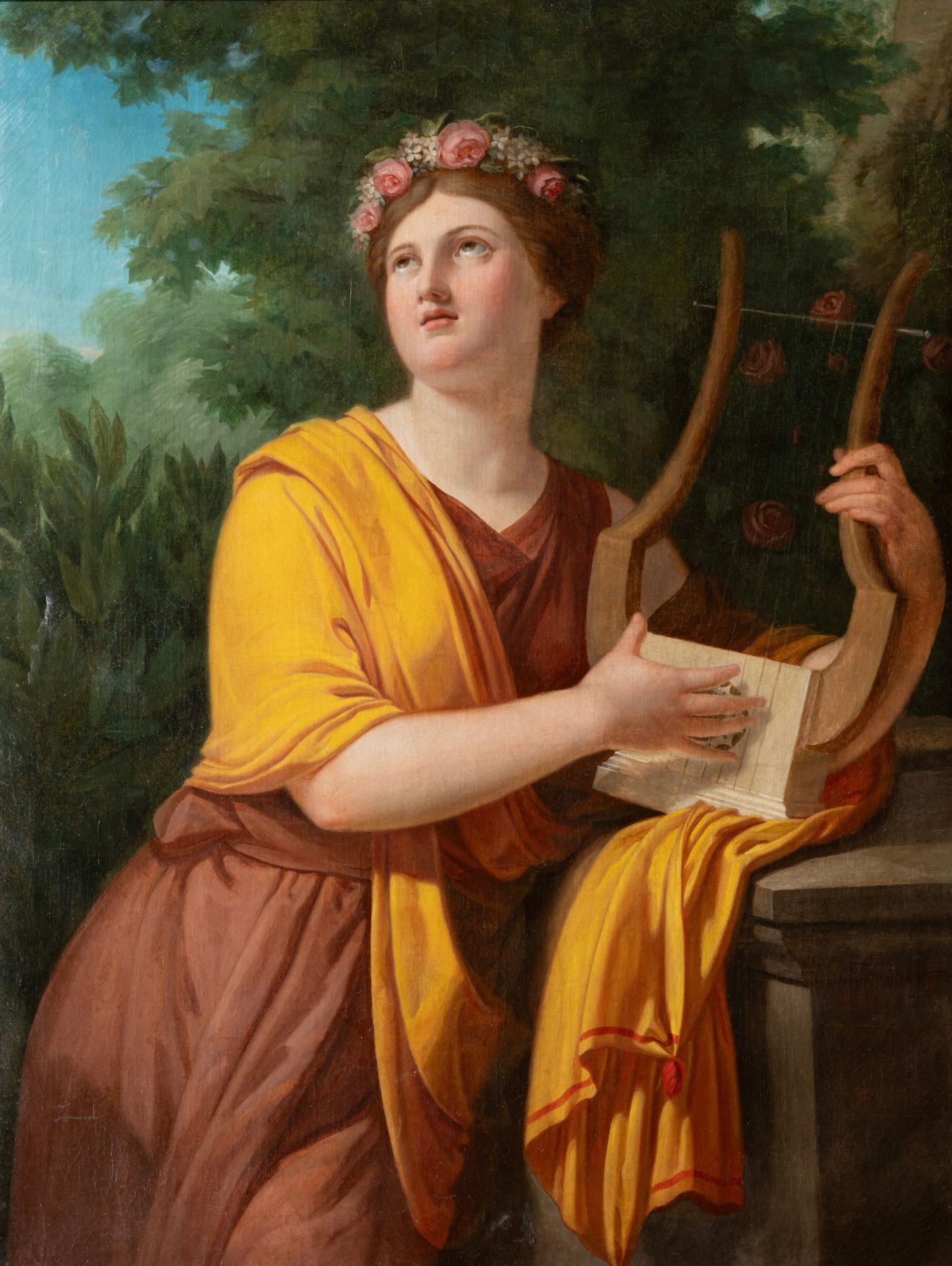
Euterpe Playing the Lyre
Circa 1804. Oil on canvas. H: 98; W: 72 cm.
Exhibitions: Salon des Artistes Vivants, Paris, 1804, no. 304: “Euterpe against a Landscape Background.”
Adélaïde Binart, the future Madame Lenoir, received her first training in painting in the studio of Gabriel-François Doyen. There she notably met her husband, Alexandre Lenoir, famous for his work at the Musée des Monuments Français.
Specializing in portraiture, Adélaïde Lenoir made her public debut at the Salon of 1795. Absent from the 1796 edition, she did not reappear until 1799.
Absent from the Salon of 1802, she joined the studio of the celebrated Jean-Baptiste Regnault around this time. She then set about correcting her shortcomings, improving her technique, and refining her style in preparation for the Salon of 1804. Certainly encouraged by Regnault, she decided to submit a history painting to this exhibition. Through this ambition, Lenoir placed herself in the tradition of talented women artists trained in Regnault's studio who had achieved success in the genre in previous years (Pauline Auzou and, even more notably, Angélique Mongez).
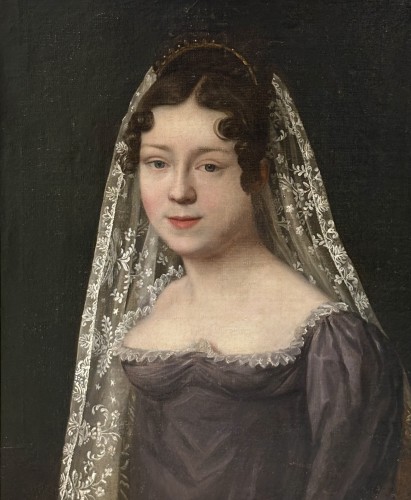
At the Salon of 1804, Lenoir thus exhibited the only history painting of her career, Euterpe against a Landscape Background. In examining this work, it is interesting to emphasize the artist's very clear progress in her art, particularly in the execution of the freely brushed landscape, a technique already employed in a Portrait of a Young Girl exhibited in 1799 (Fig. 3), as well as in the particularly accomplished treatment of the drapery.
Already at the Salon of 1801, with a Portrait of a Seated Woman with Her Two Children (Fig. 4, Musée du Louvre), Lenoir had demonstrated her mastery of large-format painting. We can observe stylistic similarities between this earlier painting and our Euterpe. In addition to the identical modeling of the hands, Lenoir depicted the roses and foliage crowning her Euterpe in the same manner as those adorning the young girl on the left in her family portrait.
Furthermore, Lenoir's Euterpe combines accurate bodily proportions with a natural pose. The artist thus demonstrates her mastery of anatomy, most certainly acquired through the study of the live model, which she had apparently lacked previously.
As for the pictorial choices employed in Euterpe, they appear to have been conceived and developed within Regnault's studio itself, in consultation with the artist's fellow students. We are tempted to recognize in Euterpe's physiognomy and pose the influence of an early work by Pauline Auzou, executed nearly ten years earlier, depicting Flora.
Even more strikingly, the acidic coloring of Euterpe's garment, inspired by the 17th century, can also be found in a second history painting produced in Regnault's studio and exhibited at the same Salon. This is Calypso Receiving Telemachus and Mentor on Her Island (Fig. 5), painted by Pierre Louis Edme Pellier.
The chromatic connection with Parisian Atticism is further reinforced in Lenoir's work by the very subject of the painting. By depicting the Muse of Music, she establishes a connection with the panels painted by Lesueur that adorned the Cabinet of the Muses at the Hôtel Lambert.