Offered by Galerie Magdeleine
REQUEST INFORMATION

Paintings and drawings from the 17th to the 19th century
Louise DESNOS (Paris, 1807 – Abbeville, 1878)
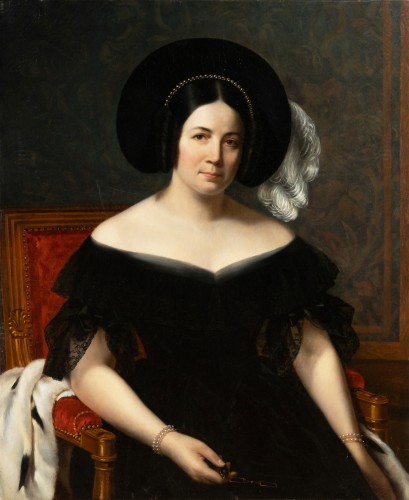
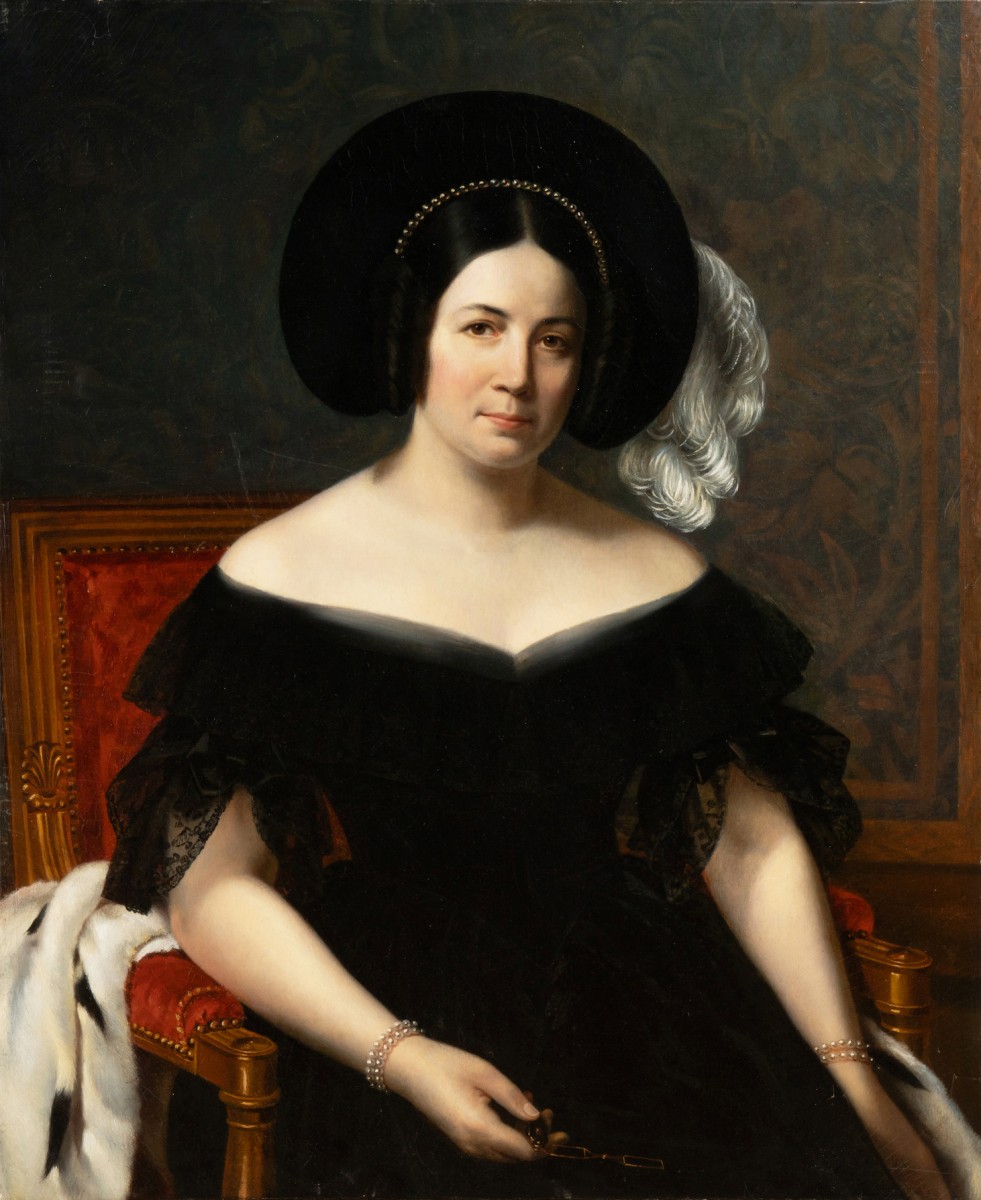
Presumed Portrait of Adèle Hugo
Circa 1842. Oil on canvas. H: 88; W: 70 cm.
Exhibition: Salon des Artistes Vivants, Paris, 1842, no. 546: “Portrait of Mme H\*\*\*”, recorded under no. 1208 in the Register of Works of the 1842 Salon: “1 painting, portrait of Mme H. / Height: 90; Width: 74 cm.”
A pupil of Louis and Louise Hersent, with whom she lived and worked, Louise Desnos made her public debut at the Salon of 1831. Regularly exhibiting portraits of prominent figures from Parisian high society, probably thanks to the Hersents' network, she quickly achieved recognition when the French State acquired her painting The Widow's Mite following the Salon of 1840. Through this acquisition for the royal collections, Desnos became one of only four women painters whose works were exhibited at the Musée du Luxembourg, which was dedicated to living artists.
The portrait of Madame Hugo was presented at the Salon of 1842 alongside an ambitious canvas, The Consecration of Saint Genevieve to God, the artist's first history painting.
Desnos produced a truly aristocratic and official portrait, faithful to the tradition of formal portraiture. Seated confidently and directing a stern gaze at the viewer in a sumptuous setting, Adèle Hugo appears as a prominent woman assured of her position and her place within the elite. The ermine placed behind her back explicitly reaffirms to the viewer the nobility associated with the sitter. Indeed, Victor Hugo became a viscount in 1837 following the death of his brother Eugène. The new Viscountess Hugo was particularly delighted with this new status, and the couple initially made a point of asserting their membership of the nobility. The commission of this portrait is one such indication.
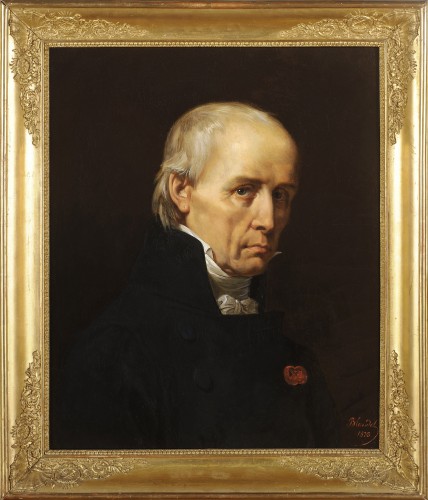
In this respect, Desnos's portrait differs fundamentally, both in its presentation and in its impact on the viewer, from another portrait of Adèle Hugo executed a few years earlier, in 1839, by Louis Boulanger, a friend of the Hugo couple.
By exhibiting portraits of prestigious sitters, Desnos demonstrated the new reputation she had acquired through the expansion of her clientele into aristocratic circles. She thus established herself as a painter of the wealthy elite, who sought official portraits.
The portraits she exhibited at the Salon of 1844, the true pinnacle of her career, depicted influential figures, whether from military circles, including a general and an admiral, or more fashionable personalities such as Ekaterina Gagarina, sister of the highly influential Sophie Swetchine.
Desnos developed a perfectly recognizable style in her portraits. The particular attention paid to clothing and surroundings was undoubtedly inherited from her teachers, as were the firmly established poses and frontal attitudes of her sitters. Several recurring stylistic elements can be observed across her works, notably the treatment of the pearls on the bracelets in the portraits of Adèle Hugo and Juliette Destailleurs (Ill. 3; 1846; preserved at the Musée Carnavalet).
The background of our portrait, featuring floral wallpaper, although unprecedented in her work in 1842, would be reused by the artist and her circle in subsequent years. It can thus be seen in the portrait of Countess Gagarina of 1844 (Ill. 4), as well as in the portrait of Louise Desnos by her teacher Louise Hersent (Ill. 5), executed in 1845. This highly distinctive green wallpaper therefore appears to have actually existed, decorating a wall in the Hersents' home.