Offered by Galerie PhC
REQUEST INFORMATION

European paintings from the 17th, 18th and 19th centuries.
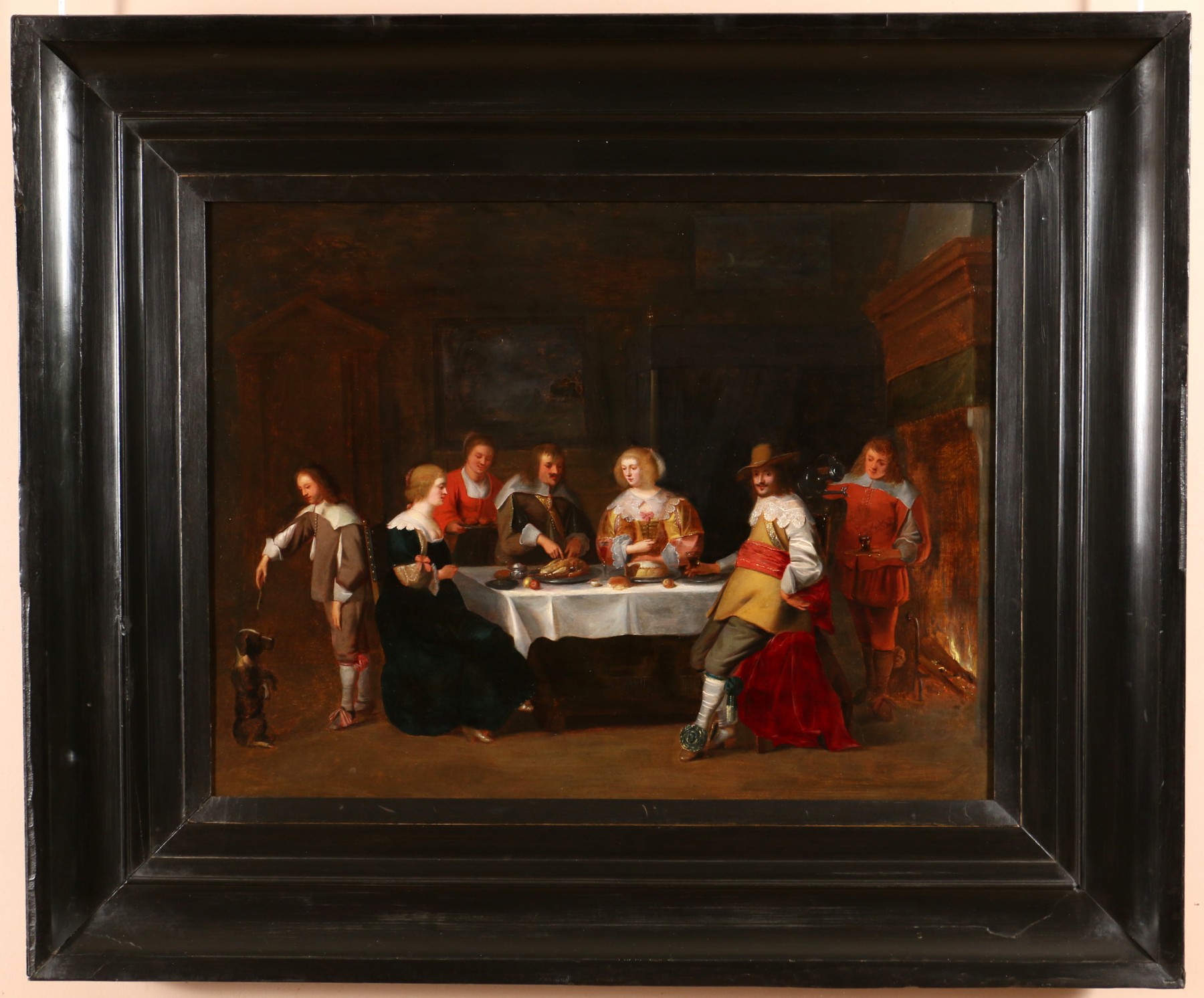
Oil on panel mounted on panel; 65 cm x 49 cm.
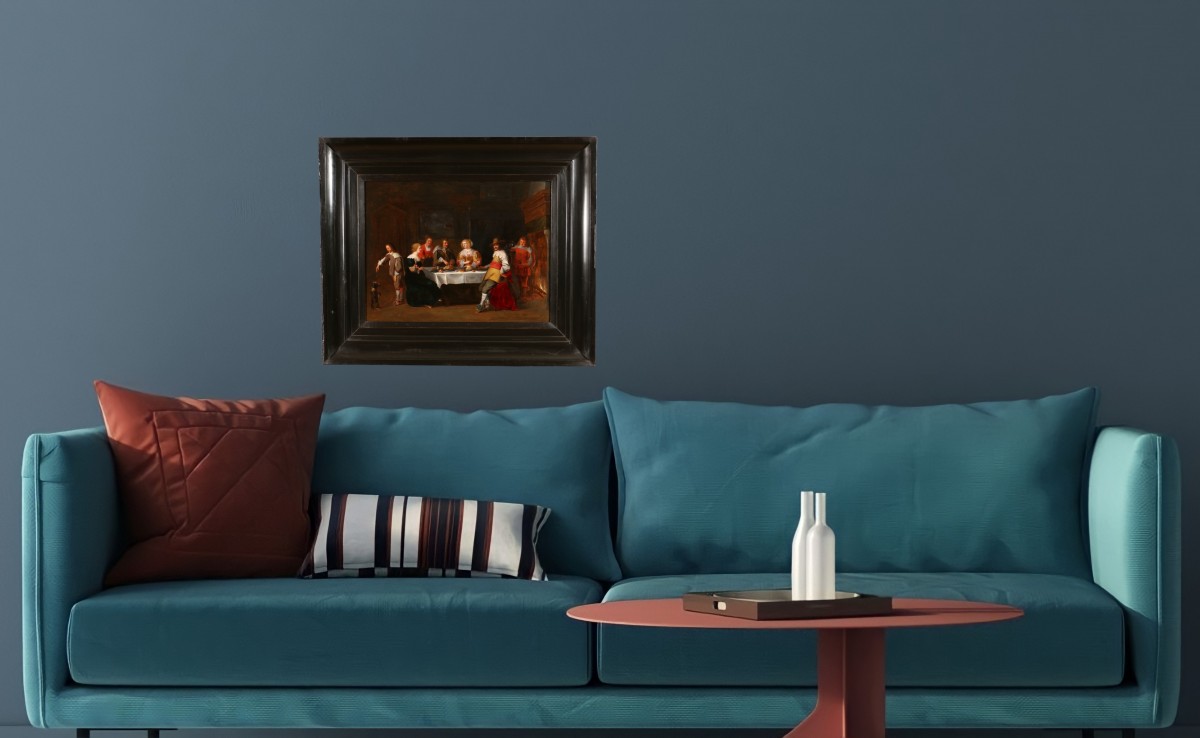
Period blackened wood frame; 91 cm x 76 cm.
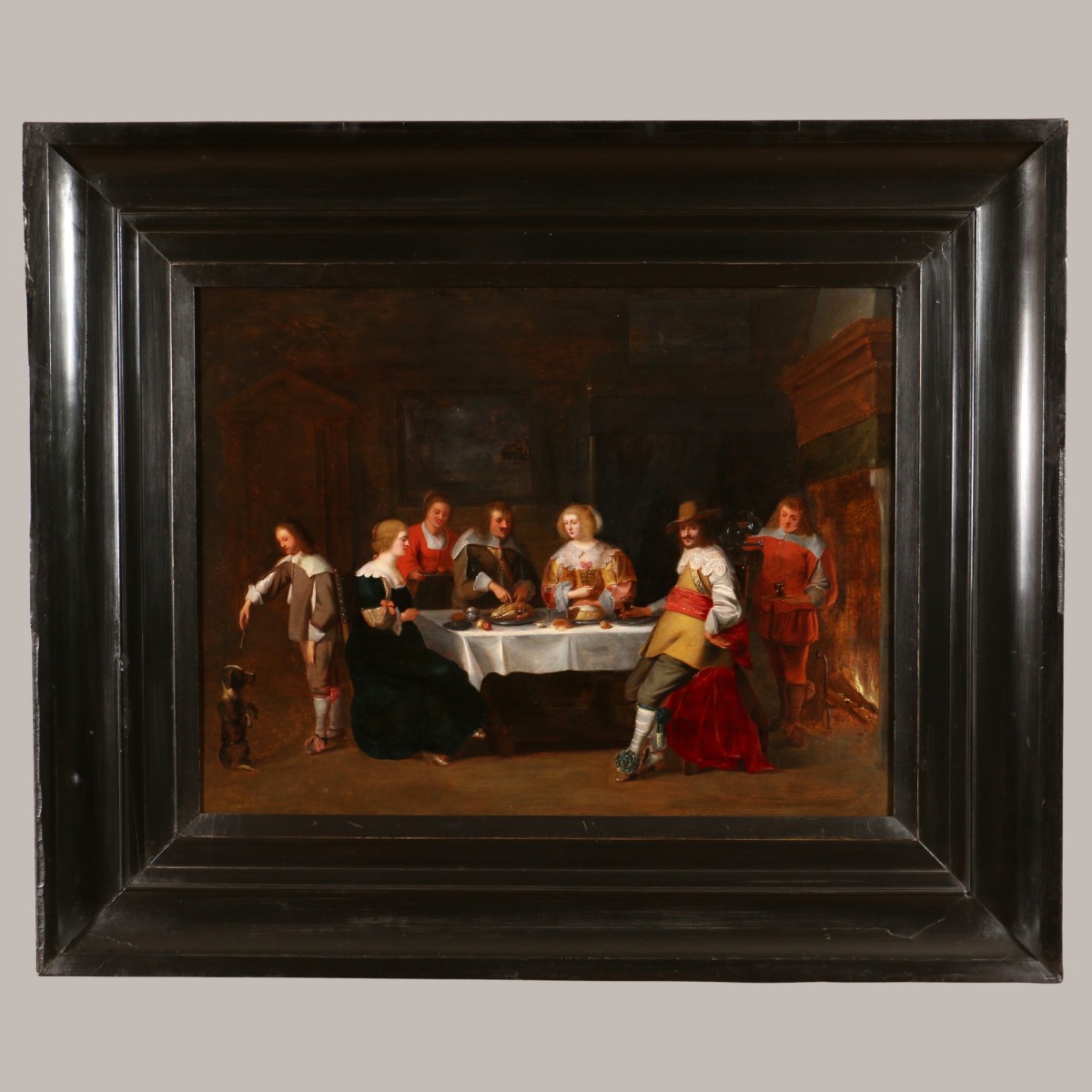
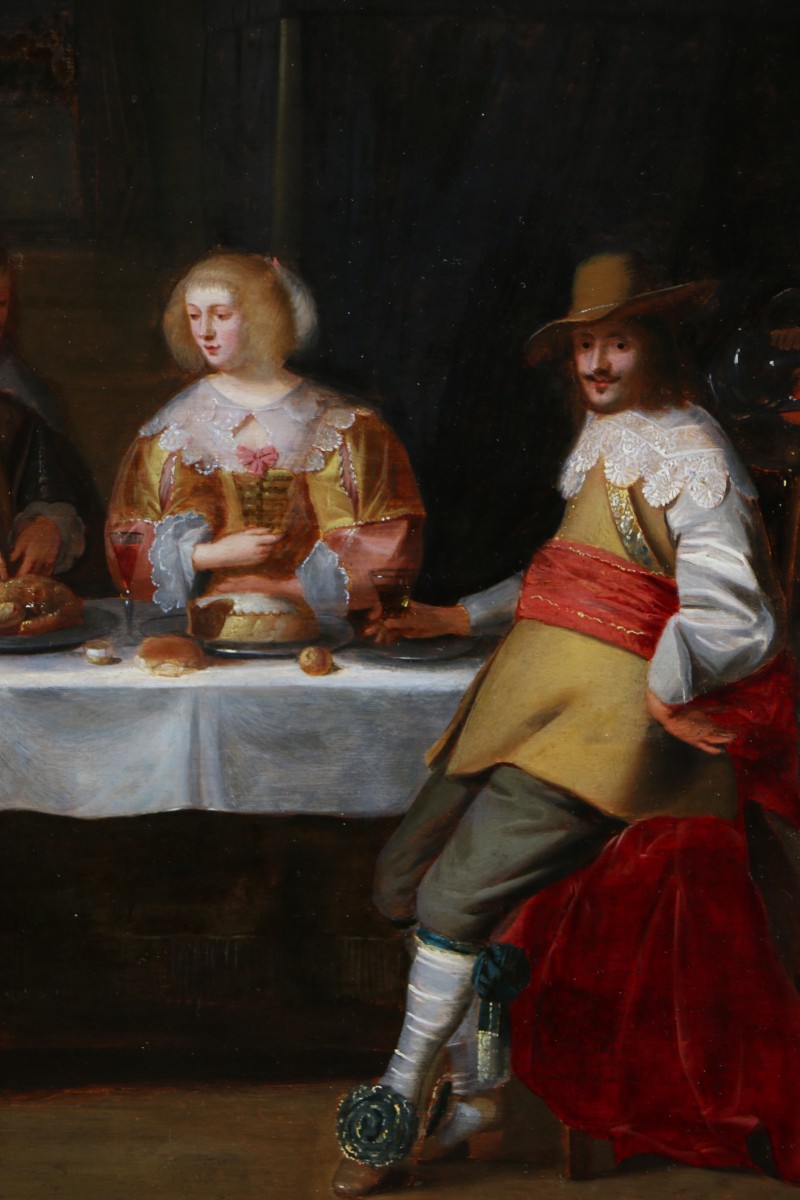
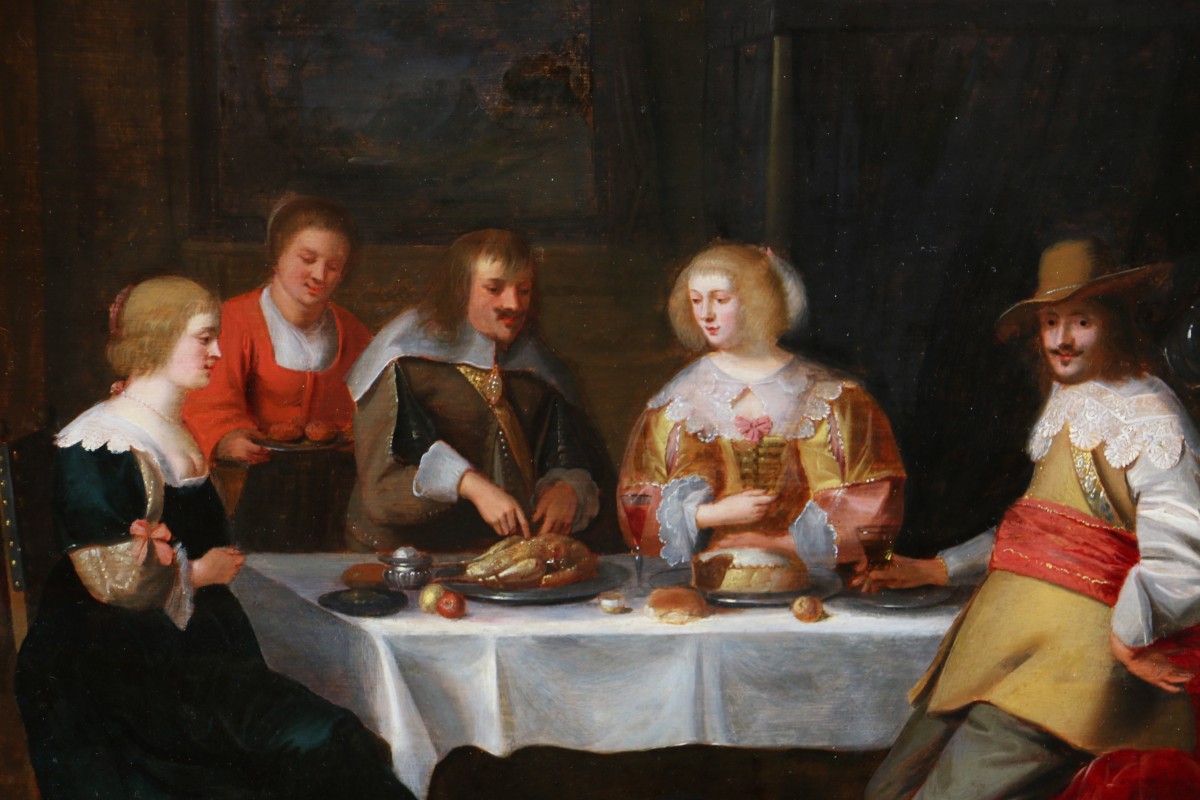
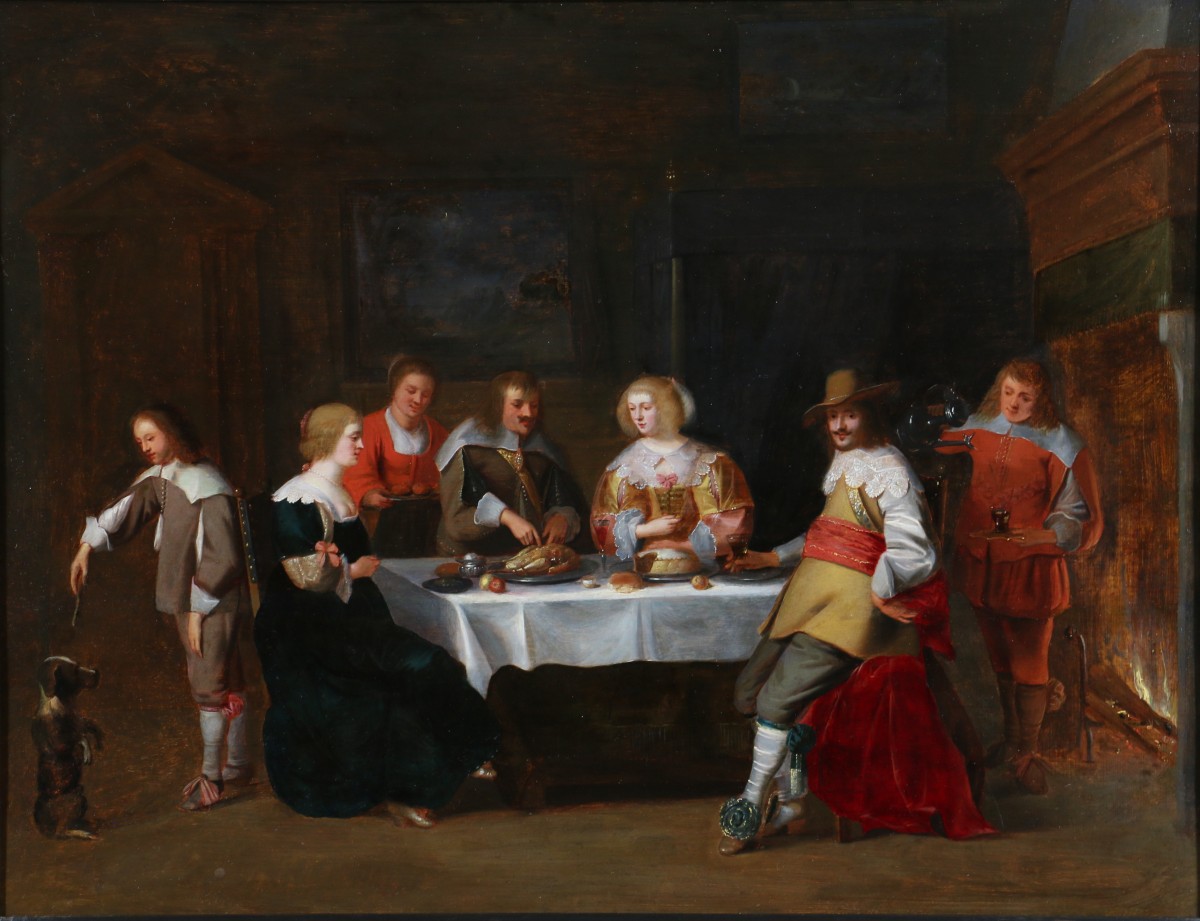
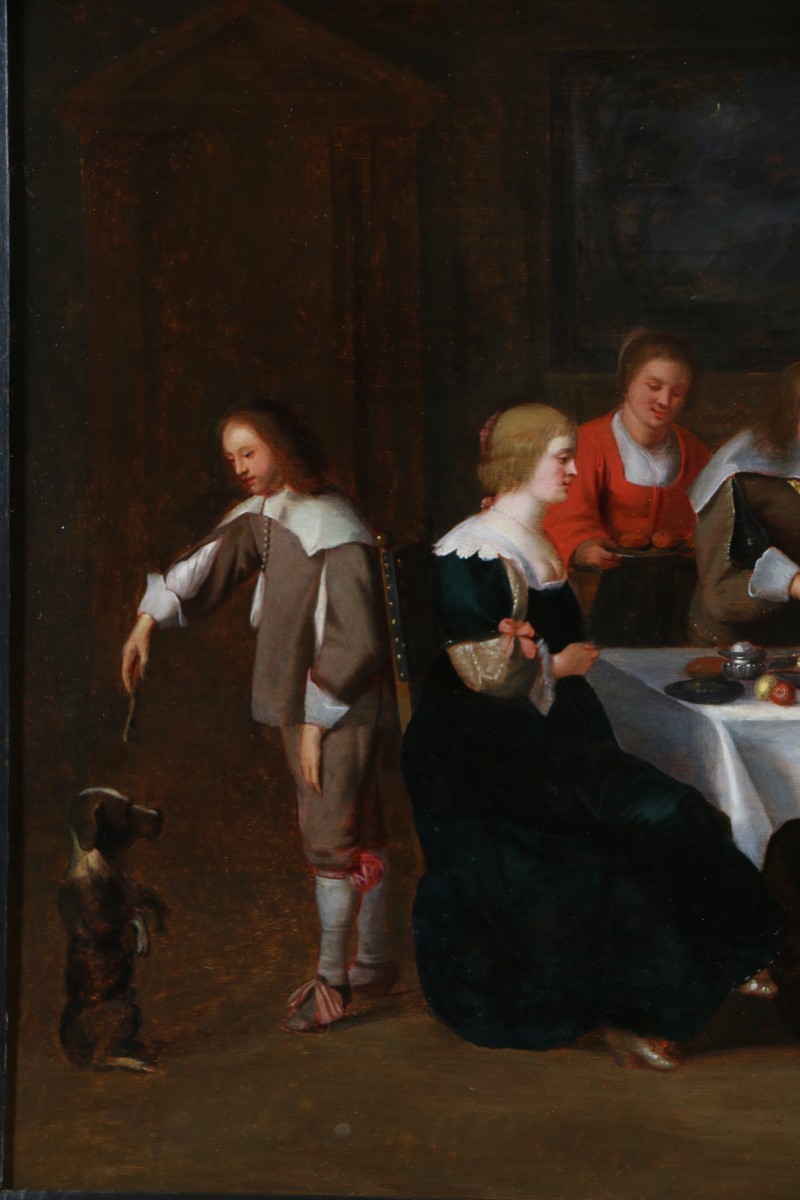
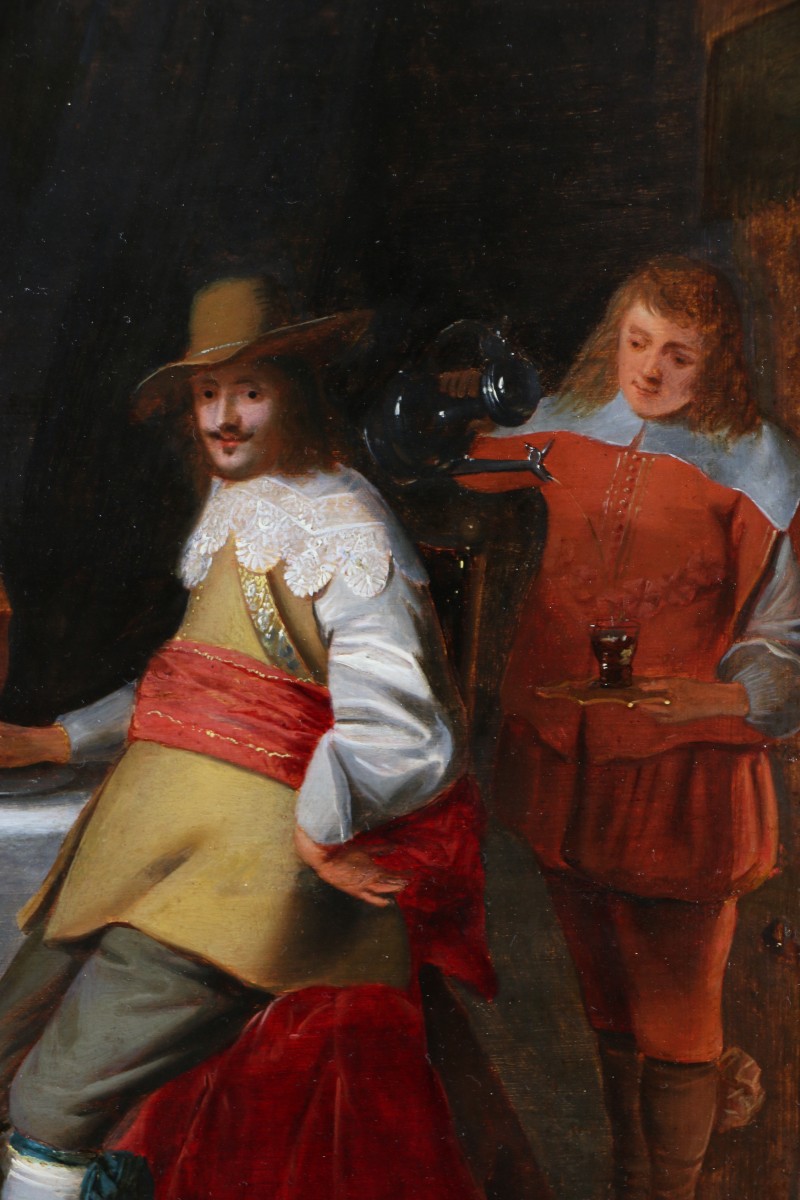
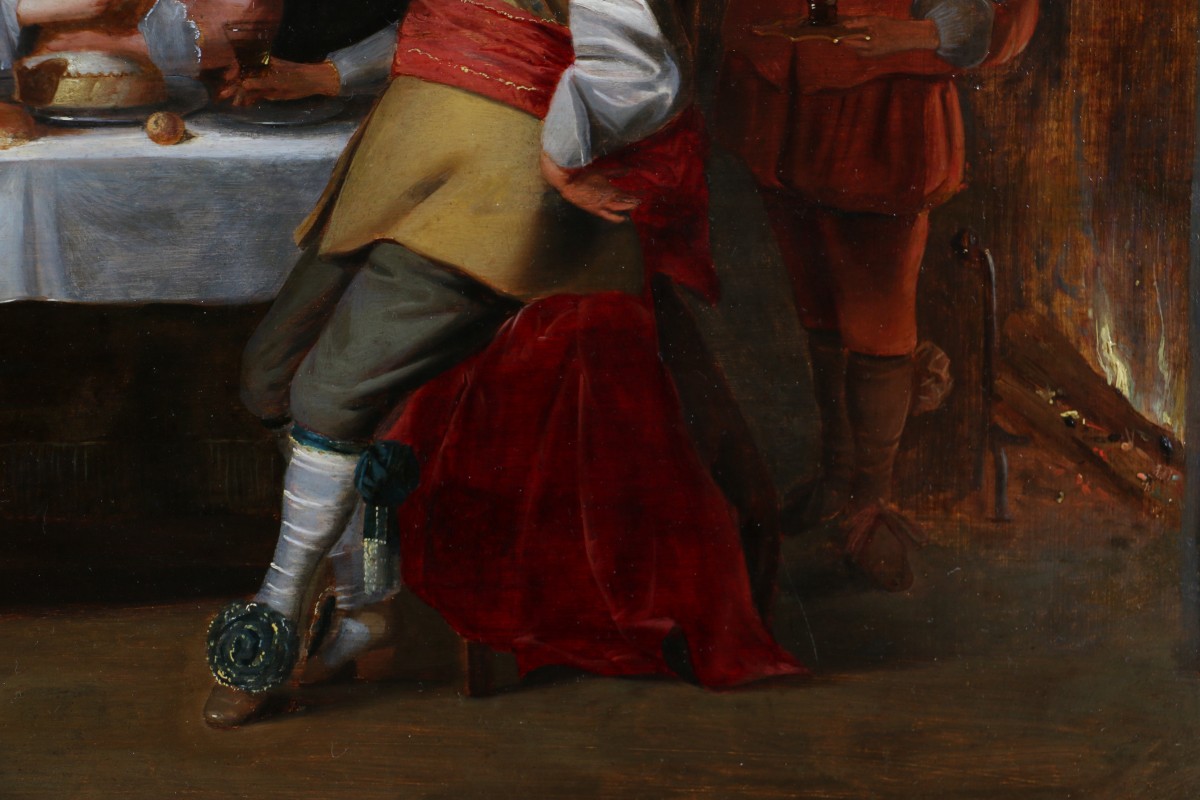
This genre scene depicts an elegant company gathered around a table set within the spacious interior of a Flemish bourgeois home. The artist presents eight figures—richly dressed in the fashion of the 1630s and 1640s—sharing a meal in a convivial yet refined atmosphere. At the center of the composition, a young woman in a gold and pink satin gown draws the eye. She is surrounded by guests conversing peacefully, while a young man—wearing a wide-brimmed hat and draped in a red sash—turns toward the viewer, establishing a direct connection. Behind the diners, a maidservant brings in a dish, underscoring the domestic nature of the scene. To the left, a child moves away from the table holding an object, accompanied by a small dog standing on its hind legs—a picturesque detail frequently used in Flemish painting to enliven the composition. On the right, near the imposing fireplace where a fire burns, a young servant holds a goblet or ewer, ready to serve the guests. The table is covered with a brilliant white cloth holding a pâté, bread, fruit, goblets, and pieces of fine metalwork that attest to the figures' social standing. The warm tones of the wood paneling and the subtle chiaroscuro enhance the intimate feel of this interior scene. This work is entirely characteristic of the oeuvre of Christoph Jacobsz. Van der Laemen was a specialist in "elegant companies" (*gezelschappen*), a genre highly prized in 17th-century Flemish painting. Heir to the tradition of conversation pieces developed in the United Provinces, the painter excelled at depicting social gatherings where music, dining, dancing, and gallantry illustrated the ideal of refined living among the Antwerp bourgeoisie. His style is characterized by balanced composition, figures with theatrical poses, and meticulous attention to the rendering of fabrics and luxury accessories.
Christoph Jacobsz. van der Laemen (1606–1651)
A Flemish painter of the Golden Age, Christoph (or Christoffel) Jacobsz. van der Laemen was born around 1606—likely in Brussels, although some sources suggest Antwerp as his birthplace. He was the son of the painter Jacob van der Laemen (1584–1624), from whom he presumably received his initial training before continuing his apprenticeship within the circle of Frans Francken the Younger, one of the leading masters of the Antwerp school. Admitted as a master to the Antwerp Guild of Saint Luke in 1636–1637, he quickly developed the specialty that would bring him renown: genre scenes depicting elegant companies (*gezelschappen*), bringing together gentlemen, ladies of quality, soldiers, musicians, or courtesans in refined interiors, taverns, or gardens. These compositions, inspired by the Dutch conversation pieces of Dirck Hals or Pieter Codde, enjoyed great success among the Antwerp bourgeoisie in the mid-17th century. His body of work is devoted almost exclusively to these scenes of social interaction, in which figures engage in dining, concerts, card games, dancing, or gallant gatherings. Beneath their apparent lightheartedness, these paintings often contain a moral dimension, warning against the excesses of lust, drunkenness, or vanity, in keeping with the tradition of Flemish genre painting. Indeed, episodes from the Parable of the Prodigal Son are a recurring theme in his body of work. Van der Laemen’s style is distinguished by carefully balanced compositions, a warm palette, and a virtuoso rendering of silk and velvet fabrics, as well as close attention to luxurious accessories—such as silverware, glassware, carpets, and furniture—that underscore the characters' social standing. His figures, often arranged around a table, inhabit spacious interiors bathed in soft light that contributes to the elegant atmosphere of his works. Specialists also highlight the influence of Frans Francken II and, in certain compositions, that of the festive scenes and "gardens of love" painted by Peter Paul Rubens. In 1642, he married Maria Michielsen, with whom he had six children. His pupils included Hieronymus (Jérôme) Janssens (1624–1693)—nicknamed "the Dancer"—who would successfully carry on the tradition of *fêtes galantes* (elegant social gatherings) into the second half of the 17th century. Van der Laemen died in Antwerp between September 1651 and September 1652; the latter date marks the entry in the Guild of Saint Luke’s registers recording the payment of fees associated with his death.
Delevery information :
All our paintings benefit from careful and secure packaging. No geographic restrictions.