Offered by Galerie PhC

European paintings from the 17th, 18th and 19th centuries.
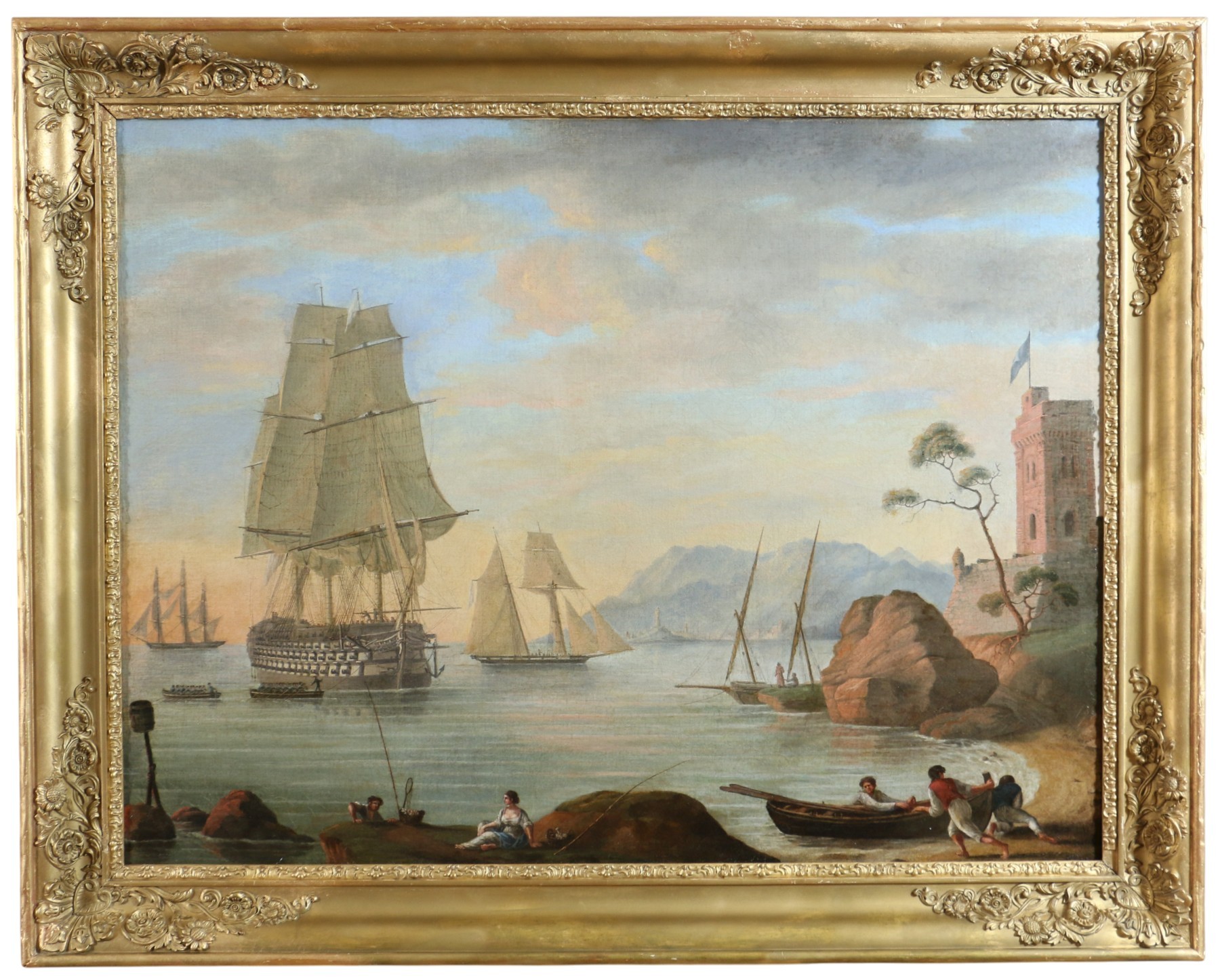
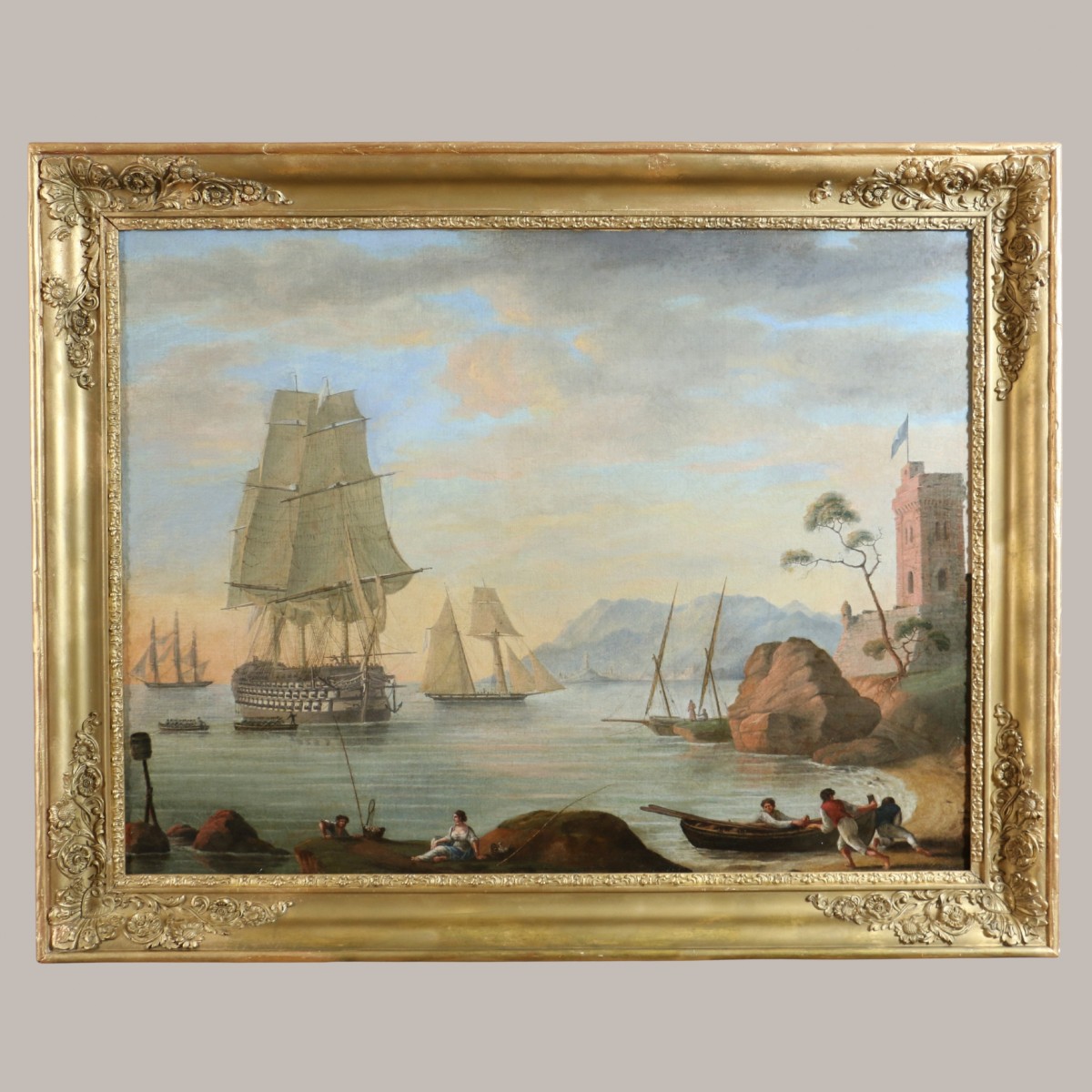
Oil on canvas (original canvas and stretcher), 90 cm x 68.5 cm.
Period frame, 102 cm x 81 cm.
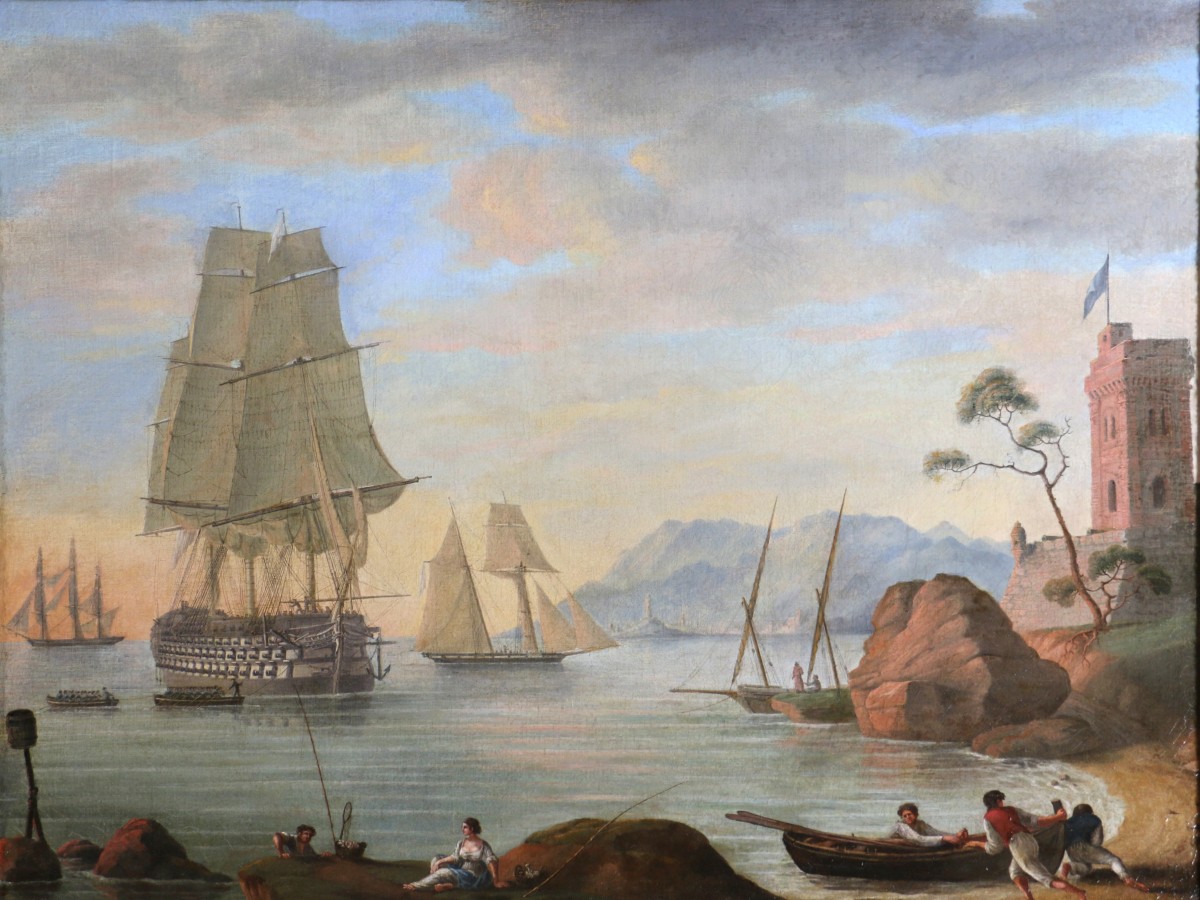
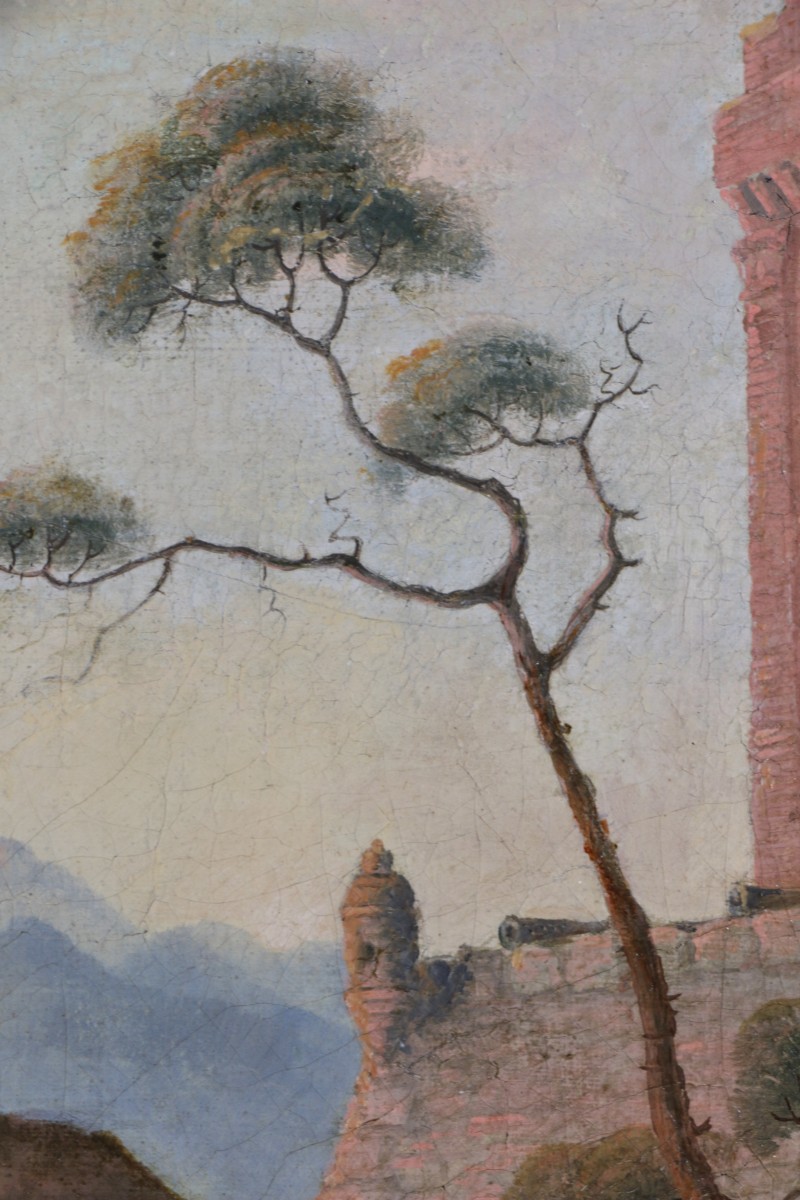
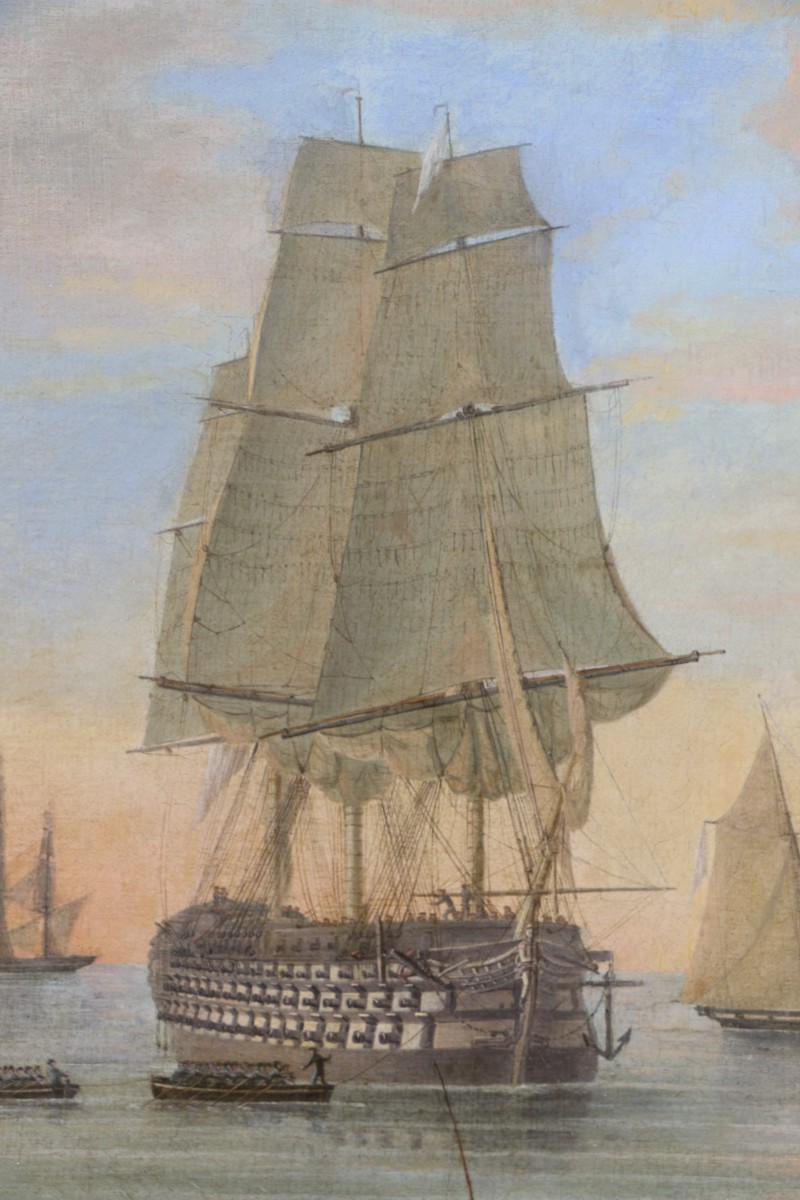
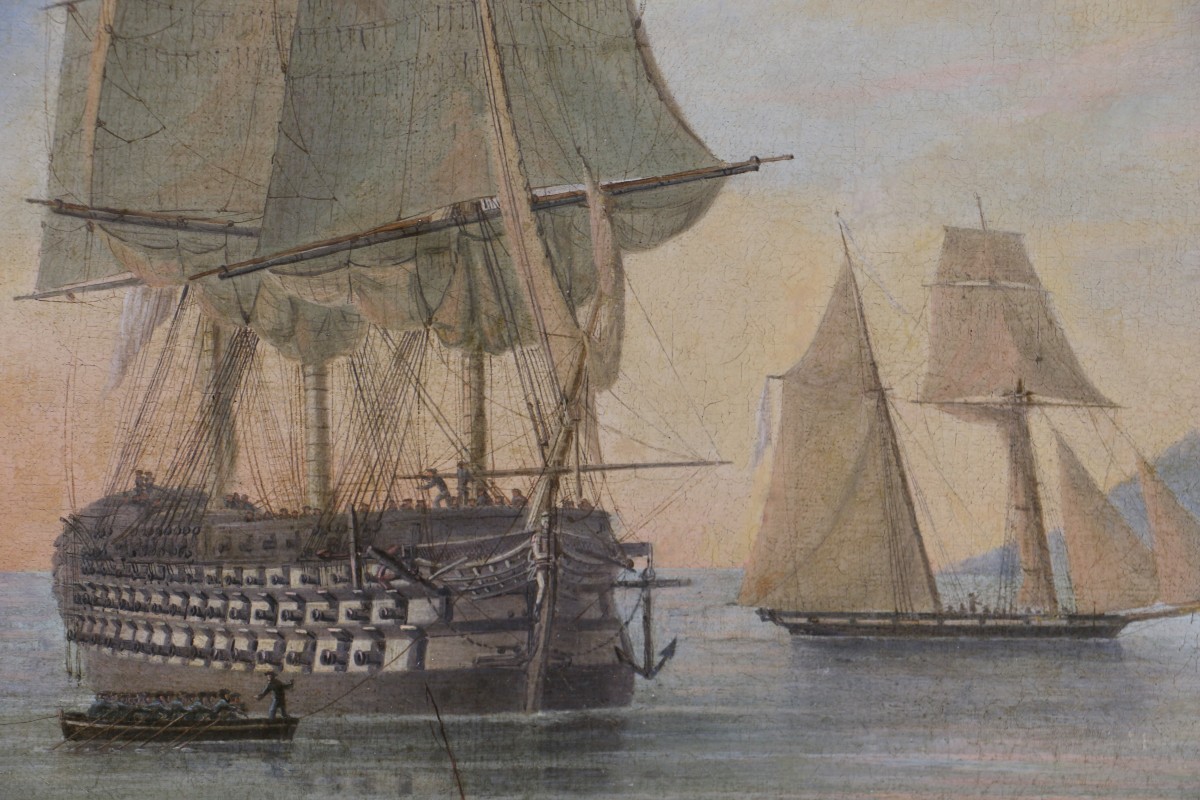
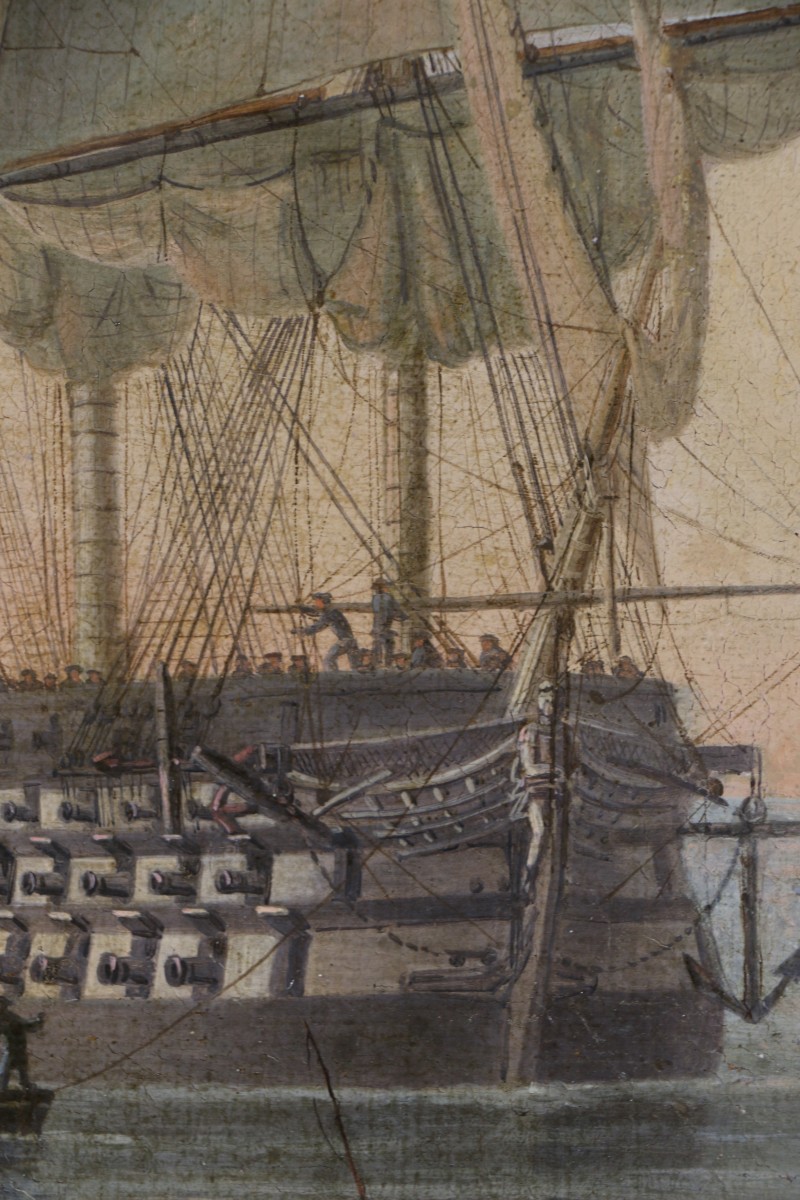
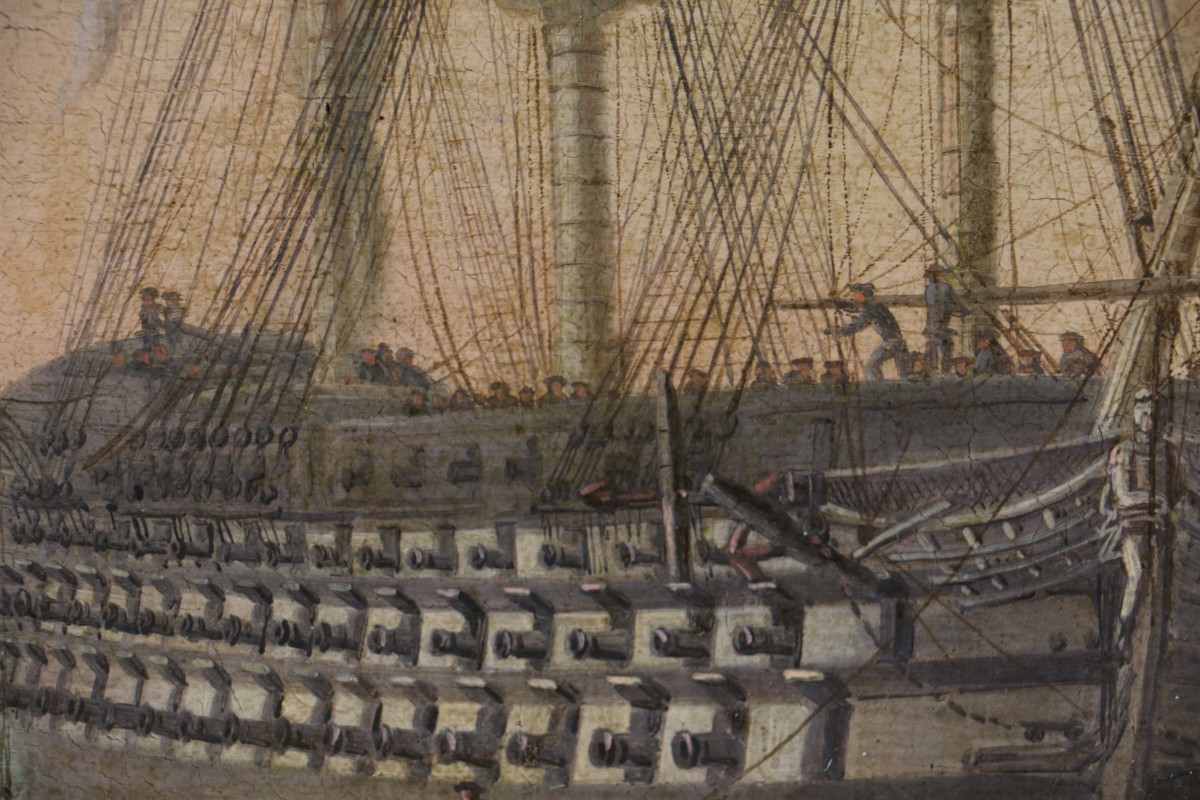
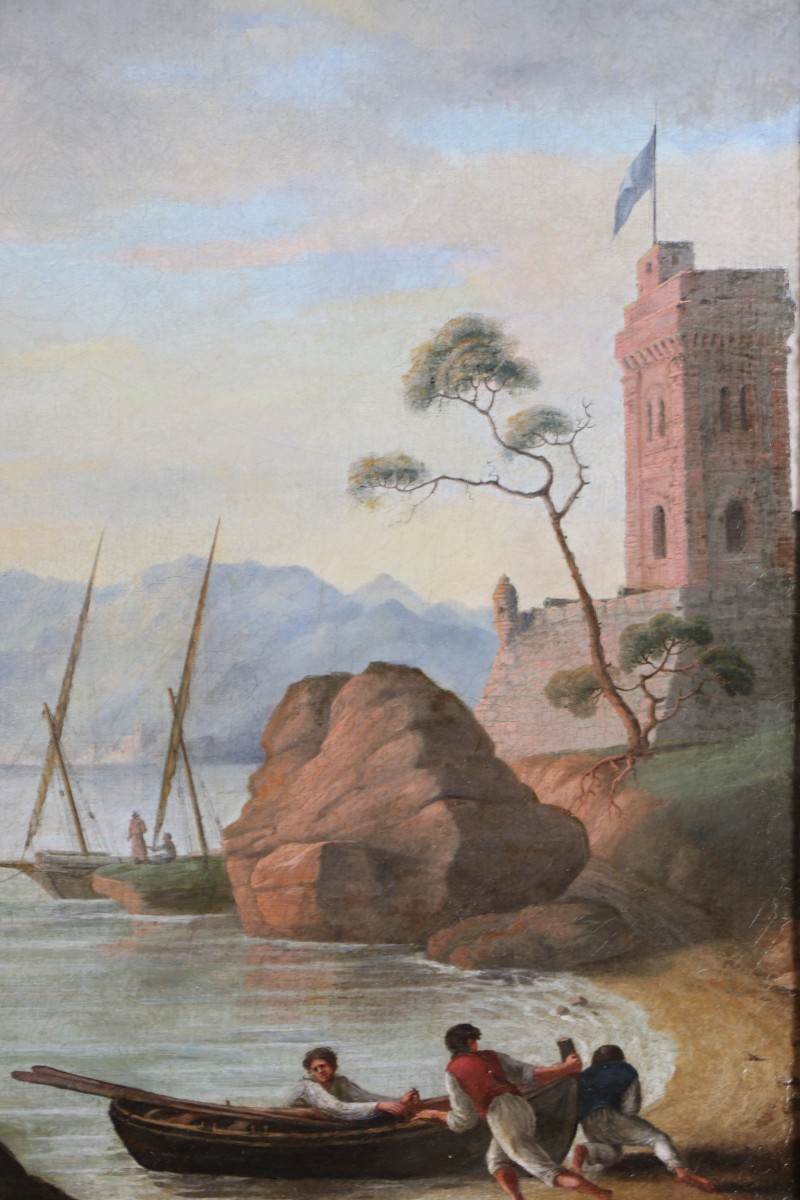
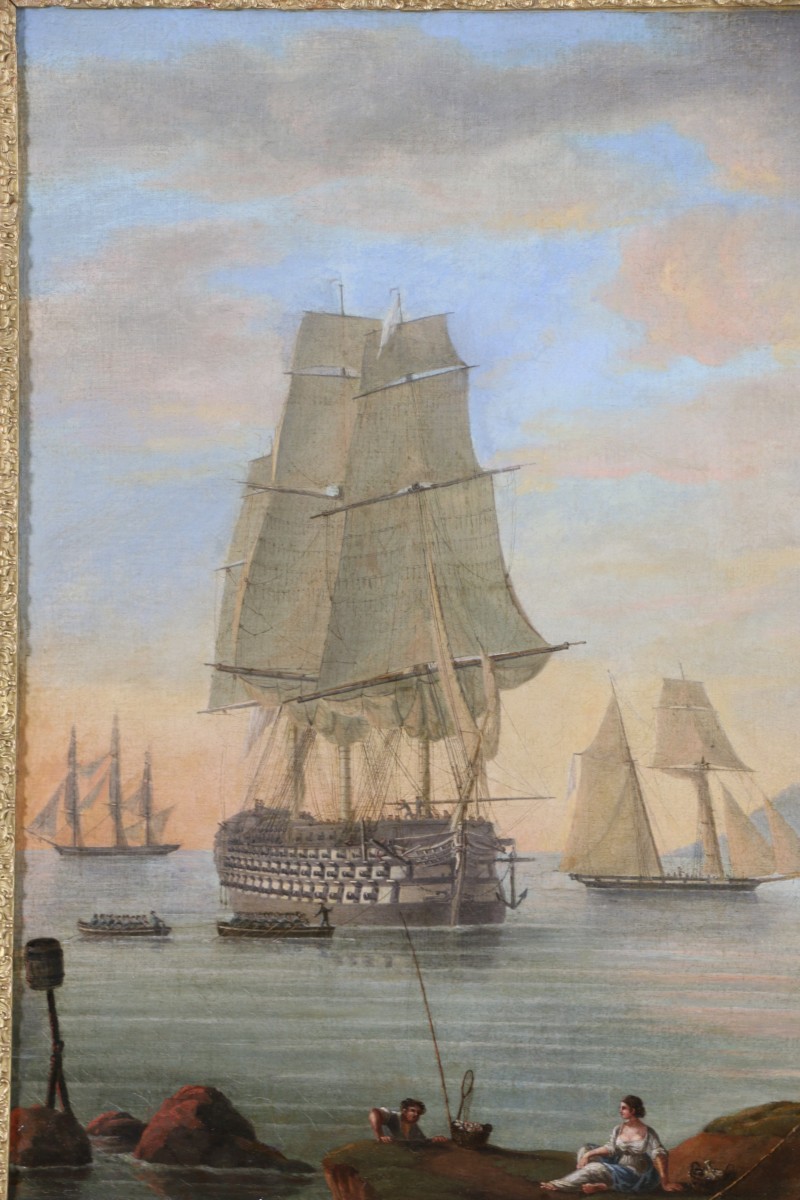
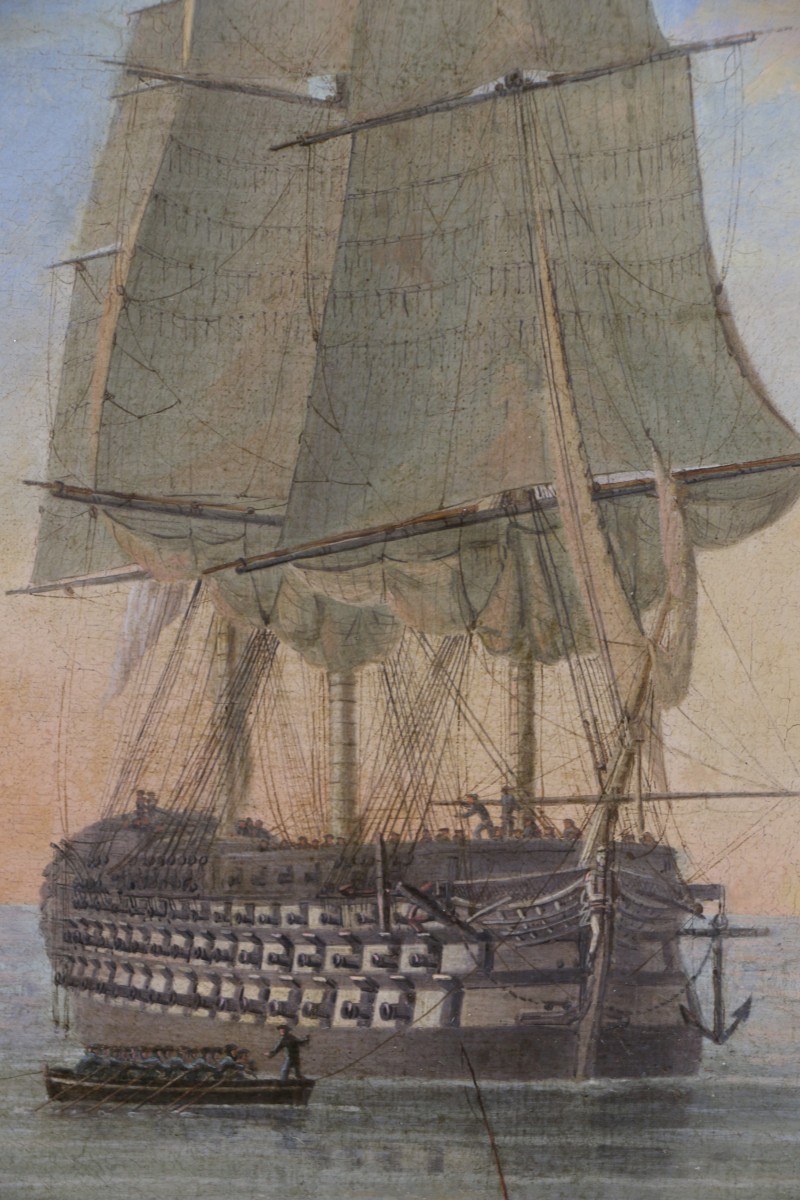
This significant marine painting depicts a large Royal Navy ship of the line at anchor in a Mediterranean roadstead. In the foreground, fishermen haul their boat onto a small rocky beach, while various figures populate the shoreline. To the right rises a coastal fortification featuring a tall medieval tower and a low bastion flanked by a corner watchtower, topped with a small blue flag. The background is dominated by mountainous terrain characteristic of the Western Mediterranean or Adriatic coasts. The artist demonstrates remarkable mastery of naval architecture. The rigging, ship's boats, gun port lids, davits, and deck fittings are rendered with great technical precision, reflecting a deep knowledge of Royal Navy vessels. The finely executed figures and the sensitive treatment of the landscape elevate the work beyond a mere ship portrait, placing it within the tradition of great English marine painting from the first half of the 19th century. The clearly visible female figurehead on the bow points to the vessel being a major Royal Navy first-rate ship. Based on current research, the most likely candidate is *HMS Queen* (110 guns), launched at Portsmouth in 1839. This vessel served as the flagship of the British Mediterranean Fleet from 1843 under the command of Vice-Admiral Sir Campbell Rich Owen, making numerous port calls across the Mediterranean. The specific location depicted remains unidentified. The depicted fortification—combining an old tower, an artillery bastion, and a corner watchtower—is more evocative of Genoese or Venetian fortifications than of British architecture. The mountainous terrain, the vegetation (notably the umbrella pine), and the presence of the blue ensign suggest a port of call along the coast of the former Republic of Genoa or former Venetian territories: Liguria (Porto Venere, La Spezia), Corsica (Calvi, Bastia), the island of Elba (Portoferraio), or, to a lesser extent, the Dalmatian coast. This architecture appears to correspond to a real location rather than an imaginary setting. In terms of style, execution, and knowledge of British naval vessels, the work aligns with the circle of John Ward of Hull. John Ward of Hull (1798–1849) John Ward—known as John Ward of Hull—was born in Kingston upon Hull on December 28, 1798, into a seafaring family. His father, Abraham Ward, was both a master mariner and a painter, a background that sparked Ward's early interest in the maritime world. After an apprenticeship as a house painter under Thomas Meggitt, he was listed in Hull directories as early as 1826 as a "House and Ship Painter." Influenced by the marine artist William Anderson, Ward quickly developed a distinctive style rooted in the meticulous observation of vessels. He became Hull’s leading ship portraitist and marine painter during the first half of the 19th century, creating works that ranged from portraits of merchant vessels and Royal Navy ships to whaling scenes and views of estuaries and harbors. From the 1840s onwards, he exhibited regularly at the Royal Academy in London and the British Institution, helping to establish his reputation beyond Yorkshire. Several of his works were engraved and reproduced as lithographs, further spreading his renown among shipowners, captains, and naval officers. His work is characterized by great precision in the depiction of naval architecture. Unlike many marine painters who prioritized atmospheric effects, Ward focused on accurately rendering hull shapes, rigging, and technical details; consequently, his paintings are used today as reference material by British maritime historians. His most famous works include *H.M.S. Britannia at Anchor with the Fleet*, *H.M.S. Queen Sailing out of Portsmouth Harbour*, and *The Northern Whale Fishery: The Swan and Isabella*, as well as various portraits of Royal Navy warships. John Ward died prematurely of cholera on September 28, 1849. His work is now held in several major public collections, notably the Ferens Art Gallery in Hull, the Hull Maritime Museum, the National Gallery of Art in Washington, and other British institutions. Considered the most important 19th-century marine painter from Hull, he holds a key place in English marine painting alongside Thomas Whitcombe, Nicholas Pocock, and William John Huggins.
Delevery information :
All our paintings benefit from careful and secure packaging. No geographic restrictions.