Offered by Cristina Ortega & Michel Dermigny
REQUEST INFORMATION

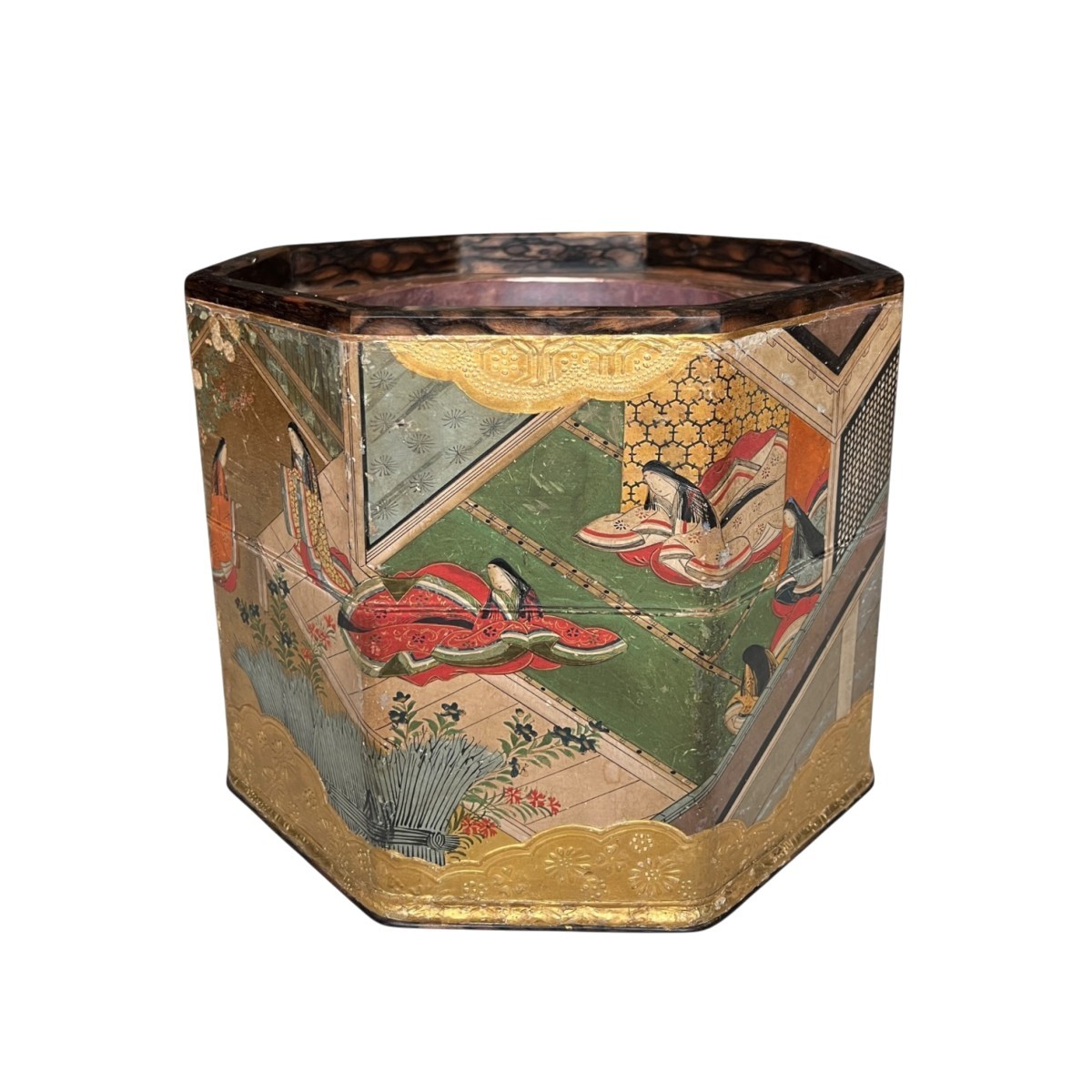
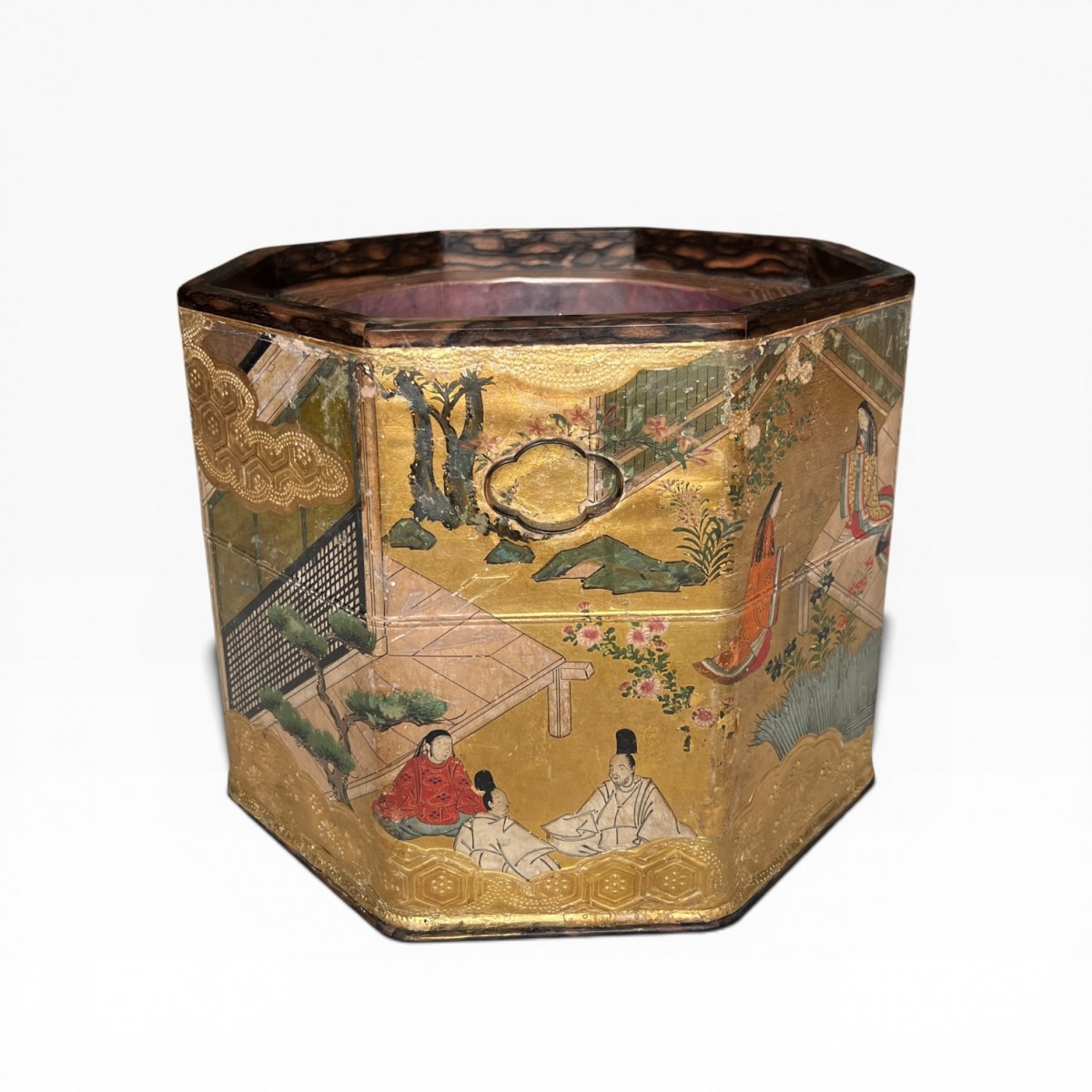
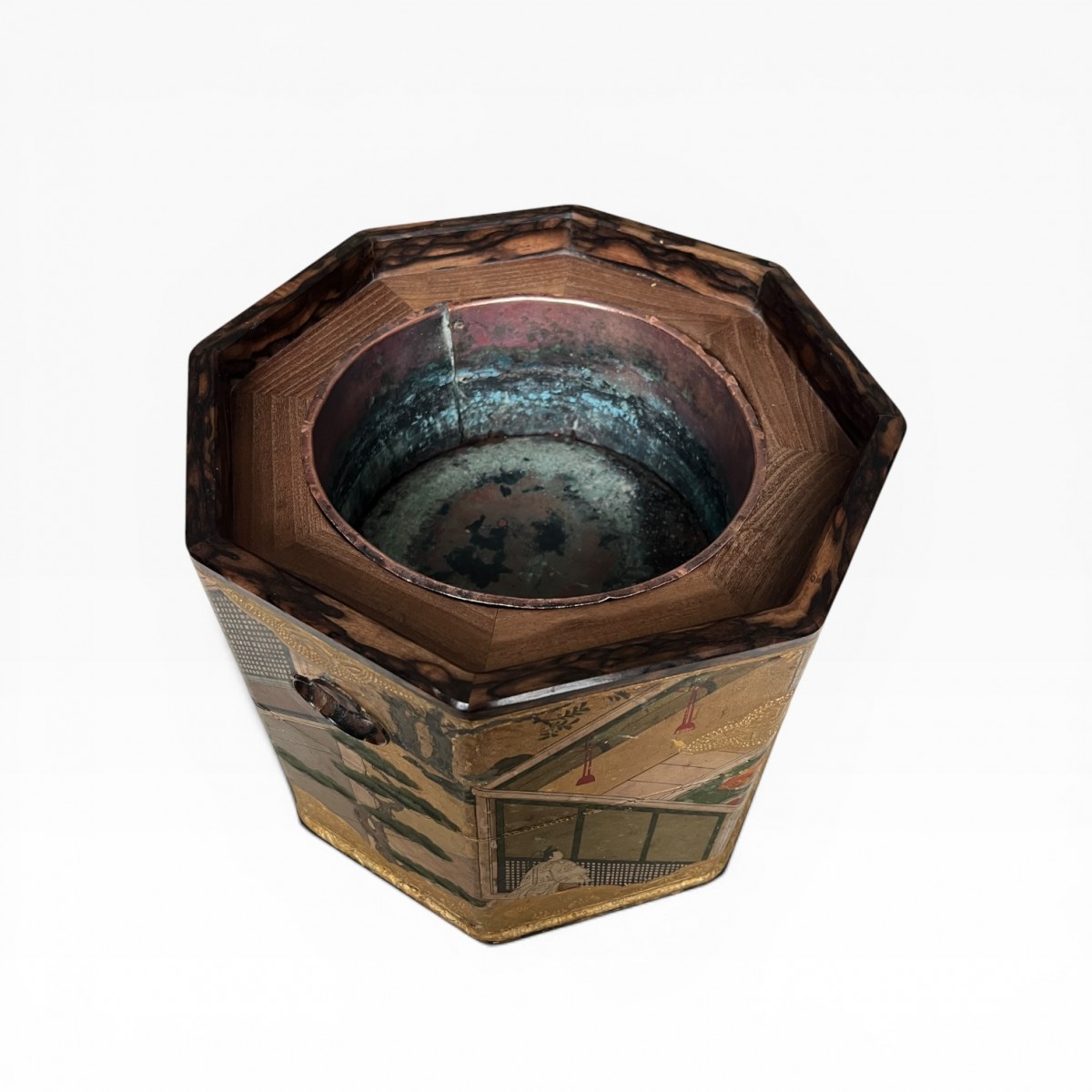
Octagonal hibachi with a wooden structure, framed by persimmon-wood uprights, with an inner basin in hammered copper. The base is reinforced by a thick cardboard support covered with mounted paper. The body is rhythmically articulated by lateral openings bordered with wood, through which the decoration can be seen continuing without interruption.
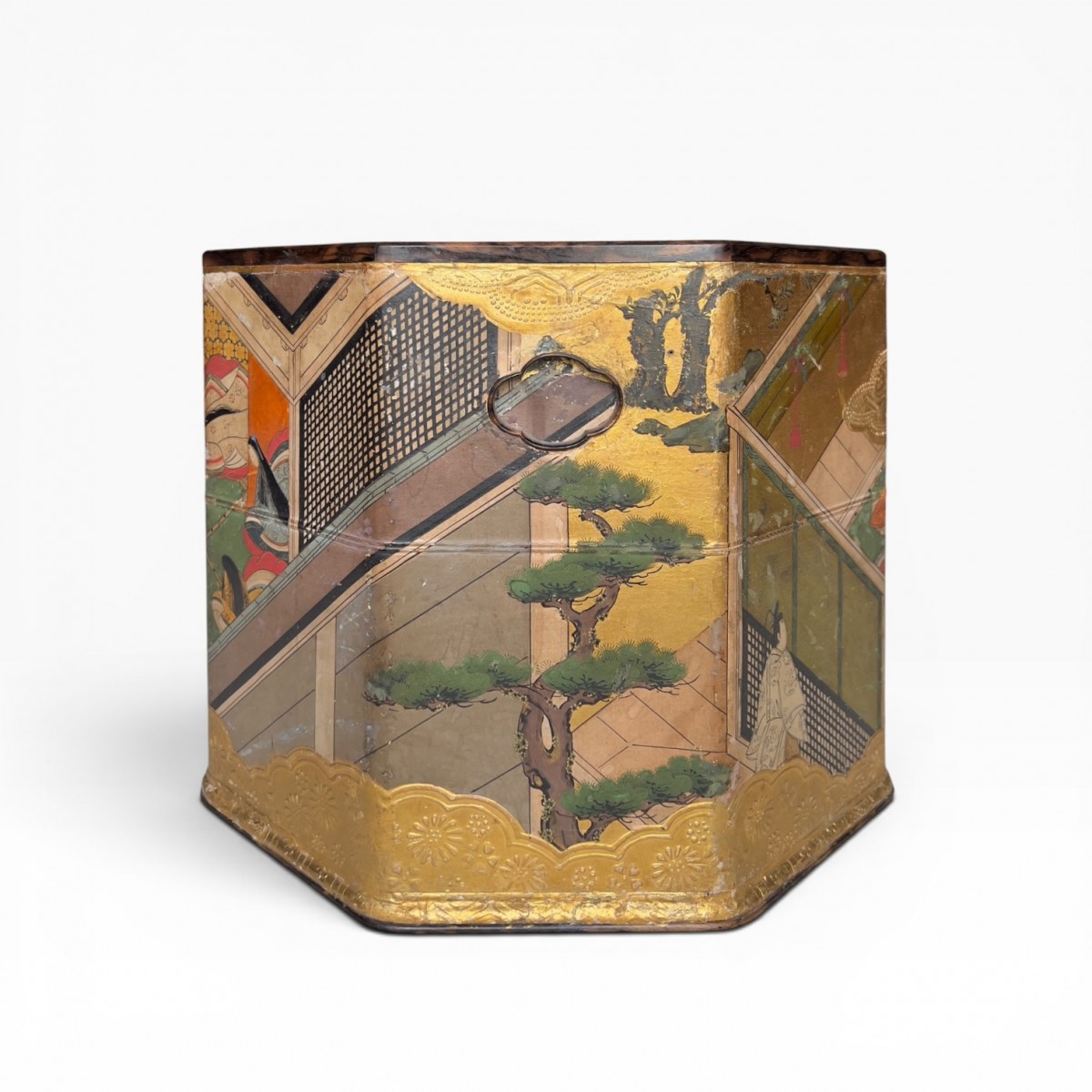
The exterior covering consists of paper applied to the support. Regular geometric reliefs, executed in gofun (ground shell white), structure the cloud-like zones. Gold leaf is applied over these reliefs, forming broad gilded fields animated by lightly raised hexagonal motifs. The polychromy, made with bound pigments, is then developed over these grounds, with a dense and matte palette characteristic of court painting.
The decoration unfolds across the various sides as a cycle of scenes inspired by the Genji monogatari. The compositions, constructed in oblique perspective, open onto aristocratic interiors treated according to the principle of blown-off roof perspective, in which partitions, screens, and tatami organize the space into successive planes. The female figures, with their long black hair and layered robes, belong to the repertory of yamato-e. One of the scenes shows a group of women playing go, identifiable with the Utsusemi chapter, an episode frequently represented in Genji iconography.
This pictorial technique finds direct parallels in Edo-period kai-awase boxes, whose surfaces combine a gofun preparation, gold-leaf decoration, and polychromy, as well as in certain 18th-century Kyoto hagoita, where gofun relief, hakuoshi, and court-style painting derive from the same body of knowledge. The object belongs to a group of productions linked to aristocratic circles in which Genji subjects formed a privileged repertory.
The rarity of such hibachi is due to the very conditions of their use. Exposure to heat, changes in humidity, and deposits of soot quickly affect painted surfaces. The survival of a legible decoration gives this example particular importance, allowing the full decorative program and the coherence of its execution to be appreciated.
Dimensions: height 24.5 cm; diameter 31 cm.
Delevery information :
A special care is given to packing. Bigest pieces are crated.
All our shippings are insured with tracking.
As we do a lot of shippings, we do have very special rates. Please inquire!