Offered by Cristina Ortega & Michel Dermigny
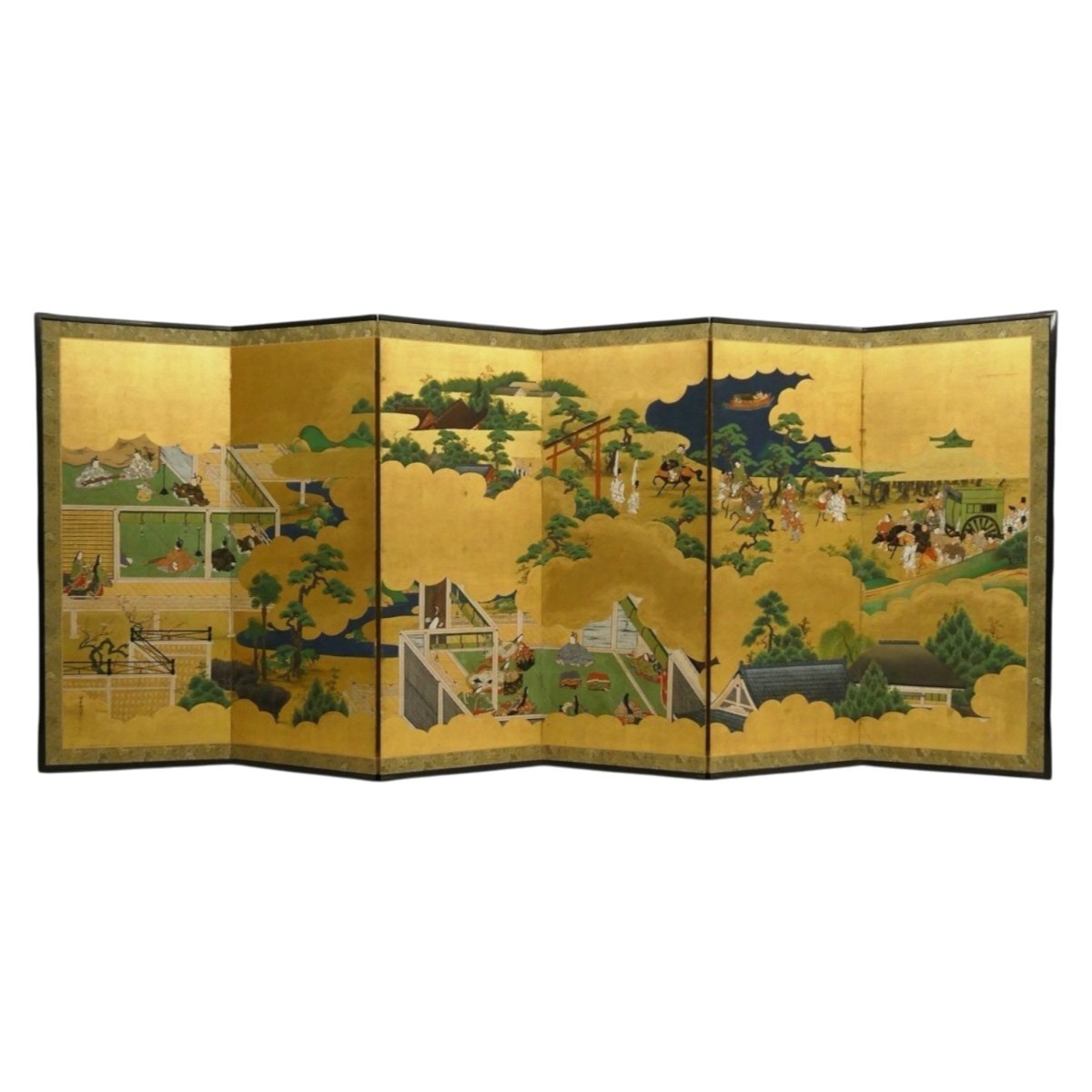
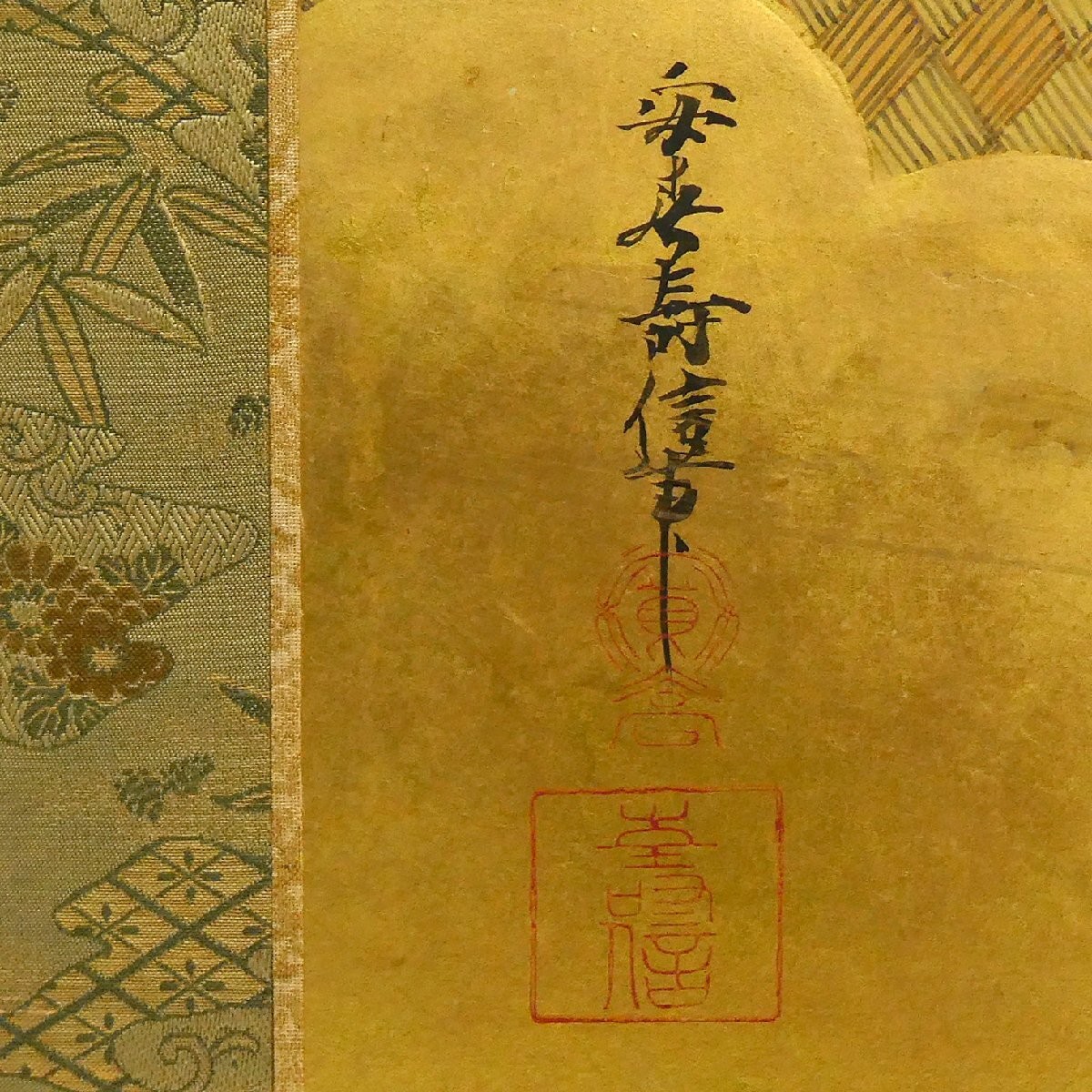
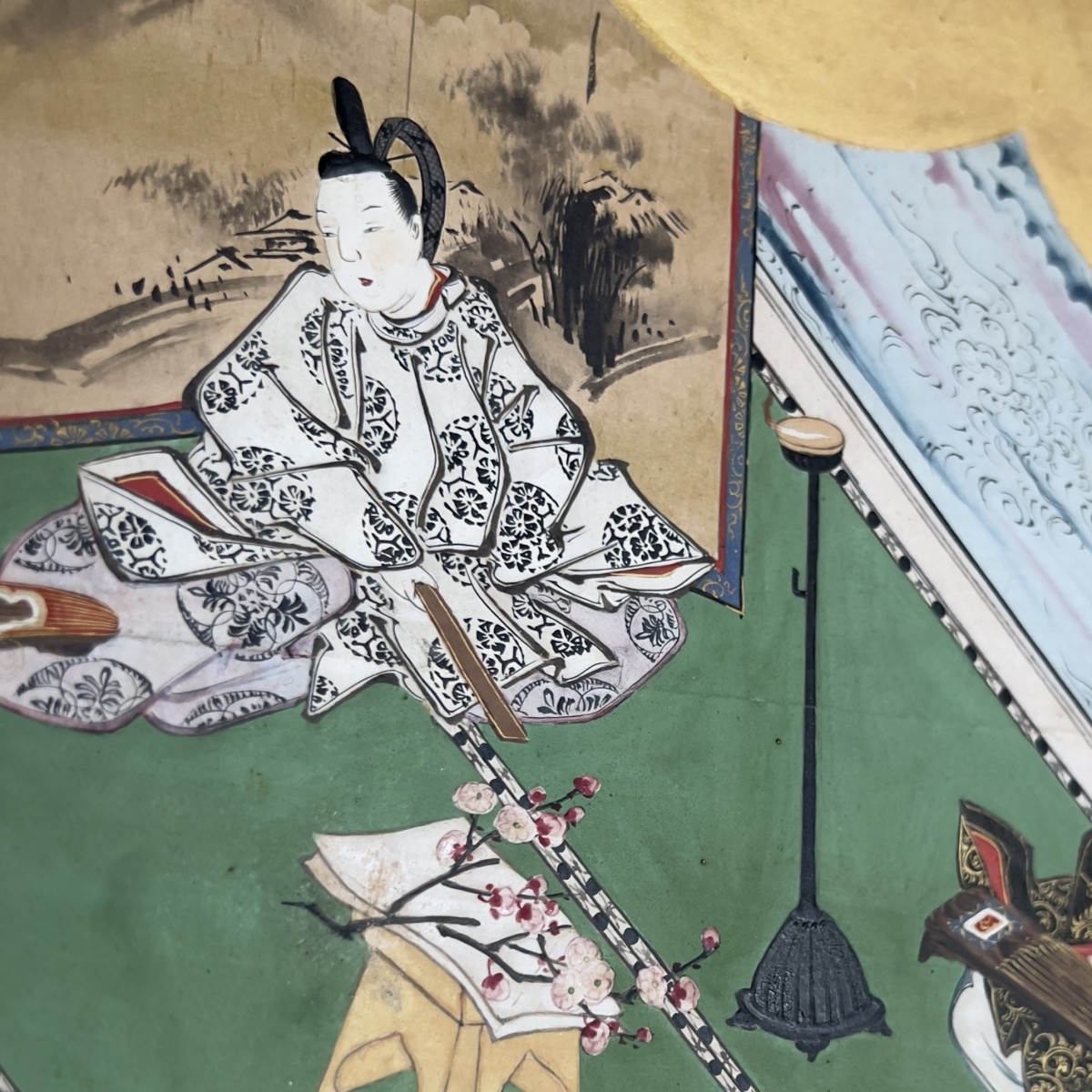

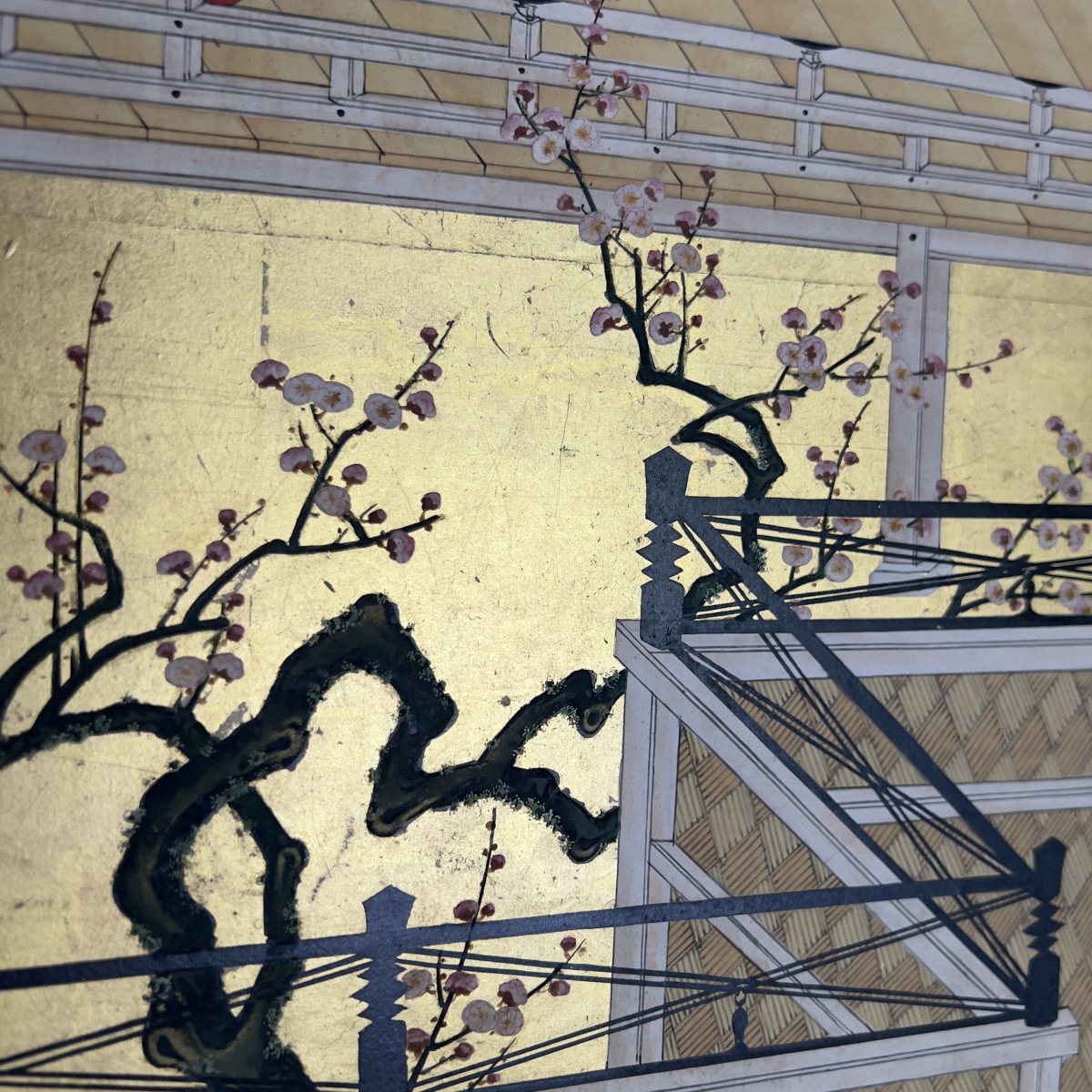
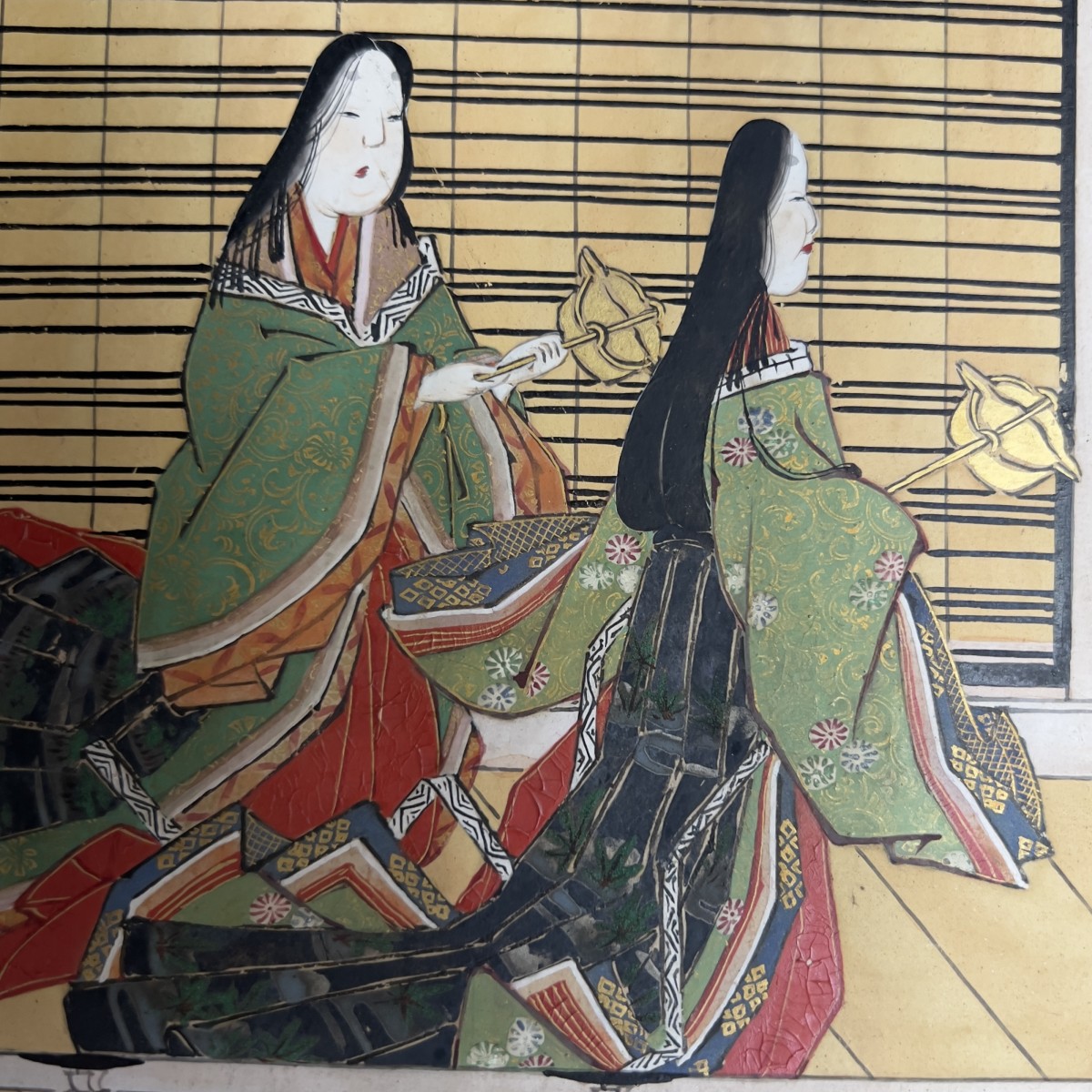
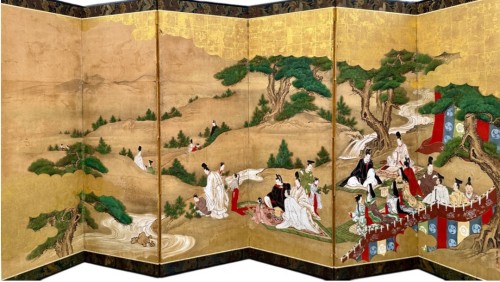
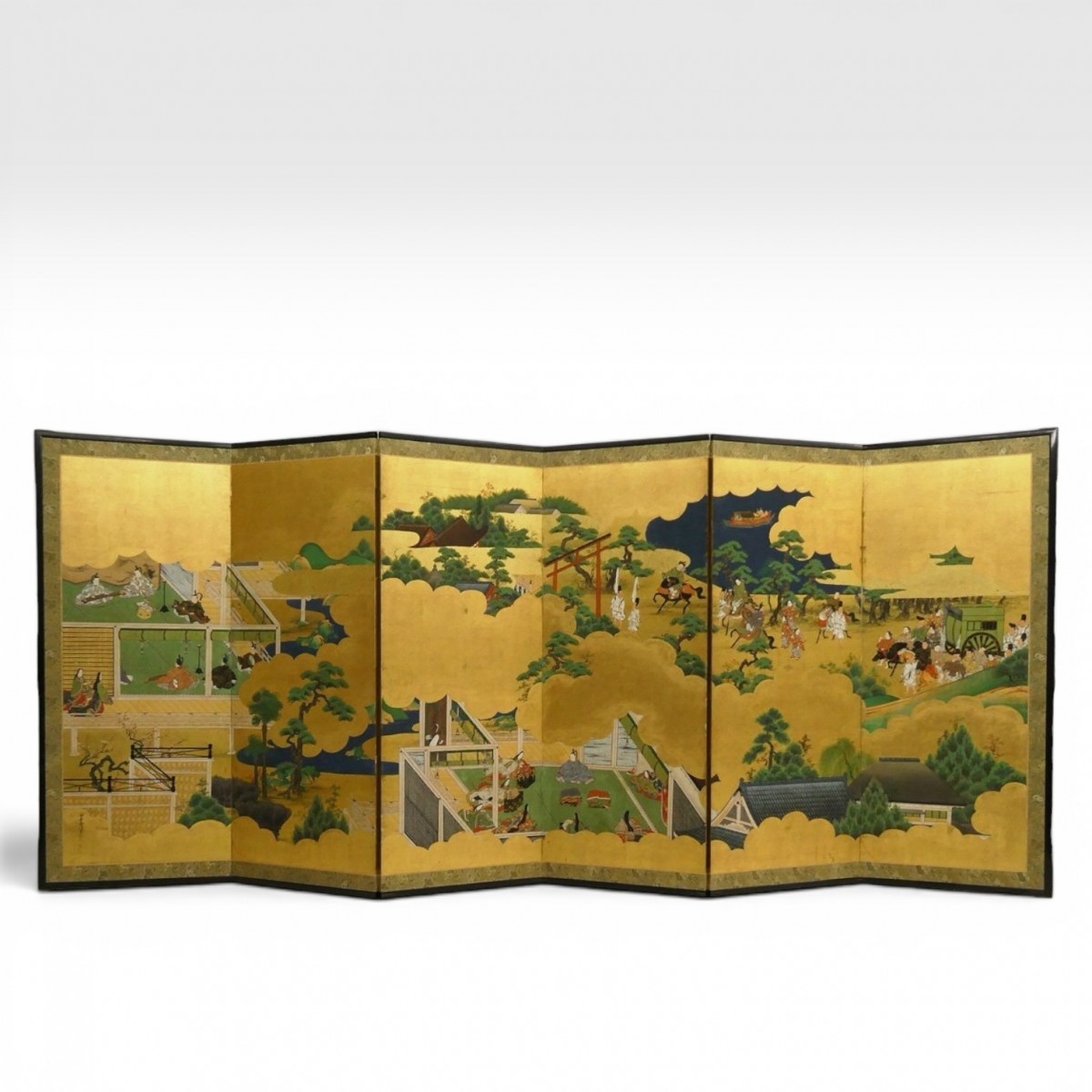
This six-panel folding screen depicts various scenes from The Tale of Genji (Genji Monogatari), the great court novel written in the early 11th century by Murasaki Shikibu. The work chronicles the life of Prince Hikaru Genji and the refined world of the Heian aristocracy, where courtly relationships, poetry, music, the changing seasons, and famous locales shape the narrative.
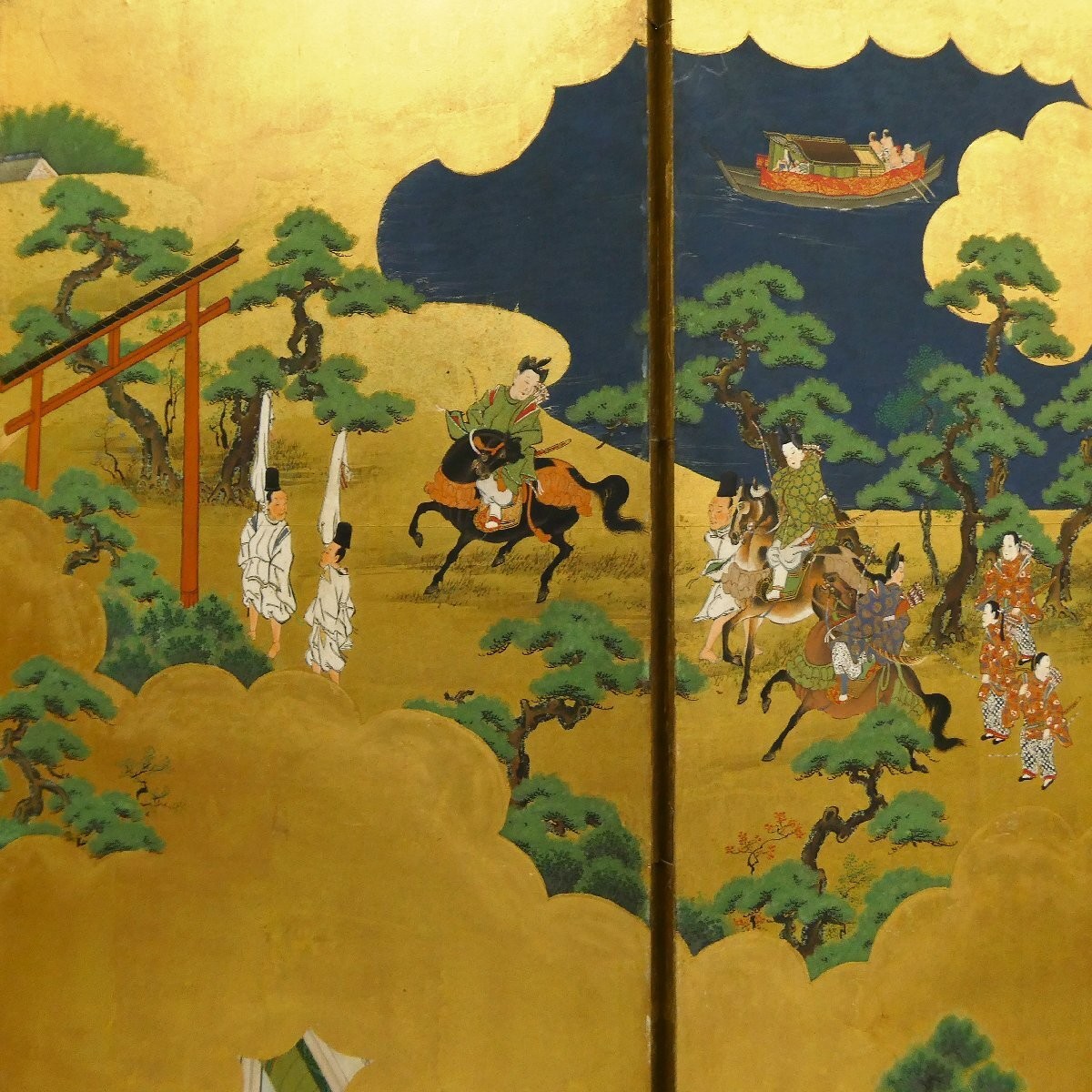
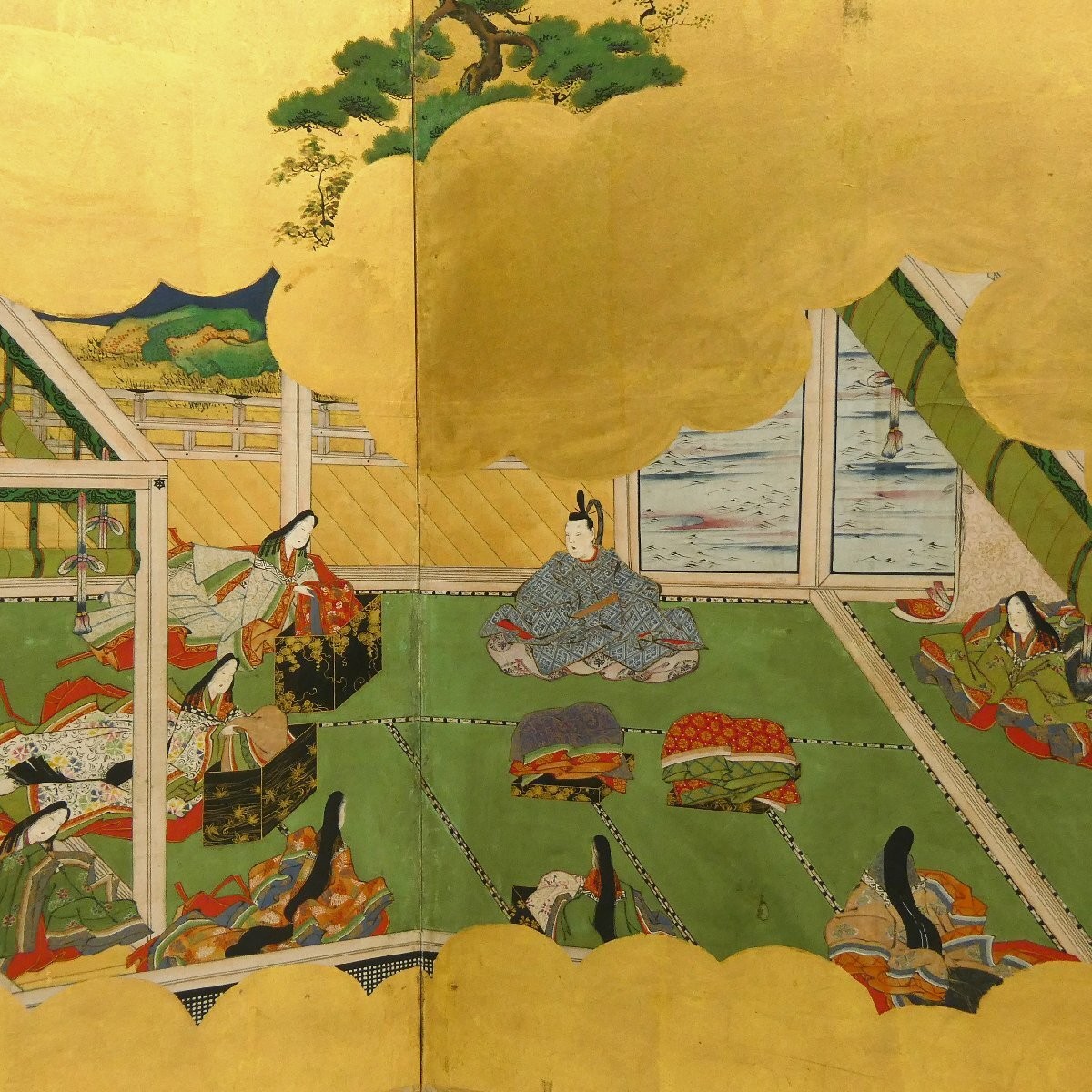
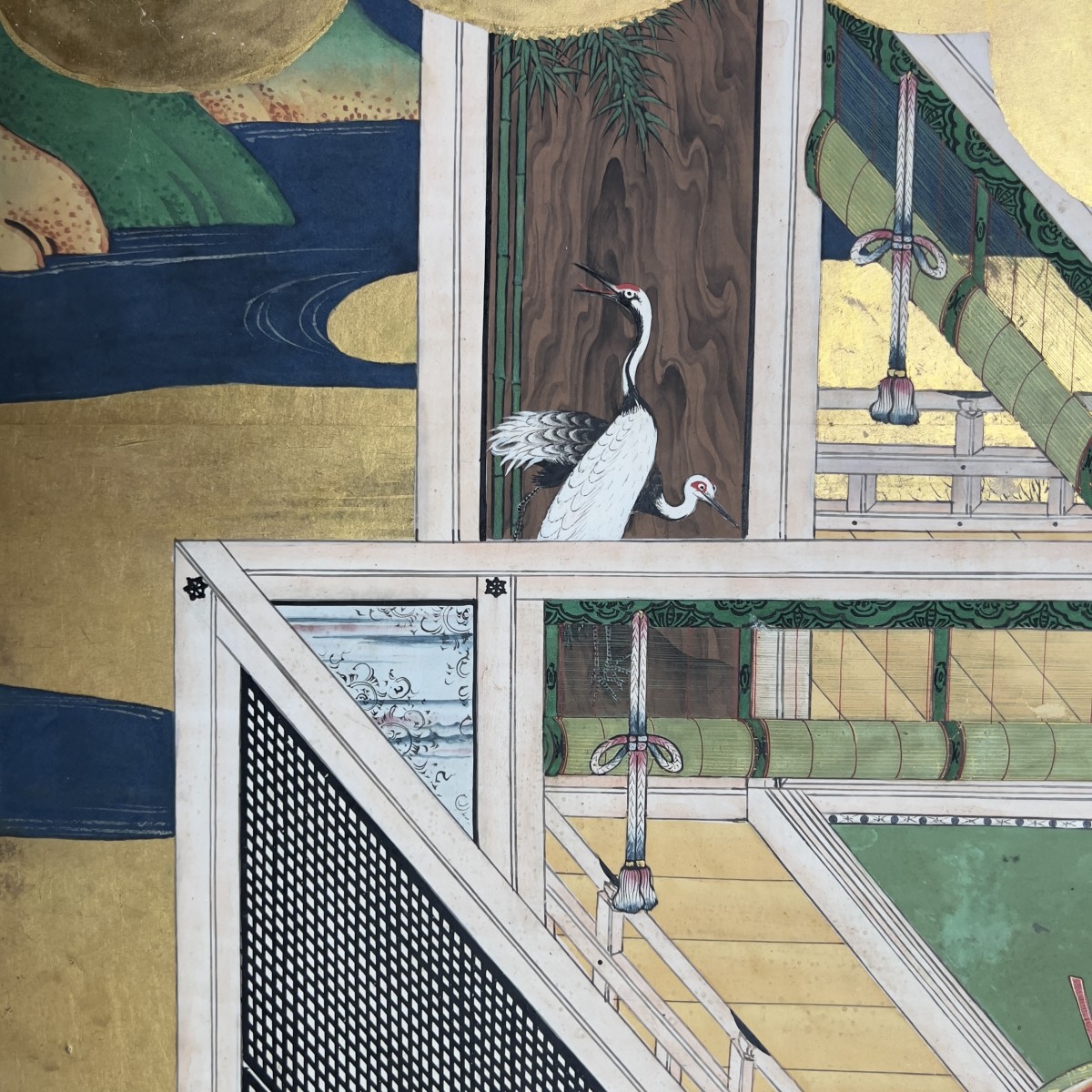
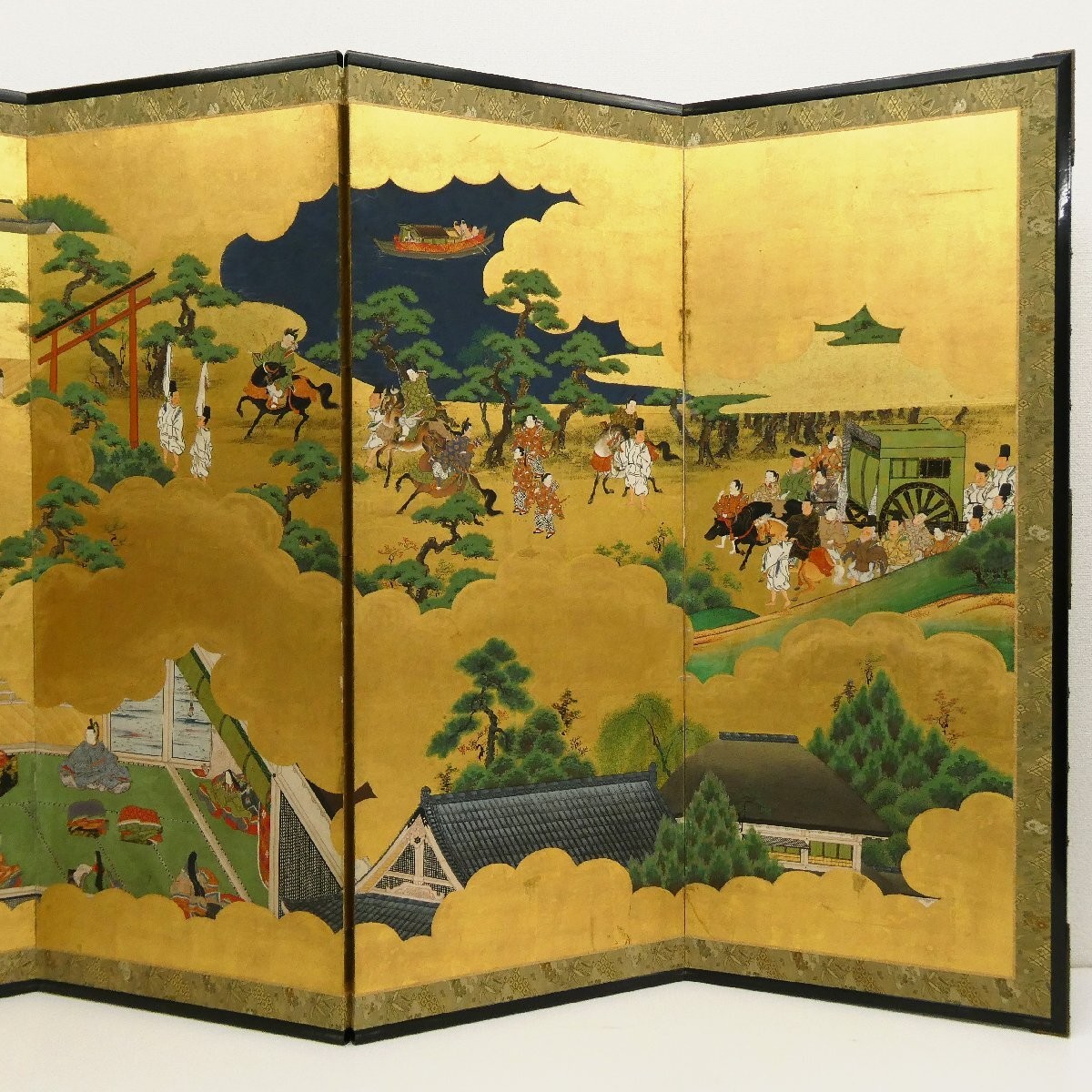
The composition is set against a vast background of gold leaf, enlivened by large golden clouds that segment the space and frame the individual scenes. Architectural elements are rendered using the fukinuki yatai—or "blown-off roof"—technique, which opens the interiors to the viewer's gaze. Court figures, bamboo blinds, musical instruments, layered costumes, pine trees, deep waters, a torii gate, a carriage, and an aristocratic procession all place the work firmly within the tradition of Genji-e (paintings inspired by The Tale of Genji).
The most readily identifiable scene is "Miotsukushi" (Channel Markers), the novel's fourteenth chapter. It is distinguished by the Sumiyoshi Shrine—indicated by the red torii gate—as well as Genji’s lavish procession, the court carriage, and a boat visible on the water. In this episode, Genji travels to Sumiyoshi to offer thanks to the deity following his return from exile. Akashi no Kimi, who has also come on a pilgrimage, catches a glimpse of his magnificent procession from her boat. The scene captures a distant encounter between two individuals bound by love yet separated by social rank.
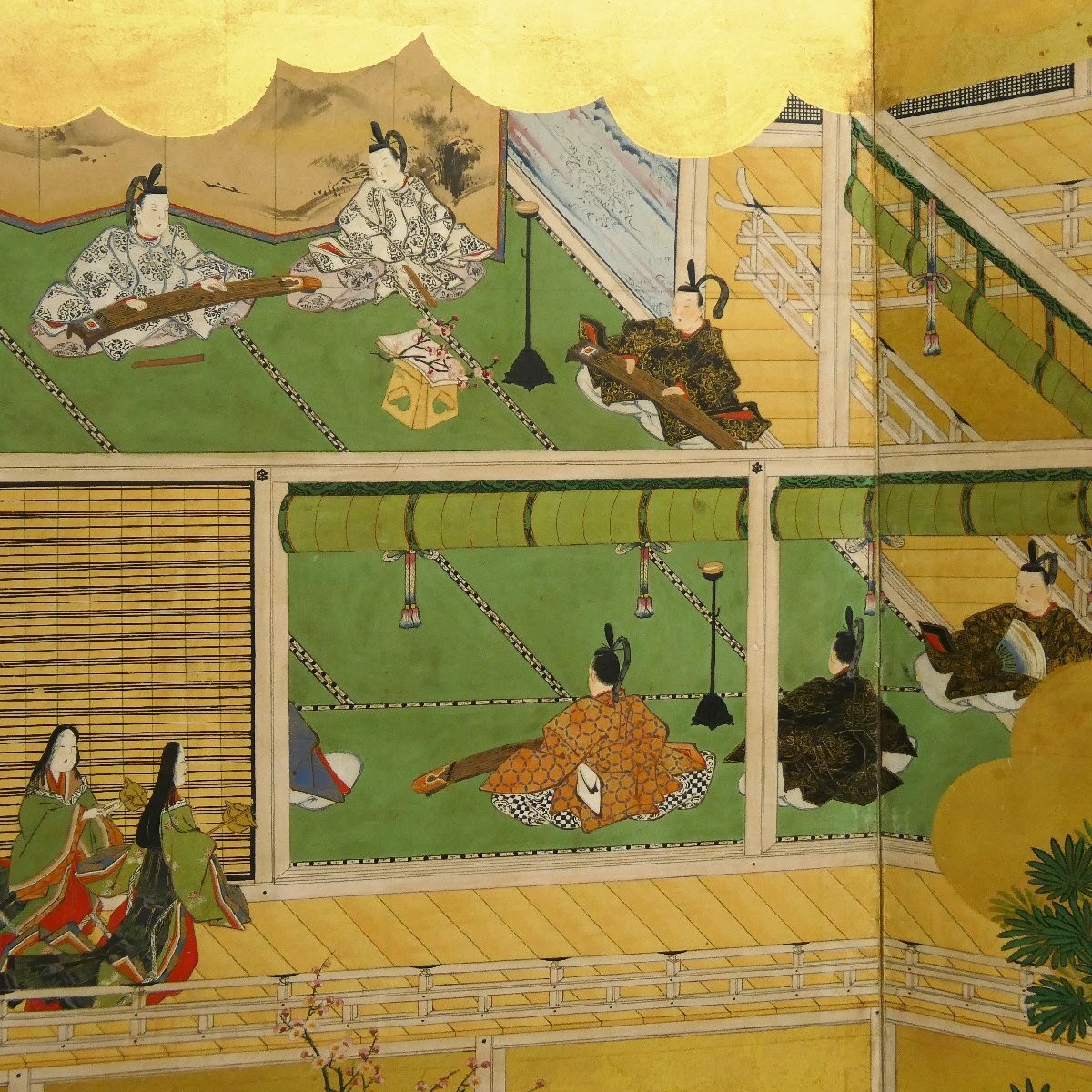
The left side of the screen depicts scenes set within the palace and aristocratic interiors. Courtiers play music—notably the koto—while female figures appear behind blinds and within open rooms. These scenes round out the world of Genji by evoking courtly arts, music, poetic exchanges, and the private life within aristocratic residences. Precisely identifying these episodes requires further comparison with Genji-e albums, yet their visual vocabulary clearly belongs to the novel’s narrative cycle.
The signature reads "painted by Kan? Sosen Toshinobu." Sosen is the artist's art name (g?). Toshinobu is also read as Jushin in some Japanese records; the National Diet Library lists the reading Kan? Toshinobu while noting Kan? Sosen as an alternative name, whereas the Itabashi Museum uses the reading Kan? Jushin for the same characters and cites the dates 1814–1897. This dual reading reflects the Japanese convention regarding artist names, where the same characters can have multiple pronunciations.
Kano Sosen Toshinobu belonged to the final generation of the Kano school, active during the 19th century as the traditional painting system of the Edo period extended into the Meiji era. The Itabashi Museum holds a Turezuregusa-zu by?bu (folding screen illustrating Essays in Idleness) by him, executed in pigments and gold leaf on paper. Other Japanese sources also document works on folding screens, confirming the consistency of the format and the type of commission.
This screen is a work rooted in a scholarly tradition. While the subject matter evokes classical Heian culture, the execution is that of a 19th-century Kan? painter. The work’s significance lies in this continuity: an artist trained in the official language of Japanese painting adopts the major decorative conventions of Genji-e—gold backgrounds, clouds, open-walled palaces, processions, and court scenes—at a time when the world that had fostered this culture was already becoming a subject of historical memory.
Condition: Shows wear, slight rubbing, and signs of use consistent with the age and function of a folding screen. The reverse is covered in plain, dark blue-gray paper. Overall, the piece retains a strong decorative presence and remains in good condition. Dimensions when open: 119 × 283 cm.
Delevery information :
A special care is given to packing. Bigest pieces are crated.
All our shippings are insured with tracking.
As we do a lot of shippings, we do have very special rates. Please inquire!