Offered by Franck Baptiste Provence
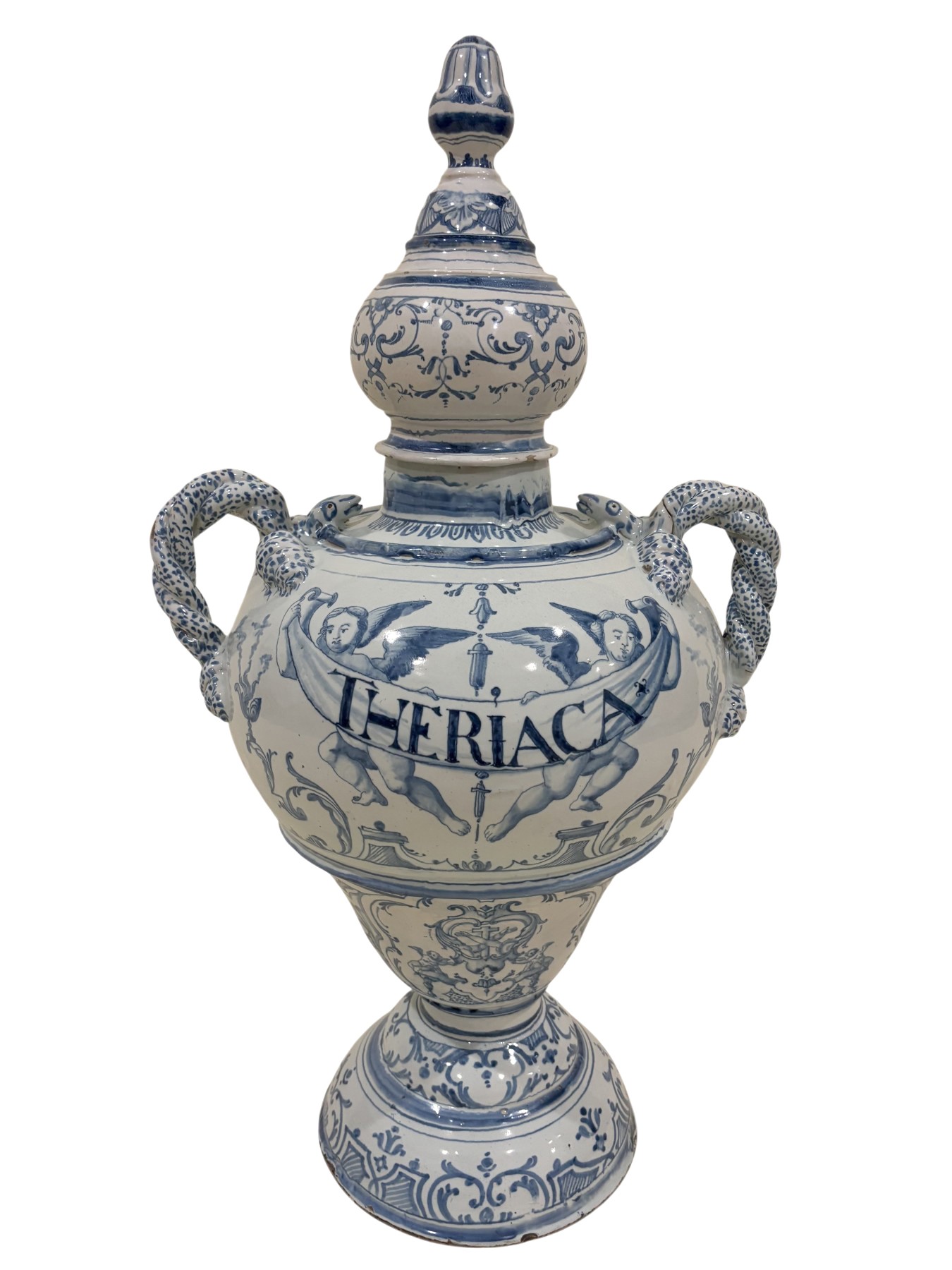
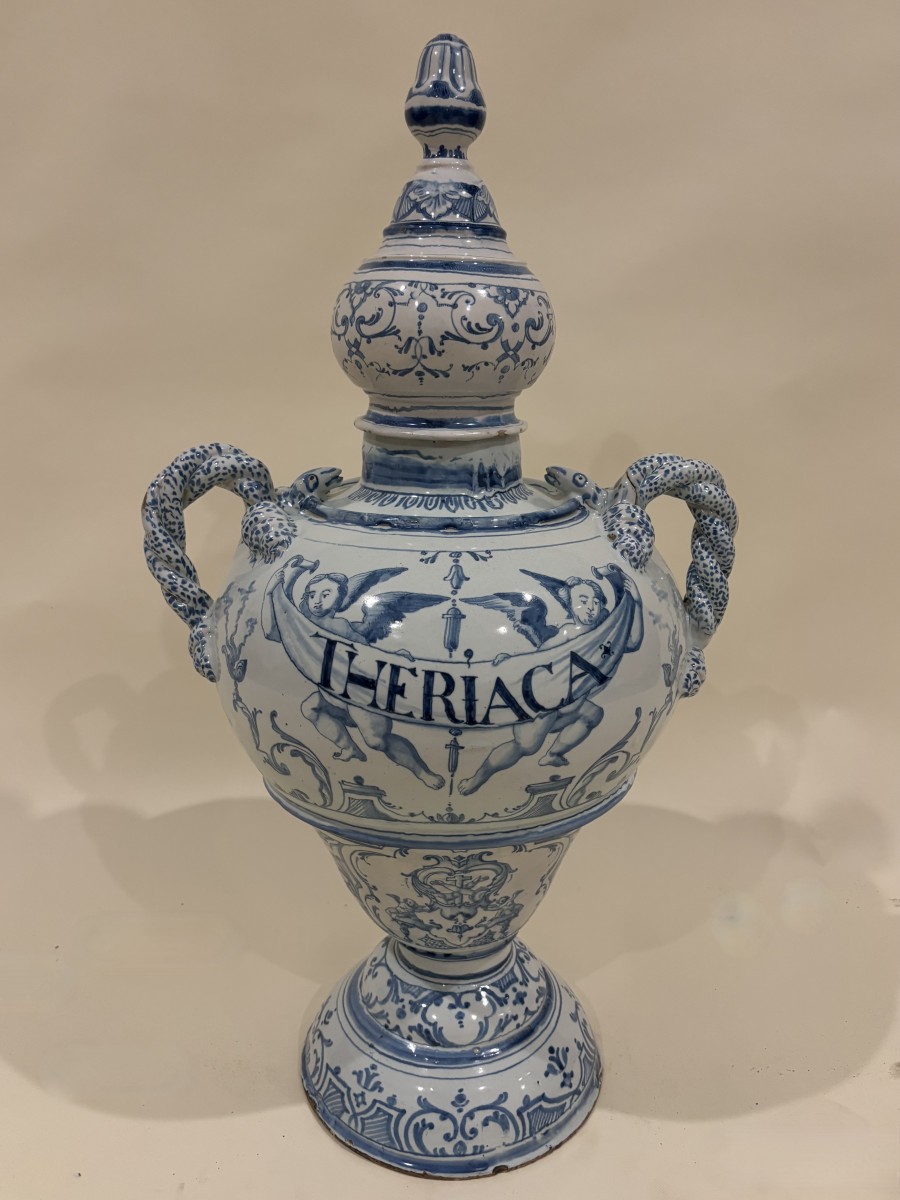

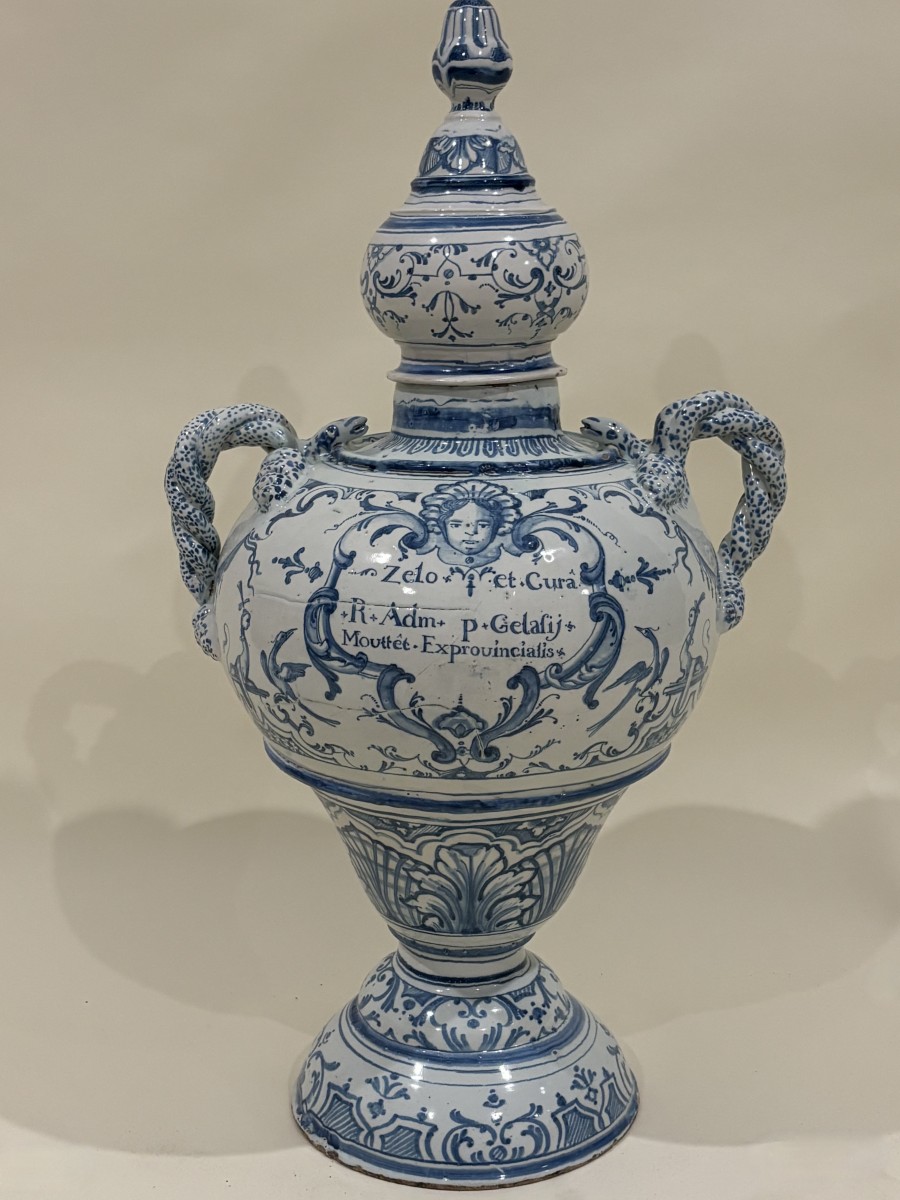
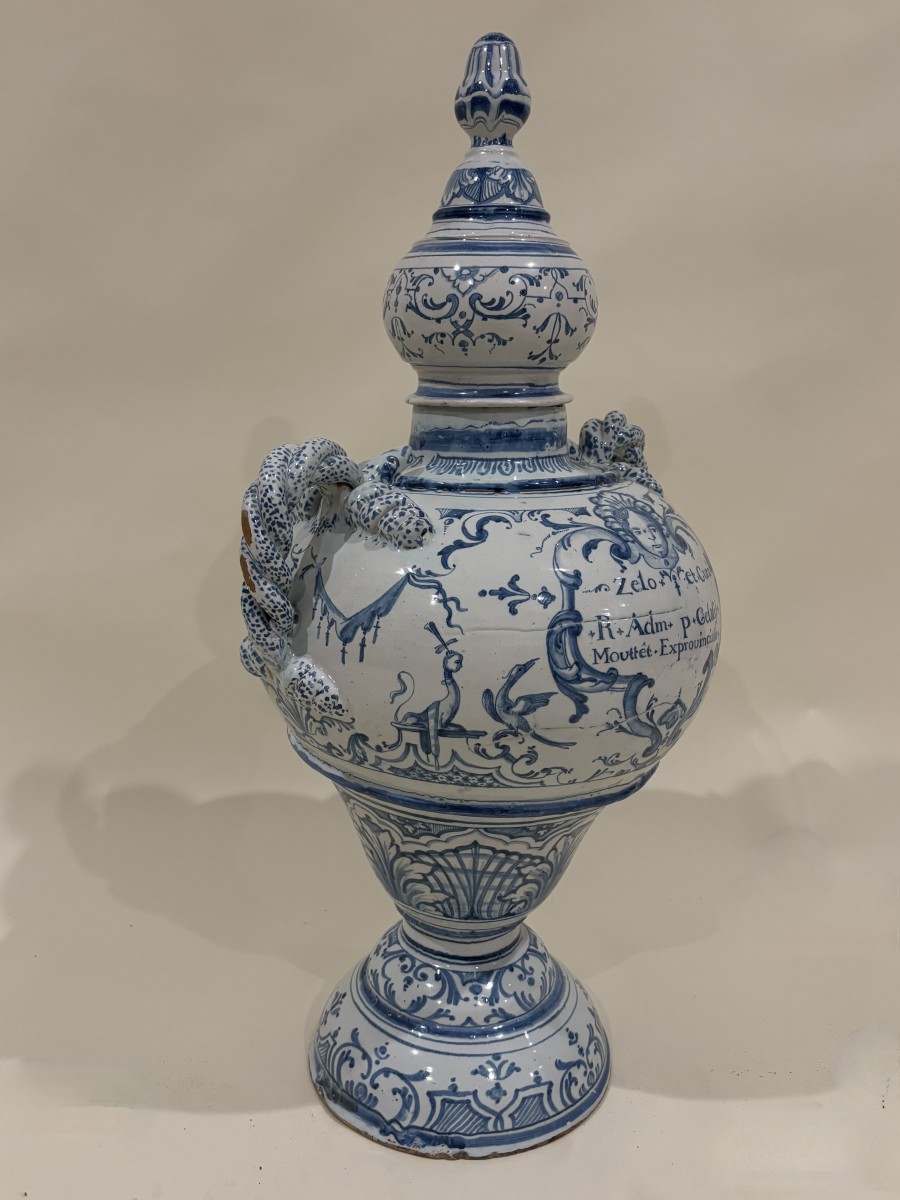
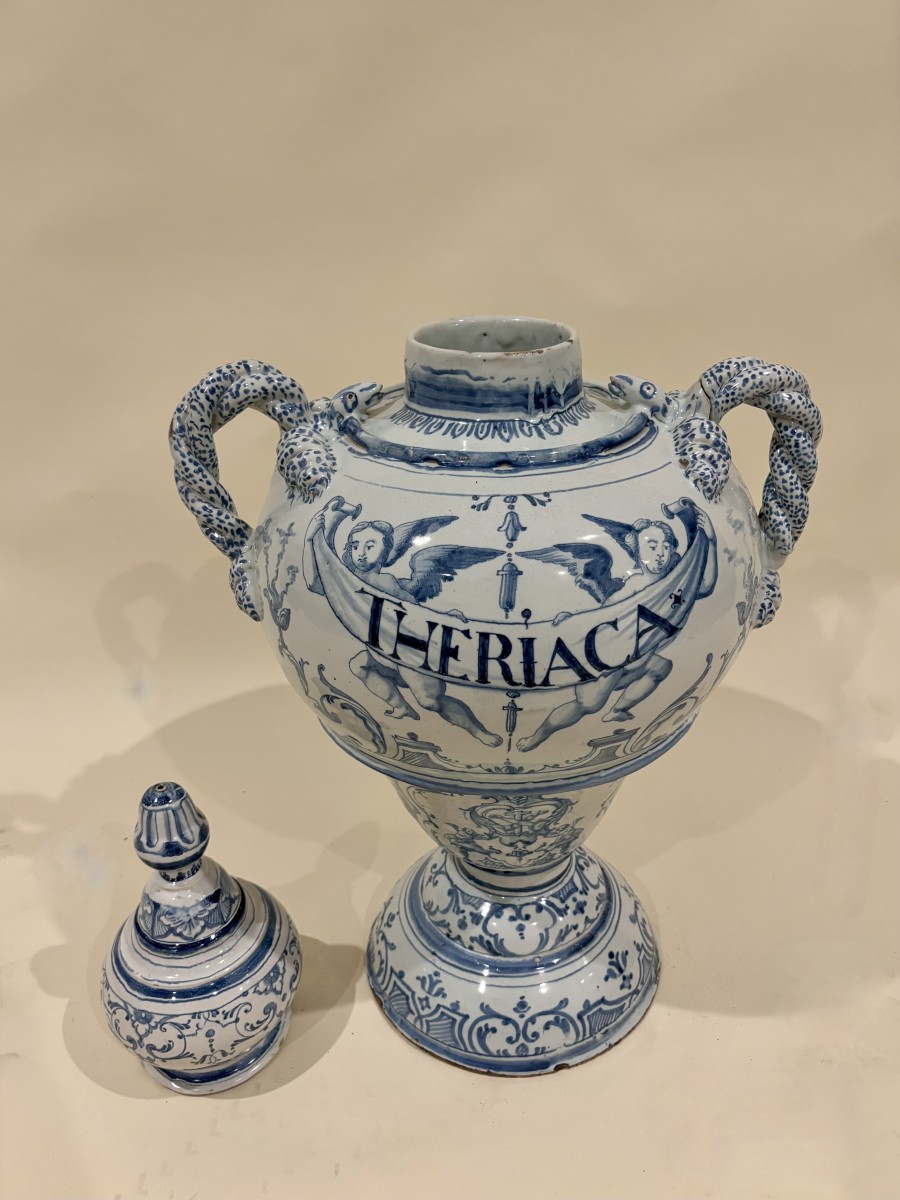
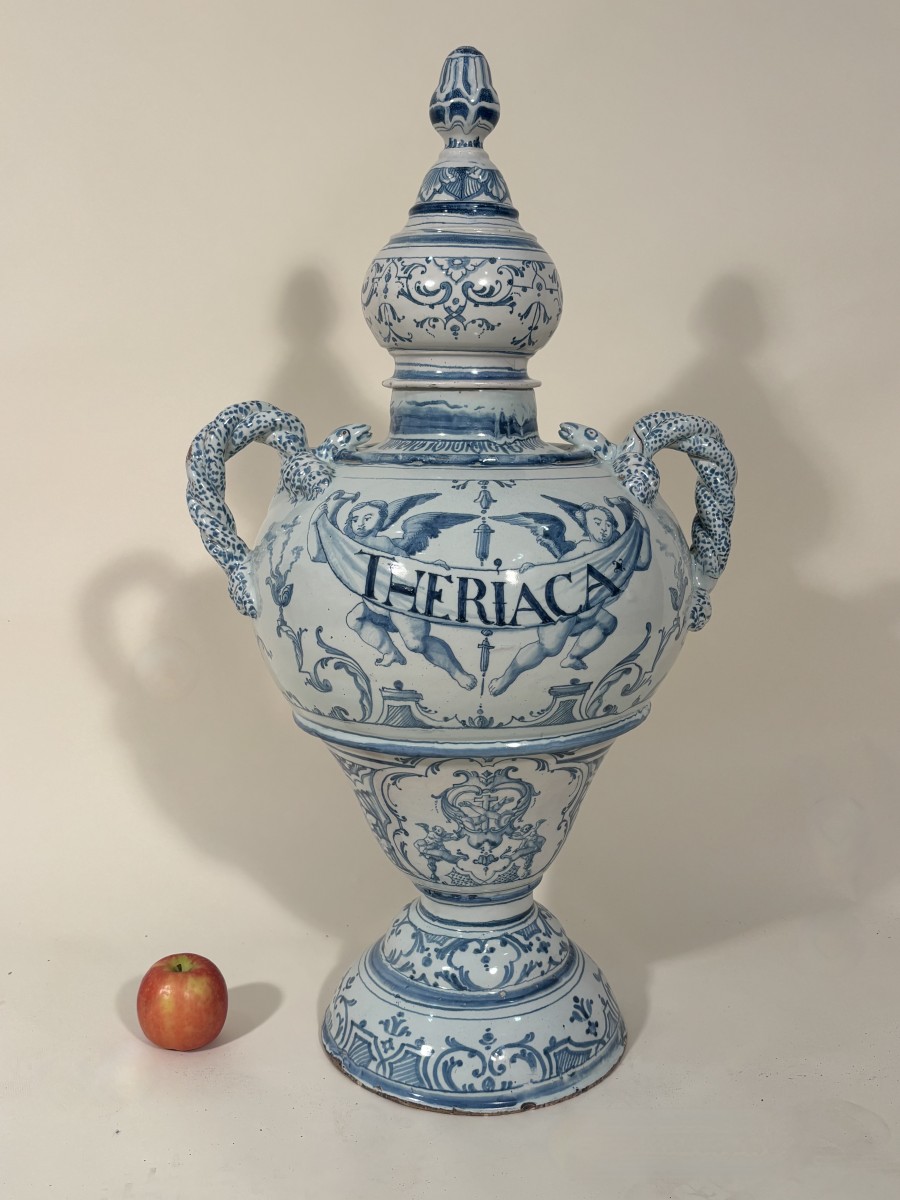
Monumental earthenware apothecary jar decorated in blue monochrome using the grand feu technique.
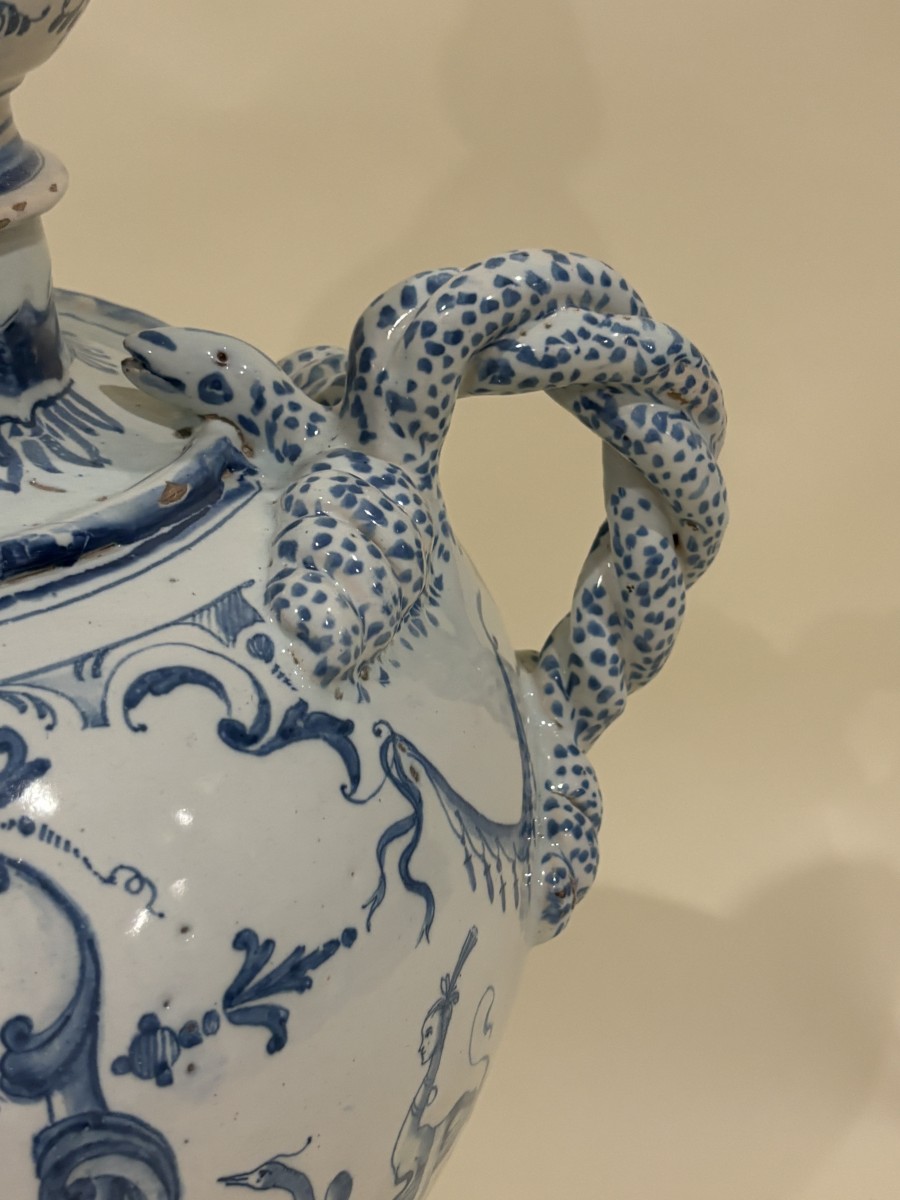
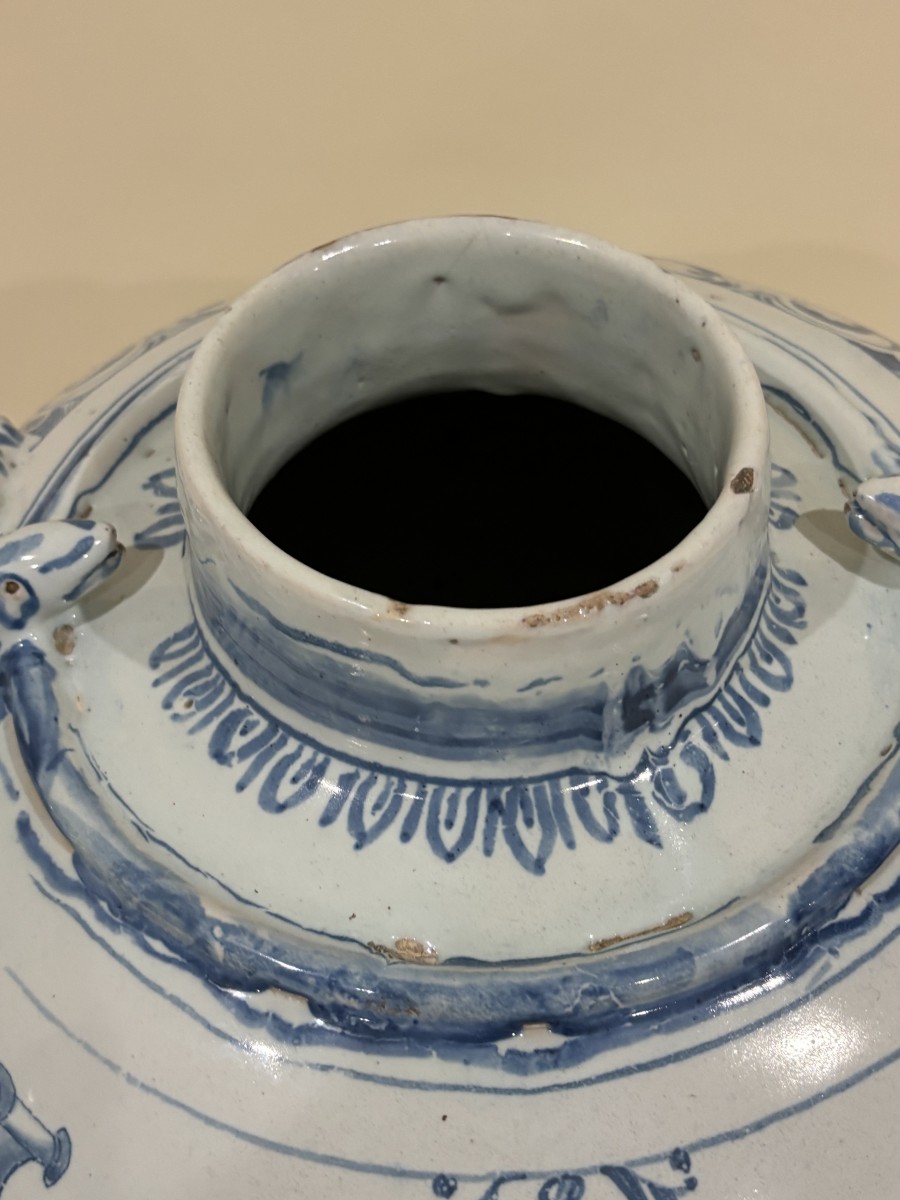
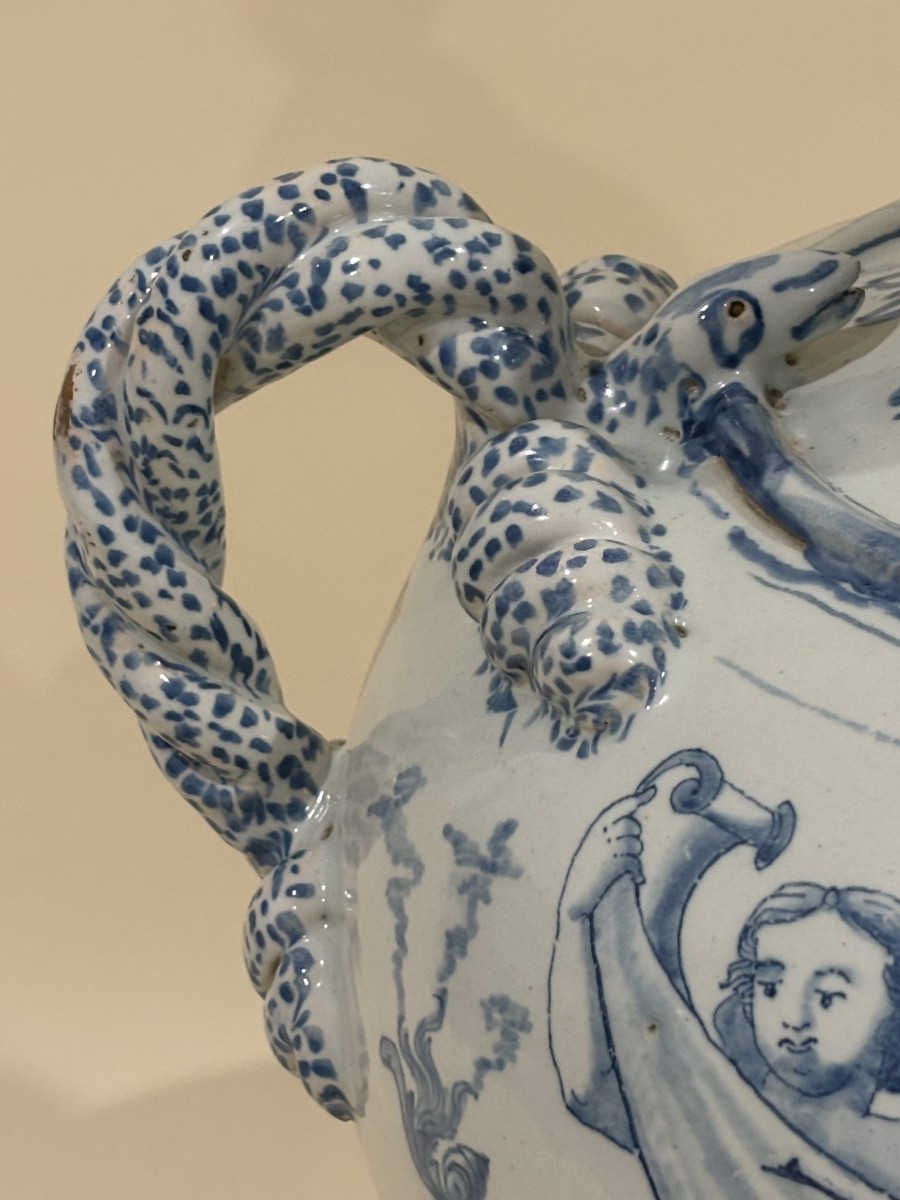
The baluster-shaped body is framed by two twisted handles simulating serpents and rests on a circular pedestal.
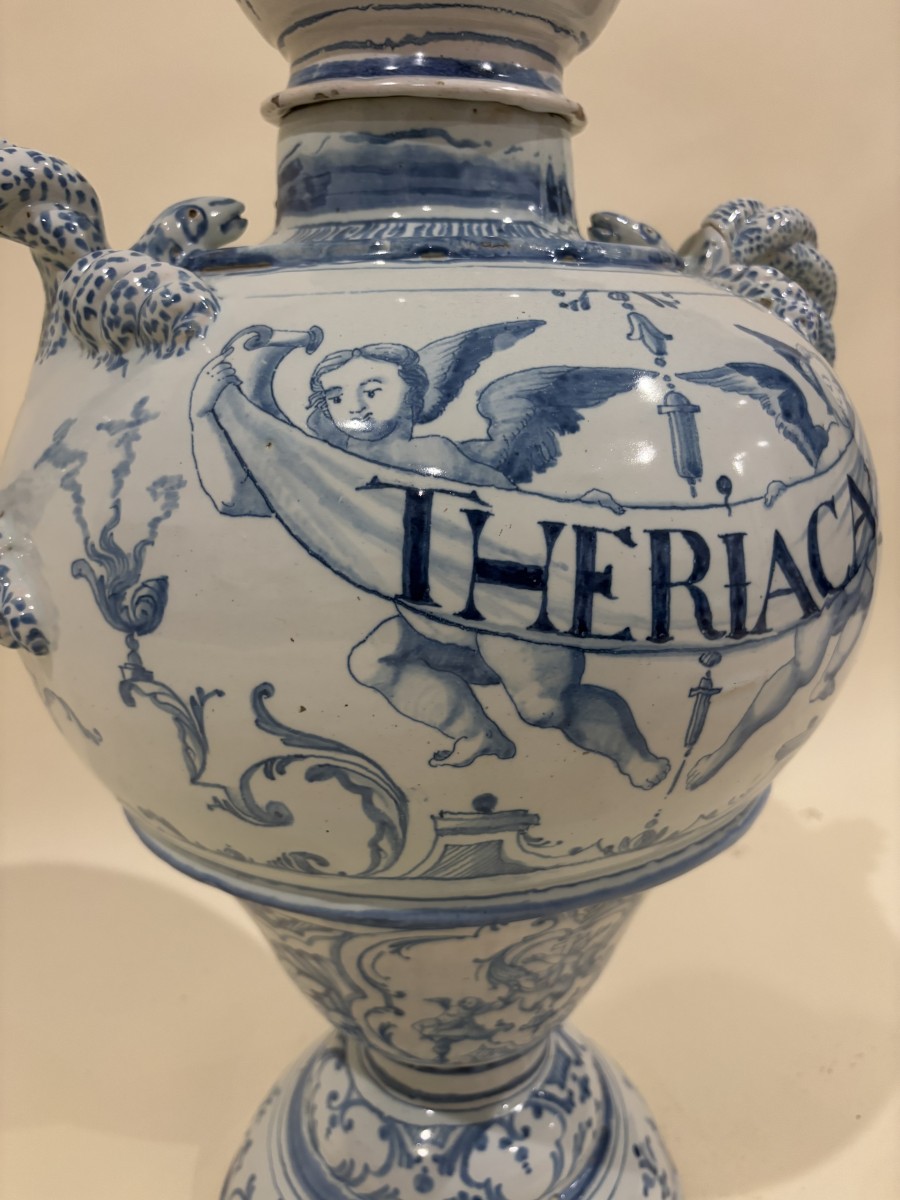
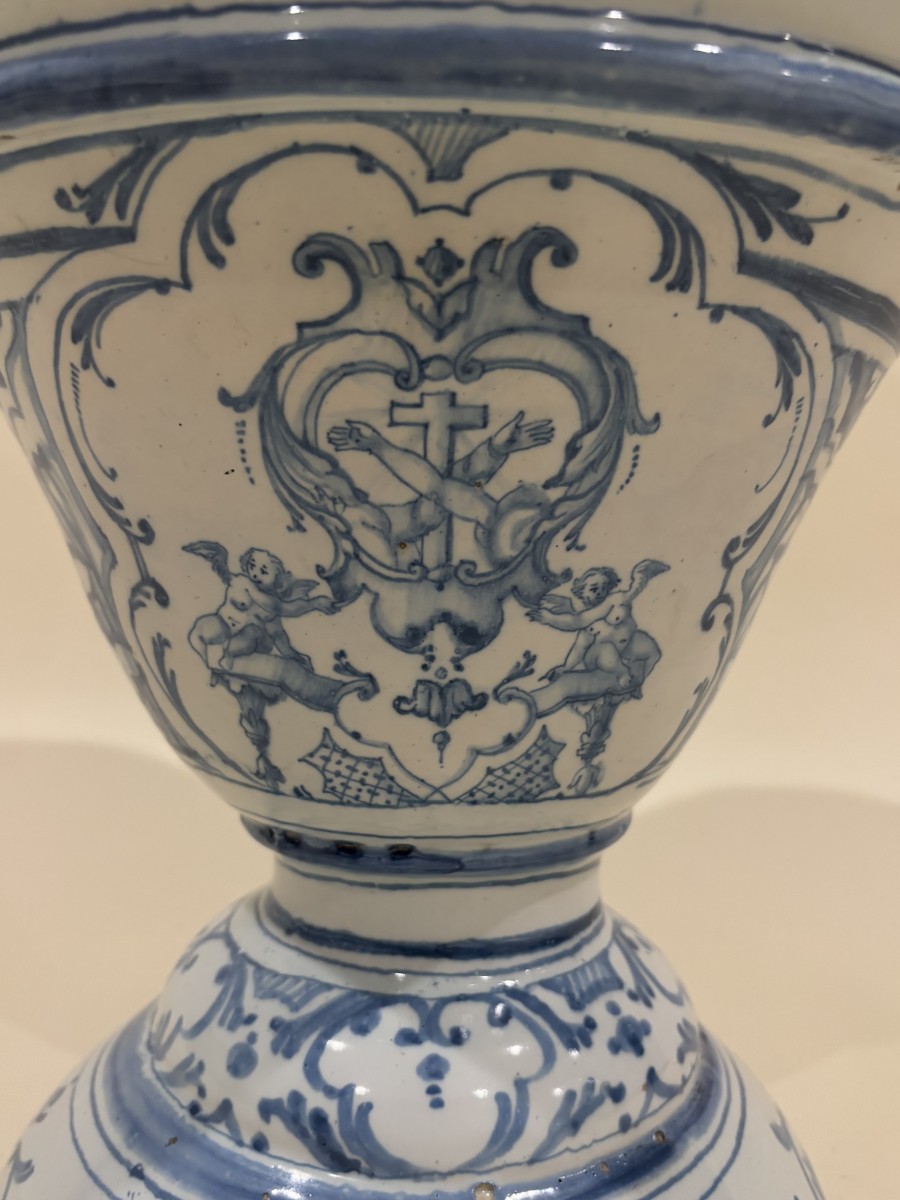
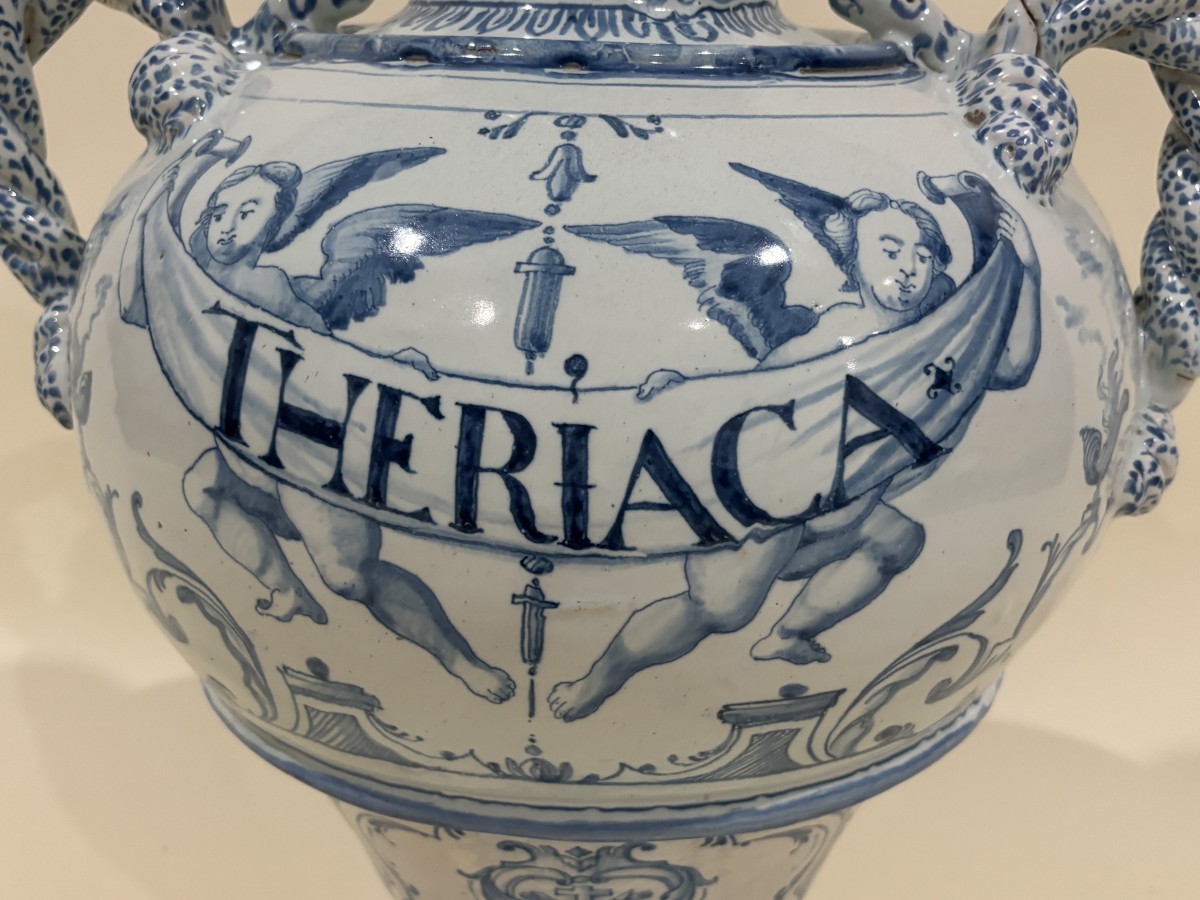
The front bears the inscription "Thériaque" on a banner held by two cherubs, and below it, the coat of arms of the Franciscan order (the crossed arms of Christ and St. Francis).
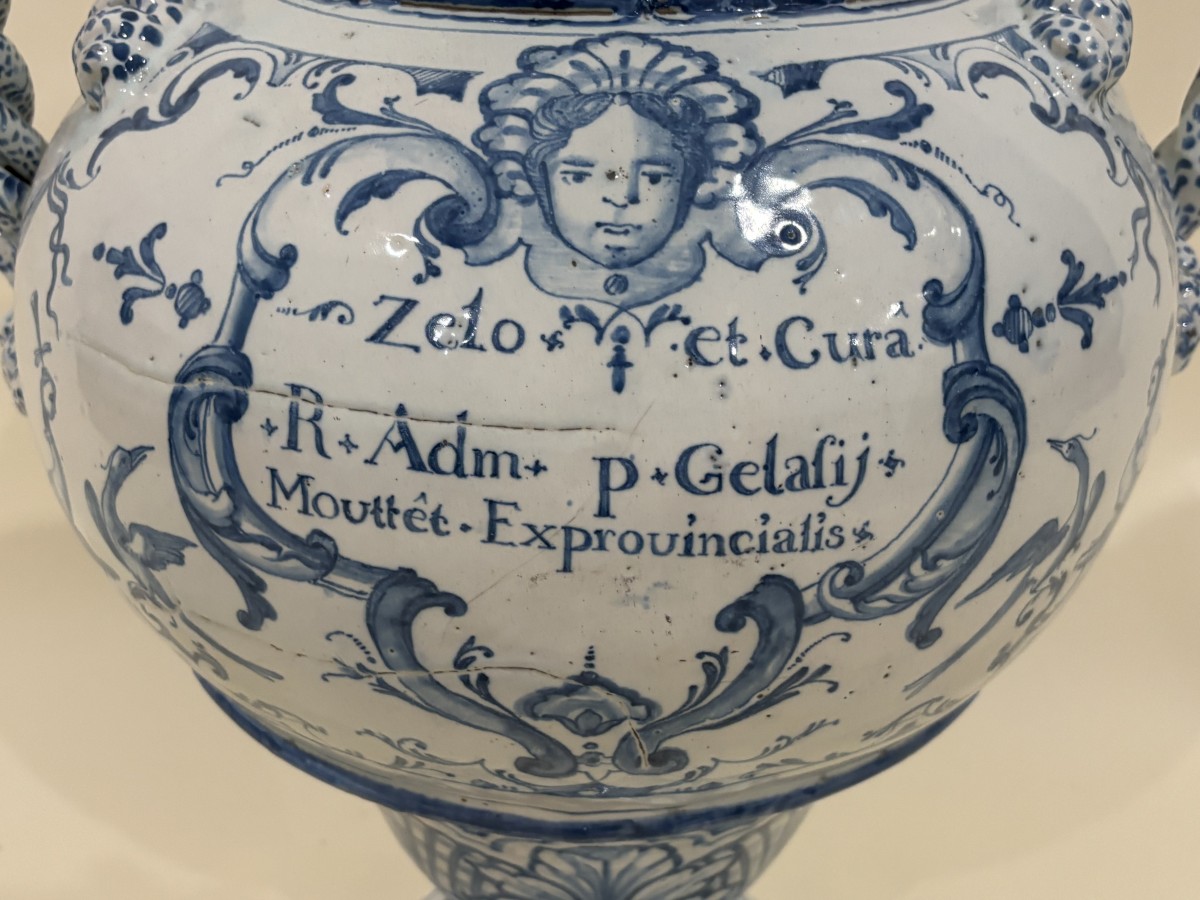
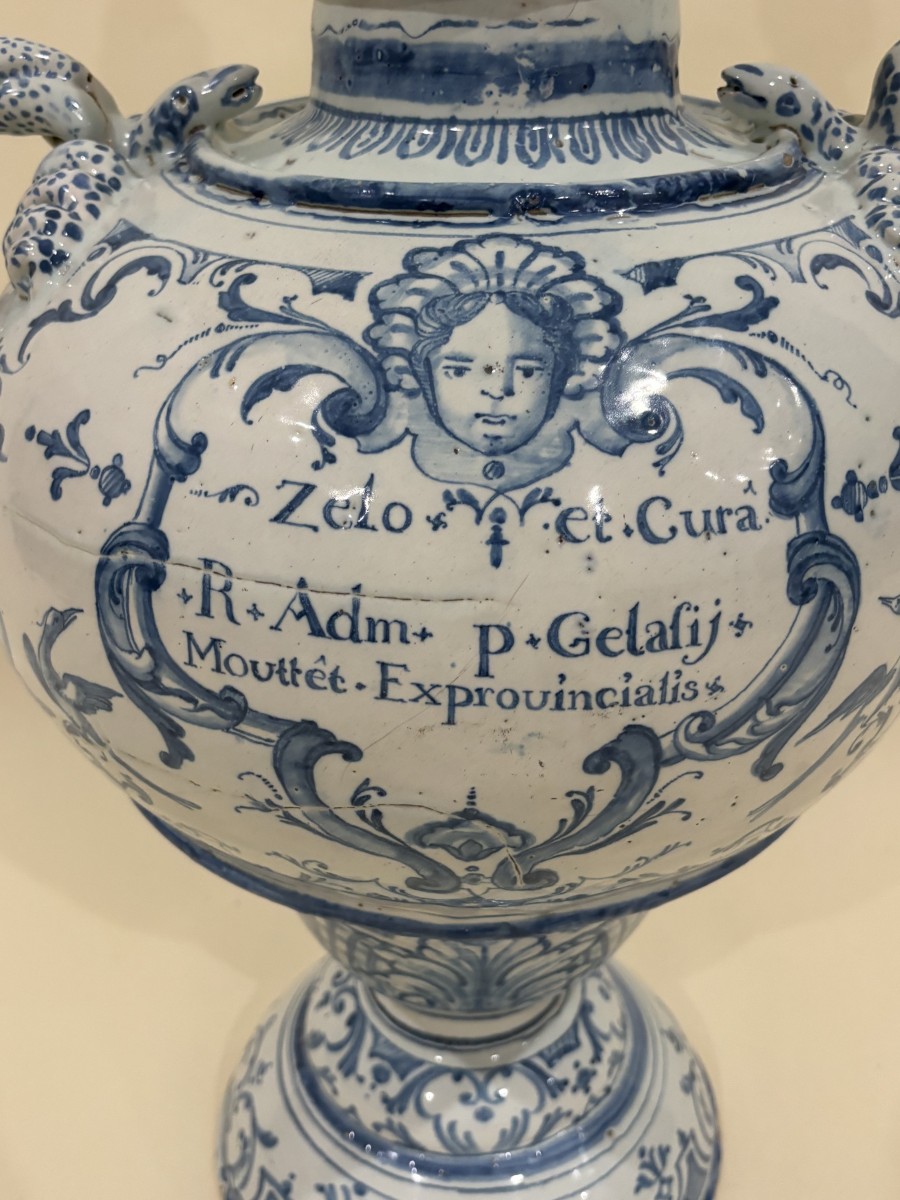
The back is adorned with a cartouche featuring a mascaron, the Latin phrase "Zelo et Cura" (with zeal and care) in the center, and below it, the honorific religious title "R. Adm. P. Gelatij Mouttet Exprovincialis," which can be translated as "Very Reverend Father Gelatij Mouttet, former provincial."
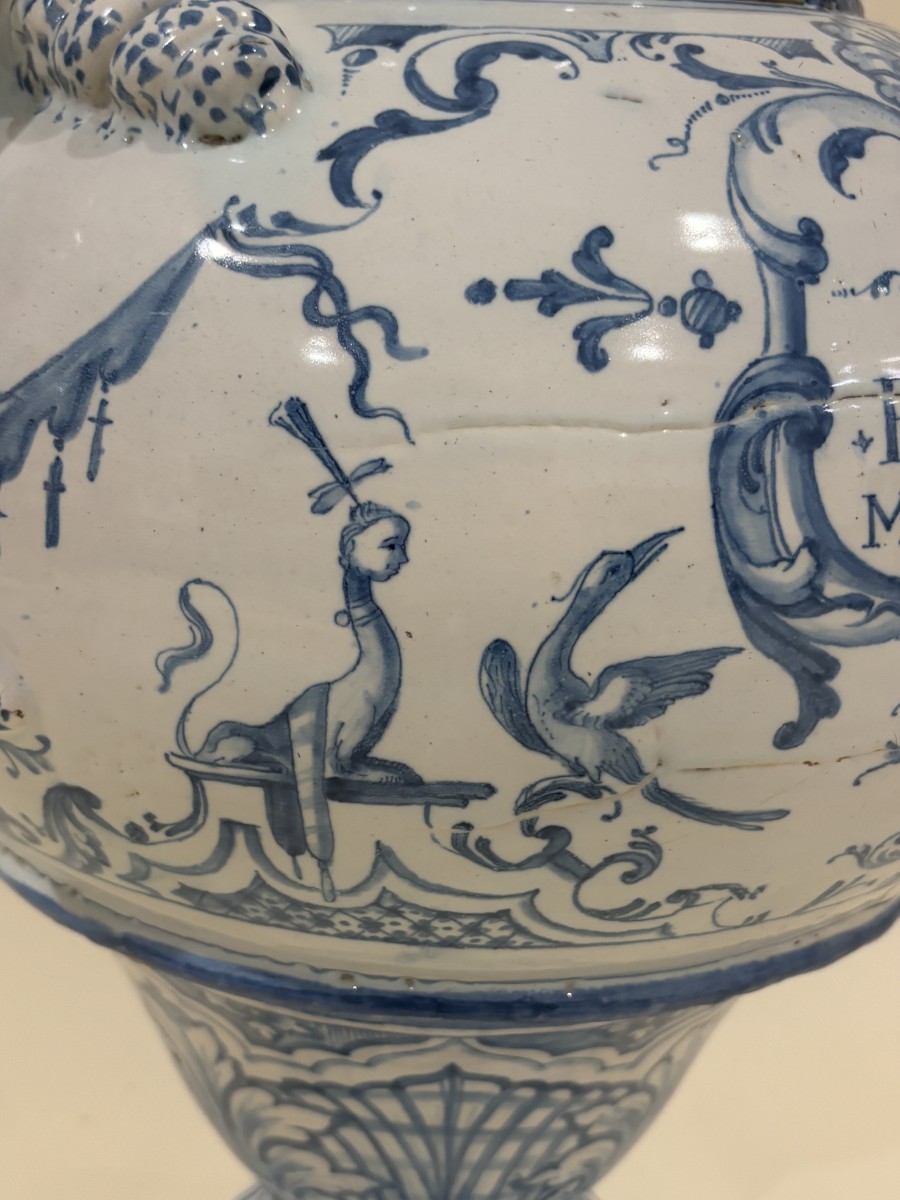
The body of the vase is decorated with sphinxes, lambrequins, and birds inspired by the works of the decorator Jean Berain (1640-1711).
In very good condition, original lid.
Montpellier, probably Jacques Ollivier factory, circa 1700-1720.
Dimensions:
Height: 82 cm; Width: 43 cm
Our opinion:
The large tin-glazed earthenware pharmacy jar we are presenting, with its exceptional height of 82 cm, belongs to the category of monstrance jars, the most important and prestigious items in old apothecaries. Due to its unusual size, it was intended to occupy a central place on the shelves, surrounded by smaller jars, thus becoming the focal point of the display.
Its blue monochrome decoration on a white background is characterized by rich scrolling foliage framing an inscribed cartouche, surmounted by a mascaron and flanked by zoomorphic handles. The whole belongs to the ornamental repertoire known as "à la Bérain," inspired by the creations of Jean Bérain (1640-1711), whose elegant arabesques, symmetrical scrolls, and airy compositions profoundly influenced the decorative arts of the late reign of Louis XIV and the early 18th century.
The cartouche notably bears the mention of theriac, as well as a religious inscription referring to a high-ranking cleric, probably a former Provincial of a religious order. This inscription testifies to the close link that united the major apothecaries with religious and hospital communities.
By its decoration, quality of execution, and monumental scale, this piece can be attributed to the workshop of Jacques Ollivier (1675-1743) in Montpellier, one of the major centers of earthenware production in southern France at the end of the 17th and beginning of the 18th centuries. The large pharmacy jars from this workshop are among the most spectacular examples of Montpellier earthenware.
This attribution resonates particularly strongly with the history of Montpellier, whose Faculty of Medicine, founded in the 13th century, is one of the oldest in Europe still in operation. Renowned throughout the Western world, it made the city a major center of medical and pharmaceutical knowledge, fostering the development of prestigious apothecaries and a significant production of earthenware intended for medicinal use. Theriac had been considered since antiquity as the quintessential universal remedy. Inherited from Greco-Roman medicine and constantly refined until the 18th century, it was an ingredient in extremely complex preparations sometimes combining dozens of ingredients: aromatic plants, oriental spices, honey, mineral substances, and viper flesh. Renowned for its effectiveness against poisons, fevers, venomous bites, and numerous diseases, it held a privileged place in apothecaries, where it was kept in the largest and most prestigious vessels, true symbols of pharmaceutical knowledge and the prestige of the establishment.