Offered by Jan Muller
REQUEST INFORMATION

MASTER OF THE PRODIGAL SON
Oil on panel
We’d like to thank dr. Peter van den Brink for his advice;
Dimensions: 88 x 67 cm, 107 x 87 cm (framed)
THE ARTIST
The Master of the Prodigal Son was the notname given to a Flemish painter and designer of tapestries, and stained glass. He was active in Antwerp where he operated a large workshop between 1530 and 1560. Little is known about this artist who was given his notname in 1909 by Belgian art historian Georges Hulin de Loo after one of his best-known works depicting The return of the prodigal son.
A monogram of "LK" was discovered on one of his paintings. Some doubt has been raised as to whether the monogram is genuine and no other evidence exists to conclude that the artist should be identified with the Leonart Kroes mentioned as the teacher of Gillis van Coninxloo in the Flemish 16th century art historian Karel van Mander's Schilder-boeck of 1604. Based on the size of his output it is believed he operated a large workshop with several pupils in Antwerp
He painted religious subjects, landscapes, genre scenes, and allegories. He is regarded as a leading master of Flemish Mannerism in the sixteenth century. His work shows the influence of leading painters working in Antwerp in the mid-16th century, such as Pieter Coecke van Aelst, Pieter Aertsen, Jan Mandijn, and Frans Floris. The sharply accented realism of some figures in his work is closely related to Pieter Aertsen. A certain Mannerism in his work approaches that of Jan Mandijn and Frans Floris as well as the School of Fontainebleau. This aspect is most obvious in his compositions with large figures.
THE ARTWORK
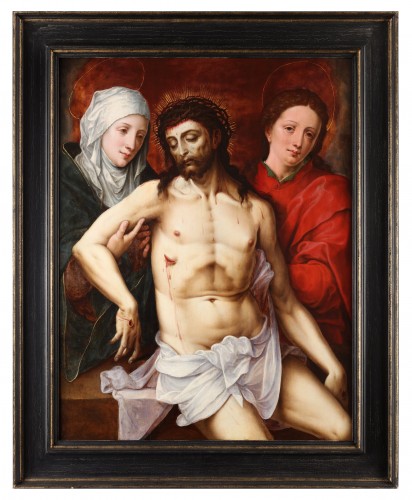
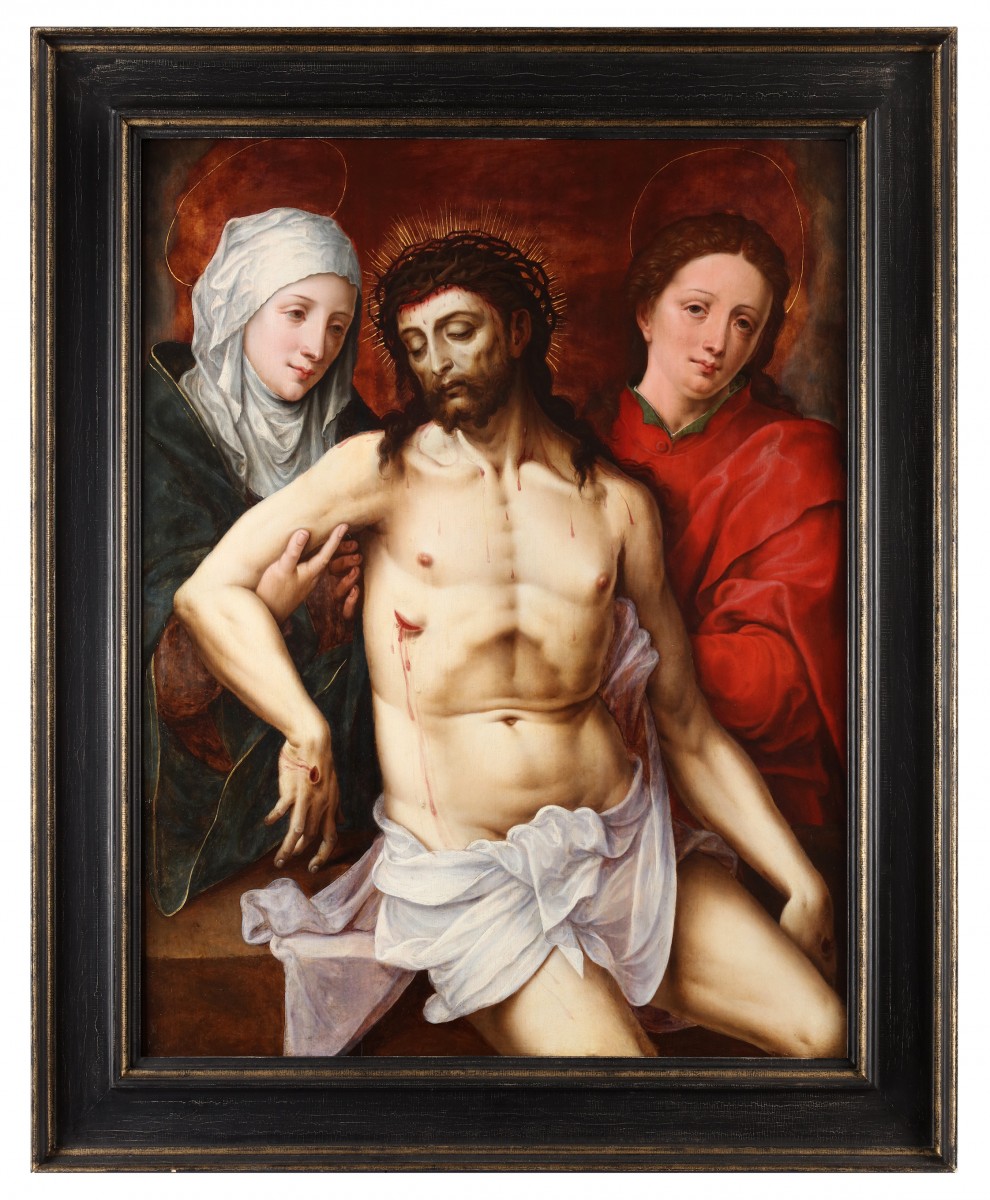
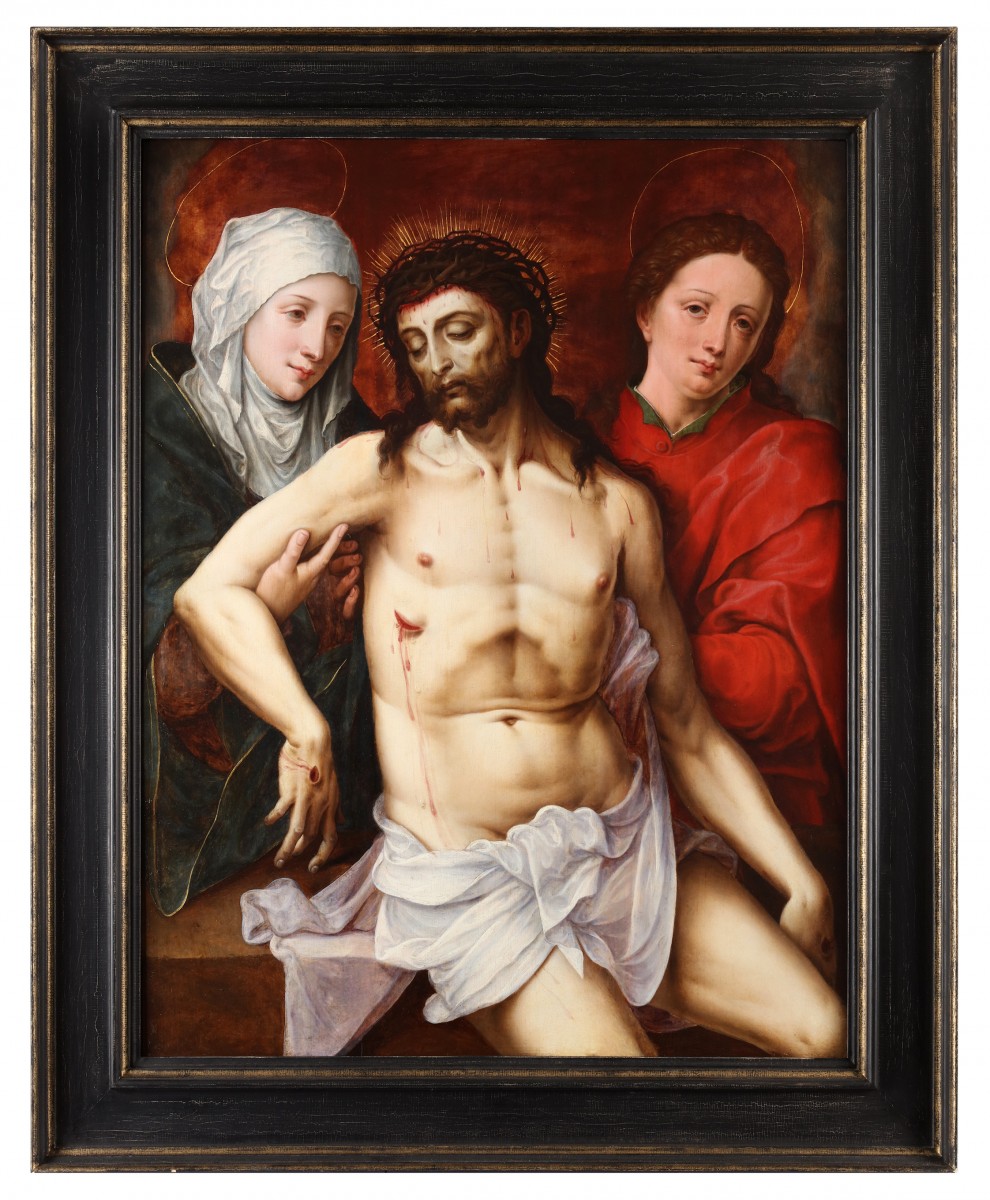
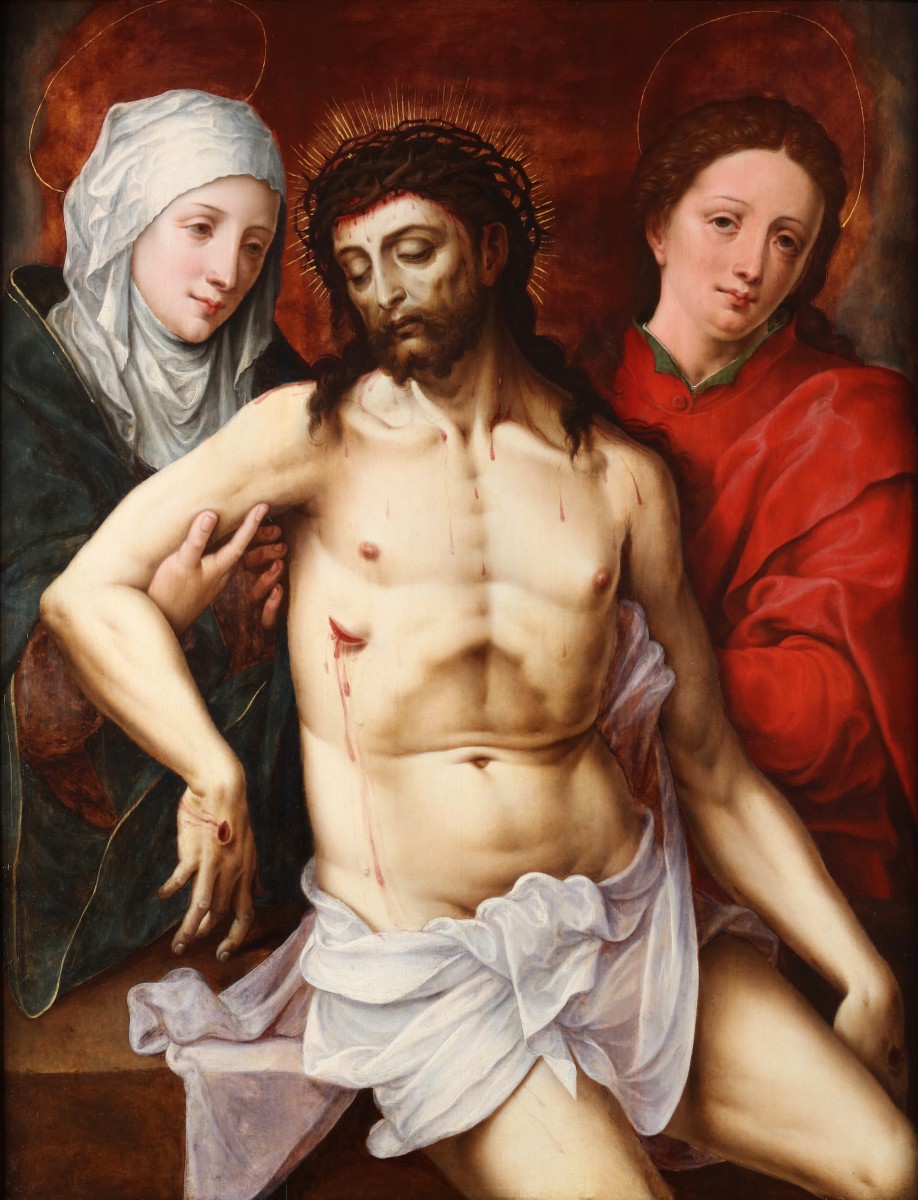
The scene unfolds with profound emotion as the artist captures the heart-wrenching moment of Christ's lifeless body cradled by the grieving figures of the Virgin Mary and Saint John. This evocative portrayal, aptly titled "pieta," transcends mere representation to become a poignant meditation on sorrow, sacrifice, and profound love.
At the center of this composition, the lifeless Christ is rendered with haunting realism. His hollow, lean body bears the weight of the ultimate sacrifice, accentuated by a wound on his side from which blood drips. The crown of thorns still rests on his head, a stark reminder of the agony endured. His closed eyes and hollow cheeks convey a serene repose, a poignant contrast to the tumultuous events that led to this mournful scene.
The Virgin Mary, dressed in hues of blue and white, supports the lifeless form of her divine son. Her eyes filled with sorrow as she holds Christ's fragile frame. On the other side stands Saint John, his youthful face etched with profound sadness. Dressed in vibrant red cloth, his eyes gaze into the distance, perhaps contemplating the magnitude of the loss.
The Virgin Mary and Saint John the Evangelist support the body of the dead Christ, which rests on a stone slab. This composition is based on a plaquette by Moderno, the pseudonym of a goldsmith and medallist active in north Italy at the turn of the sixteenth century, datable to around 1508–13. It seems that one of his plaquettes reached the Low Countries and attracted the attention of Jan Sanders van Hemessen, who painted an enlarged version of it, perhaps in around 1530 or 1540. This variation on van Hemessen’s picture by the Master of the Prodigal Son became extremely popular and was reproduced in many painted versions, perhaps over a long period, and in an engraving. The reason for its popularity is unclear, but it’s possible that the plaquette, or one of the versions, was believed to have worked a miracle.
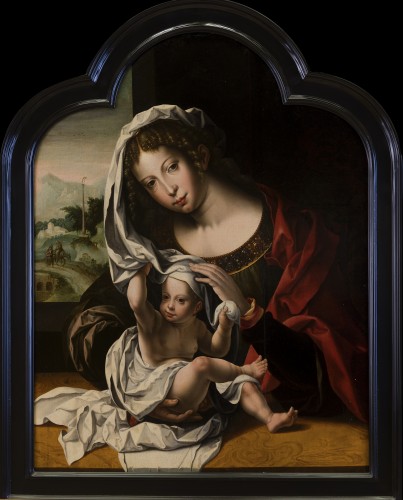
His figures have a sculptural character. Their skin color is bright, and the female figures also have the sheen of marble. The small faces, pointed chins, and closely spaced eyes, the large hands with defined fingernails, and the figures that walk as if they are “walking on their toes” are also characteristics that are typical of his style.
The Master of the Prodigal Son's masterful brushwork and nuanced portrayal of emotion in this artwork invites viewers to enter the sacred space of this timeless scene. Through this evocative masterpiece, the artist captures the essence of the Christian narrative, immortalizing the grief and love that converge at the heart of Christ’s sacrifice.
Delevery information :
After reception of payment we can box and ship our items all over the world. Estimates of this service can be provided.