Offered by Galerie FC Paris
REQUEST INFORMATION

Dutch School, 17th century
Oil on canvas
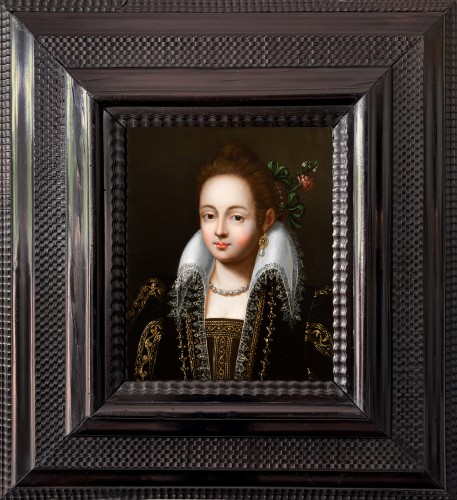
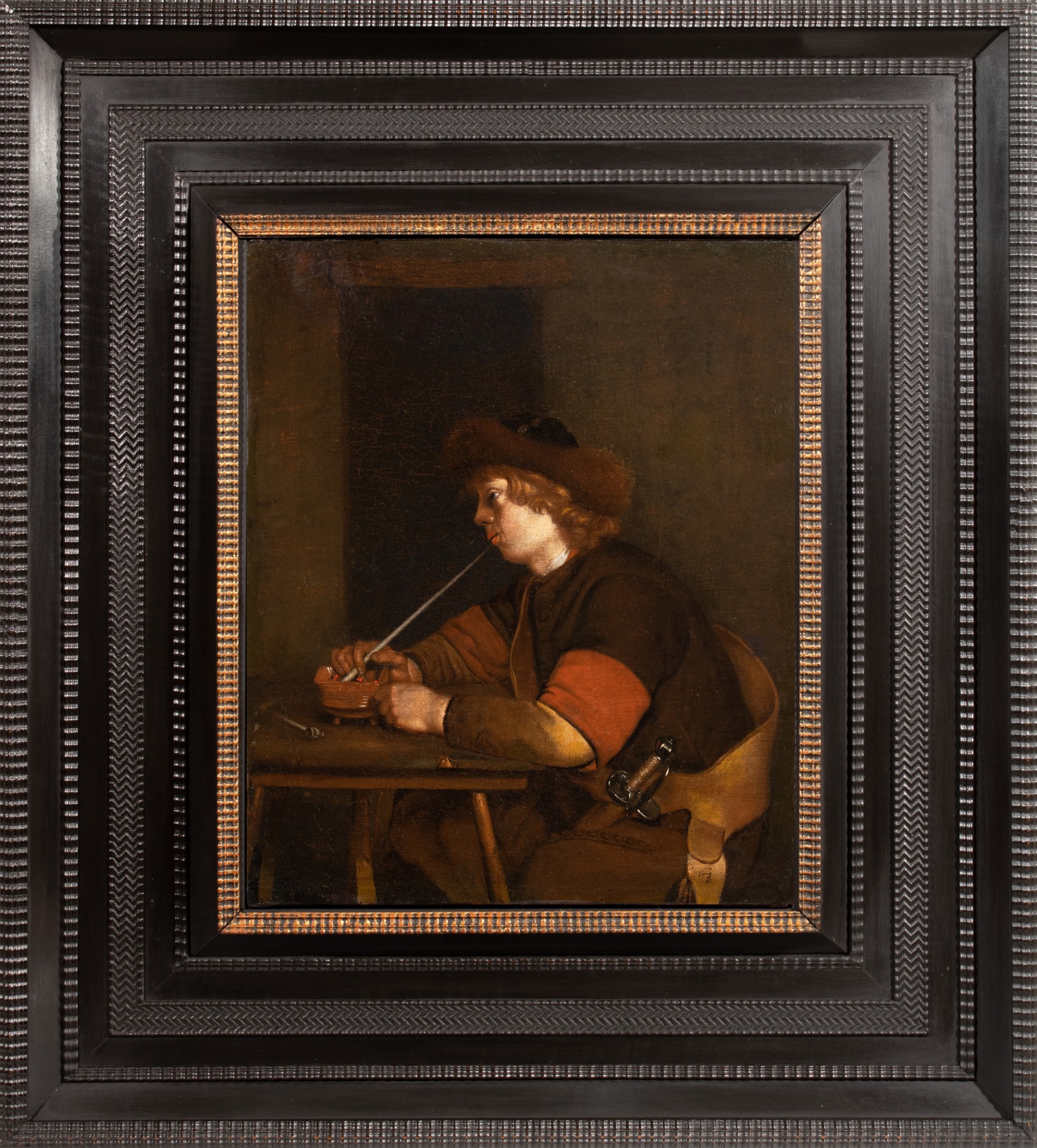
Presented in a beautiful antique ebonized veneer frame, deeply moulded with a reversed profile. The guilloche motif is executed with remarkable finesse.
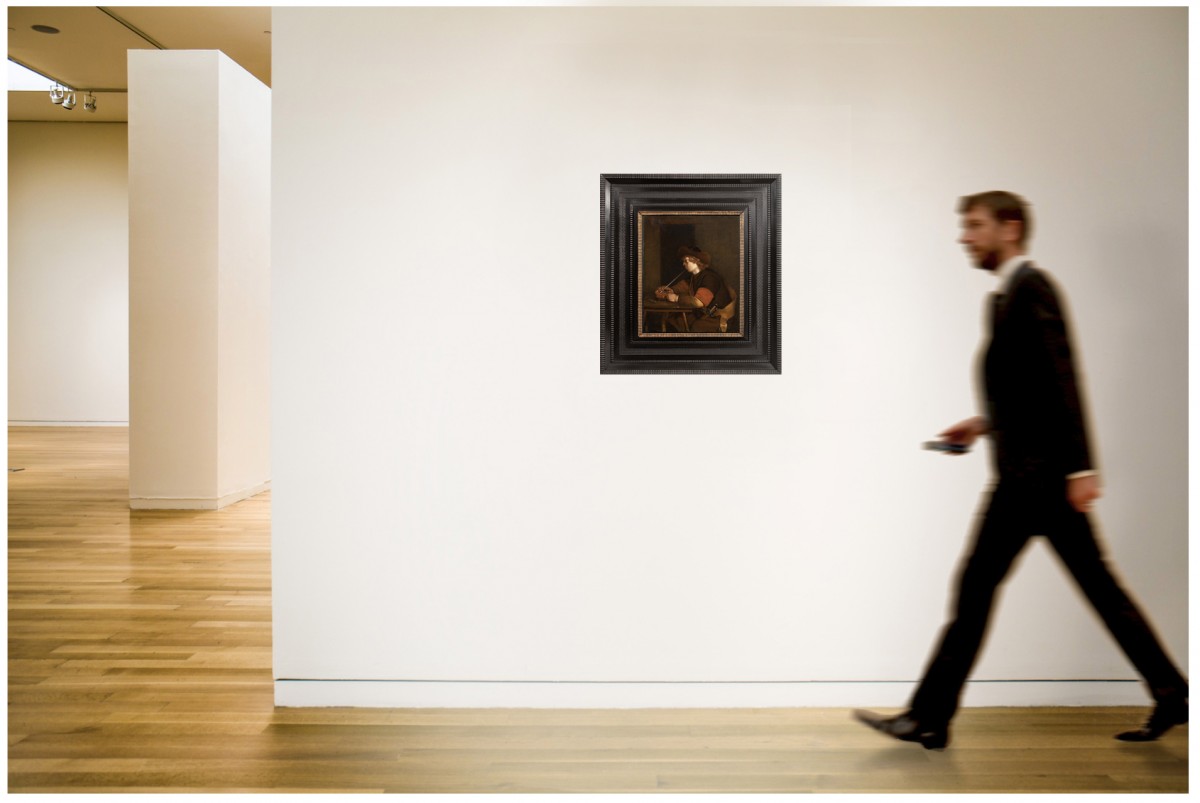
Overall dimensions: 71 × 64 cm — Canvas: 41 × 33 cm
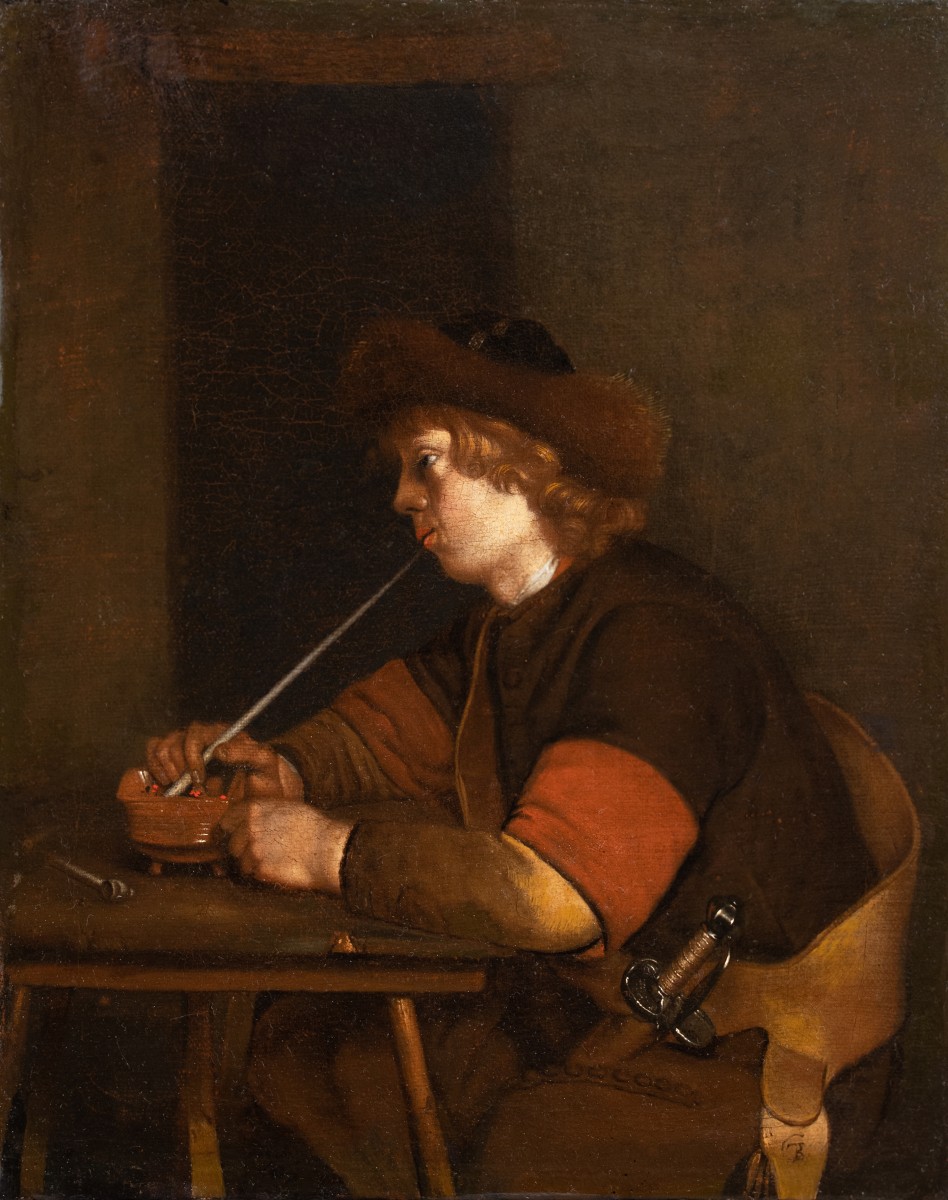
This painting depicts a young soldier captured in a moment of quiet intimacy as he lights his long clay pipe. Seated at a wooden table, he leans slightly toward a small charcoal brazier from which he draws the necessary ember. Beside him lies a second pipe, broken — a typical detail of Dutch genre painting, where everyday objects serve as subtle narrative cues.
Dressed in a brown coat with red sleeves and wearing a broad fur-trimmed hat, the figure embodies the familiar motif of the idle soldier, recurrent in 17th century Dutch art. The sword hanging at his side underscores his military status while contrasting with the simplicity and tranquillity of the scene. The restrained, intimate composition stands out against a dark background that enhances the warmth of the brown and red tones, as well as the precision of the textures — fabrics, wood, metal, clay — characteristic of the Ter Borch aesthetic.
Several versions of this subject are known, all derived from the prototype preserved at the Gemäldegalerie in Berlin. The similarities in composition and execution point to a work produced in Gerard ter Borch’s workshop, likely painted by one of his pupils or by one of his brothers, who were also active artists.
The theme of the smoker holds an important place in Dutch Golden Age painting. Introduced to Europe in the 16th century, tobacco quickly became an ambivalent symbol: daily pleasure, sociability, but also vanity or idleness. Ter Borch and his circle offer here a subtle interpretation focused on calm concentration and the quiet ritual of the gesture.
Gerard ter Borch, born in Zwolle into a family of artists, is one of the leading figures of 17th century Dutch painting. Trained by his father, Gerard ter Borch the Elder, he travelled extensively at a young age — to London, Rome, and Madrid — refining his observational skills and his taste for intimate scenes.
Settled in Deventer from 1654 onward, he specialised in refined genre painting: quiet interiors, conversation pieces, and elegant portraits. His exceptional rendering of fabrics, especially satin, became his hallmark. Ter Borch excelled in capturing subtle attitudes, silences, and psychological nuances, making him one of the most sensitive painters of his time.
His influence was considerable: Pieter de Hooch, Metsu, and even Vermeer drew inspiration from his intimate approach to domestic scenes. His works are now held in major museums, including the Rijksmuseum, the Louvre, the Prado, the National Gallery, and the Gemäldegalerie.
Excellent state of preservation. Sold with a certificate.