Offered by Galerie FC Paris
REQUEST INFORMATION
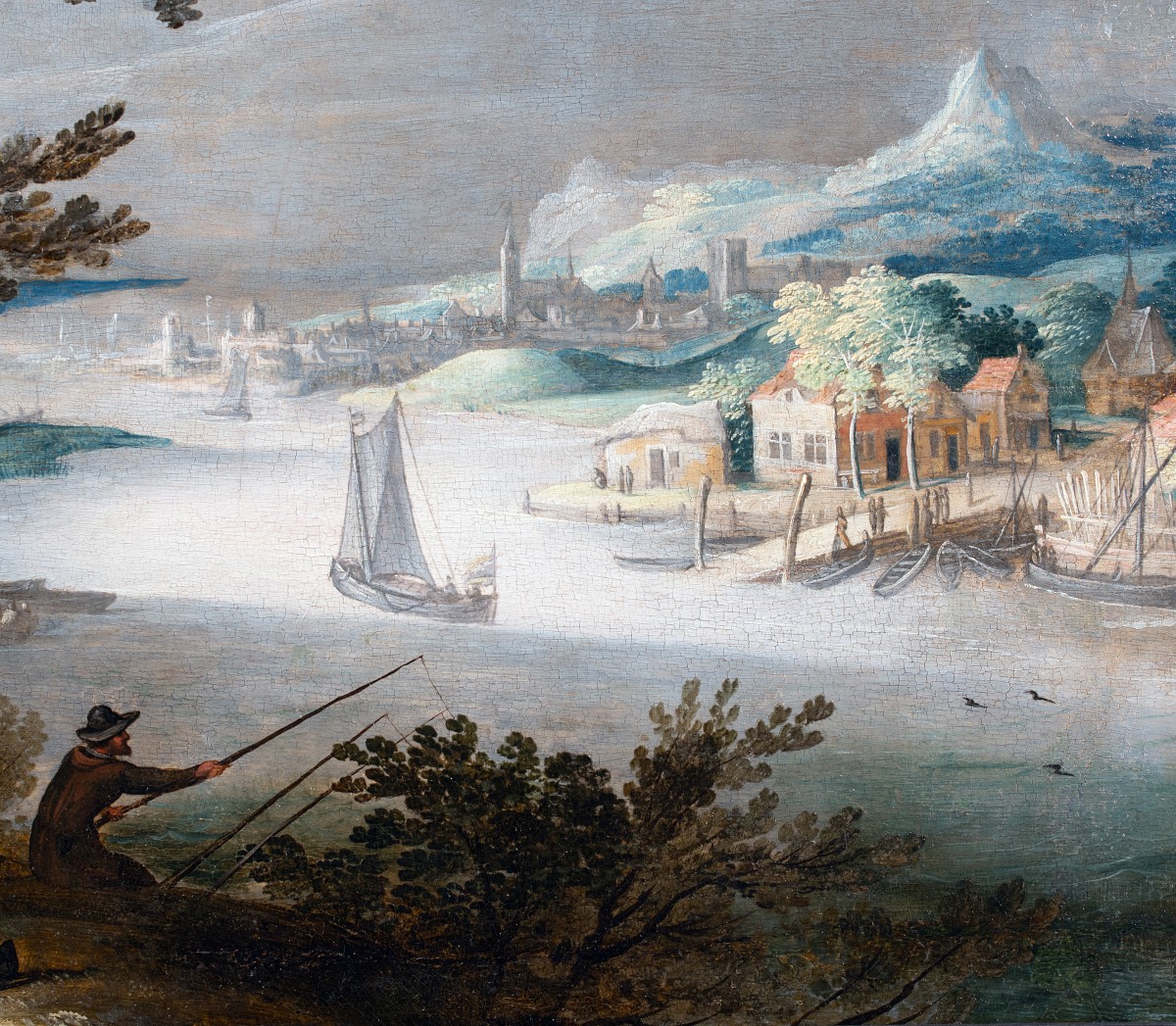

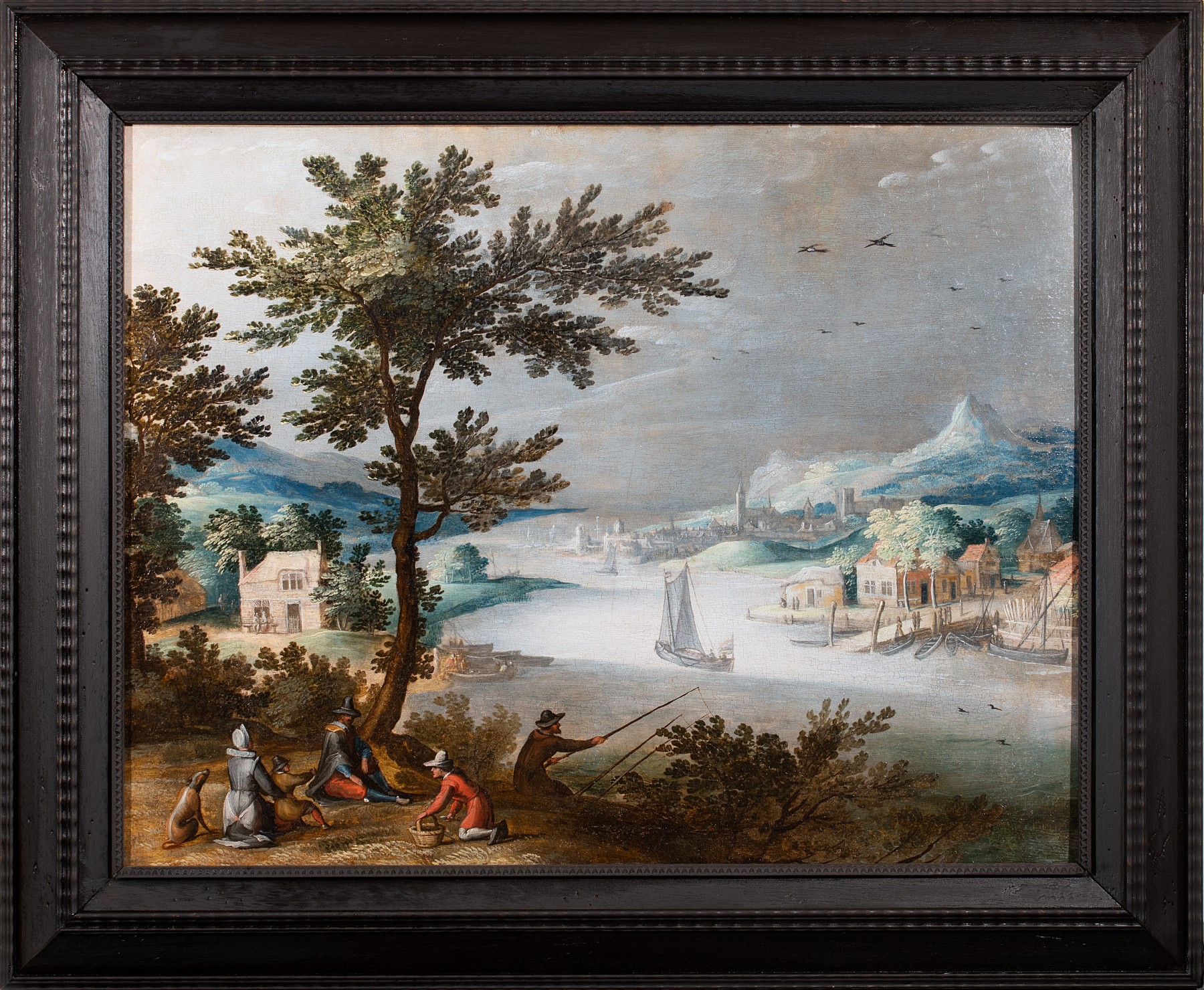
Flanders, circa 1610–1620
Oil on oak panel (2 joined planks) Presented in a Flemish-style frame in blackened wood with an inverted profile. Dimensions with frame: 68 × 80 cm. Panel alone: 50 × 64 cm.
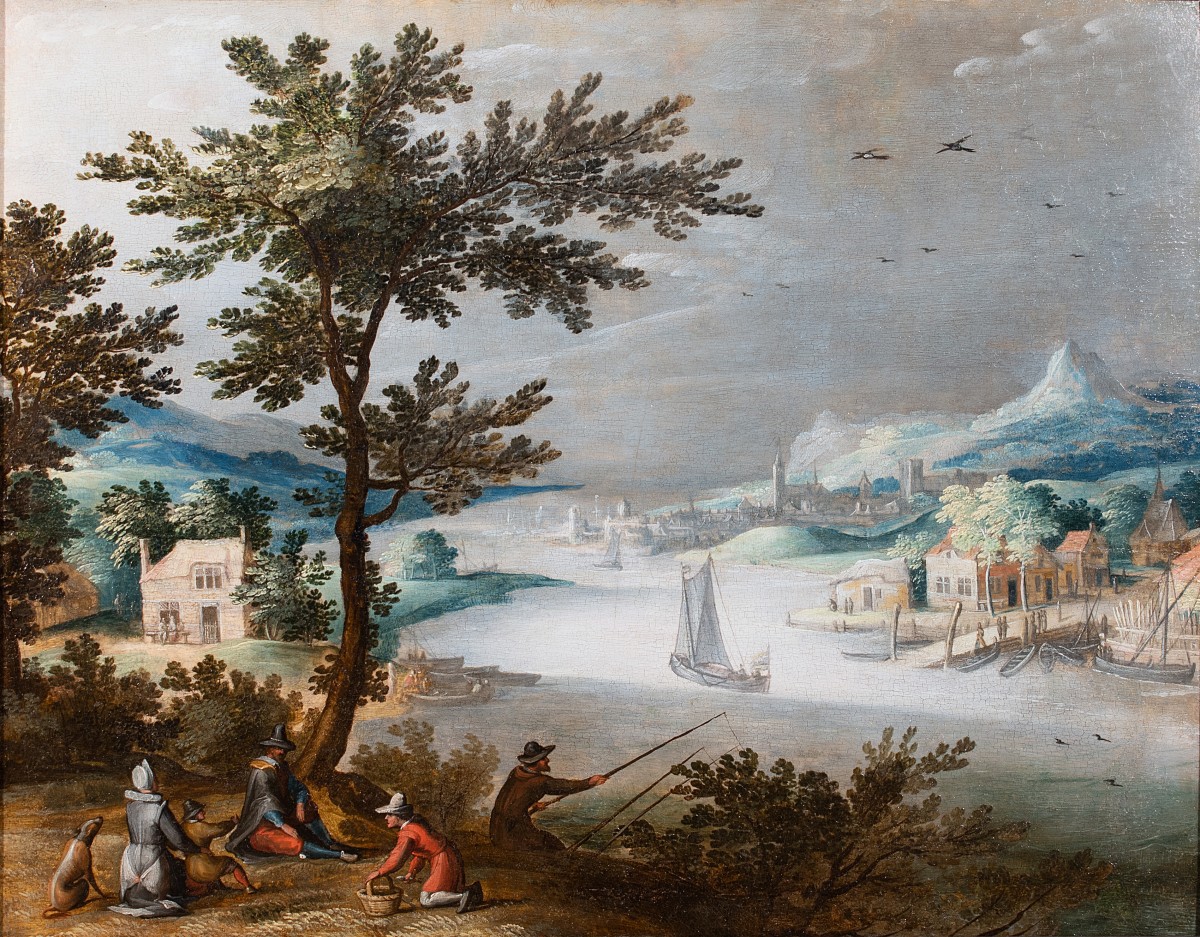
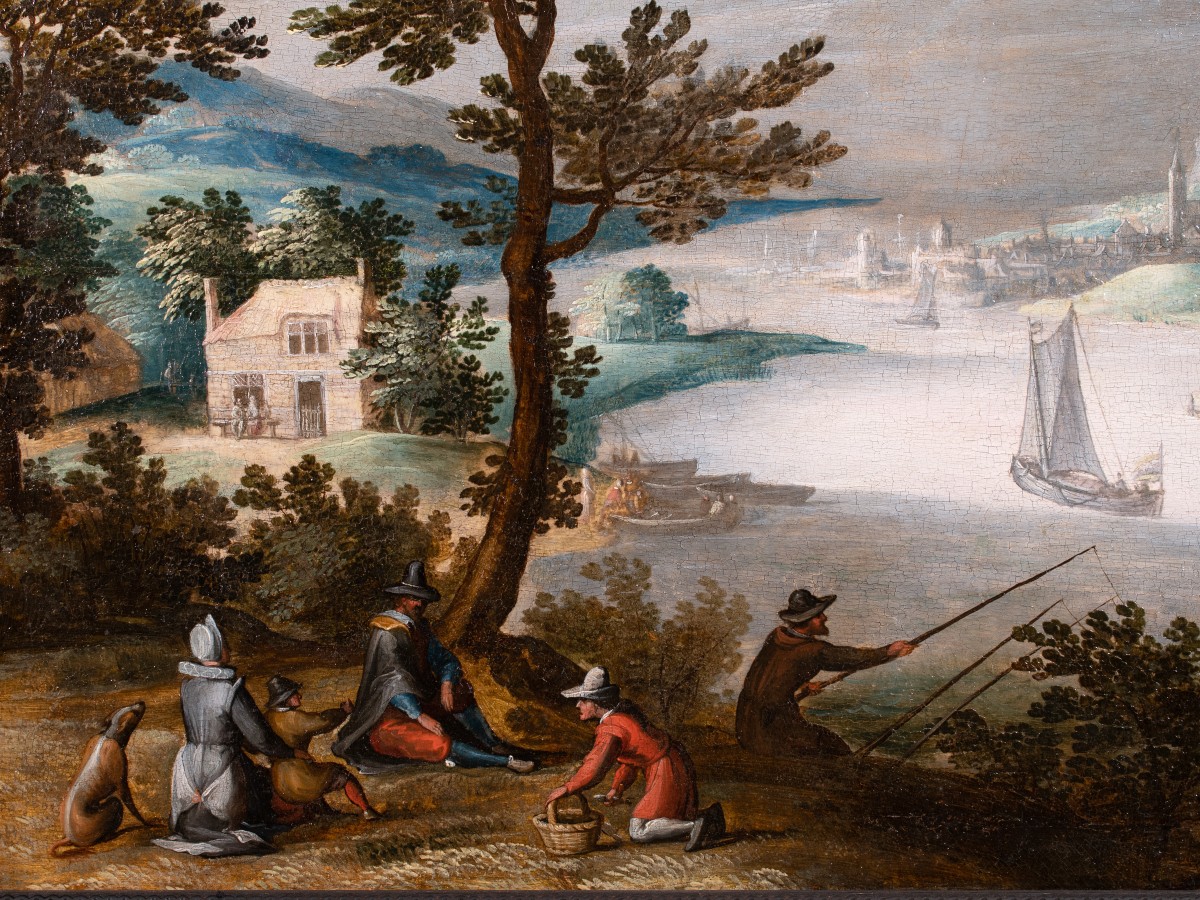
This river landscape, bathed in crystalline light and dominated by a range of celestial and aquatic blues, illustrates an idealized vision of nature as developed in Flemish workshops influenced by Italy. In the foreground, a group of figures enjoys a peaceful meal on the grass in a convivial, relaxed posture, while another person fishes nearby. Dressed in early 17th century attire, these figures embody a bucolic genre scene typical of Flemish painting. A large tree with dense foliage structures the composition and frames the scene. The river winds through the center, dotted with sailing boats and small vessels, linking the lively banks to the distant horizon. On the left, a solitary house nestles beneath the trees; on the right, a small port with quays and buildings evokes village activity. In the background, a fortified town with slender spires sits among the hills beneath a sky crossed by birds. This type of landscape, both narrative and decorative, belongs to the tradition of classical Flemish landscapes developed in Rome by Paul Bril and his followers. While Bril is often cited as the master of this genre, Willem van Nieulandt—trained within his circle—distinguishes himself through a cooler palette, more precise architecture, and a more theatrical atmosphere. The strong dominance of blue here enhances the sense of depth and lends the whole composition an almost meditative serenity.
Willem van Nieulandt (Antwerp, 1584 – Amsterdam, 1635/36) A Flemish painter, engraver, poet, and playwright, and a prominent figure of the early 17th century. Born in Antwerp in 1584 into a family of artists, he grew up in an environment steeped in painting, drawing, and the art trade. After the fall of Antwerp, his family settled in Amsterdam in 1589.
• Pupil of the painter Jacob Savery in Amsterdam, from whom he inherited a taste for detailed landscapes.
• Traveled to Rome in 1601, where he worked in the studio of his uncle, Willem van Nieulandt the Elder, and later with the great landscape painter Paul Bril.
• This Italian period profoundly shaped his style, enriched by Italianate landscapes, ancient ruins, and Roman views.
Excellent state of preservation. Sold with a certificate of authenticity.