Offered by Galerie FC Paris
REQUEST INFORMATION
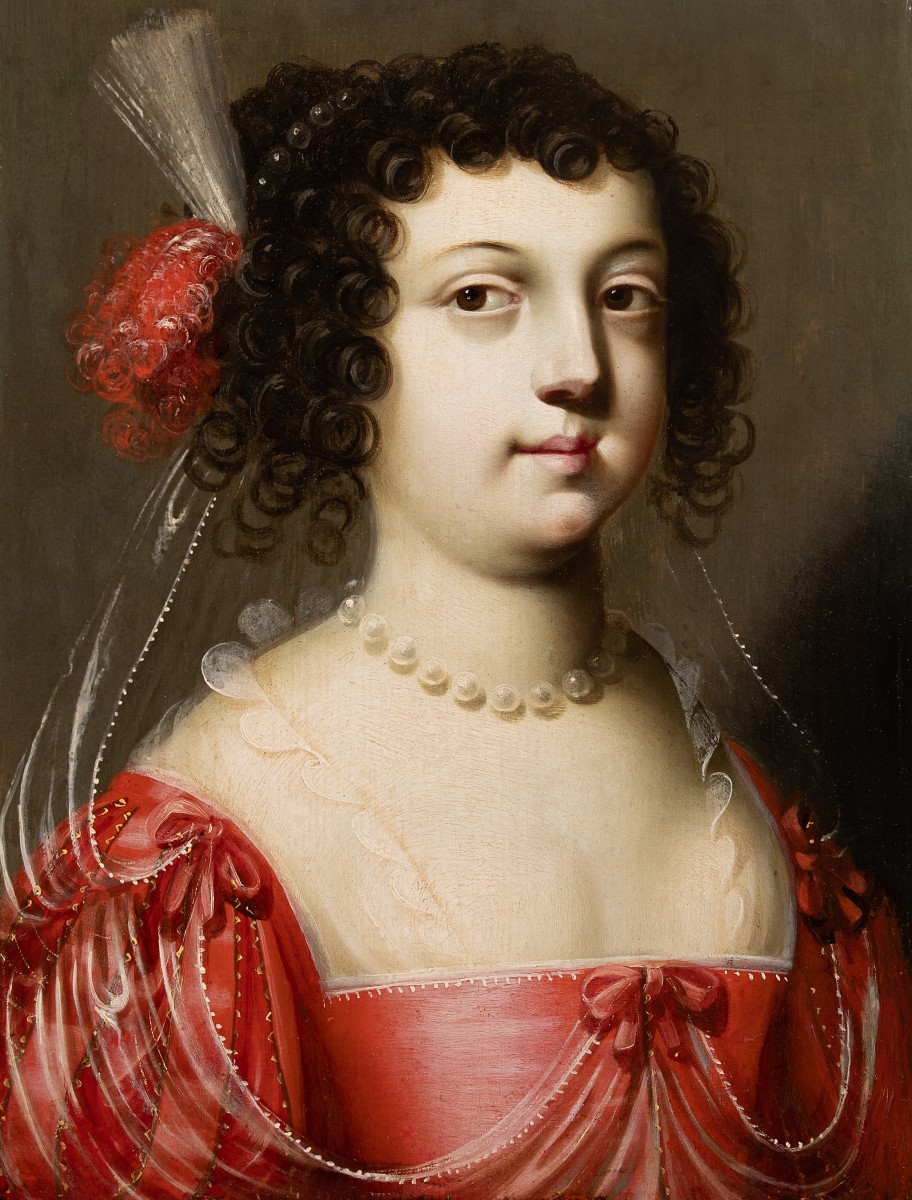

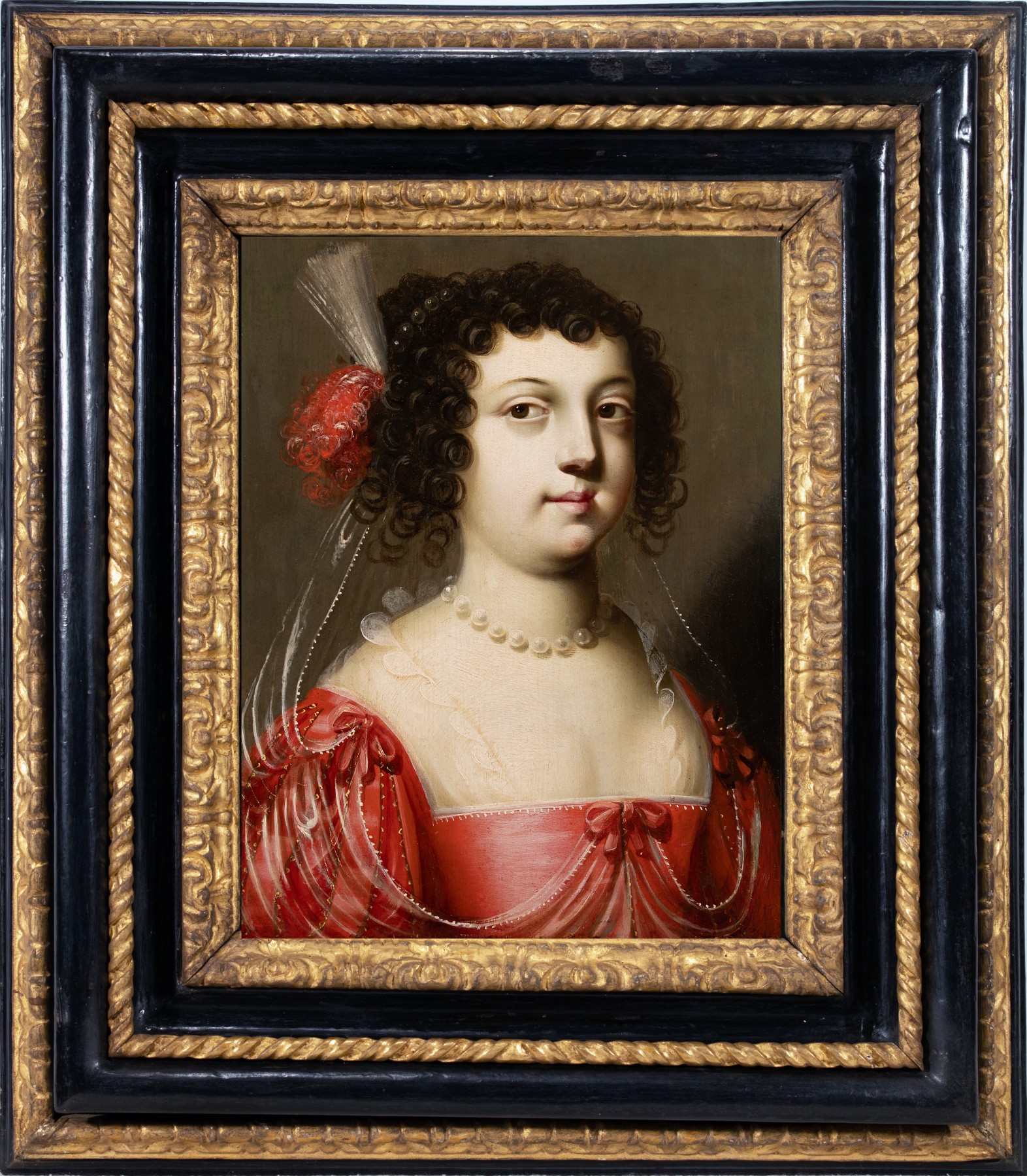
Portrait of a Young Courtesan in a Red Dress
Attributed to Claude Deruet (c. 1588–1660)
France, c. 1620–1630
Oil on oak panel (later reinforced)
Presented in a finely moulded frame, black?lacquered with a gilt twisted ribbon and a gilt acanthus?leaf frieze.
Frame type known as the “Salvator Rosa” model
Overall dimensions: 57 × 48 cm — Panel: 35 × 27 cm
Description
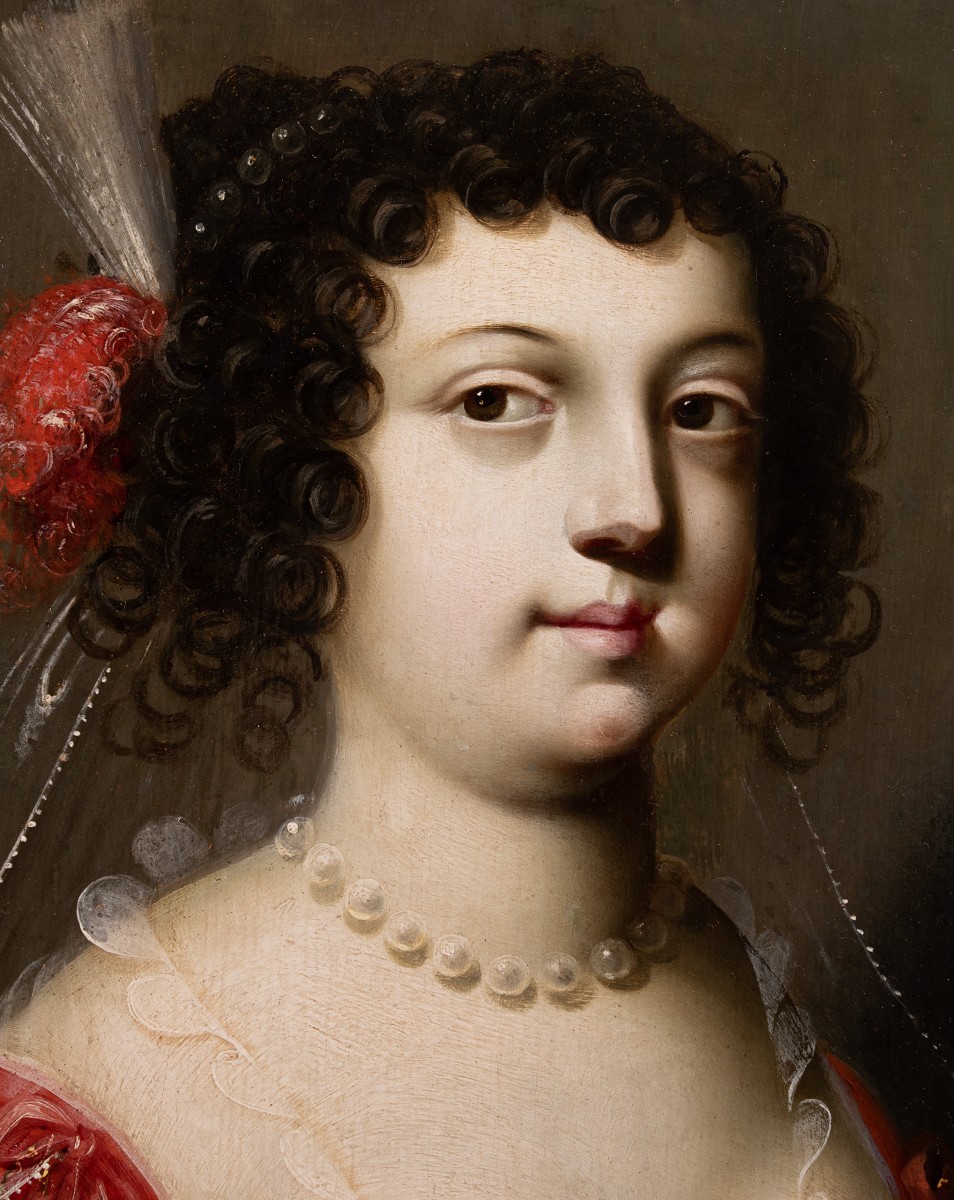
This refined small?scale portrait depicts a richly adorned young woman wearing a brilliant red gown embellished with bows, gilt trimming, and white lace. Her hairstyle, composed of tight curls decorated with feathers and pearls — a fashionable arrangement sometimes referred to as a “Medici coiffure” — perfectly reflects the aristocratic and galant modes of the early seventeenth century. The jewellery, particularly the pearl necklace, reinforces the impression of high social status or an association with the courtly and seductive milieu.
The composition is characteristic of small portraits produced in Lorraine and France during the 1620s–1630s: a dark background, a bust?length figure in slight three?quarter view, and soft lighting modelling the face and fabrics. The meticulous rendering of textiles, the vivid colours, and the delicacy of ornamental details suggest the hand of a painter accustomed to elegant portraiture and idealised female figures.
The attribution to Claude Deruet is supported by several stylistic features: elongated silhouettes, a taste for refined ornamentation, a warm palette, and the lingering influence of late mannerism inherited from Jacques Bellange. Deruet, active in Nancy, frequently portrayed female figures in sumptuous attire, blending realism with stylisation.
Function and Context
Portraits of this type were often intended for private use: galant gifts, likenesses of celebrated courtesans, intimate keepsakes, or idealised representations of feminine beauty. Their small format made them easy to transport and to display in private cabinets, where they were kept alongside miniatures, precious objects, and curiosities.
Claude Deruet (c. 1588–1660) is one of the leading figures of the early seventeenth?century Lorraine school. Trained under Jacques Bellange, he inherited from his master a marked taste for elegant silhouettes, sophisticated drapery, and a certain mannerist tension. He later travelled to Rome, working within the circle of the Cavaliere d’Arpino, which introduced a more pronounced Baroque dimension into his work.
Upon returning to Nancy, Deruet became the official painter to Duke Charles IV of Lorraine. He produced portraits, allegorical scenes, religious compositions, and courtly works celebrating the prestige of the duchy. His reputation extended beyond Lorraine: Louis XIII knighted him in 1645. His refined, colourful, and highly ornamental style makes him a key witness to the transition from late mannerism to the emerging Baroque in Lorraine.
Excellent state of preservation. Sold with a certificate of authenticity.