Offered by Franck Baptiste Paris
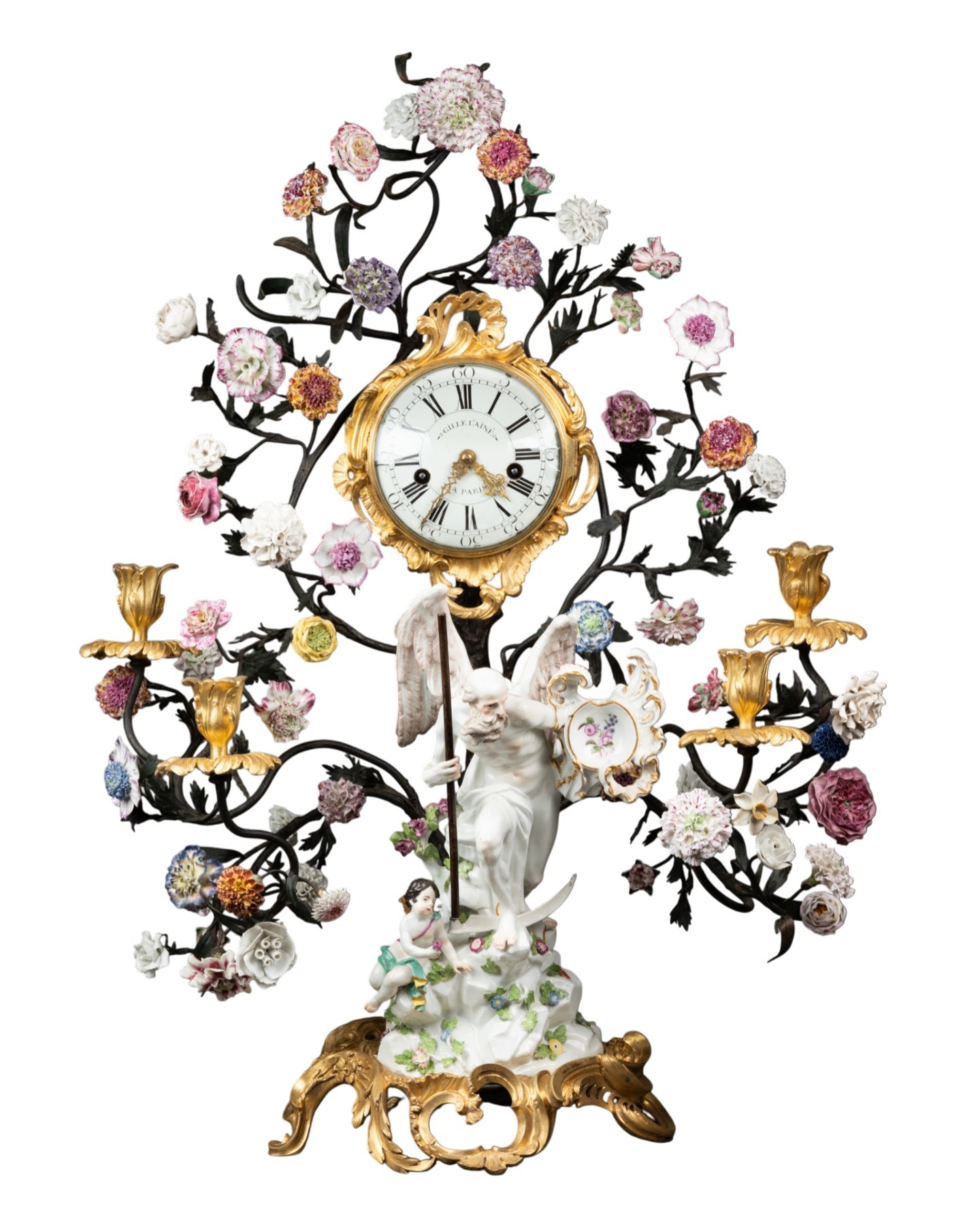
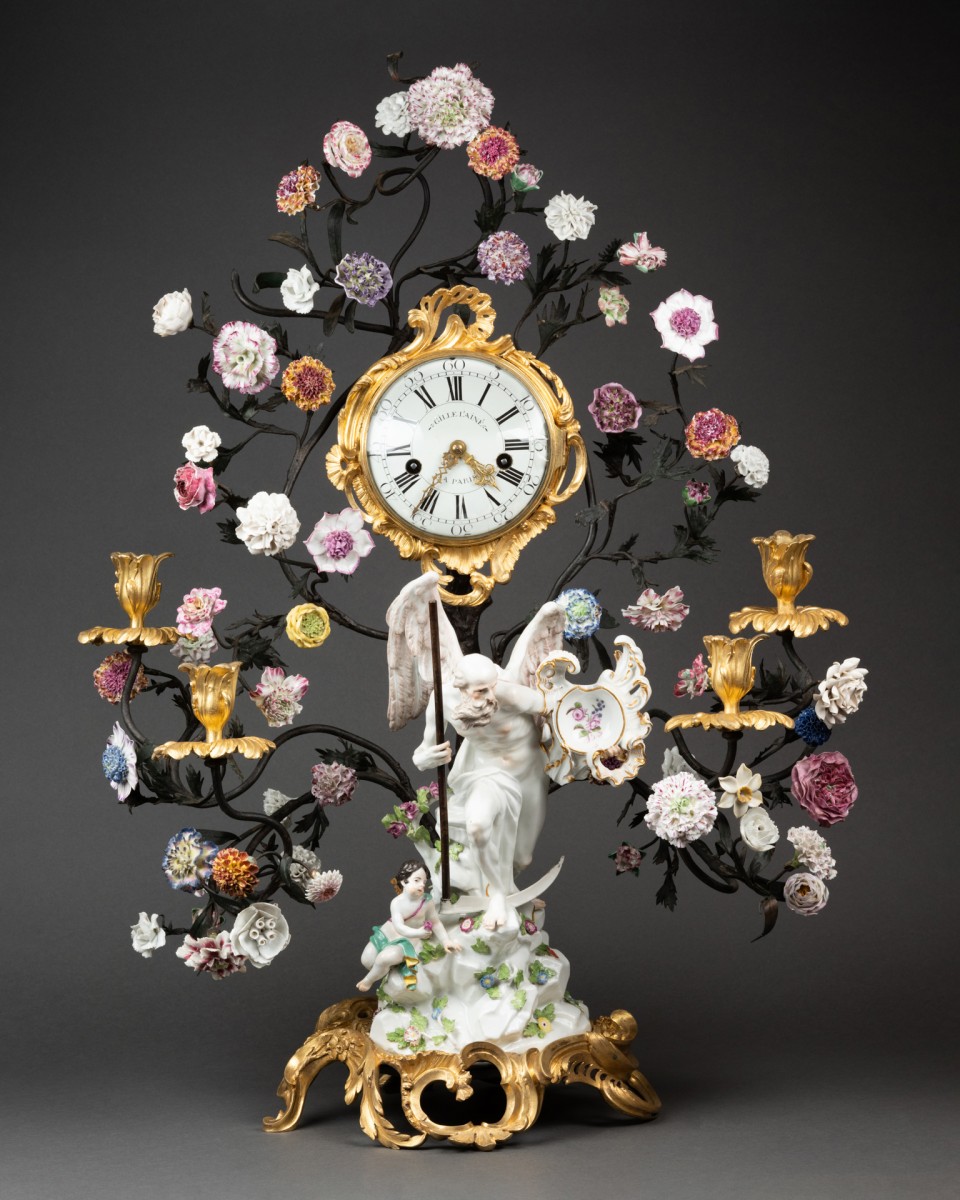

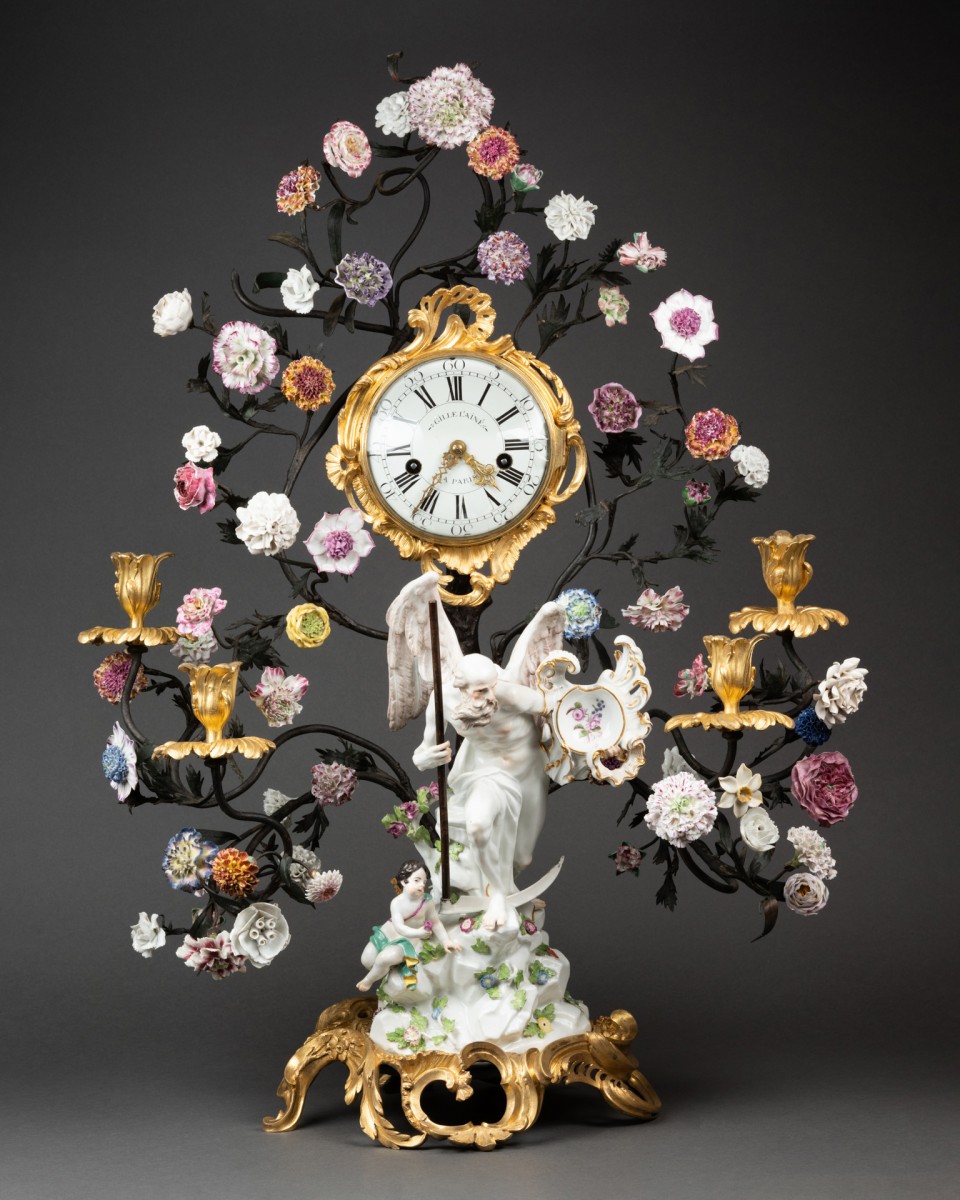
A Time Clock-Candelabra, Paris, circa 1760
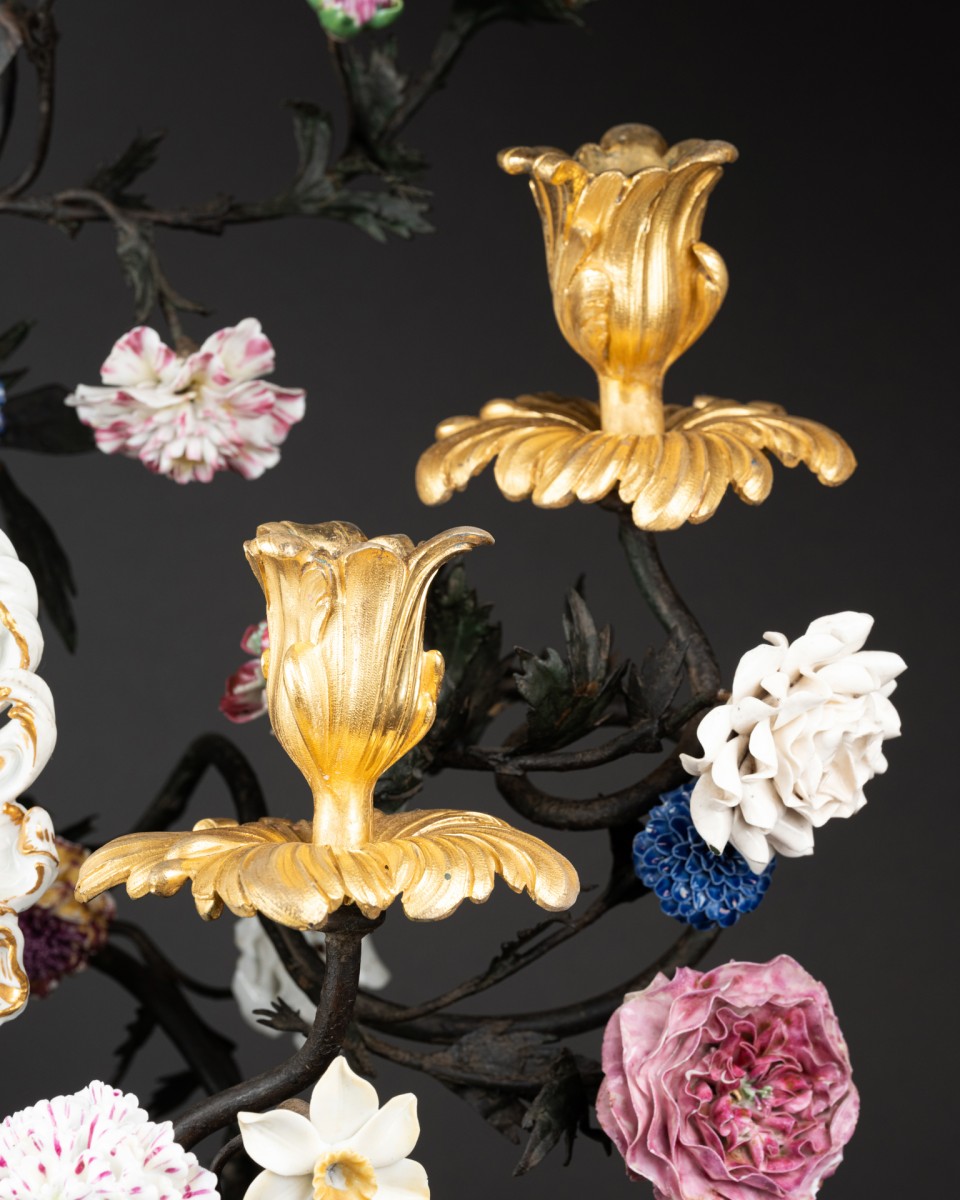
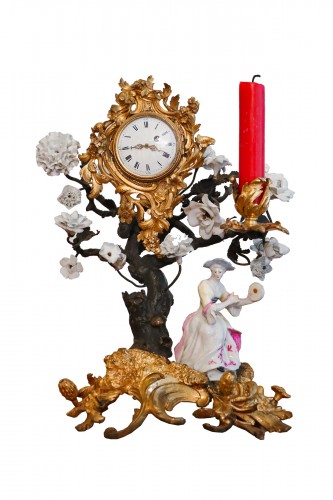
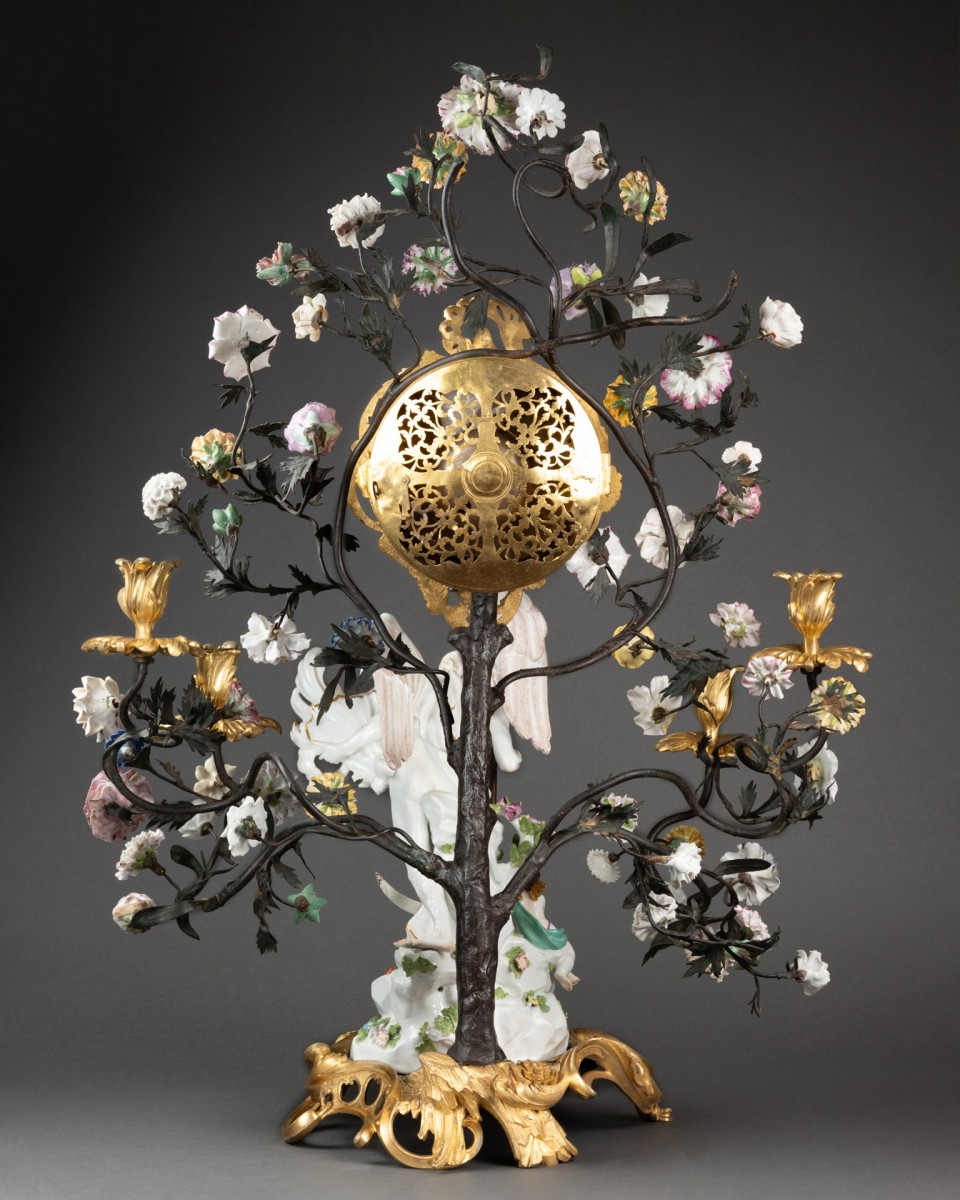
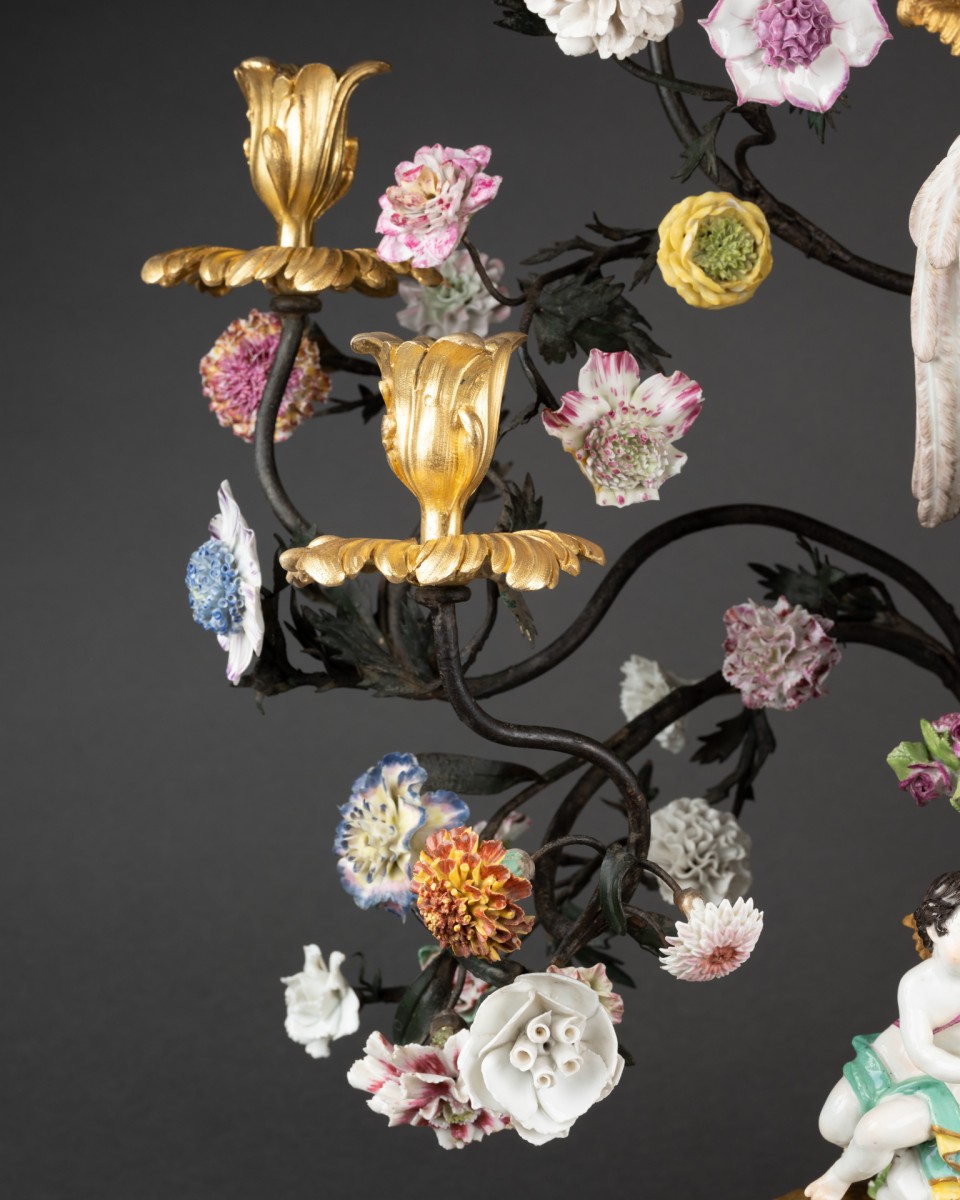
A rare and spectacular clock serving as a four-light candelabra.
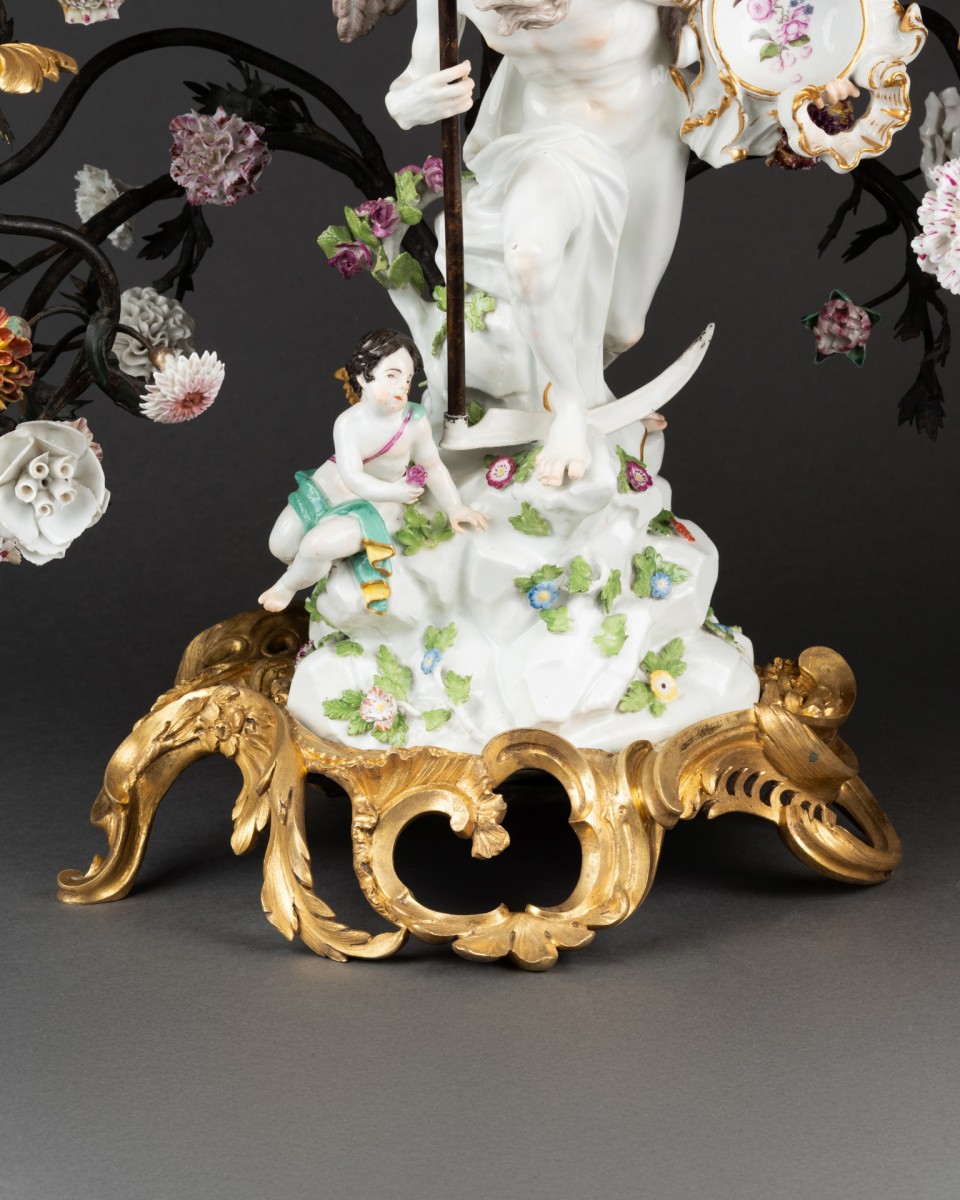
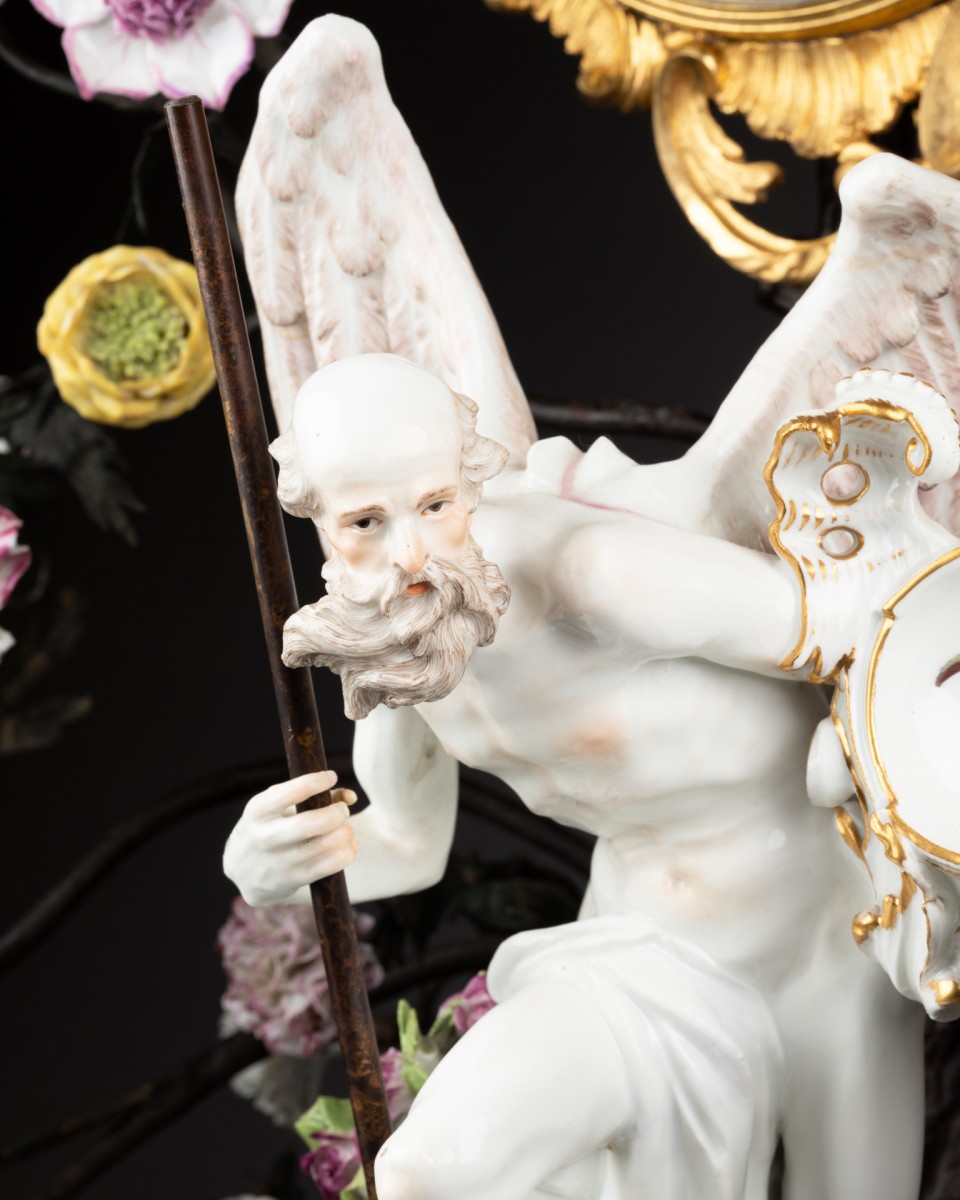
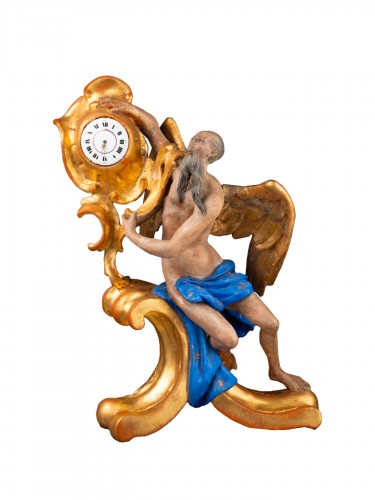
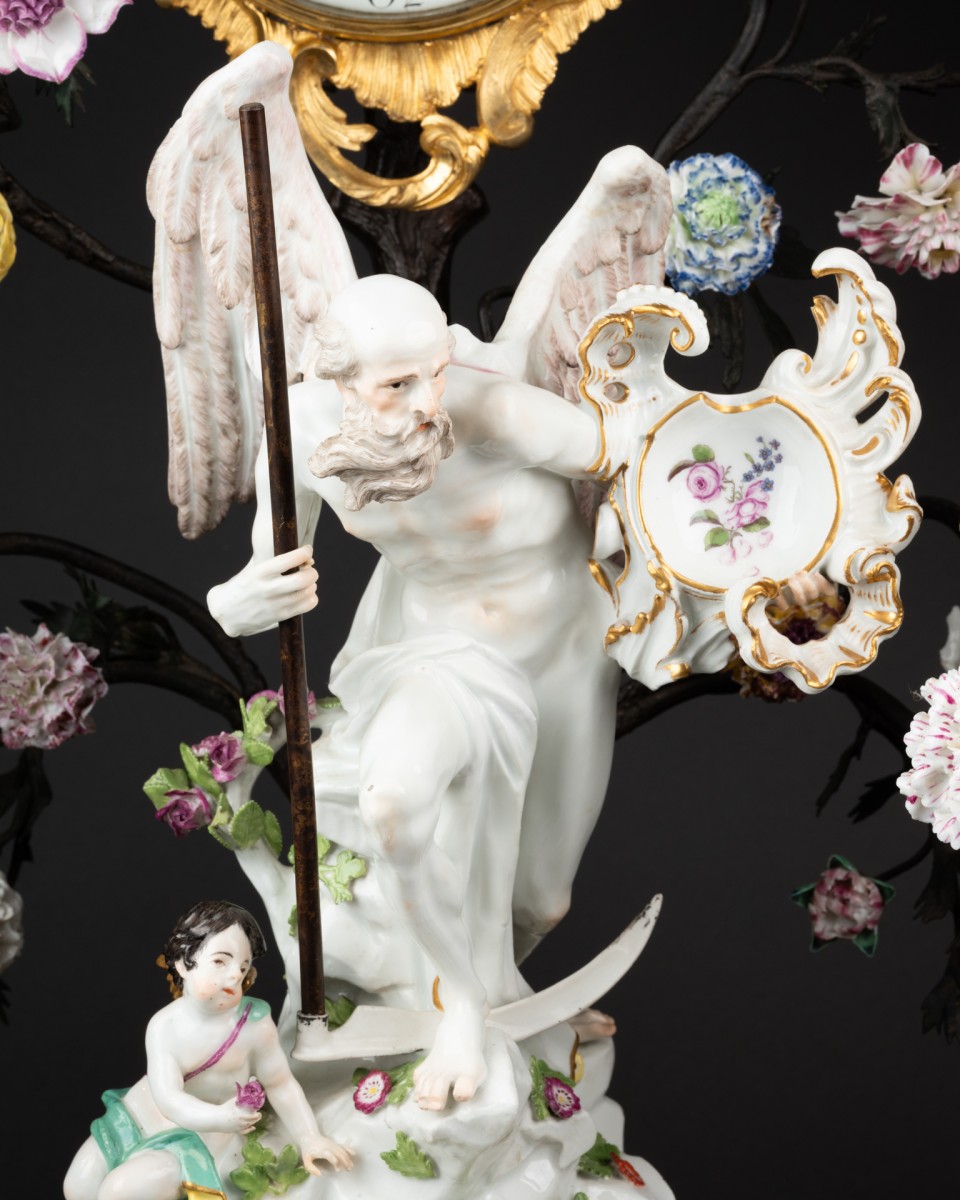
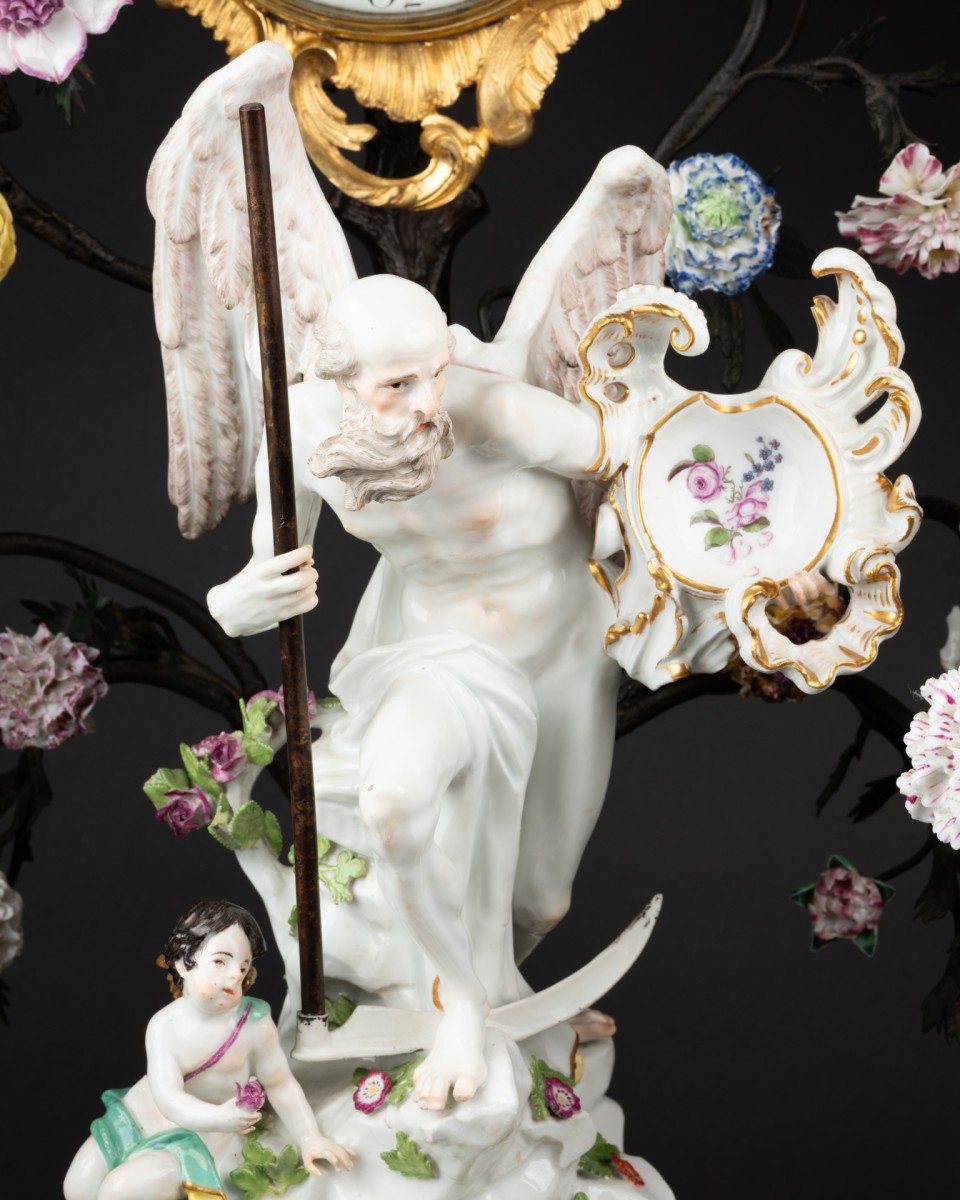
It consists of a rocaille base in chased, gilded, and openwork bronze, upon which rests a large porcelain figure of Chronos, symbolizing an allegory of Time in the guise of a winged old man wielding a scythe.
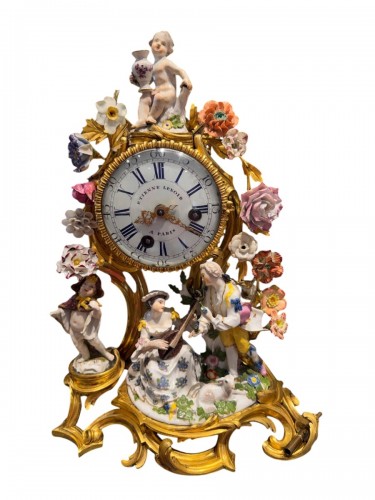
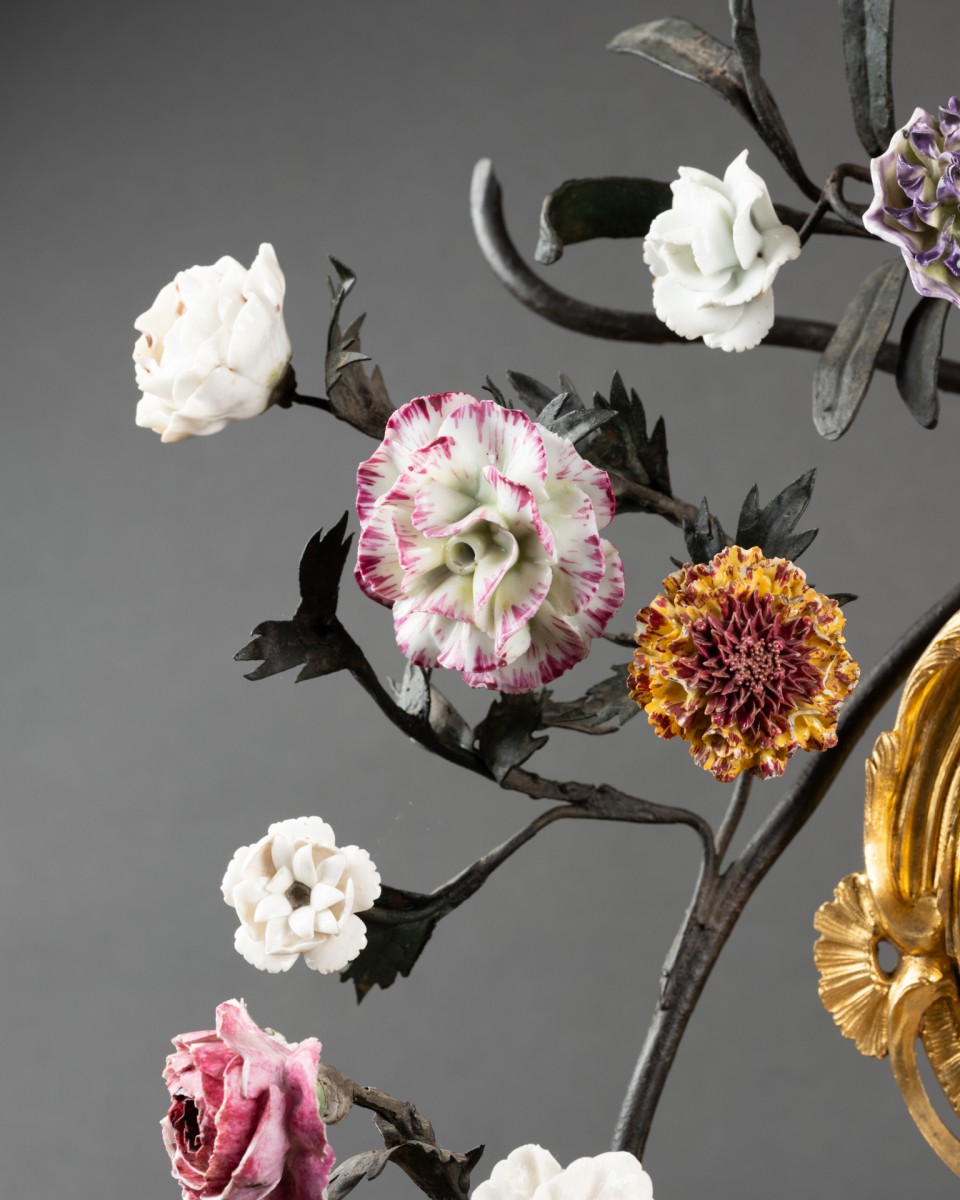
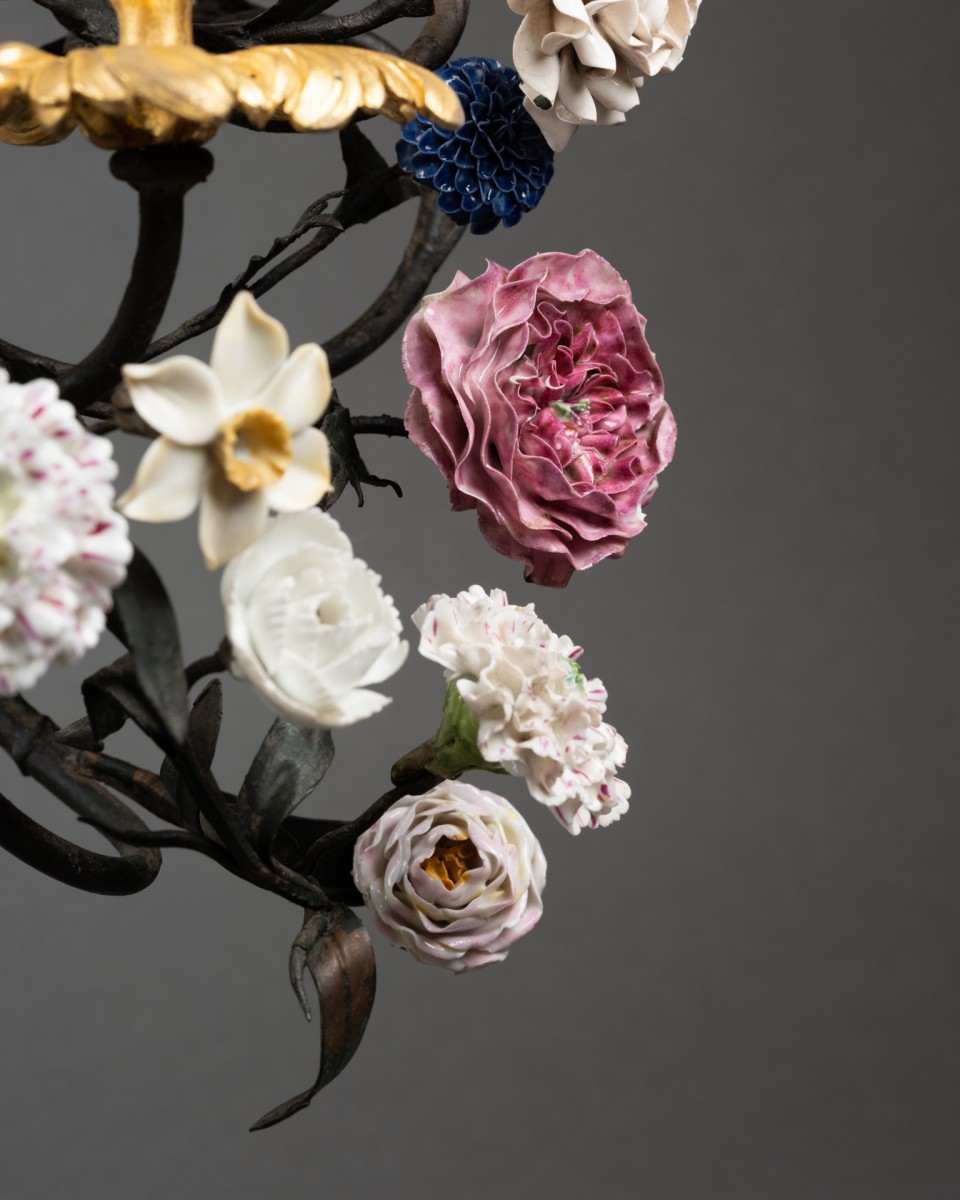
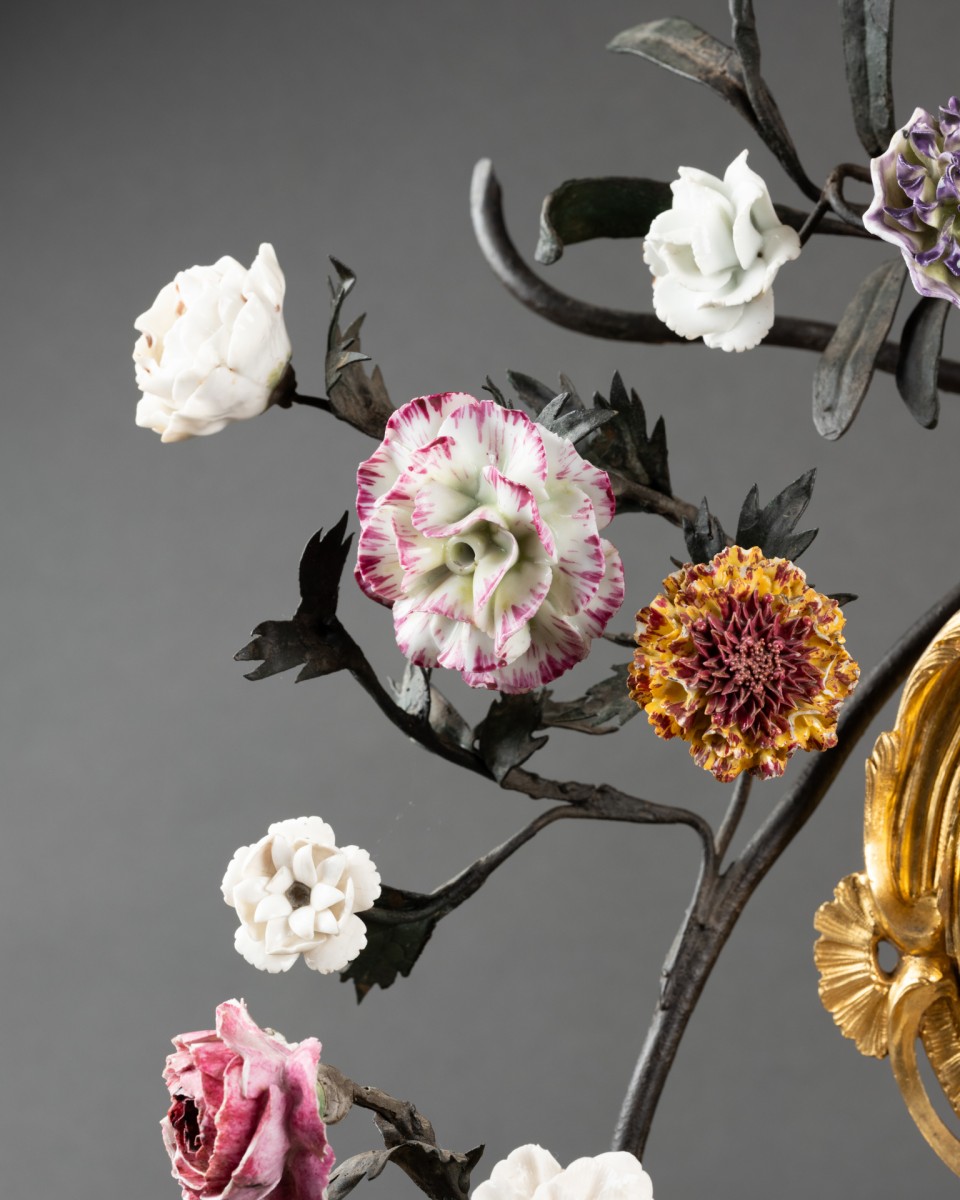
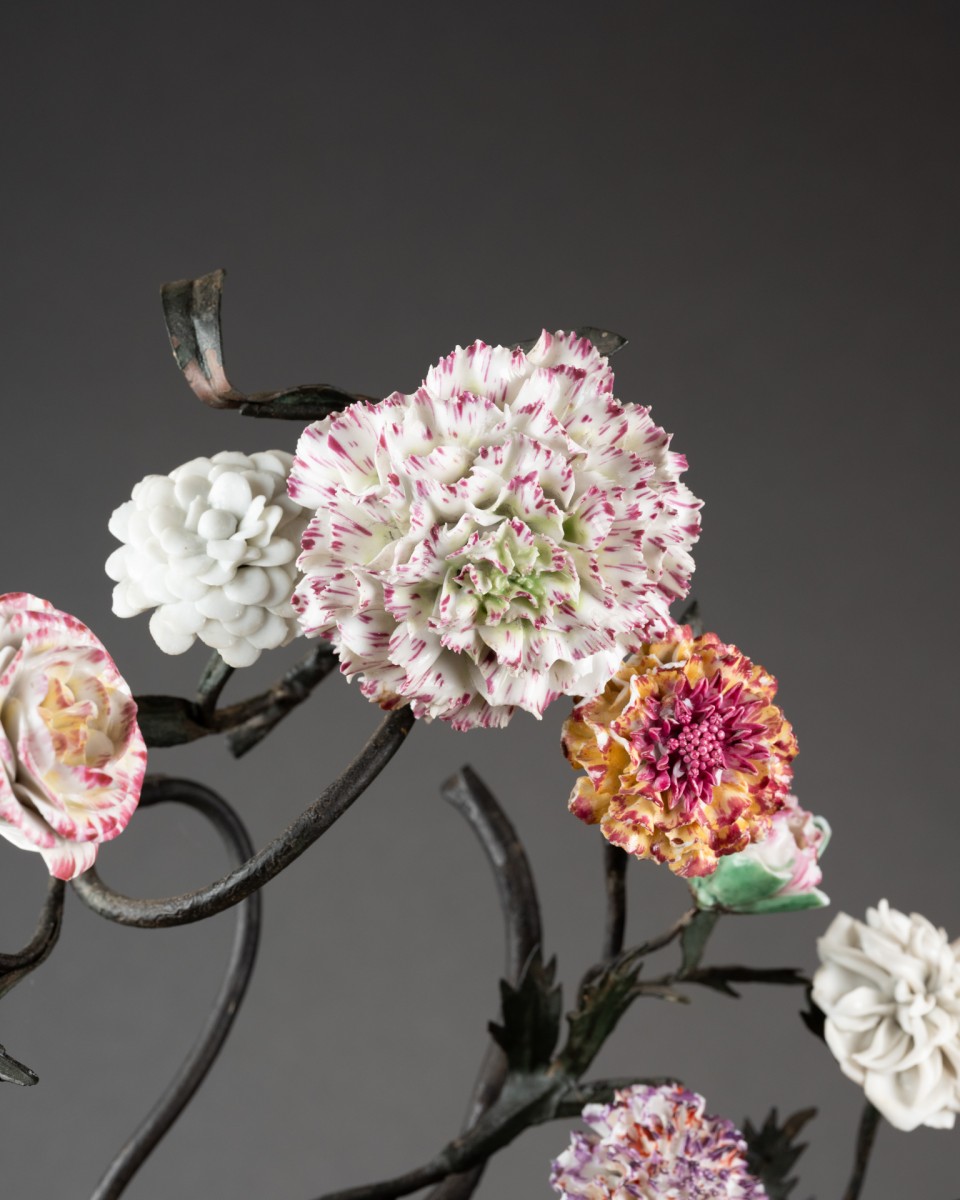
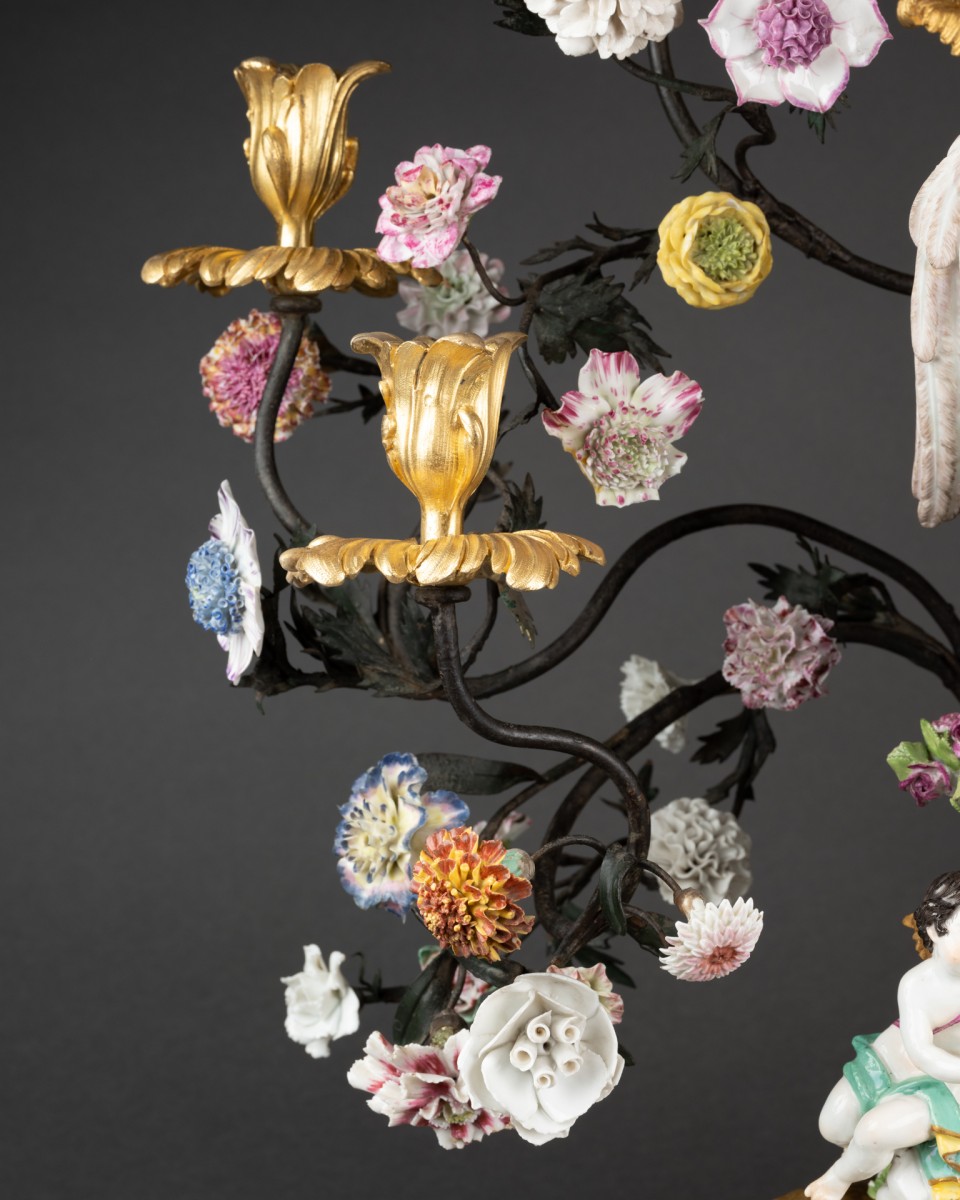
Behind the base unfolds a wrought iron and painted sheet metal structure depicting a naturalistic shrub with sinuous branches entirely adorned with polychrome porcelain flowers, including roses, carnations, chrysanthemums, daisies, ranunculus, and anemones.
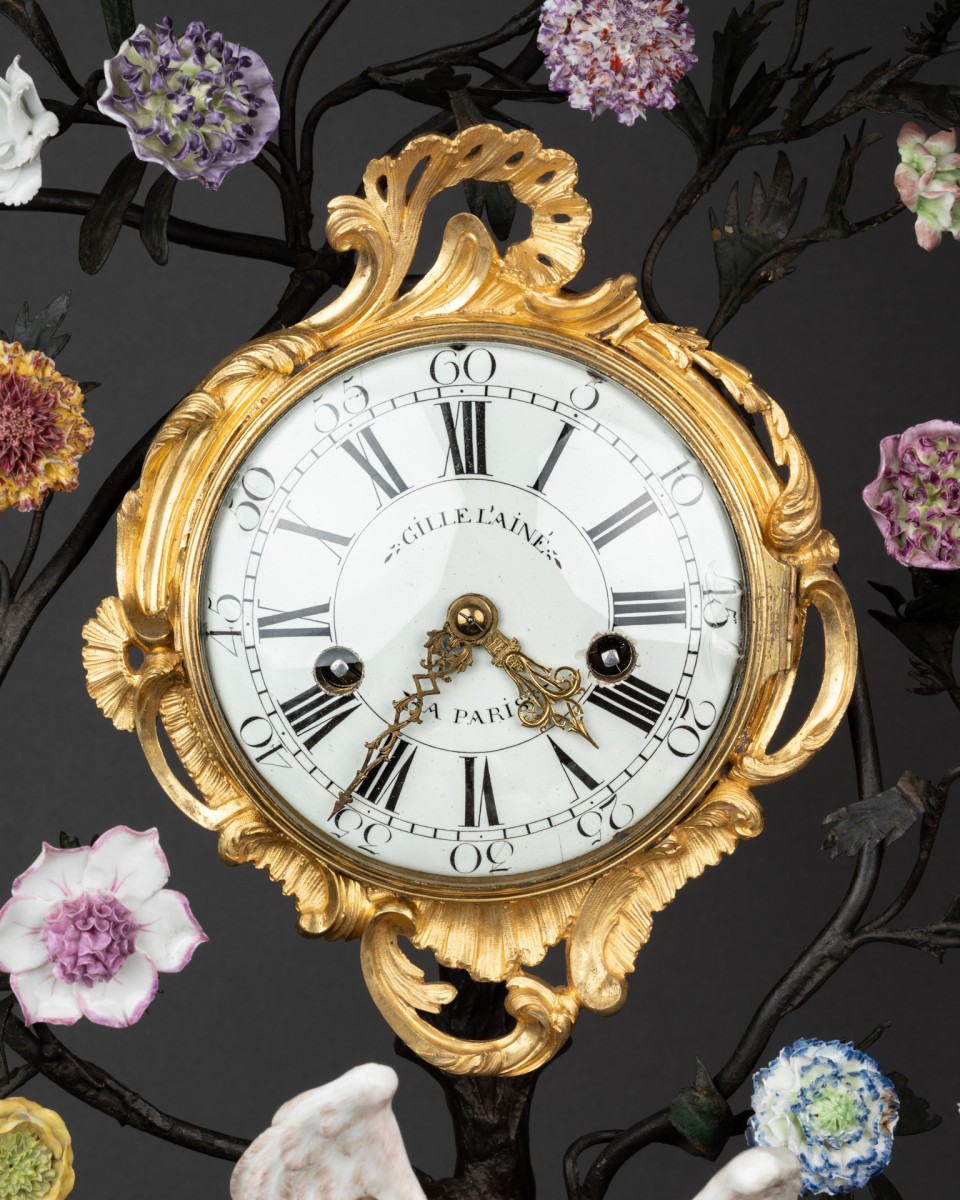
At the center of the shrub, fixed to the trunk, is the bronze case decorated with acanthus clasps, which houses the clock movement.
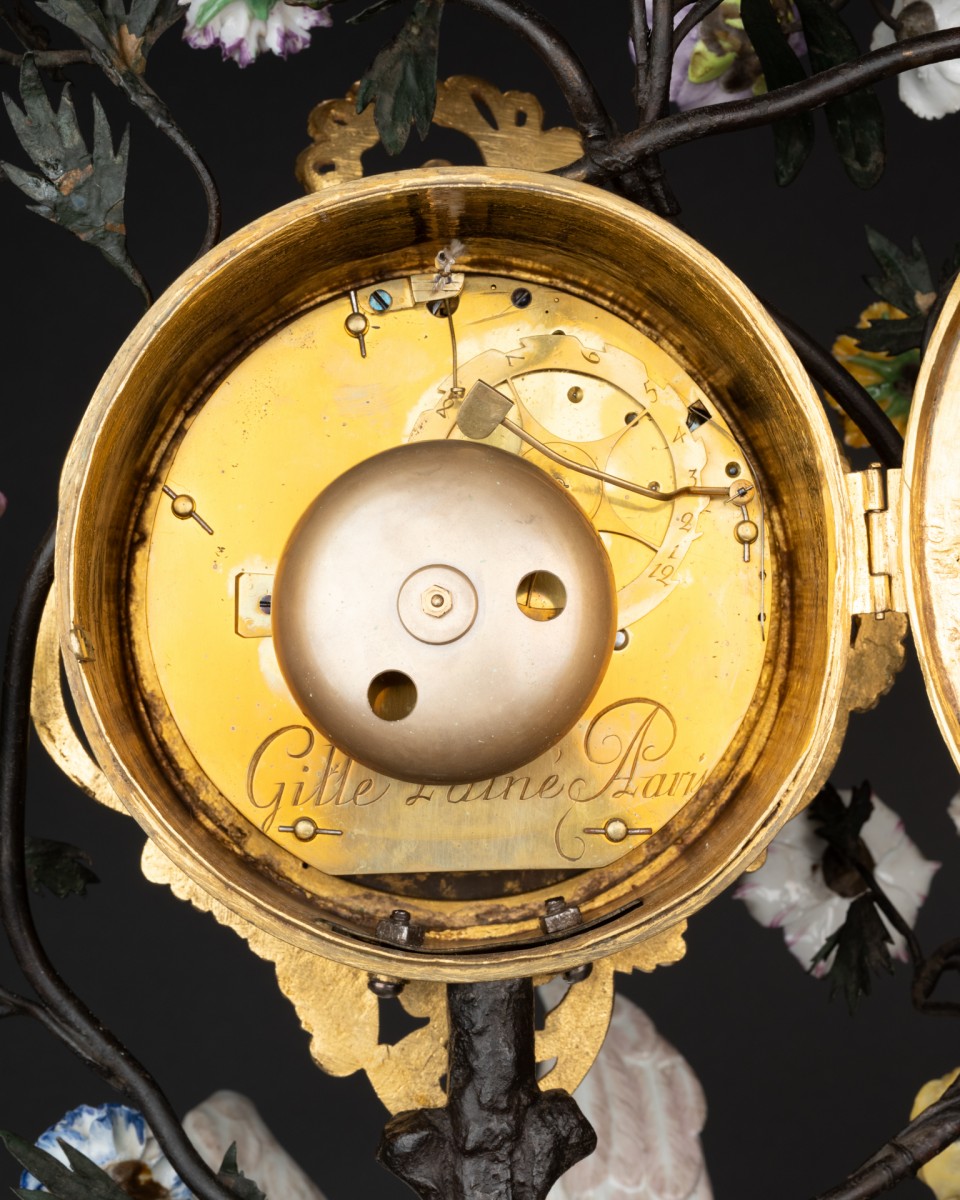
The movement is signed on the backplate and on the dial "Gilles l'Ainé à Paris" (Gilles the Elder in Paris). The white enamel dial features Roman numerals for the hours and Arabic numerals for the minutes.
It strikes the hours and half-hours.
-The large Meissen porcelain figure of Chronos (37 cm) is attributed to the sculptor-modeler Johann Joachim Kaëndler (1706-1771); it is mentioned in the records for the year 1747.
This figure was probably originally designed as a watch stand to house the movement in the medallion presented by Chronos.
A similar example was in the René Fribourg collection (sold at Sotheby’s New York, October 1963).
Other examples are held in the collections of Burghley House, the Seattle Museum, and the Landesmuseum Württemberg in Stuttgart.
-The soft-paste porcelain flowers are attributed to the flower department of the Vincennes porcelain factory.
The movement and dial of our clock bear the signature of the clockmaker Pierre II Gille (1723-1784).
After being admitted to the guild on November 18, 1746, as the son of a master craftsman, Pierre II Gille established his workshop on Rue Saint-Martin, Rue Saint-Denis, and Rue aux Ours. At the beginning of his career, he worked with his father, then ran his own workshop in the mid-18th century, immediately achieving immense success with major collectors. Upon his father's death in 1765, Pierre II Gille took over his signature, thus affixing the mark "Gille l'Aîné à Paris" to his pieces.
Finally, it is worth noting that in the 18th century, clocks bearing the signature "Gille L'aîné" were recorded in the possession of the Marquis de Brunoy, Prince Charles of Lorraine, the powerful tax farmer Perrinet de Jars, the Duke of Gramont, the Prince of Condé, and Augustus II of Saxony.
Our clock, the result of the collaboration between a bronze caster, a clockmaker, and two porcelain manufacturers, was commissioned by a Parisian merchant during the reign of Louis XV, around 1750-1760.
This type of creation, with its pronounced "Pompadour" style, was the preserve of the most prominent mercers, such as Lazare Duvaux (1703-1758), Simon-Philippe Poirier (c. 1720-1785), and Thomas-Joachim Hebert (1687-1773).
In excellent condition, with original gilding, original movement, silk thread suspension, minor losses and chips to the floral motifs, and a few later additions.
Dimensions:
Height: 81 cm; Width: 61 cm; Depth: 27 cm
Provenance:
Formerly in the collection of perfumer Jacques Guerlain (1874-1963)
“The Exceptional Sale,” November 27, 2018, Christie’s Paris, lot 504
Our opinion: Our clock is an allegory of the passage of time and served as a memento mori, reminding us of the fragility of existence and the inevitable flight of time.
With its monumental dimensions (81 cm), the presence of four integrated candle arms, the extraordinary profusion of more than fifty soft-paste porcelain flowers from Vincennes, some reaching 7.5 cm in diameter, as well as the addition of a substantial Meissen porcelain group (37 cm), this clock represents a truly exceptional piece of prestige.
The technical complexity of the assembly and the exorbitant price of the necessary materials imply a considerable selling price, reserving this type of work for a very high-ranking commission, probably of a princely type.