Offered by Jan Muller
REQUEST INFORMATION

Adriaen van Stalbemt (Antwerp, 12 June 1580 – 21 September 1662) was a Flemish Baroque painter and printmaker, known for his landscapes with religious, mythological and allegorical scenes. He was also a gifted figure painter, who was regularly asked to paint the figures in compositions by fellow painters.
After the fall of Antwerp in 1585 his family moved to Middelburg for religious reasons, where he probably received his training. In 1609, at the start of the Twelve Years’ Truce, he returned to Antwerp and became a master of the Guild of Saint Luke. He married Barbara Verdelft, the daughter of the art dealer Jan Verdelft. After that his career took off, and the family was able to buy a house in the city centre, on the Meir. In the guild year 1618-1619 he was dean of the guild and managed to restore certain privileges of the chamber of rhetoric De Violieren.
He worked on commission for the art dealer Peter Goetkint II, for whom he made cabinet paintings: small paintings on copper that were built into cabinets. He also made paintings for the Antwerp art dealer Chrysostomos van Immerseel. In 1633 he worked in London for about ten months. According to Cornelis de Bie, King Charles I had invited him. During his stay he painted two landscapes of Greenwich with King Charles I and Queen Henrietta Maria (still in the Royal Collection). He must have enjoyed a considerable reputation, for otherwise Charles I would hardly have summoned him there.
His style has been described as eclectic and shows influences from, among others, Jan Brueghel the Elder and the Younger, Hendrick van Balen, Paul Bril and Adam Elsheimer. His landscapes were also influenced by Gillis van Coninxloo. Together with Abraham Govaerts he is considered one of the best followers and imitators of Jan Brueghel the Elder. Several characteristics help distinguish his work from Brueghel’s: to render the foliage and the colour of the houses he used light yellow, where Brueghel used pink. Only a small number of his works are dated, which makes it difficult to establish a chronology. He collaborated with, among others, Jan Brueghel the Younger and Frans Francken II, and painted the figures in church interiors by Pieter Neefs. He also made etchings: a series of landscape prints shows, among other things, a coastal landscape with ships, a watermill, a windmill, ruins and a castle on a mountain.
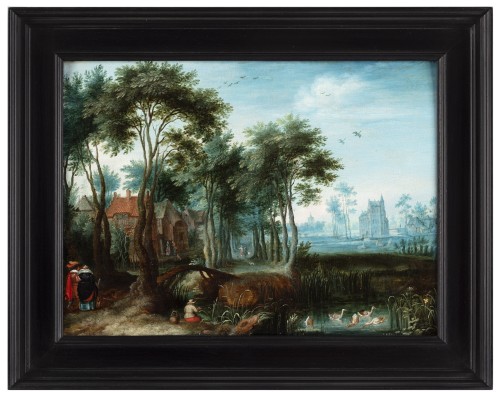
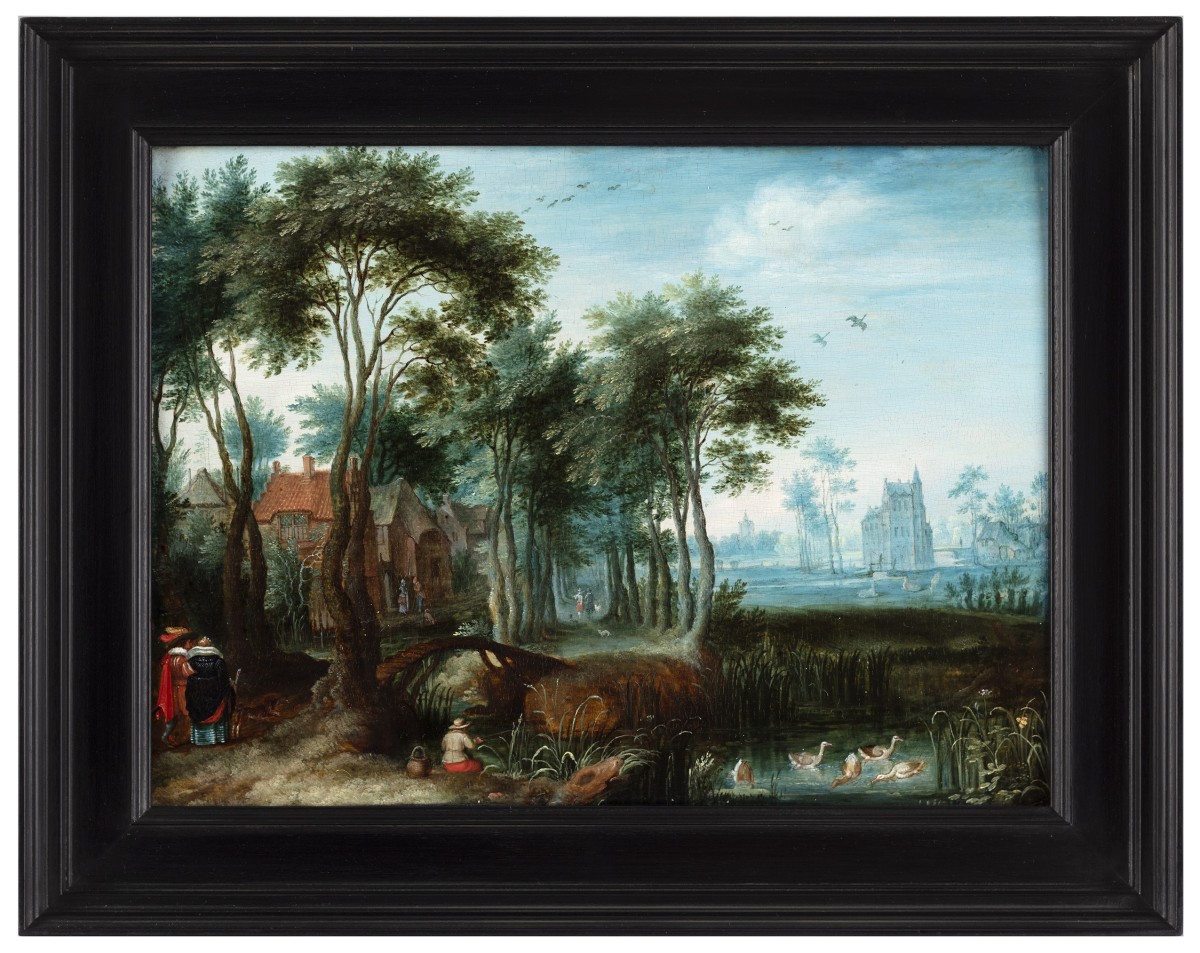
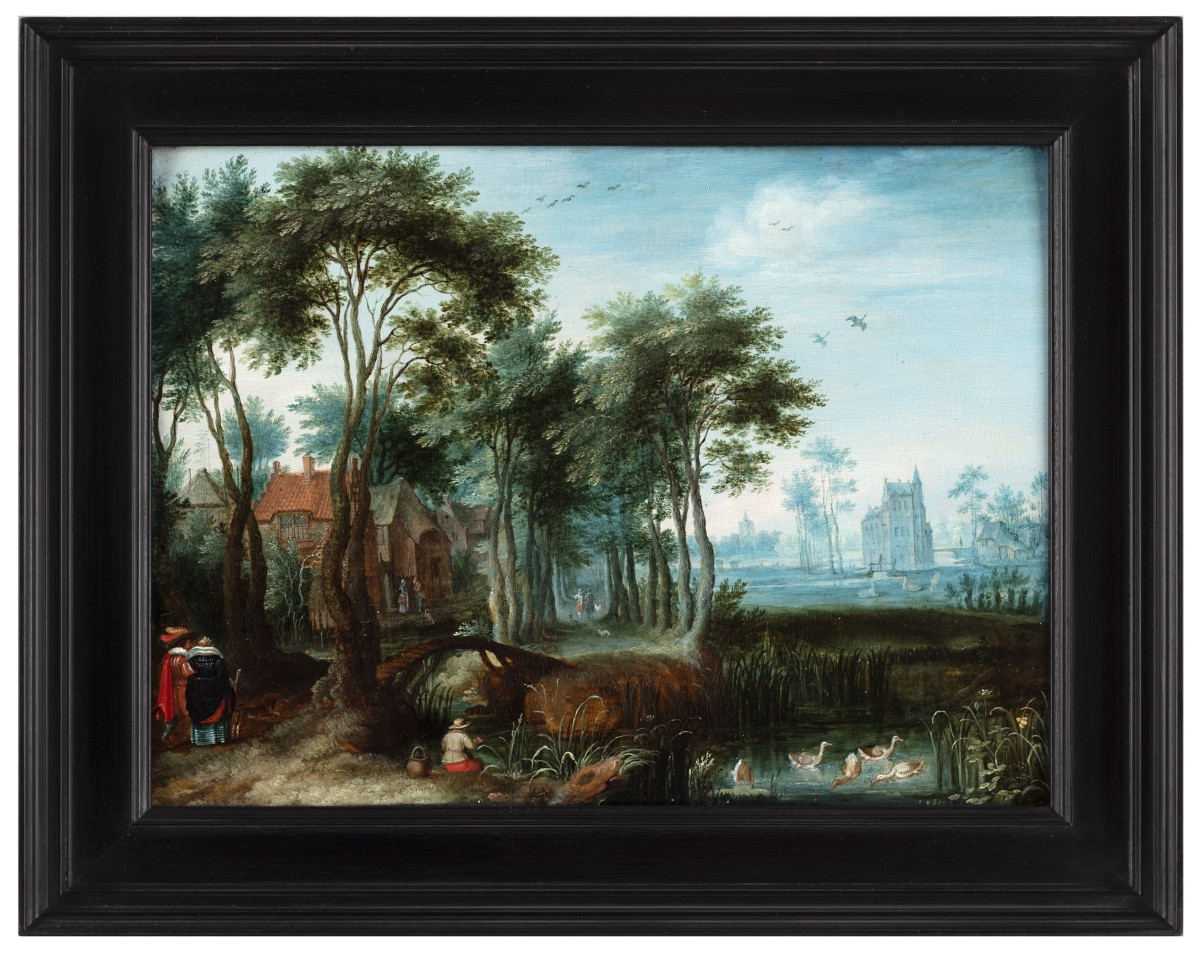
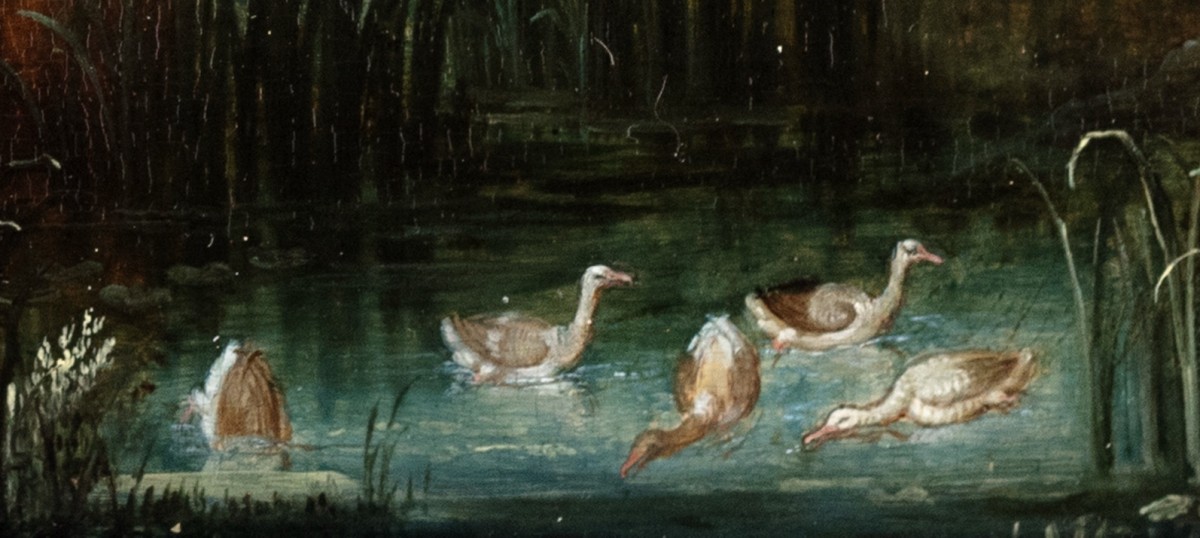
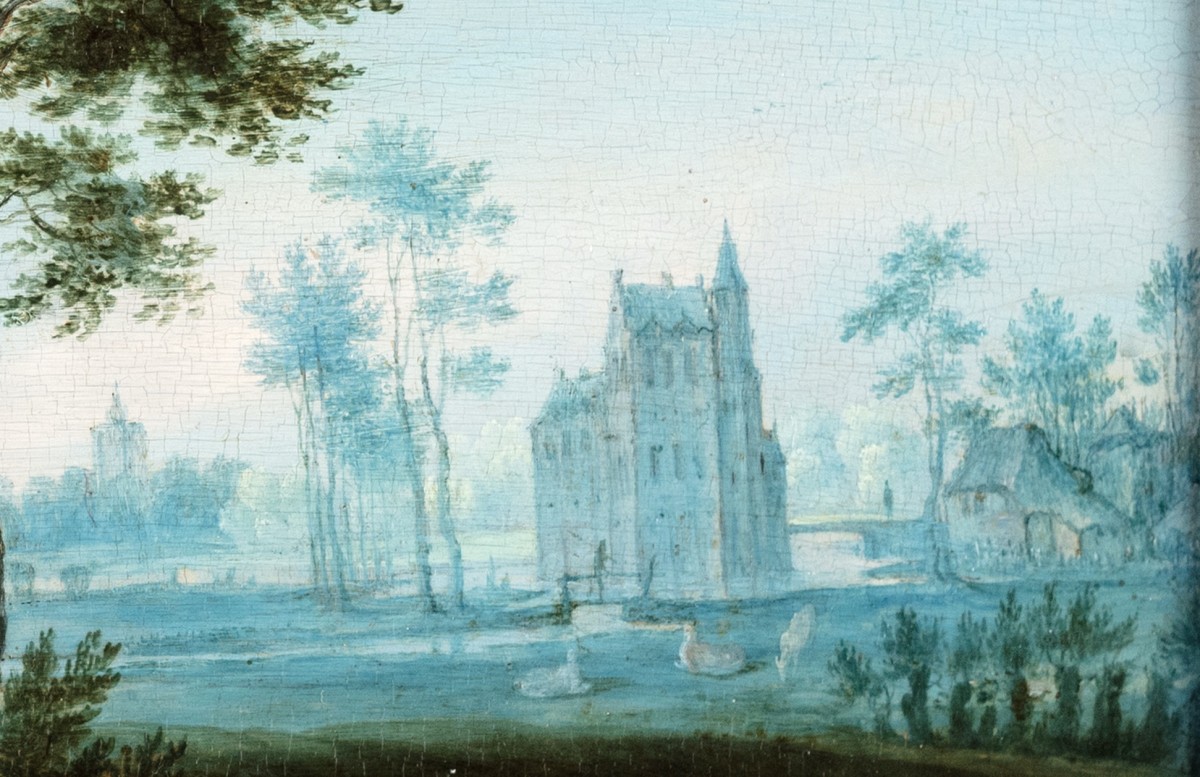
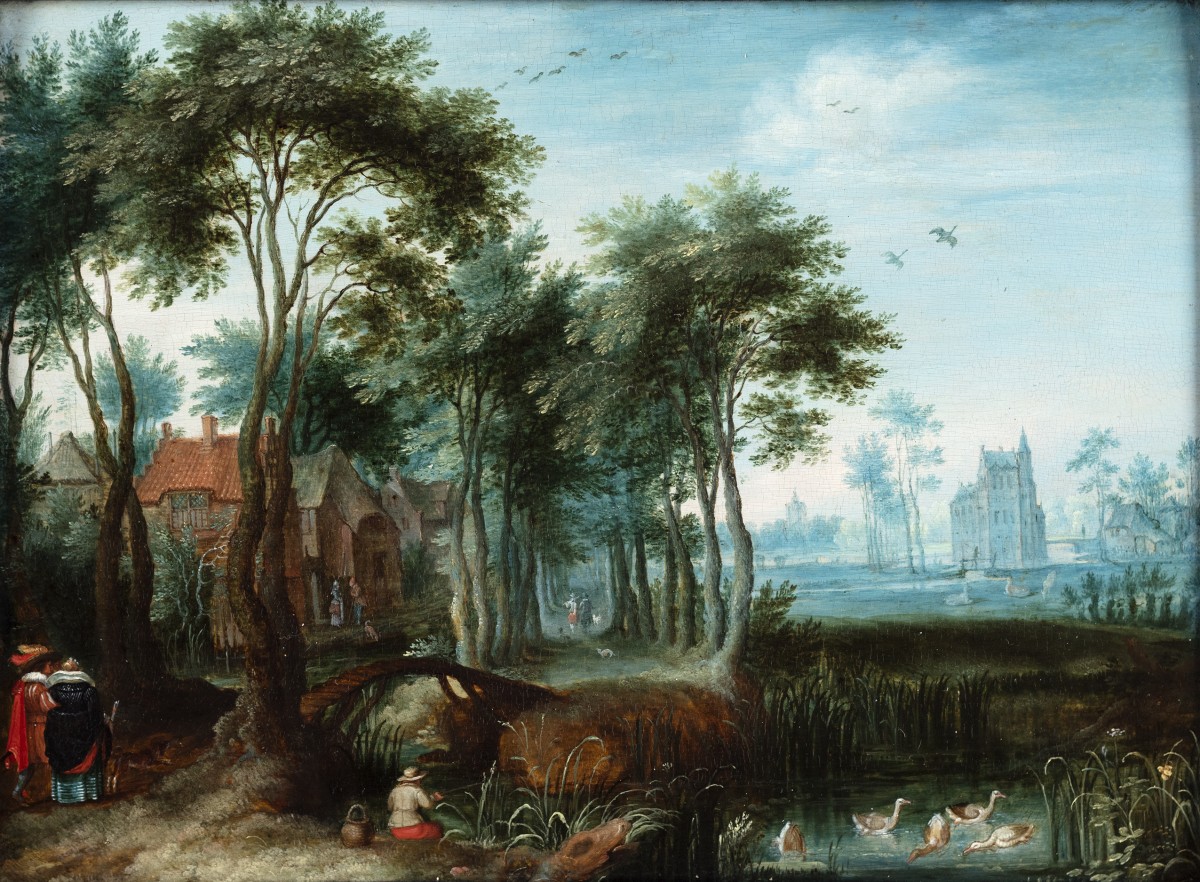
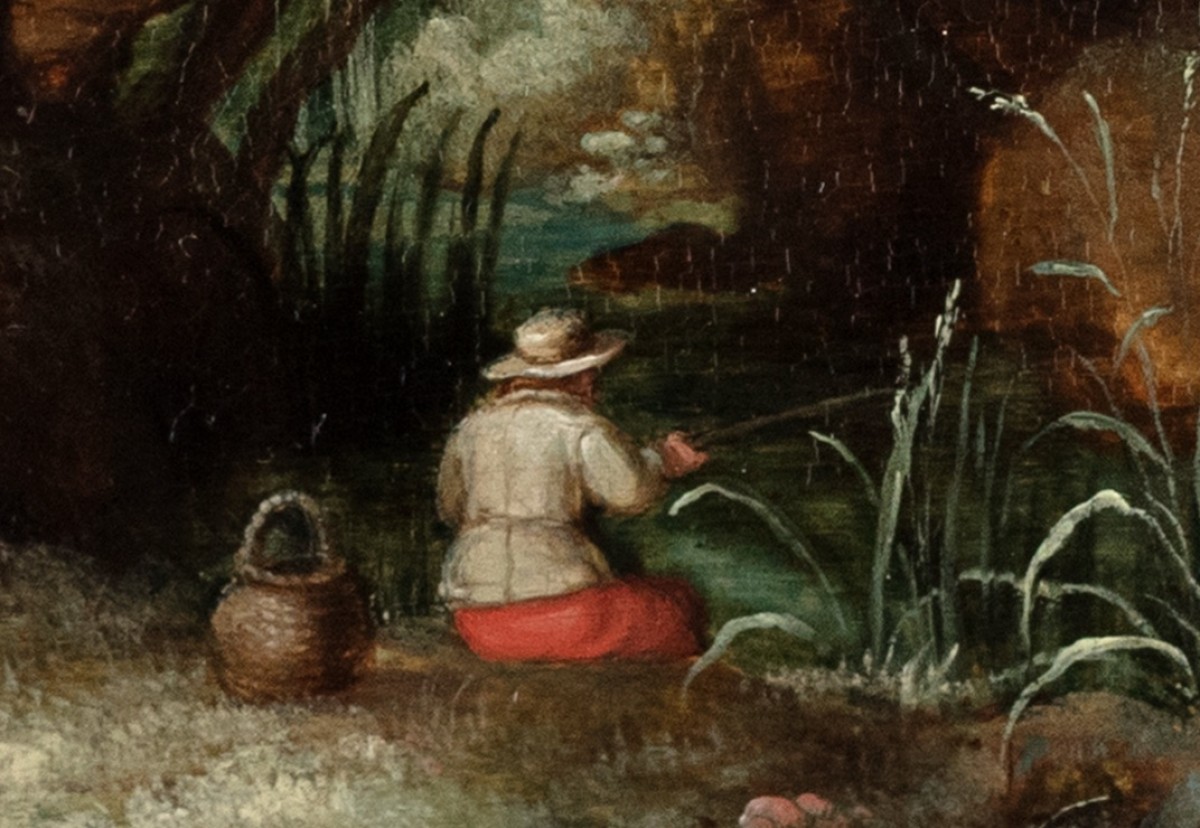
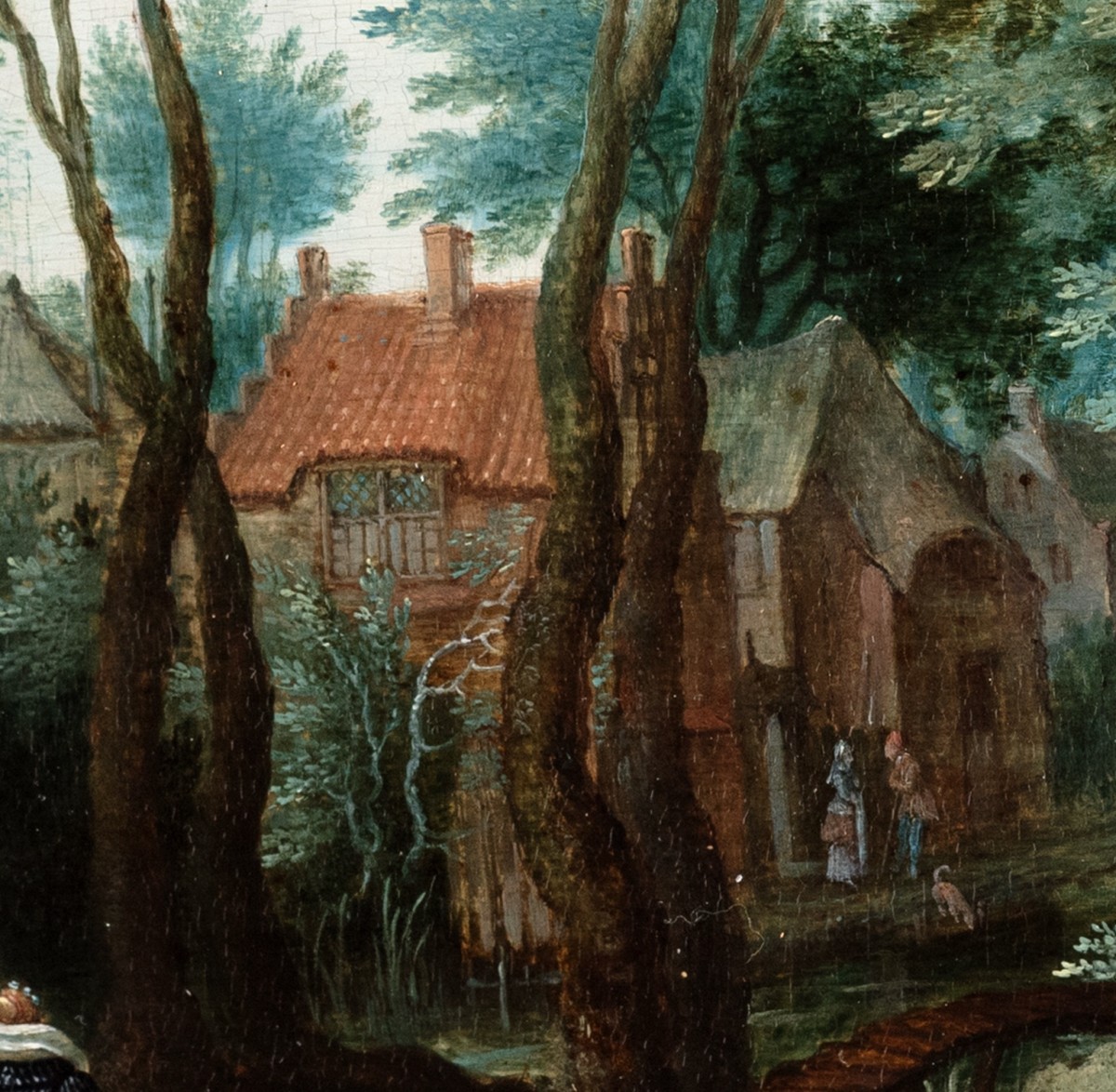
We see a road lined with trees on both sides. On the left houses are visible. In the foreground two figures stand with their backs to the viewer, and a fisherman sits. In the right foreground lies a small river with ducklings swimming in it, which runs under a bridge. Further to the right we see a castle. Birds fly in the sky, and at the back the landscape fades into a blue distance.
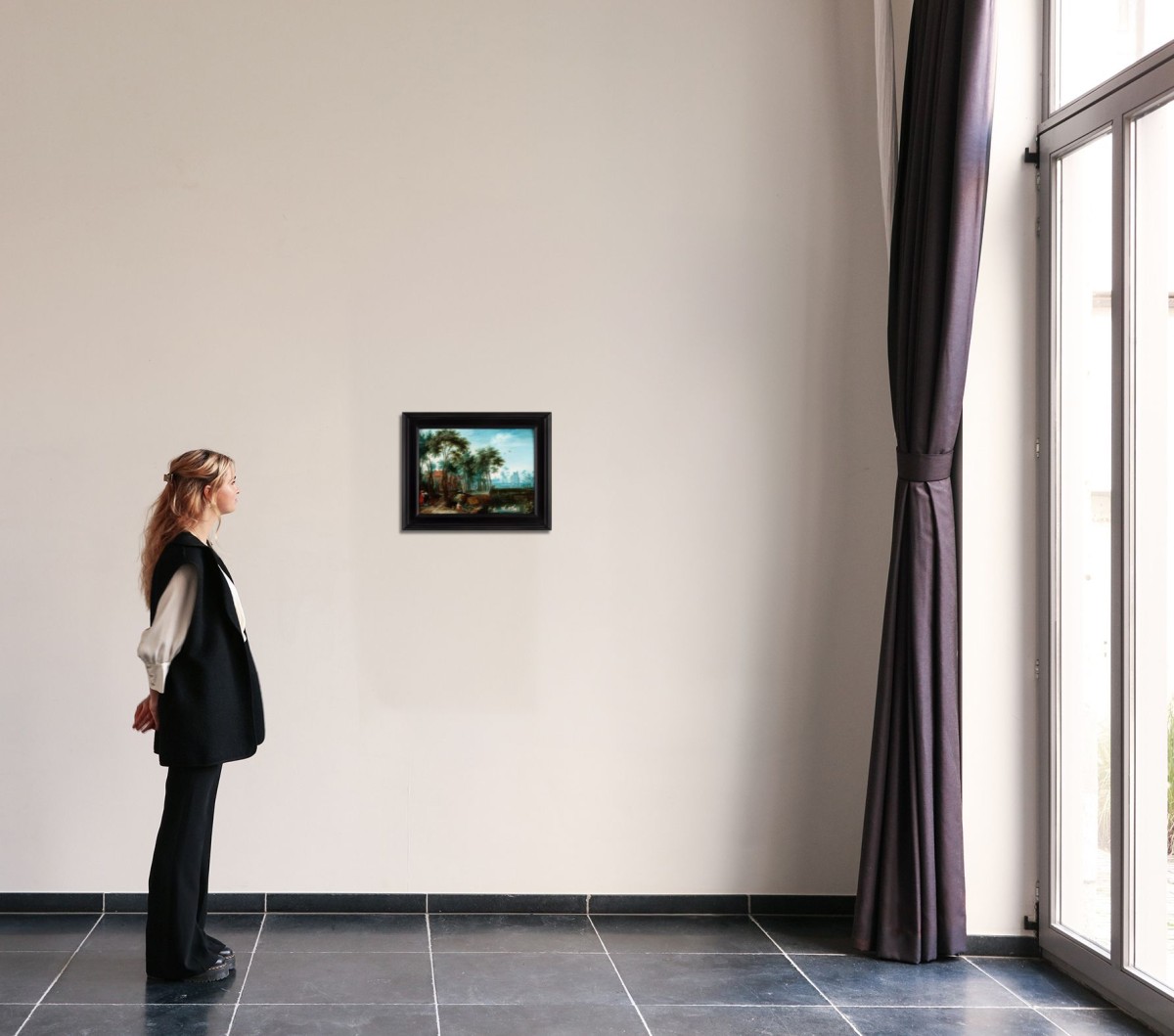
In the seventeenth century landscape painting grew strongly in the Netherlands, with many painters specialising in it and extremely subtle realist techniques for rendering light and weather. Dutch landscapes were mostly small, made for smaller houses. This work, too, is of small format. Stalbemt’s landscapes, as we know them from the familiar types in the manner of Jan Brueghel, are usually less dramatic and more pastoral.
As an independent subject, landscape appeared as early as the early sixteenth century, among others with Joachim Patinir’s panoramic “world landscape”. In the seventeenth century it became a genre in its own right, often with allegorical and poetic narratives.
Oil on panel
Dimensions: 27 x 36,5 cm, 36 x 46 cm (framed)
We’d like to thank dr. Joost Vander Auwera for his advice.
Delevery information :
After reception of payment we can box and ship our items all over the world. Estimates of this service can be provided.