Offered by Jan Muller
REQUEST INFORMATION

Adriaen van Utrecht (Antwerp, 12 January 1599 – 1652) was a Flemish Baroque painter. He is best known for his sumptuous banquet still lifes, game and fruit still lifes, market and kitchen scenes and depictions of live poultry. His paintings, especially the hunting and game pieces, show the influence of Frans Snyders. The two artists are regarded as the main founders of the pronkstilleven (ostentatious still life): still lifes that emphasise abundance through a variety of objects, fruit, flowers and dead game, often together with living people and animals.
In 1614 he became a pupil of Herman de Neyt. He then travelled to France, Germany and Italy. In 1625 he returned to Antwerp, where he became a free master of the Guild of Saint Luke. He became a successful artist with international commissions from the Emperor of Germany, King Philip IV of Spain and the Prince of Orange. His work is represented in numerous museum collections, including the Royal Museum of Fine Arts Antwerp, the Rijksmuseum, the Louvre, the Hermitage and the Getty Museum.
He regularly collaborated with leading Antwerp painters who had been pupils or assistants of Peter Paul Rubens, such as Jacob Jordaens, David Teniers II, Erasmus Quellinus II and Theodoor Rombouts. Van Utrecht did not favour bright colours the way Snyders did, but preferred warm earth tones, especially grey-green, and strong chiaroscuro effects. The latter was probably derived from his knowledge of Italian painting and in particular the work of the followers of Caravaggio.
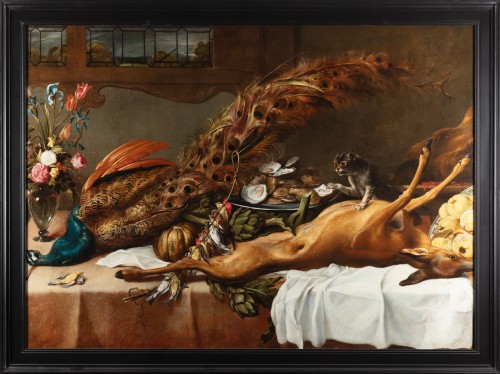
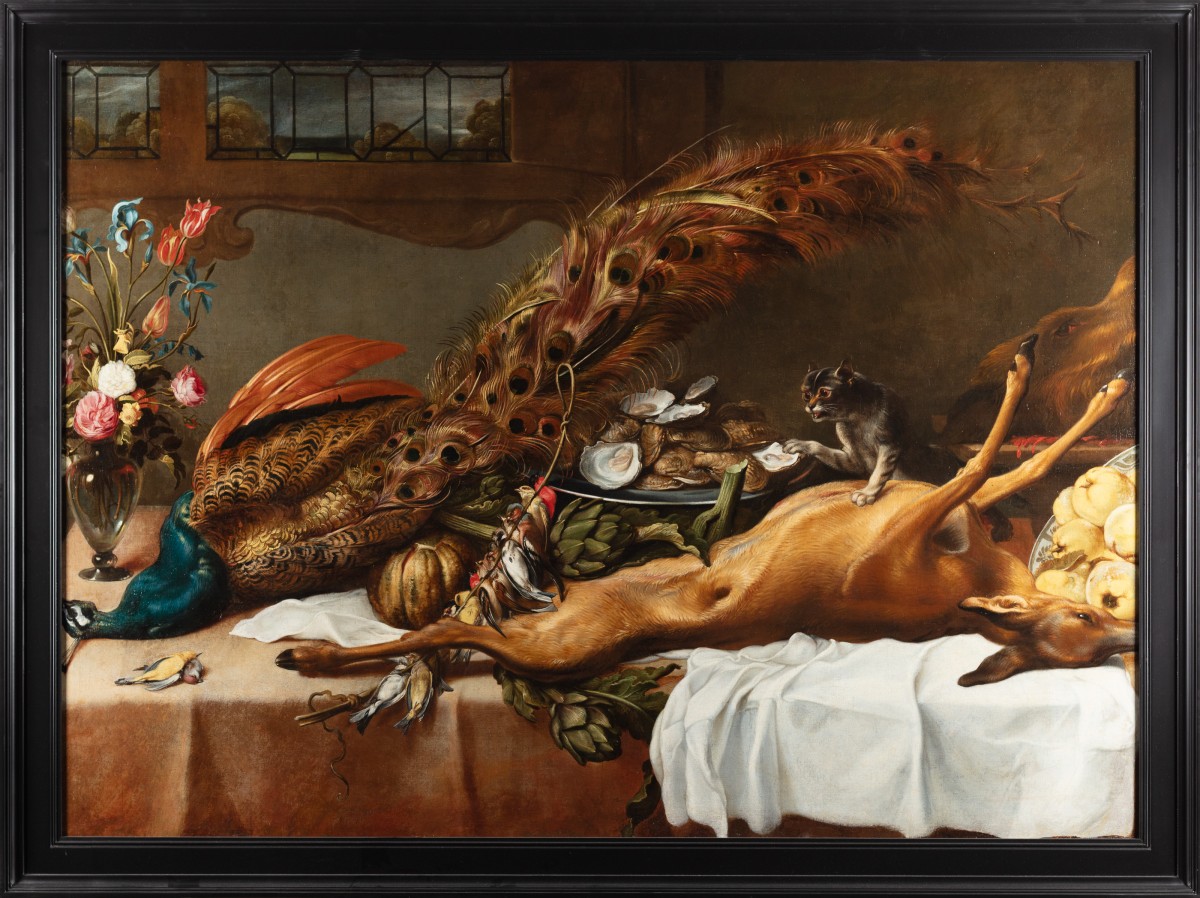
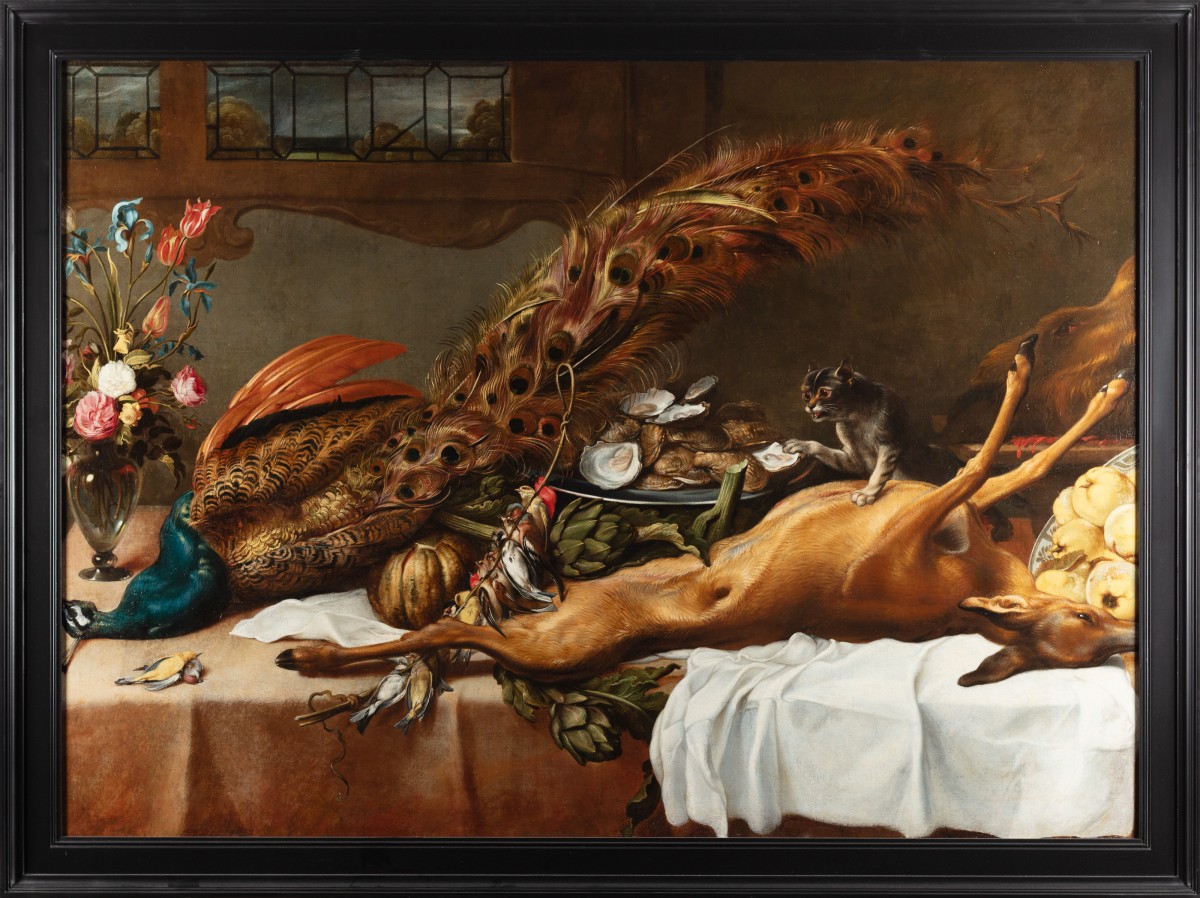
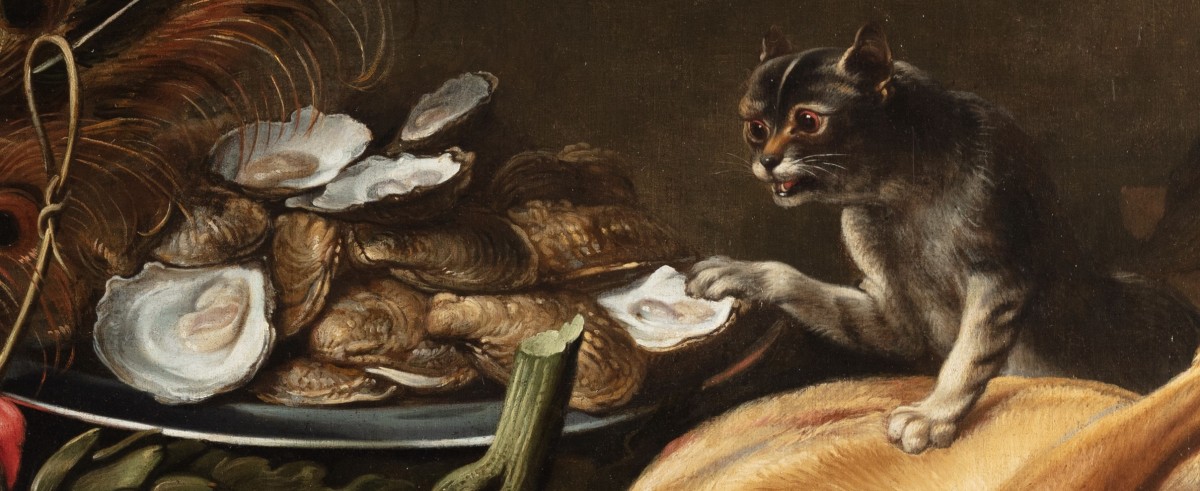
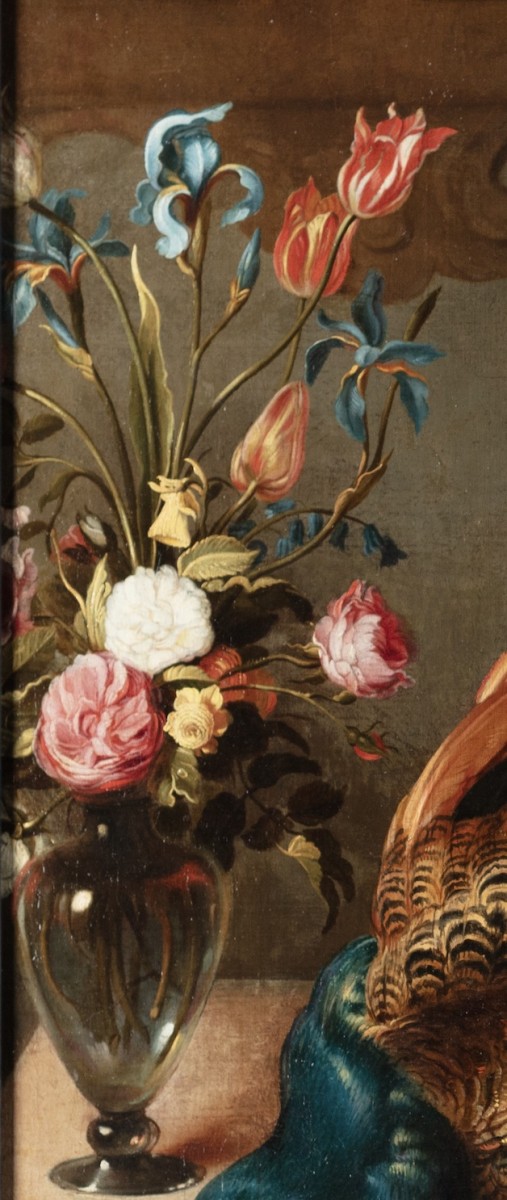
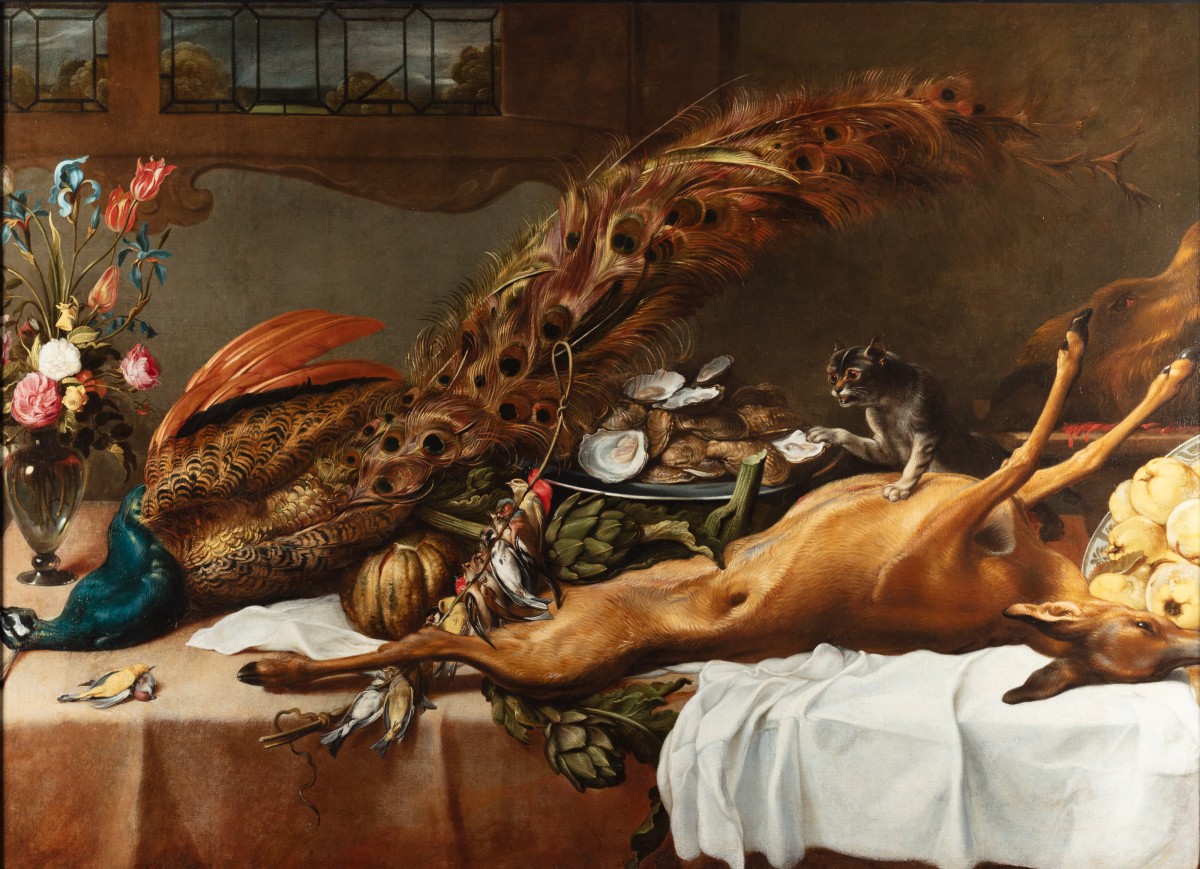
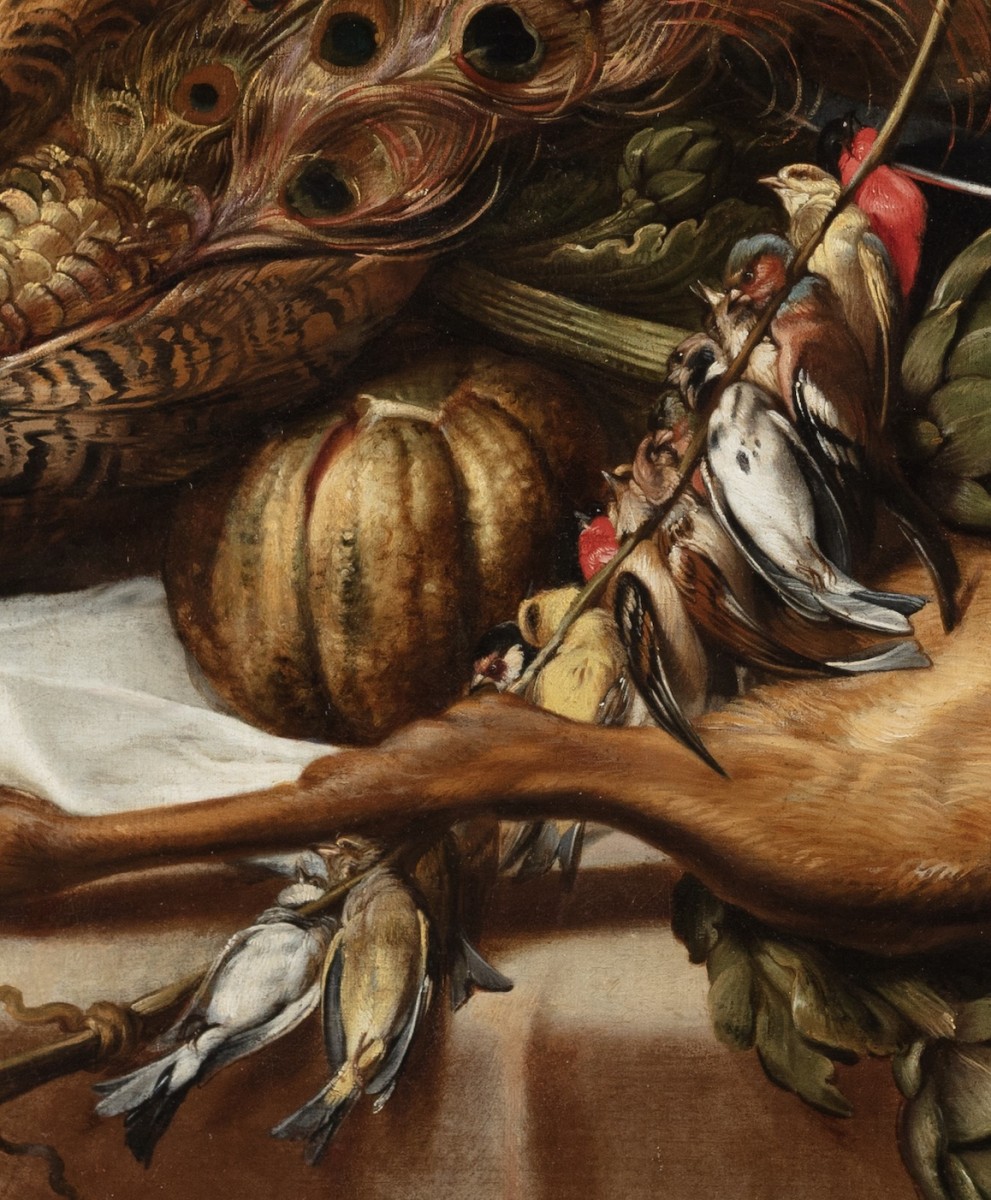
We see a table full of different things. A roe deer lies stretched out across the table, its legs in the air. A grey cat stands on top of the game, with a paw on the dish of oysters and its mouth half open, as if about to snatch an oyster at any moment. On the left lies a peacock with large, fanning feathers and a blue-green neck. The table also holds artichokes, a striped pumpkin or melon, oysters on a dish and, on the right, a bowl of quinces. Small songbirds hang from a string, and another yellow bird lies on the tabletop. On the left stands a vase with a colourful bouquet of, among other flowers, irises, tulips and roses. A white tablecloth covers part of the table. The background is not entirely neutral: at the top we see a leaded window with a landscape beyond. The roe deer lies diagonally across the table and so forms a strong diagonal. The window in the background is a device that Van Utrecht used to add movement and depth.
Kitchen still lifes show food such as fruit and game, often together with cooking and table utensils, in scenes of domesticity, abundance or preparation. They are characterised by realistic textures, dramatic light, often asymmetrical compositions with diagonals and an emphasis on earth tones with accents of colour, which gives an impression of immediacy or even chaotic realism.
Large market and kitchen still lifes, often with figures, were popularised in Antwerp in the mid-sixteenth century by Pieter Aertsen and his pupil Joachim Beuckelaer. Aertsen returned to his native Amsterdam around 1557 and inspired Dutch painters such as Joachim and Peter Wtewael to make similar works. Van Utrecht stood in that tradition, as it was further developed by Frans Snyders in the early seventeenth century. In the Southern Netherlands game pieces were especially at home: Snyders and his follower Jan Fyt turned fowl, hares and deer into studies in colour and texture, and into testaments of a comfortable life on sprawling estates. The popularity of still lifes reflects the growing urbanisation of Dutch and Flemish society, which placed emphasis on the home and personal possessions, trade, education and all aspects of daily life.
In this genre, objects can also carry a symbolic meaning. The deer may stand for prosperity, abundance and the riches of nature. Dead animals may recall the fleeting nature of earthly pleasures (vanitas): dead game in kitchens showed wealth, but also warned against gluttony. The peacock may stand for luxury, wealth and vanity, and, through its rare beauty, for exoticism and power. The cat is often associated with lust, cunning and domestic disorder. In Van Utrecht’s work, too, the abundance in kitchen scenes sometimes alludes, according to art historians, to the excesses of gluttony and lust, linked to the senses of taste and touch.
Oil on canvas
We’d like to thank dr. Jan de Maere for his advice
Dimensions: 137 x 185 cm, 153 x 204 cm (framed)
Delevery information :
After reception of payment we can box and ship our items all over the world. Estimates of this service can be provided.