Offered by Jan Muller
REQUEST INFORMATION

Frederik van Valckenborch (Antwerp, 1566 – Nuremberg, 1623) was a Southern Netherlandish painter of landscapes and history paintings, and an art collector. He was mainly active in Germany.
He came from a well-known family of painters. Fourteen painters are known in the family history. His father was the painter Marten van Valckenborch, Lucas van Valckenborch was his uncle, and his brother Gillis was also a painter. As Protestants, the Valckenborchs left the Spanish Netherlands because of the anti-Protestant policies of the Catholic King Philip II of Spain and settled in Frankfurt.
His father probably taught him landscape painting. For the figures he likely had another teacher, since his early drawings show clear differences from his father’s work. Besides his father, Gillis van Coninxloo was probably his most important influence. It is assumed that around 1590-1592 he travelled to Italy with his brother, although there is no direct evidence for this. During that stay he may have been influenced by Flemish compatriots in Venice, such as Pauwels Franck and Lodewijk Toeput.
Frederik also moved in good circles. Around 1602 he settled in Nuremberg. In 1607 Archduke Maximilian of Austria commissioned him to copy the central panel of Albrecht Dürer’s Heller Altarpiece from the Dominican monastery in Frankfurt. He was regarded as an important Dürer connoisseur and owned a collection of works by the master. From 1610 to 1623 he was a member of the Great Council of Nuremberg.
As a representative of late Mannerism, landscapes formed the core of his work. The often dramatic chiaroscuro of his paintings is heightened by fantastical mountains and rock formations and a haunting, almost surreal atmosphere. He shows a great interest in the forces of nature, in stormy interplays of forms and in an impression of deliberate imbalance. Only a small number of his works are signed or monogrammed.
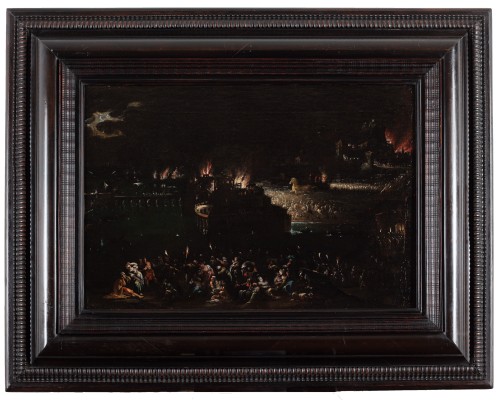
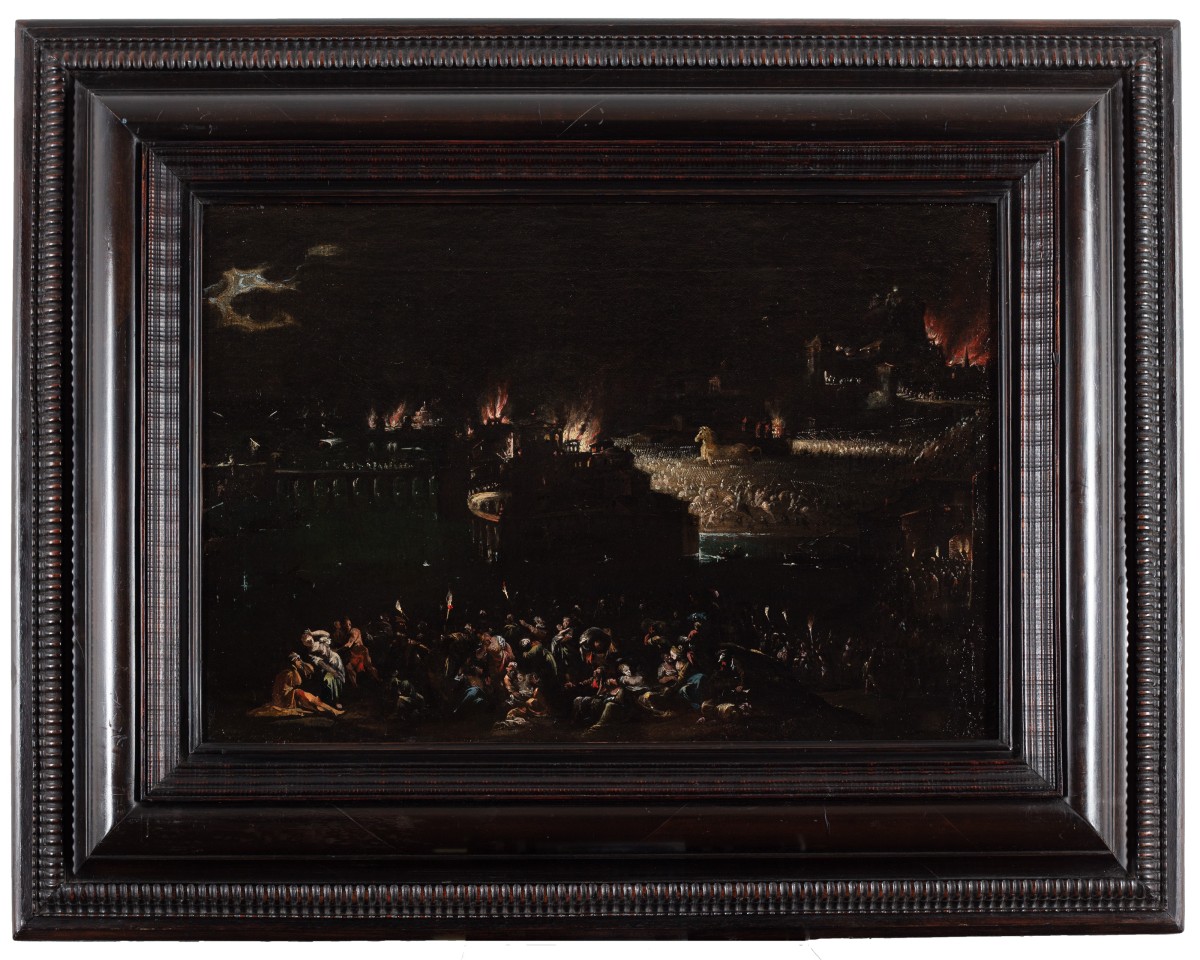
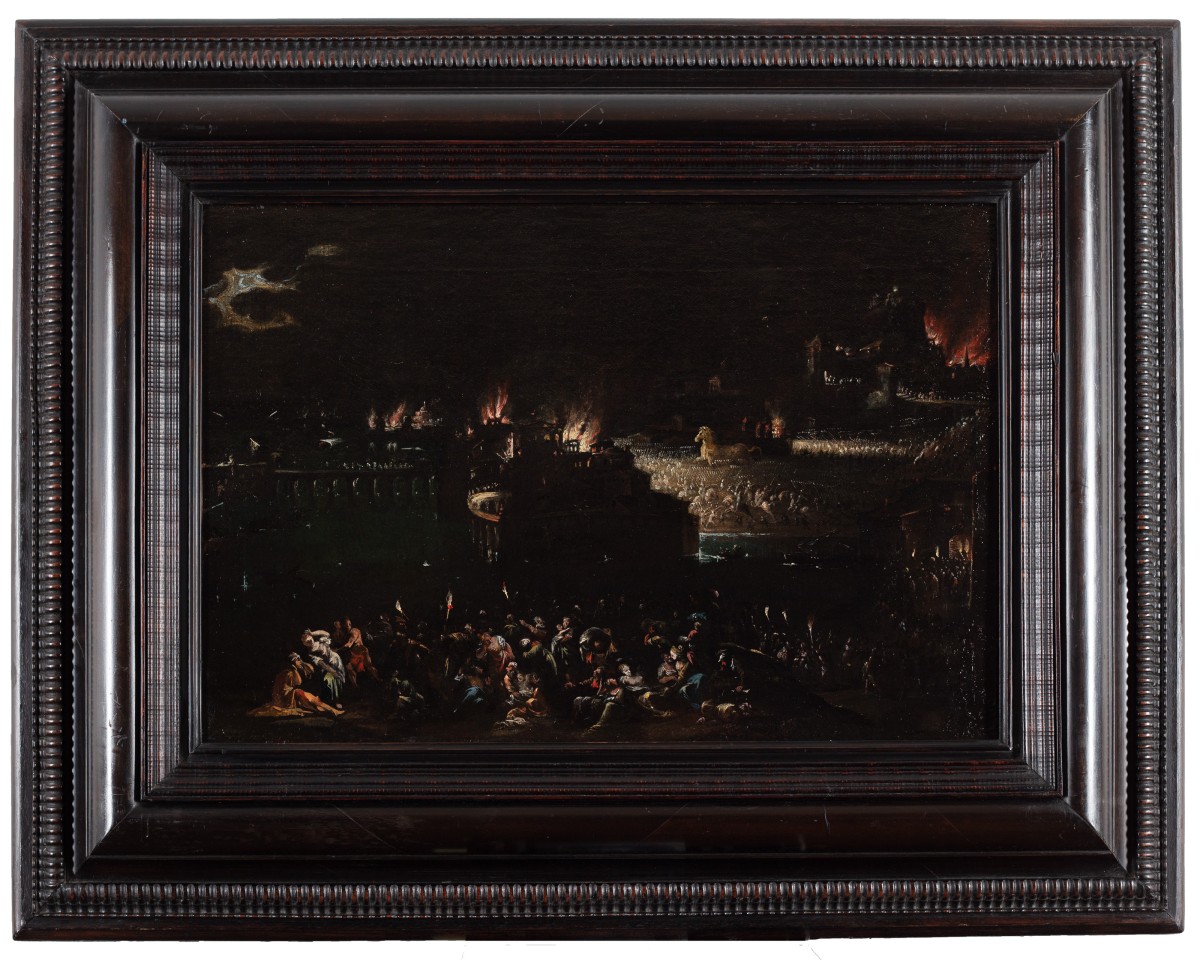
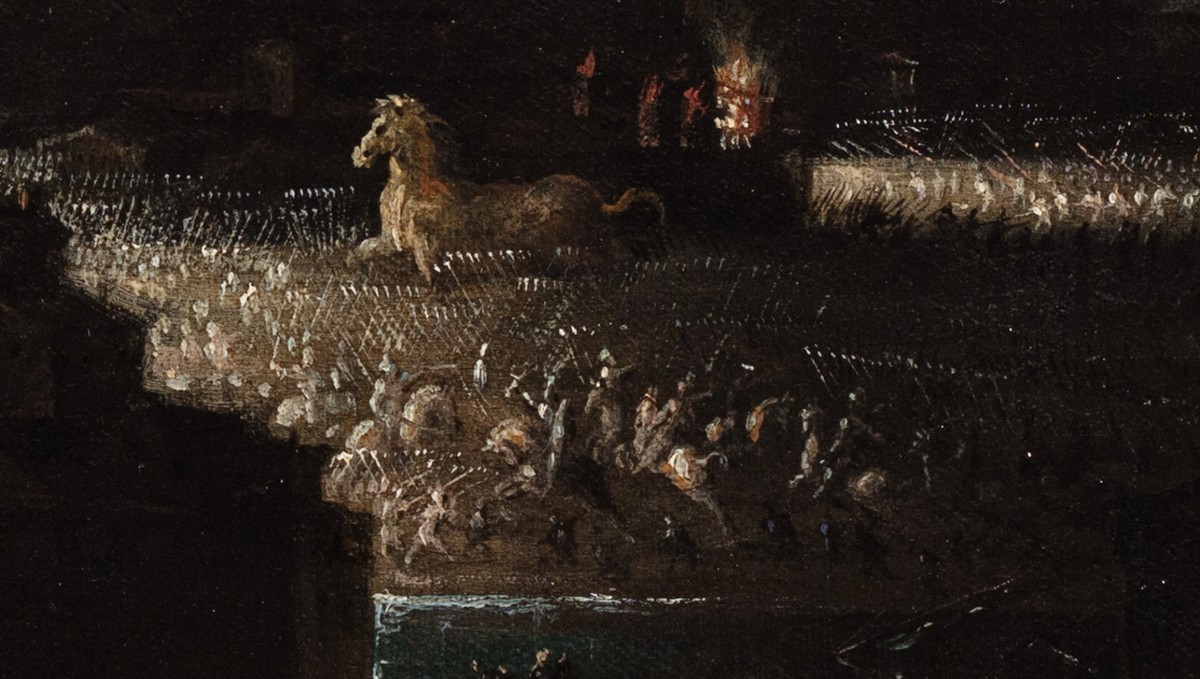
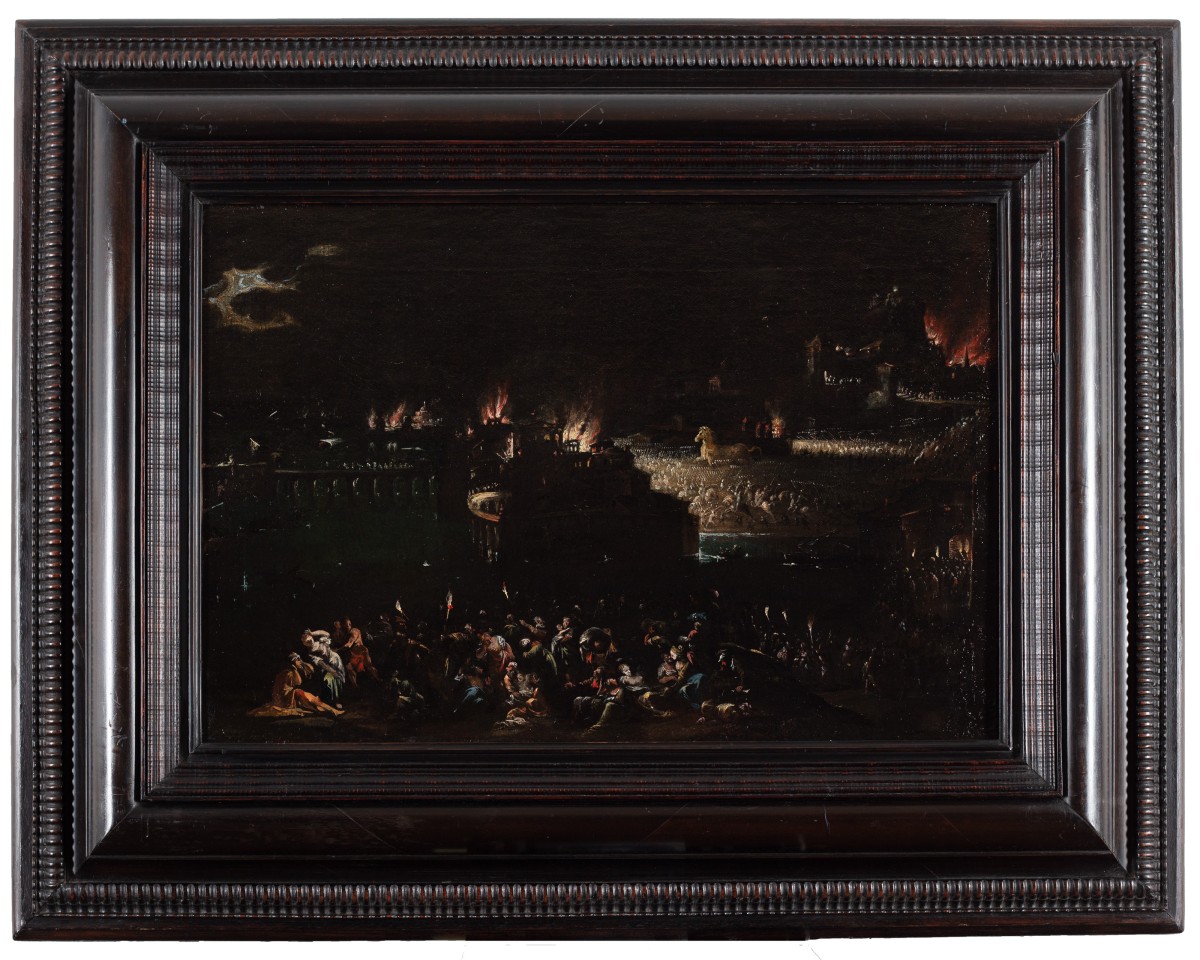
The scene is dark, both literally and figuratively. In the background stands a large horse. The city is ablaze, and the fire casts a glow over the scene. In the foreground we see groups of fleeing people and soldiers running riot.
The painting shows the fall of Troy, the end of a war that had lasted ten years. When force offered no way out, the Greeks, according to tradition on the advice of the seer Calchas and with a plan devised by the cunning Odysseus, resorted to a trick. They built an enormous wooden horse in which they hid prominent warriors, among them Odysseus himself, Neoptolemus (the son of Achilles), Menelaus and Diomedes. They then broke camp and pretended to sail home, while their ships lay at anchor off the island of Tenedos. One Greek, Sinon, stayed behind.
In their euphoria of victory, the Trojans dragged the horse into the city and celebrated. When they lay asleep, drunk, Sinon signalled the ships with a torch and freed his comrades from the horse, who opened the city gates. Because of the surprise and the drink, the Trojans, despite their superior numbers, stood no chance and were slaughtered. King Priam was killed by Neoptolemus, who also carried off Andromache, Hector’s widow, as booty. A few Trojans, among them Aeneas, managed to escape.
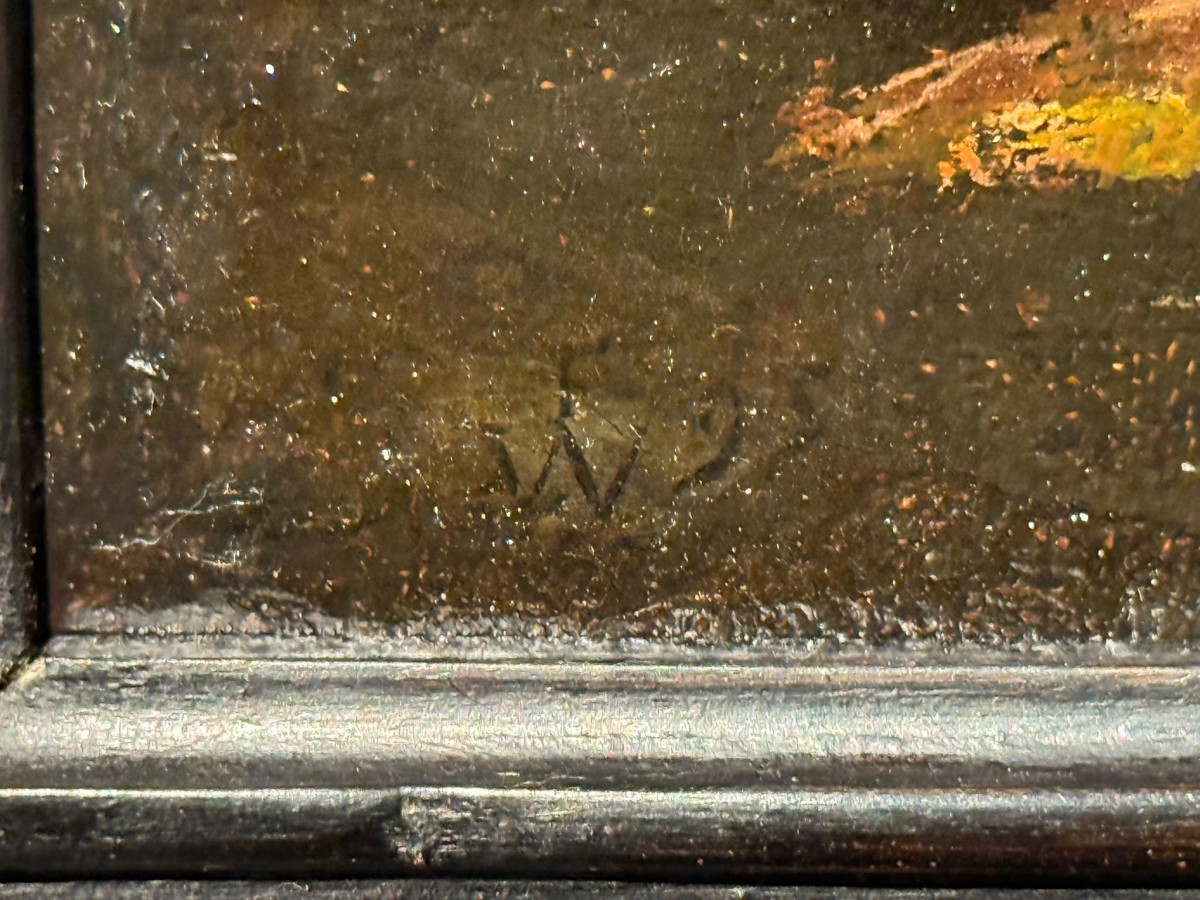
The painting thus brings together several moments of the story: the ruse of the horse, the burning city and the despair of the Trojans. The darkness, broken by fire, suits Valckenborch’s fondness for strong contrasts between light and dark. The work is signed and dated lower left (FVV, 1595), a rarity, since only a small number of his works bear a signature or monogram. It dates from the period before his move to Nuremberg.
“The fall of Troy”
Oil on canvas
Signed and dated lower left: FVV, 1595
Also on the RKD: https://rkd.nl/images/4991
Dimensions: 39 x 58 cm & 67 x 86 cm (framed)
Provenance:
Christie's, London, November 1, 1991, Lot 129.
Christie's, Paris, November 27, 2002, Lot 26.
Delevery information :
After reception of payment we can box and ship our items all over the world. Estimates of this service can be provided.