Offered by Galerie Nicolas Lenté
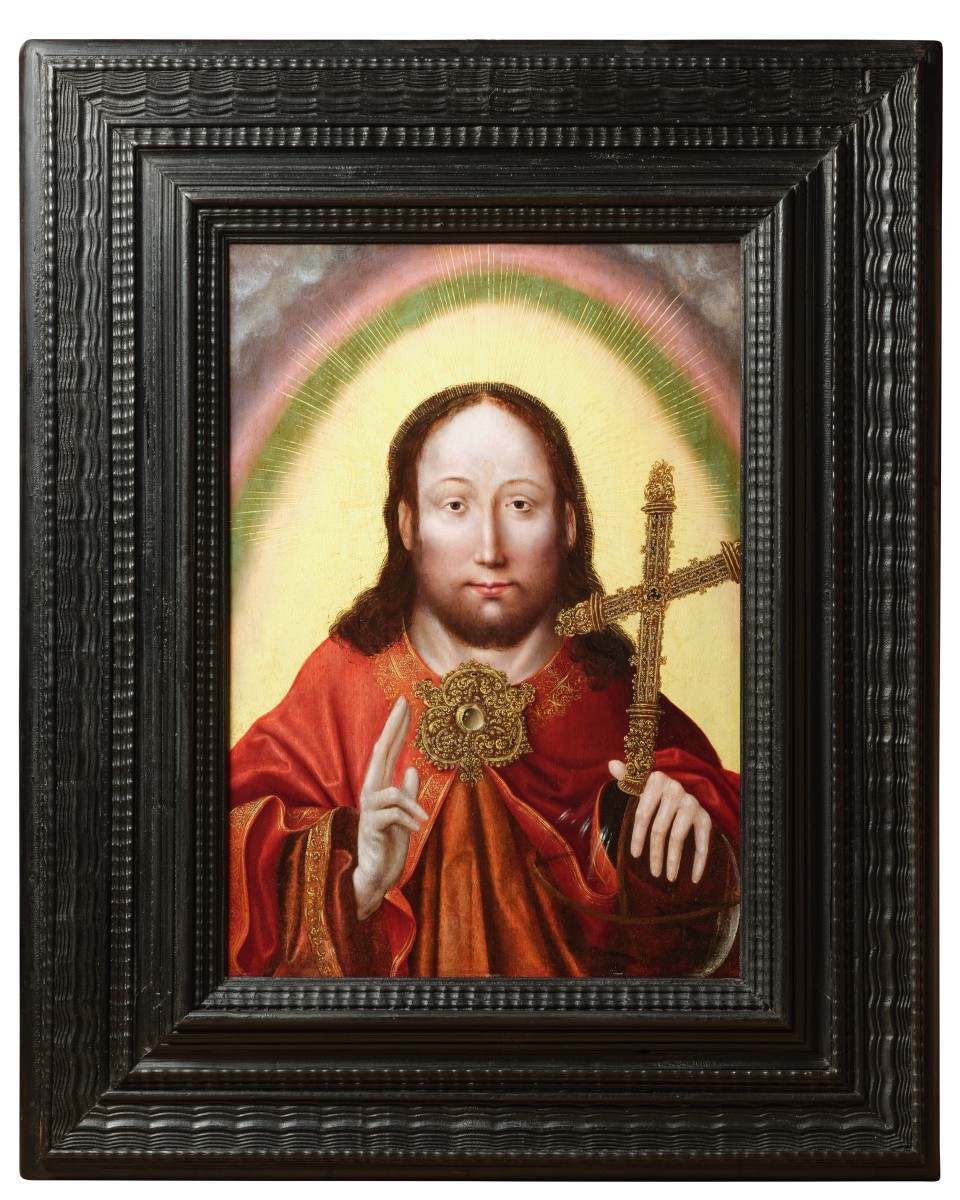

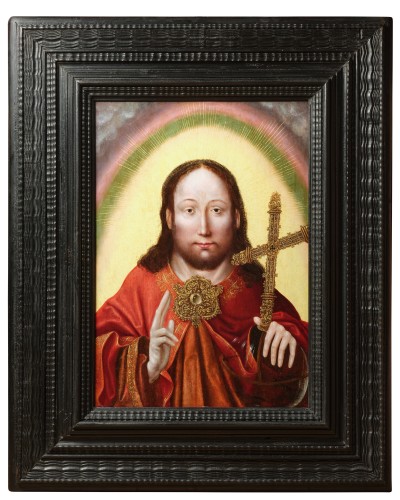
Salvator Mundi — Christ, Saviour of the World
Attributed to the Master of the Mansi Magdalen (active in Antwerp, 1510–1530)
Antwerp, early 16th century
Oil on oak panel
Height: 56 cm; width: 40 cm
Dutch-style ebonised wood frame
Framed dimensions: height 86 cm; width 68 cm
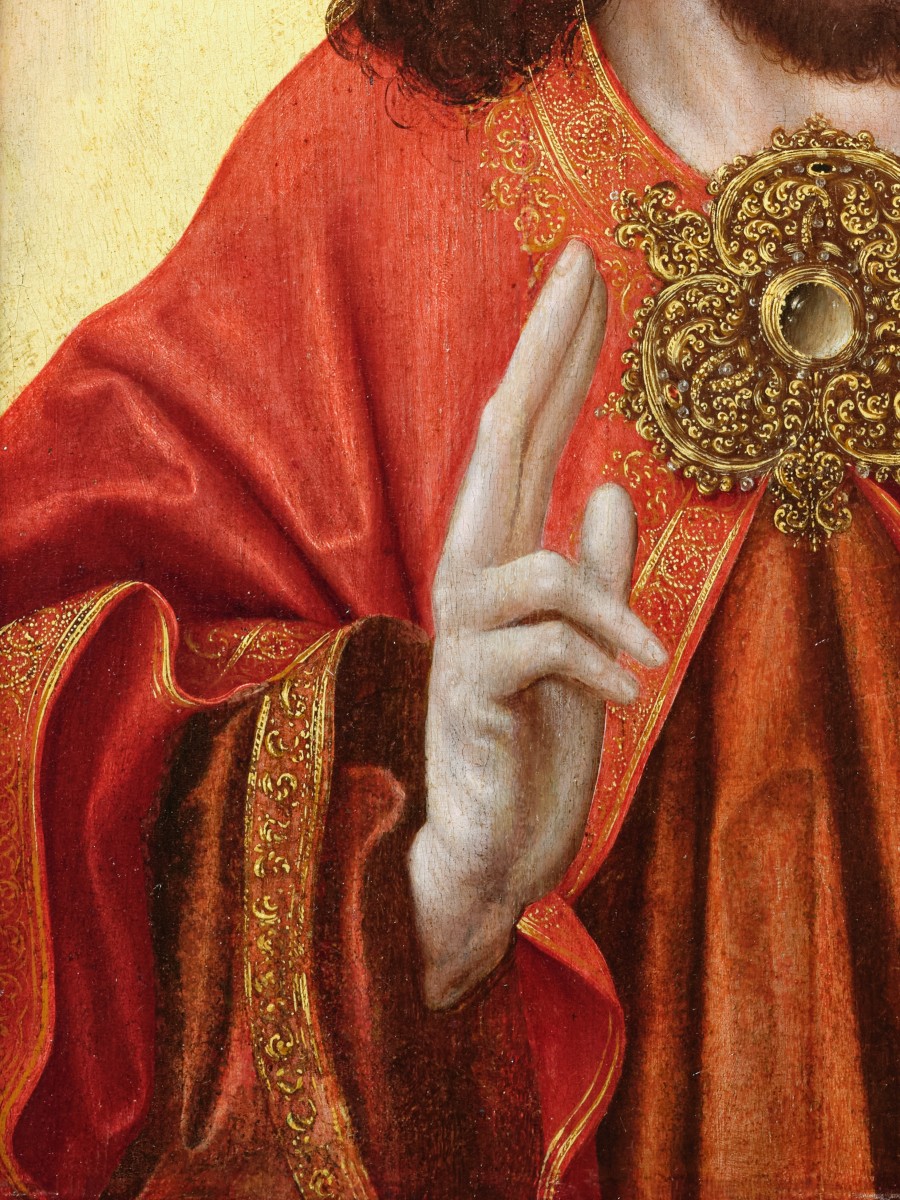
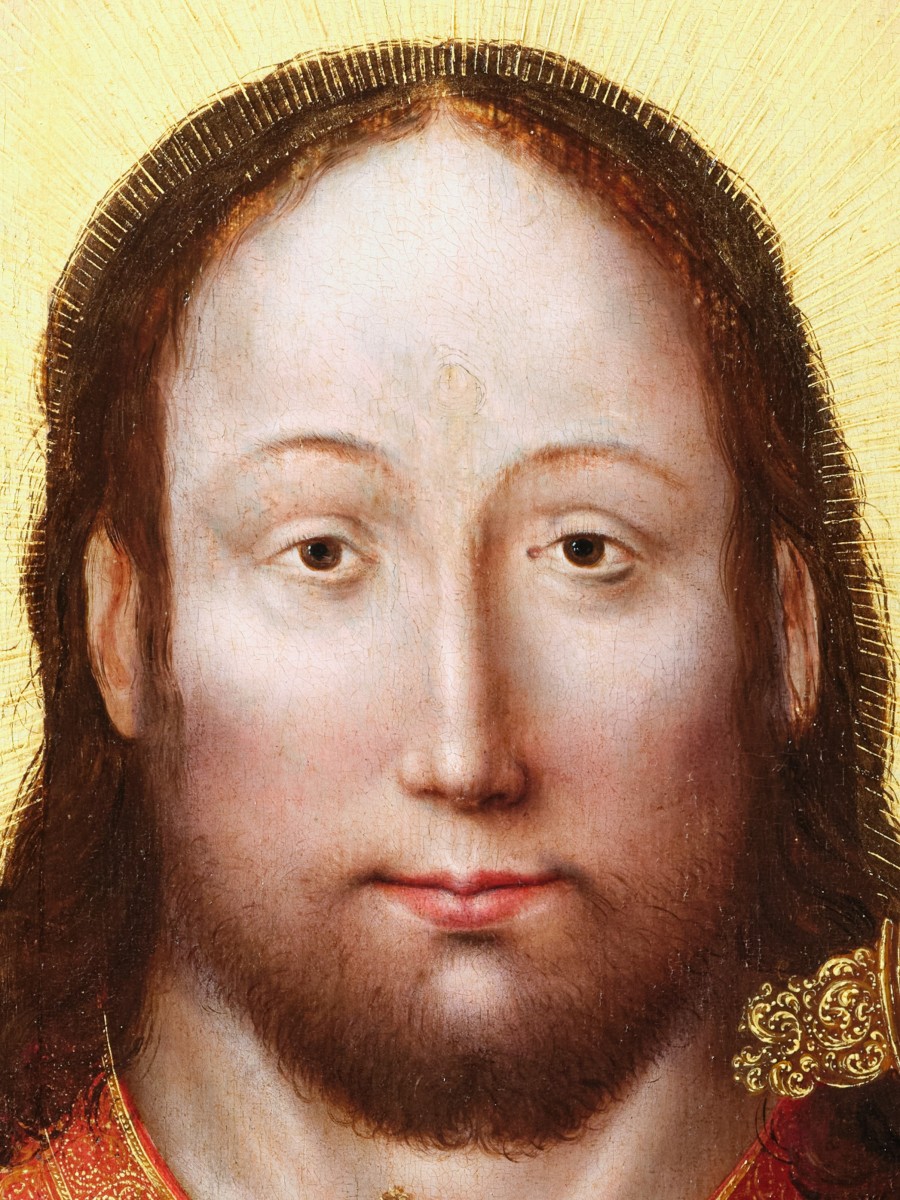
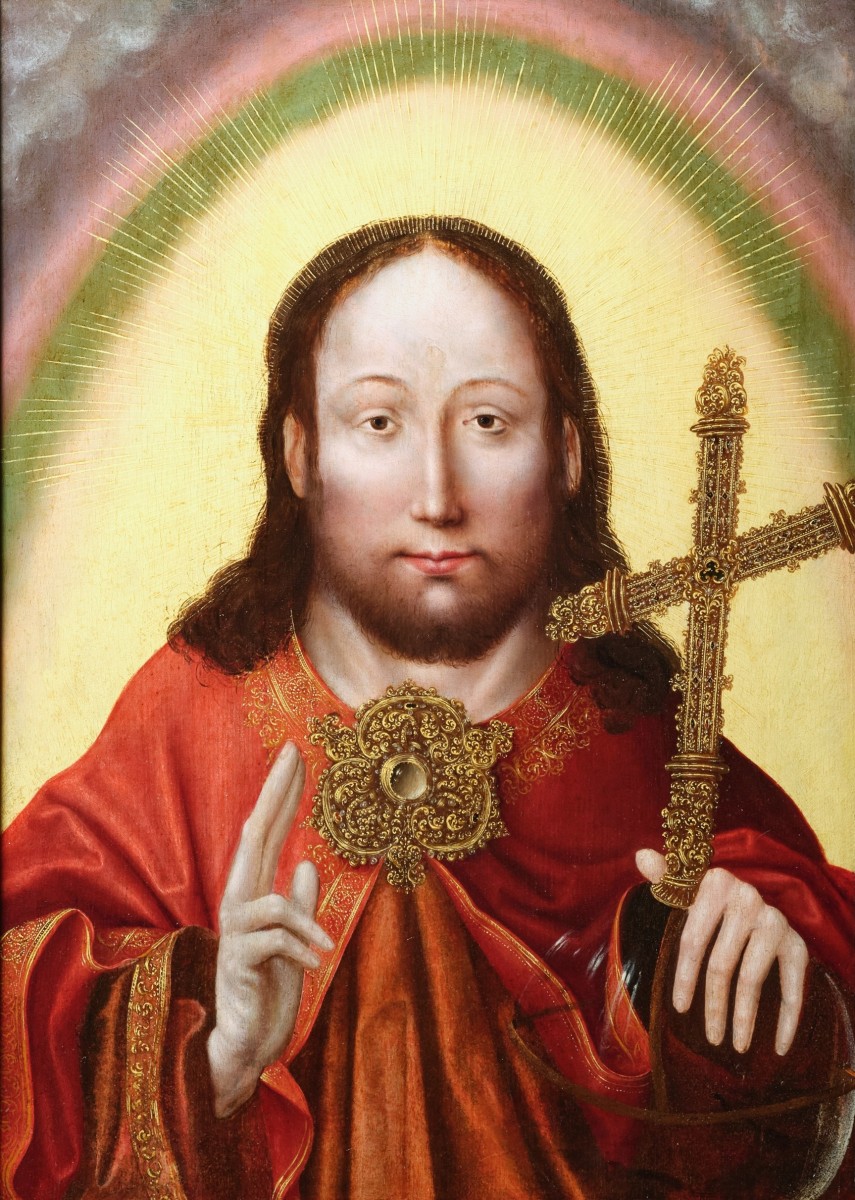
Shown half-length against a luminous, radiating background, Christ wears a red tunic beneath a voluminous red mantle with richly ornamented borders. He raises his right hand in blessing, while his left rests upon an orb surmounted by a cross. These attributes identify him as the Salvator Mundi, the Saviour of the World: the blessing expresses his redemptive mission, while the cross-bearing orb proclaims his sovereignty over the universe. The frontal composition, together with his gaze directed towards the viewer, lends this devotional image a presence that is at once solemn and intimate.
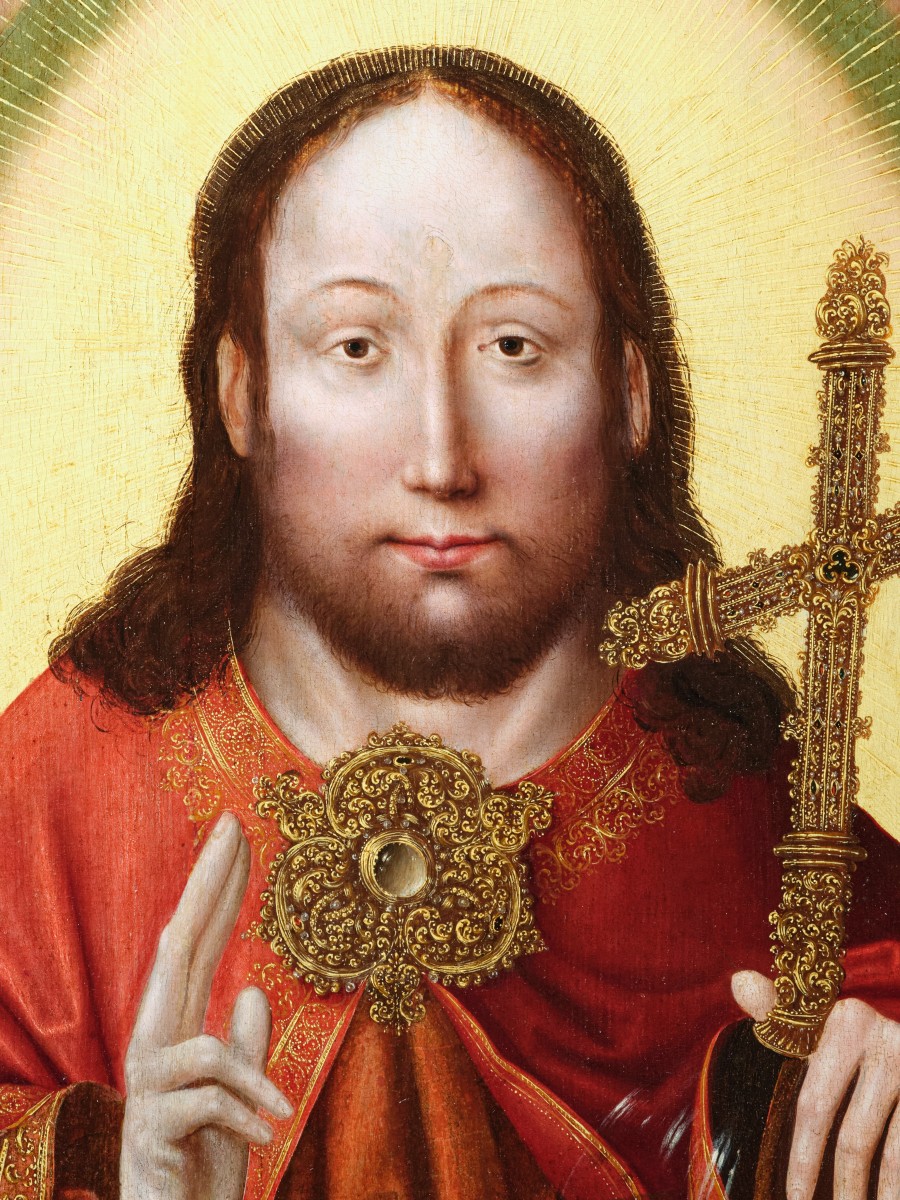
The face is distinguished by its soft modelling and delicate flesh tones, with a subtle pink flush to the cheeks. His brown hair, parted in the centre, falls to his shoulders, while a short beard frames his chin. The meticulous rendering of the eyelashes, eyebrows and individual strands of hair reveals sustained attention to detail.
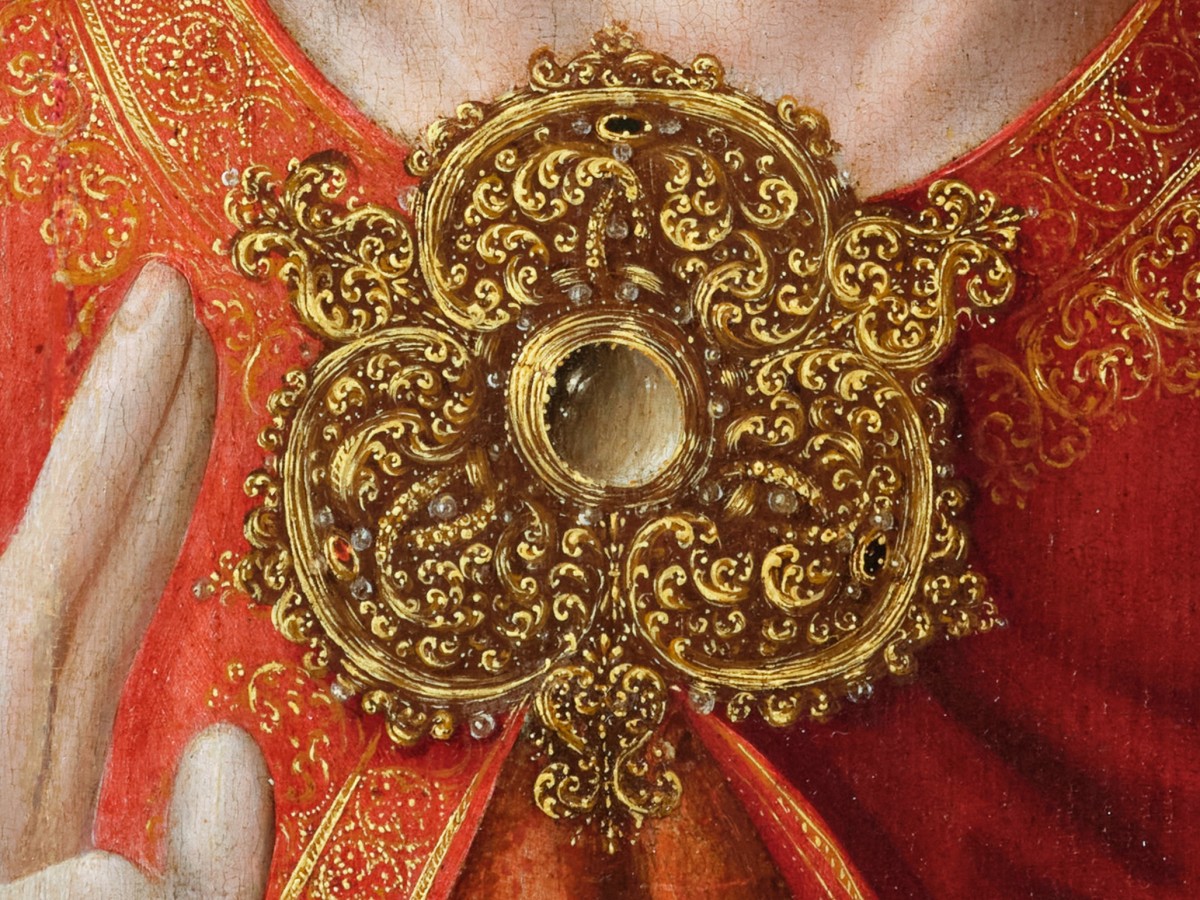
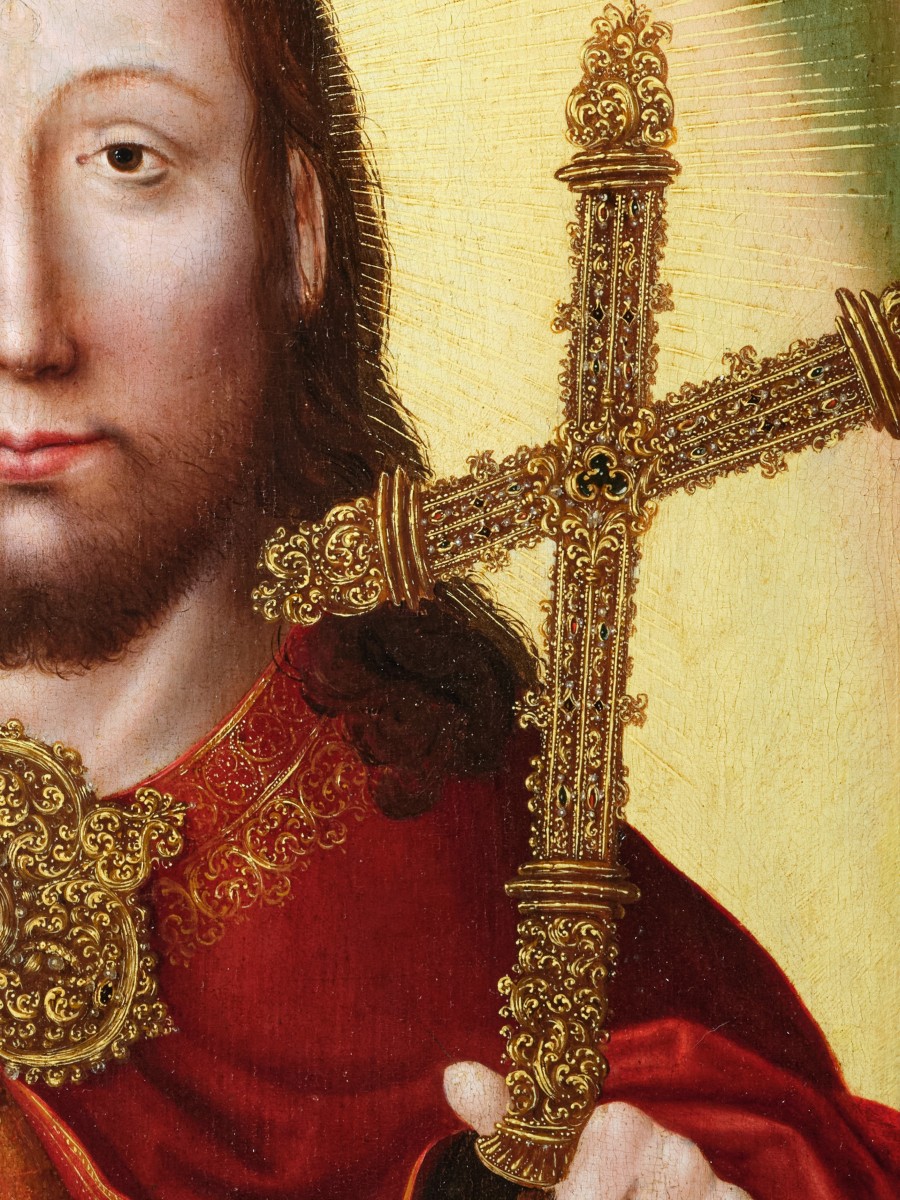
The mantle is fastened at the chest by an imposing morse, or ornamental cope clasp, with a multilobed outline, conceived as an elaborate piece of goldsmith’s work. A network of scrolling foliage and volutes, punctuated by small pearls, unfolds around an oval, translucent crystal cabochon. Alternating brown shadows and golden highlights suggest the relief of chased metal, the openwork of the setting and the gleam of its raised surfaces. The smooth cabochon contrasts with the intricate scrollwork surrounding it, while the embroidered borders of the garment extend this sumptuous decorative vocabulary.
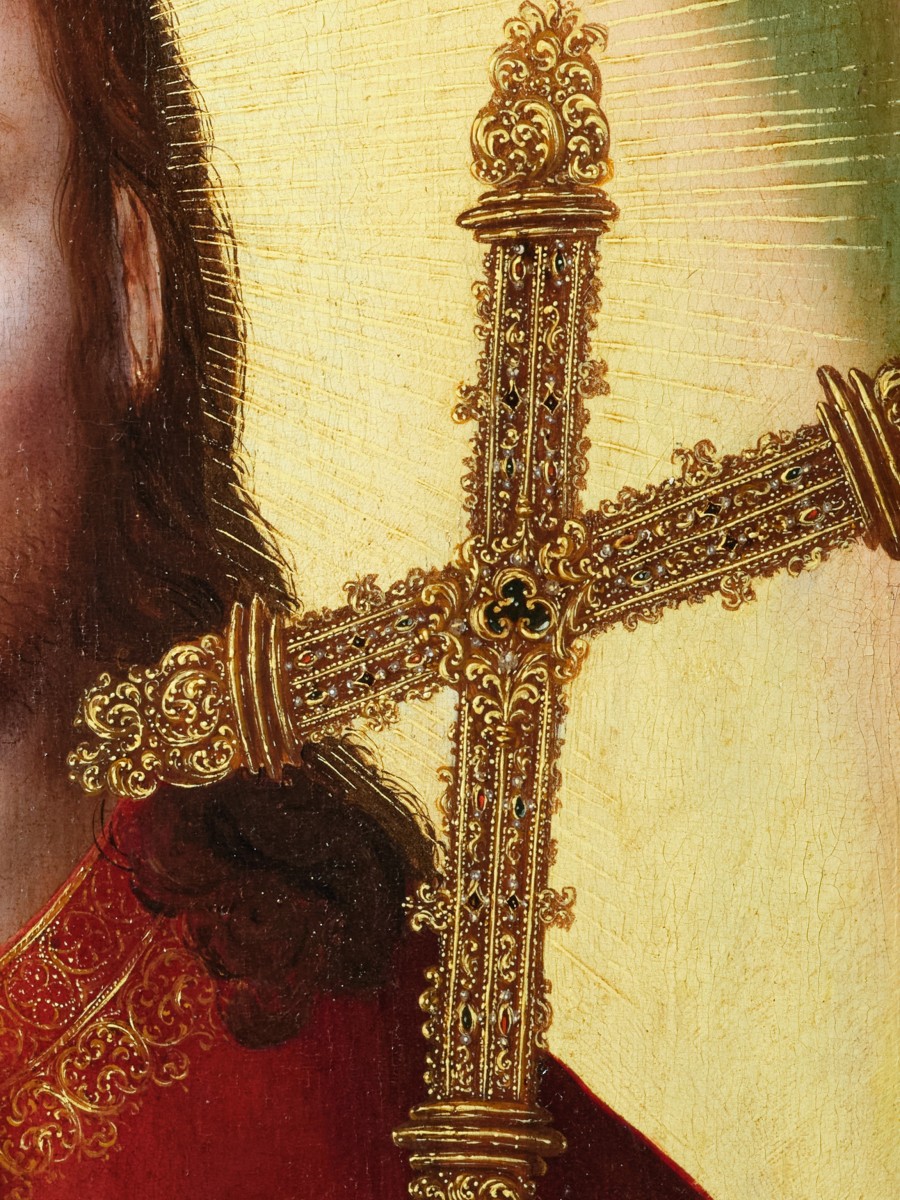
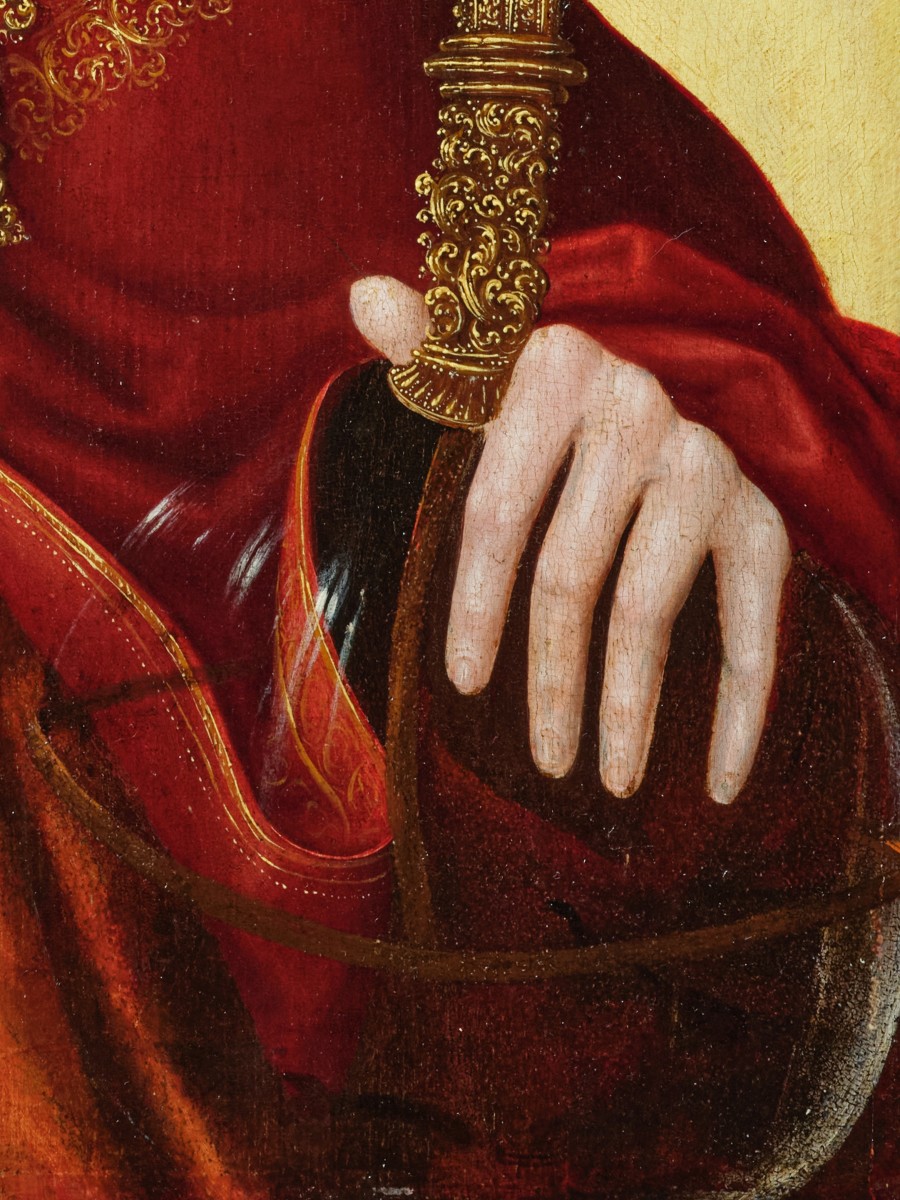
On the right, the cross-bearing orb echoes the splendour of the clasp. The dark sphere, encircled by golden bands and partially covered by Christ’s hand, supports a tall, elaborately ornamented cross. Its shaft and crossbar are enriched with delicate ornament, pearls and scrolling finials. Subtle highlights accentuate its contours, creating the illusion of three-dimensional goldsmith’s work. The material richness of the object is matched by its symbolic significance: the orb represents the world, while the cross asserts Christ’s sovereignty over it.
Around the head, fine golden rays extend across a broad luminous field, bordered by green and pink bands and, beyond them, grey clouds drawn back towards the upper corners. This iridescent border may be interpreted as an evocation of the rainbow of the Covenant. The combination of light, the gesture of blessing and the attributes of sovereignty imbues the composition with a sense of benevolent majesty.
The Master of the Mansi Magdalen
The Master of the Mansi Magdalen, whose activity the Royal Museums of Fine Arts of Belgium place in Antwerp around 1510–1530, remains an anonymous artist. His conventional name was established by Max J. Friedländer after a painting of Saint Mary Magdalen formerly in the Mansi collection in Lucca and now held in the Gemäldegalerie in Berlin.
The artist belongs to the circle of Quentin Massys, whose devotional models he adopted and reinterpreted. Friedländer proposed identifying him with Willem Muelenbroec, registered in 1501 as an apprentice to Quentin Massys in Antwerp’s Guild of Saint Luke.
The present panel belongs to this artistic tradition through its frontal composition and its combination of the blessing gesture with the cross-bearing orb, a formula widely disseminated in representations of the Salvator Mundi associated with Quentin Massys and his circle.
The arrangement of the blessing hand also deserves attention: the index finger is partially concealed behind the middle finger, creating a distinctive configuration. This feature is expressly noted in the Parke-Bernet catalogue entry for another Salvator Mundi attributed to the Master of the Mansi Magdalen. The sale’s cataloguer highlights this detail in support of a comparison with a work by Quentin Massys published by Max J. Friedländer in volume VII of Die altniederländische Malerei (1934, pl. LXIV, no. 95). This comparison provides a further argument in favour of the proposed attribution.
In the present work, the softness of the face, the carefully rendered hands and the richness of the accessories achieve a particularly harmonious balance. The restrained presentation and sumptuous detail give the painting a distinctive visual power, poised between contemplation and magnificence.
Related Works:
- Master of the Mansi Magdalen, Salvator Mundi, oil on panel, 68 × 50 cm, Suermondt-Ludwig-Museum, Aachen, inv. GK 295.
- Master of the Mansi Magdalen, Salvator Mundi, oil on panel, 44 × 32 cm, Parke-Bernet sale, New York, 10 May 1961, lot 3.
- Attributed to Quentin Massys, Salvator Mundi, oil on panel, 53 × 36 cm, North Carolina Museum of Art, USA, inv. 60.17.62.
Delevery information :
We organize the shipping and delivery of our artworks worldwide, working with specialized fine art carriers as well as DHL Express for the secure shipment of small and medium-sized works (up to 120 cm).
Each artwork is carefully packed and shipped in a custom-made transport crate to ensure optimal protection. All shipments are fully tracked and insured.
We pay the utmost attention to every stage of the shipping process to ensure fast, reliable delivery. Shipments via DHL Express are generally dispatched within approximately 7 days of purchase.
All of our artworks can be viewed at our Paris gallery and may also be collected in person.