Offered by Galerie Nicolas Lenté

Workshop of Pieter Coecke van Aelst (Aalst, 1502 – Brussels, 1550)
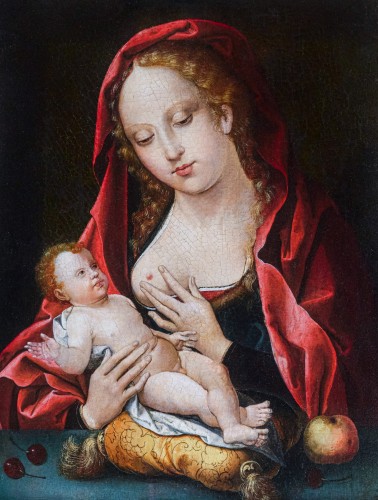
The Virgin Nursing the Christ Child
Antwerp, 16th century
Oil on oak panel
Panel dimensions: H. 36.5 cm × W. 27.5 cm
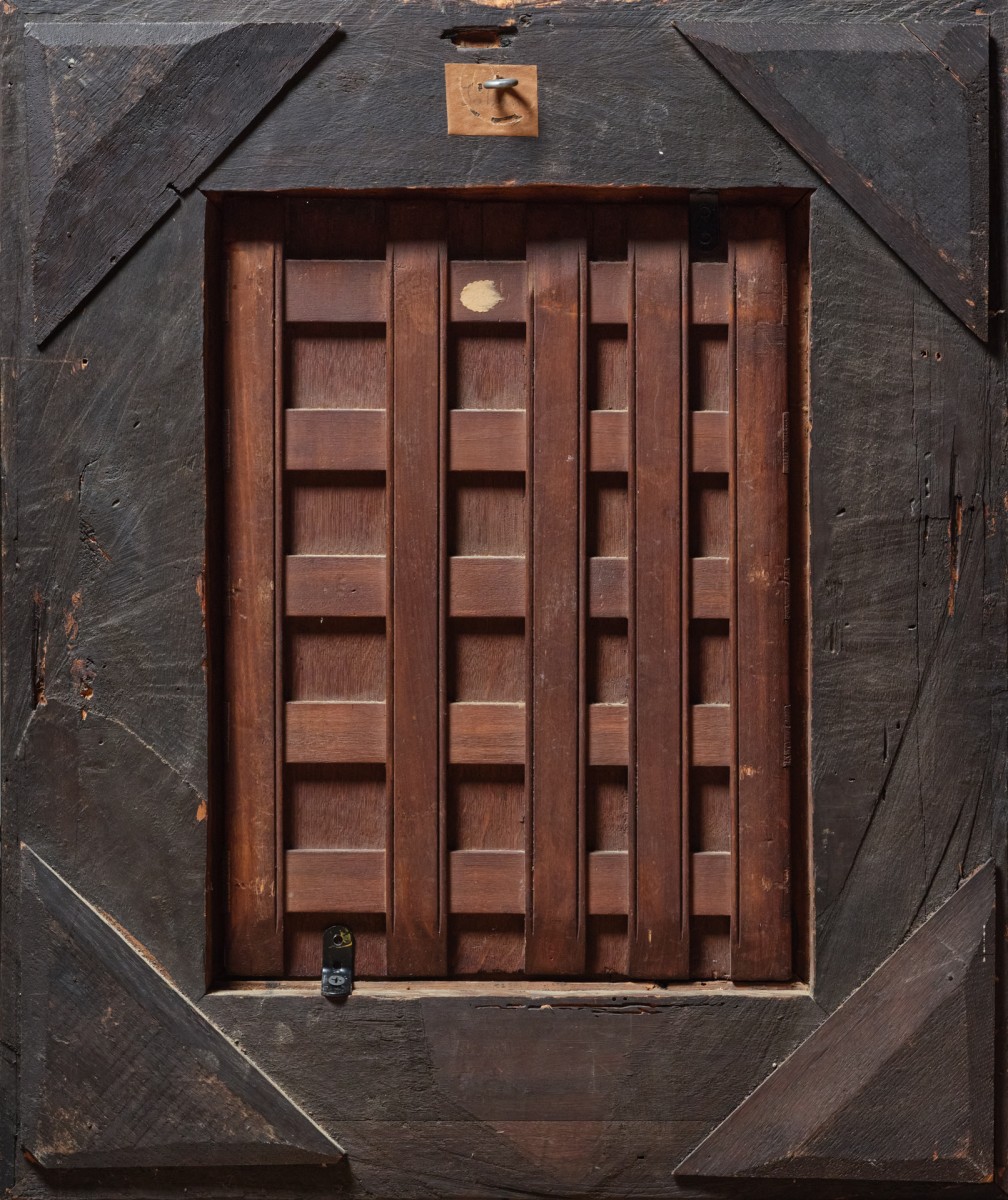
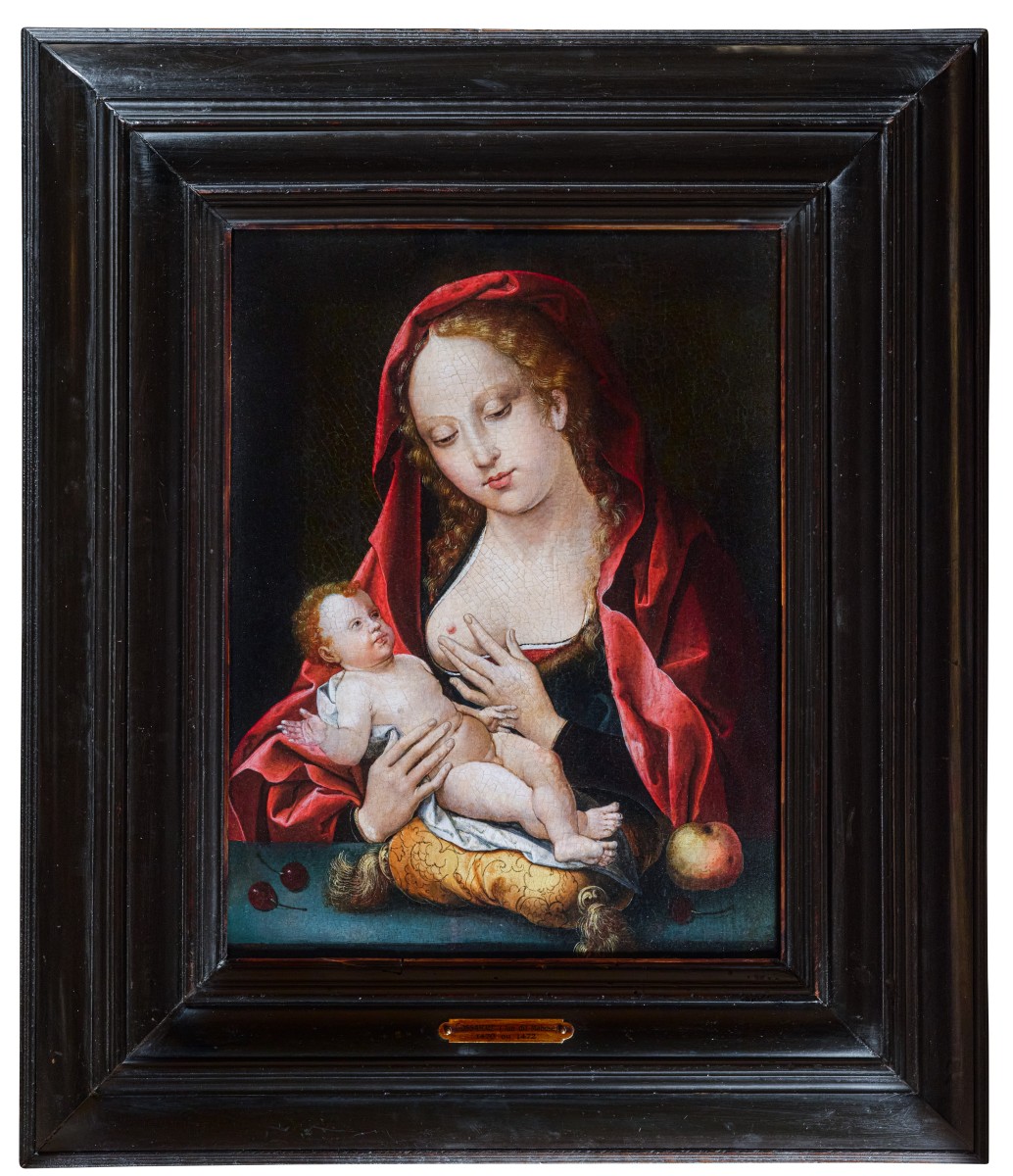
Moulded ebonized wood frame
Framed dimensions: H. 59 cm × W. 50 cm
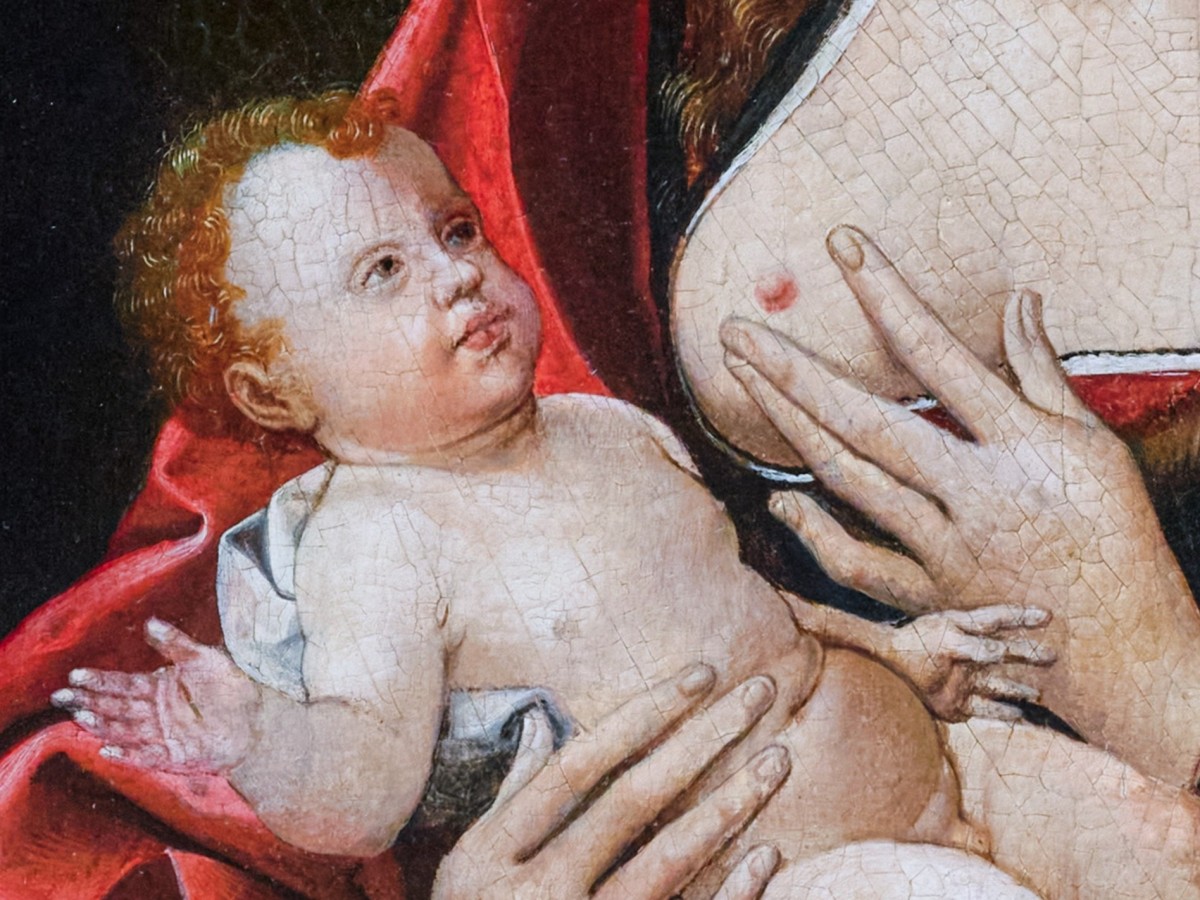
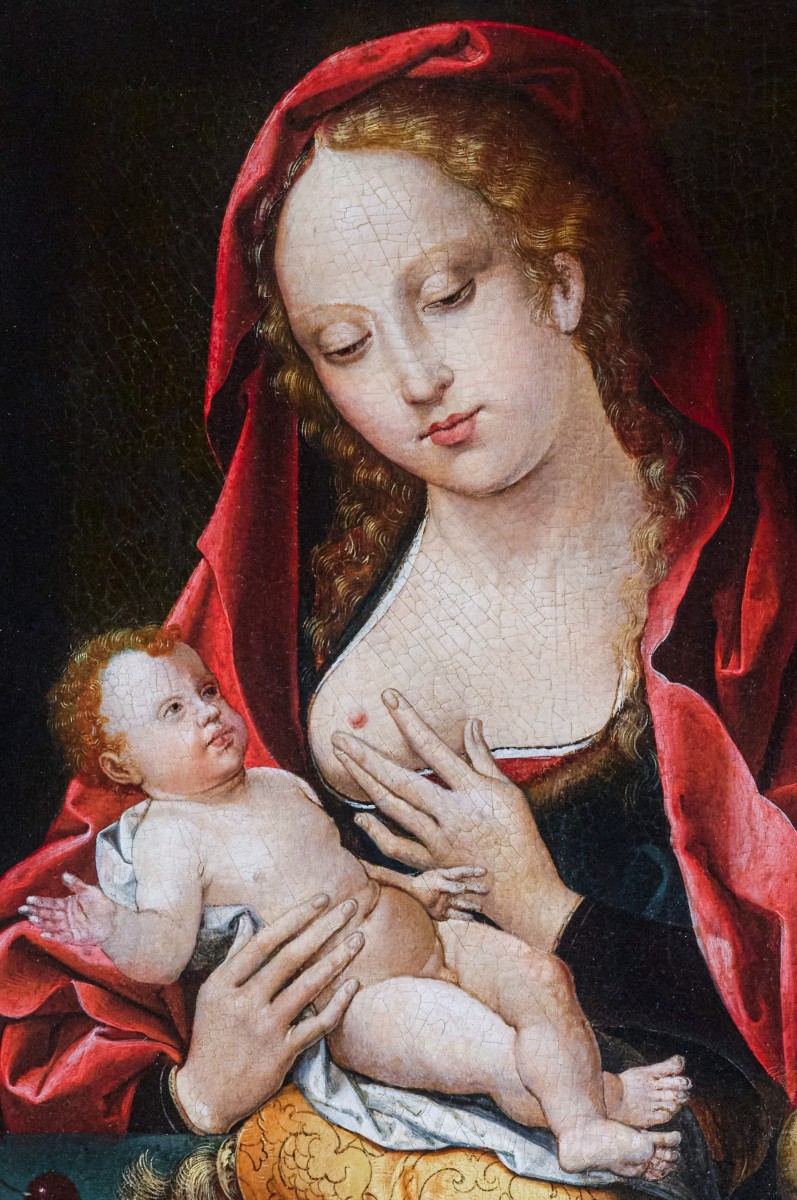
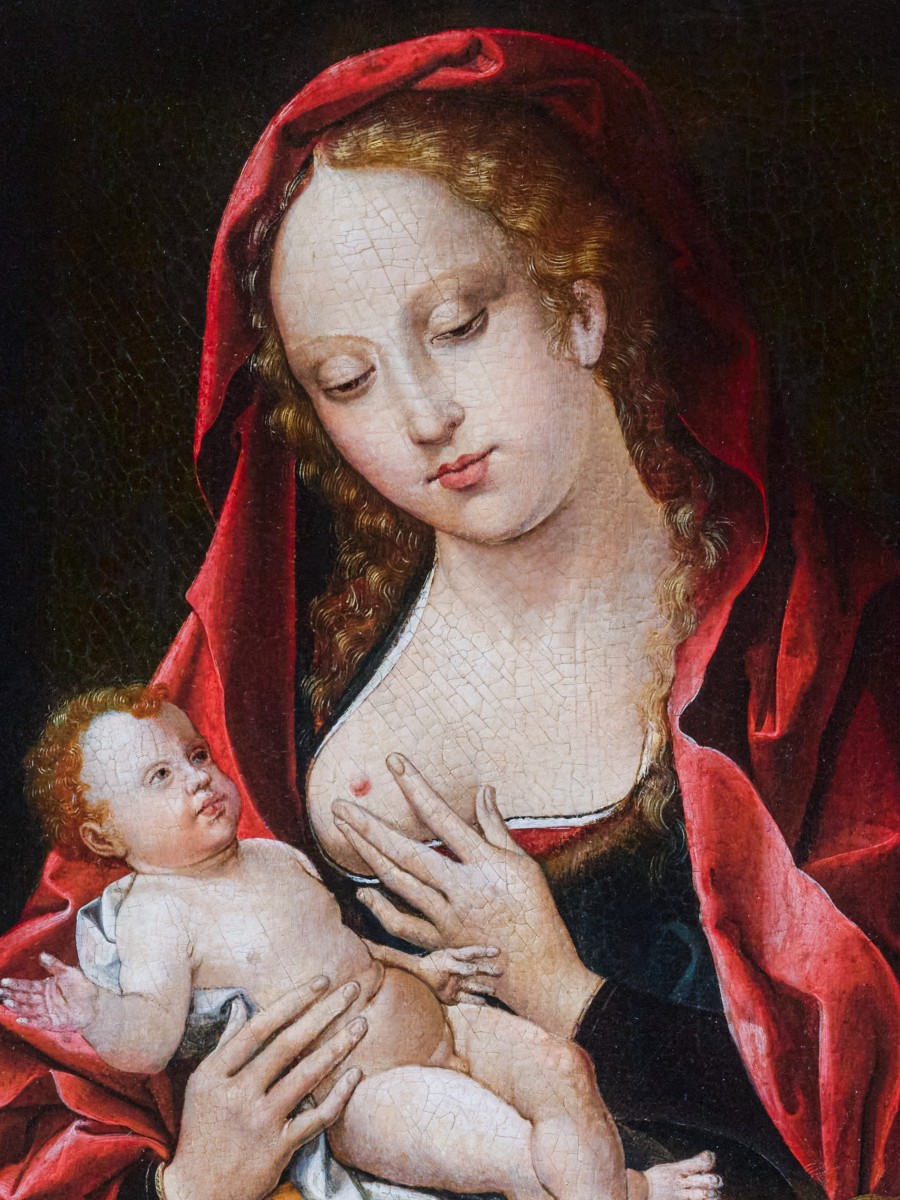
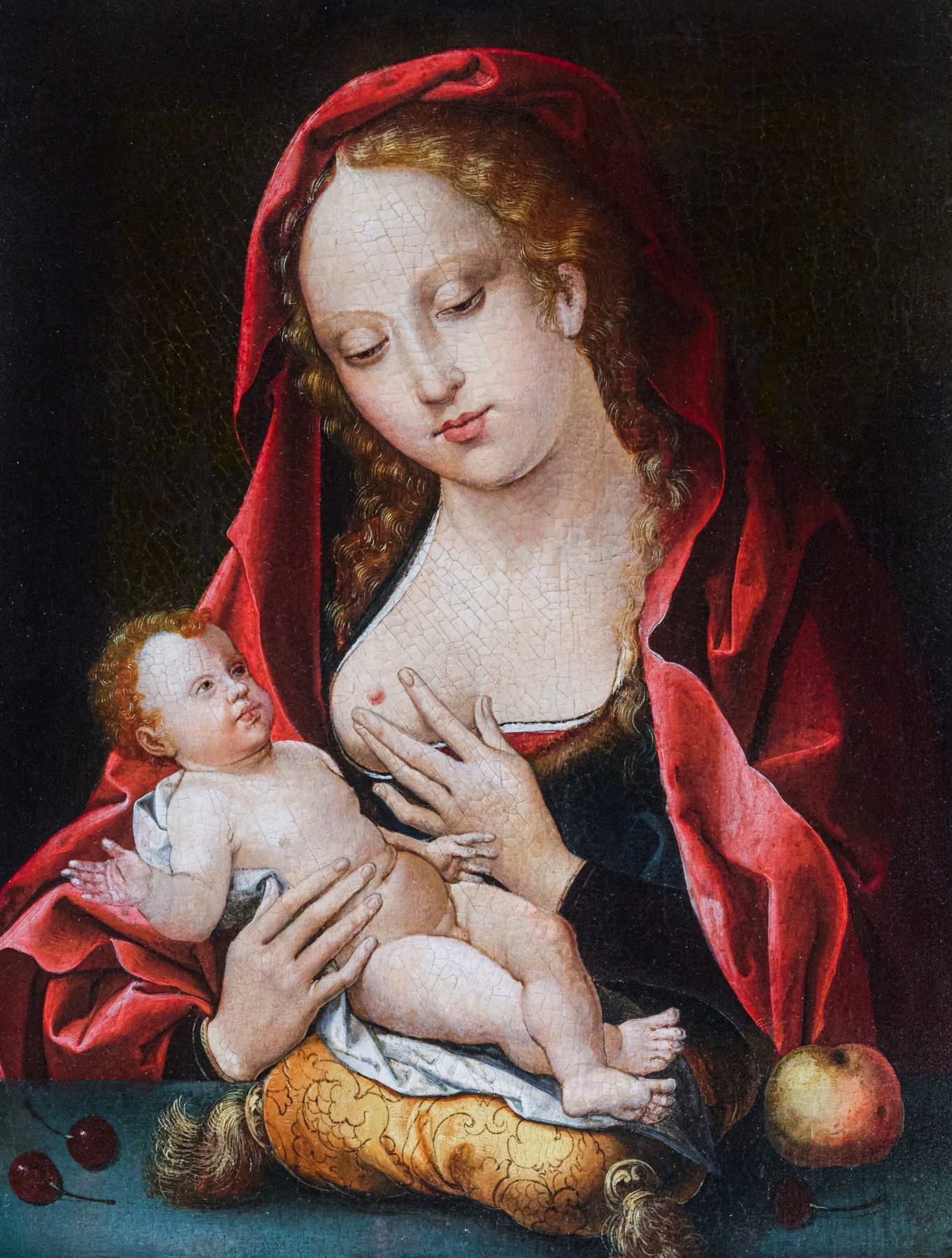
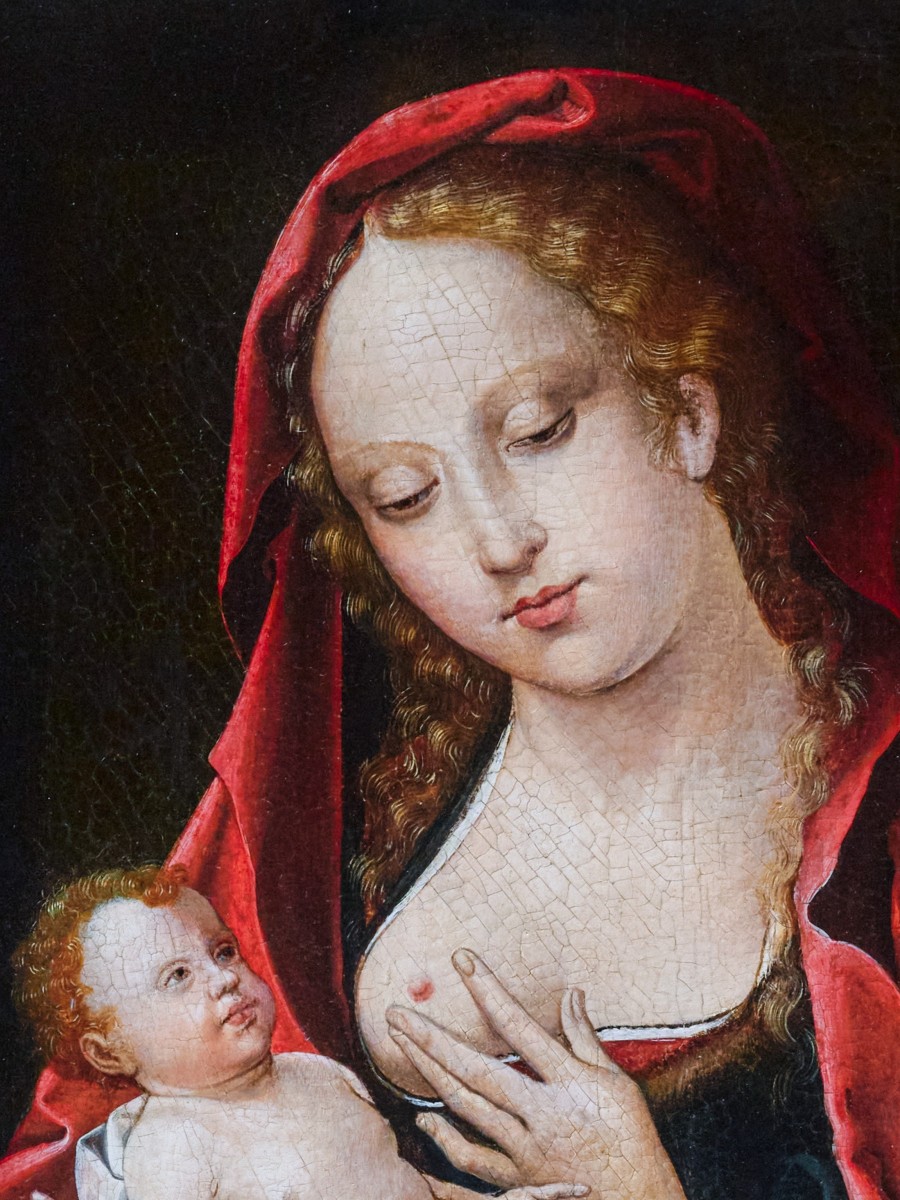
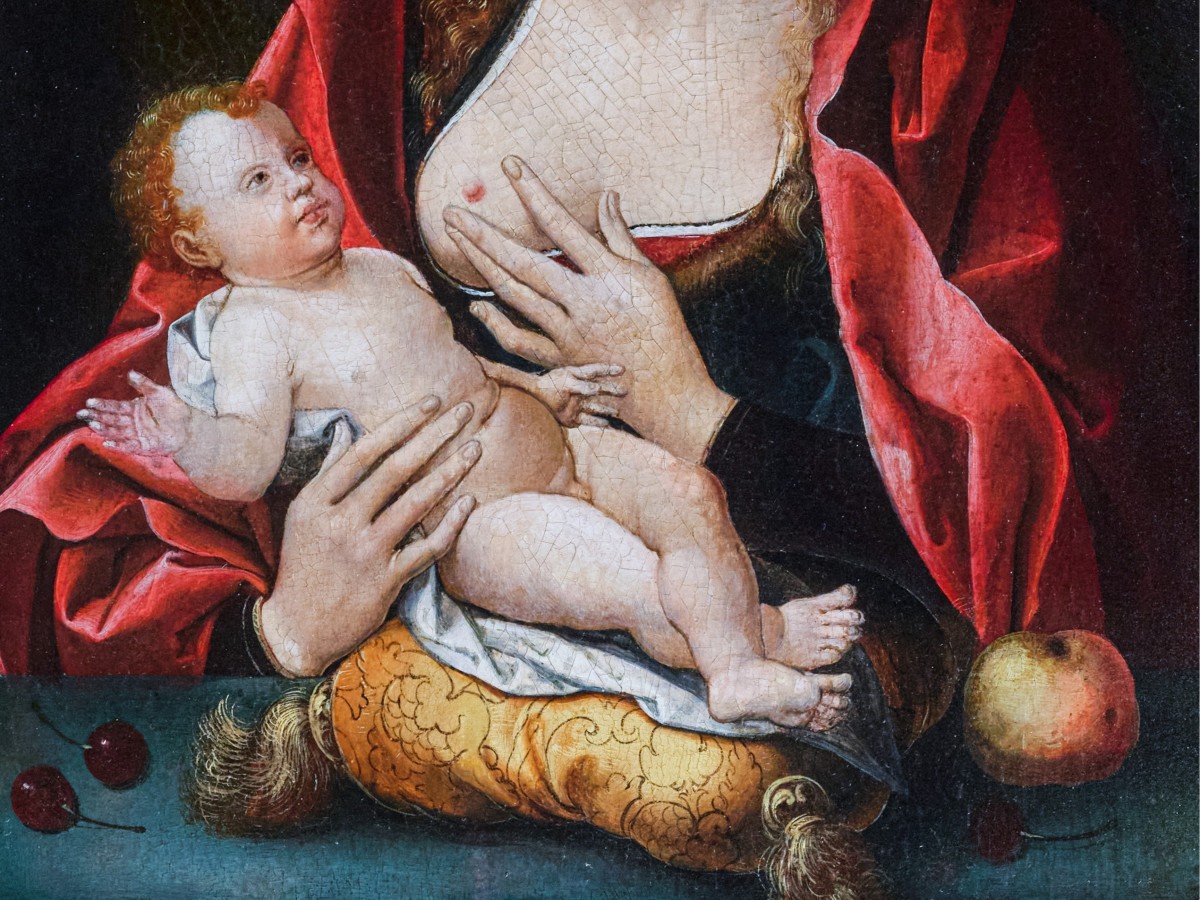
Our painting depicts a Virgin and Child imbued with gentleness and tenderness. Intended for private devotion, the composition appeals through the intimacy of the scene and the delicacy of the gestures that unite mother and child. Against a dark background that heightens the brilliance of her red mantle, Mary inclines her head towards her son and offers him her breast, while the Child, reclining on a sumptuous gold brocade cushion, gazes up at her.
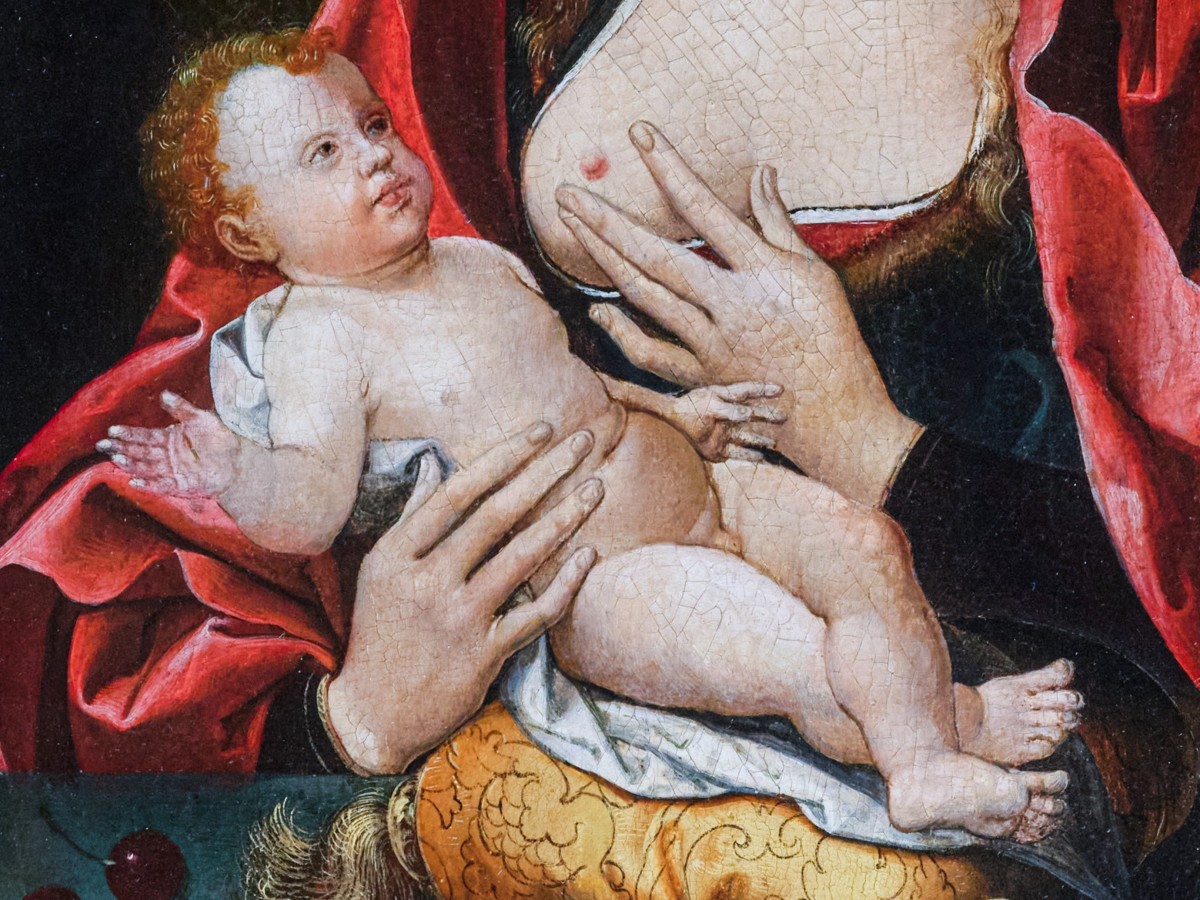
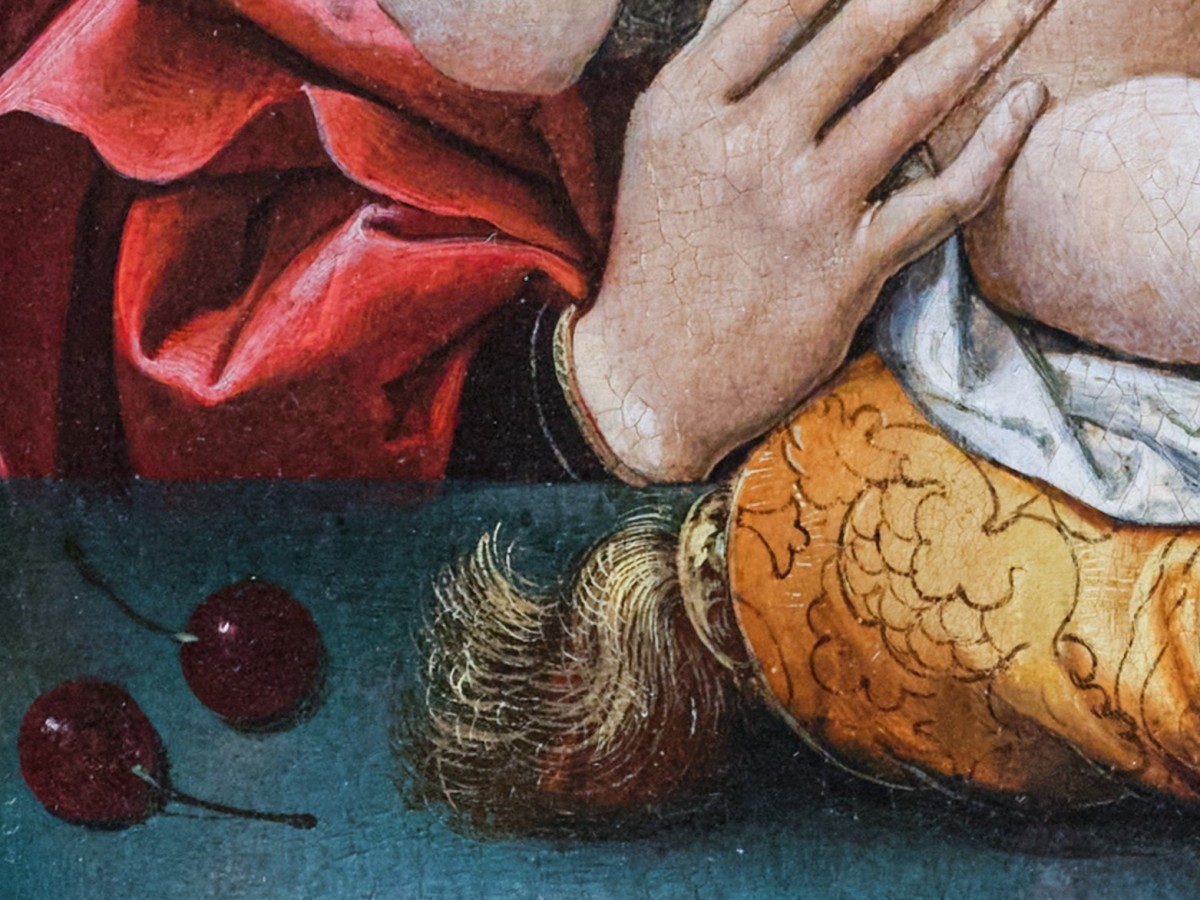
Shown at half-length, the Virgin wears a blue dress edged with brown fur at the neckline. Her ample red mantle covers her head and falls over her shoulders in deep, angular folds. Long, wavy strands of blonde hair emerge from beneath it, framing her face and neck. The Child rests on a white cloth spread over the cushion, whose floral motifs and gold-thread pom-poms enhance the refinement of the ensemble.
In the foreground, an apple and cherries rest on a ledge. Far from being merely decorative, these fruits enrich the composition with Christian symbolism. The apple recalls original sin and the Fall of Adam and Eve, answered by the promise of salvation embodied in the Christ Child. The cherries evoke the sweetness of Paradise, while their red colour foreshadows the blood Christ will shed during his Passion. Beneath the tenderness of this maternal scene lies a reminder of the Child’s redemptive mission.
The close framing concentrates attention on the two figures. The red of the mantle contrasts with the pale flesh tones and the dark background, while the golden hues of the hair and brocade enrich the colour harmony. Mary’s hands gently support the Child’s body, whose diagonal position lends movement to the scene without disturbing its balance.
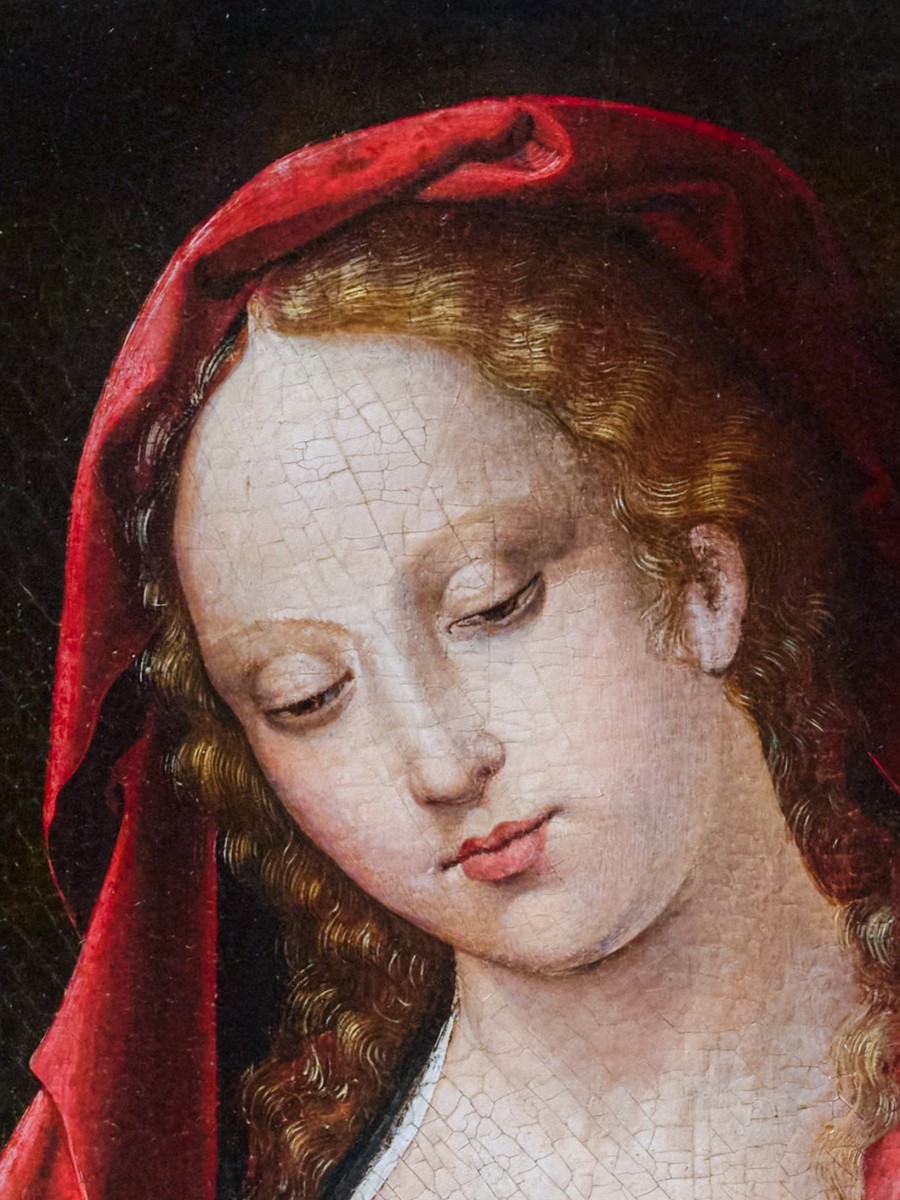
The painting belongs to the production of Pieter Coecke van Aelst’s workshop. The Virgin’s facial type displays its distinctive characteristics: a high, open forehead, an oval face with full cheeks, lowered eyelids and a small, finely drawn mouth. Her blonde hair, centrally parted and arranged in thick, wavy locks, completes this characteristic appearance. The luminous, softly blended modelling of her face, the slender fingers and the elegant drapery belong to the same stylistic vocabulary.
Our Virgin Nursing the Child follows, without the figure of Saint Joseph, a design whose closest known version by Pieter Coecke van Aelst is the Holy Family in the Bonnefantenmuseum, Maastricht. Other variants, notably one attributed to the Master of the Saint Anne Almshouse, a collaborator of Pieter Coecke van Aelst, demonstrate the circulation of this prototype. Conceived and repeated by the master himself, it was subsequently reproduced and adapted by his workshop to meet the strong demand for images of private devotion. Our panel belongs to this workshop production while placing particular emphasis on maternal intimacy. The absence of Saint Joseph focuses the composition on the Virgin and Child, highlighting the tenderness of their exchanged glances and gestures and giving the scene a more immediate and moving presence.
Related Works:
- Pieter Coecke van Aelst, The Holy Family, circa 1525, oil on panel, 37 × 30 cm, Maastricht, Bonnefantenmuseum, inv. 4039.
- Workshop of Pieter Coecke van Aelst, The Holy Family, oil on panel, 47 × 34 cm; Frederik Muller & Co. sale, Amsterdam, 4 December 1912. Recorded in the RKD database under no. 39285; illustrated in Georges Marlier, La Renaissance flamande. Pierre Coeck d’Alost, Brussels, 1966, p. 401, fig. 357, as the Master of the Saint Anne Almshouse, an assistant of Pieter Coecke van Aelst.
- Attributed to the Master of the Saint Anne Almshouse, The Holy Family, circa 1525, oil on panel, 73.5 × 62 cm, Gandia, Museu de Santa Clara, Spain.
- Attributed to Pieter Coecke van Aelst, The Virgin Nursing the Child, oil on panel, dimensions unknown; formerly in the Bremer collection, Dortmund. Recorded in the RKD database under no. 14066.
About Pieter Coecke van Aelst and His Workshop
Pieter Coecke van Aelst (1502–1550) was a leading Flemish Renaissance painter whose principal subjects were religious scenes, particularly the Virgin and Child, the Holy Family, the Adoration of the Magi and the Last Supper. His paintings ranged from intimate images for private prayer to elaborate altarpieces, combining richly detailed settings with expressive figures and elegant costumes.
He directed one of Antwerp’s largest workshops in the first half of the 16th century. Skilled assistants helped repeat and adapt his successful designs to meet the demand for devotional paintings. The present panel belongs to this tradition, focusing on the tenderness between mother and child that made these compositions so appealing to private collectors.
Delevery information :
We organize the shipping and delivery of our artworks worldwide, working with specialized fine art carriers as well as DHL Express for the secure shipment of small and medium-sized works (up to 120 cm).
Each artwork is carefully packed and shipped in a custom-made transport crate to ensure optimal protection. All shipments are fully tracked and insured.
We pay the utmost attention to every stage of the shipping process to ensure fast, reliable delivery. Shipments via DHL Express are generally dispatched within approximately 7 days of purchase.
All of our artworks can be viewed at our Paris gallery and may also be collected in person.