Offered by Galerie PhC

European paintings from the 17th, 18th and 19th centuries.
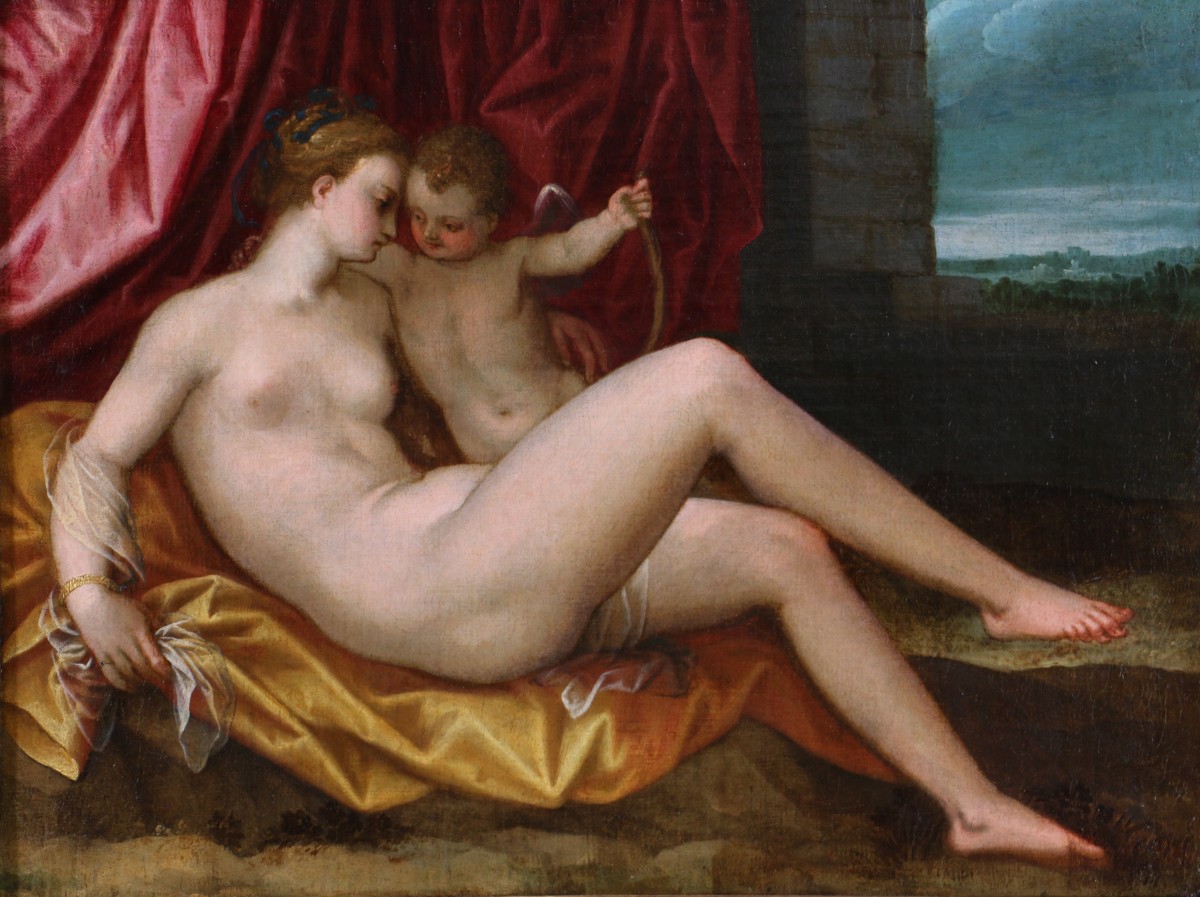
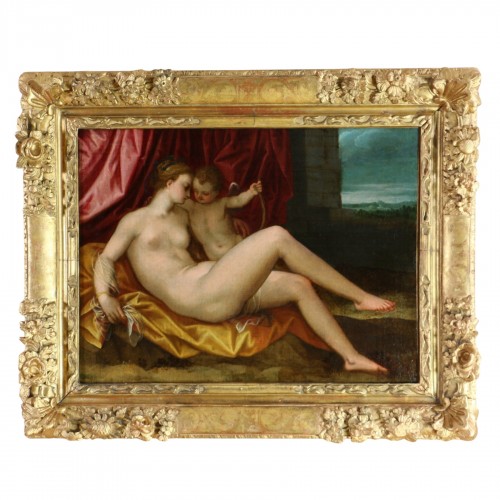
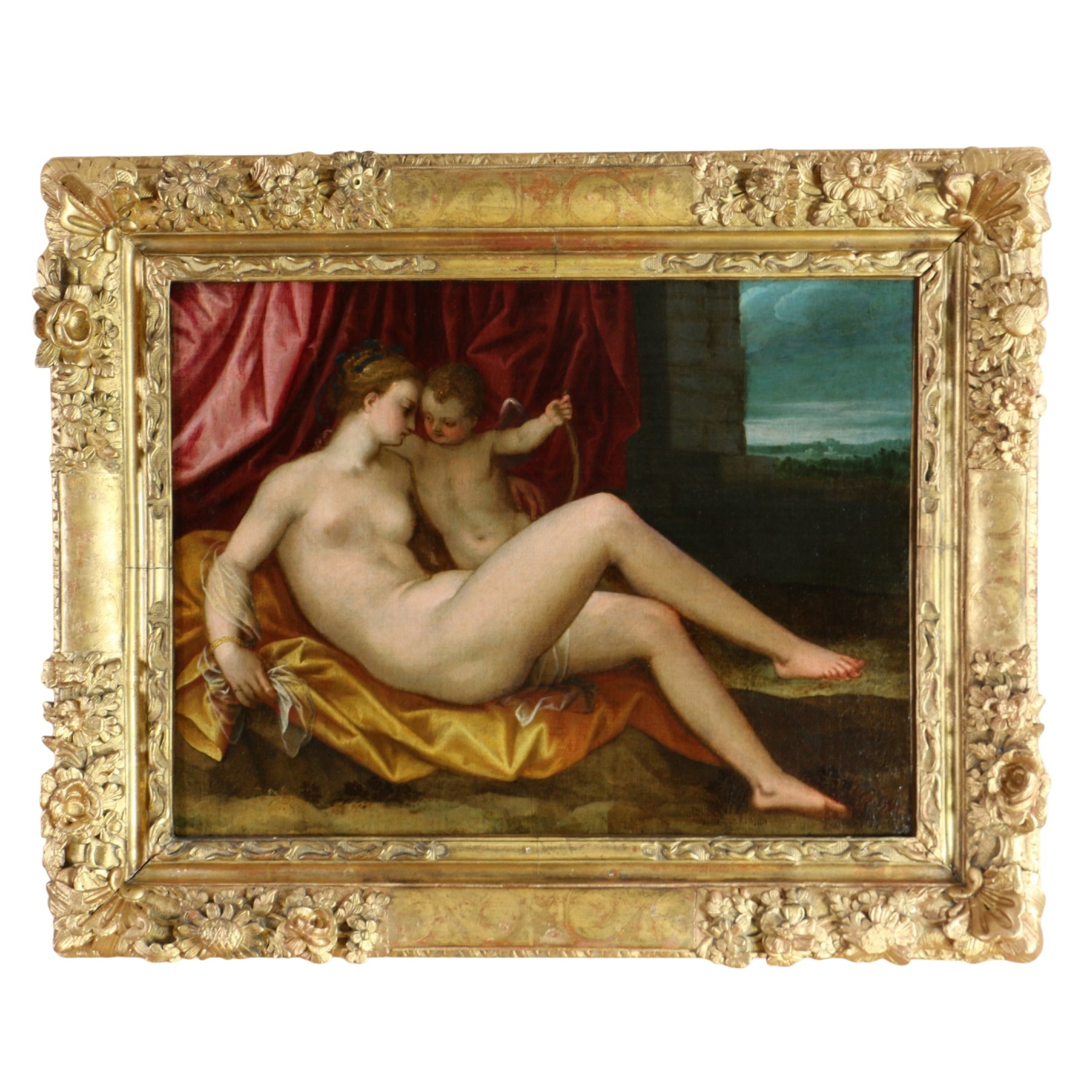
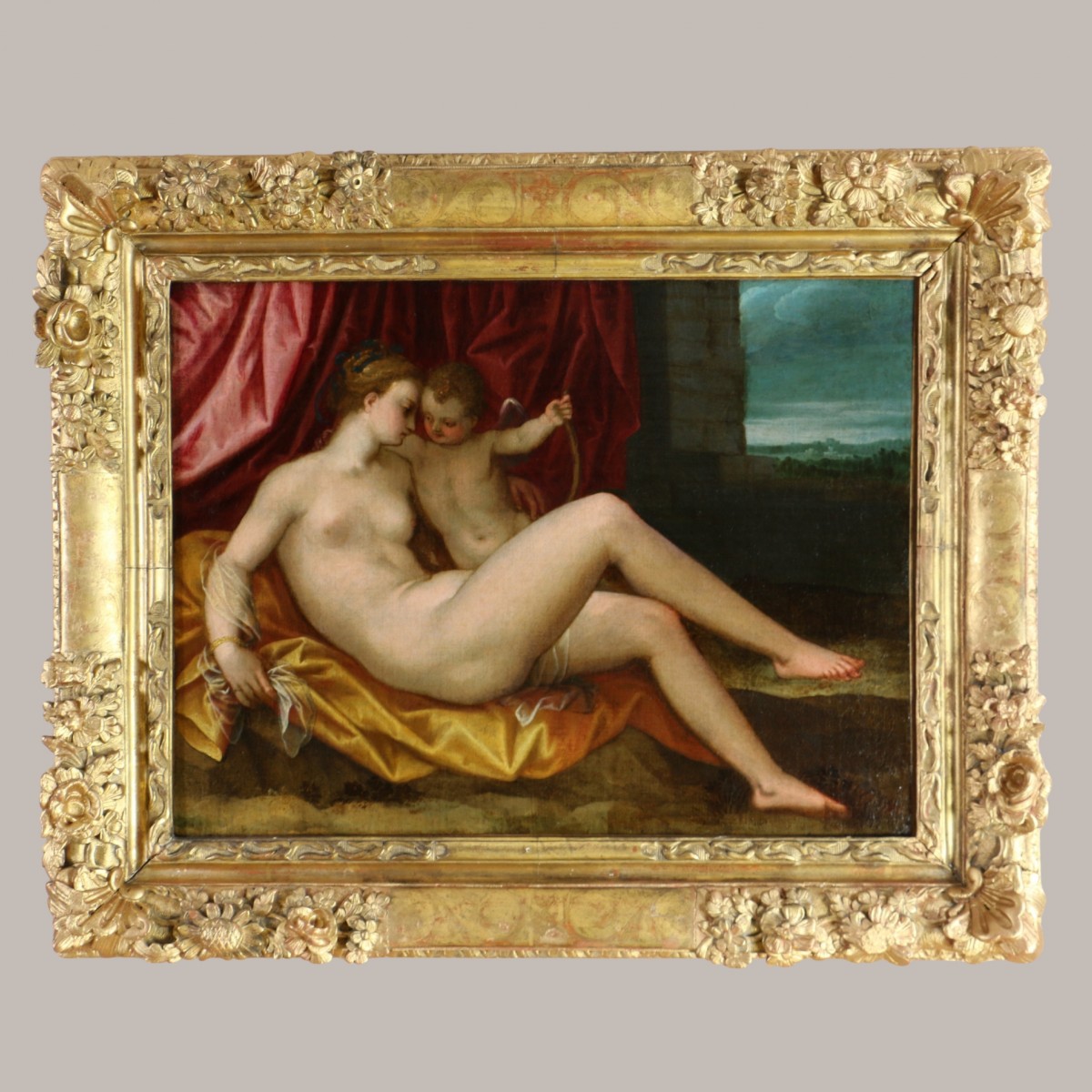
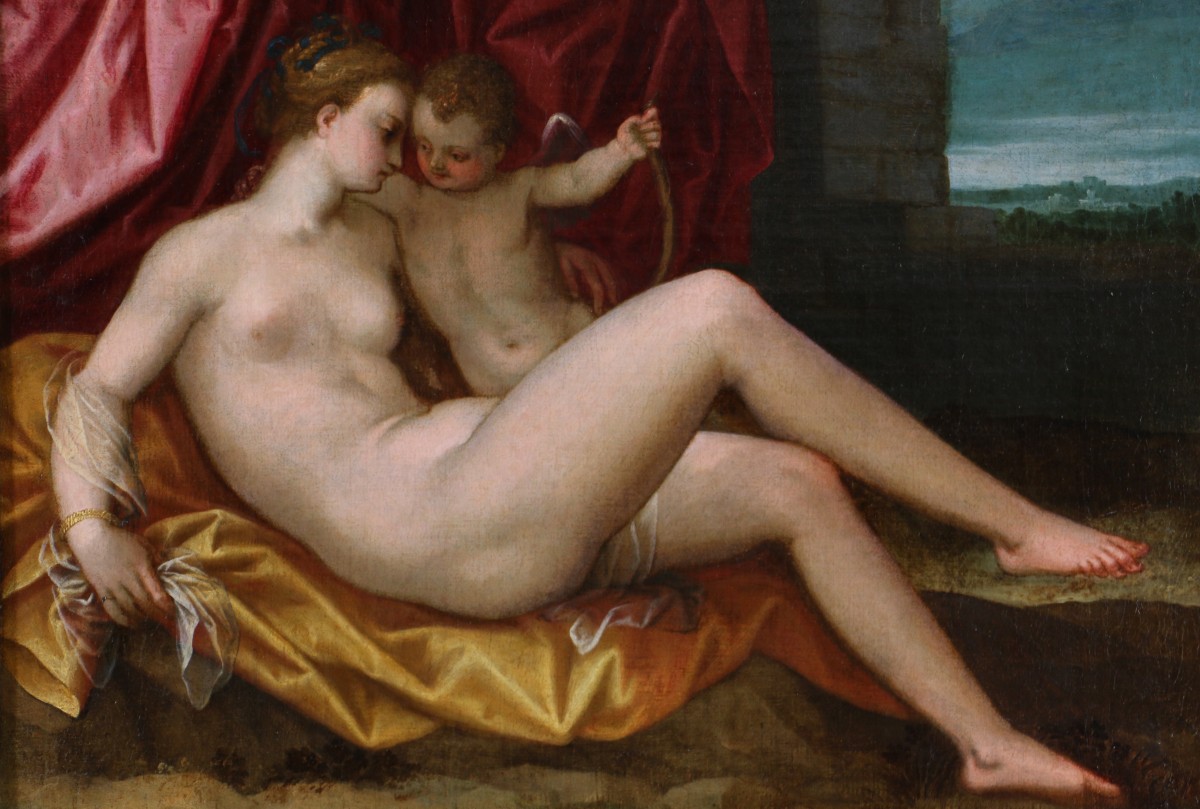
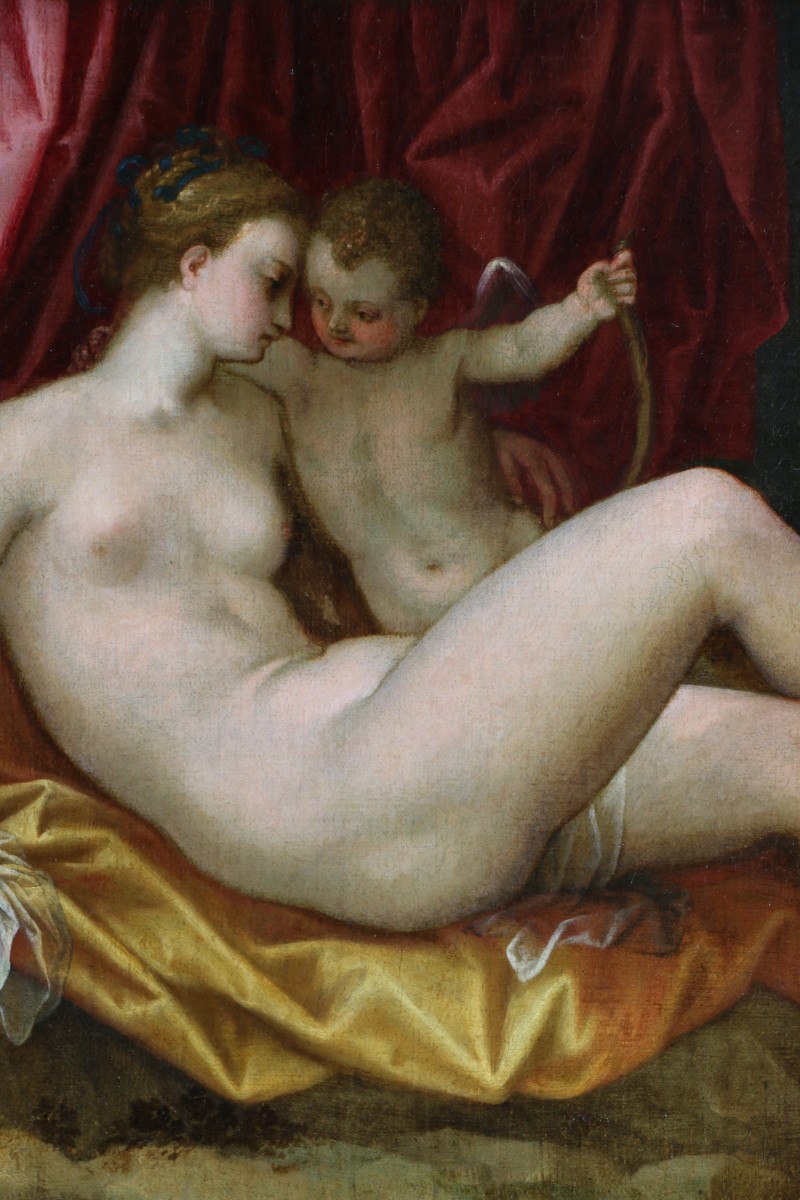
Venetian School, c. 1550, workshop of Titian. Venus and Cupid.
Relined canvas, 68.5 cm by 52 cm.
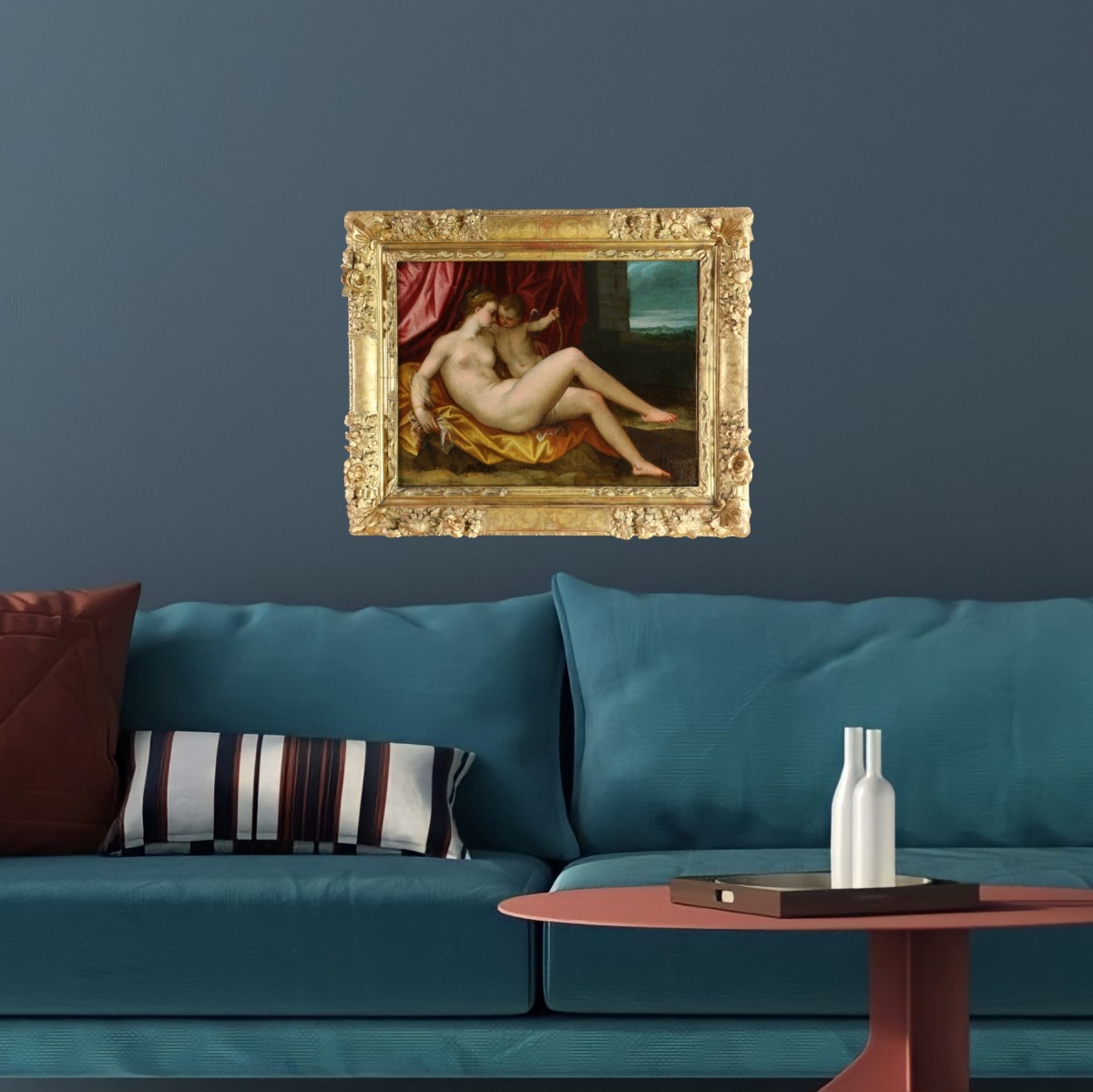
Antique frame measuring 88 cm by 72 m.
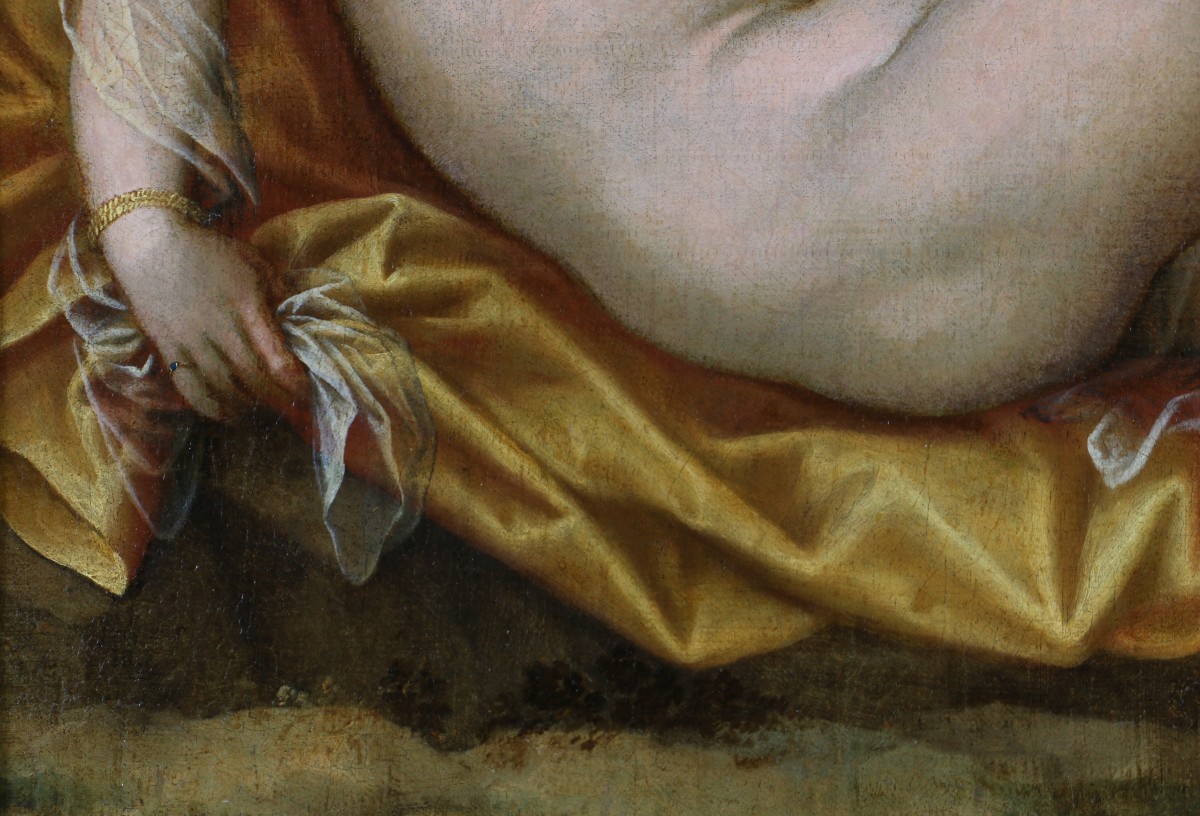
Illegible monogram in the lower left corner
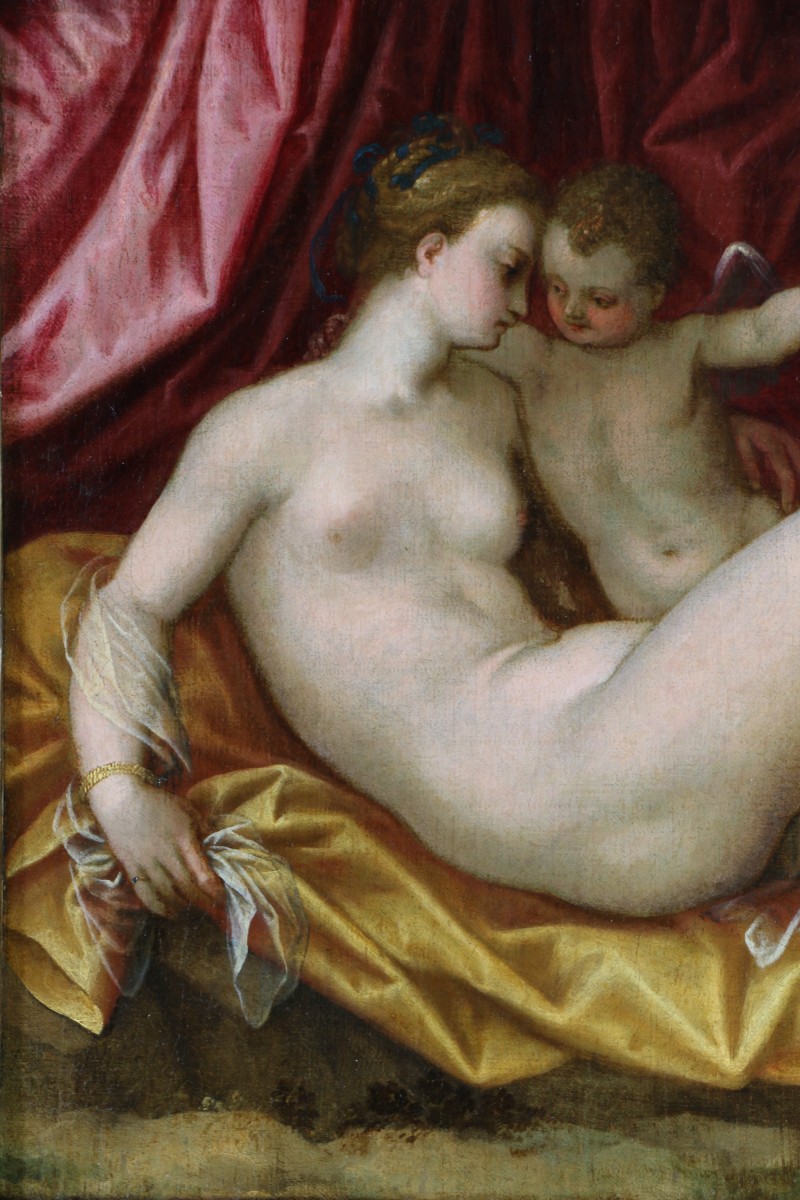
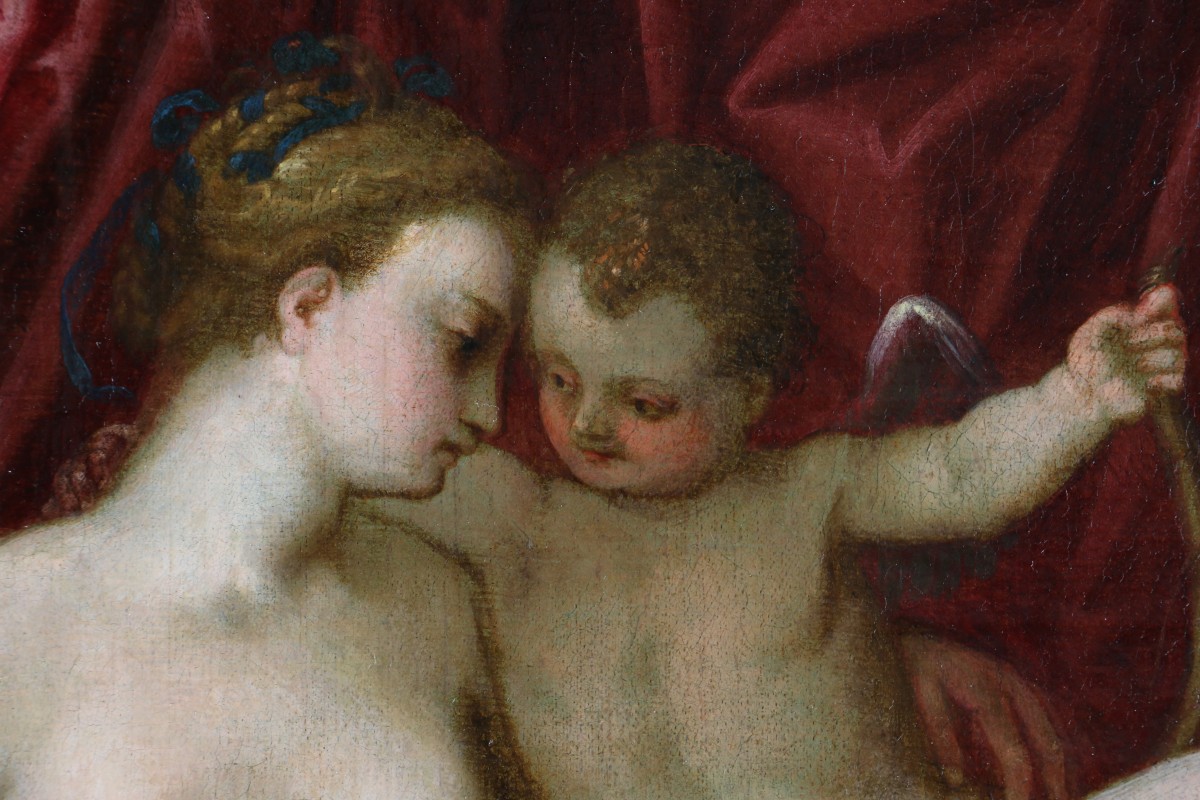
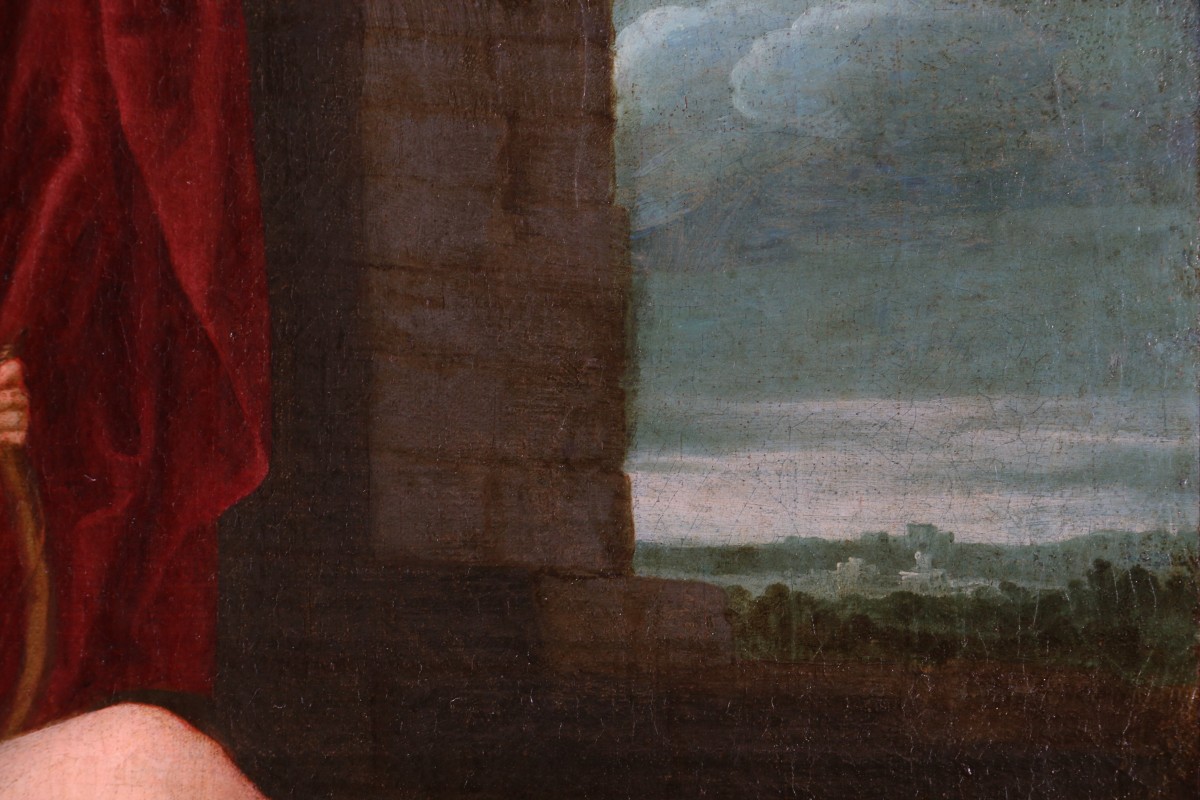
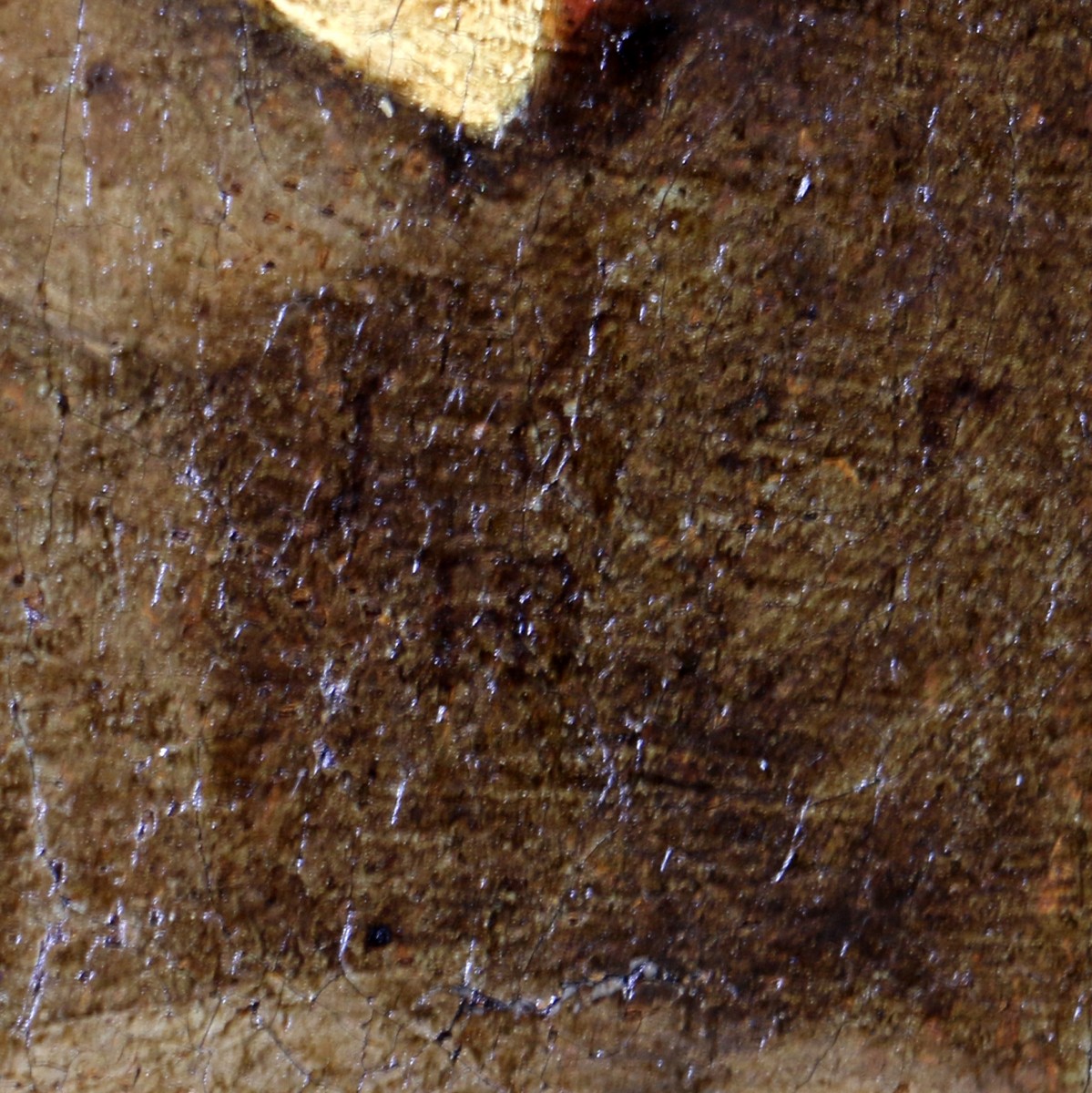
In a theatrical interior opening onto a landscape,a young nude woman is depicted reclining, accompanied by Cupid. Stretched outon rich fabrics in warm tones, she strikes a pose that is bothrelaxed and artfully composed: her upper body slightly raised, one legbent and the other extended, forming a long diagonal that structuresthe entire scene.The sophistication of her hairstyle, adorned withblue ribbons, as well as her jewelry—a bracelet and a ring—accentuate theprecious and sensual nature of the depiction. The deep red of thewall hanging and the golden-yellow drapery form a colorful setting around thefigure’s fair complexion. The view of the landscape on the right addsdepth and light to this composition, which is centered primarily on thefemale nude.Through its subject matter, its color palette, and above all thedesign of the reclining figure, the work follows in the tradition of the Venetianfemale nude developed by Titian and his workshop in the mid-16th century.In particular, it bears a remarkable resemblance to the first *Danaë*painted by Titian for Cardinal Alessandro Farnese in 1544–1545,now in the Museo e Real Bosco di Capodimonte in Naples. In this firstversion, Danaë is also accompanied by Cupid and adorned with a bracelet anda ring.The similarity pertains more specifically to theconstruction of the body: the positioning of the torso, the raised knee, the extensionof the leg, the modeling of the abdomen, and the figure’s overall posture. Thecomposition, however, is not a copy of the Danaë. TheTitianesque model appears here to have been freely reinterpreted and adapted for adepiction of Venus and Cupid.This practice of creating variations on the female nudeis characteristic of the work of Titian and his circle. During the1550s, the master developed several compositions combining a reclining Venus,Cupid, and a view of a landscape, the various versions of whichattest to the circulation and transformation of models within hisstudio.The work can thus be dated to theVenetian art scene around 1550, in Titian’s studio or immediate circle, at atime when the master’s mythological inventions were undergoing numerousvariations and reinterpretations.Traces of earlier layers, now difficult todistinguish, are visible in the paint layer in the lower left corner.Their state of preservation does not, at present, allow for adefinitive interpretation.
Titian’s WorkshopIn the mid-16th century
Titian (c.1488/1490–1576) ran a particularly active studio in Venice,fulfilling numerous commissions from Italian and European clients.Working alongside the master, several assistants participated in the execution of thepaintings and had access to a vast repertoire of compositions and modelscreated by Titian.Mythological subjects and female nudeswere among the motifs most frequently reworked and adapted bythe studio. A single figure could thus be transposed into a newcomposition, with changes to gestures, accessories, drapery, orthe landscape.The first *Danaë*, painted by Titianfor Cardinal Alessandro Farnese in 1544–1545, is one suchmajor model. The motif of the reclining nude woman was revisited and transformedin several later compositions by the master and his associates.The term “Titian’s Workshop” thus refersto a work produced within the painter’s immediate circle andclosely dependent on his artistic innovations, even when the master’s personalinvolvement cannot be established.In this *Venus and Cupid*,dated around 1550, the conception of the female nude and its remarkableresemblance to the model of the Farnese Danaë allow us to situatethe work within this context of dissemination and reinterpretation ofTitian’s artistic innovations.
Delevery information :
All our paintings benefit from careful and secure packaging. No geographic restrictions.