Offered by Galerie Nicolas Lenté

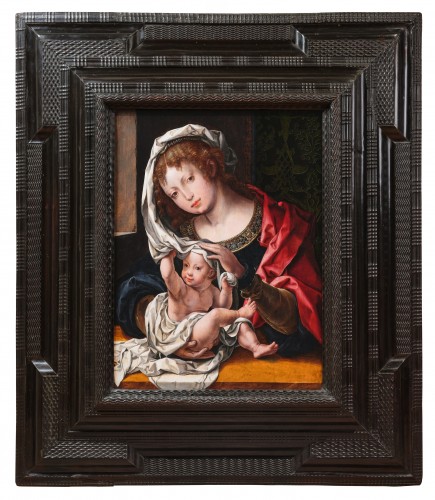
Virgin and Child
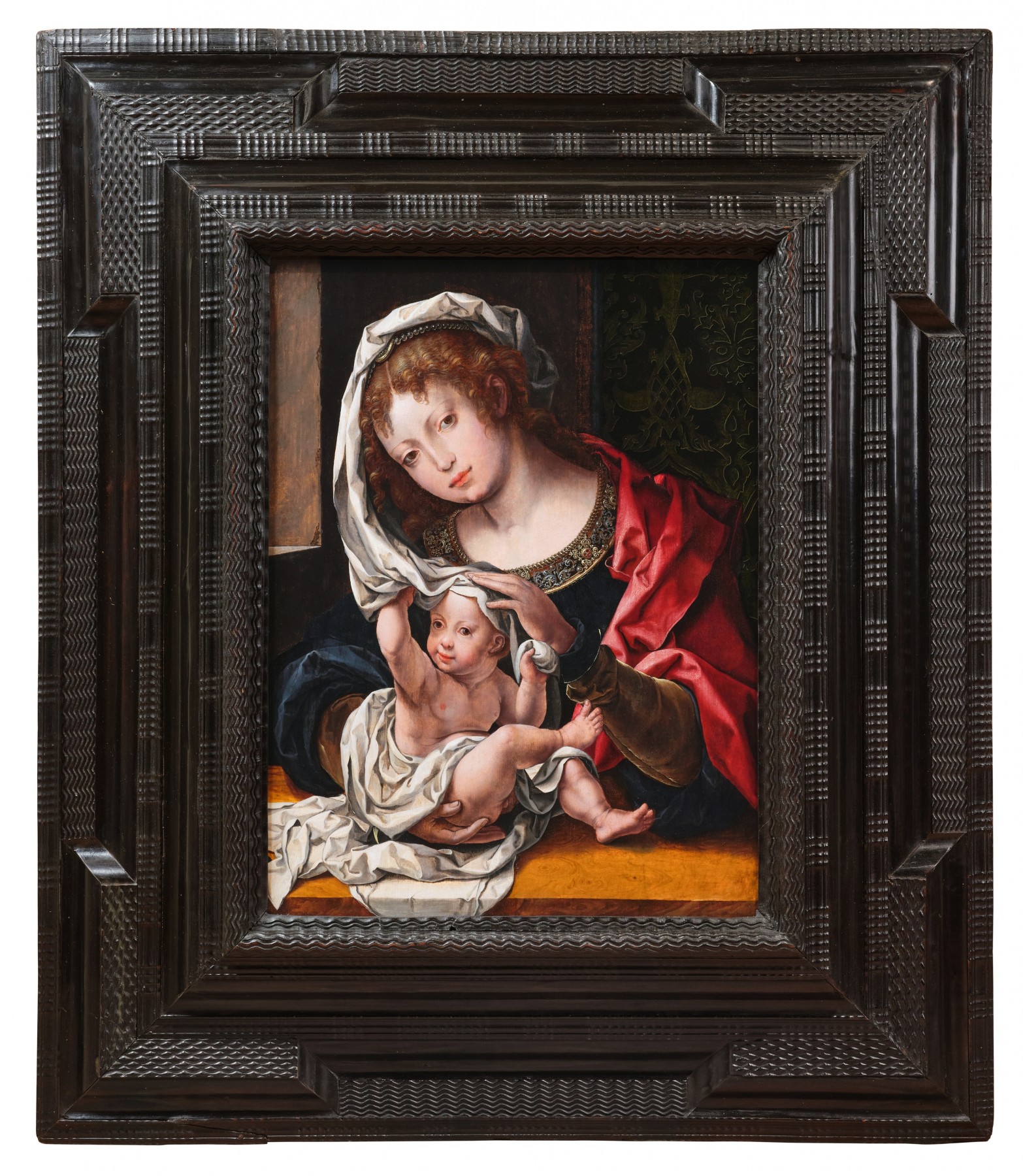
Workshop of Jan Gossaert, known as Mabuse (Maubeuge 1478–1532 Antwerp)
Antwerp, 16th first half of the 16th century
Oil on oak panel
Dimensions: h. 57 cm, w. 42.5 cm
Rare 17th-century blackened wooden frame with moulded, undulating, reverse-profiled decoration
Framed dimensions: 96 x 83 cm
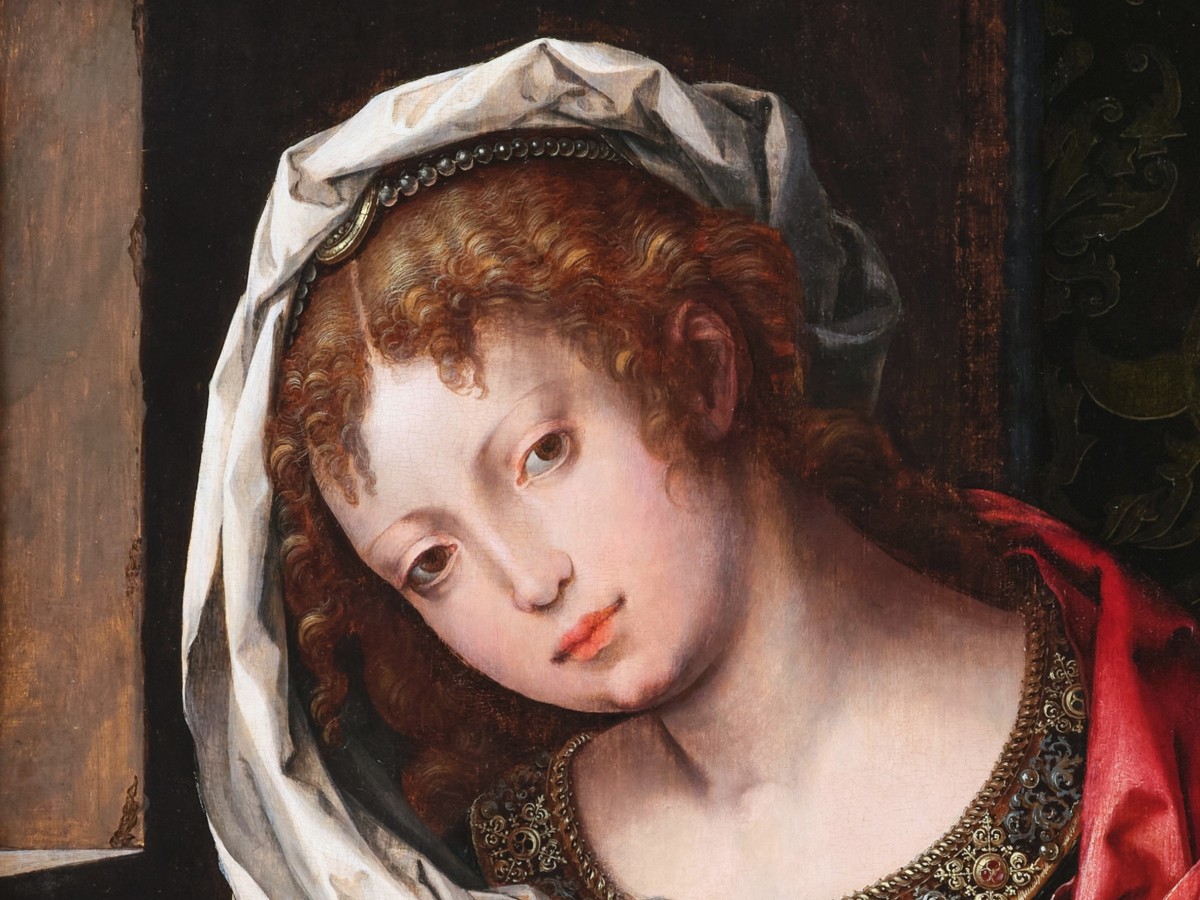
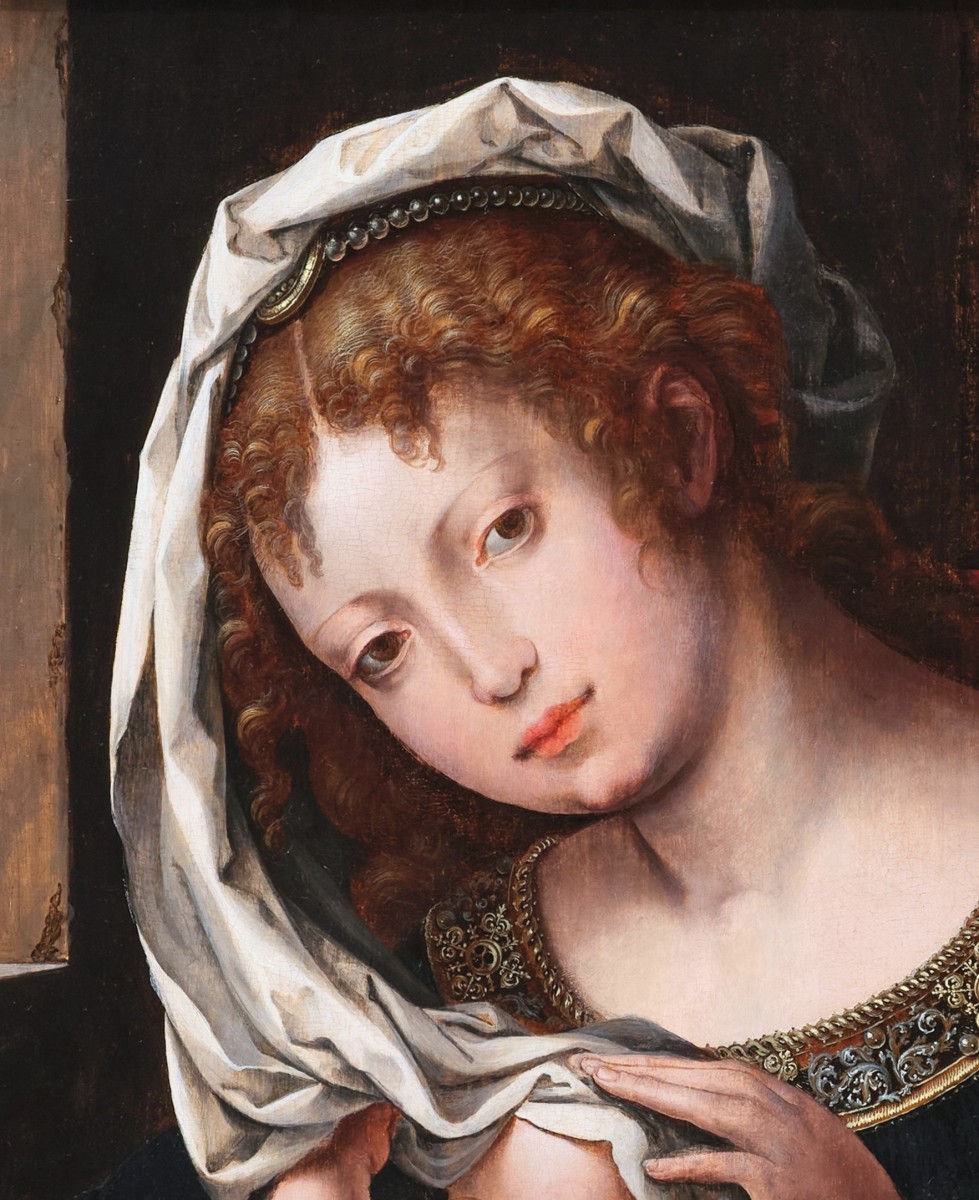
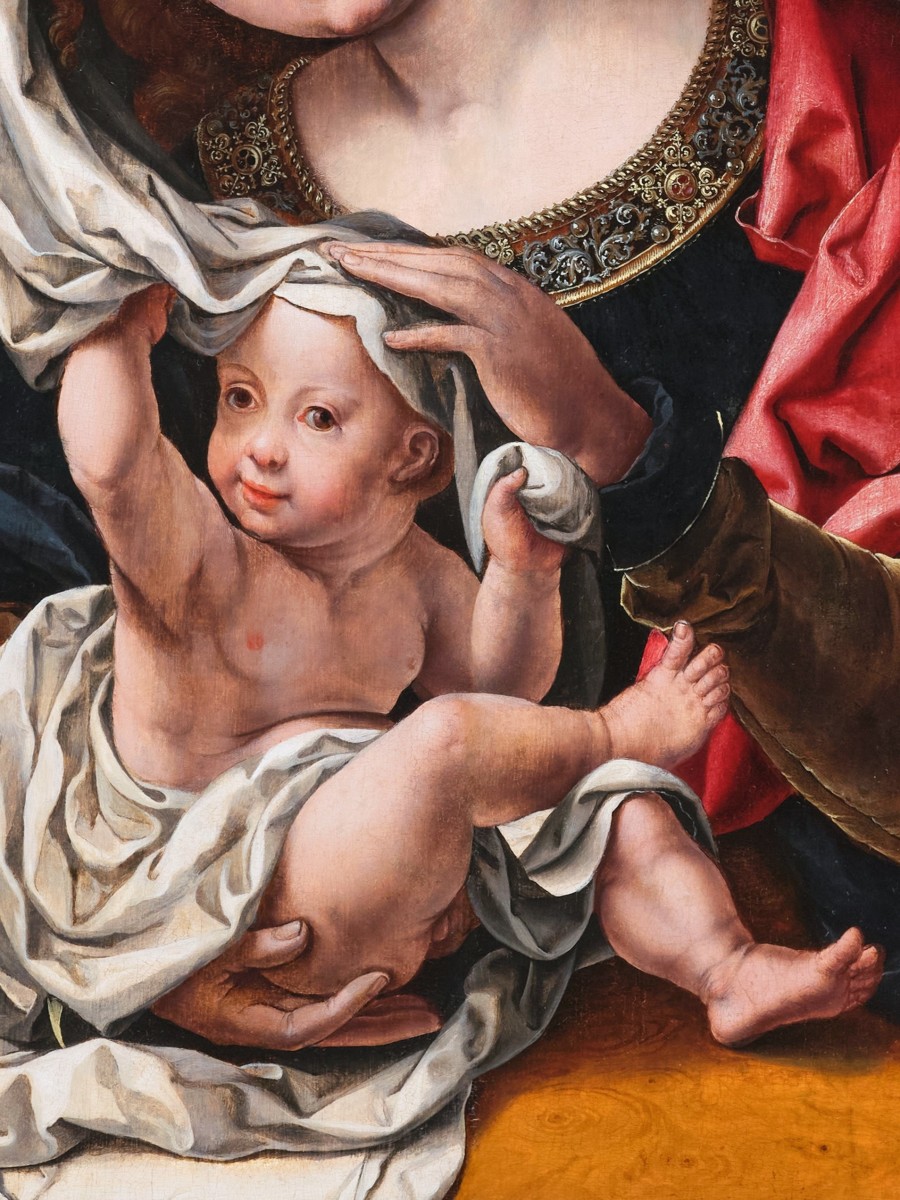
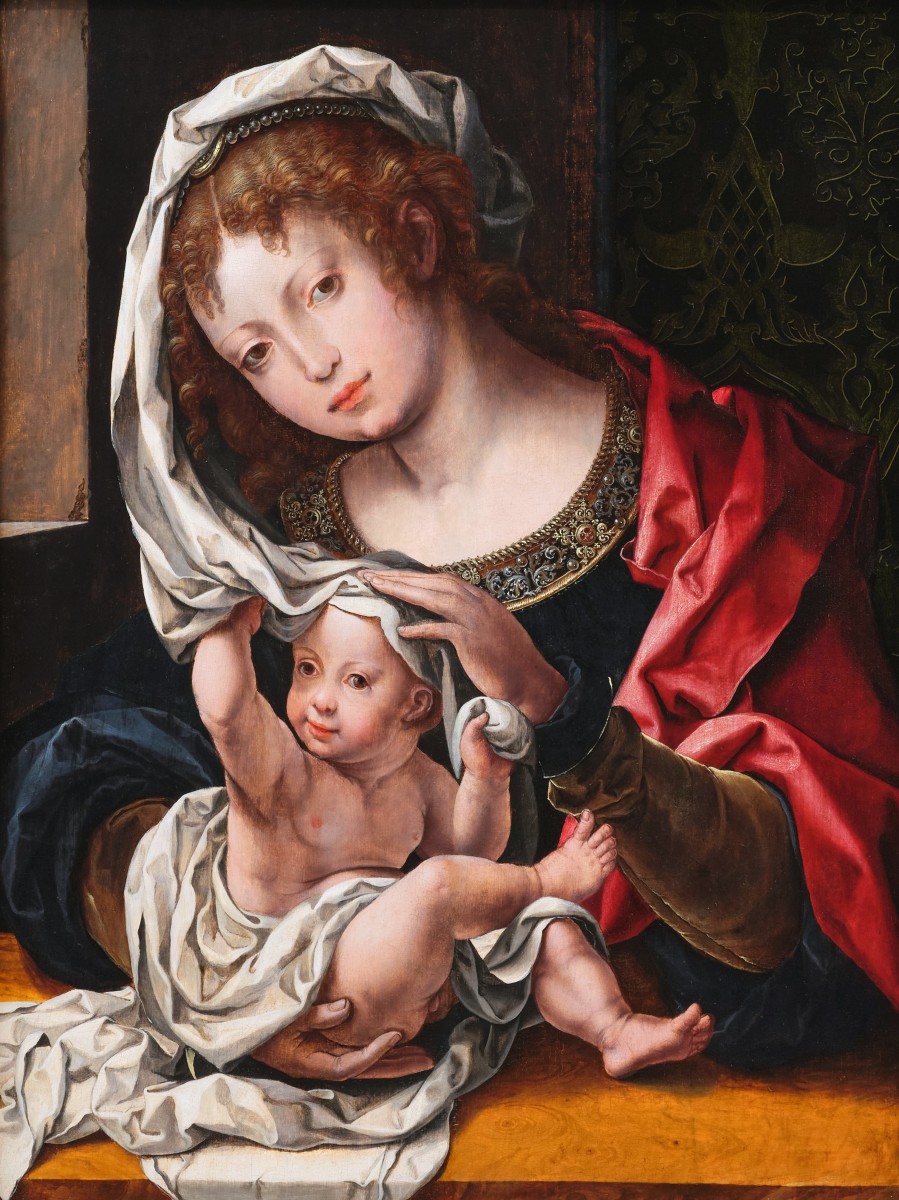
All the delicacy that 16th-century Flemish painting can offer is concentrated in this tender Virgin and Child, where the solemnity of the devotional image is combined with the spontaneity of a maternal gesture.
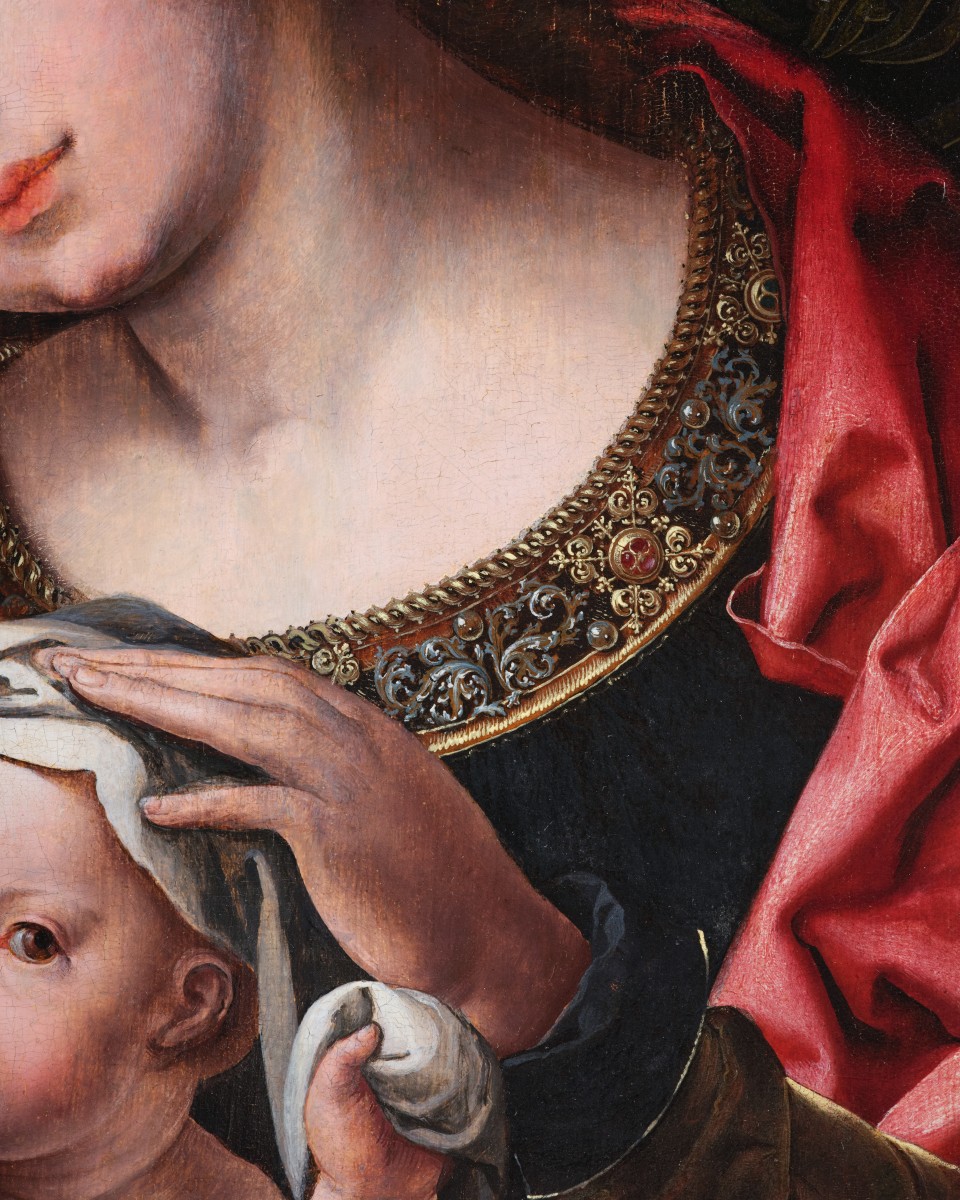
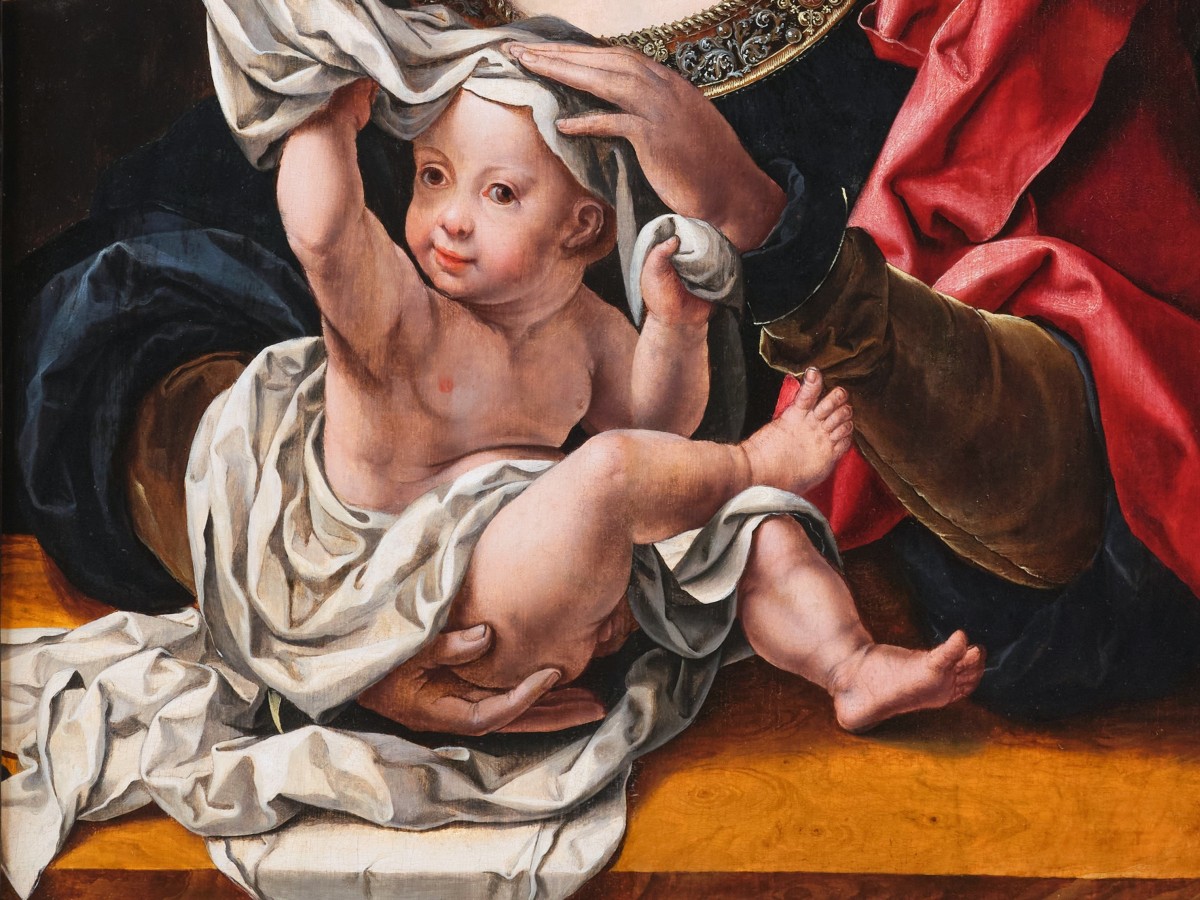
Slightly leaning towards her Child, the Virgin supports him with infinite tenderness, while he, in a wholly natural movement, plays with her veil. This game of peekaboo, of great simplicity, lends the scene a particularly touching sense of intimacy and humanity. The Virgin’s gaze, directed towards the viewer, further reinforces this silent sense of proximity. The grace of the composition also lies in the Virgin’s refined gestures: the delicacy with which her hands accompany the Child and hold back her veil conveys an almost choreographic elegance, characteristic of this pictorial tradition.
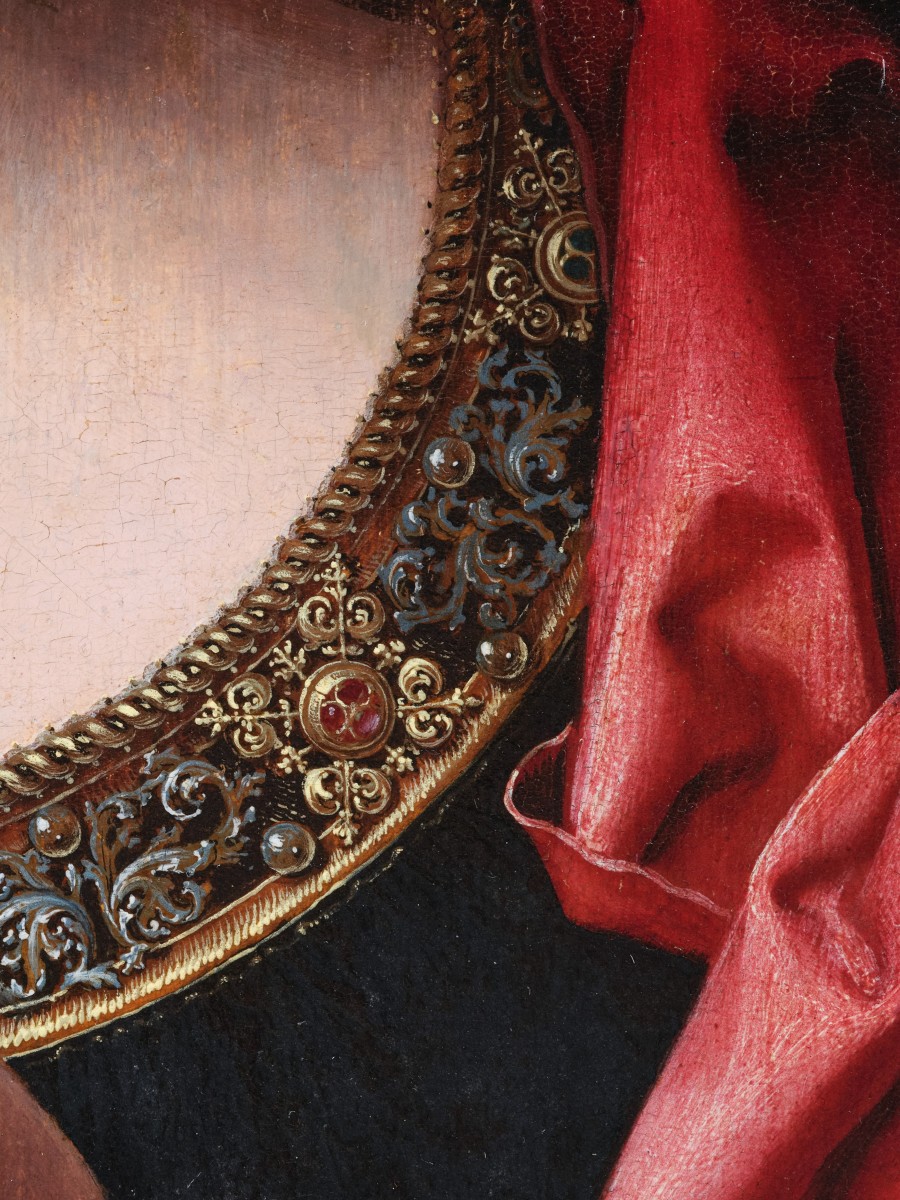
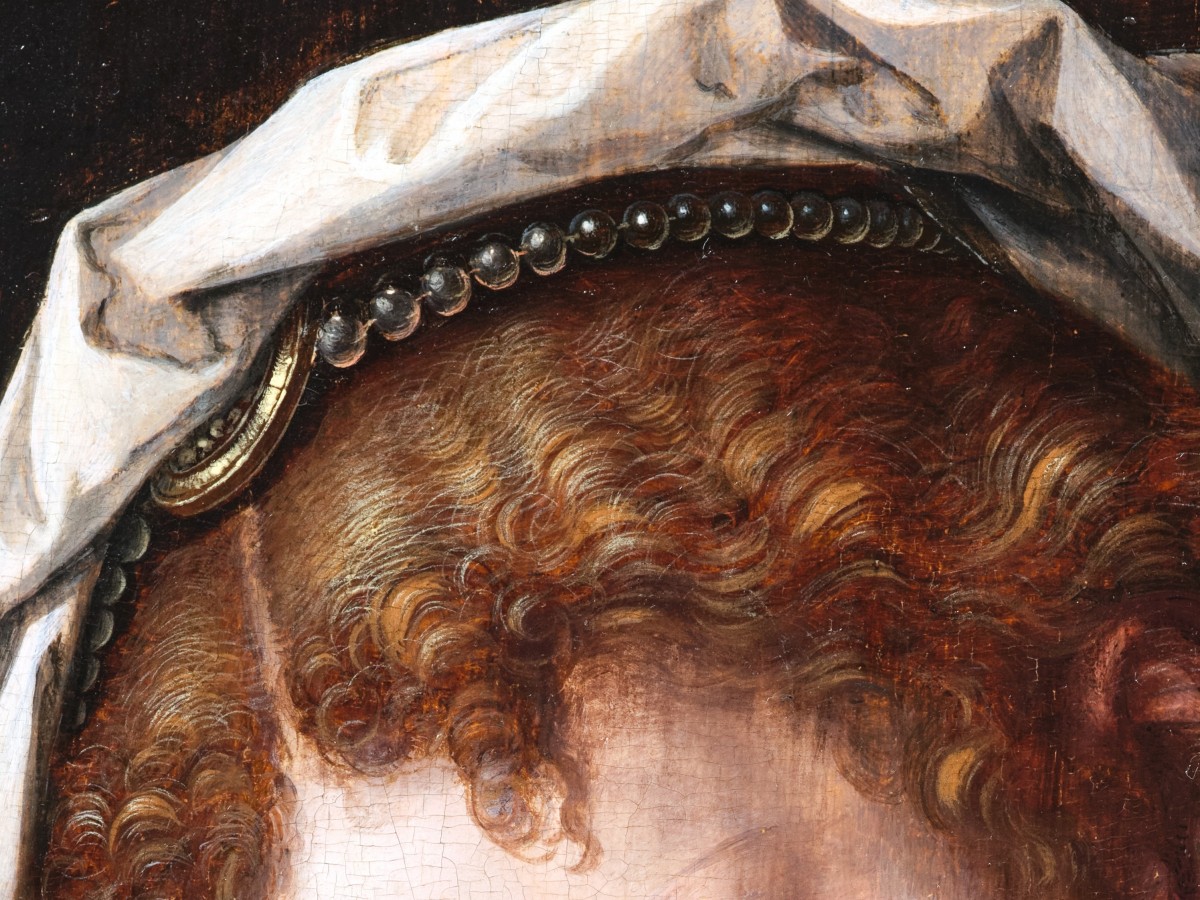
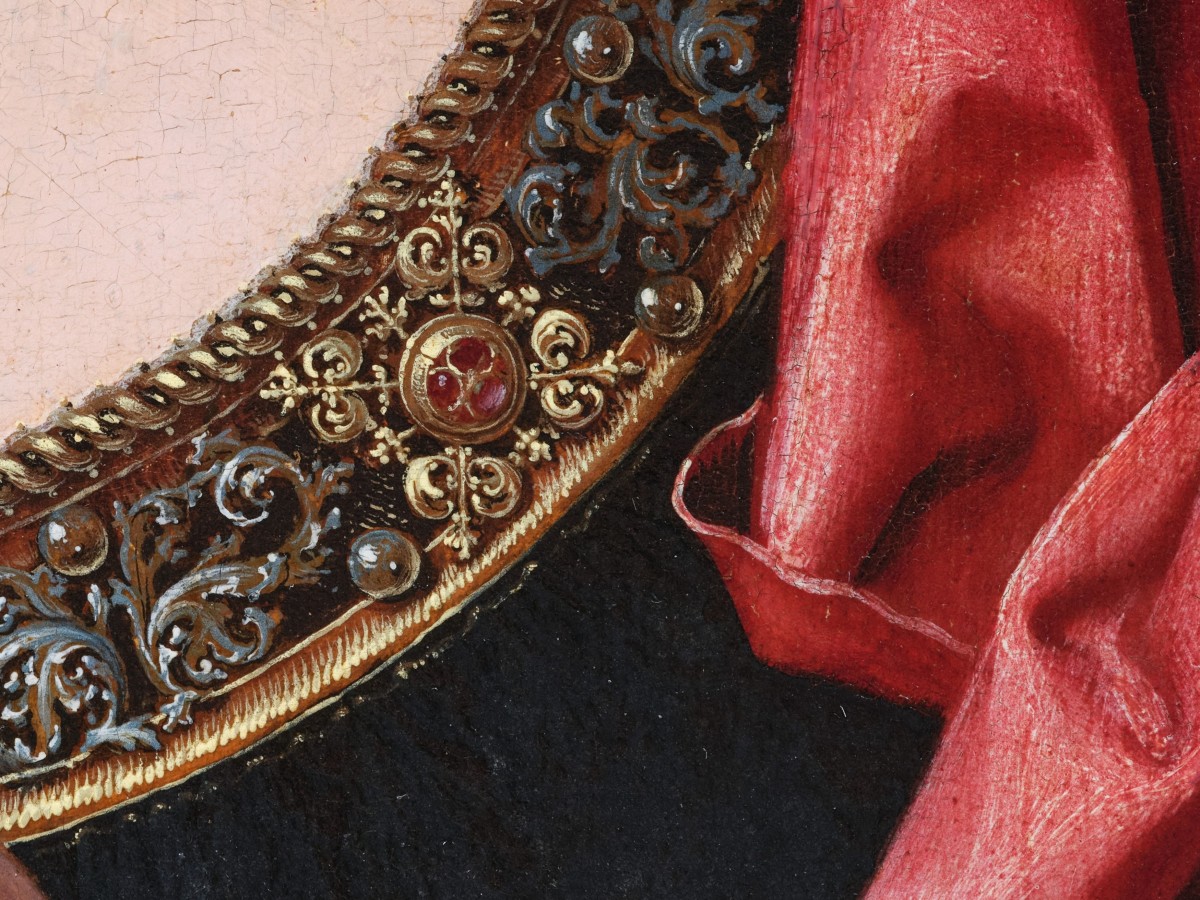
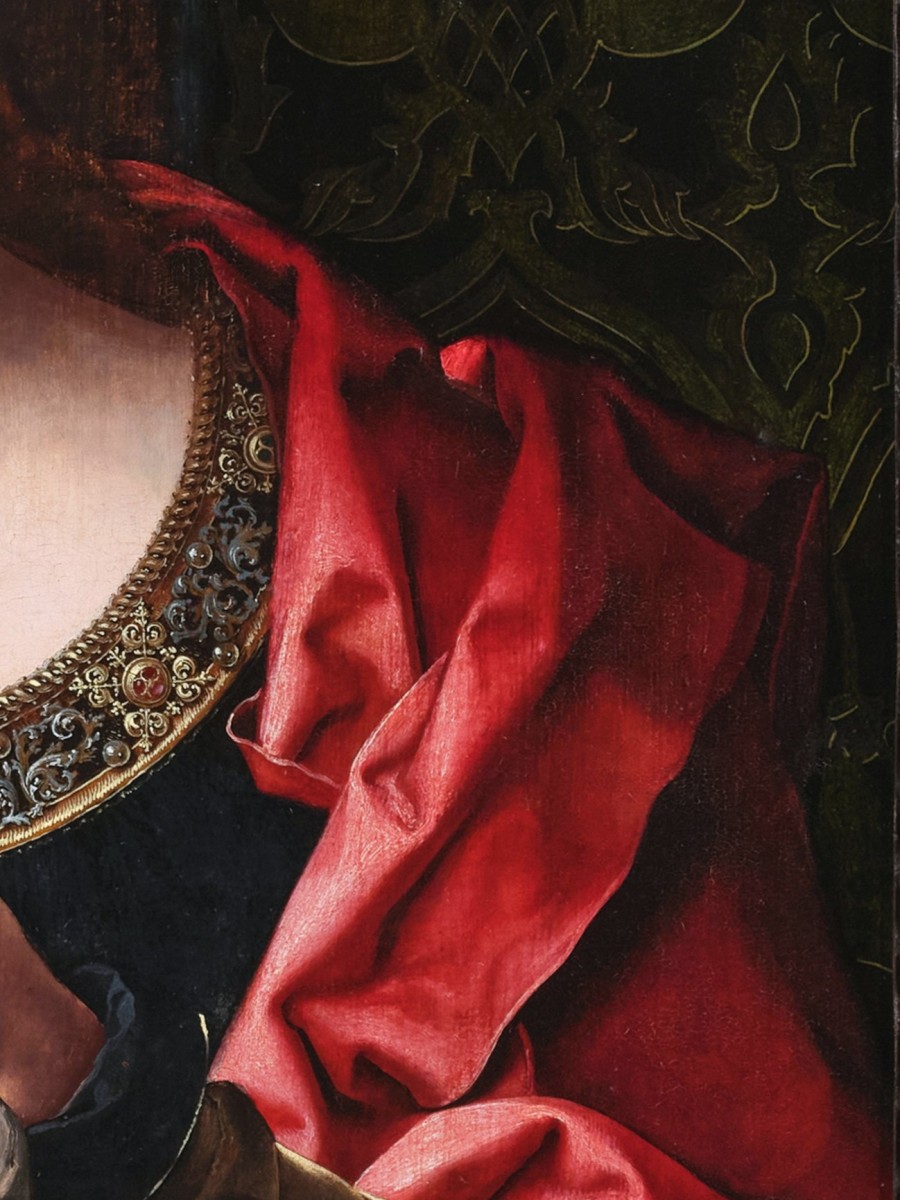
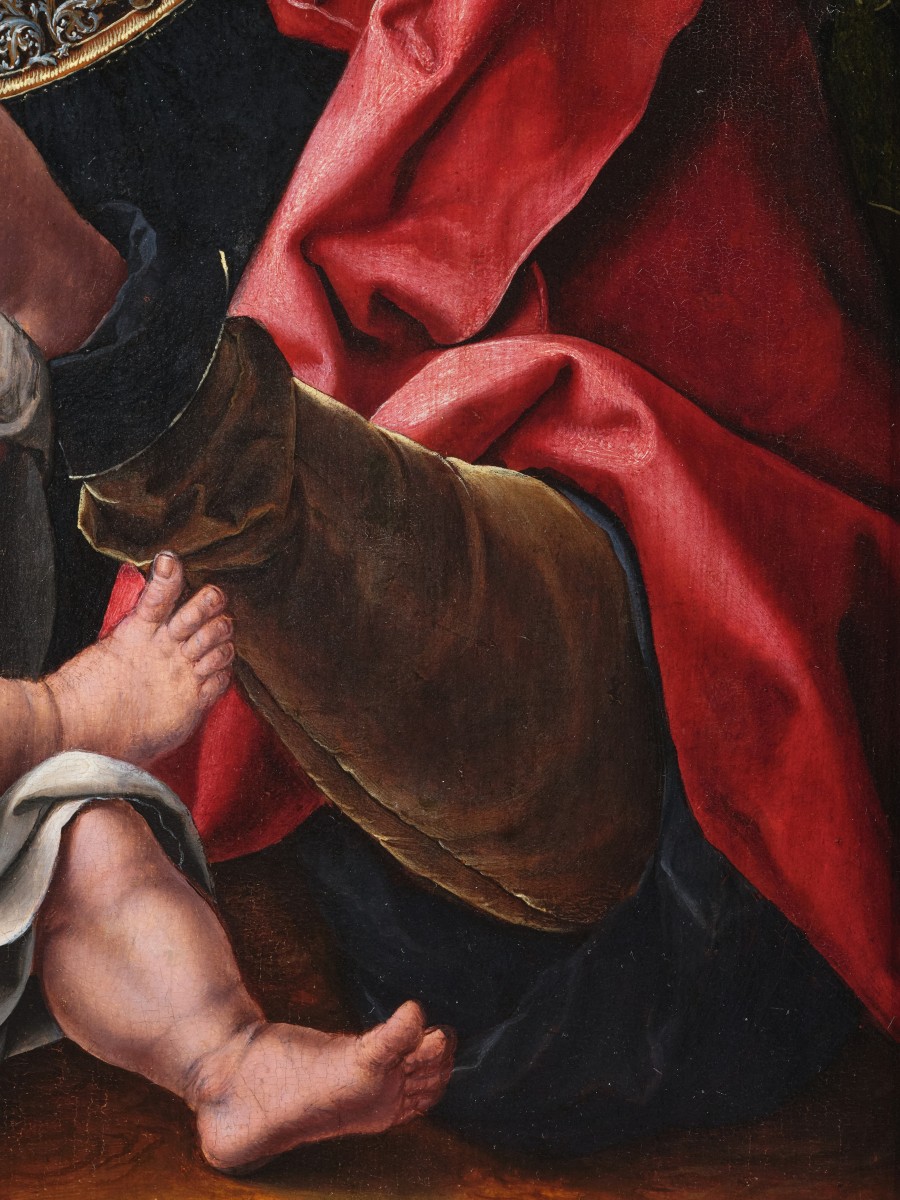
The richness of Mary’s attire bears witness to the exceptional refinement sought by the artist. Her sumptuous red mantle, with its deep, luminous folds, contrasts with the dark dress, whose neckline is enhanced by precious embroidery of pearls and ornamental motifs, executed with great meticulousness. The blue-grey velvet sleeves lend a profound nuance to the whole and likewise testify to the care devoted to the rendering of textures. In her delicately curled Venetian-blonde hair, an elegant pearl diadem adorned with a medallion stands out.
But it is above all the large white veil, rendered with remarkable attention to the effects of light, that gives the composition its distinctive character. Its abundant folds frame the Virgin’s face, envelop the Child and unfold towards the foreground, almost abolishing the distance between the sacred figures and the viewer. The immaculate white of the veil thus echoes Mary’s purity, while the brilliant red of her mantle traditionally evokes Christ’s future Passion.
The presence of the Child, plump and full of life, lends this sacred image a particularly appealing emotional dimension. His mischievous gesture, his gaze turned towards the viewer and his close contact with his mother transform the scene into a genuine moment of family complicity.
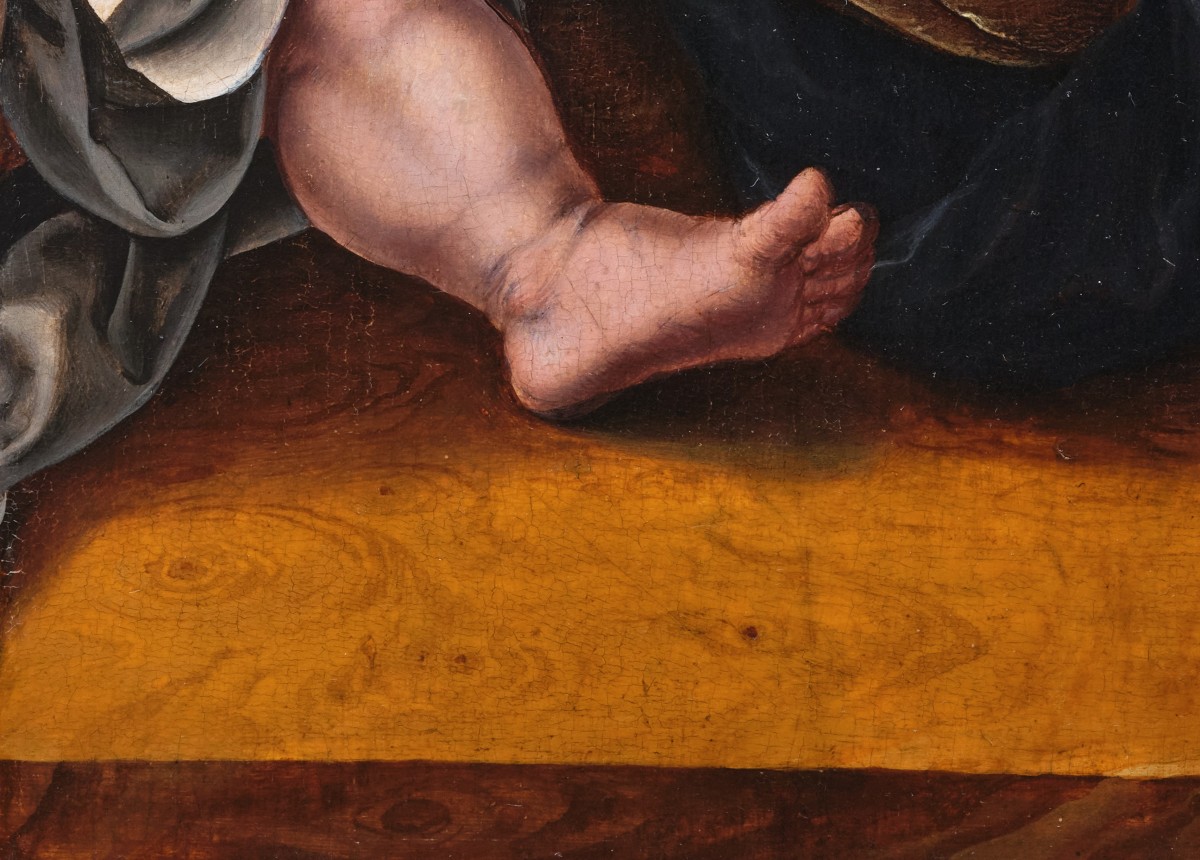
The setting fully contributes to this pursuit of realism and preciousness. The Virgin is seated within a carefully constructed architectural interior, where, on the left, one can distinguish a window whose stone surround, marked by erosion, is rendered with great precision, down to the small breaks, chips and irregularities of the material. The natural light entering through this opening gently models the faces, flesh tones and fabrics, creating subtle effects of light and shadow. In the background, a rich dark-green brocade, animated by ornamental motifs, forms an elegant textile backdrop behind the Virgin. The Christ Child is delicately placed upon a wooden table, whose top, visible in the foreground, reveals particular attention to the material, down to the precise rendering of the wood grain. This meticulous observation of detail, even in the most modest elements of the setting, bears witness both to the artist’s talent and to that particularly painstaking taste for observing the visible world encountered in some of the most refined works of Flemish painting.
Our work belongs to a group of related paintings, all derived from a now-lost model. The original of this composition of the Virgin with the Veil was painted by Jan Gossaert, known as Mabuse (c. 1478–1532), one of the first artists to introduce the Italian Renaissance style into Antwerp painting.
Another work by the master, the Virgin and Child preserved at the Mauritshuis in The Hague (inv. 830), has enabled art historians to confirm this attribution. The presence in this work of the same motif of the Child playing with his mother’s veil indeed constitutes a particularly significant element of comparison.
Intended for private devotion, these compositions sought less monumentality than emotional proximity to the holy figures. The close framing, the sumptuousness of the fabrics and the gentleness of the gestures all contribute here to creating an image that is both precious and deeply intimate.
Through its decorative elegance, the refinement of its execution and, above all, the tenderness that unites the Virgin and Child, this work offers a particularly appealing interpretation of an emblematic theme of early 16th-century Flemish painting.
Related works:
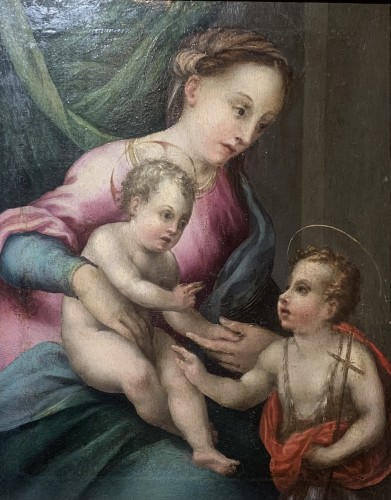
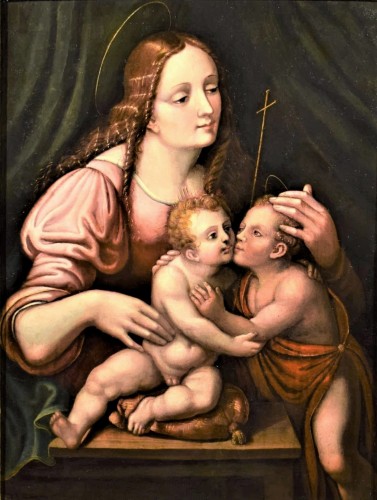
- Jan Gossaert, known as Mabuse, Virgin and Child — oil on panel, 25.4 × 19.3 cm, Mauritshuis, The Hague.
- Jan Gossaert, known as Mabuse (workshop of), Virgin with the Veil — wood, 59 × 46.5 cm, Royal Museums of Fine Arts of Belgium, Brussels, inv. 673.
- Jan Gossaert, known as Mabuse (workshop of), Virgin and Child — oil on panel, dimensions not indicated, private collection, Stuttgart (Sotheby’s sale, 2005).
- Jan Gossaert, known as Mabuse (follower of), Virgin and Child — oil on oak panel, 88.5 × 69.5 cm, National Museum in Warsaw, Warsaw.
- Jan Gossaert, known as Mabuse, Virgin and Child — oil on panel, 81 × 67 cm, private collection, Cambi sale, Genoa, Italy, lot no. 109, 2 July 2026.
Delevery information :
We organize the shipping and delivery of our artworks worldwide, working with specialized fine art carriers as well as DHL Express for the secure shipment of small and medium-sized works (up to 120 cm).
Each artwork is carefully packed and shipped in a custom-made transport crate to ensure optimal protection. All shipments are fully tracked and insured.
We pay the utmost attention to every stage of the shipping process to ensure fast, reliable delivery. Shipments via DHL Express are generally dispatched within approximately 7 days of purchase.
All of our artworks can be viewed at our Paris gallery and may also be collected in person.