Offered by Galerie Nicolas Lenté
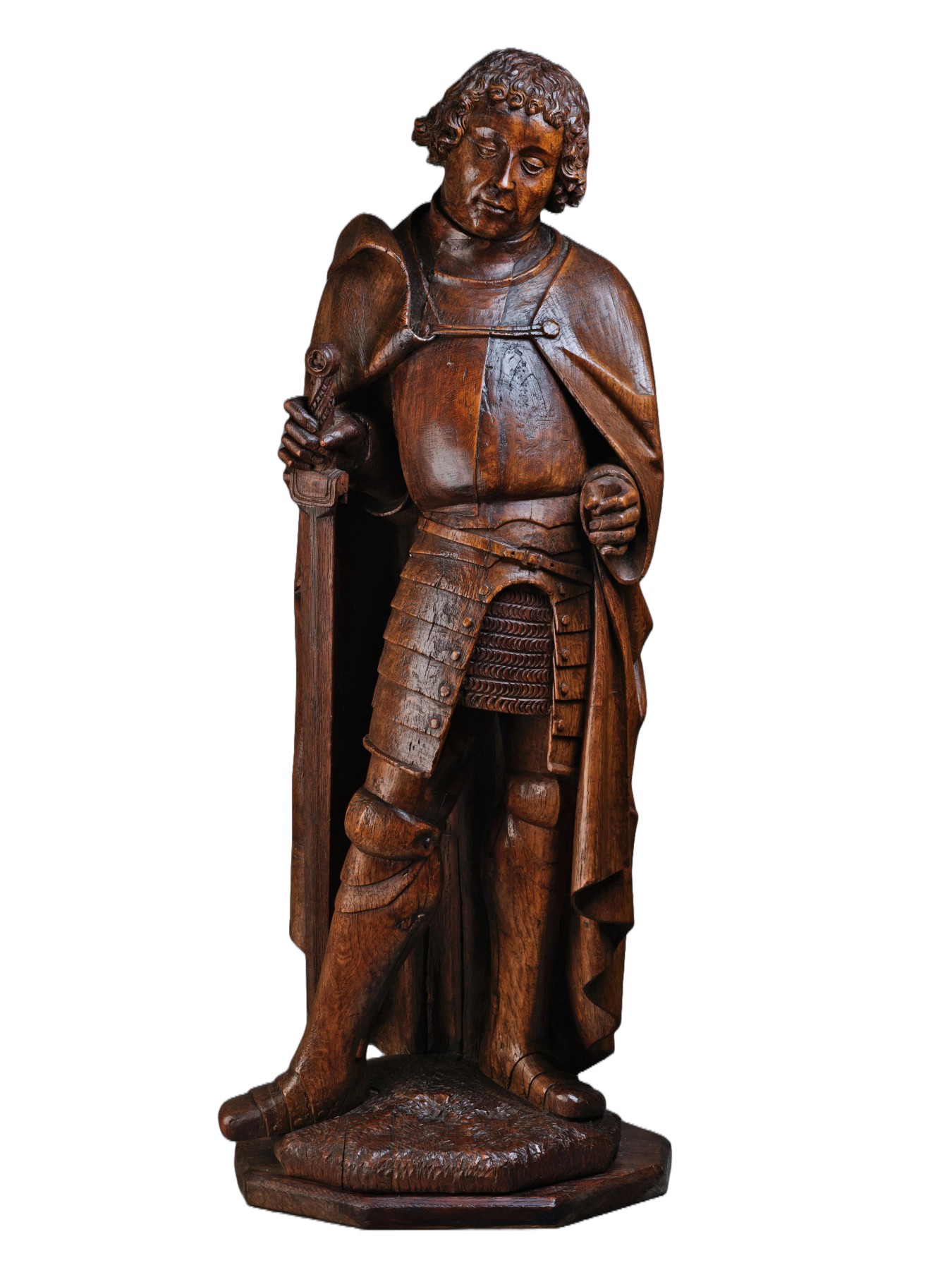

Saint Maurice
Lower Rhine, probably the Cleves region, circa 1500.
Circle of Dries Holthuys, sculptor active in Cleves circa 1490–1510
Oak carved in the round.
Height: 85 cm
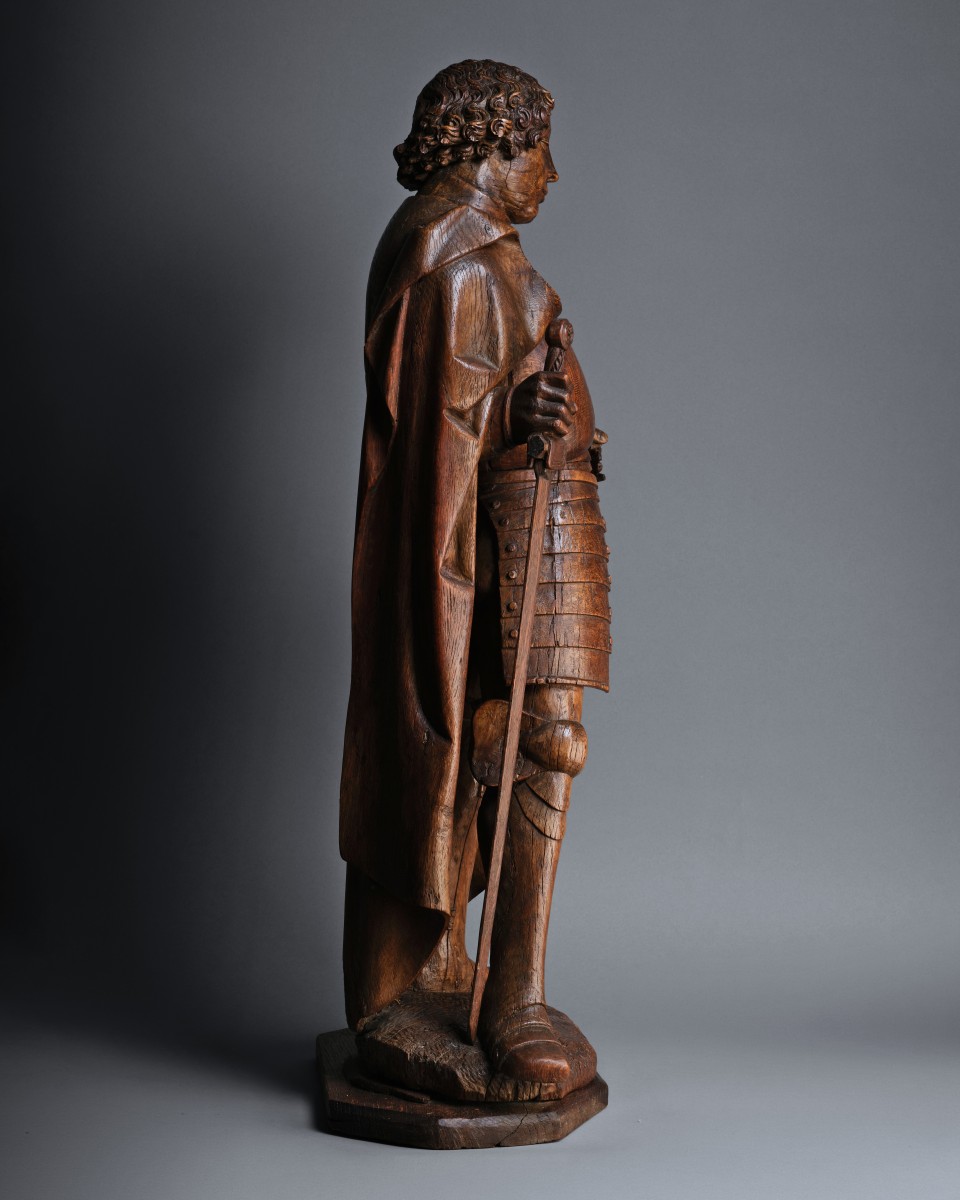
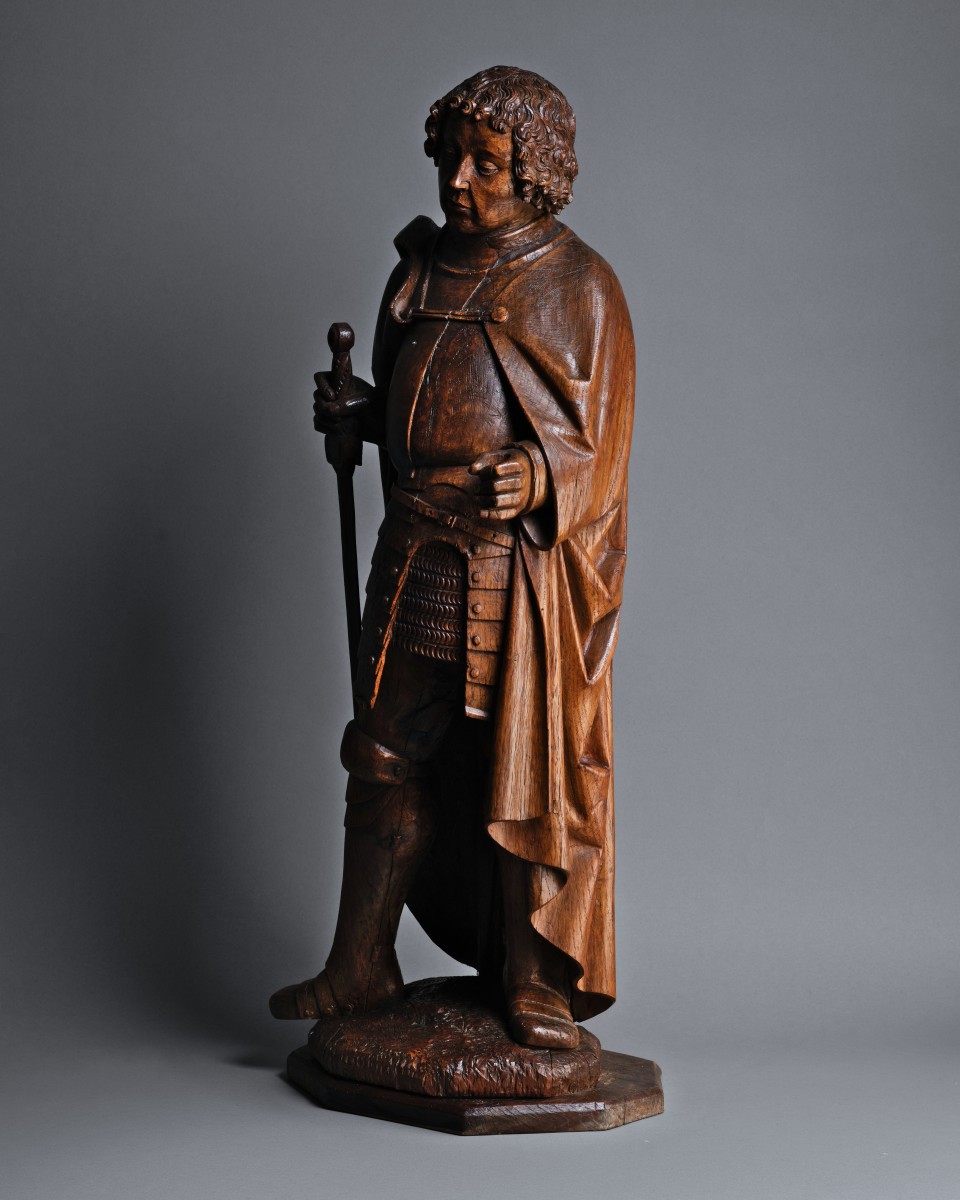
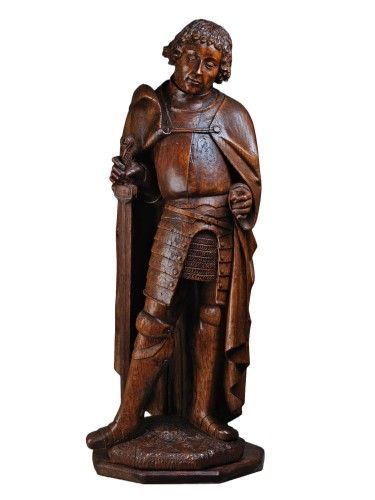
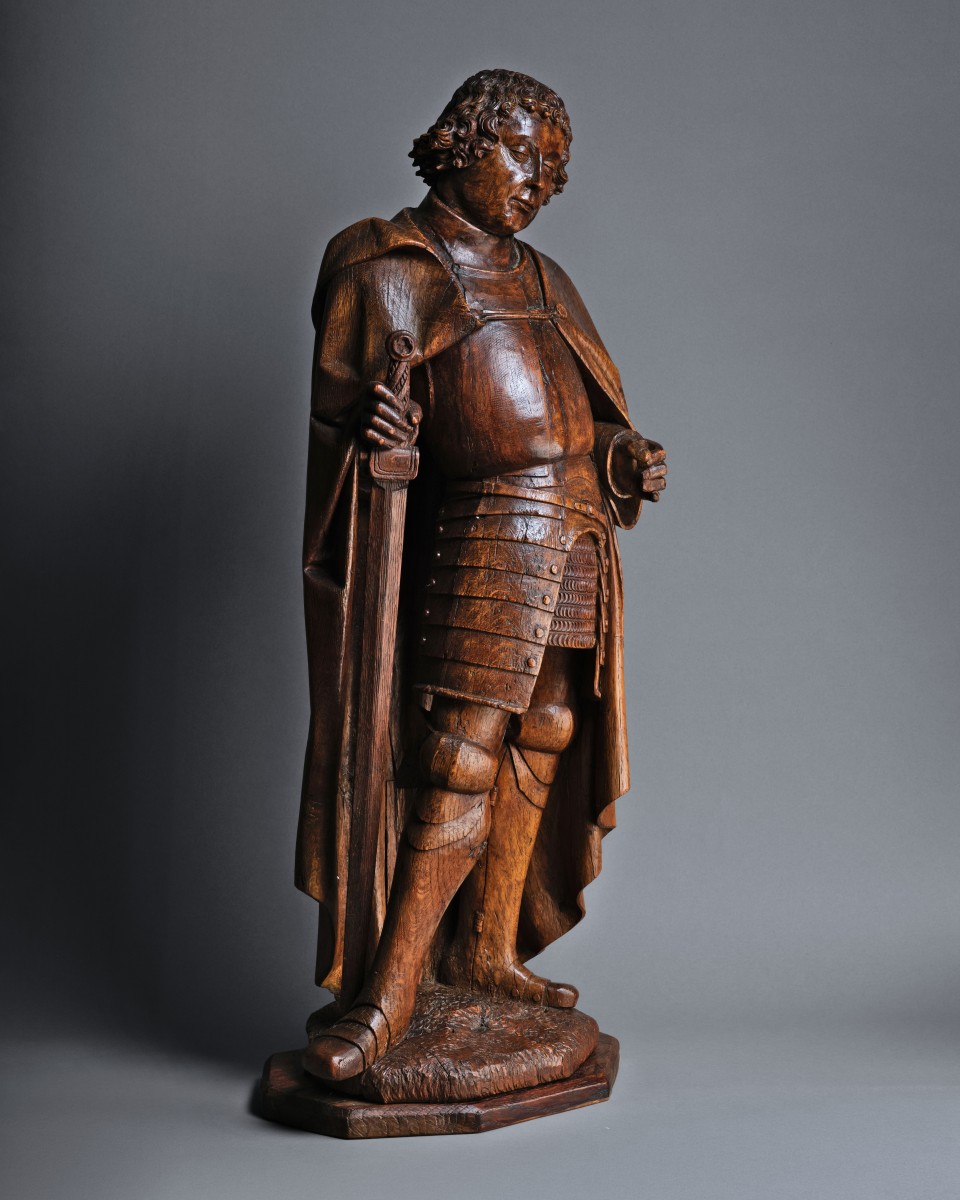
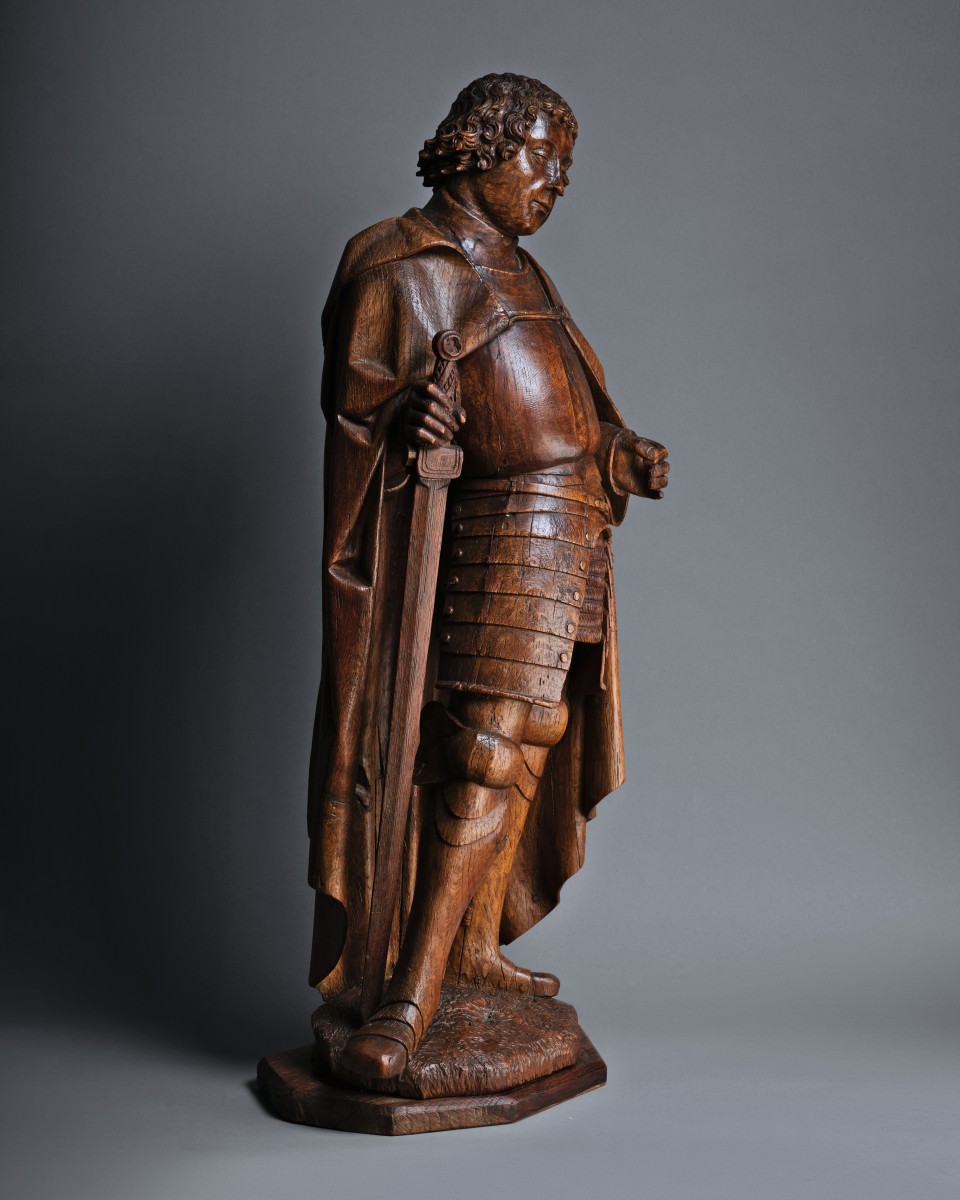
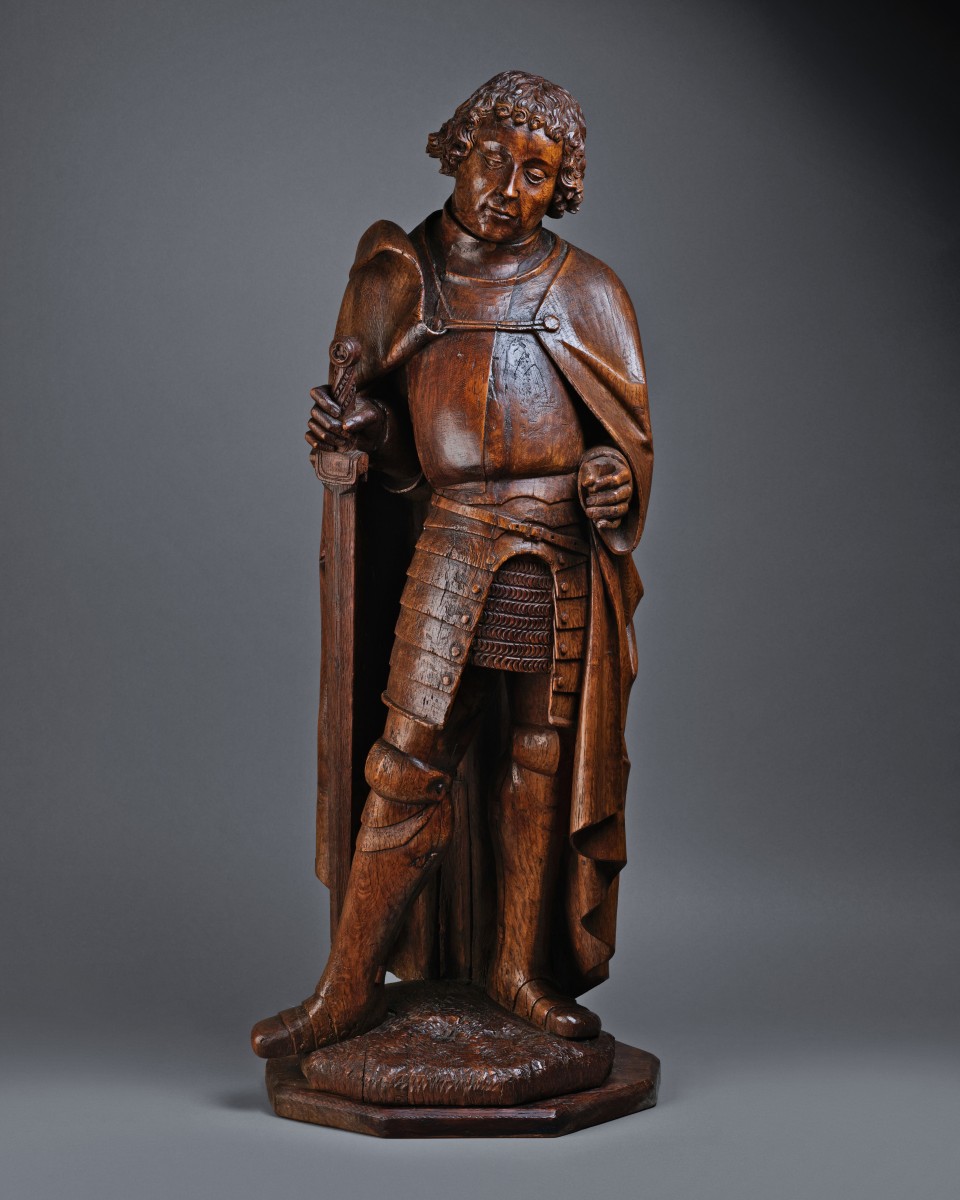
A rare depiction of Saint Maurice in armour, this sculpture stands out for the richness and precision of its armour details, the arrangement and flowing folds of its drapery, and the finely carved features and hair.
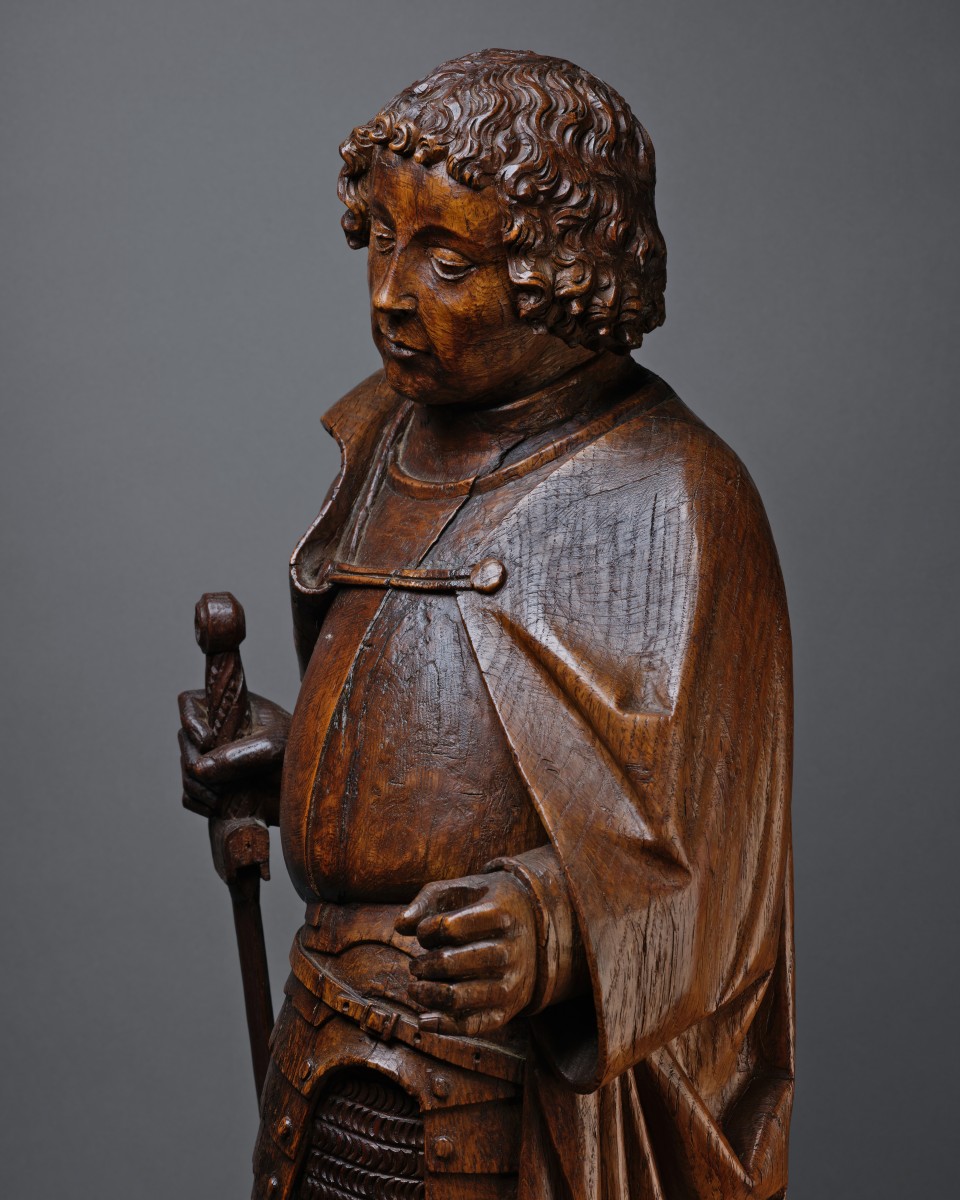
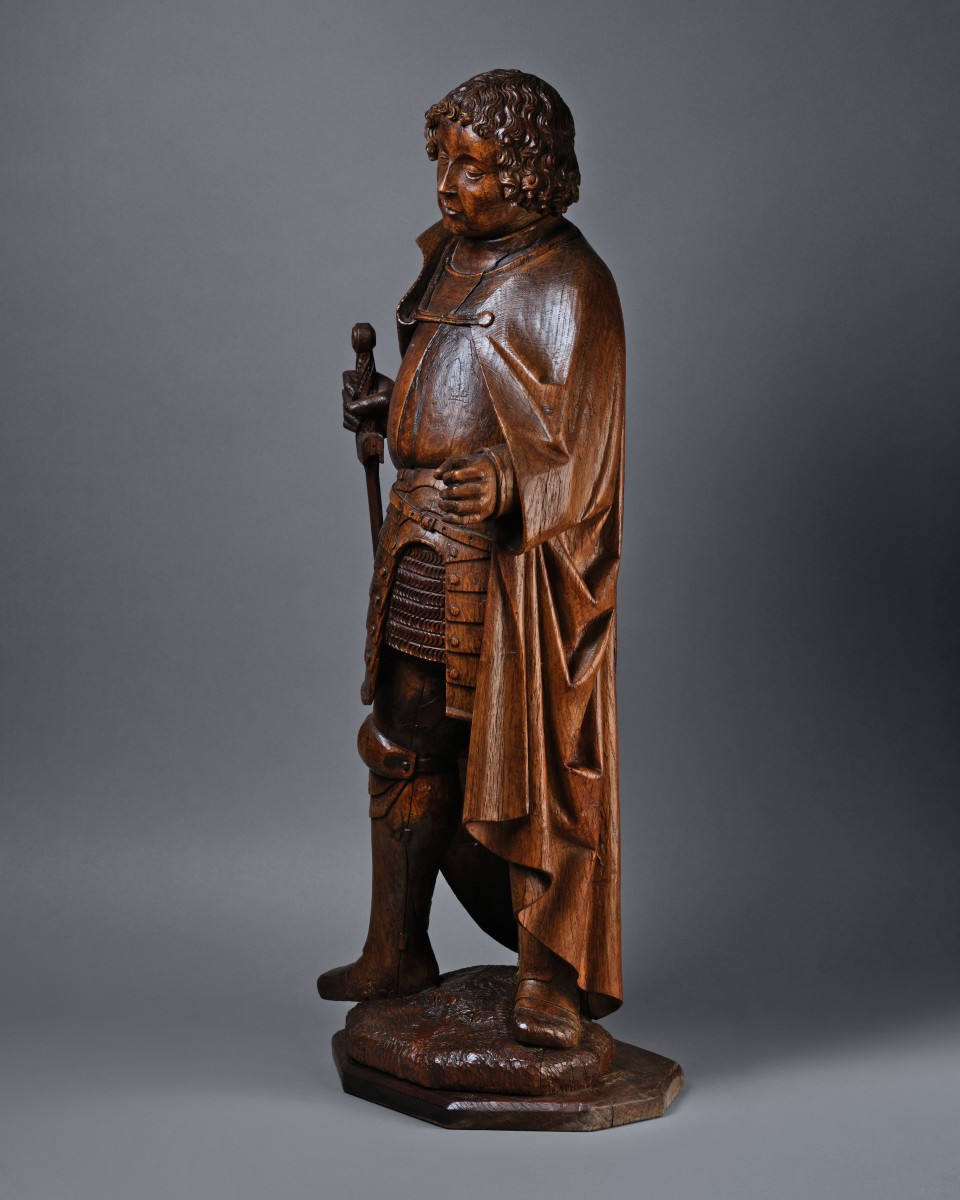
Standing bareheaded, Saint Maurice adopts a noble, composed pose. His right leg steps forward, with the foot turned slightly outwards, while his tilted head gives the figure a gentle sense of movement, balanced by the long sword held vertically. His beardless face, with full cheeks, lowered eyelids and a small, closed mouth, has a serene expression. Thick hair frames his features, carved in wavy strands across the crown and pronounced curls around the temples and ears.
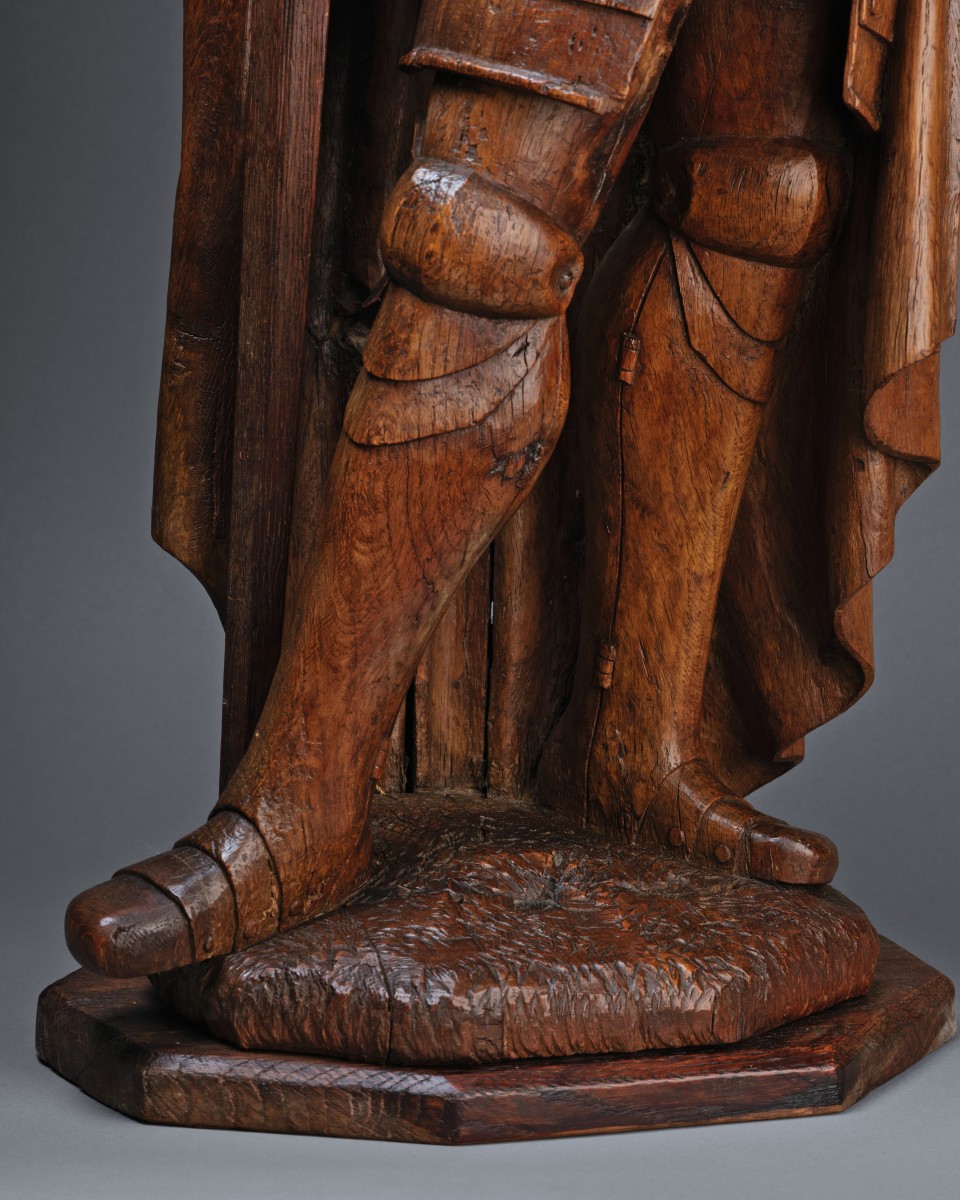
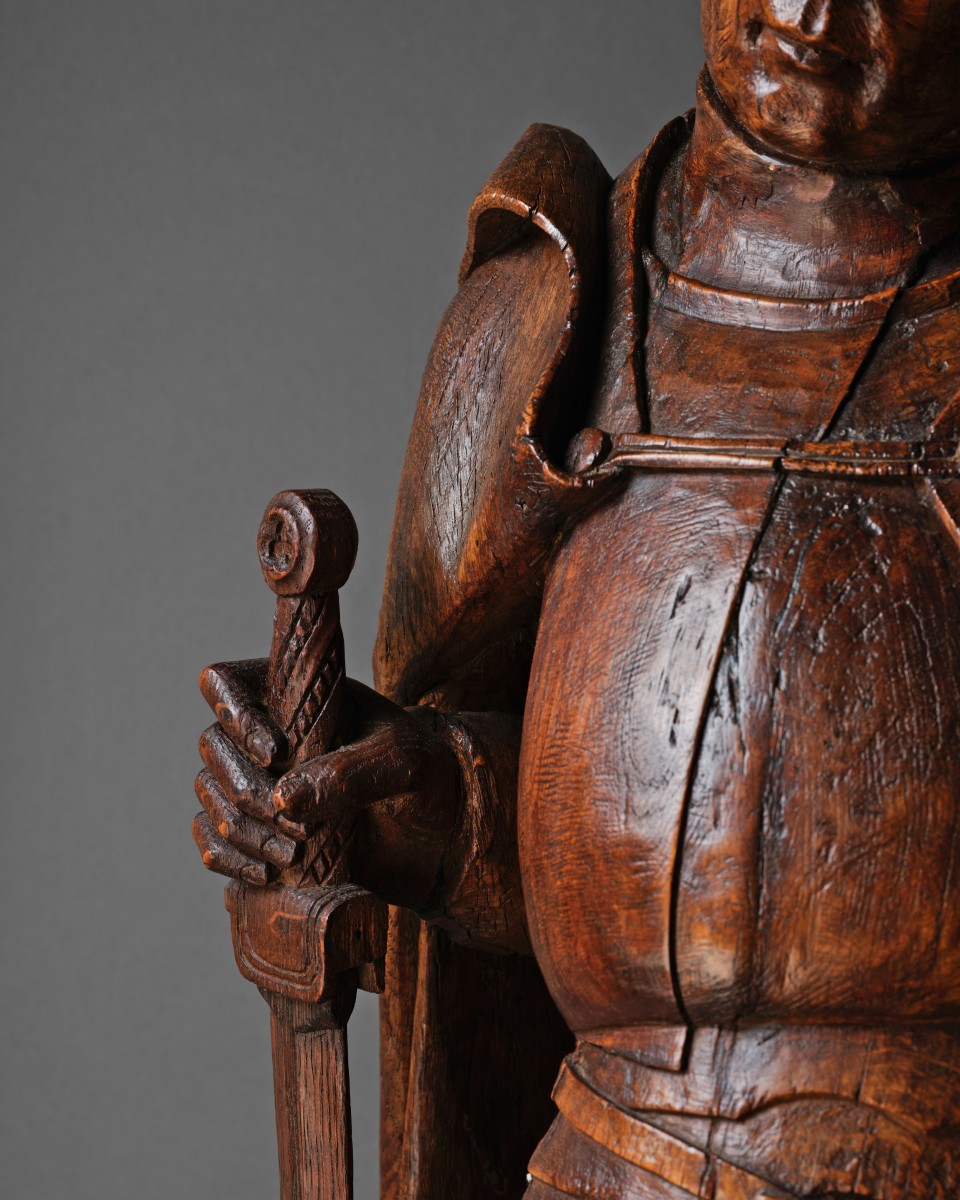
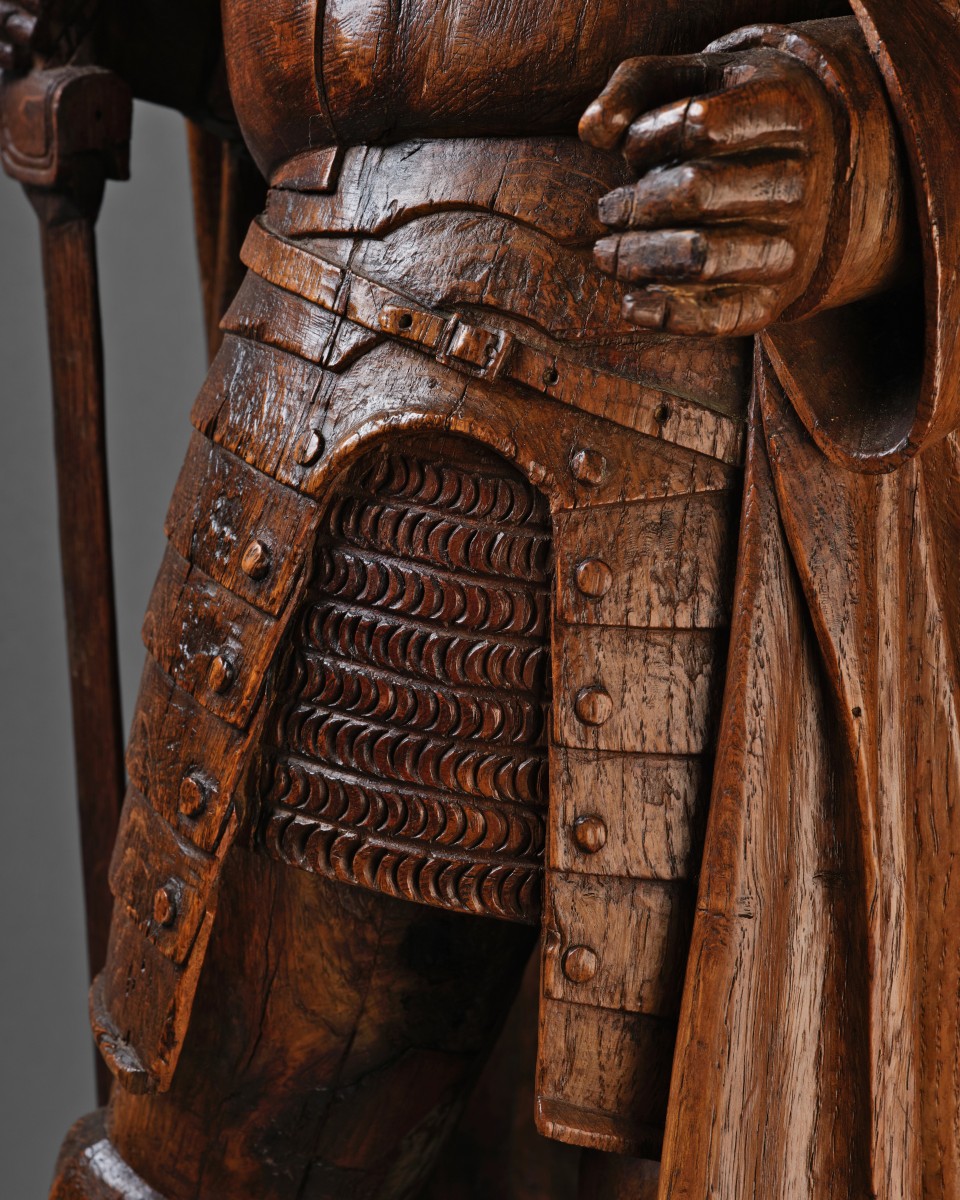
The armour is one of the sculpture’s principal features. Its individual components are carefully carved, contrasting smooth plates with the closely worked pattern of the mail. A rounded breastplate, edged at the neckline, covers the torso and extends into articulated plates at the waist. Two long thigh defences, formed from overlapping plates marked with rivets, flank a section of mail rendered in regular rows of small curved motifs. A buckled belt runs diagonally across the hips. Prominent knee guards lead into overlapping plates and greaves with carefully carved small side hinges. The feet are covered by round-toed sabatons, detailed with transverse bands and circular fastenings. These features demonstrate the care taken in depicting the military equipment.
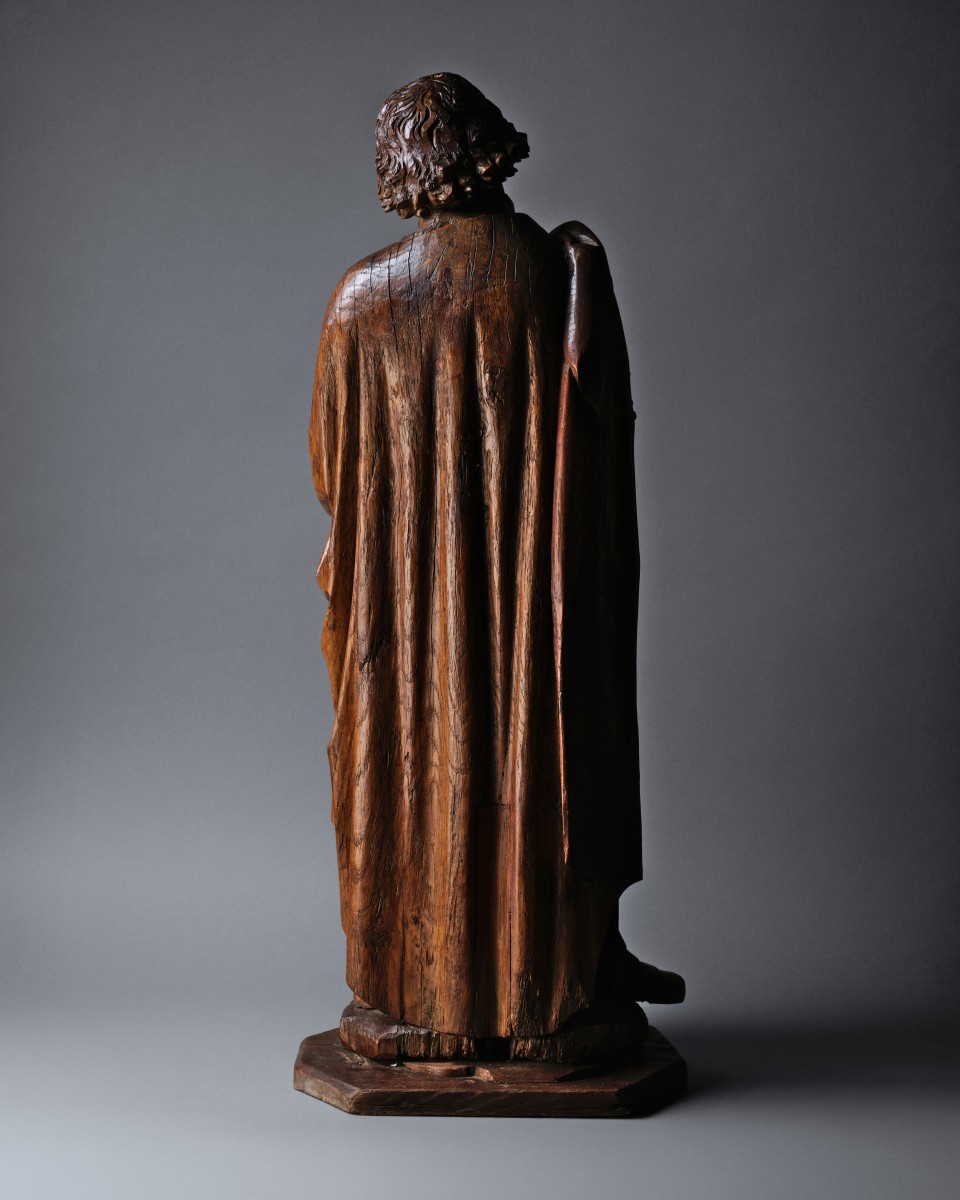
Fastened across the chest, the cloak falls in deep, angular folds, whose raised edges and recessed surfaces create strong contrasts of light and shade. A broad fold rises above the right arm, while the sides of the cloak fall along the body, adding volume to the silhouette and contrasting with the smooth surfaces of the armour.
In his right hand, the saint holds the hilt of a large sword positioned alongside his leg, its point facing downwards. The rounded pommel, decorated grip and guard with an openwork trefoil are carefully detailed. His left hand, held in front of the waist, would have carried a standard, an attribute of Saint Maurice, its now-missing shaft fitting between the curled fingers.
The figure stands on an irregularly textured ground above a base with canted corners. The warm brown patina brings out the grain of the oak and enhances the carved hair, military equipment and folds of the cloak.
A connection with the circle of Dries Holthuys
The softly modelled face, contemplative expression and attention to the military equipment suggest a connection with Lower Rhenish sculpture around 1500, particularly the circle of Dries Holthuys, who worked in Cleves in the late fifteenth and early sixteenth centuries. The Museum Kurhaus Kleve places his activity around 1490–1510 and situates his work within a Lower Rhenish tradition shaped by influences from Brabant.
An interesting comparison is provided by the oak *Saint Adrian*, attributed to Holthuys’s workshop and offered at auction by Lempertz in Cologne. Despite their different subjects, the two figures share a similar arrangement of armour: a rounded breastplate, long articulated thigh defences and mail visible between them. Both cloaks also form a broad fold above the right arm, framing the torso.
Our figure differs in its fuller face, more relaxed shift of weight and less elaborate arrangement of folds. These distinctions lead us to propose an attribution to the circle of Dries Holthuys. The sculpture combines the presence of a knightly saint with a gentle facial expression that softens its martial character.
Related works:
- Workshop of Dries Holthuys, Saint Adrian, carved oak, height 107 cm. Lempertz, sale 1108, lot 1170.
- Dries Holthuys, Saint Michael Slaying the Dragon, circa 1490–1500, carved oak, 103 × 35 × 29 cm. Museum Kurhaus Kleve, inv. 1999-XII-III.
- Dries Holthuys, Virgin and Child, circa 1500, carved oak, 68 × 25.5 × 17 cm. Museum Kurhaus Kleve, inv. 2011-V-I.
- Dries Holthuys, Adoration of the Christ Child, 1490–1495, oak relief, 37 × 45 × 14.5 cm. Museum Kurhaus Kleve, inv. 2011-IX-IV.
Saint Maurice, the knightly saint
According to tradition, Maurice commanded the Theban Legion, a body of Christian soldiers from Egypt. Under Emperor Maximian, in the late third century, Maurice and his companions are said to have refused to sacrifice to pagan gods and renounce their faith. They were reportedly put to death at Agaunum, now Saint-Maurice in the Swiss canton of Valais. The account of their martyrdom was notably recorded by Bishop Eucherius of Lyon in the fifth century.
A figure of Christian faithfulness and courage, Maurice was honoured as a patron saint of the Holy Roman Emperors. He is depicted as a military commander, wearing armour and carrying a sword, lance or standard. In this sculpture, the surviving sword and the standard that the left hand would have held belong to this tradition of the knightly saint.
Delevery information :
We organize the shipping and delivery of our artworks worldwide, working with specialized fine art carriers as well as DHL Express for the secure shipment of small and medium-sized works (up to 120 cm).
Each artwork is carefully packed and shipped in a custom-made transport crate to ensure optimal protection. All shipments are fully tracked and insured.
We pay the utmost attention to every stage of the shipping process to ensure fast, reliable delivery. Shipments via DHL Express are generally dispatched within approximately 7 days of purchase.
All of our artworks can be viewed at our Paris gallery and may also be collected in person.