Offered by Galerie Magdeleine
REQUEST INFORMATION

Paintings and drawings from the 17th to the 19th century
Marie-Antoinette PETIT-JEAN (1794, Lyon – 1832, Lyon)
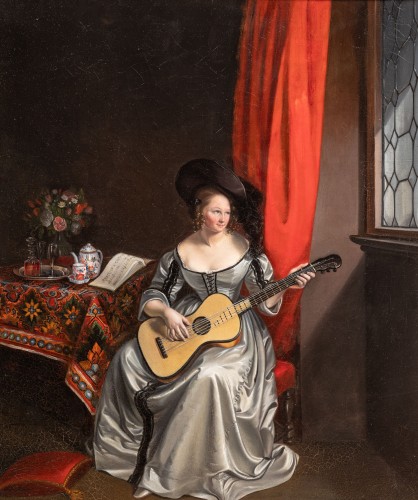
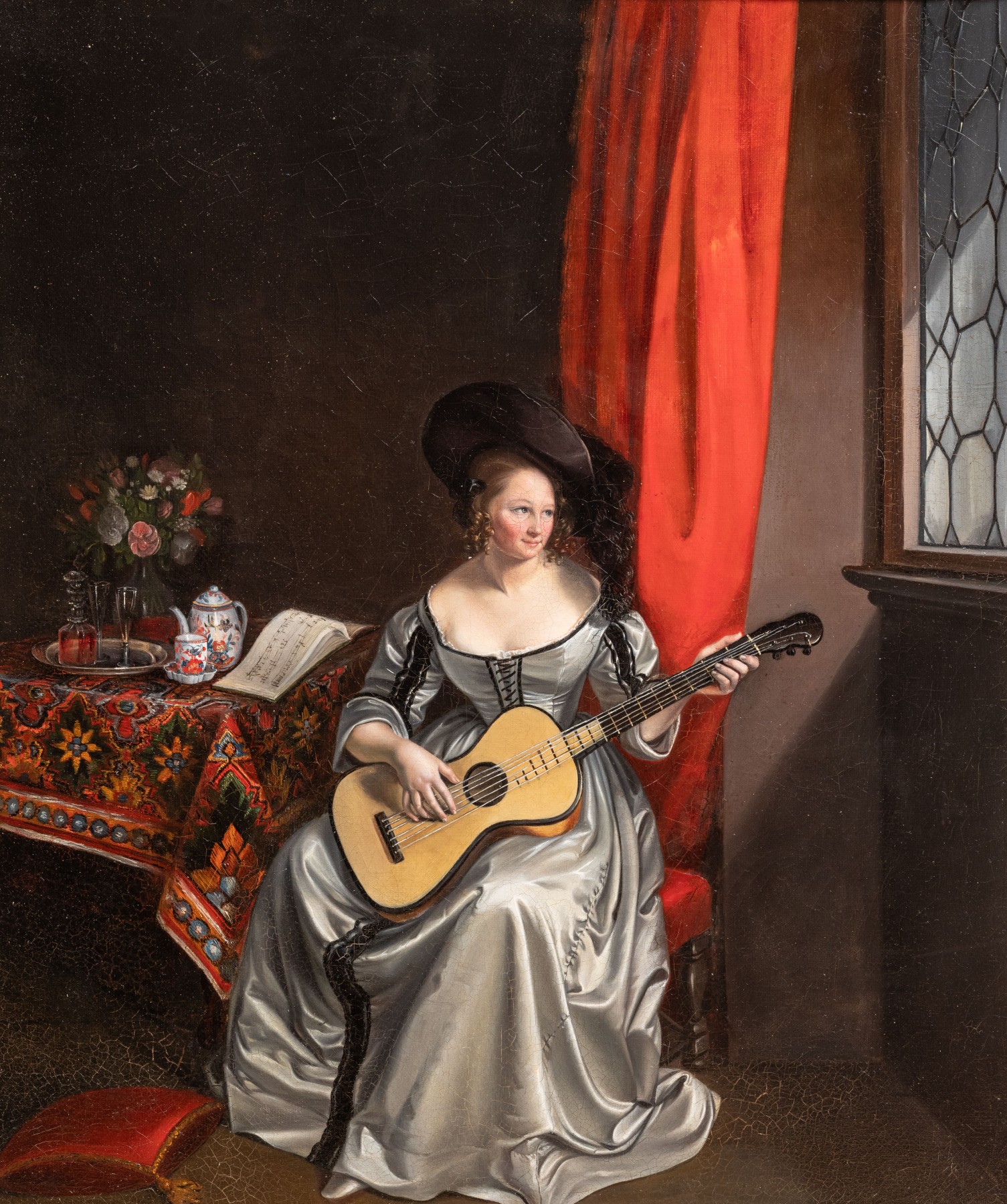
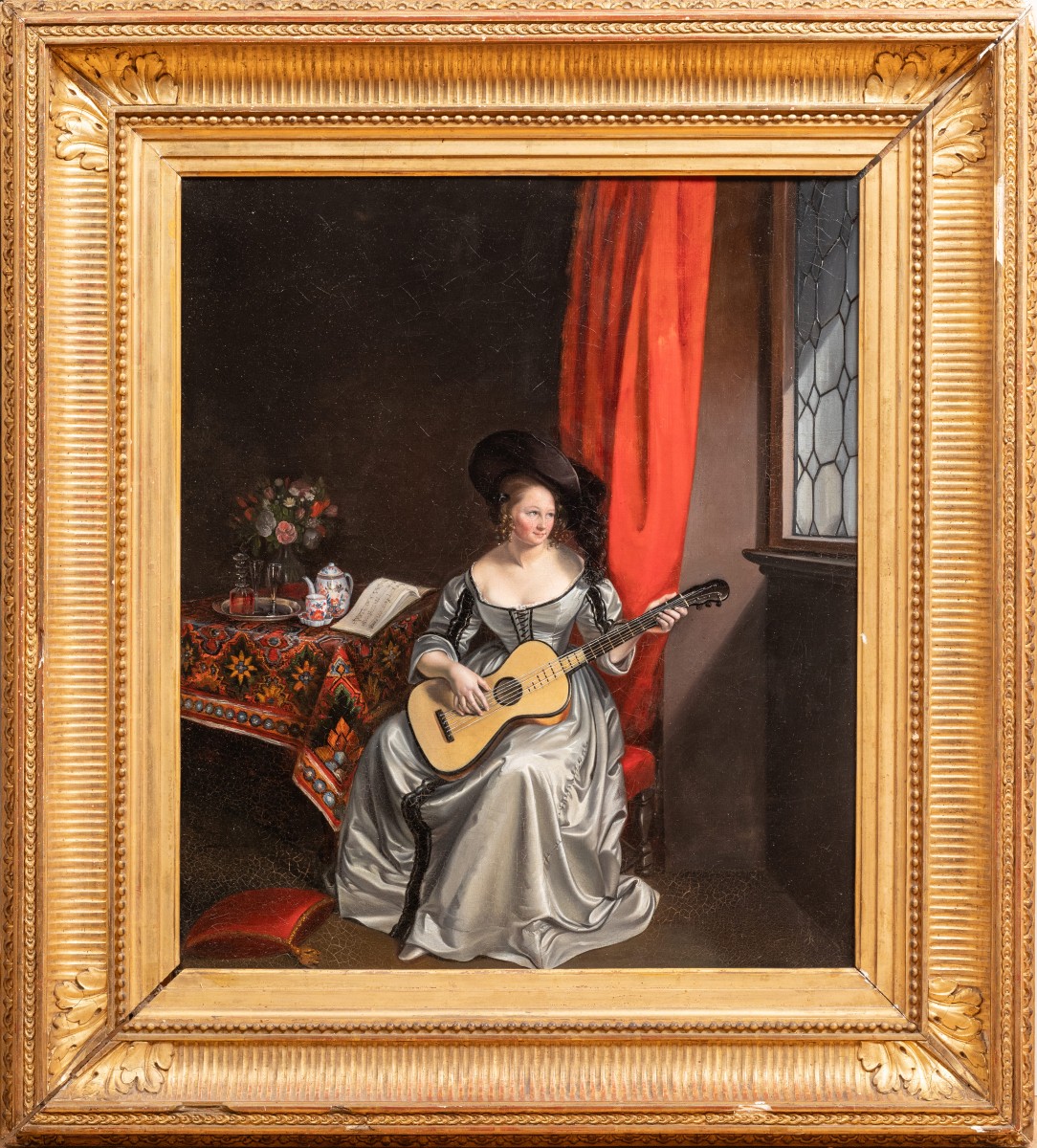
Reverie
Circa 1828–1832. Oil on canvas. H: 53; W: 44 cm.
In a silent interior bathed in subdued light, a seated young woman holds a Romantic guitar on her lap. Dressed in a shimmering grey-green satin gown adorned with a black lace-up bodice, she has set aside her instrument and turns slightly toward the viewer, her gaze distant, a barely perceptible smile on her lips: this is the suspended moment of reverie.
The theme of musical reverie, popularized by Romantic poets (Lamartine, Chateaubriand) and by a whole body of sentimental literature stemming from the Méditations (1820), made the guitar the quintessential feminine instrument during the Restoration and the July Monarchy, as an attribute of silent introspection and gentle melancholy. The open sheet music and the interrupted guitar playing clearly suggest this moment of lyrical meditation.
A pupil of Alexis Grognard and Carra, daughter of Jean-Louis Trimolet, an embroidery designer who instilled in her a taste for drawing from childhood, and elder sister of Anthelme Trimolet, Marie-Antoinette Trimolet married Claude François Petit-Jean in 1816. Following a typical Lyonnais artistic education, she quickly established herself among the leading women artists of the Lyon School, opening a painting and drawing studio for ladies in her home. Her painting The Sick Man earned her a gold medal at the Louvre Salon, and she was awarded two silver medals in 1827 at the Salons of Lille and Douai.
Her career, brief but brilliant, was interrupted by a long illness and her premature death on November 12, 1832, at the age of thirty-eight. Her work, profoundly influenced by the Troubadour aesthetic then flourishing in Lyon in the wake of Pierre Révoil and Fleury Richard, combines the meticulous finish of Dutch painting inherited from the minor masters of the 17th century, an intimate and anecdotal sensibility, and particular virtuosity in the rendering of fabrics and still-life objects.
The attribution to Marie-Antoinette Petit-Jean is based on a series of precise and converging stylistic correspondences with her documented body of work.
The shimmering satin of the gown finds its direct equivalent in the white dress of the princess in Sleeping Beauty, a painting acquired in 1822 by the Société des Amis des Arts de Lyon and described as a “masterpiece of Troubadour painting.” The technique of sharply broken folds rendered with pearly grey-white highlights, the deep saturated shadows in the recesses, and the overall velvety texture of the paint are exactly the same.
Treated as small still lifes, a teapot, a vase, tableware, and a musical score revive the intimate manner the artist employed in Young Woman Nursing Her Child and Caring for Her Sick Husband, where the white earthenware ewer, incense burner, glass vial, and plate of fruit form part of the same repertoire: an accumulation of precious objects rendered with the precision of a miniaturist.
The leaded diamond-pane glazing of the window is precisely of the same type as that visible behind the open door in The Catechism Examination (circa 1825), displaying the same taste for the medievalizing archaism characteristic of the Troubadour style.
The richly patterned carpet with Orientalist motifs draped over the table in Reverie is not merely an atmospheric accessory. It is a genuine recurring motif throughout the pictorial production of the Trimolet circle and constitutes one of its most recognizable signatures. It appears, identical in design and palette, in Edma Trimolet's Reverie (1827); in The Catechism Examination by Marie-Antoinette herself (circa 1825); in Anthelme Trimolet's Self-Portrait of 1849; and in the Portrait of Edma Trimolet by Anthelme in 1850. The recurrence of this textile over nearly a quarter of a century, in works signed by Marie-Antoinette, Anthelme, and Edma alike, certainly suggests that it was a real object belonging to the family.
The second decisive material element lies in the porcelain service arranged on the carpet: a teapot, a lidded cup decorated with Chinese-inspired motifs, and a silver tray. It should be recalled that Anthelme and Edma Trimolet were the most important collectors in Lyon of their generation, and that their collection, bequeathed to the City of Dijon in 1878 and preserved under the name “Musée Trimolet,” included a considerable collection of Chinese porcelain. Marie-Antoinette, who lived within her brother's immediate circle, naturally had access to these objects and drew upon the family collection for the models of her still lifes.
We have also succeeded in locating a previously unpublished portrait of Marie-Antoinette by her brother, which corresponds perfectly to the young guitarist. The painter's biographer refers to it in these terms: “Mr. Trimolet was seventeen years old. […] His first canvas was devoted to his family. He painted a large, full-length portrait of his sister, palette in hand, standing before an easel.” Probably dating from 1815, the portrait depicts the young woman at the age of twenty-one.
The bequest made by Anthelme and Edma Trimolet to the City of Dijon, accepted by municipal resolution on October 10, 1878 (more than nineteen hundred catalogue entries), notably preserved the Trimolet family's collection of drawings, part of which is attributable to Marie-Antoinette. Two sheets appear to be potential preparatory studies for our painting.
The first is a preliminary study of the central motif of a woman holding a mandolin, which became a guitar in Reverie.
The second is an architectural drawing, rigorously geometrical according to the rules of linear perspective. It depicts the exact interior setting of Reverie: the room viewed from the front, the window opening on the right, the projecting section of wall at the back, and the tiled floor drawn in receding perspective.
The subject and very title of our painting cannot be fully understood without comparison with Edma Trimolet's Reverie, executed in 1827 and also originating from the Trimolet bequest. Marie-Antoinette's sister-in-law, Edma Saulnier, had married Anthelme Trimolet on September 9, 1824. She depicts herself, in a disguised self-portrait, leaning against a piece of furniture in an attitude of thoughtful meditation, her face shown in three-quarter view, entirely absorbed in her inner daydreaming.
Our painting thus appears as Marie-Antoinette's response to her sister-in-law.