Offered by Galerie Magdeleine
REQUEST INFORMATION

Paintings and drawings from the 17th to the 19th century
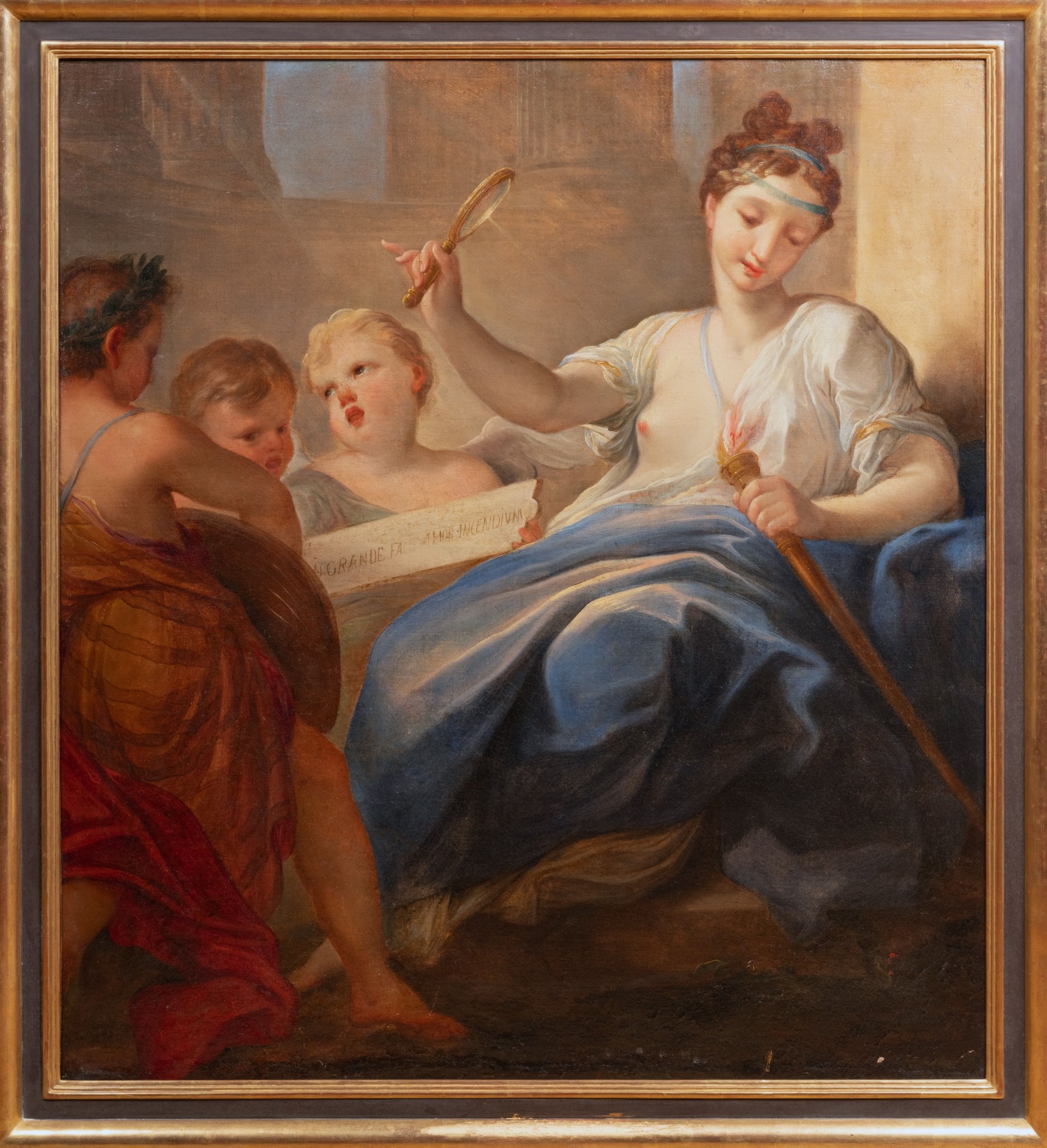
The Origin of Love
Circa 1738.
Oil on canvas. H: 104; W: 96 cm.
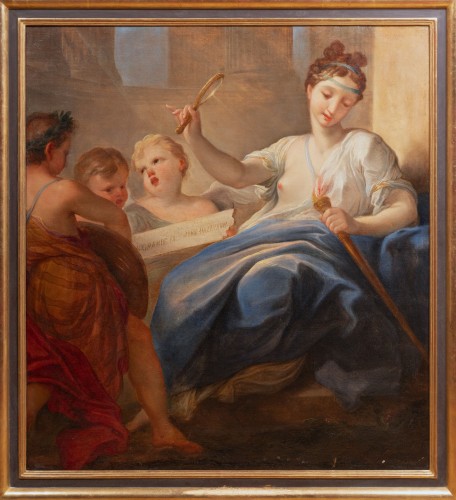
Exhibition: Salon de l'Académie royale de peinture et de sculpture, Paris, 1738, no. 77: “A painting, an overdoor measuring three feet high by four feet wide, representing the origin of Love demonstrated by Beauty, holding a burning glass which lights the Torch of Love.”
Antoine Boizot presented this canvas at the Salon de l'Académie royale de peinture et de sculpture in 1738 under no. 77. The Salon catalogue describes a “painting, an overdoor measuring three feet high by four feet wide, representing the origin of Love demonstrated by Beauty, holding a burning glass which lights the Torch of Love.”
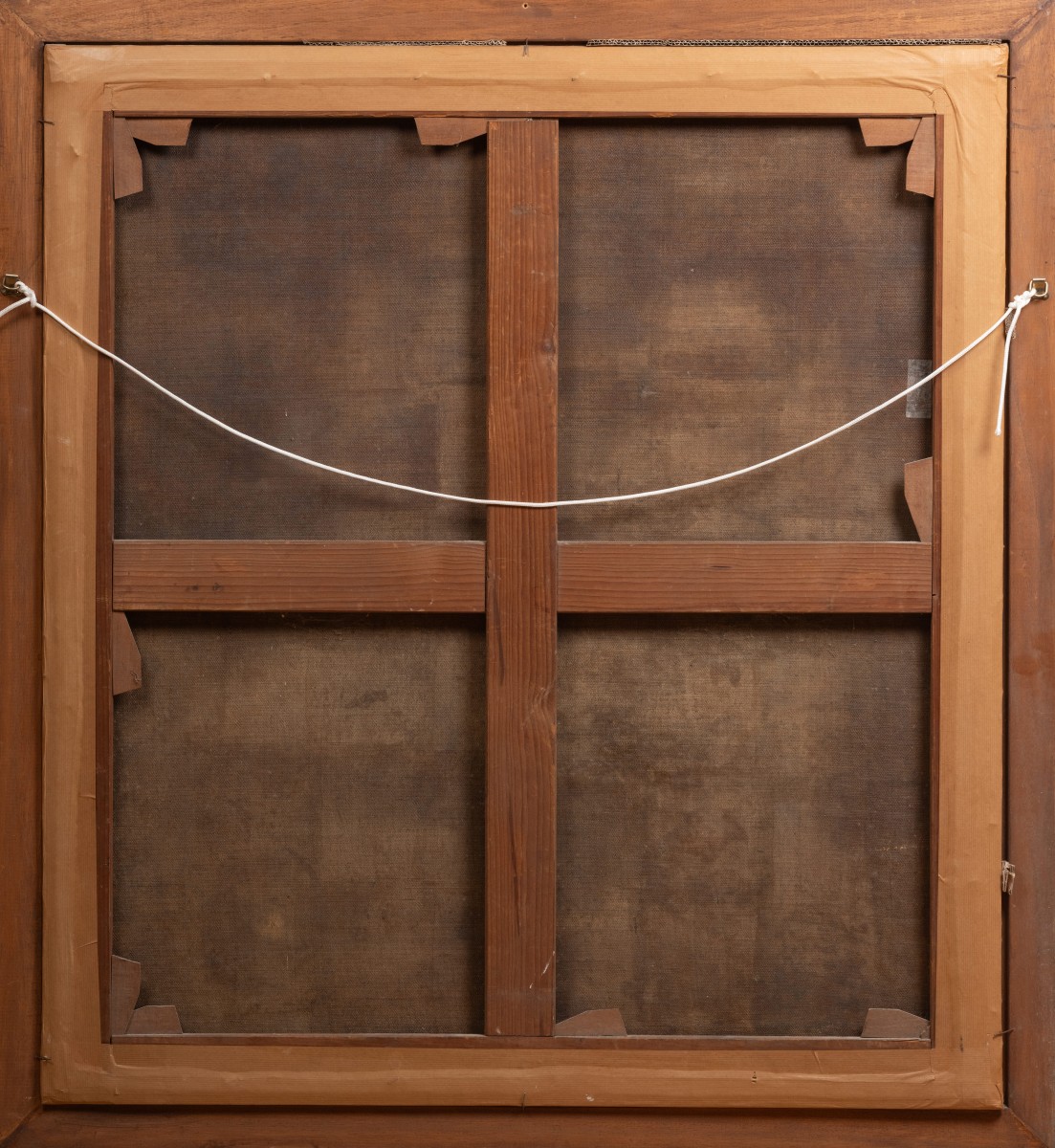
The painting's original purpose as an overdoor explains its initial horizontal format of approximately 97 × 130 cm (three feet by four). The current dimensions of the canvas (104 × 96 cm) indicate a slight physical alteration during its history. This reduction, probably a trimming of the sides to adapt it to a new frame or new wood paneling in the 19th century, altered the balance of the composition by concentrating the action around the central figures.
Antoine Boizot trained in Paris under François Lemoyne. He won the second Prix de Rome in 1729, followed by the first prize in 1730. A resident of the French Academy in Rome, he was approved by the Académie royale in 1736 and received as a history painter in May 1737 with the painting Apollo Caressing Leucothoe. Boizot exhibited regularly at the Salon from 1737 until 1771, mainly presenting light mythological subjects, often intended for decoration and tapestries, which explains the absence of signatures on many of his canvases. He died in Paris in 1782.
The subject of The Origin of Love is not merely a gallant fantasy; it draws upon an established philosophical and literary tradition. The identified direct source is Cesare Ripa's Iconologia, in its French translation by Jean Baudoin published in 1644. The “burning glass” (a spherical mirror or convex lens) serves as an allegorical instrument to explain how Beauty, through the gaze, sets the heart aflame.
In Boizot's painting, this demonstration is staged with didactic clarity. Beauty, the central figure, does not merely embody beauty; she actively manipulates the optical instrument to transmit fire to Cupid's torch. This emphasis on the scientific instrument of the lens reflects the 18th century's interest in optics and the natural sciences, here incorporated into a poetic discourse on passion.
The tablet held by the central putto bears the Latin motto in capital letters, “Sic in corde facit Amor incendium” (“Thus Love kindles a fire in the heart”), reproduced word for word by Boizot. This quotation from the Iconologia directly explains the visual analogy. The burning glass sets the heart (the torch) ablaze, just as the radiance of Beauty inflames the viewer's soul.
Finally, it should be noted that contemporary discourse associated this image with Neoplatonic philosophy (Marsilio Ficino), which regarded the gaze as a means of transporting the soul (the eyes being described as the “windows of the soul”). The secondary figure crowned with laurels at the far left, often interpreted as a poet or allegorical witness, emphasizes the intellectual dimension of the work. He appears to validate the physical demonstration performed by Beauty, presenting love not as a blind impulse but as a phenomenon governed by laws of universal sympathy and light.
A direct precedent for our painting is preserved at the Musée d'Art Roger-Quilliot in Clermont-Ferrand.
This Allegory of Love, long attributed to Lemoyne, presents almost identical iconography: a woman dressed in the Antique style lighting a torch with a magnifying glass, accompanied by putti. Comparison of the two works shows that Boizot may have appropriated the motif, whether borrowed from his master Lemoyne or not, while introducing greater modern clarity and a more spacious arrangement.
The composition of Boizot's work, decorative and dense, depicts figures with elongated torsos and voluminous draperies occupying a shallow space, emphasizing the painting's ornamental function. This theatricality corresponds to its original decorative context as an overdoor in a salon.
The observations made by Galerie Alexis Bordes concerning Bacchus and Ariadne can be perfectly applied to The Origin of Love: “The artist's securely attributed works, as well as his reception piece, display many similarities with our canvas. […] We find the same theatrical organization of space, with the background brought very close and tight framing, the type of figures inspired by ancient statuary, the interest in ornaments and attributes, the pursuit of a decorative effect, the thick and enveloping draperies, and the relaxed gestures.”
In that same year, 1738, Boizot presented his Origin of Love at the Salon and married Marie Oudry, daughter of his elder colleague Jean-Baptiste Oudry. Although no direct connection can be established between the commission and this private event, the coincidence deserves mention. The subject resonates with a personal moment in the painter's life, which would soon bring him professional opportunities.
Shortly after his marriage, he began a career at the Gobelins Manufactory through the intervention of his father-in-law. It is possible that, beyond its decorative function, this painting offers a discreet and personal testimony to Boizot's life.