Offered by Galerie Alexandre Piatti
REQUEST INFORMATION

Works of art, sculptures and furniture Haute Epoque
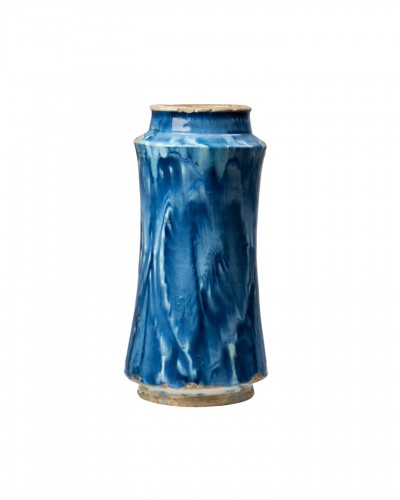
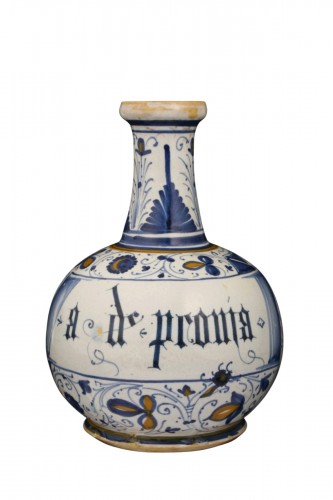
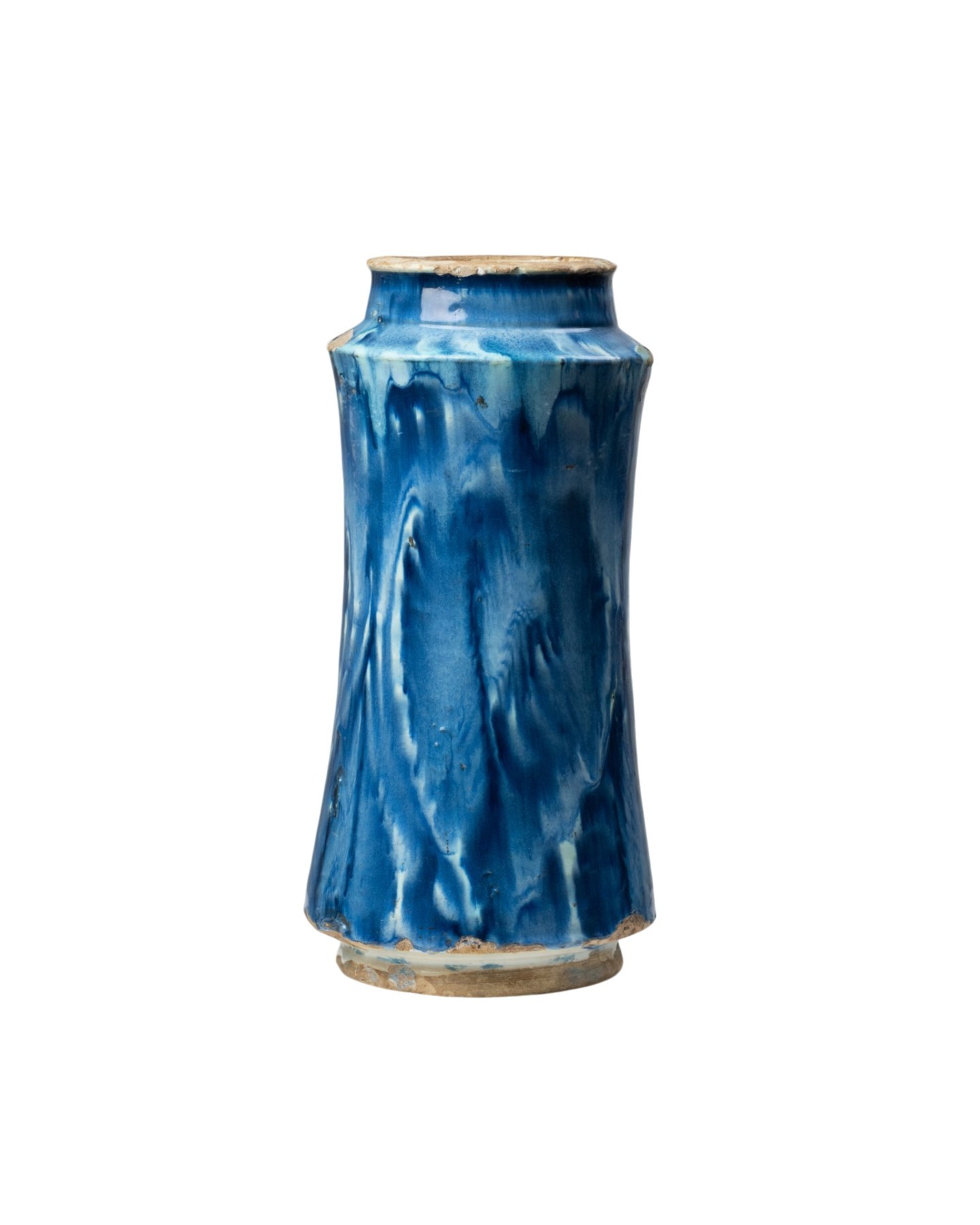
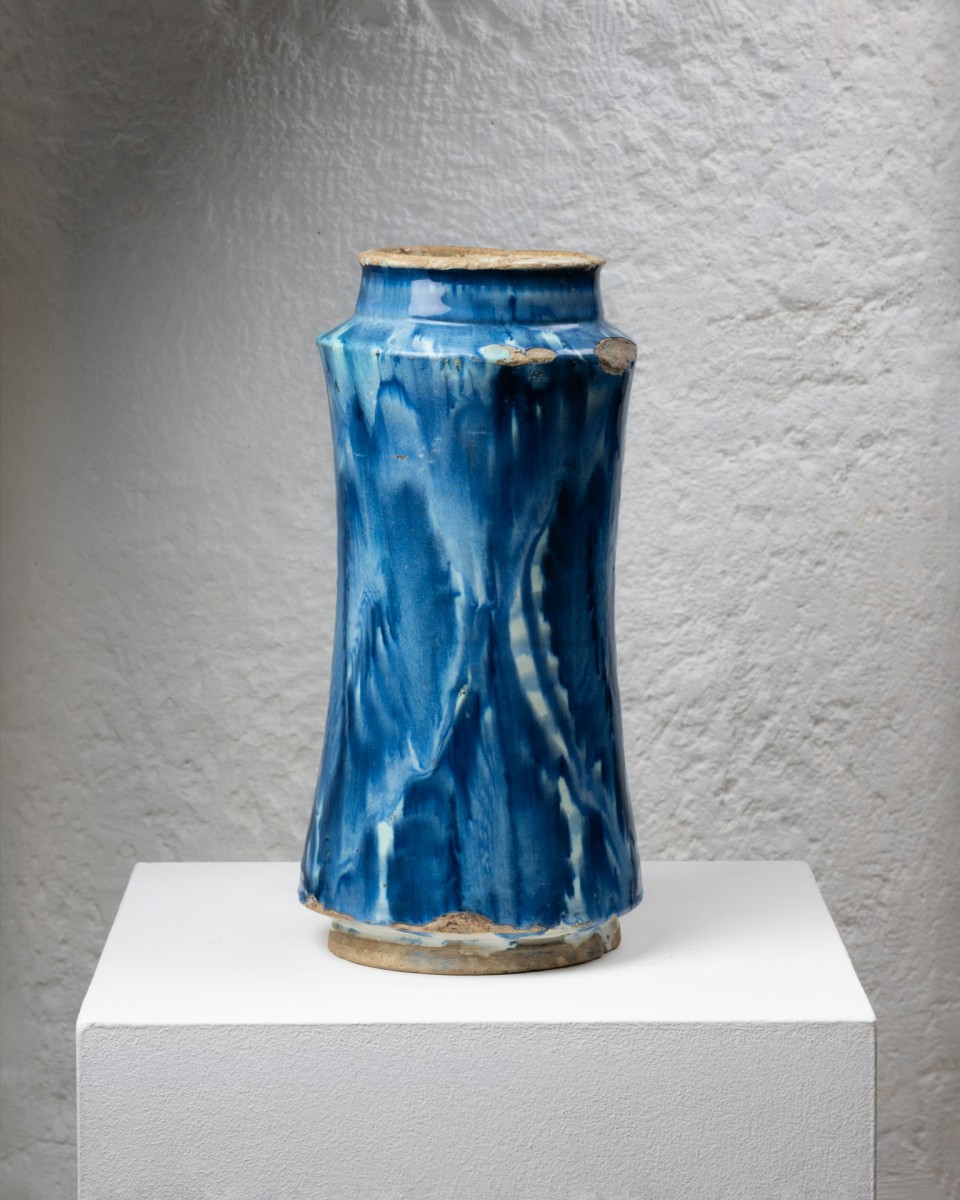
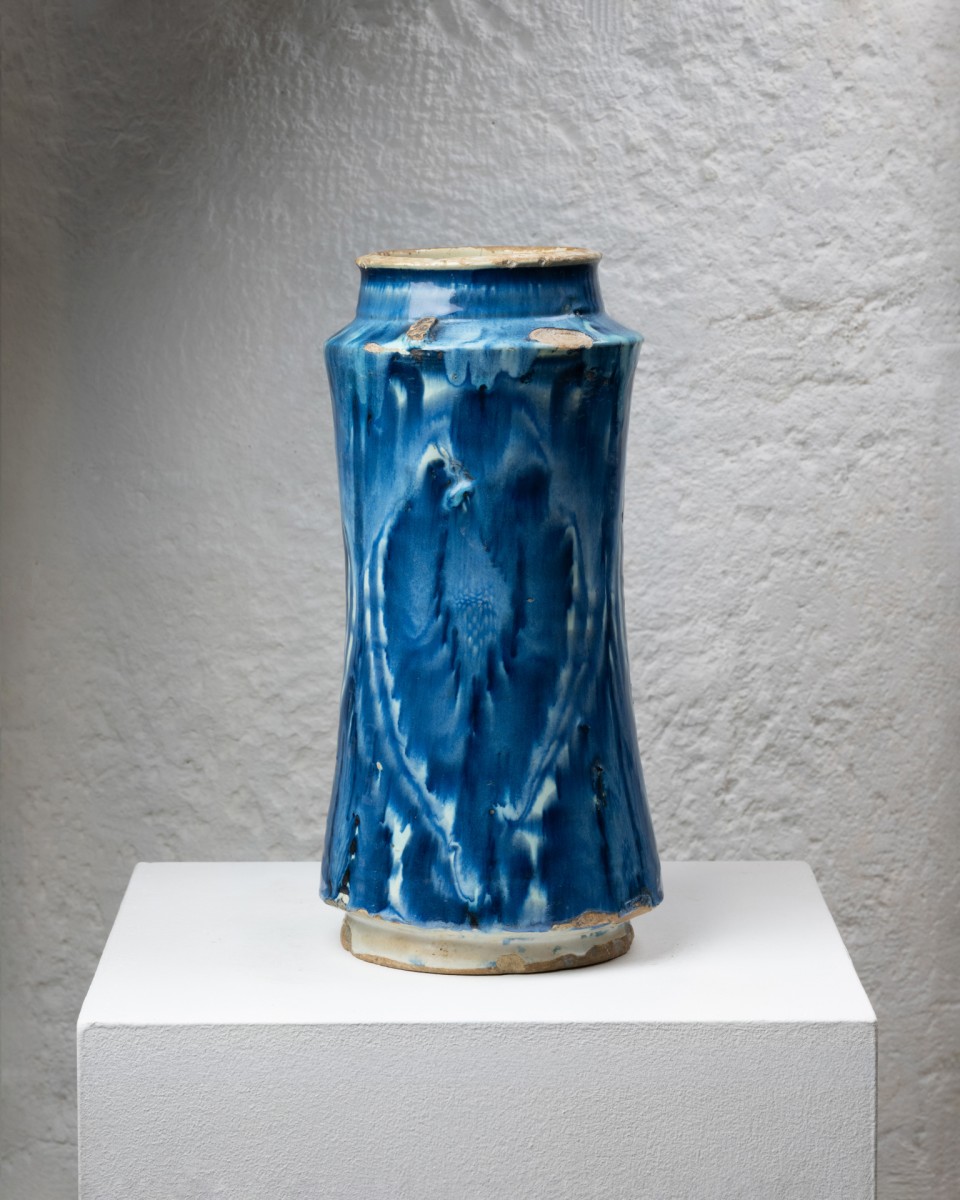
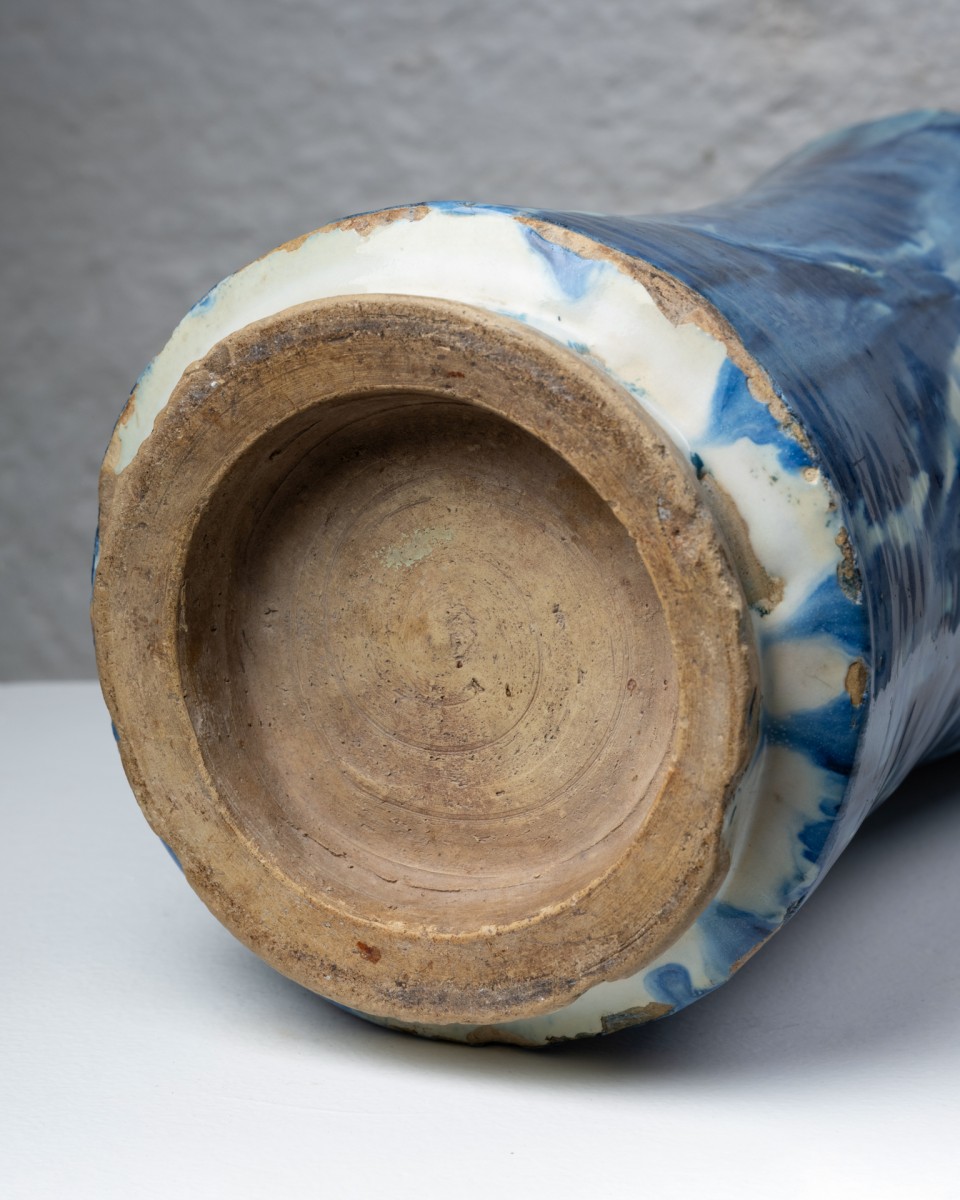
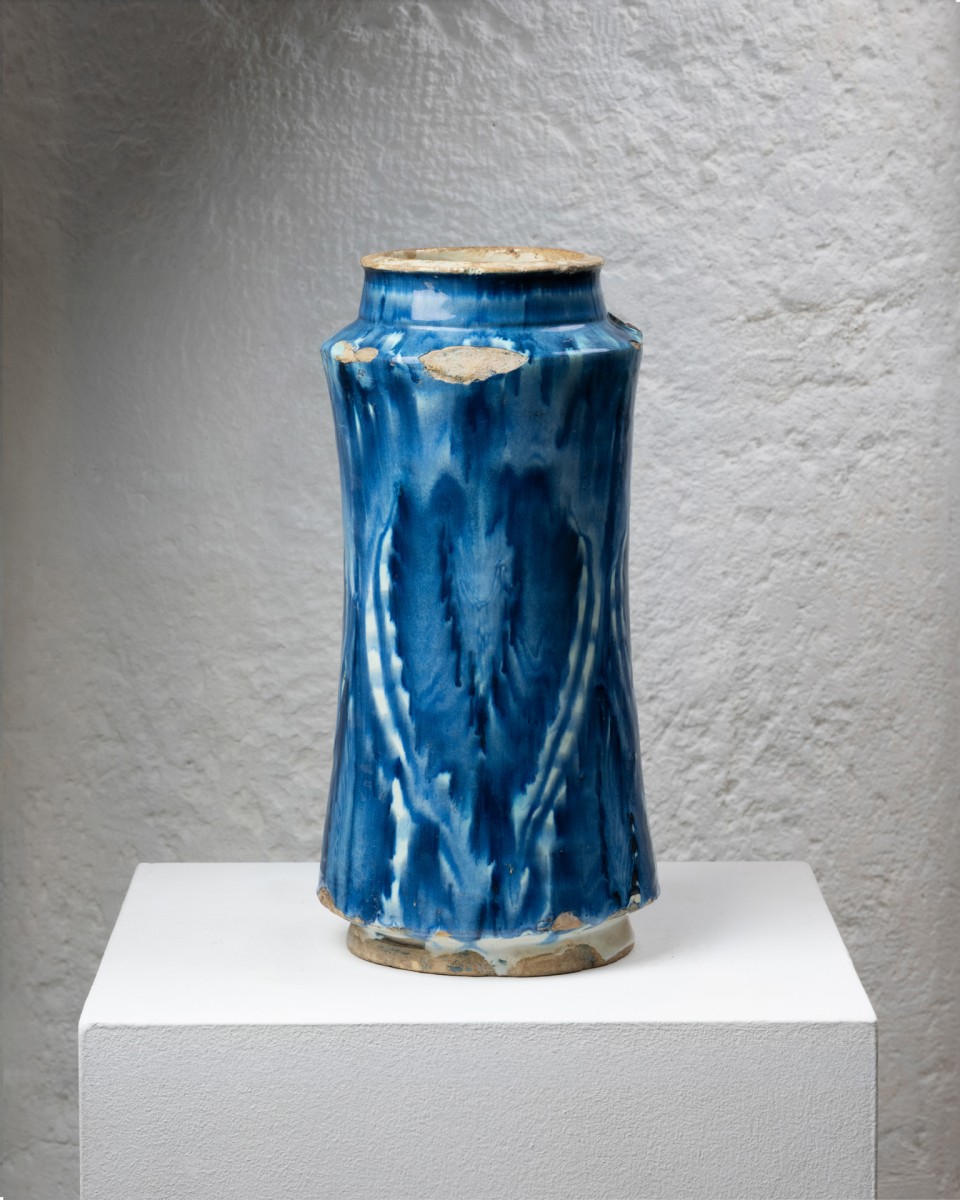
A remarkable Hispano-Moorish ceramic apothecary jar, whose shape is characteristic of apothecary vessels dating from the late Middle Ages. Its cylindrical body, slightly narrowed in the middle, tapers upward toward a short, round neck and rests on a circular foot. This form, designed to be grasped, opened, and handled, belongs to a tradition of pharmaceutical vessels whose origins date back to the Near East and which, beginning in the 13th and 14th centuries, spread widely throughout the Mediterranean before being produced in Europe, particularly in Italy and on the Iberian Peninsula. Drawing inspiration from older Iranian and Syrian examples, potters in Valencia and later in Catalonia developed their own glaze decorations, often blending Spanish Gothic motifs with Islamic designs.
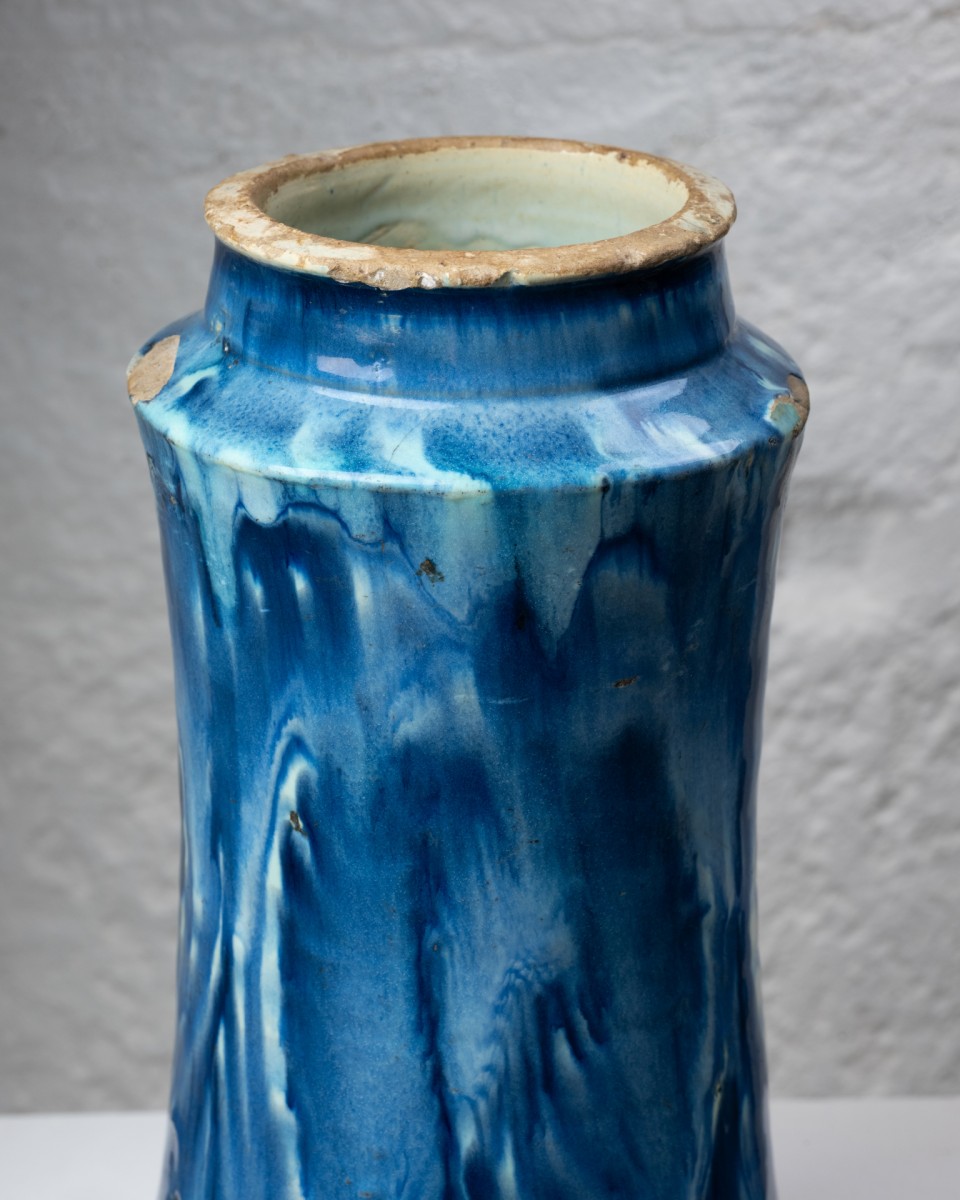
The true uniqueness of this piece, however, lies in its surface treatment. The so-called “al regalat” decoration—characterized by splashes and drips of cobalt blue on a white glaze—transforms the body into a surface brought to life by the flow of color. The Catalan term “regalat” is associated with the idea of trickling or flowing. These vessels are referred to in historical sources as “pots blaus regalats,” literally “blue pots that have run” or “dripping blue pots.” Beneath the drips, one can make out stylized palmette motifs—the emblematic decoration of “al regalat” pieces—which were initially drawn by the potter before the fire caused the glaze to run.
The phenomenon is primarily technical in nature. The decorator applies cobalt blue to a white base, traditionally a tin-based glaze. During firing, the glaze melts and becomes fluid enough to allow the pigment—especially when applied thickly—to migrate and spread across the surface. The result can differ greatly from the initial application: the line begins to run, elongates under the effect of gravity, concentrates in certain areas, splits into thin strands, or merges with neighboring runs. Here, one must be careful with the concept of “overfiring”: this does not necessarily mean a piece that is simply overfired in the sense of a kiln accident that has damaged the ceramic. Rather, the phenomenon stems from the interaction between temperature, firing time, glaze composition, the amount of blue applied, and the viscosity of the molten materials. The design we see is not exactly the one the potter’s hand applied before the piece entered the kiln: part of the design was created by the fire.
This characteristic could have remained a mere firing defect, but it clearly became a recognized and reproducible phenomenon. A source from the National Ceramics Museum in Valencia cites a contract from 1449 in which the master potters of Manises, Bernardo and Juan Cardere, undertook to produce “pots blaus regalats cuyt de dues cuytes”—blue regalat pots, “fired twice.” This reference is crucial to understanding the object: by the mid-15th century, the term “regalat” was no longer simply the name for an isolated defect observed after firing. It referred to a type of production distinct enough to be named in a professional and commercial context.
We thus move from a focus on mere technical mastery to something more subtle: mastery of the unpredictable. The potter does not relinquish control over his work; on the contrary, he controls the conditions that will allow the fire to play its part. The kiln thus becomes almost a second workshop. The hand shapes, but firing transforms; the artisan prepares, and the material responds. This relationship between intention and transformation is particularly fruitful in 15th-century Valencian ceramics. Manises and Paterna were among the major centers of Hispano-Moorish ceramic production at the time, heirs to Islamic traditions and deeply engaged in artistic exchanges across the Mediterranean. Manises was particularly famous as early as the late 14th century for its metallic-luster ceramics, the production of which already required highly specialized firing techniques.
What strikes us today about this albarello is the visual effect of this technique. The vertical drips disrupt the regularity of the design. In places, the motif ceases to be immediately recognizable as a representation and becomes surface, movement, and color. This likely explains the strange visual modernity of these pieces. A contemporary viewer can discern in them—several centuries later—something of the freedom of brushwork, the autonomy of color, and the interest in the trace of the gesture that would be celebrated much later in modern painting.
Delevery information :
Please note that packing and shipping costs are not included in the price of the objects which are quoted ex shop.
Final amount including packing and shipment to be discussed with Galerie Alexandre Piatti.