Offered by Antichità di Alina
REQUEST INFORMATION
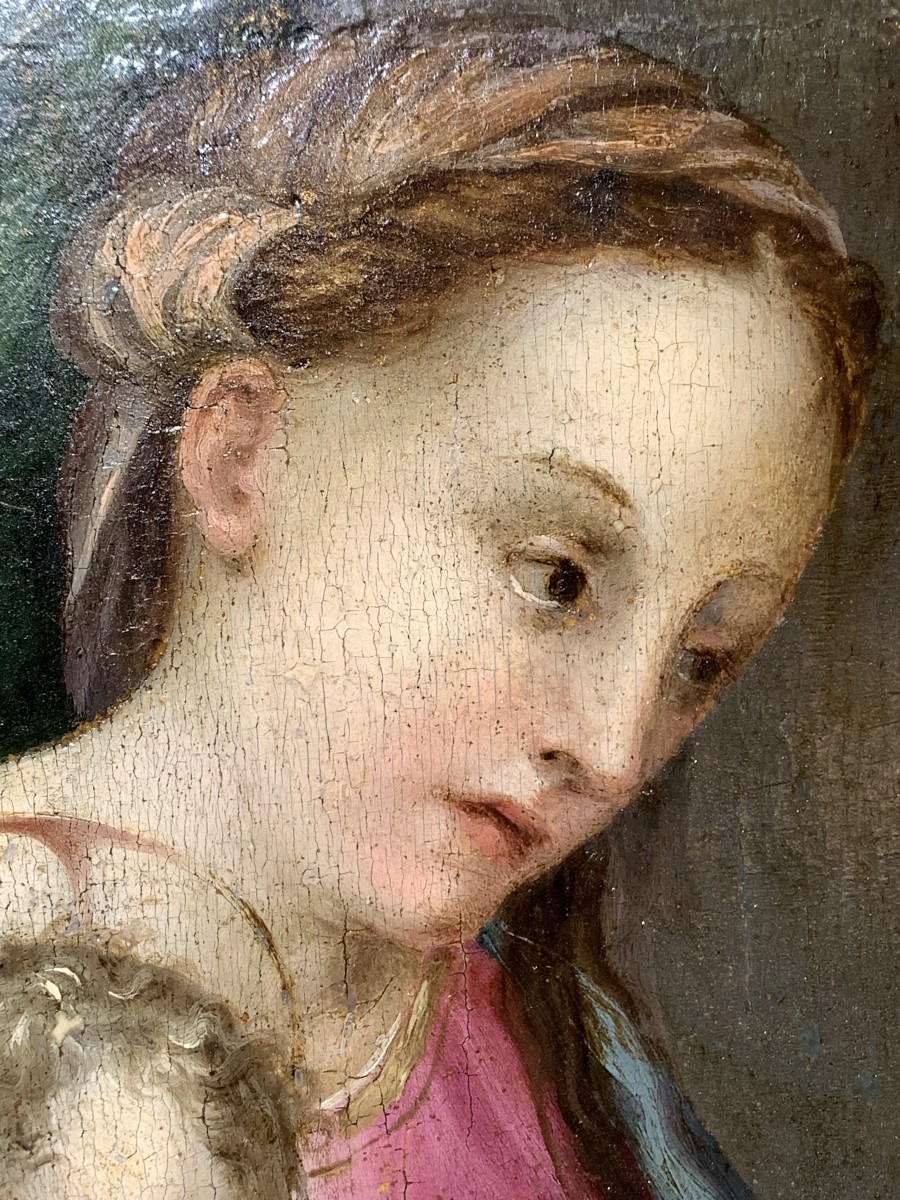
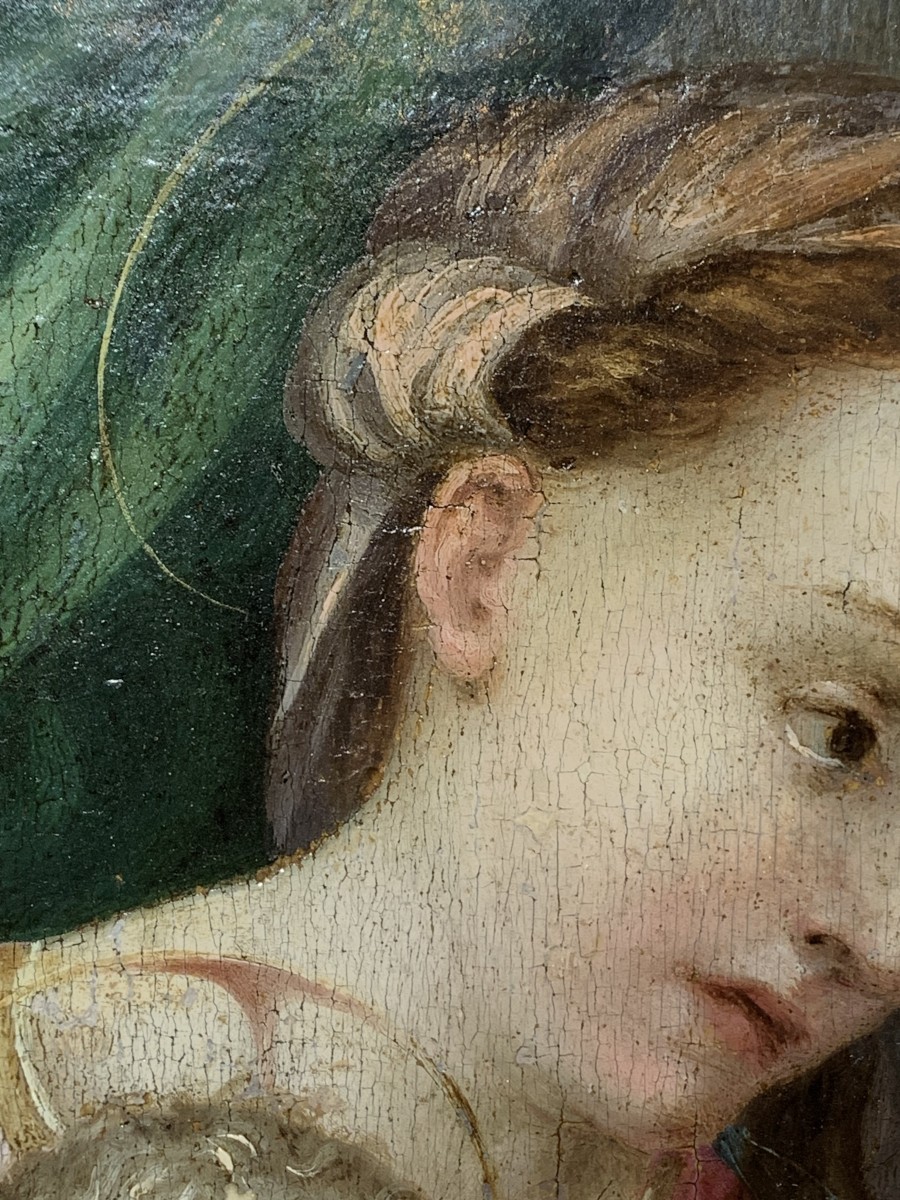

Oil on panel.
Dimensions: 51 × 40 cm (panel)
With frame: 89 × 69 cm
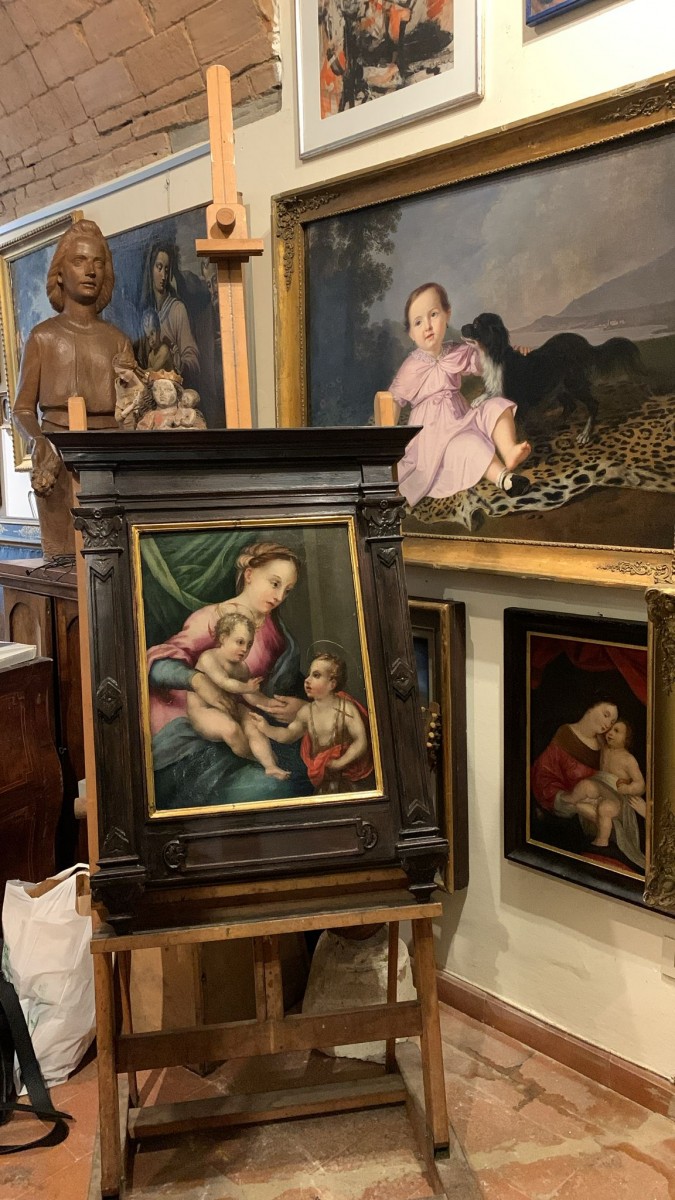
Frame: late 19th-century tabernacle frame in Renaissance style.
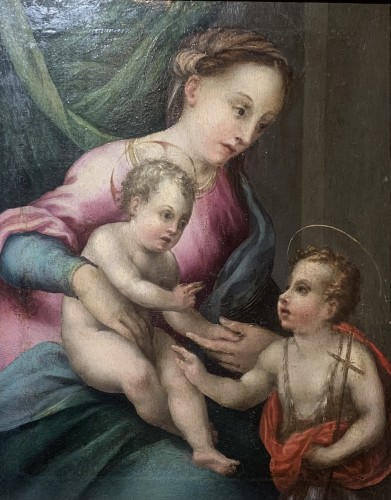
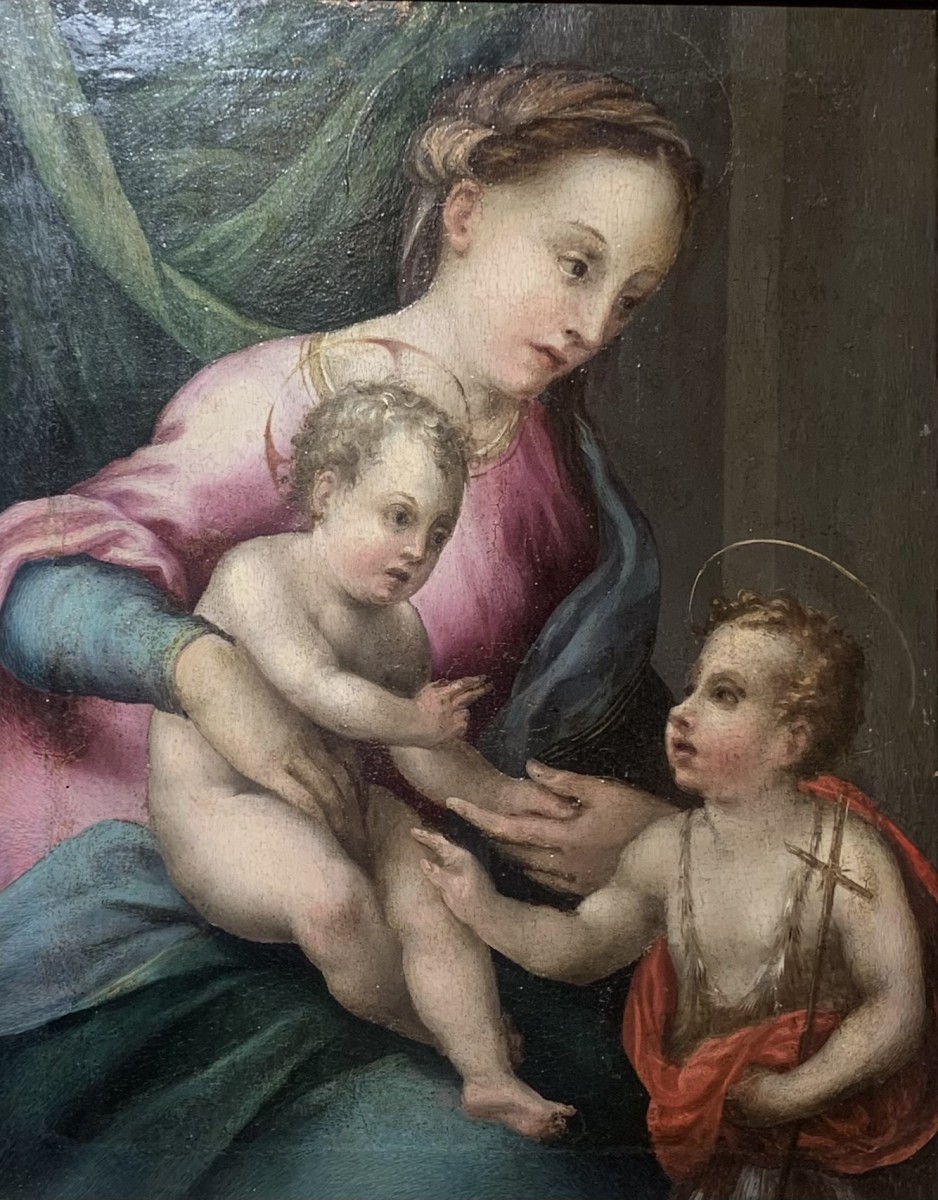
This painting depicts the Virgin seated in three-quarter view, holding the Christ Child on her lap. The Child turns toward the young Saint John the Baptist and blesses him. The young saint, dressed in a camel-skin garment and a red mantle and holding a reed cross, returns Christ’s gaze. A silent dialogue is established between the figures through their glances and gentle gestures.
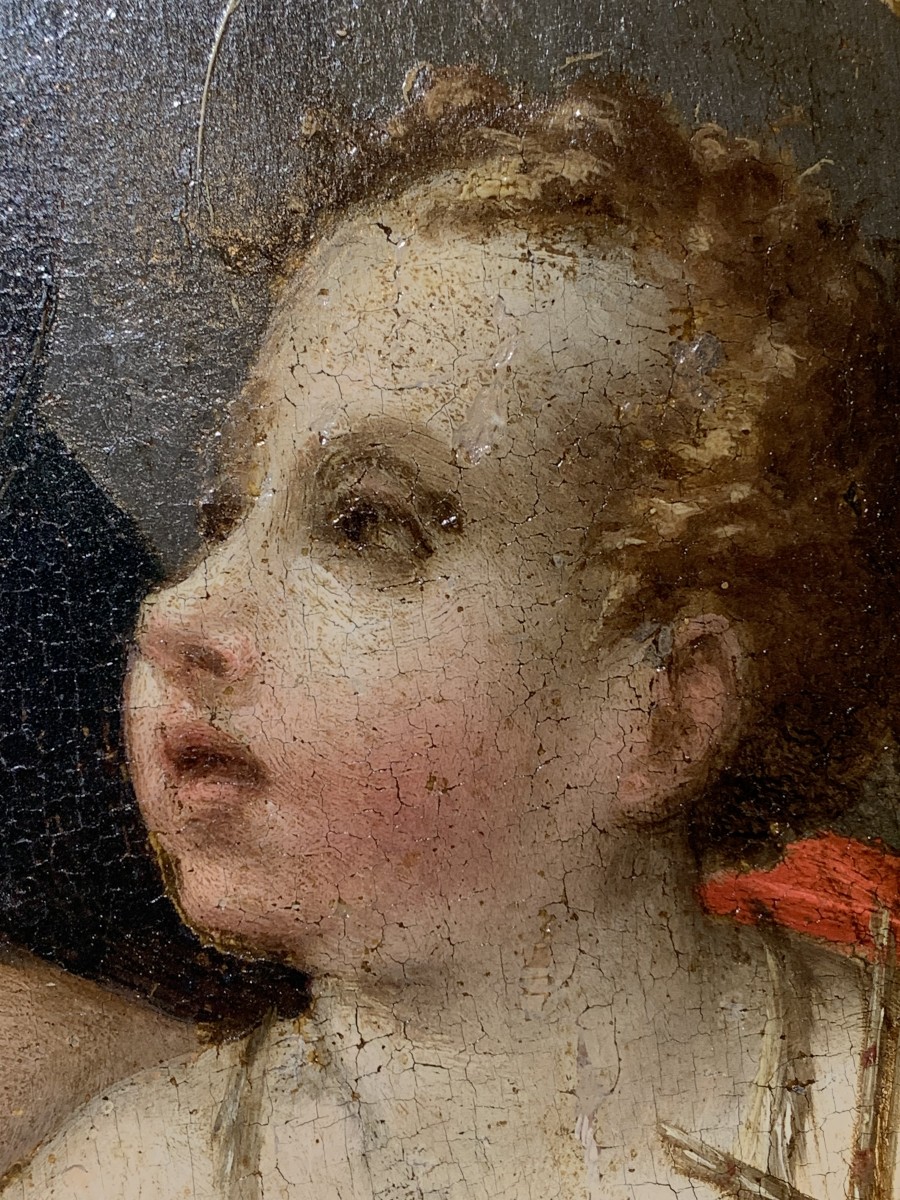
Intended for private devotion, the composition draws on models from Andrea del Sarto, Ridolfo del Ghirlandaio, and especially Domenico Puligo. However, it is distinguished by its sharply defined forms, incisive contours, and highly characteristic physiognomies: small, round, widely spaced eyes, slightly swollen eyelids, elongated noses, small heart-shaped mouths, rounded protruding chins, and soft, curly hair.
These features, together with a distinctive and somewhat irregular stylistic language, allow the work to be associated with the group of paintings assembled by Federico Zeri around the altarpiece of San Pietro in Selci in Volterra under the name “Maître de Volterra.” The artist belongs to the circle of the so-called “Florentine eccentrics” and develops a synthesis of motifs and influences mainly derived from Domenico Puligo, Andrea del Sarto, Antonio del Ceraiolo, Ridolfo del Ghirlandaio, and Michele Tosini.
More recently, Alessandro Nesi has proposed identifying the Maître de Volterra with the workshop of the Verrocchi family, and in particular with Giovambattista Verrocchi (Florence 1494–1569). Elena Capretti notes affinities between this painting and works attributed to Verrocchi, including the altarpiece in Volterra, two Madonnas in the Pinacoteca Nazionale of Siena, and others in the Ospedale di Santa Maria Nuova and the Villa del Poggio Imperiale in Florence.
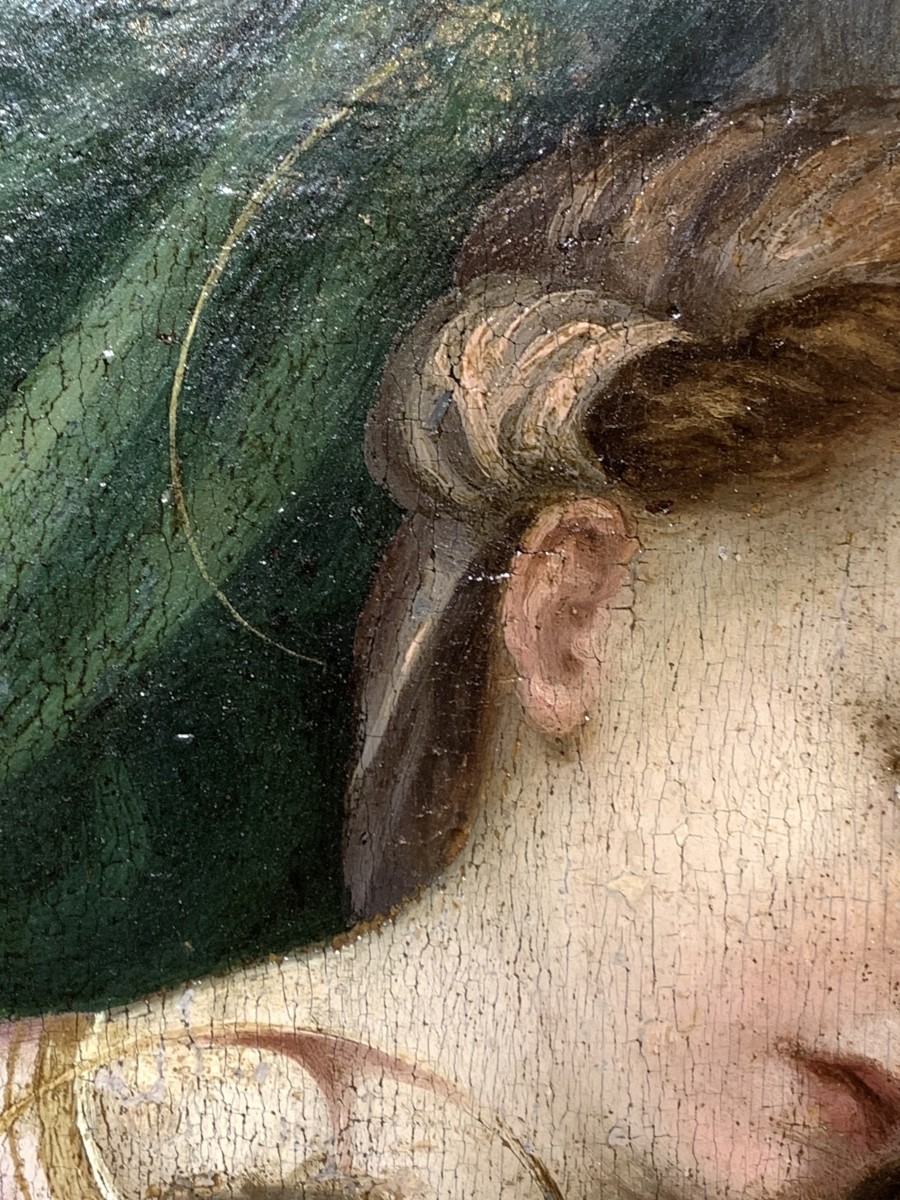
The painting is in excellent condition. A recent cleaning has removed old retouchings and yellowed varnish, revealing a dense pictorial surface built up through broad brushwork and glazing, with carefully modulated passages of light and shadow.