Offered by Poncelin de Raucourt Fine Arts
REQUEST INFORMATION

Paintings and drawings, from 16th to 19th century
WILLIAM LOCK THE YOUNGER
(London, 1767–1847)
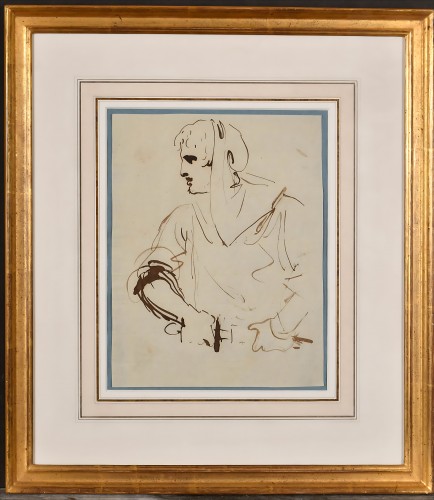
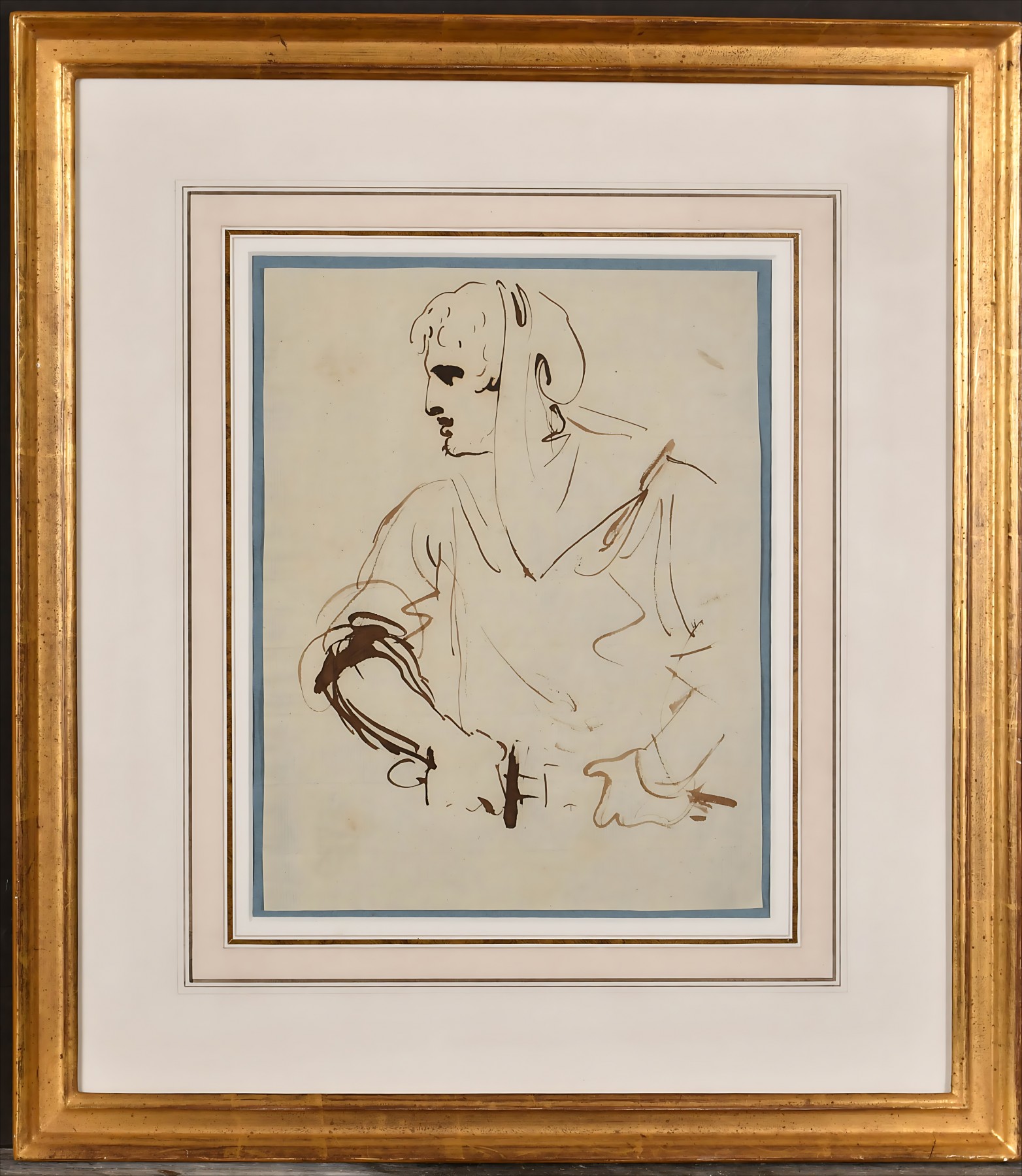
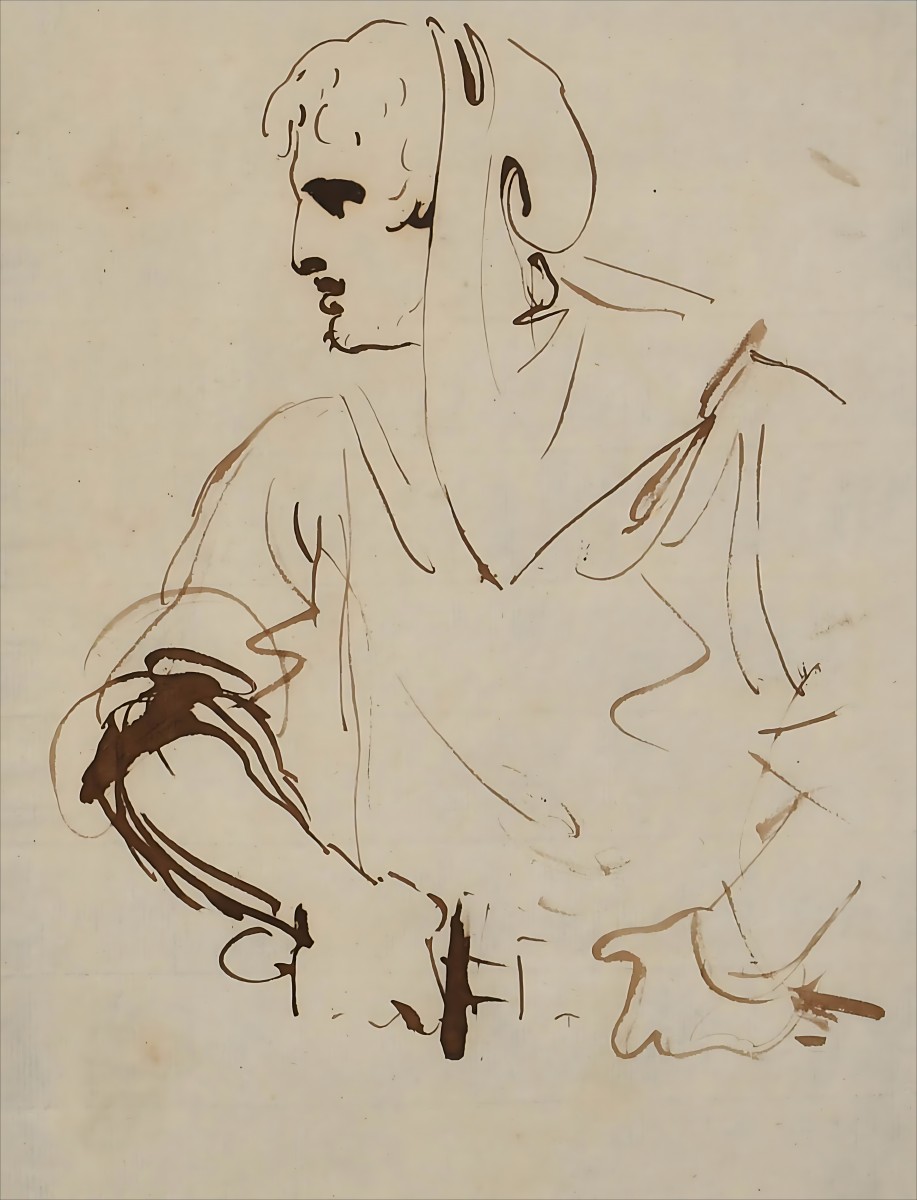
A CLASSICAL SOLDIER DRAWING HIS SWORD
Circa 1780–1784
Pen and brown ink on paper
25.4 × 19.4 cm
PROVENANCE
The family of the Reverend William Gilpin (1724–1804), Lock’s early drawing master and a close friend of the Lock family, by descent;
Bonhams, London, 10 April 2013, lot 235, as part of A disbound album containing 44 tipped-in drawings by William Lock the Younger;
Private collection, United Kingdom.
This striking study of a classical warrior belongs to the remarkable group of early drawings by William Lock the Younger formerly preserved in the family of the Reverend William Gilpin, Lock’s first drawing master and one of the formative figures in his artistic education. Executed with an extraordinary economy of means, the sheet exemplifies the precocious draughtsmanship for which Lock was admired by his contemporaries and reveals the combination of classical subject matter, expressive gesture and brilliantly abbreviated penmanship that characterises his finest youthful drawings.
A helmeted warrior is represented at half length, turned towards the left and seen in emphatic profile. His head is slightly inclined, while his arms converge towards the hilt of the sword at his waist. The pose gives the impression of an action caught at the instant before its completion: the soldier appears to be drawing his weapon, his bent arm creating a powerful diagonal across the lower half of the composition. Lock has dispensed with setting and narrative accessories, concentrating instead upon the silhouette, costume and gesture of the solitary figure.
The warrior’s appearance is deliberately classical rather than archaeologically exact. His rounded helmet, long cheekpiece and loosely falling garment evoke the visual vocabulary of ancient military dress familiar to eighteenth-century artists through sculpture, engraved gems, prints and Old Master compositions. Lock transforms these elements into a highly personal invention. The elongated neck, strongly profiled head and broad folds of the costume give the figure an almost monumental presence despite the modest dimensions of the sheet.
Particularly beautiful is the contrast between the delicacy of the initial pen work and the passages in which the brown ink becomes dramatically darker and more heavily charged. Fine, searching lines establish the shoulder, neckline and cascading folds of the drapery, while concentrated accents define the eye, nose, lips, helmet and sword hand. The face is constructed with remarkable economy. A dense sweep of ink forms the shadowed eye and brow; the nose emerges from a single angular contour; and a few short strokes are sufficient to articulate the mouth and chin. Lock similarly reinforces the bent arm with several parallel strokes of saturated brown ink, creating an expressive concentration of energy around the soldier’s gesture.
This alternation between delicate contour and powerful calligraphic accent is one of the most engaging aspects of Lock’s early manner. Rather than describing every part of the body, he allows extensive areas of untouched paper to participate in the construction of the figure. The eye completes forms that the pen merely suggests. The broad expanse of the torso, for example, is evoked through a handful of descending folds, while the lower hands and sword are reduced to a rapid sequence of intersecting strokes. The effect is one of exceptional immediacy: the drawing retains the freshness of the artist’s first conception.
William Lock the Younger was born in 1767, the eldest son of William Lock of Norbury, one of the notable collectors and connoisseurs of later eighteenth-century Britain. The elder Lock assembled an important collection of paintings, sculpture and antiquities at Norbury Park in Surrey and moved in a sophisticated artistic and intellectual circle. His patronage and friendships brought his son into contact from an early age with some of the most stimulating figures in British art.
Among the most important of these was the Reverend William Gilpin, today celebrated as one of the principal theorists of the Picturesque. Lock received instruction from Gilpin while still a boy. The connection is especially significant for the present drawing, since it belonged to the group of Lock drawings preserved by Gilpin’s descendants until the twenty-first century. The survival of these sheets together provides an unusually vivid record of the young artist’s development and of the close relationship between pupil and teacher.
Lock’s talent emerged remarkably early. A closely related Classical Figure with his Shield, and Other Studies is signed and dated “W. Lock april 1780”, when the artist was only about thirteen years old. Other drawings from the same period demonstrate his fascination with classical history, dramatic literature and figures in moments of heightened emotion. Gilpin encouraged precisely these qualities. In discussing historical composition with the Lock family during the early 1780s, he emphasised the importance of energy of character and expression in achieving the sublime. The present soldier, whose identity is conveyed through pose and gesture rather than elaborate narrative detail, is an especially attractive demonstration of that principle.
The young Lock subsequently came under the powerful influence of Henry Fuseli. The relationship was both personal and artistic: Fuseli encouraged Lock’s ambitions and admired his drawings to an exceptional degree. The British Museum records Joseph Farington’s recollection that as late as 1795 Fuseli considered Lock’s drawings unrivalled among contemporary artists for their “invention, taste and spirit”. Lock’s elongated figures, dramatic gestures and imaginative engagement with classical and literary subjects naturally developed within this milieu. Yet his drawings possess a distinctive lightness and spontaneity of their own. Where Fuseli frequently constructs the body through exaggerated muscular tension, Lock can suggest a figure through an extraordinarily sparse sequence of lines.
The present sheet is particularly illuminating when compared with Lock’s securely dated early drawings. The Classical Figure with his Shield of April 1780 employs the same combination of lightly traced contours and emphatic passages of darker ink. The construction of the antique costume, the abbreviated treatment of anatomy and the concentration of graphic energy around the figure’s principal gesture all belong to the same vocabulary. Such affinities suggest a date in the opening years of the 1780s.
Another important chronological point of comparison is provided by Lock’s Studies of Fairies with a Pair of Hands, dated 1784 and now in the Metropolitan Museum of Art, New York. There Lock works in a richer combination of graphite, red chalk, brown ink, grey wash and white bodycolour, but the imaginative freedom of the figures and their elegantly attenuated forms clearly continue the investigations visible in the present sheet. The Metropolitan drawing also demonstrates how rapidly Lock’s graphic language developed during his adolescence.
The broader trajectory of his career confirms the exceptional nature of this early achievement. Lock entered the circle of the Royal Academy and in March 1785 was granted permission by its council to draw from the female model. He was also closely acquainted with Thomas Lawrence, another prodigiously gifted young artist. The Lock family knew Lawrence from the 1780s, and Lawrence painted portraits of both father and son around 1789–90. Fuseli, Lawrence and Lock consequently formed part of a particularly fertile moment in British draughtsmanship in which academic study, literary imagination and a new emphasis upon expressive line converged.
Lock subsequently travelled to Italy, living in Rome from 1789 and remaining in Italy into the early 1790s. His encounter with antique sculpture and the great traditions of Italian art reinforced interests already apparent in drawings such as the present Classical Soldier. Yet the freshness of these earlier sheets is distinctive. Antiquity is not approached as a matter of archaeological reconstruction but as a repertoire of forms capable of communicating character, movement and heroic emotion.
The provenance of the present drawing provides an especially valuable context for understanding its purpose. It formed part of the album of forty-four drawings by Lock preserved by descendants of William Gilpin and sold at Bonhams, London, on 10 April 2013. The album contained drawings after Old Masters alongside historical, literary, landscape and figure subjects, with several sheets carrying dates from the 1780s. Its contents therefore constituted a remarkably concentrated record of Lock’s youthful artistic education.
The album format also helps explain the informal brilliance of the present sheet. This was not conceived as a highly finished exhibition drawing. Rather, it belongs to the intimate world of artistic invention: the rapid testing of a pose, the exploration of a historical character and the transformation of an idea into line. Its very incompleteness is integral to its appeal. Lock describes precisely as much as is required to make the warrior live on the page and then stops.
A date circa 1780–1784 places A Classical Soldier Drawing His Sword at the heart of this intensely creative early period. It belongs alongside the dated classical studies of 1780 and the increasingly imaginative compositions that culminated in works such as the Metropolitan Museum’s 1784 sheet. The classical subject, forceful profile, expressive hands and alternation between delicate and heavily charged ink are all characteristic of the young artist’s graphic vocabulary.
The drawing also offers a particularly appealing example of the qualities that made Lock’s work so admired within the Fuseli circle. The figure is at once monumental and fleeting: monumental in conception, yet captured with the speed and freedom of a sketch. A few strokes summon helmet, face, garment, arm and weapon; darker accents establish the psychological and compositional centres of the image. The result has the immediacy of an artist thinking directly through his pen.
A Classical Soldier Drawing His Sword can therefore be situated confidently among William Lock the Younger’s early drawings of the first half of the 1780s. Its descent from William Gilpin’s family and its preservation within the Bonhams album give it an unusually evocative connection with the artist’s earliest training. Combining classical imagination with vigorous, economical penmanship, the sheet captures the youthful Lock at precisely the moment when the originality of his draughtsmanship was beginning to emerge.
SELECTED BIBLIOGRAPHY AND ONLINE COMPARANDA
Vittoria Colonna Caetani, Duchess of Sermoneta, The Locks of Norbury: The Story of a Remarkable Family in the XVIIIth and XIXth Centuries, London, John Murray, 1940.
https://archive.org/details/locksofnorburyst00serm
Nancy L. Pressly, The Fuseli Circle in Rome: Early Romantic Art of the 1770s, New Haven, Yale Center for British Art, 1979.
https://archive.org/details/fuselicircleinro0000pres
Daniel Shackleton, Exhibition of Drawings by William Lock of Norbury (1767–1847), Edinburgh, 1990.
Kim Sloan, “A Noble Art”: Amateur Artists and Drawing Masters, c. 1600–1800, London, British Museum Press, 2000.
William Lock the Younger, Studies of Fairies with a Pair of Hands, possibly representing the Opening of Pandora’s Box, 1784, graphite and red chalk, pen and brown ink, brush and grey wash and white gouache, 38 × 55.3 cm, The Metropolitan Museum of Art, New York, inv. 2004.264.
https://www.metmuseum.org/art/collection/search/365454
William Lock the Younger, Two Studies of Lady Hamilton Dancing the Tarantella, circa 1791–95, graphite with pen and grey and brown ink, 36.9 × 28.6 cm, British Museum, London, inv. 1906,0719.4.
https://www.britishmuseum.org/collection/object/P_1906-0719-4
William Lock the Younger, Composition of Several Figures, pen and brown ink with brown and grey wash, 31.2 × 29.1 cm, British Museum, London, inv. 1947,1010.4.
https://www.britishmuseum.org/collection/object/P_1947-1010-4
William Lock the Younger, The Sorceress, illustration to Theocritus, Idyll II, black, grey and blue washes over pencil, 33.3 × 25 cm, The Morgan Library & Museum, New York, inv. 1959.1.
https://www.themorgan.org/drawings/item/123153
William Lock the Younger, Portrait of the Pugilist Johnson, 1790, Yale Center for British Art, New Haven.
https://collections.britishart.yale.edu/catalog/artists:2305
William Lock the Younger, Mary, Queen of Scots, Embarking, circa 1785–90, Yale Center for British Art, New Haven.
https://collections.britishart.yale.edu/catalog/artists:2305
Bonhams, London, 10 April 2013, lot 235, William Lock the Younger, A disbound album containing 44 tipped-in drawings.
https://www.bonhams.com/auction/20611/lot/235/
VERIFIED SELECTION OF MUSEUMS AND PUBLIC COLLECTIONS HOLDING WORKS BY THE ARTIST
The British Museum, London, United Kingdom. The collection includes drawings by William Lock the Younger, among them Two Studies of Lady Hamilton Dancing the Tarantella, inv. 1906,0719.4, and a multi-figure composition, inv. 1947,1010.4.
https://www.britishmuseum.org/collection/object/P_1906-0719-4
https://www.britishmuseum.org/collection/object/P_1947-1010-4
The Metropolitan Museum of Art, New York, United States. Studies of Fairies with a Pair of Hands, possibly representing the Opening of Pandora’s Box, 1784, inv. 2004.264.
https://www.metmuseum.org/art/collection/search/365454
The Morgan Library & Museum, New York, United States. The Sorceress, illustration to Theocritus, Idyll II, inv. 1959.1.
https://www.themorgan.org/drawings/item/123153
Yale Center for British Art, New Haven, United States. Holds several works by Lock, including Portrait of the Pugilist Johnson, 1790; Mary, Queen of Scots, Embarking, circa 1785–90; and Three Racehorses Approaching the Winning Post.
https://collections.britishart.yale.edu/catalog/artists:2305