Offered by Poncelin de Raucourt Fine Arts
REQUEST INFORMATION

Paintings and drawings, from 16th to 19th century
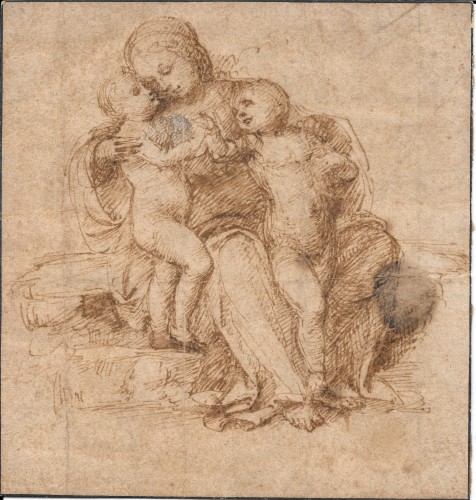
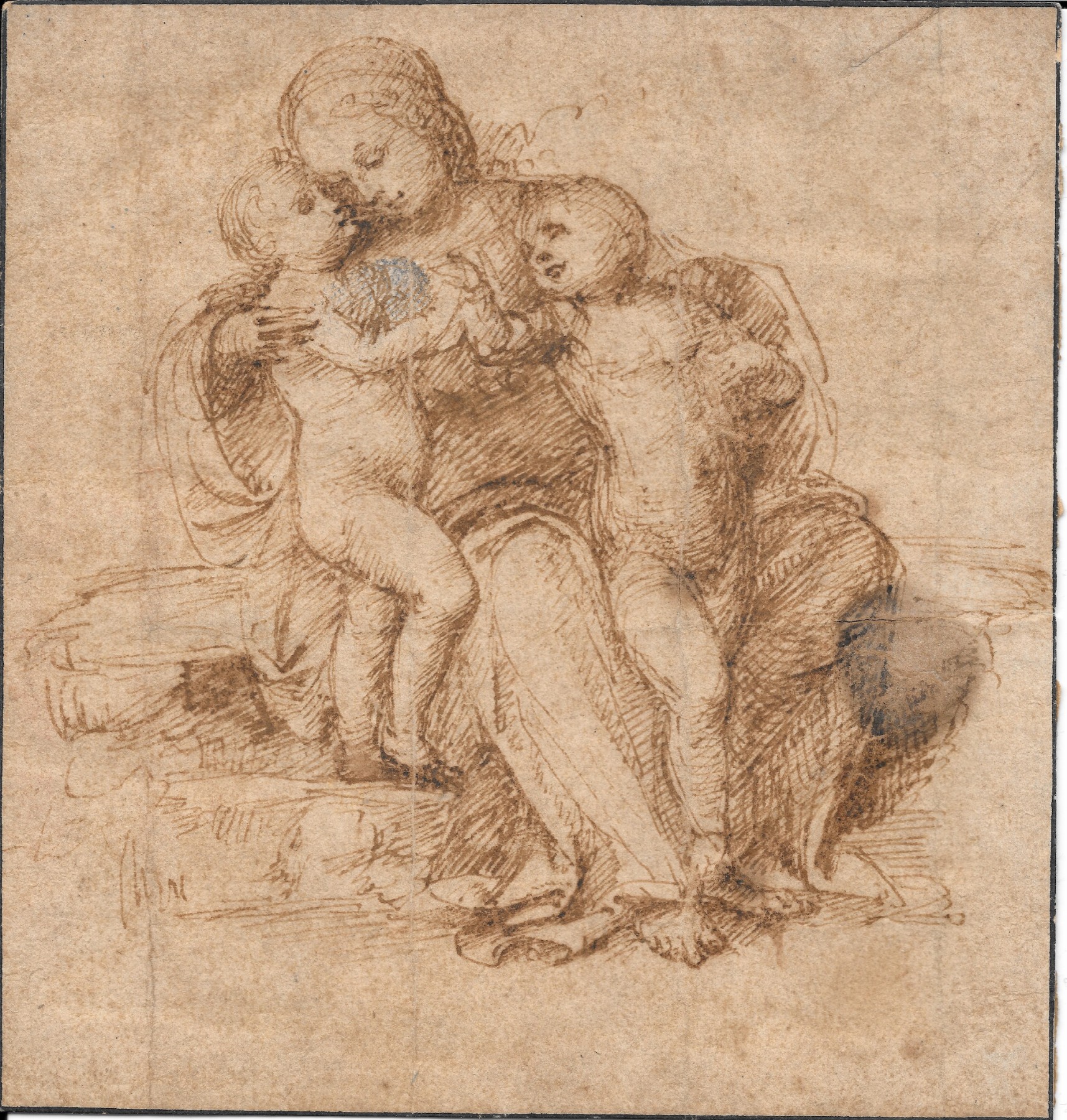
Raffaello Sanzio, known as Raphael (Urbino, 1483 – Rome, 1520), attributed to
The Virgin and Child with the Infant Saint John the Baptist
Circa 1505–1506
Pen and brown ink on paper
145 × 135 mm (approximately 5.71 × 5.31 in.)
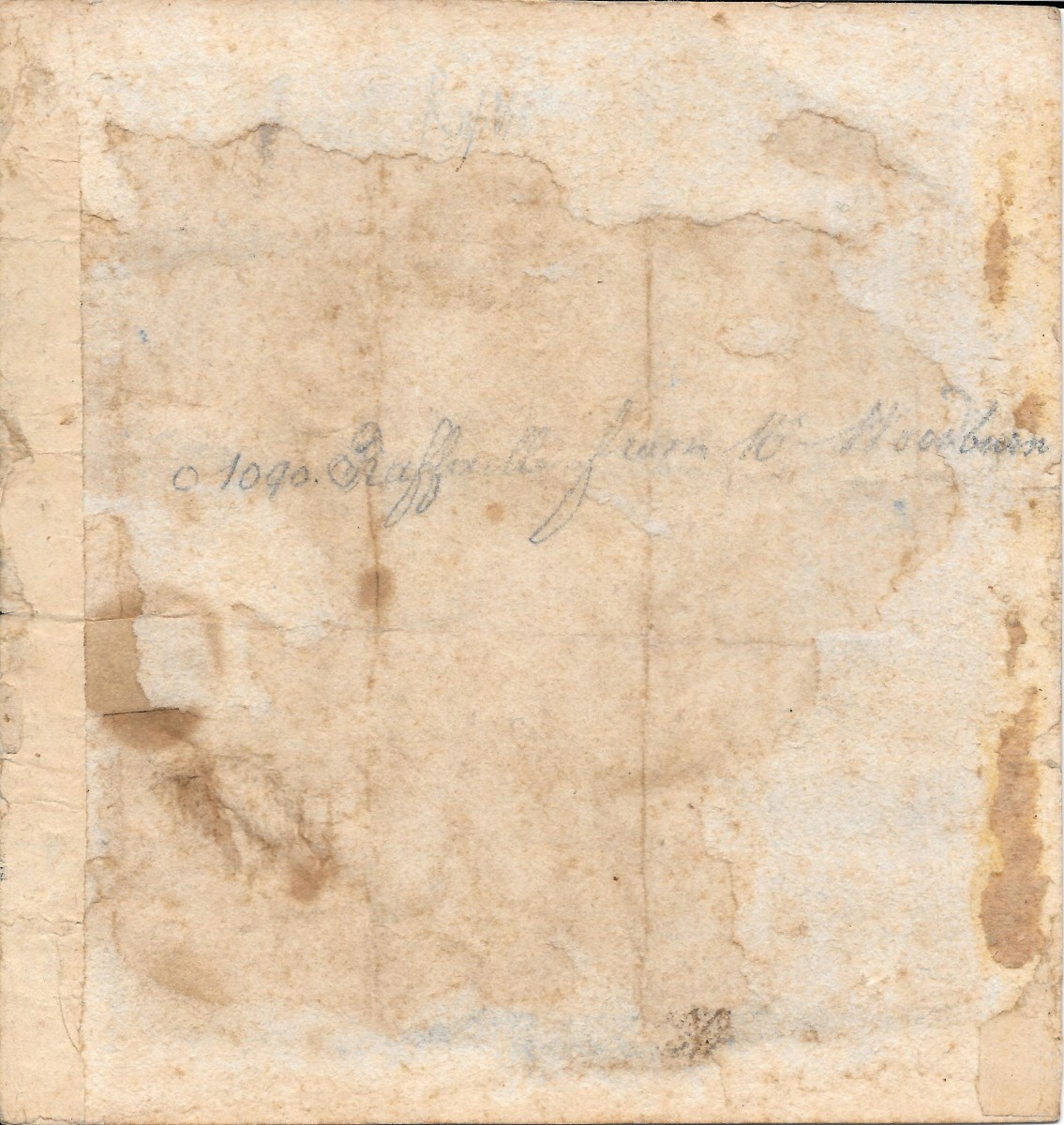
Inscribed in pencil on the verso, transcribed in our research as:
“O 1090. Raffaelle from M Woodburn”.
This intimate pen drawing brings together the Virgin, the Christ Child and the infant Saint John the Baptist in a closely interwoven composition. Seated upon a lightly indicated rocky support, Mary inclines her head towards the children, whose movements draw the three figures together. Their gestures and exchanged glances lend animation to the scene, while the sweeping folds of the Virgin’s drapery give the group a striking sense of monumentality. Within its modest dimensions, the sheet combines tenderness of expression with breadth of conception.
Supple outlines and layered hatching establish the forms, with denser passages in the drapery contrasting with the more lightly articulated flesh. The interplay between ink and untouched paper creates volume and rhythm. The Virgin’s lowered face, the rounded bodies of the children and the coordination of their gestures invite comparison with the visual language Raphael developed during his Florentine years.
Our research places the composition more specifically in relation to the Madonna of the Goldfinch, now in the Uffizi and dated by the museum to before February 1506. The painting belongs to an exceptionally fertile period in which Raphael explored new arrangements of the Virgin and the two children, responding in particular to Leonardo da Vinci’s treatment of unified figure groups and expressive interaction.
The closest comparisons proposed in our research are two drawings in the Louvre: an anonymous copy after a lost Raphael study associated with the Madonna of the Goldfinch (INV 4281), and a composition by Biagio Pupini (INV 4276), likewise linked in the museum’s catalogue to that lost invention. The present sheet offers a related arrangement, with variations in the figures’ poses and relationships. We propose that it may preserve another stage in the development of the composition.
Our research also identifies a possible pentimento around the Virgin’s knee and suggests that a small bird can be discerned between the children. These observations contribute to the proposed interpretation of the sheet as an exploratory study.
Inscription and proposed provenance
The verso inscription records an earlier attribution to Raphael and refers to “M Woodburn”, identified in our research as Mary Woodburn. A list dated 7 August 1858, preserved in the Royal Archives, documents drawings formerly belonging to Sir Thomas Lawrence and then in Mary Woodburn’s possession. Our research proposes identifying the present sheet with an entry describing the Virgin, Child and Saint John in a landscape, and suggests subsequent ownership by the Reverend Henry Wellesley. This proposed provenance remains to be confirmed.
With its affectionate grouping, compelling visual associations and intriguing collecting history, this drawing offers a rewarding subject for the collector interested in Raphael’s Madonnas and the continuing study of Renaissance draughtsmanship.