Offered by Poncelin de Raucourt Fine Arts
REQUEST INFORMATION

Paintings and drawings, from 16th to 19th century
Benedetto Caliari
(Verona 1538 – 1598 Venice)
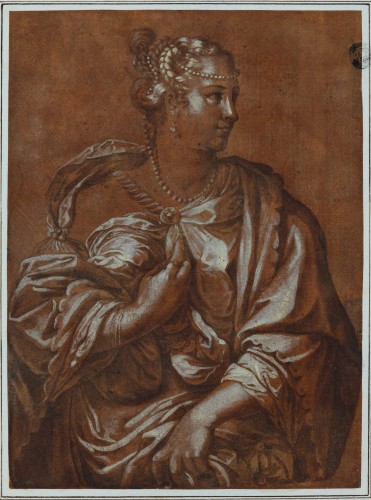
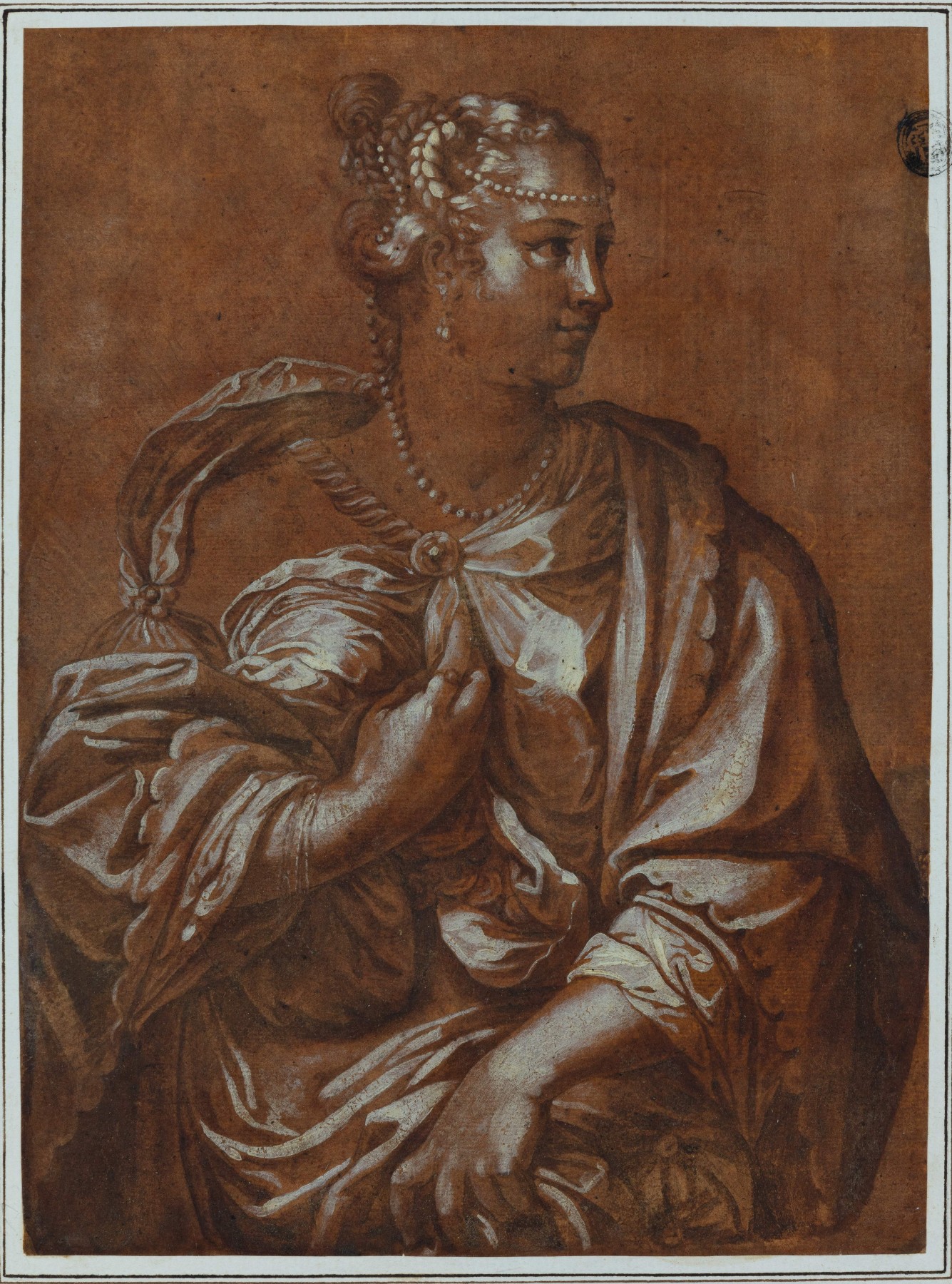
Portrait of a Woman
Pen and brown ink, brown ink wash, heightened with white gouache, on prepared brown paper
22.4 × 30 cm
Provenance:
Private collection, France
Chiaroscuro drawings occupy a central place in the graphic œuvre of Benedetto Caliari, the younger brother of Paolo Veronese.
This refined chiaroscuro portrait of a woman, previously unpublished, is executed with remarkable precision and care. Benedetto adopts the technique developed by his elder brother: the image is constructed through highlights — most often white heightening — set against a prepared dark-toned ground.
Although Veronese was not the inventor of this technique — already explored by both Italian and Northern artists — the approximately thirty sheets he executed in this manner have long been admired for their delicacy and highly finished appearance. They are notably the only drawings mentioned by his first biographer, Carlo Ridolfi, in 1648.
Ridolfi’s enthusiasm is easily understood, as these works appear to have been conceived as independent compositions. Veronese here engages with an earlier Venetian drawing tradition, demonstrating a strong inventive spirit in both religious and allegorical subjects, often introducing unusual variations on established themes.
Function and Dating: A Scholarly Debate
Questions remain regarding the function of these drawings.
According to David Rosand, they were most often modelli, representing the final stage in the preparation of a painted work, possibly also serving as presentation drawings or ricordi.
In contrast, Richard Cocke, in his catalogue raisonné, rejects this interpretation and considers them as independent works.
Their dating is also debated:
William R. Rearick suggests a production spanning from the mid-1540s to the end of Veronese’s career;
Cocke, on the other hand, places them within a narrower timeframe, between 1550 and 1560.
Benedetto and the Chiaroscuro Tradition
Beyond these debates, Benedetto fully embraced this technique.
Of the series of female allegories drawn by Veronese in chiaroscuro, six sheets are now preserved in Frankfurt (Städel), Vienna (Albertina), Paris (Louvre), Norfolk (Holkham Hall), and Zurich. A seventh sheet in the Louvre is likely a copy after a lost original.
Benedetto himself produced three copies on blue paper after Veronese’s Fortuna, now in the Louvre (Allegory of Wealth, Maritime Fortune, Terrestrial Fortune). These sheets, annotated “da Paolo,” clearly indicate their derivation from Veronese’s compositions.
The graphic treatment — figures built through white heightening against a toned ground, with strong contrasts between figures and lightly sketched architectural elements — closely relates to the technique seen in the present sheet.
Attribution and Stylistic Analysis
The quality of execution and the technique, firmly rooted in Veronese’s practice, strongly suggest the hand of an artist working in his immediate circle: his younger brother and collaborator, Benedetto Caliari.
The sheet is distinguished by:
a remarkable fluidity in the white highlights,
a strong sense of volume,
and specific physical characteristics — notably slightly disproportionate hands in relation to the small face — typical of Benedetto.
The careful use of white gouache defines the textures of silks and pearls while delicately suggesting the light illuminating the sitter’s face.
The figure belongs to the refined typology of courtly women dressed in rich, contemporary garments, characteristic of Veronese’s visual world.
Comparative Works
The drawing may be compared with two sheets in the Musée de Grenoble (Head of a Woman and Head of a Young Girl, bequest of Léonce Mesnard), whose hairstyles, facial features, and execution show strong similarities.
A further comparison may be drawn with Benedetto’s painting The Finding of Moses (sold at Christie's, London, 7 July 2017; later at Sotheby's, London, 28 April 2021), which demonstrates a closely related handling of figures.
Artistic Context
Benedetto Caliari, the younger brother of Veronese, is documented as working in his brother’s workshop as early as 1556, at the age of eighteen. He remained there for most of his career and took over the workshop after Veronese’s death in 1588, alongside his nephews Carlo and Gabriele.
They frequently signed collaborative works under the name Haeredes Pauli (“Heirs of Paolo”), thus continuing Veronese’s artistic legacy.