Offered by Poncelin de Raucourt Fine Arts
REQUEST INFORMATION

Paintings and drawings, from 16th to 19th century
Federico Zuccaro (c. 1540/42 – 1609)
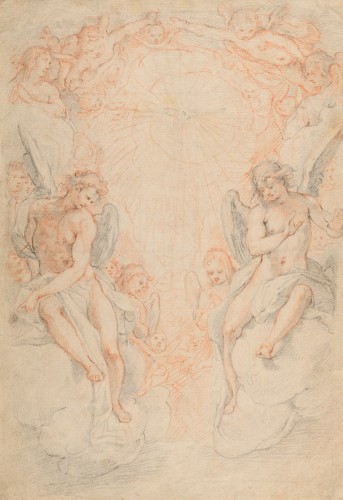
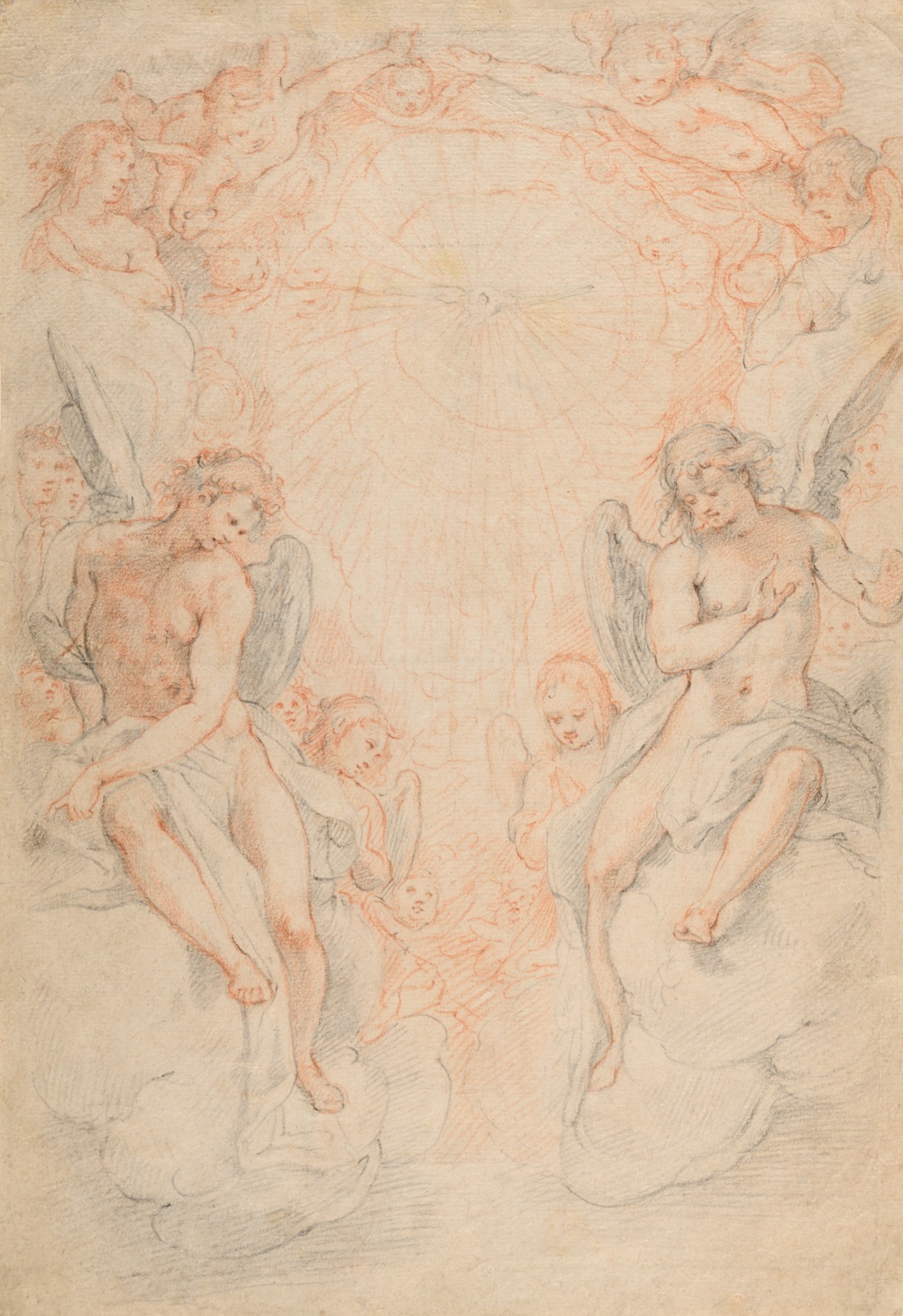
The Holy Spirit Surrounded by Angels
Black chalk and red chalk on paper
379 × 270 mm
Provenance
Sale, London, Phillips, 7 July 1999, lot 50
Federico Zuccaro, born in the Marche region at Sant’Angelo in Vado around 1540 or 1542, was one of the major figures of late sixteenth-century Italian Mannerism. The younger brother of the painter Taddeo Zuccaro, he continued the activity of the family workshop and rapidly achieved international renown, working in Rome, Florence and Venice, as well as in Spain and France. His career was closely linked to major papal and aristocratic commissions, in an artistic context shaped by the legacy of Michelangelo and the stylistic explorations of late Mannerism.
The present drawing is a preparatory study for the upper section of the fresco representing The Baptism of Cornelius the Centurion, executed for the Cappella Paolina in the Apostolic Palace at the Vatican between 1580 and 1584. This chapel, built for Pope Paul III Farnese, was one of the most prestigious decorative spaces in the Vatican. After the death of the painter Lorenzo Sabatini, Zuccaro was commissioned by Pope Gregory XIII to complete the decorative programme left unfinished since the time of Michelangelo.
In this sheet, the artist conceives the celestial zone of the composition: a group of angels and putti arranged in a circle around the Holy Spirit, represented at the centre of a radiant burst of light. The circular construction organizes the space around an ascending movement suggesting the opening of the heavens. This arrangement, already very close to the final solution of the fresco, demonstrates the conceptual rigor of the preparatory design.
The execution skillfully combines red chalk and black chalk, a technique particularly appreciated in sixteenth-century Italy for the study of the human figure. The red chalk lends the figures warmth and a soft corporeal presence, while the black chalk reinforces volumes and areas of shadow. The two large angels seated on clouds framing the composition are treated with particular care: their elegant, slightly twisting poses recall the Mannerist aesthetic inherited from Michelangelo and further developed by Roman artists of the following generation.
The drawing also reveals the freedom of the creative process. Some putti present in this study were simplified or removed in the final fresco, showing how Zuccaro gradually refined the clarity and balance of the monumental composition.
Preparatory studies for the Cappella Paolina are relatively rare. This sheet therefore represents a valuable testimony to Zuccaro’s conception process for one of his most prestigious commissions. Through the quality of its line, the clarity of its organization and the delicacy of its modelling, it perfectly illustrates the artist’s graphic virtuosity and the importance of drawing in the practice of Mannerist painters.